AEN LCA 5
Leaf spring suspension
Name : Aamin Rabkavi
Atul Arkhade
Adwait Vartak
Prathmesh Kulkarni
Under Guidance of Prof Ketan Karandikar
Introduction
 A leaf spring is a simple form of spring, commonly used for the
suspension in heavy duty vehicles.
 It is also one of the oldest forms of spring, dating back to medieval
times.
 The center of the arc provides location for the axle, while tie holes
are provided at either end for attaching to the vehicle body.
 For very heavy vehicles, a leaf spring can be made from several
leaves stacked on top of each other in several layers, often with
progressively shorter leaves.
 Leaf springs can serve as damping to some extent as well as
springing functions.
 For this reason manufacturers have experimented with mono-leaf
springs.
Cont..
 The standard dimensions for the width and thickness of the leaves
section are as follows:
 Nominal thickness :- 3.2, 4.5, 5, 6, 6.5, 7, 7.5, 8, 9, 10, 11, 12, 14.
 Nominal width (mm) :- 32, 40, 45, 50, 55, 60, 65, 70, 80, 90, 100 and 125.
 The leaves are usually made up of steels.
 The factor of safety based on the yield strength is form 2 to 2.5 for
the automobile suspension.
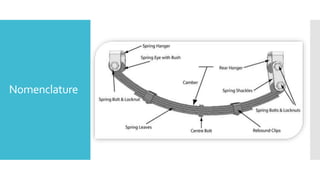
Nomenclature
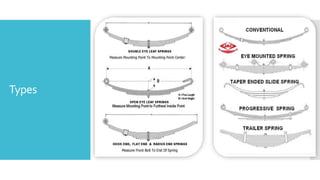
Types
Tools Required
 2 replacement leaf springs
 Ratchet wrench
 Floor jack
 2 jack stands
 Penetrating oil
 Pliers
 Pry bar
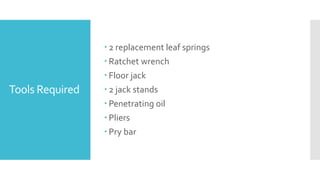
Assembly
Step 1 :
Raise the rear
wheels with a
floor jack
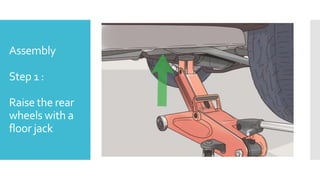
Step 2 :
Place jack
stands in front
of the back
tires.
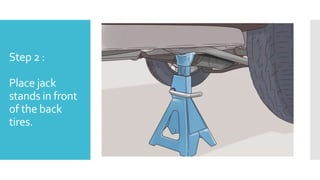
Step 3 :
Push the car
with your hand
to make sure it
is stable.
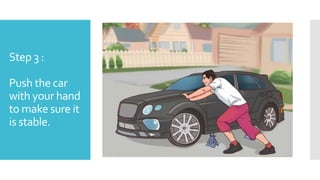
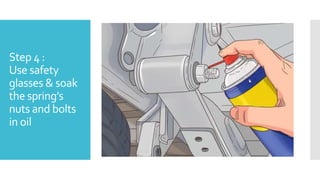
Step 4 :
Use safety
glasses & soak
the spring’s
nuts and bolts
in oil
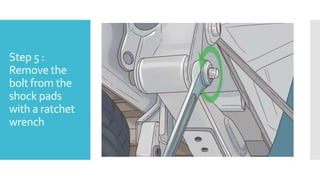
Step 5 :
Remove the
bolt from the
shock pads
with a ratchet
wrench
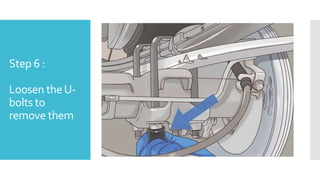
Step 6 :
Loosen theU-
bolts to
remove them
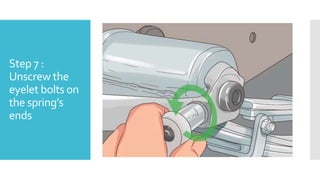
Step 7 :
Unscrew the
eyelet bolts on
the spring’s
ends
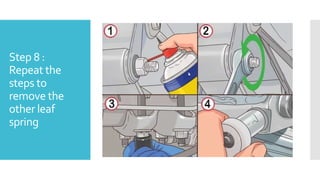
Step 8 :
Repeat the
steps to
remove the
other leaf
spring
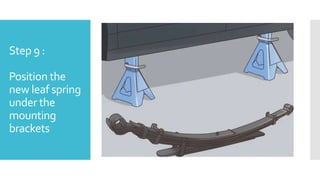
Step 9 :
Position the
new leaf spring
under the
mounting
brackets
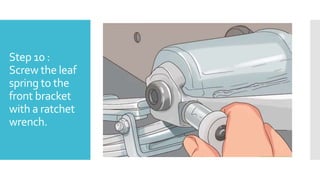
Step 10 :
Screw the leaf
spring to the
front bracket
with a ratchet
wrench.
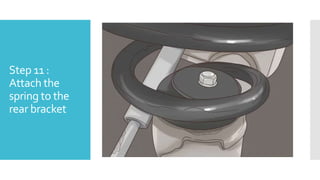
Step 11 :
Attach the
spring to the
rear bracket
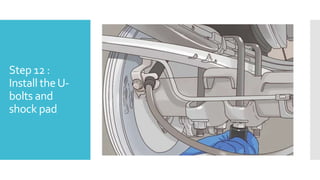
Step 12 :
Install theU-
bolts and
shock pad
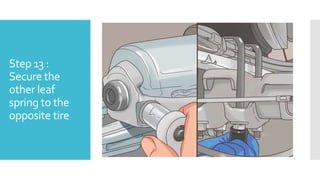
Step 13 :
Secure the
other leaf
spring to the
opposite tire
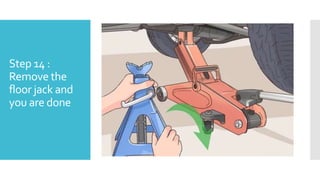
Step 14 :
Remove the
floor jack and
you are done
Advantages
 The way the suspension is constructed is really simple and strong,
acting as a linkage that holds the axle in position without the need
for separate linkage.
 Extra weight and costs are reduced because of the rear axle
location.This eliminates the need for trailing arms and a panhard
rod (AKA track bar).
 Leaf springs support the weight of the chassis, making them ideal
for commercial vehicles.
 They also control axle damping.
 The chassis roll can be controlled more efficiently due to the high
rear moment centre and wide spring base. If the springs are
mounted wider apart, the roll tendencies will be less.
Disadvantages
 They aren’t always the easiest to install – but there is a clear
process to follow that makes life much easier.
 The ride comfort isn’t as great because of the inter-leaf friction
between each leaf.
 Over time, the springs tend to lose shape and can sag.When the
sag is uneven, it can alter the cross weight of the vehicle which can
affect the handling slightly.This can also change the axle-to-
mount angle.
 Wind-up and vibration can be caused by acceleration and braking
torque.The wind-up can also cause nose-diving and rear-end
squat.
Why choose
leaf springs?
 Large layers of metal are what make up the
basic anatomy of a leaf spring, meaning they
can deal with huge vertical loads.
 They offer a huge amount of support between
the wheels, axles and the vehicles chassis,
making them perfect for commercial vans,
pickups, trailers and trucks, where the need to
support greater weights is essential.
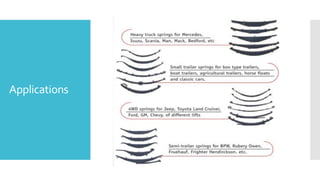
Applications
ThankYou

Leaf Spring Suspension in detail

  • 1.
    AEN LCA 5 Leafspring suspension Name : Aamin Rabkavi Atul Arkhade Adwait Vartak Prathmesh Kulkarni Under Guidance of Prof Ketan Karandikar
  • 2.
    Introduction  A leafspring is a simple form of spring, commonly used for the suspension in heavy duty vehicles.  It is also one of the oldest forms of spring, dating back to medieval times.  The center of the arc provides location for the axle, while tie holes are provided at either end for attaching to the vehicle body.  For very heavy vehicles, a leaf spring can be made from several leaves stacked on top of each other in several layers, often with progressively shorter leaves.  Leaf springs can serve as damping to some extent as well as springing functions.  For this reason manufacturers have experimented with mono-leaf springs.
  • 3.
    Cont..  The standarddimensions for the width and thickness of the leaves section are as follows:  Nominal thickness :- 3.2, 4.5, 5, 6, 6.5, 7, 7.5, 8, 9, 10, 11, 12, 14.  Nominal width (mm) :- 32, 40, 45, 50, 55, 60, 65, 70, 80, 90, 100 and 125.  The leaves are usually made up of steels.  The factor of safety based on the yield strength is form 2 to 2.5 for the automobile suspension.
  • 4.
  • 5.
  • 6.
    Tools Required  2replacement leaf springs  Ratchet wrench  Floor jack  2 jack stands  Penetrating oil  Pliers  Pry bar
  • 7.
    Assembly Step 1 : Raisethe rear wheels with a floor jack
  • 8.
    Step 2 : Placejack stands in front of the back tires.
  • 9.
    Step 3 : Pushthe car with your hand to make sure it is stable.
  • 10.
    Step 4 : Usesafety glasses & soak the spring’s nuts and bolts in oil
  • 11.
    Step 5 : Removethe bolt from the shock pads with a ratchet wrench
  • 12.
    Step 6 : LoosentheU- bolts to remove them
  • 13.
    Step 7 : Unscrewthe eyelet bolts on the spring’s ends
  • 14.
    Step 8 : Repeatthe steps to remove the other leaf spring
  • 15.
    Step 9 : Positionthe new leaf spring under the mounting brackets
  • 16.
    Step 10 : Screwthe leaf spring to the front bracket with a ratchet wrench.
  • 17.
    Step 11 : Attachthe spring to the rear bracket
  • 18.
    Step 12 : InstalltheU- bolts and shock pad
  • 19.
    Step 13 : Securethe other leaf spring to the opposite tire
  • 20.
    Step 14 : Removethe floor jack and you are done
  • 21.
    Advantages  The waythe suspension is constructed is really simple and strong, acting as a linkage that holds the axle in position without the need for separate linkage.  Extra weight and costs are reduced because of the rear axle location.This eliminates the need for trailing arms and a panhard rod (AKA track bar).  Leaf springs support the weight of the chassis, making them ideal for commercial vehicles.  They also control axle damping.  The chassis roll can be controlled more efficiently due to the high rear moment centre and wide spring base. If the springs are mounted wider apart, the roll tendencies will be less.
  • 22.
    Disadvantages  They aren’talways the easiest to install – but there is a clear process to follow that makes life much easier.  The ride comfort isn’t as great because of the inter-leaf friction between each leaf.  Over time, the springs tend to lose shape and can sag.When the sag is uneven, it can alter the cross weight of the vehicle which can affect the handling slightly.This can also change the axle-to- mount angle.  Wind-up and vibration can be caused by acceleration and braking torque.The wind-up can also cause nose-diving and rear-end squat.
  • 23.
    Why choose leaf springs? Large layers of metal are what make up the basic anatomy of a leaf spring, meaning they can deal with huge vertical loads.  They offer a huge amount of support between the wheels, axles and the vehicles chassis, making them perfect for commercial vans, pickups, trailers and trucks, where the need to support greater weights is essential.
  • 24.
  • 25.