Agile Product Discovery
Leading the Requirements Gathering
Process


                            Armond Mehrabian
                                      PMI San Diego
                                 September 26, 2012


                                                 1
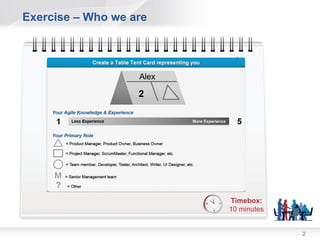
Exercise – Who we are


            Introductions


                            Timebox:
                            10 minutes


                                         2
About the Speaker

 Armond Mehrabian
  • Portofino Solutions, Inc.
  • 24 years in the software development industry
  • Enterprise Agile Coach since 2008
  • amehrabian@portofinosolutions.com
  • @armond_m


                                                    3
Agenda

  Introductions
  The Agile Project Manager
  Facilitating Product Discovery
  Personas
  Story Maps
  Estimation of Effort
  Q&A


                                    4
The Agile Project Manager


                            5
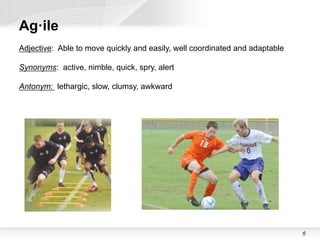
Ag·ile
Adjective: Able to move quickly and easily, well coordinated and adaptable

Synonyms: active, nimble, quick, spry, alert

Antonym: lethargic, slow, clumsy, awkward


                                                                             6
                                                                             6
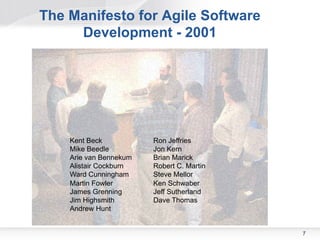
The Manifesto for Agile Software
     Development - 2001


    Kent Beck           Ron Jeffries
    Mike Beedle         Jon Kern
    Arie van Bennekum   Brian Marick
    Alistair Cockburn   Robert C. Martin
    Ward Cunningham     Steve Mellor
    Martin Fowler       Ken Schwaber
    James Grenning      Jeff Sutherland
    Jim Highsmith       Dave Thomas
    Andrew Hunt


                                           7
                                           7
Agile Principles – The Agile Manifesto
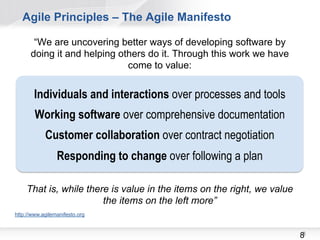
       “We are uncovering better ways of developing software by
      doing it and helping others do it. Through this work we have
                             come to value:


        Individuals and interactions over processes and tools
        Working software over comprehensive documentation
            Customer collaboration over contract negotiation
                 Responding to change over following a plan

    That is, while there is value in the items on the right, we value
                       the items on the left more”
http://www.agilemanifesto.org


                                                                        88
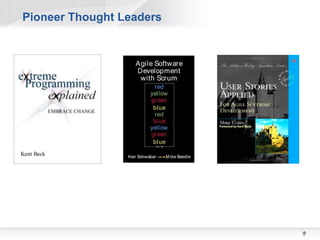
Pioneer Thought Leaders


                          9
                          9
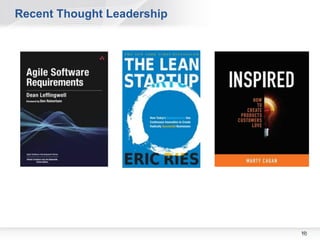
Recent Thought Leadership


                            10
                            10
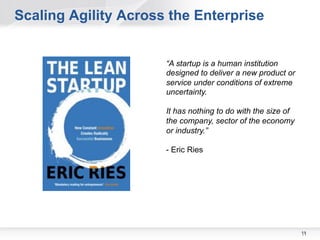
Scaling Agility Across the Enterprise


                      “A startup is a human institution
                      designed to deliver a new product or
                      service under conditions of extreme
                      uncertainty.

                      It has nothing to do with the size of
                      the company, sector of the economy
                      or industry.”

                      - Eric Ries


                                                              11
                                                              11
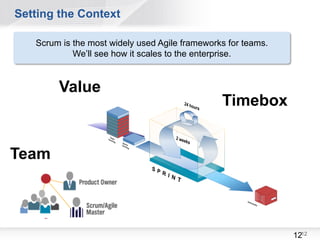
Focus has been on Delivery

   Scrum is the most widely used Agile frameworks for teams.
            We’ll see how it scales to the enterprise.


        Value
                                                Timebox


Team


                                                               1212
Driving Innovation


                     13
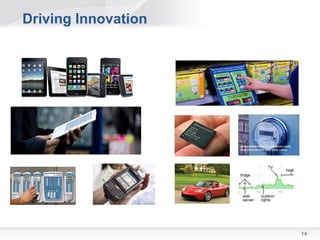
Driving Innovation


                     14
User Stories

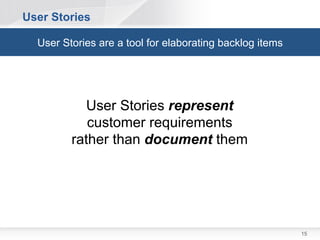
  User Stories are a tool for elaborating backlog items


           User Stories represent
            customer requirements
         rather than document them


                                                          15
User Story Template

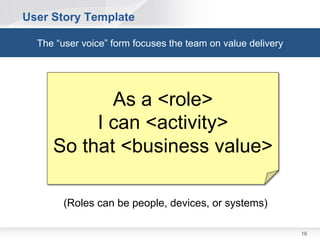
  The “user voice” form focuses the team on value delivery


                 As a <role>
              I can <activity>
         So that <business value>

        (Roles can be people, devices, or systems)

                                                             16
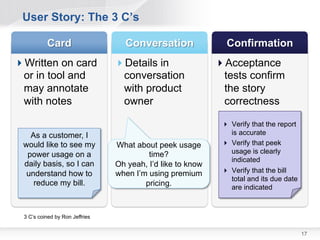
User Story: The 3 C’s


Written on card                Details in                 Acceptance
 or in tool and                  conversation                tests confirm
 may annotate                    with product                the story
 with notes                      owner                       correctness

                                                              Verify that the report
   As a customer, I                                            is accurate
 would like to see my           What about peek usage         Verify that peek
  power usage on a                       time?                 usage is clearly
                                                               indicated
 daily basis, so I can          Oh yeah, I’d like to know
  understand how to             when I’m using premium        Verify that the bill
                                                               total and its due
    reduce my bill.                     pricing.               date are indicated


 3 C’s coined by Ron Jeffries


                                                                                        17
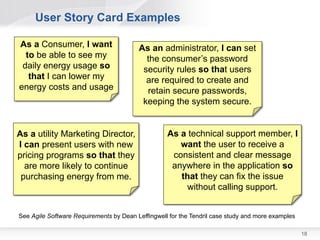
User Story Card Examples

As a Consumer, I want                    As an administrator, I can set
  to be able to see my                     the consumer’s password
 daily energy usage so                    security rules so that users
   that I can lower my                     are required to create and
energy costs and usage                     retain secure passwords,
                                          keeping the system secure.


As a utility Marketing Director,                   As a technical support member, I
I can present users with new                          want the user to receive a
pricing programs so that they                       consistent and clear message
  are more likely to continue                       anywhere in the application so
 purchasing energy from me.                           that they can fix the issue
                                                       without calling support.


See Agile Software Requirements by Dean Leffingwell for the Tendril case study and more examples

                                                                                                   18
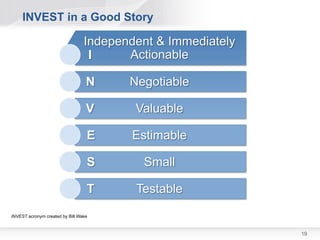
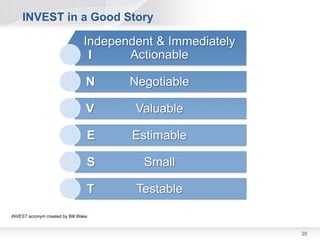
INVEST in a Good Story


INVEST acronym created by Bill Wake


                                      19
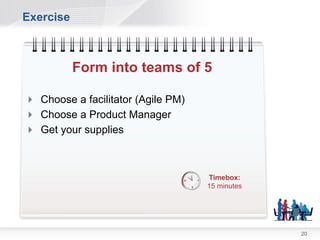
Exercise


           Form into teams of 5

 Choose a facilitator (Agile PM)
 Choose a Product Manager
 Get your supplies


                                    Timebox:
                                    15 minutes


                                                 20
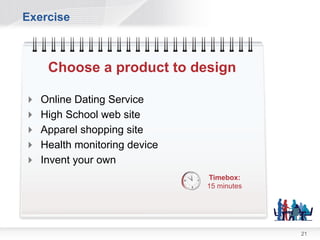
Exercise


     Choose a product to design

   Online Dating Service
   High School web site
   Apparel shopping site
   Health monitoring device
   Invent your own
                               Timebox:
                               15 minutes


                                            21
Personas


           22
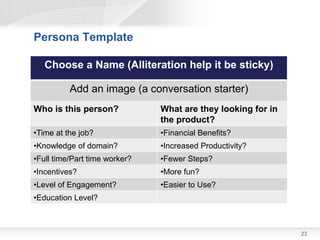
Persona Template

   Choose a Name (Alliteration help it be sticky)

          Add an image (a conversation starter)
Who is this person?            What are they looking for in
                               the product?
•Time at the job?              •Financial Benefits?
•Knowledge of domain?          •Increased Productivity?
•Full time/Part time worker?   •Fewer Steps?
•Incentives?                   •More fun?
•Level of Engagement?          •Easier to Use?
•Education Level?


                                                              23
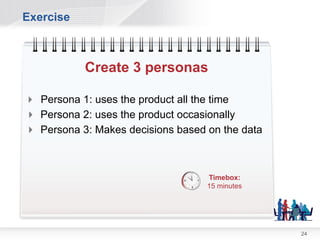
Exercise


           Create 3 personas

 Persona 1: uses the product all the time
 Persona 2: uses the product occasionally
 Persona 3: Makes decisions based on the data


                                   Timebox:
                                   15 minutes


                                                 24
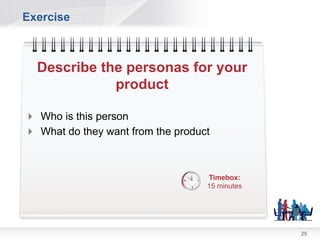
Exercise


  Describe the personas for your
             product

 Who is this person
 What do they want from the product


                                   Timebox:
                                   15 minutes


                                                25
Persona Template

   Choose a Name (Alliteration help it be sticky)

          Add an image (a conversation starter)
Who is this person?            What are they looking for in
                               the product?
•Time at the job?              •Financial Benefits?
•Knowledge of domain?          •Increased Productivity?
•Full time/Part time worker?   •Fewer Steps?
•Incentives?                   •More fun?
•Level of Engagement?          •Easier to Use?
•Education Level?


                                                              26
User Story Maps


                  27
User Story Maps

   User Story Mapping is an Agile technique for
    managing product backlogs developed by Jeff
    Patton
   They give structure and context to user
    stories.
   They describe the user’s experience with your
    product


                                                    28
User Story Mapping

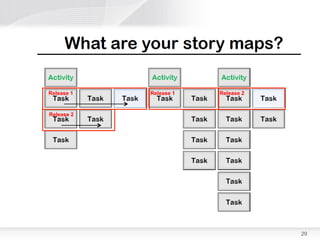
   A way of organizing and prioritizing user
    stories.
   Show the relationship between stories and
    their children
   Help explain the user experience
   Help you plan releases in complete and
    valuable slices of functionality.


                                                29
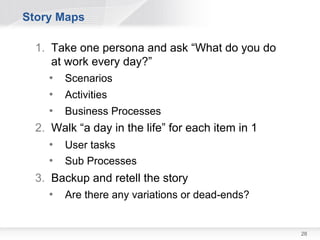
Building Story Maps

  1. Take one persona and ask “What do you do
     at work every day?”
     • Scenarios
     • Activities
     • Business Processes
  2. Walk “a day in the life” for each item in 1
     • User tasks
     • Sub Processes
  3. Backup and retell the story
     • Are there any variations or dead-ends?


                                                   30
Release 1   Release 1   Release 2


Release 2


                                    31
Exercise


    Create a story map for each
              persona

 What are some tasks that they perform?
 What are the sub-tasks that the system must
  perform on their behalf?
 What are the paths through a complete user
  task.
                                    Timebox:
                                    10 minutes


                                                 32
User Story Splitting


                       33
INVEST in a Good Story


INVEST acronym created by Bill Wake


                                      34
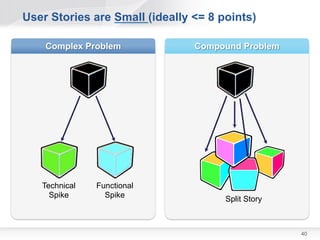
User Stories are Small (ideally <= 8 points)


   Technical   Functional
     Spike       Spike                Split Story


                                                    35
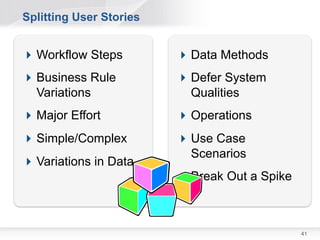
Splitting User Stories


 Workflow Steps          Data Methods
 Business Rule           Defer System
  Variations               Qualities
 Major Effort            Operations
 Simple/Complex          Use Case
                           Scenarios
 Variations in Data
                          Break Out a Spike


                                               36
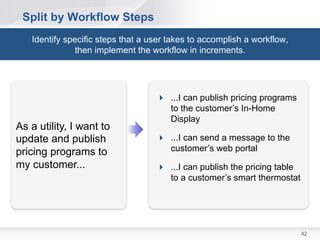
Split by Workflow Steps
   Identify specific steps that a user takes to accomplish a workflow,
              then implement the workflow in increments.


                                    ...I can publish pricing programs
                                     to the customer’s In-Home
                                     Display
As a utility, I want to
update and publish                  ...I can send a message to the
pricing programs to                  customer’s web portal
my customer...                      ...I can publish the pricing table
                                     to a customer’s smart thermostat


                                                                          37
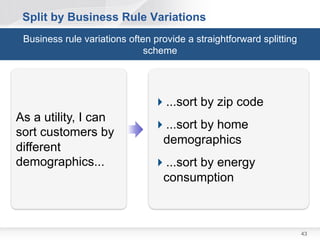
Split by Business Rule Variations
 Business rule variations often provide a straightforward splitting
                              scheme


                                ...sort by zip code
As a utility, I can
                                ...sort by home
sort customers by
                                 demographics
different
demographics...                 ...sort by energy
                                 consumption


                                                                      38
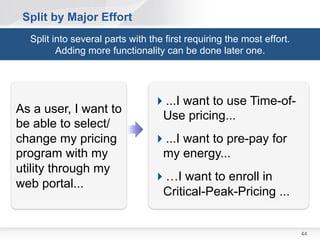
Split by Major Effort
  Split into several parts with the first requiring the most effort.
         Adding more functionality can be done later one.


As a user, I want                ...I want to use Time-of-
to be able to                     Use pricing...
select/change my
                                 ...I want to pre-pay for
pricing program
                                  my energy...
with my utility
through my web                   …I want to enroll in
portal...                         Critical-Peak-Pricing ...


                                                                       39
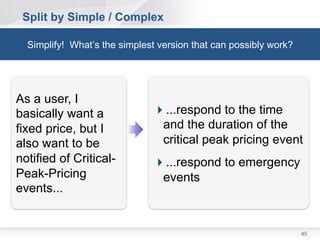
Split by Simple / Complex

  Simplify! What’s the simplest version that can possibly work?


As a user, I
basically want a              ...respond to the time
fixed price, but I             and the duration of the
also want to be                critical peak pricing event
notified of Critical-         ...respond to emergency
Peak-Pricing                   events
events...


                                                                  40
Split by Operations
 Split by type of operation example: Create Read Update Delete
                             (CRUD)…


                              ...I can sign up for an
                               account.

As a user, I can              ...I can edit my account
manage my account              settings.
...                           ...I can cancel my account.
                              …I can add more devices to
                               my account


                                                                 41
Split by Use Case Scenarios
If use cases are used to represent complex interaction, the story can
                 be split via the individual scenarios


                                   Use Case/Story #1 (happy path):
                                    Notify utility that consumer has
                                    equipment
As a user, I can enroll
                                   Use Case/Story #2: Utility
in the energy savings
                                    provisions equipment and data,
program through a                   notifies consumer
retail distributor ...
                                   Use Case/Story #3 (alternate
                                    scenario): Handle data validation
                                    errors


                                                                        42
Split – If All Else Fails, Break out a Spike

 In some cases, a story may be
  hard to estimate
   –   may be too large or overly
       complex
   –   or perhaps the implementation
       is poorly understood            Technical   Functional
                                         Spike       Spike

 In that case, build a technical or
  functional spike to figure it out;
  then split the stories based on
  that result.


                                                                43
Questions?


             44
My Contact Info

   Armond Mehrabian
   amehrabian@portofinosolutions.com
   Your feedback at
     www.armondmehrabian.com/feedback
   (760) 354-9053
   Twitter: armond_m
   Skype: armond.mehrabian


                                        45

Leading Agile Product Discovery

  • 1.
    Agile Product Discovery Leadingthe Requirements Gathering Process Armond Mehrabian PMI San Diego September 26, 2012 1
  • 2.
    Exercise – Whowe are Introductions Timebox: 10 minutes 2
  • 3.
    About the Speaker Armond Mehrabian • Portofino Solutions, Inc. • 24 years in the software development industry • Enterprise Agile Coach since 2008 • amehrabian@portofinosolutions.com • @armond_m 3
  • 4.
    Agenda  Introductions  The Agile Project Manager  Facilitating Product Discovery  Personas  Story Maps  Estimation of Effort  Q&A 4
  • 5.
  • 6.
    Ag·ile Adjective: Able tomove quickly and easily, well coordinated and adaptable Synonyms: active, nimble, quick, spry, alert Antonym: lethargic, slow, clumsy, awkward 6 6
  • 7.
    The Manifesto forAgile Software Development - 2001 Kent Beck Ron Jeffries Mike Beedle Jon Kern Arie van Bennekum Brian Marick Alistair Cockburn Robert C. Martin Ward Cunningham Steve Mellor Martin Fowler Ken Schwaber James Grenning Jeff Sutherland Jim Highsmith Dave Thomas Andrew Hunt 7 7
  • 8.
    Agile Principles –The Agile Manifesto “We are uncovering better ways of developing software by doing it and helping others do it. Through this work we have come to value: Individuals and interactions over processes and tools Working software over comprehensive documentation Customer collaboration over contract negotiation Responding to change over following a plan That is, while there is value in the items on the right, we value the items on the left more” http://www.agilemanifesto.org 88
  • 9.
  • 10.
  • 11.
    Scaling Agility Acrossthe Enterprise “A startup is a human institution designed to deliver a new product or service under conditions of extreme uncertainty. It has nothing to do with the size of the company, sector of the economy or industry.” - Eric Ries 11 11
  • 12.
    Focus has beenon Delivery Scrum is the most widely used Agile frameworks for teams. We’ll see how it scales to the enterprise. Value Timebox Team 1212
  • 13.
  • 14.
  • 15.
    User Stories User Stories are a tool for elaborating backlog items User Stories represent customer requirements rather than document them 15
  • 16.
    User Story Template The “user voice” form focuses the team on value delivery As a <role> I can <activity> So that <business value> (Roles can be people, devices, or systems) 16
  • 17.
    User Story: The3 C’s Written on card Details in Acceptance or in tool and conversation tests confirm may annotate with product the story with notes owner correctness  Verify that the report As a customer, I is accurate would like to see my What about peek usage  Verify that peek power usage on a time? usage is clearly indicated daily basis, so I can Oh yeah, I’d like to know understand how to when I’m using premium  Verify that the bill total and its due reduce my bill. pricing. date are indicated 3 C’s coined by Ron Jeffries 17
  • 18.
    User Story CardExamples As a Consumer, I want As an administrator, I can set to be able to see my the consumer’s password daily energy usage so security rules so that users that I can lower my are required to create and energy costs and usage retain secure passwords, keeping the system secure. As a utility Marketing Director, As a technical support member, I I can present users with new want the user to receive a pricing programs so that they consistent and clear message are more likely to continue anywhere in the application so purchasing energy from me. that they can fix the issue without calling support. See Agile Software Requirements by Dean Leffingwell for the Tendril case study and more examples 18
  • 19.
    INVEST in aGood Story INVEST acronym created by Bill Wake 19
  • 20.
    Exercise Form into teams of 5  Choose a facilitator (Agile PM)  Choose a Product Manager  Get your supplies Timebox: 15 minutes 20
  • 21.
    Exercise Choose a product to design  Online Dating Service  High School web site  Apparel shopping site  Health monitoring device  Invent your own Timebox: 15 minutes 21
  • 22.
  • 23.
    Persona Template Choose a Name (Alliteration help it be sticky) Add an image (a conversation starter) Who is this person? What are they looking for in the product? •Time at the job? •Financial Benefits? •Knowledge of domain? •Increased Productivity? •Full time/Part time worker? •Fewer Steps? •Incentives? •More fun? •Level of Engagement? •Easier to Use? •Education Level? 23
  • 24.
    Exercise Create 3 personas  Persona 1: uses the product all the time  Persona 2: uses the product occasionally  Persona 3: Makes decisions based on the data Timebox: 15 minutes 24
  • 25.
    Exercise Describethe personas for your product  Who is this person  What do they want from the product Timebox: 15 minutes 25
  • 26.
    Persona Template Choose a Name (Alliteration help it be sticky) Add an image (a conversation starter) Who is this person? What are they looking for in the product? •Time at the job? •Financial Benefits? •Knowledge of domain? •Increased Productivity? •Full time/Part time worker? •Fewer Steps? •Incentives? •More fun? •Level of Engagement? •Easier to Use? •Education Level? 26
  • 27.
  • 28.
    User Story Maps  User Story Mapping is an Agile technique for managing product backlogs developed by Jeff Patton  They give structure and context to user stories.  They describe the user’s experience with your product 28
  • 29.
    User Story Mapping  A way of organizing and prioritizing user stories.  Show the relationship between stories and their children  Help explain the user experience  Help you plan releases in complete and valuable slices of functionality. 29
  • 30.
    Building Story Maps 1. Take one persona and ask “What do you do at work every day?” • Scenarios • Activities • Business Processes 2. Walk “a day in the life” for each item in 1 • User tasks • Sub Processes 3. Backup and retell the story • Are there any variations or dead-ends? 30
  • 31.
    Release 1 Release 1 Release 2 Release 2 31
  • 32.
    Exercise Create a story map for each persona  What are some tasks that they perform?  What are the sub-tasks that the system must perform on their behalf?  What are the paths through a complete user task. Timebox: 10 minutes 32
  • 33.
  • 34.
    INVEST in aGood Story INVEST acronym created by Bill Wake 34
  • 35.
    User Stories areSmall (ideally <= 8 points) Technical Functional Spike Spike Split Story 35
  • 36.
    Splitting User Stories Workflow Steps  Data Methods  Business Rule  Defer System Variations Qualities  Major Effort  Operations  Simple/Complex  Use Case Scenarios  Variations in Data  Break Out a Spike 36
  • 37.
    Split by WorkflowSteps Identify specific steps that a user takes to accomplish a workflow, then implement the workflow in increments.  ...I can publish pricing programs to the customer’s In-Home Display As a utility, I want to update and publish  ...I can send a message to the pricing programs to customer’s web portal my customer...  ...I can publish the pricing table to a customer’s smart thermostat 37
  • 38.
    Split by BusinessRule Variations Business rule variations often provide a straightforward splitting scheme ...sort by zip code As a utility, I can ...sort by home sort customers by demographics different demographics... ...sort by energy consumption 38
  • 39.
    Split by MajorEffort Split into several parts with the first requiring the most effort. Adding more functionality can be done later one. As a user, I want ...I want to use Time-of- to be able to Use pricing... select/change my ...I want to pre-pay for pricing program my energy... with my utility through my web …I want to enroll in portal... Critical-Peak-Pricing ... 39
  • 40.
    Split by Simple/ Complex Simplify! What’s the simplest version that can possibly work? As a user, I basically want a ...respond to the time fixed price, but I and the duration of the also want to be critical peak pricing event notified of Critical- ...respond to emergency Peak-Pricing events events... 40
  • 41.
    Split by Operations Split by type of operation example: Create Read Update Delete (CRUD)… ...I can sign up for an account. As a user, I can ...I can edit my account manage my account settings. ... ...I can cancel my account. …I can add more devices to my account 41
  • 42.
    Split by UseCase Scenarios If use cases are used to represent complex interaction, the story can be split via the individual scenarios  Use Case/Story #1 (happy path): Notify utility that consumer has equipment As a user, I can enroll  Use Case/Story #2: Utility in the energy savings provisions equipment and data, program through a notifies consumer retail distributor ...  Use Case/Story #3 (alternate scenario): Handle data validation errors 42
  • 43.
    Split – IfAll Else Fails, Break out a Spike  In some cases, a story may be hard to estimate – may be too large or overly complex – or perhaps the implementation is poorly understood Technical Functional Spike Spike  In that case, build a technical or functional spike to figure it out; then split the stories based on that result. 43
  • 44.
  • 45.
    My Contact Info  Armond Mehrabian  amehrabian@portofinosolutions.com  Your feedback at www.armondmehrabian.com/feedback  (760) 354-9053  Twitter: armond_m  Skype: armond.mehrabian 45