Chapter -7
Leadership and Motivation
Learning Topics
1. Concept Of leadership
2. Function and Importance Of Leadership
3. Difference Between Leader and Manager
4. Leadership Style
5. Approaches of Leadership
6. Qualities of Good Leadership
7. Group Formation and Types Of Group
8. Group Formation Process
9. Team Management
10. Types of Team
11. Conflict
12. Types of Conflict
13. Managing Conflict by organization
14. Concept of Motivation
15. Importance of Motivation
16. Motivation Theories
17. Emerging Issue of Motivation
18. Motivation through Employee Participation
Introduction
According to Peter Drucker, “ Leadership is
shifting of own vision to higher sights,the
raising of man’s performance to higher
standards, the building of man’s personality
beyond its normal limitations.”
- Leadership is the one of the most
important function of management.
-Leading involves directing, influencing &
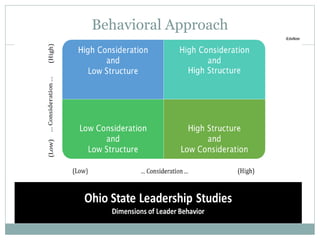
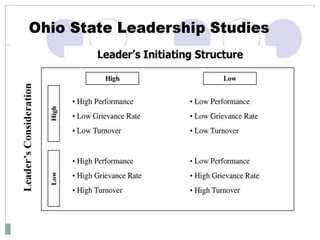
motivating employees to perform.
Features Of Leadership
1.Leaders and Followers : Relationship between
Leaders and Followers.
2.Ability to influence: Leadership is the ability
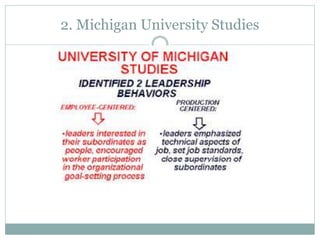
to influence the behavior, effort of followers.
3. Common Objectives:
4.Regular Process
5. Situational Activity :
6. Motivational Functions:
7. Reciprocal influence:
Who is leader?
 One that leads or guides.
One who is in charge or in command of others.
One who heads of an organization.
One who has influence or power, especially of
a political nature.
Importance/Functions of Leadership
1.Goal Determination: Leadership set up the Vision, mission, objectives
and
goals of an organization. They also changes the policies of the organization
to cope with the change in environment.
2. Environmental Adaption: Business environment is complex and
dynamic so
Leaders are responsible for monitoring, scanning and predicting the
environmental changes and the probable effects.
3. Directing : Leadership direct to their followers(Subordinates for the
maximum effort that leads to achieve the organizational goal.
4. Motivating: Financial and non-financial benefits scheme.
5. Communication: Leaders set proper channel of Communication,
leaders influences the followers.Two- way of communication is better
to build the trust among them.
6. Supervising and Controlling :
7. Encouraging Network:
Difference Between Manager And Leader
MANAGER
Oversees the current process
well
Must achieve balance
Thinks execution
Comfortable with control
Problems are just that & need
resolution ASAP
Procedure is King
Instructs as to technique &
process
Impersonal, remote
LEADER
Wants to create the future
Needs to make change
Thinks ideal
Welcomes risks
Sees problems as
opportunities is patient
Substance thumps the King
Your best college professor
High emotional
intelligence
Leadership Style
Leadership style is the manner and approach of
Directing, Implementing plans and motivating the
People involved in organization.
1. Autocratic Leadership Style
2. Democratic
3. Lassies Faire
1. Autocratic Leadership Style
-Under the autocratic leadership style, all decision-
making powers are centralized in the leader, as with
dictator leaders.
-They do not entertain any suggestions or initiatives
from subordinates. The autocratic management has
been successful as it provides strong motivation to
the manager.
-It permits quick decision-making, as only one
person decides for the whole group and keeps each
decision to himself until he feels it is needed to be
shared with the rest of the group.
High degree of dependency on the leader
Features of Autocratic Leadership
1. All the Decisions are made by leaders
without any consultation of the followers.
2. Leaders control the information and
communication Channel.
3. Leaders expect the desired output
at the desired time in any cost from
their followers.
4. Negative motivational techniques like the
threatening, Suspension, Demotion etc.
Benefits of Autocratic Leadership Style
1. All the employees work in strict discipline
2. Employees need not to be involved in
decision making process.
3. Employees are not supposed to reject
or suspect the order.
4. This style is most appropriate in the
organizations having new,
unskilled and less experienced employees.
5. Job division in this style becomes more
clear and easy to understand.
Disadvantages Of Autocratic Leadership Style
1. Employees do not participate in decision making.
2. Job Turnover ratio is high, because of Low career Opportunity.
3. One way communication, employee satisfaction and
Performance may be below the expectation.
4. Succession planning becomes very poor because of lack
Opportunity to improve the decision making power in employees.
5.Employees commitment will be low.
6. This leadership style is not suitable for the large and
diversified organization.
2. Democratic Style of Leadership
The democratic leadership style favors decision-
making by the group .
They can win the cooperation of their group and
can motivate them effectively and positively.
The decisions of the democratic leader are not
unilateral as with the autocrat because they arise
from consultation with the group members and
participation by them.
Consultative: process of consultation before
decisions are taken
Persuasive: Leader takes decision and seeks to
persuade others that the decision is correct.
Features of Democratic Leadership Style
1.Subordinates are encouraged to participate
in decision making.
2.This style follow two-way communication.
3.Employees are highly encouraged for creativity.
4.Employees are consider as a important
members of an organization.
5. Team effort is encouraged.
6.Positive motivational tools are used to
encourage employees.
3. Laissez-Faire Style
Laissez –Faire or free rein style
A free rein leader does not lead, but leaves the group
entirely to itself such a leader allows maximum
freedom to subordinates, i.e. they are given a free hand
in deciding their own policies and methods.
Can be very useful in businesses where creative ideas are
important
Can be highly motivational, as people have control over their
working life
Can make coordination and decision making time-
consuming and lacking in overall direction
Relies on good team work
Features Of Lassies Faire Leadership Style
1.Decisions regarding personal goals,
performance standard, working process etc.
2. Leaders only coordinate and facilitate
for resources.
3. Employees are self directed and guided.
4.Every employees holds the rights to use
own intellectual freedom.
Advantage of Lassies Faire Leadership
1.Decisions are made by employees themselves.
2.It helps to create and fulfill common goal of
Orgn.
3.Employees become highly creative.
4.Employees evaluate their performance
themselves.
5.This style is appropriate to modern and big
organizations.
6.Employees have chance of Career development.
Disadvantages of Lassies Faire Leadership
1.This style is not appropriate to
organizations having majority of unskilled
and semi skilled manpower.
2.Every employees may concentrate to the
individual goal and effort.
3.There may be serious problem of discipline.
1.Coordination between employees can
decrease gradually
Approaches Of Leadership
1.Trait Approach of Leadership
2.Behavioral Approach of Leadership
3.Transformational Leadership
4.Coaching Leadership
5.Entrepreneurial Leadership
1. Trait Approach Of Leadership
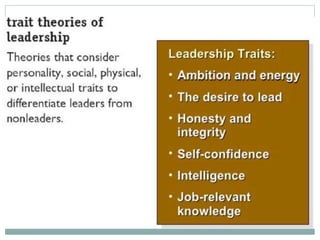
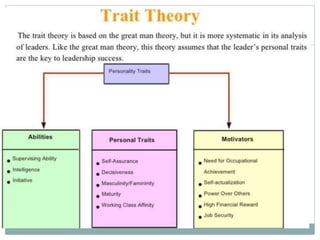
Trait theory of leadership differentiates leaders
from non leaders by focusing on personal
qualities and characteristics.
Trait theory of leadership sought personality,
social, physical and intellectual traits.
Trait theory assumes that leaders are born.
Trait Theory
1. Intelligence and scholarship,
Physical traits like age, height, weight, strength
etc.
2.Social status and experience Task Orientation
3. Personality characteristics:
4. Ambition and energy Desire to lead
5. Honesty and integrity
6. Self confidence
7. Job relevant knowledge etc.
Trait theorist refers to people like Father of
nation M.K. Gandhi, Indira Gandhi, Margrat
Thracher, Nelson Mandela, Virgin Group
CEO Richard Branson, Apple Co-founder
Steve Jobs, Ratan Tata of the Tata Group,
Azim Premji of Wipro, Narayana Murthy of
Infosys, Binod Chaudhary of CG
etc.
-
The trait theory arose from the the “Great Man”
theory as a way of identifying the key
characteristics of successful leaders .
It was believed that through this theory
critical leadership traits could be isolated and
that people with such trait could then be
recruited ,selected and installed into leadership
positions.
This theory was common in the military and
is still used as a set of criteria to select
candidates for commissions.
2. Behavioral Approach
The theory concerned about what a leader
actually does and how she/he does it. The
assumption under this theory was;
i. The behavior of effective leader would be
different from the behavior of less effective
leader.
ii. The behavior of effective leaders would
be the same across all situations.
Behavioral Approach
There are three important research
studies, which attempted to analyze
the leadership behaviors. They are:
a. Ohio State Studies.
b. Michigan Studies.
c. Management Grid.
Ohio State Model
A team of Research were undertaken
in the 1945 AD at Ohio State
University to find what behaviors
make leadership effective? From their
study, two dimension of leadership
behavior were identified.
Ohio State Approach of Leadership
Ohio State University model narrowed
description of leader behavior into two
dimensions:
Initiating Structure Behavior: The behavior
of leaders who define the leader-subordinate role
so that everyone knows what is expected,
establish formal lines of communication, and
determine how tasks will be performed.
Consideration Behavior: The behavior of
leaders who are concerned for subordinates and
attempt to establish a warm, friendly, and
supportive climate.
Behavioral Approach
Behavioral Approach
2. Michigan University Studies
a. Job(production) Centered Leadership
production-centered
Leadership: Managers using job-
centered leader behavior pay close
attention to subordinates’ work,
explain work procedures and are
keenly interested in performance.
c. Emloyee Centered Leadership
Employee-centered Leadership:
Managers using employee-centered leader
behavior are interested in developing a
cohesive workgroup and ensuring that
employees are satisfied with their jobs. The
Michigan Leadership Studies found that
both the styles of leadership led to an
increase in production, but it was slightly
more in case of production of job-centered
style.
Criticized of Michigan Studies
These ‘studies are criticized on the following grounds:
The Michigan Leadership Studies failed to suggest whether
leader behavior is a cause or effect. They did not clarify
whether the employee-centered leadership makes the group
productive or whether the highly productive group induces
the leader to be employee-centered.
The Michigan Leadership Studies did not consider the nature
of the subordinates’ tasks or their characteristics. Group
characteristics and other situational variables were also
ignored.
The behavioral styles suggested by Michigan Leadership
Studies have been termed as static. A leader is supposed to
follow either of the two styles, viz., task orientation and
employee orientation. But in practice, a practical style may
succeed in one situation and fail in another.
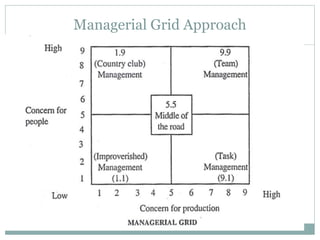
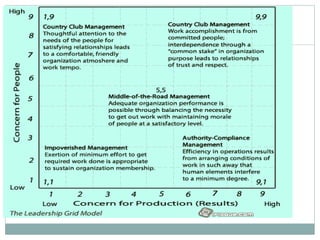
Managerial Grid Model of
Leadership Explained
Developed by R. R. Blake and J. S.
Mouton, the Managerial Grid
Model helps Managers to analyze their
leadership styles through a technique
known as grid training.
Also, Managers can identify how they
concerning their concern for production
and people with the Managerial Grid
Model.
The two dimensions of leadership, viz.
concern for people on ‘vertical’ axis and
concern for production on the
‘horizontal’ axis have been
demonstrated by R. R. Blake and J. S.
Mouton in the form of Managerial Grid
Model.
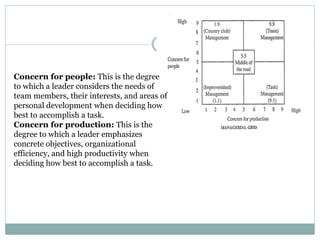
Managerial Grid Approach
Concern for people: This is the degree
to which a leader considers the needs of
team members, their interests, and areas of
personal development when deciding how
best to accomplish a task.
Concern for production: This is the
degree to which a leader emphasizes
concrete objectives, organizational
efficiency, and high productivity when
deciding how best to accomplish a task.
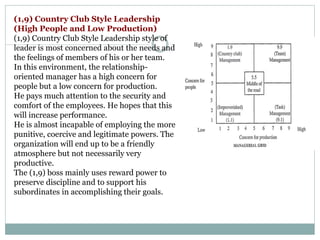
(1,9) Country Club Style Leadership
(High People and Low Production)
(1,9) Country Club Style Leadership style of
leader is most concerned about the needs and
the feelings of members of his or her team.
In this environment, the relationship-
oriented manager has a high concern for
people but a low concern for production.
He pays much attention to the security and
comfort of the employees. He hopes that this
will increase performance.
He is almost incapable of employing the more
punitive, coercive and legitimate powers. The
organization will end up to be a friendly
atmosphere but not necessarily very
productive.
The (1,9) boss mainly uses reward power to
preserve discipline and to support his
subordinates in accomplishing their goals.
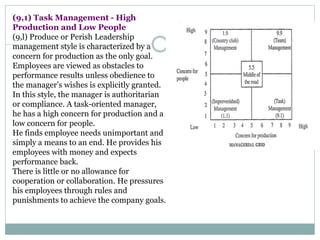
(9,1) Task Management - High
Production and Low People
(9,l) Produce or Perish Leadership
management style is characterized by a
concern for production as the only goal.
Employees are viewed as obstacles to
performance results unless obedience to
the manager’s wishes is explicitly granted.
In this style, the manager is authoritarian
or compliance. A task-oriented manager,
he has a high concern for production and a
low concern for people.
He finds employee needs unimportant and
simply a means to an end. He provides his
employees with money and expects
performance back.
There is little or no allowance for
cooperation or collaboration. He pressures
his employees through rules and
punishments to achieve the company goals.
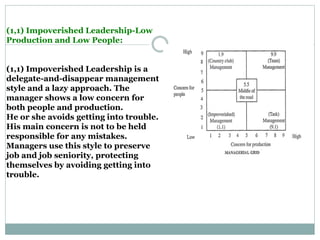
(1,1) Impoverished Leadership-Low
Production and Low People:
(1,1) Impoverished Leadership is a
delegate-and-disappear management
style and a lazy approach. The
manager shows a low concern for
both people and production.
He or she avoids getting into trouble.
His main concern is not to be held
responsible for any mistakes.
Managers use this style to preserve
job and job seniority, protecting
themselves by avoiding getting into
trouble.
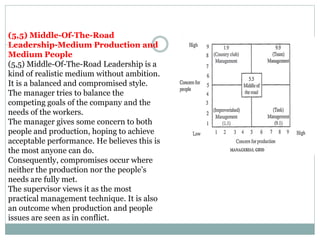
(5,5) Middle-Of-The-Road
Leadership-Medium Production and
Medium People
(5,5) Middle-Of-The-Road Leadership is a
kind of realistic medium without ambition.
It is a balanced and compromised style.
The manager tries to balance the
competing goals of the company and the
needs of the workers.
The manager gives some concern to both
people and production, hoping to achieve
acceptable performance. He believes this is
the most anyone can do.
Consequently, compromises occur where
neither the production nor the people’s
needs are fully met.
The supervisor views it as the most
practical management technique. It is also
an outcome when production and people
issues are seen as in conflict.
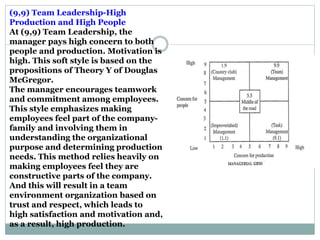
(9,9) Team Leadership-High
Production and High People
At (9,9) Team Leadership, the
manager pays high concern to both
people and production. Motivation is
high. This soft style is based on the
propositions of Theory Y of Douglas
McGregor.
The manager encourages teamwork
and commitment among employees.
This style emphasizes making
employees feel part of the company-
family and involving them in
understanding the organizational
purpose and determining production
needs. This method relies heavily on
making employees feel they are
constructive parts of the company.
And this will result in a team
environment organization based on
trust and respect, which leads to
high satisfaction and motivation and,
as a result, high production.
Limitations of the Managerial Grid
The model ignores the importance of internal and
external limits, matter and scenario.
There is some more aspect of leadership that can be
covered but are not.
Blake and Mouton’s Managerial Grid Model was one
of the most influential management models to appear
in the 1960s, it also provided a foundation for even
more complex contingency approaches to leadership.
Advantages of the Managerial
Grid Model
Managers help to analyze their
leadership styles through a technique
known as grid training.
Managers identify how they for their
concern for production and people.
Group & Team
Groups & Teams
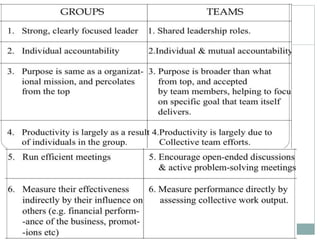
Group - two or more people with common
interests, objectives, and continuing
interaction
Work Team - a group of people with
complementary skills who are committed
to a common mission, performance goals,
and approach for which they hold
themselves mutually accountable
Characteristics of a Well-Functioning, Effective Group
-
Comfortable, informal atmosphere
Task well understood & accepted
Members listen well & participate
People express feelings & ideas
Conflict & disagreement center around
ideas or methods
Group aware of its operation & function
Consensus decision making
Clear assignments made & accepted
Difference Between Groups and Teams
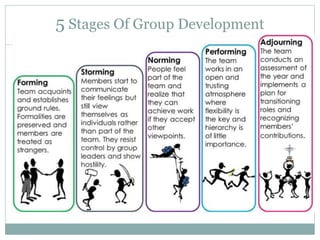
5 Stages Of Group Development
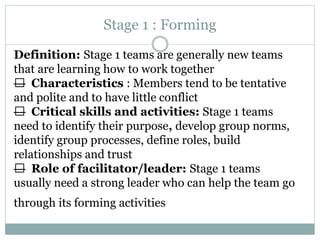
Stage 1 : Forming
Definition: Stage 1 teams are generally new teams
that are learning how to work together
— Characteristics : Members tend to be tentative
and polite and to have little conflict
— Critical skills and activities: Stage 1 teams
need to identify their purpose, develop group norms,
identify group processes, define roles, build
relationships and trust
— Role of facilitator/leader: Stage 1 teams
usually need a strong leader who can help the team go
through its forming activities
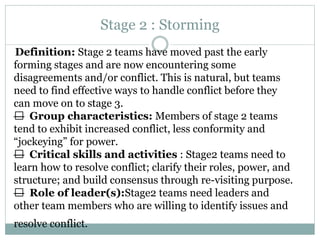
Stage 2 : Storming
Definition: Stage 2 teams have moved past the early
forming stages and are now encountering some
disagreements and/or conflict. This is natural, but teams
need to find effective ways to handle conflict before they
can move on to stage 3.
— Group characteristics: Members of stage 2 teams
tend to exhibit increased conflict, less conformity and
“jockeying” for power.
— Critical skills and activities : Stage2 teams need to
learn how to resolve conflict; clarify their roles, power, and
structure; and build consensus through re-visiting purpose.
— Role of leader(s):Stage2 teams need leaders and
other team members who are willing to identify issues and
resolve conflict.
Stage 3: Norming
Definition: Stage 3 teams have successfully moved out of
the storming stage and are ready to move to a higher level of
communication and problem- solving.
Group characteristics: Members of stage 3 teams
demonstrate an improved ability to complete tasks, solve
problems, resolve conflict.
Critical skills and activities: Stage 3 teams need to learn
to engage in more sophisticated problem-solving and
decision-making, continue the use of effective strategies for
conflict resolution and take greater levels of responsibility
for their roles
Role of leader(s): In stage 3, leaders become less
directive, team members feel empowered, and multiple
leaders emerge
Stage 4 : Performing
Definition:Stage4 teams are at the highest level of performance
and can process their strengths and weaknesses while accomplishing
their goals.
Group characteristics: In stage 4,the team takes a flexible
approach to roles and structures depending on the task at hand. The
team is able to evaluate its effectiveness and views conflict is viewed
as an opportunity. Stage 4 teams tend to be energetic, creative, and
fun!
— Critical skills and activities: Stage 4 teams need to hold high
expectations for their performance. They often use sub-groups as
well as the large group for decision- making and task completion.
Teams also recognize the need to ensure that all members are in
agreement with the role and purpose of sub-groups.
— Role of Leader: In a stage 4 team, it’s often difficult to identify
the leader, because everyone is sharing in leadership.
5th stages: Adjouring
In this final stage of group development,
members prepare to say goodbye. The
main goals of the Adjourning stage are to
achieve closure and end on a positive
note. Group members need time to
reflect on their individual participation
and growth. It is also important to
recognize the growth, progress, and
achievements of the group as a whole.
Types Of Group/Team
1. Formal groups refer to those which are established
under the legal or formal authority with the view to
achieve a particular end result and The group is
designated by the organizational structure, having work
assignments establishing tasks. E.g People making up
the airline flight crew, trade unions.
Classification Of Formal Group
a. Standing Task / Command Group
The Standing Task group are formed by subordinates
reporting directly to the particular manager and are
determined by the formal organizational chart. E.g. an
assistant regional transport officer and his two transport
supervisors form a command group.
b.Task Group
The task groups are composed of people who work
together to perform a task but involve a cross- command
relationship. Its boundaries are not located within its
immediate hierarchical superior. E.g. for finding out who
was responsible for causing wrong medication order
would require liaison between ward in charge, senior
sisters and head nurse.
2. Informal Group
a. Interest Group
— The interest group involves people who come together to
accomplish a particular goal with which they are
concerned .Office employees joining hands to go to vacation
or get vacation schedule changed form an interest group .
b. Friendship group
— The friendship group are formed by people having one or
more common features . The people coming from a same
college ,martial status, political views or having same language
to speak belong to a friendship group.
c. Reference Group
— Base of Interest & Friendship.
— Have in common race, gender,
religion, social class, educational
level, profession.

Leadership management chapter 7

  • 1.
  • 2.
    Learning Topics 1. ConceptOf leadership 2. Function and Importance Of Leadership 3. Difference Between Leader and Manager 4. Leadership Style 5. Approaches of Leadership 6. Qualities of Good Leadership 7. Group Formation and Types Of Group 8. Group Formation Process 9. Team Management 10. Types of Team 11. Conflict 12. Types of Conflict 13. Managing Conflict by organization 14. Concept of Motivation 15. Importance of Motivation 16. Motivation Theories 17. Emerging Issue of Motivation 18. Motivation through Employee Participation
  • 3.
    Introduction According to PeterDrucker, “ Leadership is shifting of own vision to higher sights,the raising of man’s performance to higher standards, the building of man’s personality beyond its normal limitations.” - Leadership is the one of the most important function of management. -Leading involves directing, influencing & motivating employees to perform.
  • 4.
    Features Of Leadership 1.Leadersand Followers : Relationship between Leaders and Followers. 2.Ability to influence: Leadership is the ability to influence the behavior, effort of followers. 3. Common Objectives: 4.Regular Process 5. Situational Activity : 6. Motivational Functions: 7. Reciprocal influence:
  • 5.
    Who is leader? One that leads or guides. One who is in charge or in command of others. One who heads of an organization. One who has influence or power, especially of a political nature.
  • 6.
    Importance/Functions of Leadership 1.GoalDetermination: Leadership set up the Vision, mission, objectives and goals of an organization. They also changes the policies of the organization to cope with the change in environment. 2. Environmental Adaption: Business environment is complex and dynamic so Leaders are responsible for monitoring, scanning and predicting the environmental changes and the probable effects. 3. Directing : Leadership direct to their followers(Subordinates for the maximum effort that leads to achieve the organizational goal. 4. Motivating: Financial and non-financial benefits scheme. 5. Communication: Leaders set proper channel of Communication, leaders influences the followers.Two- way of communication is better to build the trust among them. 6. Supervising and Controlling : 7. Encouraging Network:
  • 7.
    Difference Between ManagerAnd Leader MANAGER Oversees the current process well Must achieve balance Thinks execution Comfortable with control Problems are just that & need resolution ASAP Procedure is King Instructs as to technique & process Impersonal, remote LEADER Wants to create the future Needs to make change Thinks ideal Welcomes risks Sees problems as opportunities is patient Substance thumps the King Your best college professor High emotional intelligence
  • 8.
    Leadership Style Leadership styleis the manner and approach of Directing, Implementing plans and motivating the People involved in organization. 1. Autocratic Leadership Style 2. Democratic 3. Lassies Faire
  • 9.
    1. Autocratic LeadershipStyle -Under the autocratic leadership style, all decision- making powers are centralized in the leader, as with dictator leaders. -They do not entertain any suggestions or initiatives from subordinates. The autocratic management has been successful as it provides strong motivation to the manager. -It permits quick decision-making, as only one person decides for the whole group and keeps each decision to himself until he feels it is needed to be shared with the rest of the group. High degree of dependency on the leader
  • 10.
    Features of AutocraticLeadership 1. All the Decisions are made by leaders without any consultation of the followers. 2. Leaders control the information and communication Channel. 3. Leaders expect the desired output at the desired time in any cost from their followers. 4. Negative motivational techniques like the threatening, Suspension, Demotion etc.
  • 11.
    Benefits of AutocraticLeadership Style 1. All the employees work in strict discipline 2. Employees need not to be involved in decision making process. 3. Employees are not supposed to reject or suspect the order. 4. This style is most appropriate in the organizations having new, unskilled and less experienced employees. 5. Job division in this style becomes more clear and easy to understand.
  • 12.
    Disadvantages Of AutocraticLeadership Style 1. Employees do not participate in decision making. 2. Job Turnover ratio is high, because of Low career Opportunity. 3. One way communication, employee satisfaction and Performance may be below the expectation. 4. Succession planning becomes very poor because of lack Opportunity to improve the decision making power in employees. 5.Employees commitment will be low. 6. This leadership style is not suitable for the large and diversified organization.
  • 13.
    2. Democratic Styleof Leadership The democratic leadership style favors decision- making by the group . They can win the cooperation of their group and can motivate them effectively and positively. The decisions of the democratic leader are not unilateral as with the autocrat because they arise from consultation with the group members and participation by them. Consultative: process of consultation before decisions are taken Persuasive: Leader takes decision and seeks to persuade others that the decision is correct.
  • 14.
    Features of DemocraticLeadership Style 1.Subordinates are encouraged to participate in decision making. 2.This style follow two-way communication. 3.Employees are highly encouraged for creativity. 4.Employees are consider as a important members of an organization. 5. Team effort is encouraged. 6.Positive motivational tools are used to encourage employees.
  • 16.
    3. Laissez-Faire Style Laissez–Faire or free rein style A free rein leader does not lead, but leaves the group entirely to itself such a leader allows maximum freedom to subordinates, i.e. they are given a free hand in deciding their own policies and methods. Can be very useful in businesses where creative ideas are important Can be highly motivational, as people have control over their working life Can make coordination and decision making time- consuming and lacking in overall direction Relies on good team work
  • 17.
    Features Of LassiesFaire Leadership Style 1.Decisions regarding personal goals, performance standard, working process etc. 2. Leaders only coordinate and facilitate for resources. 3. Employees are self directed and guided. 4.Every employees holds the rights to use own intellectual freedom.
  • 18.
    Advantage of LassiesFaire Leadership 1.Decisions are made by employees themselves. 2.It helps to create and fulfill common goal of Orgn. 3.Employees become highly creative. 4.Employees evaluate their performance themselves. 5.This style is appropriate to modern and big organizations. 6.Employees have chance of Career development.
  • 19.
    Disadvantages of LassiesFaire Leadership 1.This style is not appropriate to organizations having majority of unskilled and semi skilled manpower. 2.Every employees may concentrate to the individual goal and effort. 3.There may be serious problem of discipline. 1.Coordination between employees can decrease gradually
  • 20.
    Approaches Of Leadership 1.TraitApproach of Leadership 2.Behavioral Approach of Leadership 3.Transformational Leadership 4.Coaching Leadership 5.Entrepreneurial Leadership
  • 21.
    1. Trait ApproachOf Leadership Trait theory of leadership differentiates leaders from non leaders by focusing on personal qualities and characteristics. Trait theory of leadership sought personality, social, physical and intellectual traits. Trait theory assumes that leaders are born.
  • 22.
    Trait Theory 1. Intelligenceand scholarship, Physical traits like age, height, weight, strength etc. 2.Social status and experience Task Orientation 3. Personality characteristics: 4. Ambition and energy Desire to lead 5. Honesty and integrity 6. Self confidence 7. Job relevant knowledge etc.
  • 23.
    Trait theorist refersto people like Father of nation M.K. Gandhi, Indira Gandhi, Margrat Thracher, Nelson Mandela, Virgin Group CEO Richard Branson, Apple Co-founder Steve Jobs, Ratan Tata of the Tata Group, Azim Premji of Wipro, Narayana Murthy of Infosys, Binod Chaudhary of CG etc.
  • 24.
    - The trait theoryarose from the the “Great Man” theory as a way of identifying the key characteristics of successful leaders . It was believed that through this theory critical leadership traits could be isolated and that people with such trait could then be recruited ,selected and installed into leadership positions. This theory was common in the military and is still used as a set of criteria to select candidates for commissions.
  • 27.
    2. Behavioral Approach Thetheory concerned about what a leader actually does and how she/he does it. The assumption under this theory was; i. The behavior of effective leader would be different from the behavior of less effective leader. ii. The behavior of effective leaders would be the same across all situations.
  • 29.
    Behavioral Approach There arethree important research studies, which attempted to analyze the leadership behaviors. They are: a. Ohio State Studies. b. Michigan Studies. c. Management Grid.
  • 30.
    Ohio State Model Ateam of Research were undertaken in the 1945 AD at Ohio State University to find what behaviors make leadership effective? From their study, two dimension of leadership behavior were identified.
  • 31.
    Ohio State Approachof Leadership Ohio State University model narrowed description of leader behavior into two dimensions: Initiating Structure Behavior: The behavior of leaders who define the leader-subordinate role so that everyone knows what is expected, establish formal lines of communication, and determine how tasks will be performed. Consideration Behavior: The behavior of leaders who are concerned for subordinates and attempt to establish a warm, friendly, and supportive climate.
  • 32.
  • 33.
  • 34.
  • 35.
    a. Job(production) CenteredLeadership production-centered Leadership: Managers using job- centered leader behavior pay close attention to subordinates’ work, explain work procedures and are keenly interested in performance.
  • 36.
    c. Emloyee CenteredLeadership Employee-centered Leadership: Managers using employee-centered leader behavior are interested in developing a cohesive workgroup and ensuring that employees are satisfied with their jobs. The Michigan Leadership Studies found that both the styles of leadership led to an increase in production, but it was slightly more in case of production of job-centered style.
  • 37.
    Criticized of MichiganStudies These ‘studies are criticized on the following grounds: The Michigan Leadership Studies failed to suggest whether leader behavior is a cause or effect. They did not clarify whether the employee-centered leadership makes the group productive or whether the highly productive group induces the leader to be employee-centered. The Michigan Leadership Studies did not consider the nature of the subordinates’ tasks or their characteristics. Group characteristics and other situational variables were also ignored. The behavioral styles suggested by Michigan Leadership Studies have been termed as static. A leader is supposed to follow either of the two styles, viz., task orientation and employee orientation. But in practice, a practical style may succeed in one situation and fail in another.
  • 38.
    Managerial Grid Modelof Leadership Explained Developed by R. R. Blake and J. S. Mouton, the Managerial Grid Model helps Managers to analyze their leadership styles through a technique known as grid training.
  • 39.
    Also, Managers canidentify how they concerning their concern for production and people with the Managerial Grid Model. The two dimensions of leadership, viz. concern for people on ‘vertical’ axis and concern for production on the ‘horizontal’ axis have been demonstrated by R. R. Blake and J. S. Mouton in the form of Managerial Grid Model.
  • 40.
  • 42.
    Concern for people:This is the degree to which a leader considers the needs of team members, their interests, and areas of personal development when deciding how best to accomplish a task. Concern for production: This is the degree to which a leader emphasizes concrete objectives, organizational efficiency, and high productivity when deciding how best to accomplish a task.
  • 43.
    (1,9) Country ClubStyle Leadership (High People and Low Production) (1,9) Country Club Style Leadership style of leader is most concerned about the needs and the feelings of members of his or her team. In this environment, the relationship- oriented manager has a high concern for people but a low concern for production. He pays much attention to the security and comfort of the employees. He hopes that this will increase performance. He is almost incapable of employing the more punitive, coercive and legitimate powers. The organization will end up to be a friendly atmosphere but not necessarily very productive. The (1,9) boss mainly uses reward power to preserve discipline and to support his subordinates in accomplishing their goals.
  • 44.
    (9,1) Task Management- High Production and Low People (9,l) Produce or Perish Leadership management style is characterized by a concern for production as the only goal. Employees are viewed as obstacles to performance results unless obedience to the manager’s wishes is explicitly granted. In this style, the manager is authoritarian or compliance. A task-oriented manager, he has a high concern for production and a low concern for people. He finds employee needs unimportant and simply a means to an end. He provides his employees with money and expects performance back. There is little or no allowance for cooperation or collaboration. He pressures his employees through rules and punishments to achieve the company goals.
  • 45.
    (1,1) Impoverished Leadership-Low Productionand Low People: (1,1) Impoverished Leadership is a delegate-and-disappear management style and a lazy approach. The manager shows a low concern for both people and production. He or she avoids getting into trouble. His main concern is not to be held responsible for any mistakes. Managers use this style to preserve job and job seniority, protecting themselves by avoiding getting into trouble.
  • 46.
    (5,5) Middle-Of-The-Road Leadership-Medium Productionand Medium People (5,5) Middle-Of-The-Road Leadership is a kind of realistic medium without ambition. It is a balanced and compromised style. The manager tries to balance the competing goals of the company and the needs of the workers. The manager gives some concern to both people and production, hoping to achieve acceptable performance. He believes this is the most anyone can do. Consequently, compromises occur where neither the production nor the people’s needs are fully met. The supervisor views it as the most practical management technique. It is also an outcome when production and people issues are seen as in conflict.
  • 47.
    (9,9) Team Leadership-High Productionand High People At (9,9) Team Leadership, the manager pays high concern to both people and production. Motivation is high. This soft style is based on the propositions of Theory Y of Douglas McGregor. The manager encourages teamwork and commitment among employees. This style emphasizes making employees feel part of the company- family and involving them in understanding the organizational purpose and determining production needs. This method relies heavily on making employees feel they are constructive parts of the company. And this will result in a team environment organization based on trust and respect, which leads to high satisfaction and motivation and, as a result, high production.
  • 48.
    Limitations of theManagerial Grid The model ignores the importance of internal and external limits, matter and scenario. There is some more aspect of leadership that can be covered but are not. Blake and Mouton’s Managerial Grid Model was one of the most influential management models to appear in the 1960s, it also provided a foundation for even more complex contingency approaches to leadership.
  • 49.
    Advantages of theManagerial Grid Model Managers help to analyze their leadership styles through a technique known as grid training. Managers identify how they for their concern for production and people.
  • 50.
    Group & Team Groups& Teams Group - two or more people with common interests, objectives, and continuing interaction Work Team - a group of people with complementary skills who are committed to a common mission, performance goals, and approach for which they hold themselves mutually accountable
  • 51.
    Characteristics of aWell-Functioning, Effective Group - Comfortable, informal atmosphere Task well understood & accepted Members listen well & participate People express feelings & ideas Conflict & disagreement center around ideas or methods Group aware of its operation & function Consensus decision making Clear assignments made & accepted
  • 52.
  • 53.
    5 Stages OfGroup Development
  • 54.
    Stage 1 :Forming Definition: Stage 1 teams are generally new teams that are learning how to work together — Characteristics : Members tend to be tentative and polite and to have little conflict — Critical skills and activities: Stage 1 teams need to identify their purpose, develop group norms, identify group processes, define roles, build relationships and trust — Role of facilitator/leader: Stage 1 teams usually need a strong leader who can help the team go through its forming activities
  • 55.
    Stage 2 :Storming Definition: Stage 2 teams have moved past the early forming stages and are now encountering some disagreements and/or conflict. This is natural, but teams need to find effective ways to handle conflict before they can move on to stage 3. — Group characteristics: Members of stage 2 teams tend to exhibit increased conflict, less conformity and “jockeying” for power. — Critical skills and activities : Stage2 teams need to learn how to resolve conflict; clarify their roles, power, and structure; and build consensus through re-visiting purpose. — Role of leader(s):Stage2 teams need leaders and other team members who are willing to identify issues and resolve conflict.
  • 56.
    Stage 3: Norming Definition:Stage 3 teams have successfully moved out of the storming stage and are ready to move to a higher level of communication and problem- solving. Group characteristics: Members of stage 3 teams demonstrate an improved ability to complete tasks, solve problems, resolve conflict. Critical skills and activities: Stage 3 teams need to learn to engage in more sophisticated problem-solving and decision-making, continue the use of effective strategies for conflict resolution and take greater levels of responsibility for their roles Role of leader(s): In stage 3, leaders become less directive, team members feel empowered, and multiple leaders emerge
  • 57.
    Stage 4 :Performing Definition:Stage4 teams are at the highest level of performance and can process their strengths and weaknesses while accomplishing their goals. Group characteristics: In stage 4,the team takes a flexible approach to roles and structures depending on the task at hand. The team is able to evaluate its effectiveness and views conflict is viewed as an opportunity. Stage 4 teams tend to be energetic, creative, and fun! — Critical skills and activities: Stage 4 teams need to hold high expectations for their performance. They often use sub-groups as well as the large group for decision- making and task completion. Teams also recognize the need to ensure that all members are in agreement with the role and purpose of sub-groups. — Role of Leader: In a stage 4 team, it’s often difficult to identify the leader, because everyone is sharing in leadership.
  • 58.
    5th stages: Adjouring Inthis final stage of group development, members prepare to say goodbye. The main goals of the Adjourning stage are to achieve closure and end on a positive note. Group members need time to reflect on their individual participation and growth. It is also important to recognize the growth, progress, and achievements of the group as a whole.
  • 59.
    Types Of Group/Team 1.Formal groups refer to those which are established under the legal or formal authority with the view to achieve a particular end result and The group is designated by the organizational structure, having work assignments establishing tasks. E.g People making up the airline flight crew, trade unions.
  • 60.
    Classification Of FormalGroup a. Standing Task / Command Group The Standing Task group are formed by subordinates reporting directly to the particular manager and are determined by the formal organizational chart. E.g. an assistant regional transport officer and his two transport supervisors form a command group. b.Task Group The task groups are composed of people who work together to perform a task but involve a cross- command relationship. Its boundaries are not located within its immediate hierarchical superior. E.g. for finding out who was responsible for causing wrong medication order would require liaison between ward in charge, senior sisters and head nurse.
  • 61.
    2. Informal Group a.Interest Group — The interest group involves people who come together to accomplish a particular goal with which they are concerned .Office employees joining hands to go to vacation or get vacation schedule changed form an interest group . b. Friendship group — The friendship group are formed by people having one or more common features . The people coming from a same college ,martial status, political views or having same language to speak belong to a friendship group. c. Reference Group — Base of Interest & Friendship. — Have in common race, gender, religion, social class, educational level, profession.