
Ascent Marine Institute
Leadership and Personality
Development
Capt Ashok Menon
MAN MANAGEMENT& TEAMWORK
Man management is the art of
managing people
A manager is a man who gets things
done with people and other resources
in order to reach an objective.
He coordinates the activities of others
and thus it is important for him to learn
the art of managing people.
Motivation can be done round the
clock.
 It can take the form of official
meetings, get togethers, one to one
talk sessions, during emergency drills
and so on.
Juniors must be given due respect and
genuine mistakes must be pardoned
and turned into an opportunity for
training so that it does not re-occur.
Motivational Techniques
People can be disciplined only be a
man who is disciplined himself.
Boost the self confidence of juniors by
showing trust in them. Their sense of
responsibility will be fired by this.
Never raise your voice or lose your
temper for irrelevant matters.
A firing is more effective if done in a
calm composed voice
Earn the respect of juniors by your own
actions and behaviour and not by
pulling rank on them.
Raise your voice on important
occasions to show that you are angry
and will not tolerate such shortcomings
in future
Do not be sarcastic, point out
shortcomings in a straightforward
manner
Always be just, but never too kind, for
kindness on board is mistaken for
weakness
Prepare a training programme for
juniors. Senior Officers must take
special interest in training and
educating the juniors
All meetings, drills, brainstorming
sessions etc., are to be taken very
seriously and no laxity is to be tolerated
in this respect
All company procedures are to be
strictly followed and senior officers
should never tolerate any criticism of
the company
Safety should be given paramount
importance and a safety culture must
be encouraged on board
Welfare of the crew should be taken
seriously. Motivation can only come
from a crew who believe that their
interests are taken care of.
Demotivation
Demotivation is one of the major
causes of human error
Leads the mind to waver and
concentration levels to drop
Can lead to wrong judgment on the
bridge, in engine room etc
Demotivation and lack of concentration
may be caused due to fatigue, lack of
motivation or mental stress.
affect the performance of the team as
a whole
team leaders to remain motivated at all
times and keep all their members
motivated at all times
Can be caused due to lack of job
satisfaction
 May be also due to personal problems
on board or at home
Team leaders must try to find out the
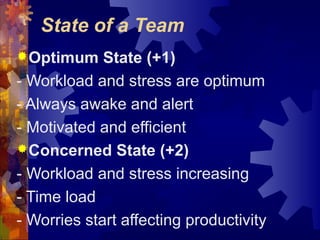
State of a Team
Optimum State (+1)
- Workload and stress are optimum
- Always awake and alert
- Motivated and efficient
Concerned State (+2)
- Workload and stress increasing
- Time load
- Worries start affecting productivity
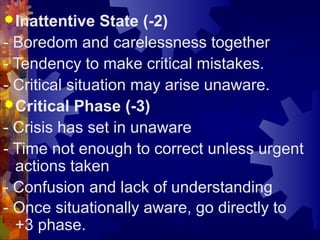
Inattentive State (-2)
- Boredom and carelessness together
- Tendency to make critical mistakes.
- Critical situation may arise unaware.
Critical Phase (-3)
- Crisis has set in unaware
- Time not enough to correct unless urgent
actions taken
- Confusion and lack of understanding
- Once situationally aware, go directly to
+3 phase.
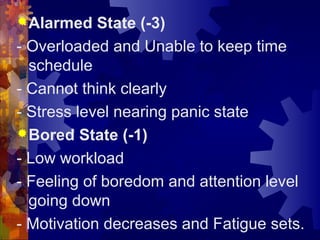
Alarmed State (-3)
- Overloaded and Unable to keep time
schedule
- Cannot think clearly
- Stress level nearing panic state
Bored State (-1)
- Low workload
- Feeling of boredom and attention level
going down
- Motivation decreases and Fatigue sets.
Leadership Styles
 Tiger : Tiger style of leaders mix high
authority with high assertiveness. They
are good performers but bad man
managers
- Quite defensive team members
- Poor communication within the team
- Low assertiveness of team members
- Team morale and confidence level low
- Team members do not take any
initiative on their own
Disadvantages
- Authoritarian Style
- May have a tendency to do or to
control everything
- Does not believe in teamwork
- One-way communication
- Does not like challenges to
leadership
- Does not delegate
Advantages :
- Believes in performance
- Takes full responsibility for his or
her decisions
- Is loyal to the team
Penguin : Low assertiveness. They
are unable to exert the assertiveness
that their position demands.
Week leaders with no authority and
thus not taken seriously enough.
Everyone in the team starts to work
independently and soon the team falls
apart.
Believes that people are more
important that performance and that if
people are well treated, they will
Advantages :
- Good man manager
- Good Listener
- Forgives easily and avoids conflicts
- Positive thinking
- Good working atmosphere
Disadvantages :
- Low assertiveness and does not
challenge others assertiveness
- Too supportive of team members
- Too much unimportant
communication
- Tolerates lower standards on board
- Little ‘on job’ training
Effect on team members :
- Low respect for leadership
- Morale down due to perception of
weak leadership
- Lowering of professional standards
and efficiency declines
 Sheep : These leaders are assertive to
a degree but gets diverted by public
opinion even if it goes against their own
ideas and logic.
 Does not like to stand up and convince
others to do what they feel is right.
 Too much flexibility makes the team
members voice their opinion too freely
and thus no consensus on important
issues.
 This management style is average and
so is the performance of the team.
Advantages :
Promising management style
Adjusts well to surroundings
Accepts challenges
 Disadvantages :
 Compromises performance or team
spirit to achieve goals
 Communication could be better
 Training standards average
Snail : This is the worst
management style.
- The performance level of the team is
low and so is the morale of the team.
- There is a serious lack of motivation
and such leaders are often lacking in
any team oriented goals.
Advantages : Nil
Disadvantages :
- Low assertiveness and weak authority
- Not interested in job / does bare
minimum
- Inferiority complex, poor communicator
and avoids conflicts
- Little training
Effect on team members :
Low team morale
Team performance very low
Dolphin : The Dolphin style of
management is the best one.
It combines the best of all the styles
and results in strong and effective
leadership and teamwork.
The performance level is high as
well as the man management.
Disadvantages : Nil
 Advantages :
- Best management style
- Good communication
- Accepts challenges and delegates
jobs
- Knows strengths and weaknesses
of team mates
- Positive and optimistic style of
management
Effect on team members :
- High team morale and confidence
- Good communication within the
team
- Highly motivated team
- Very good performance and high
professional standards
 Analysis : The best style is the dolphin, but
others also have some advantages.
 Each leader should adapt his or her style to
the situation at hand.
 A tiger may be ideal for creating order out of
chaos in emergency situations.
 In the presence of inexperienced people, it
may be good to be more of a penguin.
 In periods of low activity, a sheep may even
be adequate.
 Every leader must do his own analysis and
constantly upgrade his management style to
achieve best results.
Qualities of a Good Leader
Integrity : It is a measure of a persons
inner values and beliefs even when an
easier and more advantageous path is
available
Dedication : Dedication means
spending whatever time and energy on
a task required to get the job done,
rather than giving it whatever time you
have available.
 Magnanimity : A magnanimous leader
gives credit where it is due. No backbiting &
accepts personal responsibility for failures
 Humility : It means understanding that you
are not inherently superior to others and
consequently that they are not inferior to
you. However it does not mean debasing
oneself or having a low self-esteem. It
means behaving is a dignified manner
 Creativity : A creative person thinks
differently, out of the box, so to say and
take a new and different viewpoint on things
Assertiveness
PASSIVE
- Overly courteous
- "Beats around the bush"
- Avoids Conflicts
- "Along for the ride."
ASSERTIVE
Active Involvement
Readiness to take action
Provide useful information
Makes suggestions
OVER AGGRESSIVE
- Domination
- Intimidation
- Abusive / Hostile
Too High Authority
 Total Command expected
 No communication skills n does not delegate
 Performance oriented n needs to prove.
 Juniors silenced by such leaders
 Even if leader makes a blunder, juniors
hesitant to correct them for fear of reprisal
 Surrounded by a coterie of ‘Yes men’
 Efficiency levels drop and team commits
mistakes
Too Low Assertiveness
Unable to exert pressure on juniors
Cannot gain respect as a team leader
Unaware of what is expected
Lacks communication and managerial skills
Too much confusion as juniors try to assert
themselves
Personality clash and Team works in
confusion / efficiency levels drop
Tips for Management Level Officers
 Earn the trust of the juniors - earned by
dedication, commitment and honesty
 Building Enthusiasm - meetings and
brainstorming sessions, giving pep talks,
being positive even when the going is not
so good
 Play Games - stress busters and relaxes
both mind and body
 Get Involved in order to know the ground
realities – team is motivated
Some More Leadership Qualities
Partnership and voice
Vision and values
Knowledge and daring
Savvy and persistence
Personal qualities
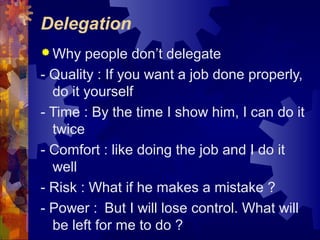
Delegation
 Why people don’t delegate
- Quality : If you want a job done properly,
do it yourself
- Time : By the time I show him, I can do it
twice
- Comfort : like doing the job and I do it
well
- Risk : What if he makes a mistake ?
- Power : But I will lose control. What will
be left for me to do ?
Thank You for paying
attention

Leadership n personality development

  • 1.
    Ascent Marine Institute Leadershipand Personality Development Capt Ashok Menon
  • 2.
    MAN MANAGEMENT& TEAMWORK Manmanagement is the art of managing people A manager is a man who gets things done with people and other resources in order to reach an objective. He coordinates the activities of others and thus it is important for him to learn the art of managing people.
  • 3.
    Motivation can bedone round the clock.  It can take the form of official meetings, get togethers, one to one talk sessions, during emergency drills and so on. Juniors must be given due respect and genuine mistakes must be pardoned and turned into an opportunity for training so that it does not re-occur.
  • 4.
    Motivational Techniques People canbe disciplined only be a man who is disciplined himself. Boost the self confidence of juniors by showing trust in them. Their sense of responsibility will be fired by this. Never raise your voice or lose your temper for irrelevant matters. A firing is more effective if done in a calm composed voice
  • 5.
    Earn the respectof juniors by your own actions and behaviour and not by pulling rank on them. Raise your voice on important occasions to show that you are angry and will not tolerate such shortcomings in future Do not be sarcastic, point out shortcomings in a straightforward manner
  • 6.
    Always be just,but never too kind, for kindness on board is mistaken for weakness Prepare a training programme for juniors. Senior Officers must take special interest in training and educating the juniors All meetings, drills, brainstorming sessions etc., are to be taken very seriously and no laxity is to be tolerated in this respect
  • 7.
    All company proceduresare to be strictly followed and senior officers should never tolerate any criticism of the company Safety should be given paramount importance and a safety culture must be encouraged on board Welfare of the crew should be taken seriously. Motivation can only come from a crew who believe that their interests are taken care of.
  • 8.
    Demotivation Demotivation is oneof the major causes of human error Leads the mind to waver and concentration levels to drop Can lead to wrong judgment on the bridge, in engine room etc Demotivation and lack of concentration may be caused due to fatigue, lack of motivation or mental stress.
  • 9.
    affect the performanceof the team as a whole team leaders to remain motivated at all times and keep all their members motivated at all times Can be caused due to lack of job satisfaction  May be also due to personal problems on board or at home Team leaders must try to find out the
  • 10.
    State of aTeam Optimum State (+1) - Workload and stress are optimum - Always awake and alert - Motivated and efficient Concerned State (+2) - Workload and stress increasing - Time load - Worries start affecting productivity
  • 11.
    Inattentive State (-2) -Boredom and carelessness together - Tendency to make critical mistakes. - Critical situation may arise unaware. Critical Phase (-3) - Crisis has set in unaware - Time not enough to correct unless urgent actions taken - Confusion and lack of understanding - Once situationally aware, go directly to +3 phase.
  • 12.
    Alarmed State (-3) -Overloaded and Unable to keep time schedule - Cannot think clearly - Stress level nearing panic state Bored State (-1) - Low workload - Feeling of boredom and attention level going down - Motivation decreases and Fatigue sets.
  • 13.
    Leadership Styles  Tiger: Tiger style of leaders mix high authority with high assertiveness. They are good performers but bad man managers - Quite defensive team members - Poor communication within the team - Low assertiveness of team members - Team morale and confidence level low - Team members do not take any initiative on their own
  • 14.
    Disadvantages - Authoritarian Style -May have a tendency to do or to control everything - Does not believe in teamwork - One-way communication - Does not like challenges to leadership - Does not delegate
  • 15.
    Advantages : - Believesin performance - Takes full responsibility for his or her decisions - Is loyal to the team
  • 16.
    Penguin : Lowassertiveness. They are unable to exert the assertiveness that their position demands. Week leaders with no authority and thus not taken seriously enough. Everyone in the team starts to work independently and soon the team falls apart. Believes that people are more important that performance and that if people are well treated, they will
  • 17.
    Advantages : - Goodman manager - Good Listener - Forgives easily and avoids conflicts - Positive thinking - Good working atmosphere
  • 18.
    Disadvantages : - Lowassertiveness and does not challenge others assertiveness - Too supportive of team members - Too much unimportant communication - Tolerates lower standards on board - Little ‘on job’ training
  • 19.
    Effect on teammembers : - Low respect for leadership - Morale down due to perception of weak leadership - Lowering of professional standards and efficiency declines
  • 20.
     Sheep :These leaders are assertive to a degree but gets diverted by public opinion even if it goes against their own ideas and logic.  Does not like to stand up and convince others to do what they feel is right.  Too much flexibility makes the team members voice their opinion too freely and thus no consensus on important issues.  This management style is average and so is the performance of the team.
  • 21.
    Advantages : Promising managementstyle Adjusts well to surroundings Accepts challenges  Disadvantages :  Compromises performance or team spirit to achieve goals  Communication could be better  Training standards average
  • 22.
    Snail : Thisis the worst management style. - The performance level of the team is low and so is the morale of the team. - There is a serious lack of motivation and such leaders are often lacking in any team oriented goals. Advantages : Nil
  • 23.
    Disadvantages : - Lowassertiveness and weak authority - Not interested in job / does bare minimum - Inferiority complex, poor communicator and avoids conflicts - Little training Effect on team members : Low team morale Team performance very low
  • 24.
    Dolphin : TheDolphin style of management is the best one. It combines the best of all the styles and results in strong and effective leadership and teamwork. The performance level is high as well as the man management. Disadvantages : Nil
  • 25.
     Advantages : -Best management style - Good communication - Accepts challenges and delegates jobs - Knows strengths and weaknesses of team mates - Positive and optimistic style of management
  • 26.
    Effect on teammembers : - High team morale and confidence - Good communication within the team - Highly motivated team - Very good performance and high professional standards
  • 27.
     Analysis :The best style is the dolphin, but others also have some advantages.  Each leader should adapt his or her style to the situation at hand.  A tiger may be ideal for creating order out of chaos in emergency situations.  In the presence of inexperienced people, it may be good to be more of a penguin.  In periods of low activity, a sheep may even be adequate.  Every leader must do his own analysis and constantly upgrade his management style to achieve best results.
  • 28.
    Qualities of aGood Leader Integrity : It is a measure of a persons inner values and beliefs even when an easier and more advantageous path is available Dedication : Dedication means spending whatever time and energy on a task required to get the job done, rather than giving it whatever time you have available.
  • 29.
     Magnanimity :A magnanimous leader gives credit where it is due. No backbiting & accepts personal responsibility for failures  Humility : It means understanding that you are not inherently superior to others and consequently that they are not inferior to you. However it does not mean debasing oneself or having a low self-esteem. It means behaving is a dignified manner  Creativity : A creative person thinks differently, out of the box, so to say and take a new and different viewpoint on things
  • 30.
    Assertiveness PASSIVE - Overly courteous -"Beats around the bush" - Avoids Conflicts - "Along for the ride."
  • 31.
    ASSERTIVE Active Involvement Readiness totake action Provide useful information Makes suggestions
  • 32.
    OVER AGGRESSIVE - Domination -Intimidation - Abusive / Hostile
  • 33.
    Too High Authority Total Command expected  No communication skills n does not delegate  Performance oriented n needs to prove.  Juniors silenced by such leaders  Even if leader makes a blunder, juniors hesitant to correct them for fear of reprisal  Surrounded by a coterie of ‘Yes men’  Efficiency levels drop and team commits mistakes
  • 34.
    Too Low Assertiveness Unableto exert pressure on juniors Cannot gain respect as a team leader Unaware of what is expected Lacks communication and managerial skills Too much confusion as juniors try to assert themselves Personality clash and Team works in confusion / efficiency levels drop
  • 35.
    Tips for ManagementLevel Officers  Earn the trust of the juniors - earned by dedication, commitment and honesty  Building Enthusiasm - meetings and brainstorming sessions, giving pep talks, being positive even when the going is not so good  Play Games - stress busters and relaxes both mind and body  Get Involved in order to know the ground realities – team is motivated
  • 36.
    Some More LeadershipQualities Partnership and voice Vision and values Knowledge and daring Savvy and persistence Personal qualities
  • 37.
    Delegation  Why peopledon’t delegate - Quality : If you want a job done properly, do it yourself - Time : By the time I show him, I can do it twice - Comfort : like doing the job and I do it well - Risk : What if he makes a mistake ? - Power : But I will lose control. What will be left for me to do ?
  • 38.
    Thank You forpaying attention