ASSOCIATION ON MASTER
MARINERS
ANNUAL SEMINAR
7TH
DEC 2018
 ARTIFICIAL INTELLIGENCE
AND ITS IMPACT ON GLOBAL
SHIPPING
 Capt Ashok Menon
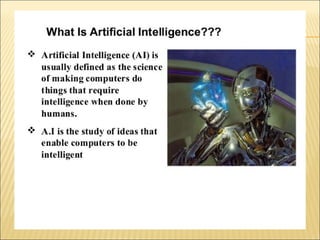
 The father of Artificial intelligence,
John McCarthy has described it as
“ the science and engineering of
making intelligent machines,
especially intelligent computer
programmes.”
 It is designing machines that can
think like human beings and can
have its own intelligence
 According to a report from three
Chinese researchers which aimed to
compare the intelligence of various
AI systems, Google's AI had an IQ
of 47.3, ahead of Chinese search
engine Baidu (33), Microsoft's Bing
(32), and Siri (24).
 But while Google's AI leads the
tech pack, it has a long way to go
before it comes close to human
intelligence; the average 6-year-old
has an IQ of 55.5, according to the
report.
Advantages of Art Intelligence
Less Errors: As decisions are
taken on previously gathered
information and certain algorithms,
without the interference of humans,
so errors are reduced and the
chance of reaching accuracy with a
greater degree of precision is a
possibility.
No Emotions: The complete
absence of emotions makes
machines to think logically and take
right decision where in humans
emotions are associated with moods
that can affect human efficiency.
Complete absence of emotions make
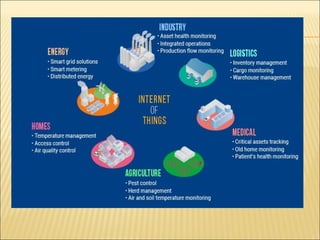
machines to take right decisions.
Medical Applications:
Increasing the integration of A.I.
tools in every day medical
applications could improve the
efficiency of treatments and avoid
cost by minimizing the risk of false
diagnosis.
AI has begun transforming the field
of surgical robotics wherein it has
enabled the advent of robots that
perform semi-automated surgical
tasks with efficiency.
Disadvantages of Artificial
Intelligence
High Costs: Can cost a lot of money
and time to build, rebuild, and repair.
Machines need repairing and
maintenance which need plenty of
cost.
Unemployment: The increasing
number of machines leading to
unemployment and job security
issues. As machines are replacing
human resources, the rate of people
losing their jobs will increase.
Because machines can work 24*7
with no break, which is more
beneficial of industries.
Can’t think out of box: They cannot
work outside of what they were
programmed for.
They could never, or, at least,
seemingly never with our
technological perceptions, recieve
creativity that humans have.
Dependency on machines: As seen
partially with smartphones and other
technology already, humans can
become too dependent on AI and
lose their mental capacities.
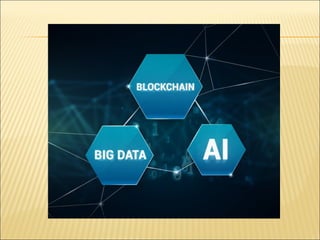
Blockchain is essentially a new
filing system for digital
information, which stores data in an
encrypted, distributed ledger
format.
Because data is encrypted and
distributed across many different
computers, it enables the creation of
tamper-proof, highly robust
databases which can be read and
updated only by those with
permission
USE OF AI IN SHIPPING
The use of AI in shipping is
limitless. They can use new
algorithms to mitigate security
risks, ensure better compliance
with new regulations and
improve the cost-effectiveness of
their operations.
Microsoft Research Asia
(MSRA), and Orient Overseas
Container Line Limited
(OOCL) announced their
partnership in applying Artificial
Intelligence research to improve
network operations and achieve
efficiencies within the shipping
industry.
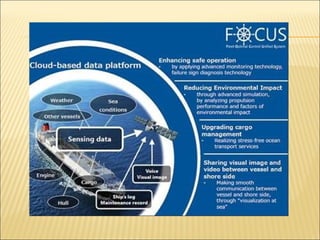
Mitsui OSK Lines (MOL) has
launched the ‘FOCUS’ project
along with Mitsui E & A
shipbuilding and Weathernews to
harness the application of AI and
IOT in predicting weather and
redefining shipping routes.
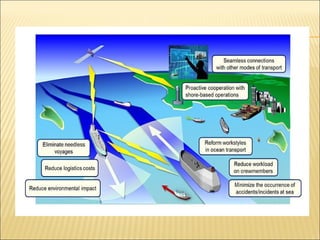
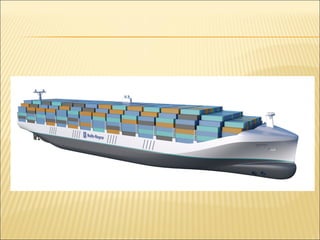
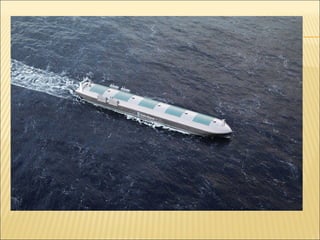
 Rolls Royce is collaborating with
Intel to design futuristic ships,
based on AI and IOT, which will
make shipping safer, more efficient
and faster. Sophisticated ship
technology is being utilized with a
focus on safety with the help of
Artificial Intelligence
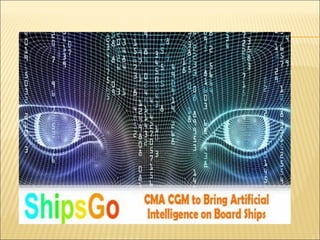
 French shipping company CMA
CGM has teamed up with San
Francisco-based startup Shone to
embed artificial intelligence on board
ships. Through the collaboration,
launched at the beginning of the
year, Shone is to access the company’s
vessels to finalize the development of
AI aboard.
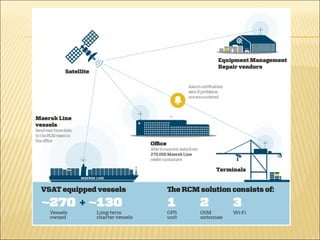
 Maersk Line is the largest
shipping company globally, is
trying to introduce more data-
driven technology into its
shipping containers is
with Remote Container
Management.
 By installing nothing more than a
modem, GPS, and a wireless SIM
card with a satellite link at global
scale, Maersk technicians are able to
see the precise location and
operational details of 270,000
refrigerated ‘reefer’ containers full of
perishable commodities thanks to the
Internet of Things (IOT).
 JRCS
 Self navigating ships are the future. As
they ply the ocean autonomously their
“digital captains” are far away on dry
land, keeping watch remotely with
Mixed Reality (MR) and artificial
intelligence (AI) technologies. JRCS -
a major Japanese maritime services
company – believes it can make this a
reality within the next 12 years.
 With the help of Microsoft, it has just
launched an ambitious plan to digitally
transform the global shipping industry.
In a series of initial steps, JRCS is
deploying MR, the Internet of Things
(IoT), and AI to change how shipping
crews are trained, how ships are
maintained, and how navigational
safety and standards are promoted and
enforced.
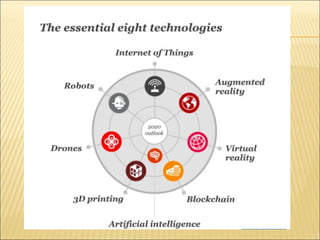
 Augmented reality (AR) adds
digital elements to a live view
often by using the camera on a
smartphone. Examples of
augmented reality experiences
include Snapchat lenses and the
game Pokemon Go. 
AR is technology that superimposes
a computer-generated image on a
user's view of the real world, thus
providing a composite view.
 Virtual reality (VR) implies a
complete immersion experience that
shuts out the physical world. Using VR
devices such as HTC Vive, Oculus Rift
or Google Cardboard, users can be
transported into a number of real-world
and imagined environments such as the
middle of a squawking penguin colony
or even the back of a dragon.
 Virtual reality (VR) is an
interactive computer-generated
experience taking place within a
simulated environment. It
incorporates mainly auditory and
visual feedback
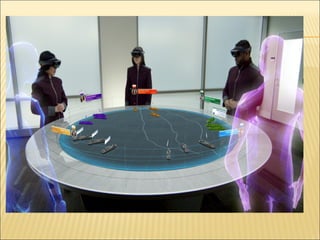
 In a mixed reality MR) experience,
which combines elements of both
AR and VR, real-world and digital
objects interact. Mixed reality
technology is just now starting to
take off with Microsoft’s HoloLens
one of the most notable early mixed
reality apparatuses.
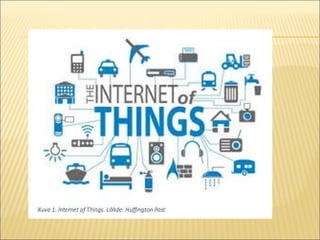
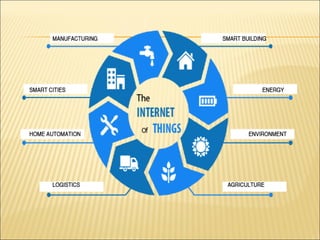
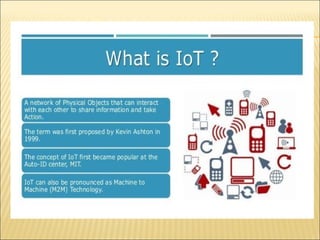
 What is the Internet of Things?
The term IoT encompasses everything
connected to the internet, but it is
increasingly being used to define
objects that "talk" to each other.
"Simply, the Internet of Things is made
up of devices – from simple sensors to
smartphones and wearables – connected
together," Matthew Evans, the IoT
programme head at techUK, says.
 By combining these connected
devices with automated systems, it
is possible to "gather information,
analyse it and create an action" to
help with a particular task, or learn
from a process. In reality, this
ranges from smart
mirrors to beacons in shops and
beyond.
 In IoT, the devices are given a fixed
set of commands like
 switch of the lights when a person
leaves the room.(let's say
communication between a light and
a wearable device on the person
based on GPS)
 Open the garage door when
a particular car approaches.
(communication between a sensor
1 on garage door and a sensor 2
on the car)
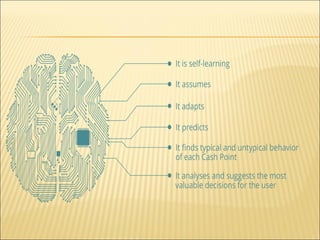
 In AI, a machine will be equipped
with a learning mechanism and a
neutral network something similar
to a Brain.
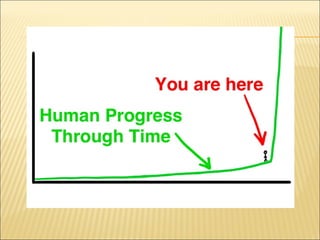
In conclusion we can say that AI and
IOT will surely change the world.
However the following is to be noted;
1.Employment opportunities will not
decrease with AI
2.Robots will not take over the world
and enslave us !!
1. Robots for disaster management
2. Smart Homes and Offices.
3. Fully autonomous cars and ships
having the edge of AI
4. The threat of unpredictable
superhuman abilities
5. Cyborg technology
6. Smart computers to solve climate
change problem
7. Using robots for war
8. Holographic Projections
9.Embedded chips in the human
body
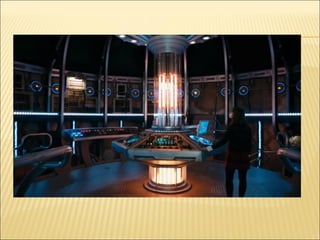
10. Space travel
11. Robotic colonies in space
followed by human colonies
12. TIME TRAVEL
I would like to thank Google,
Wikepedia, and the many pages and
images on the net and elsewhere
from where I have sourced the
material for this presentation.
Season’s Greetings to all of you.
THANK YOU FOR YOUR
ATTENTION

Art intelligence

  • 1.
  • 2.
     ARTIFICIAL INTELLIGENCE ANDITS IMPACT ON GLOBAL SHIPPING  Capt Ashok Menon
  • 4.
     The fatherof Artificial intelligence, John McCarthy has described it as “ the science and engineering of making intelligent machines, especially intelligent computer programmes.”  It is designing machines that can think like human beings and can have its own intelligence
  • 6.
     According toa report from three Chinese researchers which aimed to compare the intelligence of various AI systems, Google's AI had an IQ of 47.3, ahead of Chinese search engine Baidu (33), Microsoft's Bing (32), and Siri (24).
  • 7.
     But whileGoogle's AI leads the tech pack, it has a long way to go before it comes close to human intelligence; the average 6-year-old has an IQ of 55.5, according to the report.
  • 9.
    Advantages of ArtIntelligence Less Errors: As decisions are taken on previously gathered information and certain algorithms, without the interference of humans, so errors are reduced and the chance of reaching accuracy with a greater degree of precision is a possibility.
  • 10.
    No Emotions: Thecomplete absence of emotions makes machines to think logically and take right decision where in humans emotions are associated with moods that can affect human efficiency. Complete absence of emotions make machines to take right decisions.
  • 11.
    Medical Applications: Increasing theintegration of A.I. tools in every day medical applications could improve the efficiency of treatments and avoid cost by minimizing the risk of false diagnosis.
  • 12.
    AI has beguntransforming the field of surgical robotics wherein it has enabled the advent of robots that perform semi-automated surgical tasks with efficiency.
  • 15.
    Disadvantages of Artificial Intelligence HighCosts: Can cost a lot of money and time to build, rebuild, and repair. Machines need repairing and maintenance which need plenty of cost.
  • 16.
    Unemployment: The increasing numberof machines leading to unemployment and job security issues. As machines are replacing human resources, the rate of people losing their jobs will increase. Because machines can work 24*7 with no break, which is more beneficial of industries.
  • 17.
    Can’t think outof box: They cannot work outside of what they were programmed for. They could never, or, at least, seemingly never with our technological perceptions, recieve creativity that humans have.
  • 18.
    Dependency on machines:As seen partially with smartphones and other technology already, humans can become too dependent on AI and lose their mental capacities.
  • 21.
    Blockchain is essentiallya new filing system for digital information, which stores data in an encrypted, distributed ledger format.
  • 22.
    Because data isencrypted and distributed across many different computers, it enables the creation of tamper-proof, highly robust databases which can be read and updated only by those with permission
  • 24.
    USE OF AIIN SHIPPING The use of AI in shipping is limitless. They can use new algorithms to mitigate security risks, ensure better compliance with new regulations and improve the cost-effectiveness of their operations.
  • 25.
    Microsoft Research Asia (MSRA),and Orient Overseas Container Line Limited (OOCL) announced their partnership in applying Artificial Intelligence research to improve network operations and achieve efficiencies within the shipping industry.
  • 26.
    Mitsui OSK Lines(MOL) has launched the ‘FOCUS’ project along with Mitsui E & A shipbuilding and Weathernews to harness the application of AI and IOT in predicting weather and redefining shipping routes.
  • 30.
     Rolls Royceis collaborating with Intel to design futuristic ships, based on AI and IOT, which will make shipping safer, more efficient and faster. Sophisticated ship technology is being utilized with a focus on safety with the help of Artificial Intelligence
  • 33.
     French shippingcompany CMA CGM has teamed up with San Francisco-based startup Shone to embed artificial intelligence on board ships. Through the collaboration, launched at the beginning of the year, Shone is to access the company’s vessels to finalize the development of AI aboard.
  • 35.
     Maersk Lineis the largest shipping company globally, is trying to introduce more data- driven technology into its shipping containers is with Remote Container Management.
  • 36.
     By installingnothing more than a modem, GPS, and a wireless SIM card with a satellite link at global scale, Maersk technicians are able to see the precise location and operational details of 270,000 refrigerated ‘reefer’ containers full of perishable commodities thanks to the Internet of Things (IOT).
  • 38.
     JRCS  Selfnavigating ships are the future. As they ply the ocean autonomously their “digital captains” are far away on dry land, keeping watch remotely with Mixed Reality (MR) and artificial intelligence (AI) technologies. JRCS - a major Japanese maritime services company – believes it can make this a reality within the next 12 years.
  • 39.
     With thehelp of Microsoft, it has just launched an ambitious plan to digitally transform the global shipping industry. In a series of initial steps, JRCS is deploying MR, the Internet of Things (IoT), and AI to change how shipping crews are trained, how ships are maintained, and how navigational safety and standards are promoted and enforced.
  • 40.
     Augmented reality(AR) adds digital elements to a live view often by using the camera on a smartphone. Examples of augmented reality experiences include Snapchat lenses and the game Pokemon Go. 
  • 41.
    AR is technologythat superimposes a computer-generated image on a user's view of the real world, thus providing a composite view.
  • 42.
     Virtual reality(VR) implies a complete immersion experience that shuts out the physical world. Using VR devices such as HTC Vive, Oculus Rift or Google Cardboard, users can be transported into a number of real-world and imagined environments such as the middle of a squawking penguin colony or even the back of a dragon.
  • 43.
     Virtual reality(VR) is an interactive computer-generated experience taking place within a simulated environment. It incorporates mainly auditory and visual feedback
  • 44.
     In amixed reality MR) experience, which combines elements of both AR and VR, real-world and digital objects interact. Mixed reality technology is just now starting to take off with Microsoft’s HoloLens one of the most notable early mixed reality apparatuses.
  • 47.
     What isthe Internet of Things? The term IoT encompasses everything connected to the internet, but it is increasingly being used to define objects that "talk" to each other. "Simply, the Internet of Things is made up of devices – from simple sensors to smartphones and wearables – connected together," Matthew Evans, the IoT programme head at techUK, says.
  • 48.
     By combiningthese connected devices with automated systems, it is possible to "gather information, analyse it and create an action" to help with a particular task, or learn from a process. In reality, this ranges from smart mirrors to beacons in shops and beyond.
  • 51.
     In IoT,the devices are given a fixed set of commands like  switch of the lights when a person leaves the room.(let's say communication between a light and a wearable device on the person based on GPS)
  • 52.
     Open thegarage door when a particular car approaches. (communication between a sensor 1 on garage door and a sensor 2 on the car)  In AI, a machine will be equipped with a learning mechanism and a neutral network something similar to a Brain.
  • 54.
    In conclusion wecan say that AI and IOT will surely change the world. However the following is to be noted; 1.Employment opportunities will not decrease with AI 2.Robots will not take over the world and enslave us !!
  • 55.
    1. Robots fordisaster management 2. Smart Homes and Offices. 3. Fully autonomous cars and ships having the edge of AI 4. The threat of unpredictable superhuman abilities
  • 56.
    5. Cyborg technology 6.Smart computers to solve climate change problem 7. Using robots for war 8. Holographic Projections 9.Embedded chips in the human body
  • 57.
    10. Space travel 11.Robotic colonies in space followed by human colonies 12. TIME TRAVEL
  • 59.
    I would liketo thank Google, Wikepedia, and the many pages and images on the net and elsewhere from where I have sourced the material for this presentation.
  • 60.
  • 61.
    THANK YOU FORYOUR ATTENTION