Leadership Workshop ASME Student Leadership Training Seminar
Agenda Items What is Leadership? Are Leaders Born or Made? Examples of Good Leaders Leadership 101 Sources of Conflict Leadership Principles Leadership Cycle and Four Major Factors The Most Important Words Closing Comments For More Information
What is Leadership? Leadership is a process by which a person influences others to accomplish an objective and directs the organization in a way that makes it more cohesive and coherent.  © ASME International
Are Leaders Born or Made? Good leaders are  made  not born. If you have the desire and willpower, you can become an effective leader. Good leaders develop through a never ending process of self-study, education, training, and experience. © ASME International
Good Leaders Do you have some examples of good leaders? What qualities made them good leaders? © ASME International
Leadership 101 Becoming an effective leader is not easy Part skill development Part experience Remember, Leadership is Action, not Position Power  does not make you a leader...it simply makes you the  boss How do YOU become an effective leader? No “cookbook formula” Situational, as well as individual
Sources of Human Conflict (there is a cause to every difficulty) Inconsistent Dishonest Inflexible Afraid to make decision Poor communicator Isn’t punctual Doesn’t “step up” to situation Unreasonable Self-interest over others Superiority viewpoint Fails to use empathy Self-centered Lack of trust Unrealistic expectations Doesn’t share recognition Duplicitous “ forgets” commitments Doesn’t care Isn’t accountable Refuses to admit errors Doesn’t listen Lacks enthusiasm Lacks respect for others
Leadership Principles A Principle is a “Tested form of Action”, proven useful in the skill of leadership In isolation, principles are ineffective - must be applied based on the situation Help identify root cause of conflict guidelines to find mutually beneficial solutions Seek to understand the sources of conflict within a team, and find win-win solutions
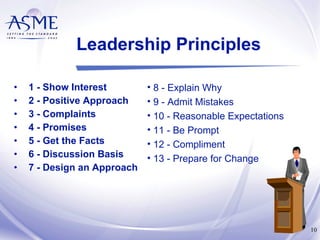
Leadership Principles 1 - Show Interest 2 - Positive Approach 3 - Complaints 4 - Promises 5 - Get the Facts 6 - Discussion Basis 7 - Design an Approach 8 - Explain Why 9 - Admit Mistakes 10 - Reasonable Expectations 11 - Be Prompt 12 - Compliment 13 - Prepare for Change
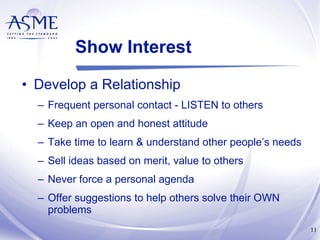
Show Interest Develop a Relationship Frequent personal contact - LISTEN to others Keep an open and honest attitude Take time to learn & understand other people’s needs Sell ideas based on merit, value to others Never force a personal agenda Offer suggestions to help others solve their OWN problems
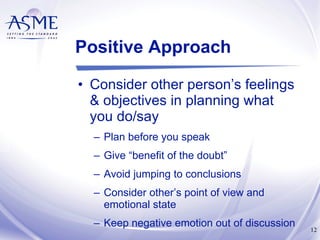
Positive Approach Consider other person’s feelings & objectives in planning what you do/say Plan before you speak Give “benefit of the doubt” Avoid jumping to conclusions Consider other’s point of view and emotional state Keep negative emotion out of discussion
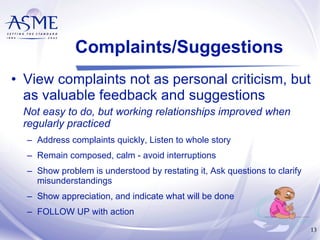
Complaints/Suggestions View complaints not as personal criticism, but as valuable feedback and suggestions Not easy to do, but working relationships improved when regularly practiced Address complaints quickly, Listen to whole story Remain composed, calm - avoid interruptions Show problem is understood by restating it, Ask questions to clarify misunderstandings Show appreciation, and indicate what will be done FOLLOW UP with action
Promises Make few promises, and keep them! Credibility lost when leadership fails to keep promises  Ensure commitment is realistic and attainable Keep stakeholders informed of progress If situations change, and promise cannot be kept: Immediately contact those affected, avoid rumors Explain carefully and thoroughly the reasons Allow free feedback, consider others Follow up with mutually agreed corrective actions
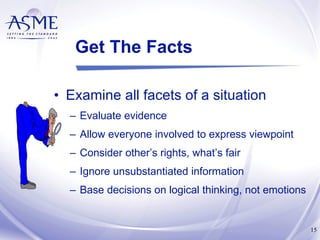
Get The Facts Examine all facets of a situation Evaluate evidence Allow everyone involved to express viewpoint Consider other’s rights, what’s fair Ignore unsubstantiated information Base decisions on logical thinking, not emotions
Discussion Basis Keep it a business-like discussion Stick to the subject Listen respectfully Avoid getting hung up on personalities Grant that other person “may have something” Do not loose temper Plan the time and place for the discussion
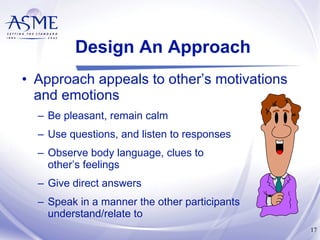
Design An Approach Approach appeals to other’s motivations and emotions Be pleasant, remain calm Use questions, and listen to responses Observe body language, clues to  other’s feelings Give direct answers Speak in a manner the other participants understand/relate to
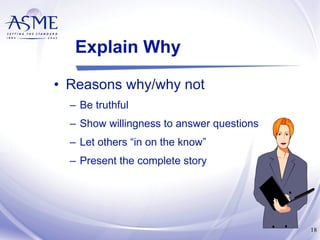
Explain Why Reasons why/why not Be truthful Show willingness to answer questions Let others “in on the know” Present the complete story
Admit Mistakes Recognize no one is perfect Natural tendency is to avoid sharing or rationalizing a mistake No mistakes => is employee or leader really doing anything?  At least not taking risks Determine who is affected by mistake, and if any corrective action needed  Recognize mistake was made, regardless of how discovered.  Show mistakes are learning opportunities Document “lessons learned” for each project
Reasonable Expectations Present fair/realistic expectations Listen completely to any objections Restate objections, outlining competing positions and underlying reasoning Use illustrations and examples Present complete picture, and rationale for subsequent decision
Be Prompt Be responsive to situations / issues Does not mean need to always act immediately Be consistent, use a structured problem solving technique Base decisions on facts, if this takes time promptly acknowledge understanding of situation Let others know what is going on Allow others to assist, give choices of alternatives Always follow up!
Compliment Always give recognition where deserved Ensure sincere and consistent Understand each person is an individual, tailor recognition to be meaningful to the person   Recognition can be simple, a note of thanks Decide whether best kept personal or public Give commendation for special accomplishments & efforts Do not overlook contributions, especially if others recognition is public
Prepare For Changes Prepare others in advance for changes affecting them Change is threatening!  And a fact of modern life Review impending change, determine effect on others Determine what/how much information should be disseminated Understand and explain reasons for change Select right time, forum for communications Promptly publicize news Listen & respond to questions, suggestions
Teamwork Doesn’t  Just Happen Takes time, effort to establish effective team Good experience gained by contributing in a volunteer professional society, such as ASME Very similar to modern industry project teams Team leader often not “the boss” Project teams pulled together, cross-functional skills quickly focused on objective Typical that members are on other teams (other jobs) Team disbanded after completion Leader needs to motivate and enable/empower Team needs to share responsibility, accountability, and recognition for “deliverables”
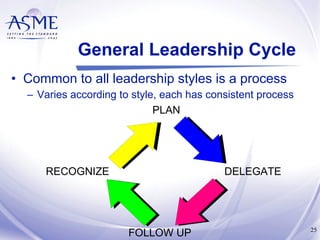
General Leadership Cycle Common to all leadership styles is a process Varies according to style, each has consistent process PLAN DELEGATE FOLLOW UP RECOGNIZE
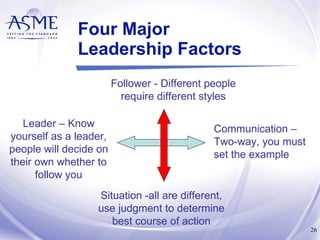
Four Major  Leadership Factors Follower - Different people require different styles Communication – Two-way, you must set the example Situation -all are different, use judgment to determine best course of action Leader – Know yourself as a leader, people will decide on their own whether to follow you
The Most Important Words The six most important words: "I admit I made a mistake." The five most important words: "You did a good job." The four most important words: "What is your opinion." The three most important words: "If you please." The two most important words: "Thank you," The one most important word: "We" The least most important word: "I" - Author unknown
Pick a Project – And Put Your Skills to the Test COMPANY TOUR MONTHLY MEETING FIELD TRIP PICNIC PANEL DISCUSSION OTHERS
Closing Comments Plan and Do! You learn from the experience Don’t be afraid of mistakes Make decisions with participation, and data As a leader, you have responsibilities to others BE DECISIVE
For More Information ASME’s Professional Practice Curriculum http://www.professionalpractice.asme.org/ Online Training Modules: Leadership Principles Leadership Styles and Attributes Teambuilding
 

Leadership

  • 2.
    Leadership Workshop ASMEStudent Leadership Training Seminar
  • 3.
    Agenda Items Whatis Leadership? Are Leaders Born or Made? Examples of Good Leaders Leadership 101 Sources of Conflict Leadership Principles Leadership Cycle and Four Major Factors The Most Important Words Closing Comments For More Information
  • 4.
    What is Leadership?Leadership is a process by which a person influences others to accomplish an objective and directs the organization in a way that makes it more cohesive and coherent. © ASME International
  • 5.
    Are Leaders Bornor Made? Good leaders are made not born. If you have the desire and willpower, you can become an effective leader. Good leaders develop through a never ending process of self-study, education, training, and experience. © ASME International
  • 6.
    Good Leaders Doyou have some examples of good leaders? What qualities made them good leaders? © ASME International
  • 7.
    Leadership 101 Becomingan effective leader is not easy Part skill development Part experience Remember, Leadership is Action, not Position Power does not make you a leader...it simply makes you the boss How do YOU become an effective leader? No “cookbook formula” Situational, as well as individual
  • 8.
    Sources of HumanConflict (there is a cause to every difficulty) Inconsistent Dishonest Inflexible Afraid to make decision Poor communicator Isn’t punctual Doesn’t “step up” to situation Unreasonable Self-interest over others Superiority viewpoint Fails to use empathy Self-centered Lack of trust Unrealistic expectations Doesn’t share recognition Duplicitous “ forgets” commitments Doesn’t care Isn’t accountable Refuses to admit errors Doesn’t listen Lacks enthusiasm Lacks respect for others
  • 9.
    Leadership Principles APrinciple is a “Tested form of Action”, proven useful in the skill of leadership In isolation, principles are ineffective - must be applied based on the situation Help identify root cause of conflict guidelines to find mutually beneficial solutions Seek to understand the sources of conflict within a team, and find win-win solutions
  • 10.
    Leadership Principles 1- Show Interest 2 - Positive Approach 3 - Complaints 4 - Promises 5 - Get the Facts 6 - Discussion Basis 7 - Design an Approach 8 - Explain Why 9 - Admit Mistakes 10 - Reasonable Expectations 11 - Be Prompt 12 - Compliment 13 - Prepare for Change
  • 11.
    Show Interest Developa Relationship Frequent personal contact - LISTEN to others Keep an open and honest attitude Take time to learn & understand other people’s needs Sell ideas based on merit, value to others Never force a personal agenda Offer suggestions to help others solve their OWN problems
  • 12.
    Positive Approach Considerother person’s feelings & objectives in planning what you do/say Plan before you speak Give “benefit of the doubt” Avoid jumping to conclusions Consider other’s point of view and emotional state Keep negative emotion out of discussion
  • 13.
    Complaints/Suggestions View complaintsnot as personal criticism, but as valuable feedback and suggestions Not easy to do, but working relationships improved when regularly practiced Address complaints quickly, Listen to whole story Remain composed, calm - avoid interruptions Show problem is understood by restating it, Ask questions to clarify misunderstandings Show appreciation, and indicate what will be done FOLLOW UP with action
  • 14.
    Promises Make fewpromises, and keep them! Credibility lost when leadership fails to keep promises Ensure commitment is realistic and attainable Keep stakeholders informed of progress If situations change, and promise cannot be kept: Immediately contact those affected, avoid rumors Explain carefully and thoroughly the reasons Allow free feedback, consider others Follow up with mutually agreed corrective actions
  • 15.
    Get The FactsExamine all facets of a situation Evaluate evidence Allow everyone involved to express viewpoint Consider other’s rights, what’s fair Ignore unsubstantiated information Base decisions on logical thinking, not emotions
  • 16.
    Discussion Basis Keepit a business-like discussion Stick to the subject Listen respectfully Avoid getting hung up on personalities Grant that other person “may have something” Do not loose temper Plan the time and place for the discussion
  • 17.
    Design An ApproachApproach appeals to other’s motivations and emotions Be pleasant, remain calm Use questions, and listen to responses Observe body language, clues to other’s feelings Give direct answers Speak in a manner the other participants understand/relate to
  • 18.
    Explain Why Reasonswhy/why not Be truthful Show willingness to answer questions Let others “in on the know” Present the complete story
  • 19.
    Admit Mistakes Recognizeno one is perfect Natural tendency is to avoid sharing or rationalizing a mistake No mistakes => is employee or leader really doing anything? At least not taking risks Determine who is affected by mistake, and if any corrective action needed Recognize mistake was made, regardless of how discovered. Show mistakes are learning opportunities Document “lessons learned” for each project
  • 20.
    Reasonable Expectations Presentfair/realistic expectations Listen completely to any objections Restate objections, outlining competing positions and underlying reasoning Use illustrations and examples Present complete picture, and rationale for subsequent decision
  • 21.
    Be Prompt Beresponsive to situations / issues Does not mean need to always act immediately Be consistent, use a structured problem solving technique Base decisions on facts, if this takes time promptly acknowledge understanding of situation Let others know what is going on Allow others to assist, give choices of alternatives Always follow up!
  • 22.
    Compliment Always giverecognition where deserved Ensure sincere and consistent Understand each person is an individual, tailor recognition to be meaningful to the person Recognition can be simple, a note of thanks Decide whether best kept personal or public Give commendation for special accomplishments & efforts Do not overlook contributions, especially if others recognition is public
  • 23.
    Prepare For ChangesPrepare others in advance for changes affecting them Change is threatening! And a fact of modern life Review impending change, determine effect on others Determine what/how much information should be disseminated Understand and explain reasons for change Select right time, forum for communications Promptly publicize news Listen & respond to questions, suggestions
  • 24.
    Teamwork Doesn’t Just Happen Takes time, effort to establish effective team Good experience gained by contributing in a volunteer professional society, such as ASME Very similar to modern industry project teams Team leader often not “the boss” Project teams pulled together, cross-functional skills quickly focused on objective Typical that members are on other teams (other jobs) Team disbanded after completion Leader needs to motivate and enable/empower Team needs to share responsibility, accountability, and recognition for “deliverables”
  • 25.
    General Leadership CycleCommon to all leadership styles is a process Varies according to style, each has consistent process PLAN DELEGATE FOLLOW UP RECOGNIZE
  • 26.
    Four Major Leadership Factors Follower - Different people require different styles Communication – Two-way, you must set the example Situation -all are different, use judgment to determine best course of action Leader – Know yourself as a leader, people will decide on their own whether to follow you
  • 27.
    The Most ImportantWords The six most important words: "I admit I made a mistake." The five most important words: "You did a good job." The four most important words: "What is your opinion." The three most important words: "If you please." The two most important words: "Thank you," The one most important word: "We" The least most important word: "I" - Author unknown
  • 28.
    Pick a Project– And Put Your Skills to the Test COMPANY TOUR MONTHLY MEETING FIELD TRIP PICNIC PANEL DISCUSSION OTHERS
  • 29.
    Closing Comments Planand Do! You learn from the experience Don’t be afraid of mistakes Make decisions with participation, and data As a leader, you have responsibilities to others BE DECISIVE
  • 30.
    For More InformationASME’s Professional Practice Curriculum http://www.professionalpractice.asme.org/ Online Training Modules: Leadership Principles Leadership Styles and Attributes Teambuilding
  • 31.

Editor's Notes

  • #5 GM Welcome Get RAC off to rousing start.
  • #6 GM Welcome Get RAC off to rousing start.
  • #7 GM Welcome Get RAC off to rousing start.
  • #10 We will review a dozen or so basics Principles- “ A Tested Form Of Action” Can Be Many Different Ones We Have Listed Several Need To Practice Them As a leader-you will have a need to act/re-act to every situation These are some that will happen and a surveyed method of dealing with them that has a track record of success
  • #11 We will review a dozen or so basics Principles- “ A Tested Form Of Action” Can Be Many Different Ones We Have Listed Several Need To Practice Them As a leader-you will have a need to act/re-act to every situation These are some that will happen and a surveyed method of dealing with them that has a track record of success
  • #12 Show Interest 1. Make Frequent Contact With Others To Get Their Viewpoints 2. Develop An Open Attitude To Other Ideas 3. Completely Honest-regardless!!! 4. Sell Your Ideas To Others Based On Their Viewpoints-do Not Force Your Ideas 5. Take Time To Learn More About Others 6. Offer Suggestions To Others To Help Them Solve Heir Problems
  • #13 Design Your Approach To Be Positive 1. Consider The Other Person- Put Yourself In Their Place Treat Them Like You Want To Be Treated Learn More About That Person 2. Pay Strict Attention To What Is To Be Said 3. Consider The Other Persons State Of Mind And Reduce Any Negative Feelings 4. Know The People Involved-plan Your Approach Based On This Knowledge.
  • #14 1. Handle Complaints Quickly Or As Soon As Possible 2. Listen Thoughtfully To Whole Story 3. Try To Avoid Interruptions- Step A Side Go To Different Room 4. Ask Questions To Clarify Any Misunderstanding 5. Restate The Problem To Show Understanding 6. Indicate What Action Will Be Taken 7. Follow Up To Ensure Complete Problem Resolution
  • #15 1. Make Only Few Promises And Then Only Those You Can Keep 2. Make Sure Your Promise Is Realistic And Attainable. 3. Keep Your Promise Keep Listener Up To Date With Progress Let Listener Know If Other Things Arise 4. Develop Alternatives
  • #16 Take Time To Get All The Necessary Facts 1. Thoroughly Examine All Facets Of The Situation 2. Evaluate All The Evidence 3. Get Other Opinions-not Necessary To Get All 4. Base Decision On Logic Thought 5. Consider Rights Of Others
  • #17 Reduce Emotions-keep Professional Level 1.Stick To The Subject Probably The Most Important Quality- people Will Love You 2. Listen Intently, Carefully-what Is Not Being Said?-Full Time Job 3. Stay Cool!! !Be Patient, Good Leaders Are!! 4. If Possible Plan The Time , Place 5. Reduce Any Personalities Issues-stay Professional!!!!
  • #18 1. Be Aware Of “Where Other People Are Coming From. What Is Their Agenda? 2. Be Pleasant-not A Grouch-make ASME Fun!! We Can Do Better-But Professional Fun 3. Calm-you Think Better 4. Use Questions To Get All The Facts, Gain Time To Think, And Show Interest 5. Give Direct Answers, Do Not Put “Spins “ On Your Answers. 6. Personality-example: describe your boss in a sentence, “define”. We can’t be something we are not, but know how you came across.
  • #19 1. Truthful-if You Loose Your Credibility -You Have Lost Everything 2. Give The Complete Picture- Do Not Leave Out The Bad Parts, Or Disadvantages-include All Pros And Cons 3. Show Willingness To Answer Questions-sometimes, Due To Time- May Have To Ask The Individual To Wait Until After The Meeting, If They Are The Only One Interested In That Subject.
  • #20 1. Do Not Try To Blame Someone Else-if You Are The Leader -You Are Responsible 2.Recognize The Mistake-and Search For Solutions 3. Determine Who May Be Affected And Tell Them-alert Them-”Houston We Have Problem” 4. Take Corrective Exaction To Solve It 5. Again Do Not Put “Spins” On Solutions Or Answers.
  • #21 Have Reasonable Expectations Of Others. 1. Present Complete Picture-listen To Other Persons Point- 2. Be Fair, Not Partial 3. Use Illustrations And Examples 4. Use Past History- “We Did This Last Year” 5. Make Sure Your Reasoning Is Based On Sound Facts- Make Sure You Have A Clear Understanding With The Other Person On What Is To Be Done
  • #22 When A Problem Or Issue Develops -Step Up To It Do Not Procrastinate 1. Acknowledge The Issue-be Sure There Is A Problem , Make Sure All Facts Are In 3. Use Scientific Reasoning Get Facts Develop Alternatives Evaluate Alternatives Select Solution 4. Seek Others To Participate In The Solution-I.E. This Is A Team
  • #23 Compliment Compliment Compliment You Might Be Able To Overdo It-but I Doubt It 1. Select The Best Method-there Are Several Ways To Do This. Do Publicly Do Not Criticize In Front Of Others!!! 2. Do Not Overlook-Someone Works All Night On A Project And You Do Not Thank Them????? 3. Use Every Chance!!!
  • #24 If There Is A Change Coming----- 1. Determine The Effect-on Others 2. How Much Information Is Needed By Everyone-may Not Need A 2 Hour Detail Presentation 3. Understand The Reasons For The Change And Convey This 4. Announce The Changes-may Need To Get Some Individuals Aside Prior- If They Are Negatively Impacted. Do Not Tell A Person They Are Fired In Front Of A Group 5. Select The Best Time Place 6. Most of what you’ve heard you have heard before -“common sense” Other sources : TI PCC-”HTWFAIP” Steven Covey Zig Ziglar SRO - TC Scott-ASME Management Skills Development Book
  • #25 If There Is A Change Coming----- 1. Determine The Effect-on Others 2. How Much Information Is Needed By Everyone-may Not Need A 2 Hour Detail Presentation 3. Understand The Reasons For The Change And Convey This 4. Announce The Changes-may Need To Get Some Individuals Aside Prior- If They Are Negatively Impacted. Do Not Tell A Person They Are Fired In Front Of A Group 5. Select The Best Time Place 6. Most of what you’ve heard you have heard before -“common sense” Other sources : TI PCC-”HTWFAIP” Steven Covey Zig Ziglar SRO - TC Scott-ASME Management Skills Development Book
  • #26 If There Is A Change Coming----- 1. Determine The Effect-on Others 2. How Much Information Is Needed By Everyone-may Not Need A 2 Hour Detail Presentation 3. Understand The Reasons For The Change And Convey This 4. Announce The Changes-may Need To Get Some Individuals Aside Prior- If They Are Negatively Impacted. Do Not Tell A Person They Are Fired In Front Of A Group 5. Select The Best Time Place 6. Most of what you’ve heard you have heard before -“common sense” Other sources : TI PCC-”HTWFAIP” Steven Covey Zig Ziglar SRO - TC Scott-ASME Management Skills Development Book
  • #27 If There Is A Change Coming----- 1. Determine The Effect-on Others 2. How Much Information Is Needed By Everyone-may Not Need A 2 Hour Detail Presentation 3. Understand The Reasons For The Change And Convey This 4. Announce The Changes-may Need To Get Some Individuals Aside Prior- If They Are Negatively Impacted. Do Not Tell A Person They Are Fired In Front Of A Group 5. Select The Best Time Place 6. Most of what you’ve heard you have heard before -“common sense” Other sources : TI PCC-”HTWFAIP” Steven Covey Zig Ziglar SRO - TC Scott-ASME Management Skills Development Book
  • #28 Information On “Quality Of Leaders Is In The Form Of A Hand Out For You To Read Later.
  • #29 Pick A Project -Select A Project You Want To Lead Others To Do. As Section “Leader” -”Programs” to Increase Membership and Participation -Could Be One Of These And Show Local MES in Your Community What ASME Is About and What It Can Do for Them
  • #30 Do Not “Appear” Indecisive- Think And Plan Ahead And Act Decisively A Poor Leader Will Procrastinate Delay Actions Appear To “Not Know What’s Going On”
  • #31 Do Not “Appear” Indecisive- Think And Plan Ahead And Act Decisively A Poor Leader Will Procrastinate Delay Actions Appear To “Not Know What’s Going On”