Project Management Leadership Alan E. Devney, Jr. PMP
Who am I Senior IT Project Manager  Walt Disney World Special Event Account Manager Sega Gameworks/Namco Cybertainment Regional Director
Today’s Topics What is Leadership Your Role as the Leader Setting Expectations Questions
What is Leadership Leadership  envisions  what the future should look like,  aligns people  with that vision, and  inspires  them to make it happen despite obstacles.  Leadership creates the ability for an organization to rapidly  adapt   to changing business environment. Absence of leadership leaves the organization without the ability to  change and develop . Ironically, a good manager may not necessarily be a good leader because management is a set of processes, which include planning, organizing/staffing, directing/motivating and controlling. Leadership, on the contrary, is about  inspiring  and  empowering .
"A good leader is a person who takes a little more than his share of the blame and a little less than his share of the credit."
Your Role as a Leader
Your Role as the Leader Set the Emotional Tone. Provide the tools your team needs. Know your team members personally. Be unyielding with your expectations. Praise Publicly, Criticize Privately. Provide immediate feedback. Communication Be open to all points of view
Your Role as the Leader - continued You Absorb the Criticism, Stress and Keep it Away from your Team. Clearly lay out your SDLC & the deliverables by resource that need to be created. Find a quick win and celebrate it in a big way.
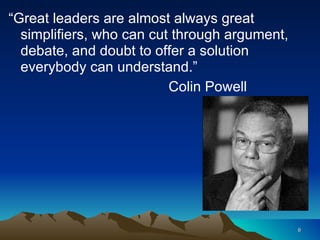
“ Great leaders are almost always great simplifiers, who can cut through argument, debate, and doubt to offer a solution everybody can understand.” Colin Powell
Work Behaviors  Always address the issue of when you have to do a subordinates job for them. Lead the team to build your plan.  Let experts do their job.  Do not dictate. Read your team’s documentation. Keep a folded copy of your project plan in your back pocket all the time. Know your due dates, and your  budget , off the top of you head. Talk directly with your project sponsorship on a regular basis.
Picking Your Team Hire what you can not train. Interview Everyone!  Do not accept assignments. You are looking for team members with a history of getting it done. There are two types of people who work projects: Those you get things done. Those who can always justify why they did not.
“ There is no substitute for CARING for your people.  They have families, problems, goals, dreams. They’re JUST LIKE YOU. They can “feel it” when you CARE. They will give themselves for you if you deserve them. If you don’t really care about your people, they pick it up in a heart beat and they disengage.”
Monkey’s Beware of Monkey’s.  Do not allow your staff to assign their work to you. You will end up doing more of their work and less of your own. You will be seen as an ineffective leader You will be the hardest working person on your team and you will still miss milestones.
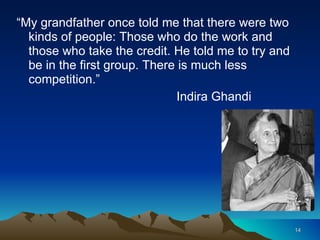
“ My grandfather once told me that there were two kinds of people: Those who do the work and those who take the credit. He told me to try and be in the first group. There is much less competition.” Indira Ghandi
Setting Expectations
‘ We Do Not Know What The Expectations Are, But We Are Pretty Sure You are Not Meeting Them.’
Kick Off Meeting Expectations We are never late due to our own accord. You must   C ommunicate in advance if any Task due date  of any task  t hat  will be late due to outside issues. Any problems you bring to me must be coupled with a potential solution. Sometimes we will need to work late and on week ends. Provide me with FACTS to support you outside the project. All members of team are must speak their mind if they believe the project is making a mistake. Culture and Environment: The Project Affects People and You Affect the Project
Training The most significant way you can set   expectations. Confirms that all members of your team have minimum skills. Training Together Is a Good Team Building Activity.
Reward Your Team Always take care of your team when they have to put in extra hours. Re-enforce positive work behavior as a  cheerleader. Use the names of resources that make significant contributions. Pizza, plagues, shirts, gift certificates. are all good ways to tell your team that you recognize their effort.  Recognize teams & individuals who deliver well against the Project criteria
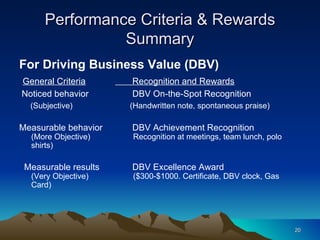
Performance Criteria & Rewards Summary For Driving Business Value (DBV) General Criteria   Recognition and Rewards Noticed behavior   DBV On-the-Spot Recognition (Subjective)   (Handwritten note, spontaneous praise) Measurable behavior   DBV Achievement Recognition  (More Objective)   Recognition at meetings, team lunch, polo shirts) Measurable results   DBV Excellence Award (Very Objective)   ($300-$1000. Certificate, DBV clock, Gas Card)
Performance Criteria & Rewards Summary Cont. Leaders are essential to this process & should: Become familiar with the project performance criteria for On-the-Spot, Achievement, and Excellence recognition.  Actively evaluate project-related performance against the criteria, for projects they sponsor, manage, participate or otherwise have responsibility for. Actively seek to recognize teams and individuals seen worthy of On-the-Spot, Achievement, and Excellence recognition Explain how the individual or team being recognized has met or exceeded the project performance standard.
Never Confuse Activity with Accomplishment Critical Path?
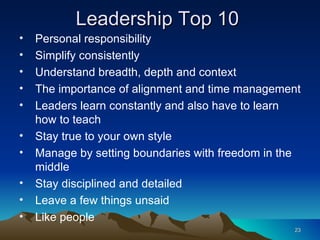
Leadership Top 10 Personal responsibility Simplify consistently Understand breadth, depth and context The importance of alignment and time management Leaders learn constantly and also have to learn how to teach Stay true to your own style Manage by setting boundaries with freedom in the middle Stay disciplined and detailed Leave a few things unsaid Like people
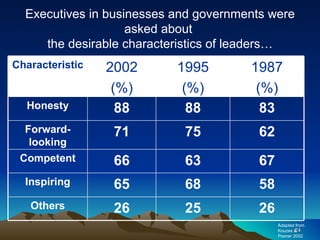
Executives in businesses and governments were asked about  the desirable characteristics of leaders… Adapted from Kouzes & Posner 2002 Characteristic 2002 (%) 1995 (%) 1987 (%) Honesty 88 88 83 Forward-looking 71 75 62 Competent 66 63 67 Inspiring 65 68 58 Others 26 25 26
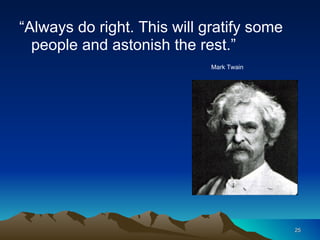
“ Always do right. This will gratify some people and astonish the rest.” Mark Twain
Questions?

Pmi Project Leadership V2

  • 1.
    Project Management LeadershipAlan E. Devney, Jr. PMP
  • 2.
    Who am ISenior IT Project Manager Walt Disney World Special Event Account Manager Sega Gameworks/Namco Cybertainment Regional Director
  • 3.
    Today’s Topics Whatis Leadership Your Role as the Leader Setting Expectations Questions
  • 4.
    What is LeadershipLeadership envisions what the future should look like, aligns people with that vision, and inspires them to make it happen despite obstacles. Leadership creates the ability for an organization to rapidly adapt to changing business environment. Absence of leadership leaves the organization without the ability to change and develop . Ironically, a good manager may not necessarily be a good leader because management is a set of processes, which include planning, organizing/staffing, directing/motivating and controlling. Leadership, on the contrary, is about inspiring and empowering .
  • 5.
    "A good leaderis a person who takes a little more than his share of the blame and a little less than his share of the credit."
  • 6.
    Your Role asa Leader
  • 7.
    Your Role asthe Leader Set the Emotional Tone. Provide the tools your team needs. Know your team members personally. Be unyielding with your expectations. Praise Publicly, Criticize Privately. Provide immediate feedback. Communication Be open to all points of view
  • 8.
    Your Role asthe Leader - continued You Absorb the Criticism, Stress and Keep it Away from your Team. Clearly lay out your SDLC & the deliverables by resource that need to be created. Find a quick win and celebrate it in a big way.
  • 9.
    “ Great leadersare almost always great simplifiers, who can cut through argument, debate, and doubt to offer a solution everybody can understand.” Colin Powell
  • 10.
    Work Behaviors Always address the issue of when you have to do a subordinates job for them. Lead the team to build your plan. Let experts do their job. Do not dictate. Read your team’s documentation. Keep a folded copy of your project plan in your back pocket all the time. Know your due dates, and your budget , off the top of you head. Talk directly with your project sponsorship on a regular basis.
  • 11.
    Picking Your TeamHire what you can not train. Interview Everyone! Do not accept assignments. You are looking for team members with a history of getting it done. There are two types of people who work projects: Those you get things done. Those who can always justify why they did not.
  • 12.
    “ There isno substitute for CARING for your people. They have families, problems, goals, dreams. They’re JUST LIKE YOU. They can “feel it” when you CARE. They will give themselves for you if you deserve them. If you don’t really care about your people, they pick it up in a heart beat and they disengage.”
  • 13.
    Monkey’s Beware ofMonkey’s. Do not allow your staff to assign their work to you. You will end up doing more of their work and less of your own. You will be seen as an ineffective leader You will be the hardest working person on your team and you will still miss milestones.
  • 14.
    “ My grandfatheronce told me that there were two kinds of people: Those who do the work and those who take the credit. He told me to try and be in the first group. There is much less competition.” Indira Ghandi
  • 15.
  • 16.
    ‘ We DoNot Know What The Expectations Are, But We Are Pretty Sure You are Not Meeting Them.’
  • 17.
    Kick Off MeetingExpectations We are never late due to our own accord. You must C ommunicate in advance if any Task due date of any task t hat will be late due to outside issues. Any problems you bring to me must be coupled with a potential solution. Sometimes we will need to work late and on week ends. Provide me with FACTS to support you outside the project. All members of team are must speak their mind if they believe the project is making a mistake. Culture and Environment: The Project Affects People and You Affect the Project
  • 18.
    Training The mostsignificant way you can set expectations. Confirms that all members of your team have minimum skills. Training Together Is a Good Team Building Activity.
  • 19.
    Reward Your TeamAlways take care of your team when they have to put in extra hours. Re-enforce positive work behavior as a cheerleader. Use the names of resources that make significant contributions. Pizza, plagues, shirts, gift certificates. are all good ways to tell your team that you recognize their effort. Recognize teams & individuals who deliver well against the Project criteria
  • 20.
    Performance Criteria &Rewards Summary For Driving Business Value (DBV) General Criteria Recognition and Rewards Noticed behavior DBV On-the-Spot Recognition (Subjective) (Handwritten note, spontaneous praise) Measurable behavior DBV Achievement Recognition (More Objective) Recognition at meetings, team lunch, polo shirts) Measurable results DBV Excellence Award (Very Objective) ($300-$1000. Certificate, DBV clock, Gas Card)
  • 21.
    Performance Criteria &Rewards Summary Cont. Leaders are essential to this process & should: Become familiar with the project performance criteria for On-the-Spot, Achievement, and Excellence recognition. Actively evaluate project-related performance against the criteria, for projects they sponsor, manage, participate or otherwise have responsibility for. Actively seek to recognize teams and individuals seen worthy of On-the-Spot, Achievement, and Excellence recognition Explain how the individual or team being recognized has met or exceeded the project performance standard.
  • 22.
    Never Confuse Activitywith Accomplishment Critical Path?
  • 23.
    Leadership Top 10Personal responsibility Simplify consistently Understand breadth, depth and context The importance of alignment and time management Leaders learn constantly and also have to learn how to teach Stay true to your own style Manage by setting boundaries with freedom in the middle Stay disciplined and detailed Leave a few things unsaid Like people
  • 24.
    Executives in businessesand governments were asked about the desirable characteristics of leaders… Adapted from Kouzes & Posner 2002 Characteristic 2002 (%) 1995 (%) 1987 (%) Honesty 88 88 83 Forward-looking 71 75 62 Competent 66 63 67 Inspiring 65 68 58 Others 26 25 26
  • 25.
    “ Always doright. This will gratify some people and astonish the rest.” Mark Twain
  • 26.