Leadership
What is leadership?
Leading people
Influencing people
Commanding people
Guiding people
What is leadership?
 Leadership is a role not a position
 Leadership is a process by which a
person:
- Influences others
- Accomplish an objective
- Directs the organization
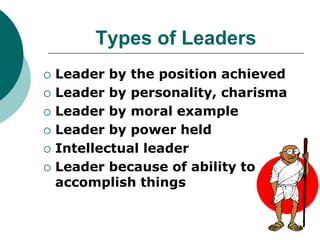
Types of Leaders
 Leader by the position achieved
 Leader by personality, charisma
 Leader by moral example
 Leader by power held
 Intellectual leader
 Leader because of ability to
accomplish things
“A born leader ?”
 Good leaders are made not born
 Good leaders develop Through:
- Self study
- Education
- Training
- Experience
 Good leaders balance results, process
and relationships
A Leader’s Role
 Define what the future should be.
 Set directions.
 Create an environment to make it
happen.
New Leader Traps
 Not learning quickly
 Isolation
 Know-it-all
 Keeping existing team
 Taking on too much
 Successor syndrome
 Captured by wrong people
 Not about you
Manage Oneself
 Be self-aware
 Define your
leadership style
 Get advice and
counsel
 Advice is from
expert to leader
 Counsel is insight
 Types of help
 Technical
 Political
 Personal
 Advisor traits
 Competent
 Trustworthy
 Enhance your status
Create Momentum
 Build credibility
 Demanding but can be satisfied
 Accessible but not too familiar
 Focused but flexible
 Active
 Can make tough calls but humane
Leadership Attributes
Good leaders show success by
applying leadership attributes
such as:
- Beliefs
- Values
- Ethics
- Character
- Knowledge
- Skills
Leadership Attributes
To earn respects as a leader
Followers will not look for attributes
They observe what you do so they:
- know who you really are?
- an honorable and trusted leader?
- self serving person; promote himself?
Leadership Attributes
Self-serving leaders are not as
effective because their employees
only obey them, not follow them
Leadership Attributes
Three important traits of a leader are
always focused on:
- Trust – Gain respect and have ethics
- Confident – have sense of direction by
conveying a strong vision
- Effective Communication:
* help employees understand strategy
* help employee understand how to contribute
* Share information with employees on status
Leadership Attributes
So in a nutshell –
you must be trustworthy and be able to
communicate a vision of where the
organization needs to go.
Leadership Attributes
 So What makes a person want
to follow you as a leader?
People want to be guided by those
they respect and who have a clear
sense of direction. To gain respect,
you must be ethical, and have a
sense of direction by conveying a
strong vision of the future.
Basis of Good Leadership
 The basis of good leadership is
honorable character and selfless
service to your organization.
 In your employees' eyes, your
leadership is about everything you
are (be), know and do.
Principle of Leadership – Be Know Do
 Know yourself and seek self-improvement - In order to
know yourself, you have to understand your be, know, and do,
attributes. Seeking self-improvement means continually
strengthening your attributes. This can be accomplished through
self-study, education, reflection, experience and interacting with
others.
 Be technically proficient - As a leader, you must know your
job and have a solid familiarity with your employees' tasks.
 Seek responsibility and take responsibility for your
actions - Search for ways to guide your organization to new
heights. And when things go wrong, they always do sooner or
later - do not blame others. Analyze the situation, take
corrective action, and move on to the next challenge.
 Make sound and timely decisions - Use good problem
solving, decision making, and planning tools.
 Set the example - Be a good role model for your employees.
Principle of Leadership- Be Know Do
 Know your people and look out for their well-being -
Know human nature and the importance of sincerely caring
for your workers.
 Keep your workers informed - Know how to
communicate with not only them, but also seniors and
other key people.
 Develop a sense of responsibility in your workers -
Help to develop good character traits that will help them
carry out their professional responsibilities.
 Ensure that tasks are understood, supervised, and
accomplished - Communication is the key to this
responsibility.
 Train as a team - Although many so called leaders call
their organization, department, section, etc. a team; they
are not really teams...they are just a group of people doing
their jobs.
 Use the full capabilities of your organization - By
developing a team spirit, you will be able to employ your
organization, department, section, etc. to its fullest
capabilities.
BE
 TECHNICAL EXCELLENCE: Excellent knowledge of
the job and professional expertise, understands the
requirements of chosen field. Stays current. Produces
quality work.
 SUCCESS ORIENTED: Persistent, willing to give extra
effort and initiative. Understands what drives success,
uncovering what is really important to success in any
situation. Does not confuse activity with results.
 PERSONAL ACCOUNTABILITY: Can be counted on;
accomplishes things in a timely manner and on a
consistent basis. Follows through on commitments.
Able to answer for self and others. Does not pass the
buck or make excuses.
 POSITIVE: Constructively looks for ways to meet
objectives. Approach begins with the desired outcome
as a given. Has “can do” enthusiasm toward
assignments and challenges and confidence in others.
BE
 PROACTIVE: Recognizes that by planning ahead they
can be in the best position to influence the outcome.
They do not hesitate to engage to solve problems.
 COLLABORATIVE: Carefully considers who needs to
be involved in situational analysis, effective decision
making, implementation planning, and reassessments
for purposes of getting the best outcome and
development of the people.
 PERSUASIVE: Articulate, confident, clear and
convincing in individual and group discussions and
public presentations.
 OPEN: Flexible, adapts, and seeks input, new ideas,
and learning. Develops creative, imaginative solutions.
BE
 EMPATHY: Sensitivity to others views, needs and
situations. An ability to know what other people want.
 LISTENS WELL: Seeks to understand others through
open dialogue, is susceptible to other’s input and
suggestions, and is patient.
 DEVELOPS OTHERS: Builds teams. Has a sincere
interest in other’s career; creates growth opportunities.
Not arrogant. People feel “in” on things. Has loyal
relationships at all levels.
 TRUSTED: Honest, ethical, candid and fair. Acts at all
times with integrity and explicitly avoids deception,
duplicity or degrading behavior.
 SELF-AWARENESS: Knows their own strengths and
weaknesses and how they come across to others. Is
mindful of their personal impact.
BE
 COURAGE: Takes responsibility for their decisions and
actions. Has the candor to be frank, honest and sincere
with others while keeping the words free from bias,
prejudice or malice.
 LOYALTY: Understands a leader earns loyalty by having
integrity, and being fair, firm and objective and treating
others appropriately. There is loyalty to the organization
and to the individuals themselves.
 JUDGMENT: Able to assess people and situations, to
accurately form opinions based on information,
experience and inference. Makes effective decisions and
follows through on them.
 VISION: Able to determine the right things to do, sound
strategic orientation, providing break-through ideas that
position the firm for success now & in the future, and
enlisting others by drawing on shared aspirations.
KNOW
 KNOW the four factors of leadership - follower,
leader, communication, situation.
 KNOW yourself. Examples: strengths and
weakness of your character, knowledge, and skills.
 KNOW human nature. Examples: Human needs,
emotions, and how people respond to stress.
 KNOW your job. Examples: be proficient and be
able to train others in their tasks.
 KNOW your organization. Examples: where to go
for help, its climate and culture, who the unofficial
leaders are.
DO
 DO provide direction. Examples: goal setting,
problem solving, decision making, planning.
 DO implement. Examples: communicating,
coordinating, supervising, evaluating.
 DO motivate. Examples: develop morale and
esprit de corps in the organization, train, coach,
counsel.
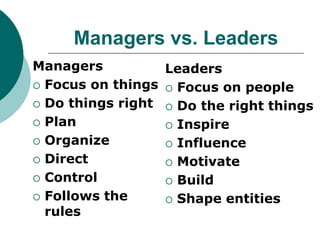
Managers vs. Leaders
Managers
 Focus on things
 Do things right
 Plan
 Organize
 Direct
 Control
 Follows the
rules
Leaders
 Focus on people
 Do the right things
 Inspire
 Influence
 Motivate
 Build
 Shape entities
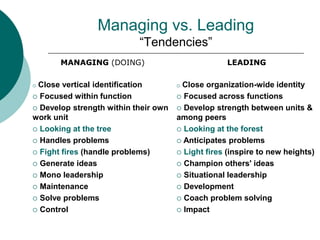
MANAGING (DOING)
 Close vertical identification
 Focused within function
 Develop strength within their own
work unit
 Looking at the tree
 Handles problems
 Fight fires (handle problems)
 Generate ideas
 Mono leadership
 Maintenance
 Solve problems
 Control
LEADING
 Close organization-wide identity
 Focused across functions
 Develop strength between units &
among peers
 Looking at the forest
 Anticipates problems
 Light fires (inspire to new heights)
 Champion others' ideas
 Situational leadership
 Development
 Coach problem solving
 Impact
Managing vs. Leading
“Tendencies”
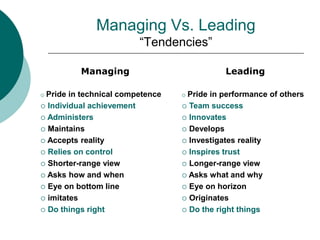
Managing Vs. Leading
“Tendencies”
Managing
 Pride in technical competence
 Individual achievement
 Administers
 Maintains
 Accepts reality
 Relies on control
 Shorter-range view
 Asks how and when
 Eye on bottom line
 imitates
 Do things right
Leading
 Pride in performance of others
 Team success
 Innovates
 Develops
 Investigates reality
 Inspires trust
 Longer-range view
 Asks what and why
 Eye on horizon
 Originates
 Do the right things
Common Activities
 Planning
 Organizing
 Directing
 Controlling
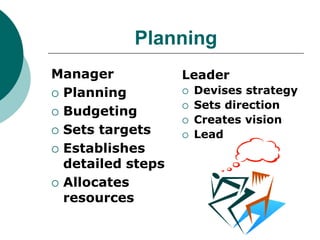
Planning
Manager
 Planning
 Budgeting
 Sets targets
 Establishes
detailed steps
 Allocates
resources
Leader
 Devises strategy
 Sets direction
 Creates vision
 Lead
Organizing
Manager
 Creates
structure
 Job
descriptions
 Staffing
 Hierarchy
 Delegates
 Training
Leader
 Gets people on board
for strategy
 Communication
 Networks
Directing Work
Manager
 Solves
problems
 Negotiates
 Brings to
consensus
Leader
 Empowers
people
 Cheerleader
Controlling
Manager
 Implements
control systems
 Performance
measures
 Identifies
variances
 Fixes variances
Leader
 Motivate
 Inspire
 Gives sense of
accomplishment
The Process of Great Leadership
The road to great leadership that is common to
successful leaders:
 Challenge the process - First, find a process that you
believe needs to be improved the most.
 Inspire a shared vision - Next, share your vision in
words that can be understood by your followers.
 Enable others to act - Give them the tools and
methods to solve the problem.
 Model the way - When the process gets tough, get your
hands dirty. A boss tells others what to do, a leader
shows that it can be done.
 Encourage the heart - Share the glory with your
followers' hearts, while keeping the pains within your
own. Stay positive.
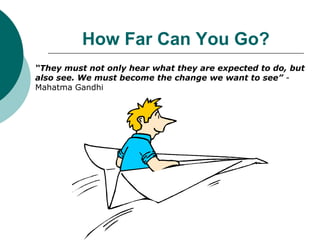
How Far Can You Go?
“They must not only hear what they are expected to do, but
also see. We must become the change we want to see” -
Mahatma Gandhi

Leadership

  • 1.
  • 2.
    What is leadership? Leadingpeople Influencing people Commanding people Guiding people
  • 3.
    What is leadership? Leadership is a role not a position  Leadership is a process by which a person: - Influences others - Accomplish an objective - Directs the organization
  • 4.
    Types of Leaders Leader by the position achieved  Leader by personality, charisma  Leader by moral example  Leader by power held  Intellectual leader  Leader because of ability to accomplish things
  • 5.
    “A born leader?”  Good leaders are made not born  Good leaders develop Through: - Self study - Education - Training - Experience  Good leaders balance results, process and relationships
  • 6.
    A Leader’s Role Define what the future should be.  Set directions.  Create an environment to make it happen.
  • 7.
    New Leader Traps Not learning quickly  Isolation  Know-it-all  Keeping existing team  Taking on too much  Successor syndrome  Captured by wrong people  Not about you
  • 8.
    Manage Oneself  Beself-aware  Define your leadership style  Get advice and counsel  Advice is from expert to leader  Counsel is insight  Types of help  Technical  Political  Personal  Advisor traits  Competent  Trustworthy  Enhance your status
  • 9.
    Create Momentum  Buildcredibility  Demanding but can be satisfied  Accessible but not too familiar  Focused but flexible  Active  Can make tough calls but humane
  • 10.
    Leadership Attributes Good leadersshow success by applying leadership attributes such as: - Beliefs - Values - Ethics - Character - Knowledge - Skills
  • 11.
    Leadership Attributes To earnrespects as a leader Followers will not look for attributes They observe what you do so they: - know who you really are? - an honorable and trusted leader? - self serving person; promote himself?
  • 12.
    Leadership Attributes Self-serving leadersare not as effective because their employees only obey them, not follow them
  • 13.
    Leadership Attributes Three importanttraits of a leader are always focused on: - Trust – Gain respect and have ethics - Confident – have sense of direction by conveying a strong vision - Effective Communication: * help employees understand strategy * help employee understand how to contribute * Share information with employees on status
  • 14.
    Leadership Attributes So ina nutshell – you must be trustworthy and be able to communicate a vision of where the organization needs to go.
  • 15.
    Leadership Attributes  SoWhat makes a person want to follow you as a leader? People want to be guided by those they respect and who have a clear sense of direction. To gain respect, you must be ethical, and have a sense of direction by conveying a strong vision of the future.
  • 16.
    Basis of GoodLeadership  The basis of good leadership is honorable character and selfless service to your organization.  In your employees' eyes, your leadership is about everything you are (be), know and do.
  • 17.
    Principle of Leadership– Be Know Do  Know yourself and seek self-improvement - In order to know yourself, you have to understand your be, know, and do, attributes. Seeking self-improvement means continually strengthening your attributes. This can be accomplished through self-study, education, reflection, experience and interacting with others.  Be technically proficient - As a leader, you must know your job and have a solid familiarity with your employees' tasks.  Seek responsibility and take responsibility for your actions - Search for ways to guide your organization to new heights. And when things go wrong, they always do sooner or later - do not blame others. Analyze the situation, take corrective action, and move on to the next challenge.  Make sound and timely decisions - Use good problem solving, decision making, and planning tools.  Set the example - Be a good role model for your employees.
  • 18.
    Principle of Leadership-Be Know Do  Know your people and look out for their well-being - Know human nature and the importance of sincerely caring for your workers.  Keep your workers informed - Know how to communicate with not only them, but also seniors and other key people.  Develop a sense of responsibility in your workers - Help to develop good character traits that will help them carry out their professional responsibilities.  Ensure that tasks are understood, supervised, and accomplished - Communication is the key to this responsibility.  Train as a team - Although many so called leaders call their organization, department, section, etc. a team; they are not really teams...they are just a group of people doing their jobs.  Use the full capabilities of your organization - By developing a team spirit, you will be able to employ your organization, department, section, etc. to its fullest capabilities.
  • 19.
    BE  TECHNICAL EXCELLENCE:Excellent knowledge of the job and professional expertise, understands the requirements of chosen field. Stays current. Produces quality work.  SUCCESS ORIENTED: Persistent, willing to give extra effort and initiative. Understands what drives success, uncovering what is really important to success in any situation. Does not confuse activity with results.  PERSONAL ACCOUNTABILITY: Can be counted on; accomplishes things in a timely manner and on a consistent basis. Follows through on commitments. Able to answer for self and others. Does not pass the buck or make excuses.  POSITIVE: Constructively looks for ways to meet objectives. Approach begins with the desired outcome as a given. Has “can do” enthusiasm toward assignments and challenges and confidence in others.
  • 20.
    BE  PROACTIVE: Recognizesthat by planning ahead they can be in the best position to influence the outcome. They do not hesitate to engage to solve problems.  COLLABORATIVE: Carefully considers who needs to be involved in situational analysis, effective decision making, implementation planning, and reassessments for purposes of getting the best outcome and development of the people.  PERSUASIVE: Articulate, confident, clear and convincing in individual and group discussions and public presentations.  OPEN: Flexible, adapts, and seeks input, new ideas, and learning. Develops creative, imaginative solutions.
  • 21.
    BE  EMPATHY: Sensitivityto others views, needs and situations. An ability to know what other people want.  LISTENS WELL: Seeks to understand others through open dialogue, is susceptible to other’s input and suggestions, and is patient.  DEVELOPS OTHERS: Builds teams. Has a sincere interest in other’s career; creates growth opportunities. Not arrogant. People feel “in” on things. Has loyal relationships at all levels.  TRUSTED: Honest, ethical, candid and fair. Acts at all times with integrity and explicitly avoids deception, duplicity or degrading behavior.  SELF-AWARENESS: Knows their own strengths and weaknesses and how they come across to others. Is mindful of their personal impact.
  • 22.
    BE  COURAGE: Takesresponsibility for their decisions and actions. Has the candor to be frank, honest and sincere with others while keeping the words free from bias, prejudice or malice.  LOYALTY: Understands a leader earns loyalty by having integrity, and being fair, firm and objective and treating others appropriately. There is loyalty to the organization and to the individuals themselves.  JUDGMENT: Able to assess people and situations, to accurately form opinions based on information, experience and inference. Makes effective decisions and follows through on them.  VISION: Able to determine the right things to do, sound strategic orientation, providing break-through ideas that position the firm for success now & in the future, and enlisting others by drawing on shared aspirations.
  • 23.
    KNOW  KNOW thefour factors of leadership - follower, leader, communication, situation.  KNOW yourself. Examples: strengths and weakness of your character, knowledge, and skills.  KNOW human nature. Examples: Human needs, emotions, and how people respond to stress.  KNOW your job. Examples: be proficient and be able to train others in their tasks.  KNOW your organization. Examples: where to go for help, its climate and culture, who the unofficial leaders are.
  • 24.
    DO  DO providedirection. Examples: goal setting, problem solving, decision making, planning.  DO implement. Examples: communicating, coordinating, supervising, evaluating.  DO motivate. Examples: develop morale and esprit de corps in the organization, train, coach, counsel.
  • 25.
    Managers vs. Leaders Managers Focus on things  Do things right  Plan  Organize  Direct  Control  Follows the rules Leaders  Focus on people  Do the right things  Inspire  Influence  Motivate  Build  Shape entities
  • 26.
    MANAGING (DOING)  Closevertical identification  Focused within function  Develop strength within their own work unit  Looking at the tree  Handles problems  Fight fires (handle problems)  Generate ideas  Mono leadership  Maintenance  Solve problems  Control LEADING  Close organization-wide identity  Focused across functions  Develop strength between units & among peers  Looking at the forest  Anticipates problems  Light fires (inspire to new heights)  Champion others' ideas  Situational leadership  Development  Coach problem solving  Impact Managing vs. Leading “Tendencies”
  • 27.
    Managing Vs. Leading “Tendencies” Managing Pride in technical competence  Individual achievement  Administers  Maintains  Accepts reality  Relies on control  Shorter-range view  Asks how and when  Eye on bottom line  imitates  Do things right Leading  Pride in performance of others  Team success  Innovates  Develops  Investigates reality  Inspires trust  Longer-range view  Asks what and why  Eye on horizon  Originates  Do the right things
  • 28.
    Common Activities  Planning Organizing  Directing  Controlling
  • 29.
    Planning Manager  Planning  Budgeting Sets targets  Establishes detailed steps  Allocates resources Leader  Devises strategy  Sets direction  Creates vision  Lead
  • 30.
    Organizing Manager  Creates structure  Job descriptions Staffing  Hierarchy  Delegates  Training Leader  Gets people on board for strategy  Communication  Networks
  • 31.
    Directing Work Manager  Solves problems Negotiates  Brings to consensus Leader  Empowers people  Cheerleader
  • 32.
    Controlling Manager  Implements control systems Performance measures  Identifies variances  Fixes variances Leader  Motivate  Inspire  Gives sense of accomplishment
  • 33.
    The Process ofGreat Leadership The road to great leadership that is common to successful leaders:  Challenge the process - First, find a process that you believe needs to be improved the most.  Inspire a shared vision - Next, share your vision in words that can be understood by your followers.  Enable others to act - Give them the tools and methods to solve the problem.  Model the way - When the process gets tough, get your hands dirty. A boss tells others what to do, a leader shows that it can be done.  Encourage the heart - Share the glory with your followers' hearts, while keeping the pains within your own. Stay positive.
  • 34.
    How Far CanYou Go? “They must not only hear what they are expected to do, but also see. We must become the change we want to see” - Mahatma Gandhi