Leader as a
Manager
Muhammad Noman
Presented
By:
Basis of leadership
•Personal characteristics (‘traits’ or ‘qualities’)
•Challenging circumstances (‘Contingency theorie
Leader
A Leader is a person who Lead
& influences a group of people to
achieve the goal.
Manager
A manager is a person responsible for planning,
organizing, controlling and coordinating a group
or an organization.
o A manager is primary concern to accomplish Organizational
goals Such as,
Managers get paid to thing done in an Organizations
o Management is about efficiency getting result through,
 System
 Processes
 Controls
 Structure
A Manager has power or authority to:
 Hire
 Promote
 Discipline
 Fire employees
A manager is accountable for themselves as well as the
behavior and performance of his or her Employees.
 A Manager would be a leader If they are effectively carry out their
leadership responsibilities to:
oCommunicate
oMotivate
oInspire
oEncourage
o Leading people
o Influencing people
o Commanding people
o Guiding people
Autocratic Leadership Style: is a form of management where
one leader typically has complete control over a work area or project.
Democratic Leaders Style:  is a style of leadership found in human
resources theory and participative management.
Laissez Faire (Free Rein) Style : is where all the rights and power to
make decisions is fully given to the worker.
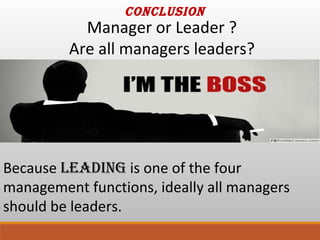
ConClusion
Manager or Leader ?
Are all managers leaders?
Because leading is one of the four
management functions, ideally all managers
should be leaders.
Manager(s)
 Transactional leadershipTransactional leadership
 Doing things rightDoing things right
 Administer & MaintainAdminister & Maintain
 Focus on systems and structuresFocus on systems and structures
 Reliance on controlReliance on control
 Short-range viewShort-range view
 ImitatesImitates
 Accepts the status quo (no change)Accepts the status quo (no change)
ConClusion
Leader(s)
 Transformational leadershipTransformational leadership
 Doing the right thingsDoing the right things
 Innovate & DevelopInnovate & Develop
 Focus on peopleFocus on people
 Inspire trustInspire trust
 Long-range perspectiveLong-range perspective
 OriginatesOriginates
 Challengers the status quoChallengers the status quo
Thank You for
Listening us

Leader as manager final.

  • 2.
    Leader as a Manager MuhammadNoman Presented By:
  • 3.
    Basis of leadership •Personalcharacteristics (‘traits’ or ‘qualities’) •Challenging circumstances (‘Contingency theorie Leader A Leader is a person who Lead & influences a group of people to achieve the goal.
  • 4.
    Manager A manager isa person responsible for planning, organizing, controlling and coordinating a group or an organization.
  • 6.
    o A manageris primary concern to accomplish Organizational goals Such as, Managers get paid to thing done in an Organizations o Management is about efficiency getting result through,  System  Processes  Controls  Structure
  • 7.
    A Manager haspower or authority to:  Hire  Promote  Discipline  Fire employees A manager is accountable for themselves as well as the behavior and performance of his or her Employees.
  • 8.
     A Managerwould be a leader If they are effectively carry out their leadership responsibilities to: oCommunicate oMotivate oInspire oEncourage
  • 9.
    o Leading people oInfluencing people o Commanding people o Guiding people
  • 10.
    Autocratic Leadership Style:is a form of management where one leader typically has complete control over a work area or project.
  • 11.
    Democratic Leaders Style: is a style of leadership found in human resources theory and participative management.
  • 12.
    Laissez Faire (FreeRein) Style : is where all the rights and power to make decisions is fully given to the worker.
  • 14.
    ConClusion Manager or Leader? Are all managers leaders? Because leading is one of the four management functions, ideally all managers should be leaders.
  • 15.
    Manager(s)  Transactional leadershipTransactionalleadership  Doing things rightDoing things right  Administer & MaintainAdminister & Maintain  Focus on systems and structuresFocus on systems and structures  Reliance on controlReliance on control  Short-range viewShort-range view  ImitatesImitates  Accepts the status quo (no change)Accepts the status quo (no change) ConClusion Leader(s)  Transformational leadershipTransformational leadership  Doing the right thingsDoing the right things  Innovate & DevelopInnovate & Develop  Focus on peopleFocus on people  Inspire trustInspire trust  Long-range perspectiveLong-range perspective  OriginatesOriginates  Challengers the status quoChallengers the status quo
  • 16.

Editor's Notes

  • #15 Managers do not differ from leaders based on their personalities or styles. Leaders are not just more lively, charismatic or larger than live managers Any mangers can lead by promoting new directions Managers can be inspiring as leaders Although groups may have informal leaders who emerge, those are not the leaders we’re or have studied. Because the conclusion is that LEADING is one of the four management functions, ideally all managers should be leaders.
  • #16 Bennis: The role of the manager is to administer and maintain systems in order. Managers focus on systems and controls. Their main concern is for the ‘bottom line’ (short-term profit), referred to management as transactional leadership, which is ‘ doing things right’. The function of the leader is to innovate and develop. Leaders focus on people, not systems. Their main concern is for the longer-term, not the short-term profit figure. Bennis referred to leadership as transformational leadership, which is ‘doing the right things’.