1
Department of Pharmaceutical Sciences
Rashtrasant Tukadoji Maharaj Nagpur University, Nagpur 440-033
Presented by:
Dhanashree N. Sarwan
M. Pharm. First Year (Pharmaceutical chemistry)
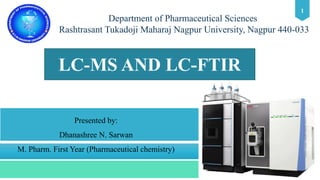
LC-MS AND LC-FTIR
2
 Hyphenated technique
 Introduction to LC-MS
 Principle
 Instrumentation and Working
 Applications
 Introduction to LC-FTIR
 Principle
 Instrumentation and Working
 Applications
 References
CONTENTS
3
HYPHENATED TECHNIQUE
 The term "hyphenation" was first adapted by Hirschfeld in 1980.
 The technique developed from coupling of separation technique and spectroscopic detection
technology.
LIST OF HYPHENATED TECHNIQUES:
 GC-MS
 LC-MS
 LC-FTIR
 GC-IR
 GC-NMR
ADVANTAGES:
1. Fast and accurate analysis.
2. Higher sample throughput.
3. Better reproducibility.
4
INTRODUCTION TO LC-MS
 LC/MS is a powerful analytical technique that combines the resolving power of LC with detection
specificity of MS.
 LC separates sample components and then introduces them to MS, creates and detects charged
ions.
 The LC/MS data used to provide information about molecular weight, structure, identity and
quantity of specific sample components.
 In LC-MS we are removing detector from column of LC and fitting column to interface of MS.
An interface is used to transfer liquid eluents from LC to MS. In most of cases the interface used
are ionization source.
5
PRINCIPLE:
 High Performance Liquid Chromatography [HPLC] principle is based on adsorption as well as
partition phenomenon.
 MS works by ionizing chemical compounds to generate charged molecules or molecule fragments
and measuring their mass-to-charge ratios.
 The ions are detected, usually by a quantitative method. The ion signal is processed into mass
spectra.
6
INSTRUMENTATION AND WORKING
7
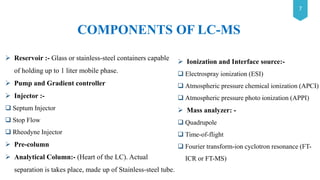
 Reservoir :- Glass or stainless-steel containers capable
of holding up to 1 liter mobile phase.
 Pump and Gradient controller
 Injector :-
 Septum Injector
 Stop Flow
 Rheodyne Injector
 Pre-column
 Analytical Column:- (Heart of the LC). Actual
separation is takes place, made up of Stainless-steel tube.
 Ionization and Interface source:-
 Electrospray ionization (ESI)
 Atmospheric pressure chemical ionization (APCI)
 Atmospheric pressure photo ionization (APPI)
 Mass analyzer: -
 Quadrupole
 Time-of-flight
 Fourier transform-ion cyclotron resonance (FT-
ICR or FT-MS)
COMPONENTS OF LC-MS
8
9
 Molecular Weight Determination
 Structural Elucidation
 Pharmaceutical Applications
 Food and Environmental Applications
 Characterization and Identification of Compounds
 Proteomics
 Glycopeptides Characterization
 Peptide Mapping
 Bioanalysis of various Biological Samples
APPLICATIONS OF LC-MS
 Pharmacokinetics: Bio analysis
 Drug development
 Toxicology
 Impurity detection
 Determination of isotopes
 Analysis of Complex Lipid Mixtures
 Phytoconstituents
10
INTRODUCTION TO LC-FTIR
 LC-FTIR (Liquid Chromatography-Fourier-Transform Infrared spectrometry)
 LC and FTIR can be combined together for the detection and identification of certain separated
compounds.
 The application of FTIR spectroscopy in LC is limited because the solvents used commonly in
LC are strong IR absorbers, limiting both sensitivity and spectral information that may be
obtained.
11
PRINCIPLE:
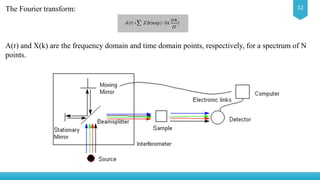
 The light passes through beamsplitter, which sends light in two directions.
 One beam goes to a stationary mirror then back to the beamsplitter. The other goes to a moving
mirror.
 When two meet up again at beamsplitter, they recombine, but difference in path lengths creates
constructive and destructive interference: an interferogram.
 The recombined beam passes through the sample, absorbs all different wavelengths characteristic
of its spectrum, and this subtracts specific wavelengths from interferogram.
 The detector now reports variation in energy versus time. Energy versus time is an odd way to
record a spectrum, until you recognize the relationship between time and frequency: they are
reciprocals!
12
The Fourier transform:
A(r) and X(k) are the frequency domain and time domain points, respectively, for a spectrum of N
points.
13
An interferogram
A spectrum
14
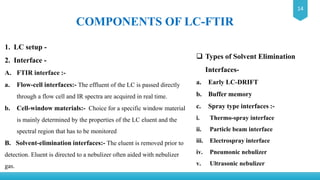
1. LC setup -
2. Interface -
A. FTIR interface :-
a. Flow-cell interfaces:- The effluent of the LC is passed directly
through a flow cell and IR spectra are acquired in real time.
b. Cell-window materials:- Choice for a specific window material
is mainly determined by the properties of the LC eluent and the
spectral region that has to be monitored
B. Solvent-elimination interfaces:- The eluent is removed prior to
detection. Eluent is directed to a nebulizer often aided with nebulizer
gas.
 Types of Solvent Elimination
Interfaces-
a. Early LC-DRIFT
b. Buffer memory
c. Spray type interfaces :-
i. Thermo-spray interface
ii. Particle beam interface
iii. Electrospray interface
iv. Pneumonic nebulizer
v. Ultrasonic nebulizer
COMPONENTS OF LC-FTIR
15
APPLICATIONS OF LC-FTIR
 In trace analysis.
 Analysis of environmental pollutants such as polycyclic aromatic hydrocarbons, pesticides and
herbicides.
 Analysis of Pharmaceuticals such as steroids and analgesics, and their impurities, drug metabolites,
polymer additives, dyes, non-ionic surfactants and fullerenes.
 Distinction of isomers
 Separation of secondary structure of proteins such as beta globulin and lysozyme.
16
1. Parasuraman S, Anish R, Balamurugan S, Muralidharan S, Kumar KJ, Vijayan V. An overview of
liquid chromatography-mass spectroscopy instrumentation. Pharmaceutical methods. 2014 Jul
1;5(2):47-55.
2. Kumar PR, Dinesh SR, Rini R. LCMS—a review and a recent update. J Pharm Pharm Sci. 2016 Mar
1;5:377-91.
3. Stachniuk A, Fornal E. Liquid chromatography-mass spectrometry in the analysis of pesticide residues
in food. Food Analytical Methods. 2016 Jun;9:1654-65.
4. Kok SJ. Coupling of liquid chromatography and fourier-transform infrared spectroscopy for the
characterization of polymers. Amsterdam: Universiteit van Amsterdam; 2004 Jan 1.
5. Griffiths PR, de Haseth JA. Fourier Transform Infrared Spectrometry John Wiley & Sons. New York.
1986;340.
6. Instrumental Methods of Analysis - By Skoog.
REFERENCES
17
THANK YOU

LC-MS LC-FTIR

  • 1.
    1 Department of PharmaceuticalSciences Rashtrasant Tukadoji Maharaj Nagpur University, Nagpur 440-033 Presented by: Dhanashree N. Sarwan M. Pharm. First Year (Pharmaceutical chemistry) LC-MS AND LC-FTIR
  • 2.
    2  Hyphenated technique Introduction to LC-MS  Principle  Instrumentation and Working  Applications  Introduction to LC-FTIR  Principle  Instrumentation and Working  Applications  References CONTENTS
  • 3.
    3 HYPHENATED TECHNIQUE  Theterm "hyphenation" was first adapted by Hirschfeld in 1980.  The technique developed from coupling of separation technique and spectroscopic detection technology. LIST OF HYPHENATED TECHNIQUES:  GC-MS  LC-MS  LC-FTIR  GC-IR  GC-NMR ADVANTAGES: 1. Fast and accurate analysis. 2. Higher sample throughput. 3. Better reproducibility.
  • 4.
    4 INTRODUCTION TO LC-MS LC/MS is a powerful analytical technique that combines the resolving power of LC with detection specificity of MS.  LC separates sample components and then introduces them to MS, creates and detects charged ions.  The LC/MS data used to provide information about molecular weight, structure, identity and quantity of specific sample components.  In LC-MS we are removing detector from column of LC and fitting column to interface of MS. An interface is used to transfer liquid eluents from LC to MS. In most of cases the interface used are ionization source.
  • 5.
    5 PRINCIPLE:  High PerformanceLiquid Chromatography [HPLC] principle is based on adsorption as well as partition phenomenon.  MS works by ionizing chemical compounds to generate charged molecules or molecule fragments and measuring their mass-to-charge ratios.  The ions are detected, usually by a quantitative method. The ion signal is processed into mass spectra.
  • 6.
  • 7.
    7  Reservoir :-Glass or stainless-steel containers capable of holding up to 1 liter mobile phase.  Pump and Gradient controller  Injector :-  Septum Injector  Stop Flow  Rheodyne Injector  Pre-column  Analytical Column:- (Heart of the LC). Actual separation is takes place, made up of Stainless-steel tube.  Ionization and Interface source:-  Electrospray ionization (ESI)  Atmospheric pressure chemical ionization (APCI)  Atmospheric pressure photo ionization (APPI)  Mass analyzer: -  Quadrupole  Time-of-flight  Fourier transform-ion cyclotron resonance (FT- ICR or FT-MS) COMPONENTS OF LC-MS
  • 8.
  • 9.
    9  Molecular WeightDetermination  Structural Elucidation  Pharmaceutical Applications  Food and Environmental Applications  Characterization and Identification of Compounds  Proteomics  Glycopeptides Characterization  Peptide Mapping  Bioanalysis of various Biological Samples APPLICATIONS OF LC-MS  Pharmacokinetics: Bio analysis  Drug development  Toxicology  Impurity detection  Determination of isotopes  Analysis of Complex Lipid Mixtures  Phytoconstituents
  • 10.
    10 INTRODUCTION TO LC-FTIR LC-FTIR (Liquid Chromatography-Fourier-Transform Infrared spectrometry)  LC and FTIR can be combined together for the detection and identification of certain separated compounds.  The application of FTIR spectroscopy in LC is limited because the solvents used commonly in LC are strong IR absorbers, limiting both sensitivity and spectral information that may be obtained.
  • 11.
    11 PRINCIPLE:  The lightpasses through beamsplitter, which sends light in two directions.  One beam goes to a stationary mirror then back to the beamsplitter. The other goes to a moving mirror.  When two meet up again at beamsplitter, they recombine, but difference in path lengths creates constructive and destructive interference: an interferogram.  The recombined beam passes through the sample, absorbs all different wavelengths characteristic of its spectrum, and this subtracts specific wavelengths from interferogram.  The detector now reports variation in energy versus time. Energy versus time is an odd way to record a spectrum, until you recognize the relationship between time and frequency: they are reciprocals!
  • 12.
    12 The Fourier transform: A(r)and X(k) are the frequency domain and time domain points, respectively, for a spectrum of N points.
  • 13.
  • 14.
    14 1. LC setup- 2. Interface - A. FTIR interface :- a. Flow-cell interfaces:- The effluent of the LC is passed directly through a flow cell and IR spectra are acquired in real time. b. Cell-window materials:- Choice for a specific window material is mainly determined by the properties of the LC eluent and the spectral region that has to be monitored B. Solvent-elimination interfaces:- The eluent is removed prior to detection. Eluent is directed to a nebulizer often aided with nebulizer gas.  Types of Solvent Elimination Interfaces- a. Early LC-DRIFT b. Buffer memory c. Spray type interfaces :- i. Thermo-spray interface ii. Particle beam interface iii. Electrospray interface iv. Pneumonic nebulizer v. Ultrasonic nebulizer COMPONENTS OF LC-FTIR
  • 15.
    15 APPLICATIONS OF LC-FTIR In trace analysis.  Analysis of environmental pollutants such as polycyclic aromatic hydrocarbons, pesticides and herbicides.  Analysis of Pharmaceuticals such as steroids and analgesics, and their impurities, drug metabolites, polymer additives, dyes, non-ionic surfactants and fullerenes.  Distinction of isomers  Separation of secondary structure of proteins such as beta globulin and lysozyme.
  • 16.
    16 1. Parasuraman S,Anish R, Balamurugan S, Muralidharan S, Kumar KJ, Vijayan V. An overview of liquid chromatography-mass spectroscopy instrumentation. Pharmaceutical methods. 2014 Jul 1;5(2):47-55. 2. Kumar PR, Dinesh SR, Rini R. LCMS—a review and a recent update. J Pharm Pharm Sci. 2016 Mar 1;5:377-91. 3. Stachniuk A, Fornal E. Liquid chromatography-mass spectrometry in the analysis of pesticide residues in food. Food Analytical Methods. 2016 Jun;9:1654-65. 4. Kok SJ. Coupling of liquid chromatography and fourier-transform infrared spectroscopy for the characterization of polymers. Amsterdam: Universiteit van Amsterdam; 2004 Jan 1. 5. Griffiths PR, de Haseth JA. Fourier Transform Infrared Spectrometry John Wiley & Sons. New York. 1986;340. 6. Instrumental Methods of Analysis - By Skoog. REFERENCES
  • 17.