THE BOSS OF YOUR BODY
The brain
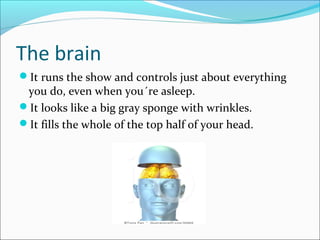
It runs the show and controls just about everything
you do, even when you´re asleep.
It looks like a big gray sponge with wrinkles.
It fills the whole of the top half of your head.
The Functions of the Brain
The human brain is a complex organ that allows us to
think, move, feel, see, hear, taste, and smell.
It controls our body, receives information, analyzes
information, and stores information (our memories).
The brain produces electrical signals, which together
with chemical reactions,let the parts of the body
communicate.
smell
touchtaste
sight
hearing
SIZE OF THE HUMAN BRAIN
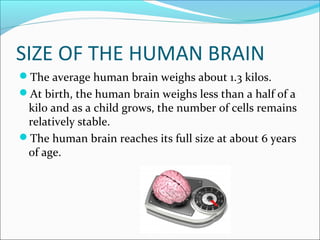
The average human brain weighs about 1.3 kilos.
At birth, the human brain weighs less than a half of a
kilo and as a child grows, the number of cells remains
relatively stable.
The human brain reaches its full size at about 6 years
of age.
THE NERVOUS SYSTEM
The brain and spinal cord make up the central
nervous system.
The brain is connected to the spinal cord, which runs
from the neck to the hip area. The spinal cord carries
nerve message between the brain and the body.
This is called the nervous system.
It controls our breathing, digesting food, blood
circulation, etc.
COMPOSITION OF THE BRAIN
The brain consists of gray matter (40%) and white
matter (60%) contained within the skull.
Brain cells include neurons and glial cells.
The cranium (the top of the skull) surrounds and
protects the brain.
PARTS OF THE BRAIN
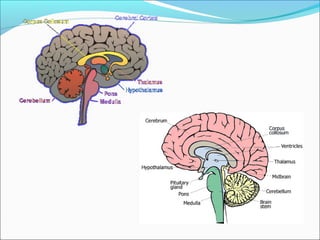
CEREBELLUM
It regulates balance, posture,
movement, and muscle
coordination.
CORPUS COLLOSUM
- A large bundle of nerve fibers
that connect the left and
right cerebral hemispheres.
In the lateral section, it looks
a bit like a “C” on its side.
_ MEDULLA OBLONGATA
- It controls automatic functions
including heartbeat, breathing,
etc.
PITUITARY GLAND
- A gland that secretes
hormones. Is very small.
- It controls growth
SPINAL CORD
- A thick bundle of nerve fibers
that runs from the base of
the brain to the hip area,
running through the spine
(vertebrae)
PITUITARY GLAND
- A gland that secretes
hormones. Is very small.
- It controls growth
. PONS
- The part of the brainstem that
joins the hemispheres of the
cerebellum and connects the
cerebrum with the
cerebellum.
The biggest part: The CEREBRUM
Is the thinking part of the brain. Controls your voluntary muscles
OCCIPITAL LOBE OF THE
CEREBRUM
- It contains the centers of
vision and reading ability
(located at the back of the
head)
. PARIETAL LOBE OF THE
CEREBRUM
-It contains important sensory
centers .
TEMPORAL LOBE OF THE
CEREBRUM
- Contains centers of hearing and
memory (located at the sides of
the head)
FRONTAL LOBE OF THE
CEREBRUM
- Regions of the cerebral
hemispheres. Used for
reasoning, emotions,
judgement, and voluntary
movement.
SPINAL CORD
- A thick bundle of nerve fibers
that runs from the base of
the brain to the hip area,
running through the spine
(vertebrae)
- PONS
- Connects the cerebrum with
the cerebellum.
HYPOTHALAMUS
- Controls temperature.If your
body is too hot, the
hypothalamus tells it to
sweat. If you are too cold, the
hypothalamus gets you
shivering.
A Healthy Brain
What can you do for your brain?
- Eat healthy foods. They contain potassium and
calcium, two minerals that are importanbt for the nervous
system.
- Get a lot of playtime (exercise)
- Wear a helmet when you ride a bike or play other sports
that require head protection
- Don´t drink alcohol, take drugs or use tobbaco.
- Use your brain by doing challenging activities, such as
puzzles, reading, playing music, making art, or anything
else that givews your brain a workout.
THANKS AND USE YOUR BRAIN

The brain

  • 1.
    THE BOSS OFYOUR BODY
  • 2.
    The brain It runsthe show and controls just about everything you do, even when you´re asleep. It looks like a big gray sponge with wrinkles. It fills the whole of the top half of your head.
  • 3.
    The Functions ofthe Brain The human brain is a complex organ that allows us to think, move, feel, see, hear, taste, and smell. It controls our body, receives information, analyzes information, and stores information (our memories). The brain produces electrical signals, which together with chemical reactions,let the parts of the body communicate.
  • 4.
  • 5.
    SIZE OF THEHUMAN BRAIN The average human brain weighs about 1.3 kilos. At birth, the human brain weighs less than a half of a kilo and as a child grows, the number of cells remains relatively stable. The human brain reaches its full size at about 6 years of age.
  • 6.
    THE NERVOUS SYSTEM Thebrain and spinal cord make up the central nervous system. The brain is connected to the spinal cord, which runs from the neck to the hip area. The spinal cord carries nerve message between the brain and the body. This is called the nervous system. It controls our breathing, digesting food, blood circulation, etc.
  • 8.
    COMPOSITION OF THEBRAIN The brain consists of gray matter (40%) and white matter (60%) contained within the skull. Brain cells include neurons and glial cells. The cranium (the top of the skull) surrounds and protects the brain.
  • 9.
    PARTS OF THEBRAIN CEREBELLUM It regulates balance, posture, movement, and muscle coordination. CORPUS COLLOSUM - A large bundle of nerve fibers that connect the left and right cerebral hemispheres. In the lateral section, it looks a bit like a “C” on its side. _ MEDULLA OBLONGATA - It controls automatic functions including heartbeat, breathing, etc. PITUITARY GLAND - A gland that secretes hormones. Is very small. - It controls growth
  • 10.
    SPINAL CORD - Athick bundle of nerve fibers that runs from the base of the brain to the hip area, running through the spine (vertebrae) PITUITARY GLAND - A gland that secretes hormones. Is very small. - It controls growth . PONS - The part of the brainstem that joins the hemispheres of the cerebellum and connects the cerebrum with the cerebellum.
  • 11.
    The biggest part:The CEREBRUM Is the thinking part of the brain. Controls your voluntary muscles OCCIPITAL LOBE OF THE CEREBRUM - It contains the centers of vision and reading ability (located at the back of the head) . PARIETAL LOBE OF THE CEREBRUM -It contains important sensory centers . TEMPORAL LOBE OF THE CEREBRUM - Contains centers of hearing and memory (located at the sides of the head) FRONTAL LOBE OF THE CEREBRUM - Regions of the cerebral hemispheres. Used for reasoning, emotions, judgement, and voluntary movement.
  • 12.
    SPINAL CORD - Athick bundle of nerve fibers that runs from the base of the brain to the hip area, running through the spine (vertebrae) - PONS - Connects the cerebrum with the cerebellum. HYPOTHALAMUS - Controls temperature.If your body is too hot, the hypothalamus tells it to sweat. If you are too cold, the hypothalamus gets you shivering.
  • 16.
    A Healthy Brain Whatcan you do for your brain? - Eat healthy foods. They contain potassium and calcium, two minerals that are importanbt for the nervous system. - Get a lot of playtime (exercise) - Wear a helmet when you ride a bike or play other sports that require head protection - Don´t drink alcohol, take drugs or use tobbaco. - Use your brain by doing challenging activities, such as puzzles, reading, playing music, making art, or anything else that givews your brain a workout.
  • 18.
    THANKS AND USEYOUR BRAIN