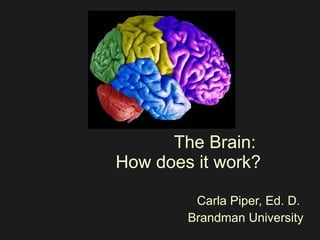
The Brain:  How does it work? Carla Piper, Ed. D.  Brandman University
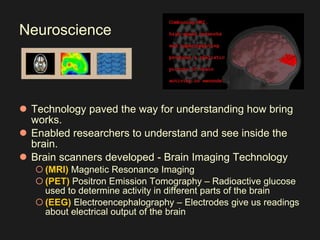
Neuroscience Technology paved the way for understanding how bring works.  Enabled researchers to understand and see inside the brain.  Brain scanners developed - Brain Imaging Technology  (MRI)  Magnetic Resonance Imaging (PET)  Positron Emission Tomography – Radioactive glucose used to determine activity in different parts of the brain  (EEG)  Electroencephalography – Electrodes give us readings about electrical output of the brain
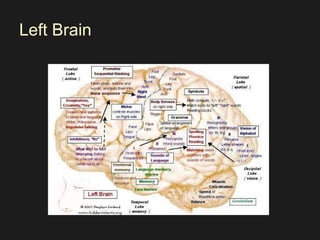
Two Cerebral Hemispheres  Left and Right Left Hemisphere  Processes things more in parts and sequentially  Musicians process music in left   hemisphere  Right Hemisphere   Music and Arts have been considered right-brain "frills" but trained musicians use more left-brain and novice musicians use more right.  Higher-level mathematicians, problem solvers, and chess players actually have more right-brained activity, but beginners use more left brain.
Left and Right Hemispheres Bundles of Nerve Fibers  Connect the left and right hemispheres Allow each side of the brain to exchange information more freely –  Crossing the midline. New research shows that early concept of left brain/right brain is outdated
The Left Brain versus the Right Brain Argument Simplification of a Very Complex Neurological System Go to Neuroscience for Kids
Drawing on the Right Side of the Brain L-Mode (left brain) The verbal, analytic mode Step-by-step style of thinking  Using words, numbers and other symbols  Strings things out in sequences, like words in a sentence R-Mode (right brain) The visual, perceptual mode Uses visual information and processes  All at once, like recognizing the face of a friend Go to: http://www.drawright.com /   Betty Edwards   Ways of Knowing  and Seeing
The Fabric of Mind "You have two brains: a left and a right. Modern brain scientists now know that your left brain is your verbal and rational brain; it thinks serially and reduces its thoughts to numbers, letters and words… Your right brain is your nonverbal and intuitive brain; it thinks in patterns, or pictures, composed of ‘whole things,’ and does not comprehend reductions, either numbers, letters, or words." From The Fabric of Mind, by the eminent scientist and neurosurgeon, Richard Bergland. Viking Penguin, Inc., New York 1985. p.1
Left Brain
Right Brain
Arts with the Brain in Mind Visual arts – complex mind and brain process Arts serves as a sketchpad for thinking Drawing  Ability changes as brain develops Engages visual perception Enhances eye-hand coordination Fosters creative expression Brain organizes information based on visual input  Strong links between visual learning and reading and learning Eric Jensen Google Book
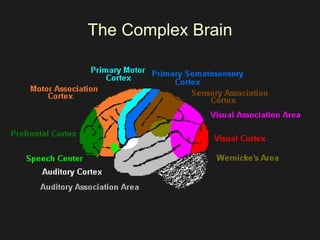
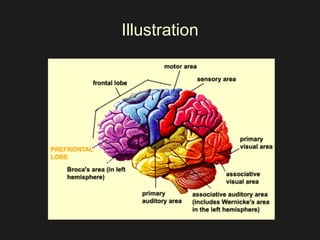
The Lobes Frontal Lobe Area around your forehead  Involved in purposeful acts like judgment, creativity, problem solving, and planning.  Parietal Lobe Top back area of the brain  Processes higher sensory and language functions  Temporal Lobe Left and right side above and around the ears  Primarily responsible for hearing, memory, meaning, and language.  Some overlap in functions of the lobes.  Occipital Lobe Back of the brain  Primarily responsible for vision  
Learning Changes the Brain Some kind of stimulus to the brain starts the learning process.  The stimulus is sorted and processed at several levels.  Results in formation of memory.   Either doing something we already know how to do - or we are doing something new.  Stimulation is doing something new - lighting up the brain scan.  Once a task is learned, the brain lights up less.
Brain Activity by Age  Stages of Development Through Sensory Experiences in the First Year
The Resting Brain PET Scans Show Brain Function Four Different Slices of the Same Brain Mapping of Cerebral Function Resting Brain Shows No “hotspots” http://www.crump.ucla.edu/software/lpp/clinpetneuro/function.html
Auditory Activity Subject listened to some music.  Increased activity in the PET image containing the auditory cortex.  Nonverbal stimuli (music) predominantly activates the nondominant (right) hemisphere. Simultaneous stimulation with language and music would cause a more bilateral activation of the auditory cortex.
Visual Activity Subject exposed to visual stimulation consisting of both pattern and color. Increased activity in the stimulated brain PET image (arrowhead).  Region of increased activity corresponds to the primary visual cortex.
Thinking Activity Increased activity in the stimulated brain PET image (arrowhead).  Region of increased activity corresponds to the frontal cortex.
Motor or Kinesthetic Activity Motor stimulation of the brain Subject to hop up and down on his right foot.  Motor task of a movement of the right foot caused: Cortical metabolic activation of the left motor strip (horizontal arrowhead) Caused supplementary motor cortex (vertical arrow, top).      Cerebellum
Neurons Neurons (brain cells) make connections between different parts of the brain.  100 billion neurons in human brain Information is carried inside a neuron by electrical pulses and transmitted across the synaptic gap from one neuron to another by chemicals called neurotransmitters.  Learning is a critical function of neurons.  
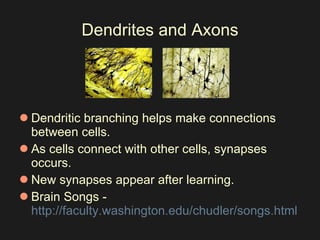
Dendrites and Axons Dendritic branching helps make connections between cells.  As cells connect with other cells, synapses occurs.    New synapses appear after learning.  Brain Songs -  http://faculty.washington.edu/chudler/songs.html
Synaptic Connectivity
Secret Life of the Brain PBS Web -  http://www.pbs.org/wnet/brain/index.html   Movie
Speech Broca’s Area: In the left frontal lobe Controls production of speech sounds Lies close to motor areas Wernicke’s Area: Left temporal lobe Gets meaning from words and sentences Formulates ideas into speech
Language and Images of the Mind
Language Processing Unpracticed Task  Yellow and red regions are "hotter – higher cell activity Patient was unpracticed at the language learning task.  The highest brain activities in the temporal lobe responsible for the hearing perception Prefrontal cortex responsible for understanding language.   Practiced Task  Same individual has now learned the language task and is spelling out.  Concentrated in the Broca area of the cortex which is responsible for the motor control of voice Real-time image of brain function. Pet Scans
Memory Activity Subject required to remember an image for later recall. Increased activity in the stimulated brain PET image (arrowhead) is the hippocampal formation.  Region of the brain implicated in learning and memory.  Hypocampus integrates sensory information along with amygdala
Learning and Memory Short-term working memory  Information is transferred to long-term memory through the hippocampus  Hypocampus integrates sensory information along with amygdala Hypocampus – long term memory Amygdala – affective responses Brain Stem – emotional reflex reactions Thalamus – the “you”   The Brain from Top to Bottom http://www.thebrain.mcgill.ca/flash/index_d.html
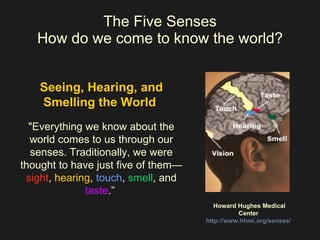
The Five Senses How do we come to know the world? Seeing, Hearing, and Smelling the World  "Everything we know about the world comes to us through our senses. Traditionally, we were thought to have just five of them— sight ,  hearing ,  touch ,  smell , and  taste .”  Howard Hughes Medical Center  http://www.hhmi.org/senses/
Memory The Brain from Top to Bottom Stimulus Sensory Organs Sensory Memory Millisecond to Second Short-Term Working Memory Less than a minute Long-Term Memory Days, Months, Years Perception Attention Forgetting Repetition
Long Term Memory Long Term Memory Implicit Explicit Emotional  Conditioning Procedural  Skills Episodic Autobiographical Events Semantic Words, Ideas Concepts Declarative Non-Declarative Priming Conditioned Reflex Unconscious Association
The Complex Brain
Illustration

Brainarts

  • 1.
    The Brain: How does it work? Carla Piper, Ed. D. Brandman University
  • 2.
    Neuroscience Technology pavedthe way for understanding how bring works. Enabled researchers to understand and see inside the brain. Brain scanners developed - Brain Imaging Technology (MRI) Magnetic Resonance Imaging (PET) Positron Emission Tomography – Radioactive glucose used to determine activity in different parts of the brain (EEG) Electroencephalography – Electrodes give us readings about electrical output of the brain
  • 3.
    Two Cerebral Hemispheres Left and Right Left Hemisphere Processes things more in parts and sequentially Musicians process music in left hemisphere Right Hemisphere Music and Arts have been considered right-brain "frills" but trained musicians use more left-brain and novice musicians use more right. Higher-level mathematicians, problem solvers, and chess players actually have more right-brained activity, but beginners use more left brain.
  • 4.
    Left and RightHemispheres Bundles of Nerve Fibers Connect the left and right hemispheres Allow each side of the brain to exchange information more freely – Crossing the midline. New research shows that early concept of left brain/right brain is outdated
  • 5.
    The Left Brainversus the Right Brain Argument Simplification of a Very Complex Neurological System Go to Neuroscience for Kids
  • 6.
    Drawing on theRight Side of the Brain L-Mode (left brain) The verbal, analytic mode Step-by-step style of thinking Using words, numbers and other symbols Strings things out in sequences, like words in a sentence R-Mode (right brain) The visual, perceptual mode Uses visual information and processes All at once, like recognizing the face of a friend Go to: http://www.drawright.com / Betty Edwards Ways of Knowing and Seeing
  • 7.
    The Fabric ofMind "You have two brains: a left and a right. Modern brain scientists now know that your left brain is your verbal and rational brain; it thinks serially and reduces its thoughts to numbers, letters and words… Your right brain is your nonverbal and intuitive brain; it thinks in patterns, or pictures, composed of ‘whole things,’ and does not comprehend reductions, either numbers, letters, or words." From The Fabric of Mind, by the eminent scientist and neurosurgeon, Richard Bergland. Viking Penguin, Inc., New York 1985. p.1
  • 8.
  • 9.
  • 10.
    Arts with theBrain in Mind Visual arts – complex mind and brain process Arts serves as a sketchpad for thinking Drawing Ability changes as brain develops Engages visual perception Enhances eye-hand coordination Fosters creative expression Brain organizes information based on visual input Strong links between visual learning and reading and learning Eric Jensen Google Book
  • 11.
    The Lobes FrontalLobe Area around your forehead Involved in purposeful acts like judgment, creativity, problem solving, and planning. Parietal Lobe Top back area of the brain Processes higher sensory and language functions Temporal Lobe Left and right side above and around the ears Primarily responsible for hearing, memory, meaning, and language. Some overlap in functions of the lobes. Occipital Lobe Back of the brain Primarily responsible for vision  
  • 12.
    Learning Changes theBrain Some kind of stimulus to the brain starts the learning process. The stimulus is sorted and processed at several levels. Results in formation of memory.  Either doing something we already know how to do - or we are doing something new. Stimulation is doing something new - lighting up the brain scan. Once a task is learned, the brain lights up less.
  • 13.
    Brain Activity byAge Stages of Development Through Sensory Experiences in the First Year
  • 14.
    The Resting BrainPET Scans Show Brain Function Four Different Slices of the Same Brain Mapping of Cerebral Function Resting Brain Shows No “hotspots” http://www.crump.ucla.edu/software/lpp/clinpetneuro/function.html
  • 15.
    Auditory Activity Subjectlistened to some music. Increased activity in the PET image containing the auditory cortex. Nonverbal stimuli (music) predominantly activates the nondominant (right) hemisphere. Simultaneous stimulation with language and music would cause a more bilateral activation of the auditory cortex.
  • 16.
    Visual Activity Subjectexposed to visual stimulation consisting of both pattern and color. Increased activity in the stimulated brain PET image (arrowhead). Region of increased activity corresponds to the primary visual cortex.
  • 17.
    Thinking Activity Increasedactivity in the stimulated brain PET image (arrowhead). Region of increased activity corresponds to the frontal cortex.
  • 18.
    Motor or KinestheticActivity Motor stimulation of the brain Subject to hop up and down on his right foot. Motor task of a movement of the right foot caused: Cortical metabolic activation of the left motor strip (horizontal arrowhead) Caused supplementary motor cortex (vertical arrow, top). Cerebellum
  • 19.
    Neurons Neurons (braincells) make connections between different parts of the brain. 100 billion neurons in human brain Information is carried inside a neuron by electrical pulses and transmitted across the synaptic gap from one neuron to another by chemicals called neurotransmitters. Learning is a critical function of neurons.  
  • 20.
    Dendrites and AxonsDendritic branching helps make connections between cells. As cells connect with other cells, synapses occurs.   New synapses appear after learning. Brain Songs - http://faculty.washington.edu/chudler/songs.html
  • 21.
  • 22.
    Secret Life ofthe Brain PBS Web - http://www.pbs.org/wnet/brain/index.html Movie
  • 23.
    Speech Broca’s Area:In the left frontal lobe Controls production of speech sounds Lies close to motor areas Wernicke’s Area: Left temporal lobe Gets meaning from words and sentences Formulates ideas into speech
  • 24.
  • 25.
    Language Processing UnpracticedTask Yellow and red regions are "hotter – higher cell activity Patient was unpracticed at the language learning task. The highest brain activities in the temporal lobe responsible for the hearing perception Prefrontal cortex responsible for understanding language. Practiced Task Same individual has now learned the language task and is spelling out. Concentrated in the Broca area of the cortex which is responsible for the motor control of voice Real-time image of brain function. Pet Scans
  • 26.
    Memory Activity Subjectrequired to remember an image for later recall. Increased activity in the stimulated brain PET image (arrowhead) is the hippocampal formation. Region of the brain implicated in learning and memory. Hypocampus integrates sensory information along with amygdala
  • 27.
    Learning and MemoryShort-term working memory Information is transferred to long-term memory through the hippocampus Hypocampus integrates sensory information along with amygdala Hypocampus – long term memory Amygdala – affective responses Brain Stem – emotional reflex reactions Thalamus – the “you” The Brain from Top to Bottom http://www.thebrain.mcgill.ca/flash/index_d.html
  • 28.
    The Five SensesHow do we come to know the world? Seeing, Hearing, and Smelling the World "Everything we know about the world comes to us through our senses. Traditionally, we were thought to have just five of them— sight , hearing , touch , smell , and taste .”  Howard Hughes Medical Center  http://www.hhmi.org/senses/
  • 29.
    Memory The Brainfrom Top to Bottom Stimulus Sensory Organs Sensory Memory Millisecond to Second Short-Term Working Memory Less than a minute Long-Term Memory Days, Months, Years Perception Attention Forgetting Repetition
  • 30.
    Long Term MemoryLong Term Memory Implicit Explicit Emotional Conditioning Procedural Skills Episodic Autobiographical Events Semantic Words, Ideas Concepts Declarative Non-Declarative Priming Conditioned Reflex Unconscious Association
  • 31.
  • 32.