Contents
Who is Insider
What is Inside Trading
How Inside Trading done
Law Governing Insider Trading
Role of SEBI in Inside Trading
Penalties
Conclusion
Law is a system of rules that are created to
regulate behaviour in sport.
The law is a set of rules that people are made
to follow by the state
Governing means to rule over by right to authority.
Governing means to exercise a directing or restraining influence over
others through power.
Insider is a term describing a director or senior officer
or a top level employee of a company.
An Insider is a person who has inside
information on publicly traded firms.
Trading means buying and selling of goods
and services which possess monetary value.
A Trading means buying and selling of financial
instruments such as stocks, bonds and mutual funds etc.
Who is Insider ?
According to SEBI:-
 Insider is the person who is “connected” with the company,
who could have the unpublished price sensitive information or
receive the information from somebody in the company.
 An Insider is a person who own 10% of share or voting rights,
senior officer, top level Employees or the person who can have
data or information which is not published to the public.
What is Insider Trading
 The Illegal practice of trading on the stock exchange to one’s
own advantage through having access to confidential
information or Price sensitive information .
 Buying or selling of security by someone who has
access to material non-public information is called
insider trading.
What is Price Sensitive info…
The price sensitive information is defined in Regulation 2(h)(a) of
the prohibition of insider trading.
“It means any information which relates directly or indirectly
with the company and which if published is likely to materially
affect the price of the security’s of the company”.
Concept of Insider Trading
There are three main dimensions of insider trading …….
Some one connected with a company has access to important
insider information which is not known to outsider.
The person buys or sells the company’s stock on the basis of
such information.
The person thereby, uses the insider information for personal
financial gain.
Disadvantages of Insider Trading
Stock brokers, informers and frauds manipulate the security
markets by leaking information.
Spread out rumor about a insider transactions.
Enhance the risk for stock market crash.
Leads to a decrease in the overall trust in the market.
Need for Regulating Insider Trading
To Stabilise the market
To prevent misappropriations in the stock market
To check unfair advantage
To protect the investors interest
To Safe guard companies info and important data.
Is Insider Trading illegal ?
YES
Insider trading is against the principal of fair market.
Insider trading is also unethical because it involves breach of
trust.
• Insider trading is an illegal act in almost all countries.
• SEBI has declared it illegal in any form.
• SEBI has issued regulations which prohibit insider trading.
https://www.moneycontrol.com/news/business/economy/polaris-insider-trading-sebi-orders-seizingrs-2-crore-1513043.html
Latest insider trading NEWS
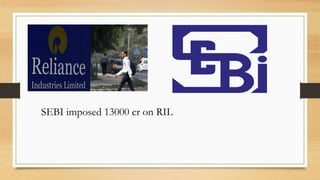
SEBI imposed 13000 cr on RIL
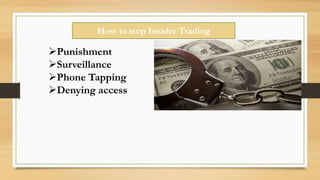
How to stop Insider Trading
Punishment
Surveillance
Phone Tapping
Denying access
SEBI prohibition of Insider Trading regulation 2015.
SEBI prohibits communication UPSI
It prohibits procuring any person to trade in securities on basis of
UPSI
Prohibition of insider trading
Need for prohibition
As per SEBI the prohibition of Insider Trading is required
to make securities market:
Fair and Transparent
To have a level playing field for all the participants in the
market
For free flow of information and avoid information asymmetry
Penalties
As per SEBI Act, 1992 insider trading is punishable with a
penalty of INR 25cr or 3 times the profit made out of insider
trading, whichever is higher.
 Any person attempting to contravene the contravention of the
Act may also be liable to imprisonment for a term which may
extend to ten years or with fine which may extend to INR 25cr or
with both.
Conclusion…
The insiders possess the knowledge and the vision. They
are the ones who make corporate decisions and business
plans, and therefore are the ones you must pay close
attention to.
Law governing insider trading

Law governing insider trading

  • 2.
    Contents Who is Insider Whatis Inside Trading How Inside Trading done Law Governing Insider Trading Role of SEBI in Inside Trading Penalties Conclusion
  • 3.
    Law is asystem of rules that are created to regulate behaviour in sport. The law is a set of rules that people are made to follow by the state Governing means to rule over by right to authority. Governing means to exercise a directing or restraining influence over others through power.
  • 4.
    Insider is aterm describing a director or senior officer or a top level employee of a company. An Insider is a person who has inside information on publicly traded firms.
  • 5.
    Trading means buyingand selling of goods and services which possess monetary value. A Trading means buying and selling of financial instruments such as stocks, bonds and mutual funds etc.
  • 6.
    Who is Insider? According to SEBI:-  Insider is the person who is “connected” with the company, who could have the unpublished price sensitive information or receive the information from somebody in the company.  An Insider is a person who own 10% of share or voting rights, senior officer, top level Employees or the person who can have data or information which is not published to the public.
  • 7.
    What is InsiderTrading  The Illegal practice of trading on the stock exchange to one’s own advantage through having access to confidential information or Price sensitive information .  Buying or selling of security by someone who has access to material non-public information is called insider trading.
  • 8.
    What is PriceSensitive info… The price sensitive information is defined in Regulation 2(h)(a) of the prohibition of insider trading. “It means any information which relates directly or indirectly with the company and which if published is likely to materially affect the price of the security’s of the company”.
  • 9.
    Concept of InsiderTrading There are three main dimensions of insider trading ……. Some one connected with a company has access to important insider information which is not known to outsider. The person buys or sells the company’s stock on the basis of such information. The person thereby, uses the insider information for personal financial gain.
  • 10.
    Disadvantages of InsiderTrading Stock brokers, informers and frauds manipulate the security markets by leaking information. Spread out rumor about a insider transactions. Enhance the risk for stock market crash. Leads to a decrease in the overall trust in the market.
  • 11.
    Need for RegulatingInsider Trading To Stabilise the market To prevent misappropriations in the stock market To check unfair advantage To protect the investors interest To Safe guard companies info and important data.
  • 12.
    Is Insider Tradingillegal ? YES Insider trading is against the principal of fair market. Insider trading is also unethical because it involves breach of trust. • Insider trading is an illegal act in almost all countries. • SEBI has declared it illegal in any form. • SEBI has issued regulations which prohibit insider trading.
  • 13.
  • 14.
  • 15.
    How to stopInsider Trading Punishment Surveillance Phone Tapping Denying access
  • 16.
    SEBI prohibition ofInsider Trading regulation 2015. SEBI prohibits communication UPSI It prohibits procuring any person to trade in securities on basis of UPSI Prohibition of insider trading
  • 17.
    Need for prohibition Asper SEBI the prohibition of Insider Trading is required to make securities market: Fair and Transparent To have a level playing field for all the participants in the market For free flow of information and avoid information asymmetry
  • 18.
    Penalties As per SEBIAct, 1992 insider trading is punishable with a penalty of INR 25cr or 3 times the profit made out of insider trading, whichever is higher.  Any person attempting to contravene the contravention of the Act may also be liable to imprisonment for a term which may extend to ten years or with fine which may extend to INR 25cr or with both.
  • 19.
    Conclusion… The insiders possessthe knowledge and the vision. They are the ones who make corporate decisions and business plans, and therefore are the ones you must pay close attention to.