What is insider trading?
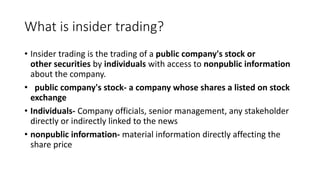
• Insider trading is the trading of a public company's stock or
other securities by individuals with access to nonpublic information
about the company.
• public company's stock- a company whose shares a listed on stock
exchange
• Individuals- Company officials, senior management, any stakeholder
directly or indirectly linked to the news
• nonpublic information- material information directly affecting the
share price
Dilemma about insider trading!
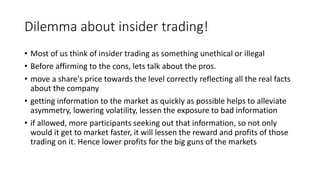
• Most of us think of insider trading as something unethical or illegal
• Before affirming to the cons, lets talk about the pros.
• move a share's price towards the level correctly reflecting all the real facts
about the company
• getting information to the market as quickly as possible helps to alleviate
asymmetry, lowering volatility, lessen the exposure to bad information
• if allowed, more participants seeking out that information, so not only
would it get to market faster, it will lessen the reward and profits of those
trading on it. Hence lower profits for the big guns of the markets
Continued…
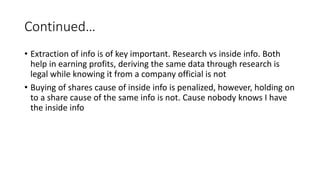
• Extraction of info is of key important. Research vs inside info. Both
help in earning profits, deriving the same data through research is
legal while knowing it from a company official is not
• Buying of shares cause of inside info is penalized, however, holding on
to a share cause of the same info is not. Cause nobody knows I have
the inside info
The problems with insider trading!
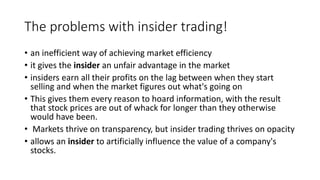
• an inefficient way of achieving market efficiency
• it gives the insider an unfair advantage in the market
• insiders earn all their profits on the lag between when they start
selling and when the market figures out what's going on
• This gives them every reason to hoard information, with the result
that stock prices are out of whack for longer than they otherwise
would have been.
• Markets thrive on transparency, but insider trading thrives on opacity
• allows an insider to artificially influence the value of a company's
stocks.
Continued…
• individuals possessing material nonpublic information begin trading
creating a small affect on price. Some uninformed traders become
aware of the insider trading through leakage or tipping of information
or through observation of insider trades.
• Finally, the market reacts to the insiders' trades and gradually moves
toward the correct price. But while derivatively informed trading can
affect price, it functions slowly and sporadically. Given the inefficiency
of derivatively informed trading, the market efficiency justification for
insider trading loses much of its force
IT- a criminal offence
• Securities Act 2015: insider trading has been officially declared a
criminal offence.
• Under the 1969 law, the SECP had no powers to intervene for investor
protection and to handle investor complaints
• High monetary penalties
• Imprisonment

Pm

  • 2.
    What is insidertrading? • Insider trading is the trading of a public company's stock or other securities by individuals with access to nonpublic information about the company. • public company's stock- a company whose shares a listed on stock exchange • Individuals- Company officials, senior management, any stakeholder directly or indirectly linked to the news • nonpublic information- material information directly affecting the share price
  • 3.
    Dilemma about insidertrading! • Most of us think of insider trading as something unethical or illegal • Before affirming to the cons, lets talk about the pros. • move a share's price towards the level correctly reflecting all the real facts about the company • getting information to the market as quickly as possible helps to alleviate asymmetry, lowering volatility, lessen the exposure to bad information • if allowed, more participants seeking out that information, so not only would it get to market faster, it will lessen the reward and profits of those trading on it. Hence lower profits for the big guns of the markets
  • 4.
    Continued… • Extraction ofinfo is of key important. Research vs inside info. Both help in earning profits, deriving the same data through research is legal while knowing it from a company official is not • Buying of shares cause of inside info is penalized, however, holding on to a share cause of the same info is not. Cause nobody knows I have the inside info
  • 5.
    The problems withinsider trading! • an inefficient way of achieving market efficiency • it gives the insider an unfair advantage in the market • insiders earn all their profits on the lag between when they start selling and when the market figures out what's going on • This gives them every reason to hoard information, with the result that stock prices are out of whack for longer than they otherwise would have been. • Markets thrive on transparency, but insider trading thrives on opacity • allows an insider to artificially influence the value of a company's stocks.
  • 6.
    Continued… • individuals possessingmaterial nonpublic information begin trading creating a small affect on price. Some uninformed traders become aware of the insider trading through leakage or tipping of information or through observation of insider trades. • Finally, the market reacts to the insiders' trades and gradually moves toward the correct price. But while derivatively informed trading can affect price, it functions slowly and sporadically. Given the inefficiency of derivatively informed trading, the market efficiency justification for insider trading loses much of its force
  • 7.
    IT- a criminaloffence • Securities Act 2015: insider trading has been officially declared a criminal offence. • Under the 1969 law, the SECP had no powers to intervene for investor protection and to handle investor complaints • High monetary penalties • Imprisonment