INSIDER TRADING
o History

o Legal Framework

o Meaning of Insider Trading

o Need of Insider Trading Regulation

o Meaning of Insiders

o Connected Persons

o Price Sensitive Information

o Prohibition of Trading
o Free Period

o Disclosures as per Securities And Exchange Board of India
  (Prohibition of Insider Trading), 1992

o Penalties
o In 1979, the Sachar Committee recommended amendments to
  the Companies Act,1956 to prohibit the insider trading.

o In 1986, the Patel Committee recommended that the Securities
  Contracts Act, 1956 may be amended to curb insider trading and
  unfair stock deals.

o In 1989, the Abid Hussain Committee recommended that the
  insider trading activities may be penalised by civil and criminal
  proceedings and also suggested the Securities And Exchange
  Board of India (SEBI) to formulate the regulations and the
  governing codes to prevent unfair dealings.

o In 1992, Securities And Exchange Board of India (prohibition of
  Insider Trading) Regulations, came into force to prohibit insider
  activities.
o SEBI introduced regulations to govern Insider Trading in 1992

o Regulations modified from time to time

o Applicable to all Listed Companies

o Applicable to all Registered Intermediaries

o Regulations require Company to adopt internal code of conduct
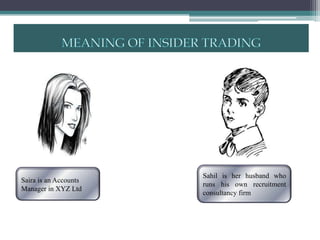
Sahil is her husband who
Saira is an Accounts
                       runs his own recruitment
Manager in XYZ Ltd
                       consultancy firm
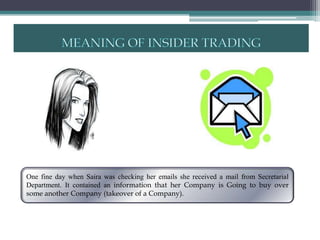
One fine day when Saira was checking her emails she received a mail from Secretarial
Department. It contained an information that her Company is Going to buy over
some another Company (takeover of a Company).
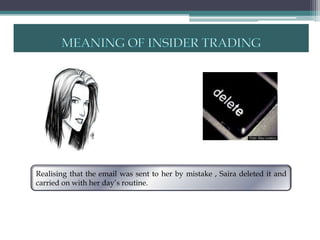
Realising that the email was sent to her by mistake , Saira deleted it and
carried on with her day’s routine.
While taking dinner Saira discussed about the email she received with her
husband.
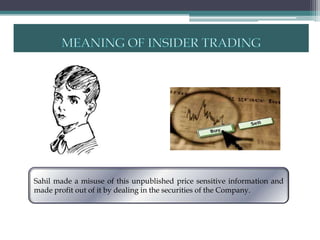
Sahil made a misuse of this unpublished price sensitive information and
made profit out of it by dealing in the securities of the Company.
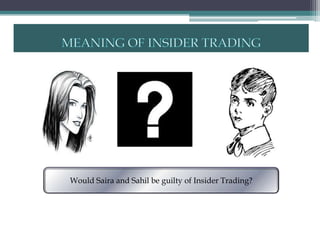
Would Saira and Sahil be guilty of Insider Trading?
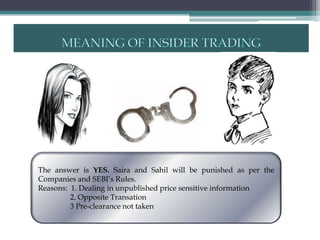
The answer is YES. Saira and Sahil will be punished as per the
Companies and SEBI’s Rules.
Reasons: 1. Dealing in unpublished price sensitive information
         2. Opposite Transation
         3 Pre-clearance not taken
As per SEBI the prohibition of Insider Trading is required to
make securities market:

oFair and Transparent

oTo have a level playing field for all the participants in market

oFree flow of information

oAvoid information asymmetry
An insider means any person who,

o is connected with the Company or is deemed to have been
   connected with the Company and is reasonably expected to
   have access to unpublished price sensitive information in
   respect of securities of a Company, or

o has received or has had access to such unpublished price
  sensitive information
As per Securities And Exchange Board of India (Prohibition of Insider
Trading), 1992 , connected persons are as below:

o Member of the Board of Directors of the Company Officer or an employee of
  the Company

o Company under the same management or group or any subsidiary company
   thereof

o Intermediaries like investment company, trustee company,asset management
  Company, merchant Banker, share transfer Agent, Registrar to an issue,
  broker, portfolio manager, Investment advisor, banker etc

o Official or an employee of a self regulatory Organisation

o An Official of a stock exchange or of clearing house corporation

o Relatives of all the above (as per section 6 of the Co. Act, 1956)
The following shall be deemed to be price sensitive information:


oPeriodical financial results of the Company

oIntended declaration of dividends (both interim and final)

oIntended issue of securities or buy-back of securities

oAny major expansion plans or execution of new projects

oAmalgamations, mergers or take-overs

oDisposal of the whole or substantially the whole of an undertaking
o Any changes in policies, plans of the Company

o Revision of credit ratings assigned to any debt or equity
  instrument of the Company

o Litigation /dispute with a material impact

o Cancellation of dividend/rights/bonus, etc

o Any other information which materially affects the prices of
  the securities of the Company
oProhibited Period Transactions

 Connected Person (CP) not to deal during prohibited period (CP
 shall be entitled to exercise the option under ESOP but cannot sale
 during the Period

oOpposite Transaction

 CP not to buy/sell during the next six months following the prior
 transactions (except ESOPs)
o Any period other than the prohibited period is free period

o Share Dealing can be done in this period subject to pre-clearance
  from the Compliance Officer
oInitial Disclosure (as per regulation 13(1) of the SEBI (Prohibition
 of Insider Trading) Regulations, 1992

Any person who holds more than 5% shares or voting rights in
any Listed Company shall disclose to the Company in Form A
within 2 working days of acquiring the shares or voting rights

Any person who is a Director or Officer (including their
dependants) of a Listed Company should disclose to the
Company in Form B all its trade positions in equity or derivatives
within 2 days of appointment
o Continual Disclosure (as per regulation 13(1) of the SEBI
  (Prohibition of Insider Trading) Regulations, 1992

Any person holding more than 5% shares or voting rights in any listed
Company shall disclose to the Company in Form C the number of shares
or voting rights held or any change exceeding 2% of total shareholding or
voting rights in the Company within 2 days of acquisition of shares

Any person who is a Director or Officer (including their dependants) of a
Listed Company should disclose to the Company in Form D, if change
exceeds Rs. 5 Lakhs in value or 25000 shares or 1% of total shareholding or
voting rights whichever is lower within 2 days of acquisition or sale of
shares
o Initiate Criminal Prosecution against the defaulter

o Prohibition from Dealing in any kind of Securities

o Restraining the defaulter from any counseling to any person to deal in
  securities

o Null and voiding such transactions

o Penalty of Rs. 25 crore or 3 times the amount of profit made
whichever is
  higher

o Imprisonment upto 10 years or fine upto 25 crores or both.
PRESENTED BY:
SHIKHA JAIN

insider_trading_

  • 1.
  • 2.
    o History o LegalFramework o Meaning of Insider Trading o Need of Insider Trading Regulation o Meaning of Insiders o Connected Persons o Price Sensitive Information o Prohibition of Trading
  • 3.
    o Free Period oDisclosures as per Securities And Exchange Board of India (Prohibition of Insider Trading), 1992 o Penalties
  • 4.
    o In 1979,the Sachar Committee recommended amendments to the Companies Act,1956 to prohibit the insider trading. o In 1986, the Patel Committee recommended that the Securities Contracts Act, 1956 may be amended to curb insider trading and unfair stock deals. o In 1989, the Abid Hussain Committee recommended that the insider trading activities may be penalised by civil and criminal proceedings and also suggested the Securities And Exchange Board of India (SEBI) to formulate the regulations and the governing codes to prevent unfair dealings. o In 1992, Securities And Exchange Board of India (prohibition of Insider Trading) Regulations, came into force to prohibit insider activities.
  • 5.
    o SEBI introducedregulations to govern Insider Trading in 1992 o Regulations modified from time to time o Applicable to all Listed Companies o Applicable to all Registered Intermediaries o Regulations require Company to adopt internal code of conduct
  • 6.
    Sahil is herhusband who Saira is an Accounts runs his own recruitment Manager in XYZ Ltd consultancy firm
  • 7.
    One fine daywhen Saira was checking her emails she received a mail from Secretarial Department. It contained an information that her Company is Going to buy over some another Company (takeover of a Company).
  • 8.
    Realising that theemail was sent to her by mistake , Saira deleted it and carried on with her day’s routine.
  • 9.
    While taking dinnerSaira discussed about the email she received with her husband.
  • 10.
    Sahil made amisuse of this unpublished price sensitive information and made profit out of it by dealing in the securities of the Company.
  • 11.
    Would Saira andSahil be guilty of Insider Trading?
  • 12.
    The answer isYES. Saira and Sahil will be punished as per the Companies and SEBI’s Rules. Reasons: 1. Dealing in unpublished price sensitive information 2. Opposite Transation 3 Pre-clearance not taken
  • 13.
    As per SEBIthe prohibition of Insider Trading is required to make securities market: oFair and Transparent oTo have a level playing field for all the participants in market oFree flow of information oAvoid information asymmetry
  • 14.
    An insider meansany person who, o is connected with the Company or is deemed to have been connected with the Company and is reasonably expected to have access to unpublished price sensitive information in respect of securities of a Company, or o has received or has had access to such unpublished price sensitive information
  • 15.
    As per SecuritiesAnd Exchange Board of India (Prohibition of Insider Trading), 1992 , connected persons are as below: o Member of the Board of Directors of the Company Officer or an employee of the Company o Company under the same management or group or any subsidiary company thereof o Intermediaries like investment company, trustee company,asset management Company, merchant Banker, share transfer Agent, Registrar to an issue, broker, portfolio manager, Investment advisor, banker etc o Official or an employee of a self regulatory Organisation o An Official of a stock exchange or of clearing house corporation o Relatives of all the above (as per section 6 of the Co. Act, 1956)
  • 16.
    The following shallbe deemed to be price sensitive information: oPeriodical financial results of the Company oIntended declaration of dividends (both interim and final) oIntended issue of securities or buy-back of securities oAny major expansion plans or execution of new projects oAmalgamations, mergers or take-overs oDisposal of the whole or substantially the whole of an undertaking
  • 17.
    o Any changesin policies, plans of the Company o Revision of credit ratings assigned to any debt or equity instrument of the Company o Litigation /dispute with a material impact o Cancellation of dividend/rights/bonus, etc o Any other information which materially affects the prices of the securities of the Company
  • 18.
    oProhibited Period Transactions Connected Person (CP) not to deal during prohibited period (CP shall be entitled to exercise the option under ESOP but cannot sale during the Period oOpposite Transaction CP not to buy/sell during the next six months following the prior transactions (except ESOPs)
  • 19.
    o Any periodother than the prohibited period is free period o Share Dealing can be done in this period subject to pre-clearance from the Compliance Officer
  • 20.
    oInitial Disclosure (asper regulation 13(1) of the SEBI (Prohibition of Insider Trading) Regulations, 1992 Any person who holds more than 5% shares or voting rights in any Listed Company shall disclose to the Company in Form A within 2 working days of acquiring the shares or voting rights Any person who is a Director or Officer (including their dependants) of a Listed Company should disclose to the Company in Form B all its trade positions in equity or derivatives within 2 days of appointment
  • 21.
    o Continual Disclosure(as per regulation 13(1) of the SEBI (Prohibition of Insider Trading) Regulations, 1992 Any person holding more than 5% shares or voting rights in any listed Company shall disclose to the Company in Form C the number of shares or voting rights held or any change exceeding 2% of total shareholding or voting rights in the Company within 2 days of acquisition of shares Any person who is a Director or Officer (including their dependants) of a Listed Company should disclose to the Company in Form D, if change exceeds Rs. 5 Lakhs in value or 25000 shares or 1% of total shareholding or voting rights whichever is lower within 2 days of acquisition or sale of shares
  • 22.
    o Initiate CriminalProsecution against the defaulter o Prohibition from Dealing in any kind of Securities o Restraining the defaulter from any counseling to any person to deal in securities o Null and voiding such transactions o Penalty of Rs. 25 crore or 3 times the amount of profit made whichever is higher o Imprisonment upto 10 years or fine upto 25 crores or both.
  • 23.