INSIDER TRADING
INSIDER TRADING
It is defined as :
“Buying or selling a company’s stock on the
basis of inside information about the
company.”
INSIDE INFORMATION
The information that is not available to
general public outside the company is
termed as insider trading. But if this
information is available to general public, it
would have a significant impact on the price
of company’s stock.
EXAMPLE
George, the president of defense company
learns that the company is about to receive a
multi-billion dollar contract from government.
By learning this news, he buys several
shares of his company stock and knowing
that the value of share will rise… Such type
of purchasing stock is considered to be as
insider trading.
ETHICS OF INSIDER TRADING
Insider trading is unethical and illegal
because it is the theft of information that
gives an insider an unfair advantage.
ARGUMENTS ON INSIDER TRADING
It has been defended as:
(a) It ensures stock prices reflect to the true
value of the stock.
(b)It does not harm any one.
(c) It has an advantage over others in the
market is not wrong in itself and is common
with experts
CRITICISM
Defenders have been criticized because
(a) The information the insider uses is not for
his or hers so stolen.
(b)Trading on inside information has harmful
effects on the stock market and increases the
cost of buying and selling stocks.
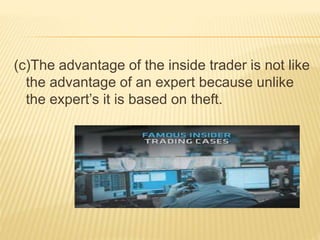
(c)The advantage of the inside trader is not like
the advantage of an expert because unlike
the expert’s it is based on theft.
EFFECTS ON STOCK MARKET
Studies show that insider trading has 2
effects on stock market that are harmful to
everyone in the market and to the society in
general.
FIRST EFFECT
Insider trading tends to reduce the size of
the market, and this harms everyone.
Harmful effects are:
(a) A decline in the liquidity of stock because it
is harder to find buyers & sellers for stock.
(b) Increase in the variability of stock prices
(c) A decline in the market’s ability to spread
risk.
(d) A decline in the market efficiency due to
reduce number of buyers and sellers.
(e) a decline in the utility gains available to
traders.
SECOND EFFECT
Insider trading increases the cost of buying
and selling stocks in the market.
In short, insider trading violates our
moral STDS of right, justice, utility. But the
issue continues to be greatly debated and is
still not completely settled. Court declared
that insider trading in illegal.
Insider trading

Insider trading

  • 1.
  • 2.
    INSIDER TRADING It isdefined as : “Buying or selling a company’s stock on the basis of inside information about the company.”
  • 3.
    INSIDE INFORMATION The informationthat is not available to general public outside the company is termed as insider trading. But if this information is available to general public, it would have a significant impact on the price of company’s stock.
  • 4.
    EXAMPLE George, the presidentof defense company learns that the company is about to receive a multi-billion dollar contract from government. By learning this news, he buys several shares of his company stock and knowing that the value of share will rise… Such type of purchasing stock is considered to be as insider trading.
  • 5.
    ETHICS OF INSIDERTRADING Insider trading is unethical and illegal because it is the theft of information that gives an insider an unfair advantage.
  • 6.
    ARGUMENTS ON INSIDERTRADING It has been defended as: (a) It ensures stock prices reflect to the true value of the stock. (b)It does not harm any one. (c) It has an advantage over others in the market is not wrong in itself and is common with experts
  • 7.
    CRITICISM Defenders have beencriticized because (a) The information the insider uses is not for his or hers so stolen. (b)Trading on inside information has harmful effects on the stock market and increases the cost of buying and selling stocks.
  • 8.
    (c)The advantage ofthe inside trader is not like the advantage of an expert because unlike the expert’s it is based on theft.
  • 9.
    EFFECTS ON STOCKMARKET Studies show that insider trading has 2 effects on stock market that are harmful to everyone in the market and to the society in general.
  • 10.
    FIRST EFFECT Insider tradingtends to reduce the size of the market, and this harms everyone. Harmful effects are: (a) A decline in the liquidity of stock because it is harder to find buyers & sellers for stock. (b) Increase in the variability of stock prices
  • 11.
    (c) A declinein the market’s ability to spread risk. (d) A decline in the market efficiency due to reduce number of buyers and sellers. (e) a decline in the utility gains available to traders.
  • 12.
    SECOND EFFECT Insider tradingincreases the cost of buying and selling stocks in the market. In short, insider trading violates our moral STDS of right, justice, utility. But the issue continues to be greatly debated and is still not completely settled. Court declared that insider trading in illegal.