Writing a Technical Paper using LATEX and Managing
References
Komala Anamalamudi
Research Officer, RRC
Madanapalle Institute of Technology& Science, Madanapalle
15 April 2015
Komala Anamalamudi Campus Lecture Series 15 April 2015 1 / 38
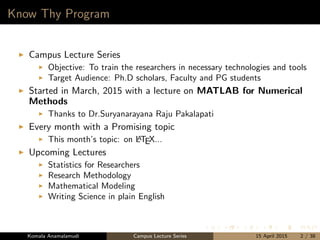
Know Thy Program
Campus Lecture Series
Objective: To train the researchers in necessary technologies and tools
Target Audience: Ph.D scholars, Faculty and PG students
Started in March, 2015 with a lecture on MATLAB for Numerical
Methods
Thanks to Dr.Suryanarayana Raju Pakalapati
Every month with a Promising topic
This month’s topic: on LATEX...
Upcoming Lectures
Statistics for Researchers
Research Methodology
Mathematical Modeling
Writing Science in plain English
Komala Anamalamudi Campus Lecture Series 15 April 2015 2 / 38
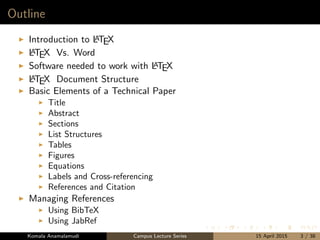
Outline
Introduction to LATEX
LATEX Vs. Word
Software needed to work with LATEX
LATEX Document Structure
Basic Elements of a Technical Paper
Title
Abstract
Sections
List Structures
Tables
Figures
Equations
Labels and Cross-referencing
References and Citation
Managing References
Using BibTeX
Using JabRef
Komala Anamalamudi Campus Lecture Series 15 April 2015 3 / 38
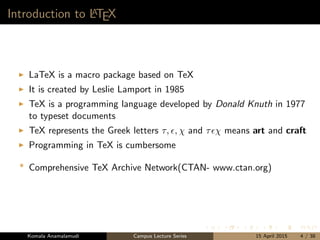
Introduction to LATEX
LaTeX is a macro package based on TeX
It is created by Leslie Lamport in 1985
TeX is a programming language developed by Donald Knuth in 1977
to typeset documents
TeX represents the Greek letters τ, , χ and τ χ means art and craft
Programming in TeX is cumbersome
* Comprehensive TeX Archive Network(CTAN- www.ctan.org)
Komala Anamalamudi Campus Lecture Series 15 April 2015 4 / 38
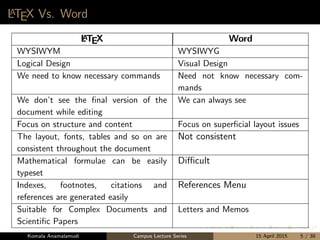
LATEX Vs. Word
LATEX Word
WYSIWYM WYSIWYG
Logical Design Visual Design
We need to know necessary commands Need not know necessary com-
mands
We don’t see the final version of the
document while editing
We can always see
Focus on structure and content Focus on superficial layout issues
The layout, fonts, tables and so on are
consistent throughout the document
Not consistent
Mathematical formulae can be easily
typeset
Difficult
Indexes, footnotes, citations and
references are generated easily
References Menu
Suitable for Complex Documents and
Scientific Papers
Letters and Memos
Komala Anamalamudi Campus Lecture Series 15 April 2015 5 / 38
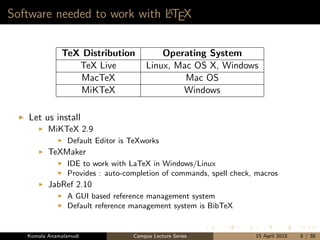
Software needed to work with LATEX
TeX Distribution Operating System
TeX Live Linux, Mac OS X, Windows
MacTeX Mac OS
MiKTeX Windows
Let us install
MiKTeX 2.9
Default Editor is TeXworks
TeXMaker
IDE to work with LaTeX in Windows/Linux
Provides : auto-completion of commands, spell check, macros
JabRef 2.10
A GUI based reference management system
Default reference management system is BibTeX
Komala Anamalamudi Campus Lecture Series 15 April 2015 6 / 38
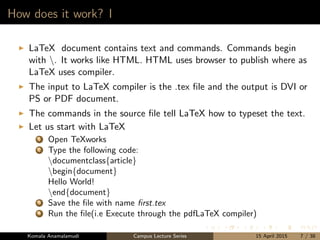
How does it work? I
LaTeX document contains text and commands. Commands begin
with . It works like HTML. HTML uses browser to publish where as
LaTeX uses compiler.
The input to LaTeX compiler is the .tex file and the output is DVI or
PS or PDF document.
The commands in the source file tell LaTeX how to typeset the text.
Let us start with LaTeX
1 Open TeXworks
2 Type the following code:
documentclass{article}
begin{document}
Hello World!
end{document}
3 Save the file with name first.tex
4 Run the file(i.e Execute through the pdfLaTeX compiler)
Komala Anamalamudi Campus Lecture Series 15 April 2015 7 / 38
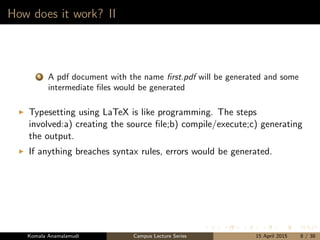
How does it work? II
5 A pdf document with the name first.pdf will be generated and some
intermediate files would be generated
Typesetting using LaTeX is like programming. The steps
involved:a) creating the source file;b) compile/execute;c) generating
the output.
If anything breaches syntax rules, errors would be generated.
Komala Anamalamudi Campus Lecture Series 15 April 2015 8 / 38
Document Structure I
documentclass{...}
usepackage{...}
begin{document
. . .
end{document}
The part of the text preceding begin{document} is called preamble.
It contains commands that apply to the whole document
documentclass
Syntax: documentclass[options]{class}
Example:documentclass[11pt,a4paper,twocolumn]{article}
Some classes are:
article
IEEEtran
report
book
Komala Anamalamudi Campus Lecture Series 15 April 2015 9 / 38
Document Structure II
letter
beamer
usepackage
is used to include additional packages and enhance capabilities of
basic LaTeX
Syntax: usepackage[options]{package}
usepackage{package1,package2,package3}
Example: usepackage{color}
Komala Anamalamudi Campus Lecture Series 15 April 2015 10 / 38
Basic Elements of a
Technical Paper
Komala Anamalamudi Campus Lecture Series 15 April 2015 11 / 38
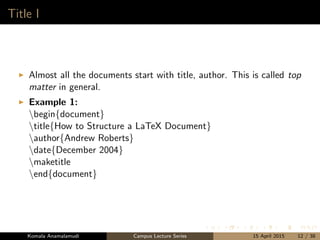
Title I
Almost all the documents start with title, author. This is called top
matter in general.
Example 1:
begin{document}
title{How to Structure a LaTeX Document}
author{Andrew Roberts}
date{December 2004}
maketitle
end{document}
Komala Anamalamudi Campus Lecture Series 15 April 2015 12 / 38
Title II
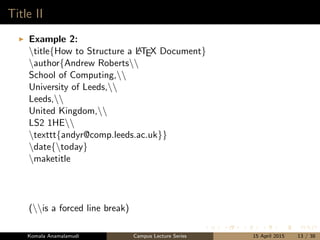
Example 2:
title{How to Structure a LATEX Document}
author{Andrew Roberts
School of Computing,
University of Leeds,
Leeds,
United Kingdom,
LS2 1HE
texttt{andyr@comp.leeds.ac.uk}}
date{today}
maketitle
(is a forced line break)
Komala Anamalamudi Campus Lecture Series 15 April 2015 13 / 38
Abstract
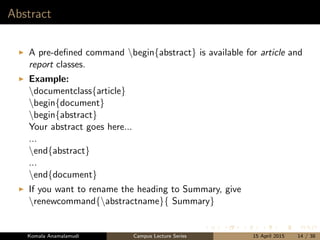
A pre-defined command begin{abstract} is available for article and
report classes.
Example:
documentclass{article}
begin{document}
begin{abstract}
Your abstract goes here...
...
end{abstract}
...
end{document}
If you want to rename the heading to Summary, give
renewcommand{abstractname}{ Summary}
Komala Anamalamudi Campus Lecture Series 15 April 2015 14 / 38
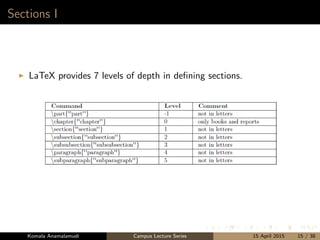
Sections I
LaTeX provides 7 levels of depth in defining sections.
Komala Anamalamudi Campus Lecture Series 15 April 2015 15 / 38
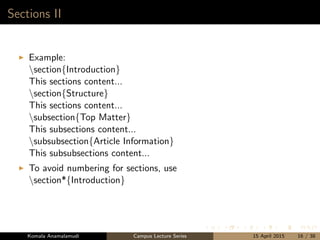
Sections II
Example:
section{Introduction}
This sections content...
section{Structure}
This sections content...
subsection{Top Matter}
This subsections content...
subsubsection{Article Information}
This subsubsections content...
To avoid numbering for sections, use
section*{Introduction}
Komala Anamalamudi Campus Lecture Series 15 April 2015 16 / 38
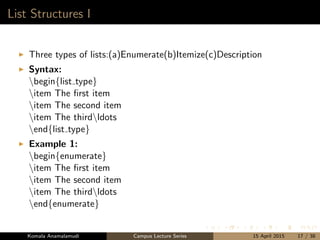
List Structures I
Three types of lists:(a)Enumerate(b)Itemize(c)Description
Syntax:
begin{list type}
item The first item
item The second item
item The thirdldots
end{list type}
Example 1:
begin{enumerate}
item The first item
item The second item
item The thirdldots
end{enumerate}
Komala Anamalamudi Campus Lecture Series 15 April 2015 17 / 38
List Structures II
Example 2:
begin{itemize}
item The first item
item The second item
item The thirdldots
end{itemize}
Example 3:
begin{description}
item[First] The first item
item[Second] The second item
item[Third] The thirdldots
end{description}
Komala Anamalamudi Campus Lecture Series 15 April 2015 18 / 38
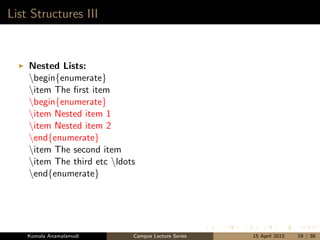
List Structures III
Nested Lists:
begin{enumerate}
item The first item
begin{enumerate}
item Nested item 1
item Nested item 2
end{enumerate}
item The second item
item The third etc ldots
end{enumerate}
Komala Anamalamudi Campus Lecture Series 15 April 2015 19 / 38
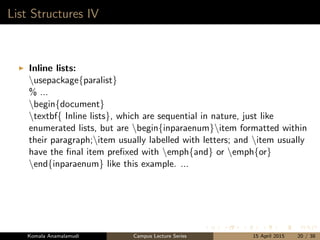
List Structures IV
Inline lists:
usepackage{paralist}
% ...
begin{document}
textbf{ Inline lists}, which are sequential in nature, just like
enumerated lists, but are begin{inparaenum}item formatted within
their paragraph;item usually labelled with letters; and item usually
have the final item prefixed with emph{and} or emph{or}
end{inparaenum} like this example. ...
Komala Anamalamudi Campus Lecture Series 15 April 2015 20 / 38
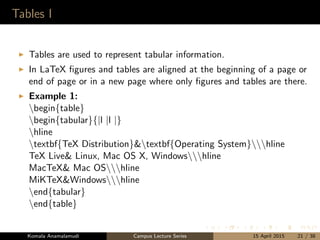
Tables I
Tables are used to represent tabular information.
In LaTeX figures and tables are aligned at the beginning of a page or
end of page or in a new page where only figures and tables are there.
Example 1:
begin{table}
begin{tabular}{|l |l |}
hline
textbf{TeX Distribution}&textbf{Operating System}hline
TeX Live& Linux, Mac OS X, Windowshline
MacTeX& Mac OShline
MiKTeX&Windowshline
end{tabular}
end{table}
Komala Anamalamudi Campus Lecture Series 15 April 2015 21 / 38
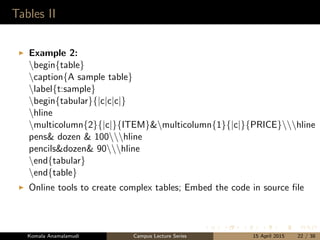
Tables II
Example 2:
begin{table}
caption{A sample table}
label{t:sample}
begin{tabular}{|c|c|c|}
hline
multicolumn{2}{|c|}{ITEM}&multicolumn{1}{|c|}{PRICE}hline
pens& dozen & 100hline
pencils&dozen& 90hline
end{tabular}
end{table}
Online tools to create complex tables; Embed the code in source file
Komala Anamalamudi Campus Lecture Series 15 April 2015 22 / 38
Figures
Pictures can be drawn in LaTeX using picture environment.
To include readily available pictures into LaTeX document, we can
use the command
includegraphics[options]{image-name}
For this, give usepackage{graphicx} in the preamble
Example:
begin{figure}
includegraphics[scale=0.5]{mits}%mits.png is in current directory
caption{Logo}
label{f:ml}% for referencing
end{figure}
Komala Anamalamudi Campus Lecture Series 15 April 2015 23 / 38
Equations I
Typesetting mathematics is one of LaTeX’s greatest strengths.
Useful Packages
amsmath
mathtools
* mathtools package is superior to amsmath package.
Math Mode Environments
1 $ Formula $
2 ( Formula )
3 [ Formula ]
4 begin{math} Formula end{math}
5 begin{displaymath} Formula end{displaymath}
6 begin{equation} Formula end{equation}
7 begin{eqnarray} Formula end{eqnarray}
Komala Anamalamudi Campus Lecture Series 15 April 2015 24 / 38
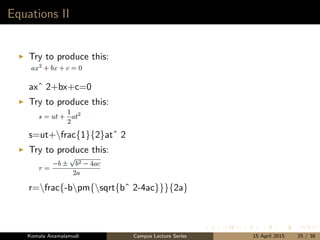
Equations II
Try to produce this:
axˆ 2+bx+c=0
Try to produce this:
s=ut+frac{1}{2}atˆ 2
Try to produce this:
r=frac{-bpm{sqrt{bˆ 2-4ac}}}{2a}
Komala Anamalamudi Campus Lecture Series 15 April 2015 25 / 38
Equations III
Try this:
nu(t)=RI[1-expleft (-{frac{t}{tau {m}}} right )]
Try this:
nu(t)=nu {r}expleft (-frac{t-t {0}}{tau {m}} right
)+frac{R}{tau {m}}int {0}ˆ {t-t {0}}expleft (
-frac{s}{tau {m}} right )I(t-s)ds
Komala Anamalamudi Campus Lecture Series 15 April 2015 26 / 38
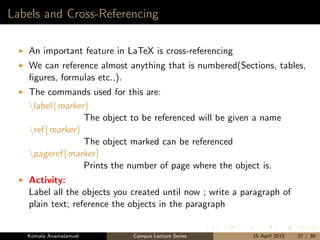
Labels and Cross-Referencing
An important feature in LaTeX is cross-referencing
We can reference almost anything that is numbered(Sections, tables,
figures, formulas etc.,).
The commands used for this are:
label{marker}
The object to be referenced will be given a name
ref{marker}
The object marked can be referenced
pageref{marker}
Prints the number of page where the object is.
Activity:
Label all the objects you created until now ; write a paragraph of
plain text; reference the objects in the paragraph
Komala Anamalamudi Campus Lecture Series 15 April 2015 27 / 38
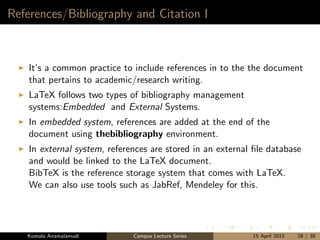
References/Bibliography and Citation I
It’s a common practice to include references in to the the document
that pertains to academic/research writing.
LaTeX follows two types of bibliography management
systems:Embedded and External Systems.
In embedded system, references are added at the end of the
document using thebibliography environment.
In external system, references are stored in an external file database
and would be linked to the LaTeX document.
BibTeX is the reference storage system that comes with LaTeX.
We can also use tools such as JabRef, Mendeley for this.
Komala Anamalamudi Campus Lecture Series 15 April 2015 28 / 38
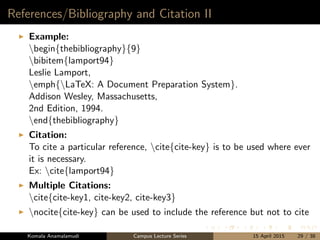
References/Bibliography and Citation II
Example:
begin{thebibliography}{9}
bibitem{lamport94}
Leslie Lamport,
emph{LaTeX: A Document Preparation System}.
Addison Wesley, Massachusetts,
2nd Edition, 1994.
end{thebibliography}
Citation:
To cite a particular reference, cite{cite-key} is to be used where ever
it is necessary.
Ex: cite{lamport94}
Multiple Citations:
cite{cite-key1, cite-key2, cite-key3}
nocite{cite-key} can be used to include the reference but not to cite
Komala Anamalamudi Campus Lecture Series 15 April 2015 29 / 38
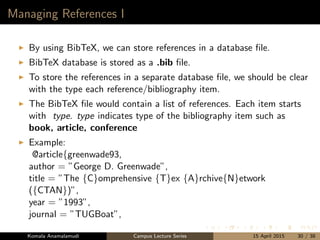
Managing References I
By using BibTeX, we can store references in a database file.
BibTeX database is stored as a .bib file.
To store the references in a separate database file, we should be clear
with the type each reference/bibliography item.
The BibTeX file would contain a list of references. Each item starts
with type. type indicates type of the bibliography item such as
book, article, conference
Example:
@article{greenwade93,
author = ”George D. Greenwade”,
title = ”The {C}omprehensive {T}ex {A}rchive{N}etwork
({CTAN})”,
year = ”1993”,
journal = ”TUGBoat”,
Komala Anamalamudi Campus Lecture Series 15 April 2015 30 / 38
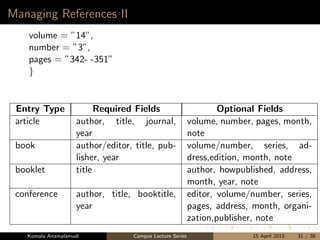
Managing References II
volume = ”14”,
number = ”3”,
pages = ”342- -351”
}
Entry Type Required Fields Optional Fields
article author, title, journal,
year
volume, number, pages, month,
note
book author/editor, title, pub-
lisher, year
volume/number, series, ad-
dress,edition, month, note
booklet title author, howpublished, address,
month, year, note
conference author, title, booktitle,
year
editor, volume/number, series,
pages, address, month, organi-
zation,publisher, note
Komala Anamalamudi Campus Lecture Series 15 April 2015 31 / 38
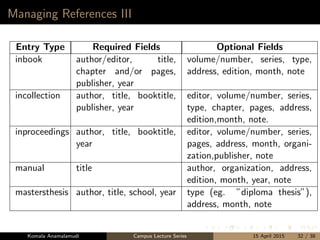
Managing References III
Entry Type Required Fields Optional Fields
inbook author/editor, title,
chapter and/or pages,
publisher, year
volume/number, series, type,
address, edition, month, note
incollection author, title, booktitle,
publisher, year
editor, volume/number, series,
type, chapter, pages, address,
edition,month, note.
inproceedings author, title, booktitle,
year
editor, volume/number, series,
pages, address, month, organi-
zation,publisher, note
manual title author, organization, address,
edition, month, year, note
mastersthesis author, title, school, year type (eg. ”diploma thesis”),
address, month, note
Komala Anamalamudi Campus Lecture Series 15 April 2015 32 / 38
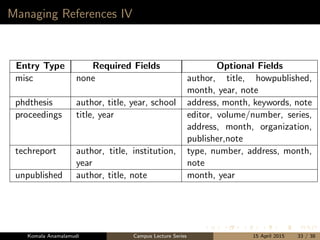
Managing References IV
Entry Type Required Fields Optional Fields
misc none author, title, howpublished,
month, year, note
phdthesis author, title, year, school address, month, keywords, note
proceedings title, year editor, volume/number, series,
address, month, organization,
publisher,note
techreport author, title, institution,
year
type, number, address, month,
note
unpublished author, title, note month, year
Komala Anamalamudi Campus Lecture Series 15 April 2015 33 / 38
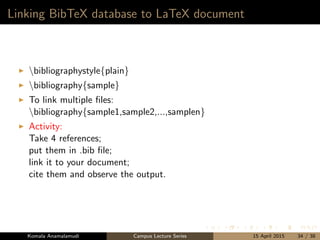
Linking BibTeX database to LaTeX document
bibliographystyle{plain}
bibliography{sample}
To link multiple files:
bibliography{sample1,sample2,...,samplen}
Activity:
Take 4 references;
put them in .bib file;
link it to your document;
cite them and observe the output.
Komala Anamalamudi Campus Lecture Series 15 April 2015 34 / 38
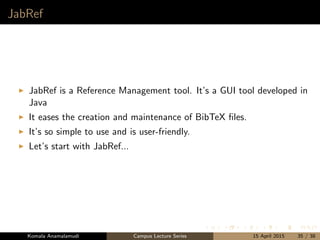
JabRef
JabRef is a Reference Management tool. It’s a GUI tool developed in
Java
It eases the creation and maintenance of BibTeX files.
It’s so simple to use and is user-friendly.
Let’s start with JabRef...
Komala Anamalamudi Campus Lecture Series 15 April 2015 35 / 38
References
[1] “Latex,” Wikibook.
[2] L. Lamport, “Latex users guide & reference manual: A document
preparation system,” Addison-Wesley Publishing Company,, vol. 67,
p. 78, 1993.
Komala Anamalamudi Campus Lecture Series 15 April 2015 36 / 38
Thank You!
Komala Anamalamudi Campus Lecture Series 15 April 2015 37 / 38
Questions?
Komala Anamalamudi Campus Lecture Series 15 April 2015 38 / 38

LaTeX-Presentation

  • 1.
    Writing a TechnicalPaper using LATEX and Managing References Komala Anamalamudi Research Officer, RRC Madanapalle Institute of Technology& Science, Madanapalle 15 April 2015 Komala Anamalamudi Campus Lecture Series 15 April 2015 1 / 38
  • 2.
    Know Thy Program CampusLecture Series Objective: To train the researchers in necessary technologies and tools Target Audience: Ph.D scholars, Faculty and PG students Started in March, 2015 with a lecture on MATLAB for Numerical Methods Thanks to Dr.Suryanarayana Raju Pakalapati Every month with a Promising topic This month’s topic: on LATEX... Upcoming Lectures Statistics for Researchers Research Methodology Mathematical Modeling Writing Science in plain English Komala Anamalamudi Campus Lecture Series 15 April 2015 2 / 38
  • 3.
    Outline Introduction to LATEX LATEXVs. Word Software needed to work with LATEX LATEX Document Structure Basic Elements of a Technical Paper Title Abstract Sections List Structures Tables Figures Equations Labels and Cross-referencing References and Citation Managing References Using BibTeX Using JabRef Komala Anamalamudi Campus Lecture Series 15 April 2015 3 / 38
  • 4.
    Introduction to LATEX LaTeXis a macro package based on TeX It is created by Leslie Lamport in 1985 TeX is a programming language developed by Donald Knuth in 1977 to typeset documents TeX represents the Greek letters τ, , χ and τ χ means art and craft Programming in TeX is cumbersome * Comprehensive TeX Archive Network(CTAN- www.ctan.org) Komala Anamalamudi Campus Lecture Series 15 April 2015 4 / 38
  • 5.
    LATEX Vs. Word LATEXWord WYSIWYM WYSIWYG Logical Design Visual Design We need to know necessary commands Need not know necessary com- mands We don’t see the final version of the document while editing We can always see Focus on structure and content Focus on superficial layout issues The layout, fonts, tables and so on are consistent throughout the document Not consistent Mathematical formulae can be easily typeset Difficult Indexes, footnotes, citations and references are generated easily References Menu Suitable for Complex Documents and Scientific Papers Letters and Memos Komala Anamalamudi Campus Lecture Series 15 April 2015 5 / 38
  • 6.
    Software needed towork with LATEX TeX Distribution Operating System TeX Live Linux, Mac OS X, Windows MacTeX Mac OS MiKTeX Windows Let us install MiKTeX 2.9 Default Editor is TeXworks TeXMaker IDE to work with LaTeX in Windows/Linux Provides : auto-completion of commands, spell check, macros JabRef 2.10 A GUI based reference management system Default reference management system is BibTeX Komala Anamalamudi Campus Lecture Series 15 April 2015 6 / 38
  • 7.
    How does itwork? I LaTeX document contains text and commands. Commands begin with . It works like HTML. HTML uses browser to publish where as LaTeX uses compiler. The input to LaTeX compiler is the .tex file and the output is DVI or PS or PDF document. The commands in the source file tell LaTeX how to typeset the text. Let us start with LaTeX 1 Open TeXworks 2 Type the following code: documentclass{article} begin{document} Hello World! end{document} 3 Save the file with name first.tex 4 Run the file(i.e Execute through the pdfLaTeX compiler) Komala Anamalamudi Campus Lecture Series 15 April 2015 7 / 38
  • 8.
    How does itwork? II 5 A pdf document with the name first.pdf will be generated and some intermediate files would be generated Typesetting using LaTeX is like programming. The steps involved:a) creating the source file;b) compile/execute;c) generating the output. If anything breaches syntax rules, errors would be generated. Komala Anamalamudi Campus Lecture Series 15 April 2015 8 / 38
  • 9.
    Document Structure I documentclass{...} usepackage{...} begin{document .. . end{document} The part of the text preceding begin{document} is called preamble. It contains commands that apply to the whole document documentclass Syntax: documentclass[options]{class} Example:documentclass[11pt,a4paper,twocolumn]{article} Some classes are: article IEEEtran report book Komala Anamalamudi Campus Lecture Series 15 April 2015 9 / 38
  • 10.
    Document Structure II letter beamer usepackage isused to include additional packages and enhance capabilities of basic LaTeX Syntax: usepackage[options]{package} usepackage{package1,package2,package3} Example: usepackage{color} Komala Anamalamudi Campus Lecture Series 15 April 2015 10 / 38
  • 11.
    Basic Elements ofa Technical Paper Komala Anamalamudi Campus Lecture Series 15 April 2015 11 / 38
  • 12.
    Title I Almost allthe documents start with title, author. This is called top matter in general. Example 1: begin{document} title{How to Structure a LaTeX Document} author{Andrew Roberts} date{December 2004} maketitle end{document} Komala Anamalamudi Campus Lecture Series 15 April 2015 12 / 38
  • 13.
    Title II Example 2: title{Howto Structure a LATEX Document} author{Andrew Roberts School of Computing, University of Leeds, Leeds, United Kingdom, LS2 1HE texttt{andyr@comp.leeds.ac.uk}} date{today} maketitle (is a forced line break) Komala Anamalamudi Campus Lecture Series 15 April 2015 13 / 38
  • 14.
    Abstract A pre-defined commandbegin{abstract} is available for article and report classes. Example: documentclass{article} begin{document} begin{abstract} Your abstract goes here... ... end{abstract} ... end{document} If you want to rename the heading to Summary, give renewcommand{abstractname}{ Summary} Komala Anamalamudi Campus Lecture Series 15 April 2015 14 / 38
  • 15.
    Sections I LaTeX provides7 levels of depth in defining sections. Komala Anamalamudi Campus Lecture Series 15 April 2015 15 / 38
  • 16.
    Sections II Example: section{Introduction} This sectionscontent... section{Structure} This sections content... subsection{Top Matter} This subsections content... subsubsection{Article Information} This subsubsections content... To avoid numbering for sections, use section*{Introduction} Komala Anamalamudi Campus Lecture Series 15 April 2015 16 / 38
  • 17.
    List Structures I Threetypes of lists:(a)Enumerate(b)Itemize(c)Description Syntax: begin{list type} item The first item item The second item item The thirdldots end{list type} Example 1: begin{enumerate} item The first item item The second item item The thirdldots end{enumerate} Komala Anamalamudi Campus Lecture Series 15 April 2015 17 / 38
  • 18.
    List Structures II Example2: begin{itemize} item The first item item The second item item The thirdldots end{itemize} Example 3: begin{description} item[First] The first item item[Second] The second item item[Third] The thirdldots end{description} Komala Anamalamudi Campus Lecture Series 15 April 2015 18 / 38
  • 19.
    List Structures III NestedLists: begin{enumerate} item The first item begin{enumerate} item Nested item 1 item Nested item 2 end{enumerate} item The second item item The third etc ldots end{enumerate} Komala Anamalamudi Campus Lecture Series 15 April 2015 19 / 38
  • 20.
    List Structures IV Inlinelists: usepackage{paralist} % ... begin{document} textbf{ Inline lists}, which are sequential in nature, just like enumerated lists, but are begin{inparaenum}item formatted within their paragraph;item usually labelled with letters; and item usually have the final item prefixed with emph{and} or emph{or} end{inparaenum} like this example. ... Komala Anamalamudi Campus Lecture Series 15 April 2015 20 / 38
  • 21.
    Tables I Tables areused to represent tabular information. In LaTeX figures and tables are aligned at the beginning of a page or end of page or in a new page where only figures and tables are there. Example 1: begin{table} begin{tabular}{|l |l |} hline textbf{TeX Distribution}&textbf{Operating System}hline TeX Live& Linux, Mac OS X, Windowshline MacTeX& Mac OShline MiKTeX&Windowshline end{tabular} end{table} Komala Anamalamudi Campus Lecture Series 15 April 2015 21 / 38
  • 22.
    Tables II Example 2: begin{table} caption{Asample table} label{t:sample} begin{tabular}{|c|c|c|} hline multicolumn{2}{|c|}{ITEM}&multicolumn{1}{|c|}{PRICE}hline pens& dozen & 100hline pencils&dozen& 90hline end{tabular} end{table} Online tools to create complex tables; Embed the code in source file Komala Anamalamudi Campus Lecture Series 15 April 2015 22 / 38
  • 23.
    Figures Pictures can bedrawn in LaTeX using picture environment. To include readily available pictures into LaTeX document, we can use the command includegraphics[options]{image-name} For this, give usepackage{graphicx} in the preamble Example: begin{figure} includegraphics[scale=0.5]{mits}%mits.png is in current directory caption{Logo} label{f:ml}% for referencing end{figure} Komala Anamalamudi Campus Lecture Series 15 April 2015 23 / 38
  • 24.
    Equations I Typesetting mathematicsis one of LaTeX’s greatest strengths. Useful Packages amsmath mathtools * mathtools package is superior to amsmath package. Math Mode Environments 1 $ Formula $ 2 ( Formula ) 3 [ Formula ] 4 begin{math} Formula end{math} 5 begin{displaymath} Formula end{displaymath} 6 begin{equation} Formula end{equation} 7 begin{eqnarray} Formula end{eqnarray} Komala Anamalamudi Campus Lecture Series 15 April 2015 24 / 38
  • 25.
    Equations II Try toproduce this: axˆ 2+bx+c=0 Try to produce this: s=ut+frac{1}{2}atˆ 2 Try to produce this: r=frac{-bpm{sqrt{bˆ 2-4ac}}}{2a} Komala Anamalamudi Campus Lecture Series 15 April 2015 25 / 38
  • 26.
    Equations III Try this: nu(t)=RI[1-expleft(-{frac{t}{tau {m}}} right )] Try this: nu(t)=nu {r}expleft (-frac{t-t {0}}{tau {m}} right )+frac{R}{tau {m}}int {0}ˆ {t-t {0}}expleft ( -frac{s}{tau {m}} right )I(t-s)ds Komala Anamalamudi Campus Lecture Series 15 April 2015 26 / 38
  • 27.
    Labels and Cross-Referencing Animportant feature in LaTeX is cross-referencing We can reference almost anything that is numbered(Sections, tables, figures, formulas etc.,). The commands used for this are: label{marker} The object to be referenced will be given a name ref{marker} The object marked can be referenced pageref{marker} Prints the number of page where the object is. Activity: Label all the objects you created until now ; write a paragraph of plain text; reference the objects in the paragraph Komala Anamalamudi Campus Lecture Series 15 April 2015 27 / 38
  • 28.
    References/Bibliography and CitationI It’s a common practice to include references in to the the document that pertains to academic/research writing. LaTeX follows two types of bibliography management systems:Embedded and External Systems. In embedded system, references are added at the end of the document using thebibliography environment. In external system, references are stored in an external file database and would be linked to the LaTeX document. BibTeX is the reference storage system that comes with LaTeX. We can also use tools such as JabRef, Mendeley for this. Komala Anamalamudi Campus Lecture Series 15 April 2015 28 / 38
  • 29.
    References/Bibliography and CitationII Example: begin{thebibliography}{9} bibitem{lamport94} Leslie Lamport, emph{LaTeX: A Document Preparation System}. Addison Wesley, Massachusetts, 2nd Edition, 1994. end{thebibliography} Citation: To cite a particular reference, cite{cite-key} is to be used where ever it is necessary. Ex: cite{lamport94} Multiple Citations: cite{cite-key1, cite-key2, cite-key3} nocite{cite-key} can be used to include the reference but not to cite Komala Anamalamudi Campus Lecture Series 15 April 2015 29 / 38
  • 30.
    Managing References I Byusing BibTeX, we can store references in a database file. BibTeX database is stored as a .bib file. To store the references in a separate database file, we should be clear with the type each reference/bibliography item. The BibTeX file would contain a list of references. Each item starts with type. type indicates type of the bibliography item such as book, article, conference Example: @article{greenwade93, author = ”George D. Greenwade”, title = ”The {C}omprehensive {T}ex {A}rchive{N}etwork ({CTAN})”, year = ”1993”, journal = ”TUGBoat”, Komala Anamalamudi Campus Lecture Series 15 April 2015 30 / 38
  • 31.
    Managing References II volume= ”14”, number = ”3”, pages = ”342- -351” } Entry Type Required Fields Optional Fields article author, title, journal, year volume, number, pages, month, note book author/editor, title, pub- lisher, year volume/number, series, ad- dress,edition, month, note booklet title author, howpublished, address, month, year, note conference author, title, booktitle, year editor, volume/number, series, pages, address, month, organi- zation,publisher, note Komala Anamalamudi Campus Lecture Series 15 April 2015 31 / 38
  • 32.
    Managing References III EntryType Required Fields Optional Fields inbook author/editor, title, chapter and/or pages, publisher, year volume/number, series, type, address, edition, month, note incollection author, title, booktitle, publisher, year editor, volume/number, series, type, chapter, pages, address, edition,month, note. inproceedings author, title, booktitle, year editor, volume/number, series, pages, address, month, organi- zation,publisher, note manual title author, organization, address, edition, month, year, note mastersthesis author, title, school, year type (eg. ”diploma thesis”), address, month, note Komala Anamalamudi Campus Lecture Series 15 April 2015 32 / 38
  • 33.
    Managing References IV EntryType Required Fields Optional Fields misc none author, title, howpublished, month, year, note phdthesis author, title, year, school address, month, keywords, note proceedings title, year editor, volume/number, series, address, month, organization, publisher,note techreport author, title, institution, year type, number, address, month, note unpublished author, title, note month, year Komala Anamalamudi Campus Lecture Series 15 April 2015 33 / 38
  • 34.
    Linking BibTeX databaseto LaTeX document bibliographystyle{plain} bibliography{sample} To link multiple files: bibliography{sample1,sample2,...,samplen} Activity: Take 4 references; put them in .bib file; link it to your document; cite them and observe the output. Komala Anamalamudi Campus Lecture Series 15 April 2015 34 / 38
  • 35.
    JabRef JabRef is aReference Management tool. It’s a GUI tool developed in Java It eases the creation and maintenance of BibTeX files. It’s so simple to use and is user-friendly. Let’s start with JabRef... Komala Anamalamudi Campus Lecture Series 15 April 2015 35 / 38
  • 36.
    References [1] “Latex,” Wikibook. [2]L. Lamport, “Latex users guide & reference manual: A document preparation system,” Addison-Wesley Publishing Company,, vol. 67, p. 78, 1993. Komala Anamalamudi Campus Lecture Series 15 April 2015 36 / 38
  • 37.
    Thank You! Komala AnamalamudiCampus Lecture Series 15 April 2015 37 / 38
  • 38.
    Questions? Komala Anamalamudi CampusLecture Series 15 April 2015 38 / 38