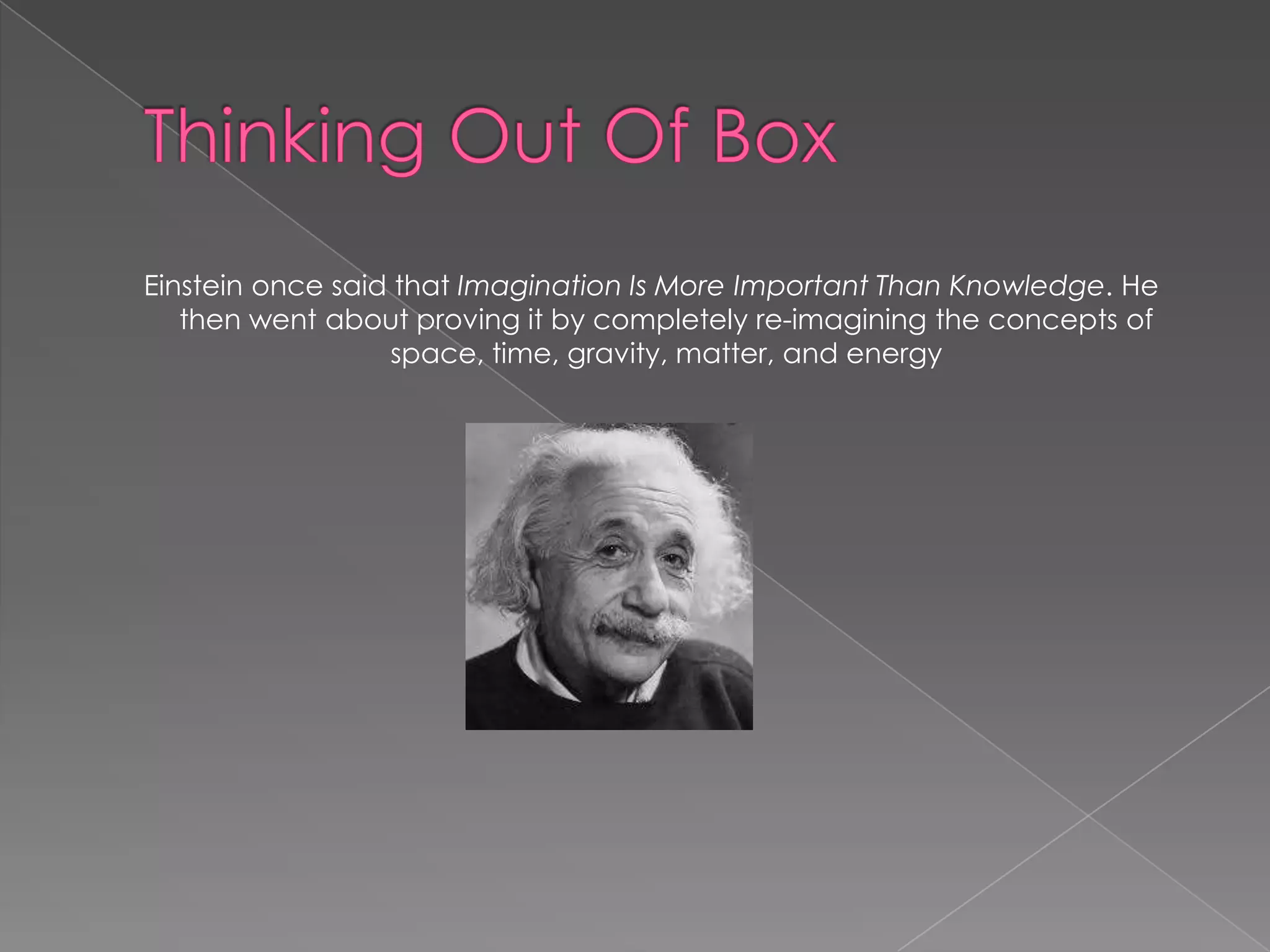
Einstein once said that Imagination Is More Important Than Knowledge. He
   then went about proving it by completely re-imagining the concepts of
                  space, time, gravity, matter, and energy
First of all -----

What Do You Mean By “The Box” ?

The range of thought and action in a workplace that is deemed “acceptable”.

Constraints, developed by cultures and organizations to govern behavior , to govern behavior

Professional standards and procedures determined to be “best practices”.
Do existing constraints preclude your options for success?

Is the thinking that has gotten you into trouble able to get you out?

Does continuous improvement require creativity?
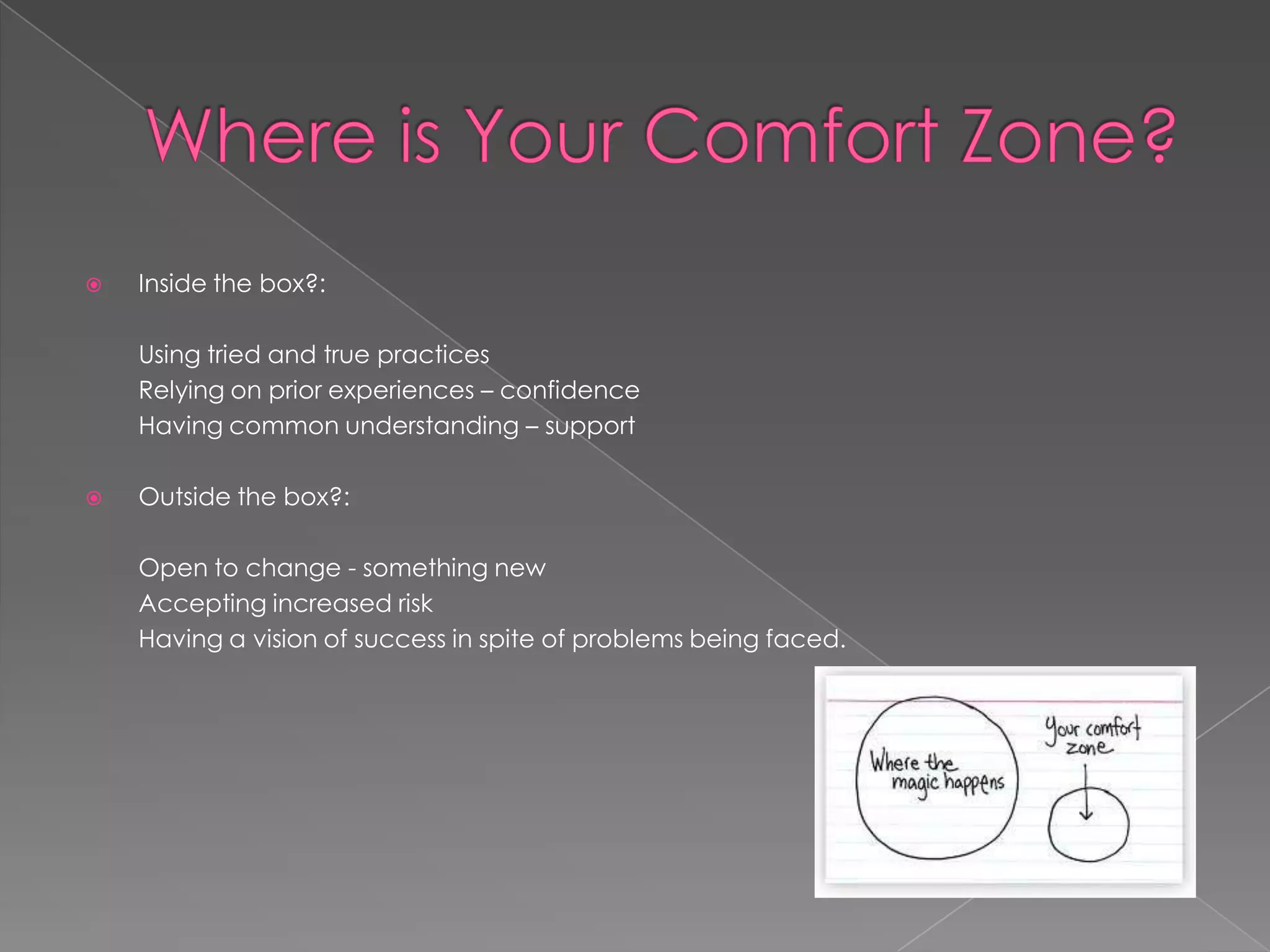
   Inside the box?:

    Using tried and true practices
    Relying on prior experiences – confidence
    Having common understanding – support

   Outside the box?:

    Open to change - something new
    Accepting increased risk
    Having a vision of success in spite of problems being faced.
   Positive:
    Innovative and creative?
    Progressive and forward thinking?
   Negative:
    Threatening to you or the organization?
    Destabilizing to daily activities?
    Risky? Careless?
   Skeptical?:
    A risk to stability unless controlled.
    First step toward a loss of control.
    Supporting the “thinker” may prompt criticism elsewhere in the
    organization.

   Supportive?:
    Fresh approach – innovative.
    Path to accelerated growth or recovery.
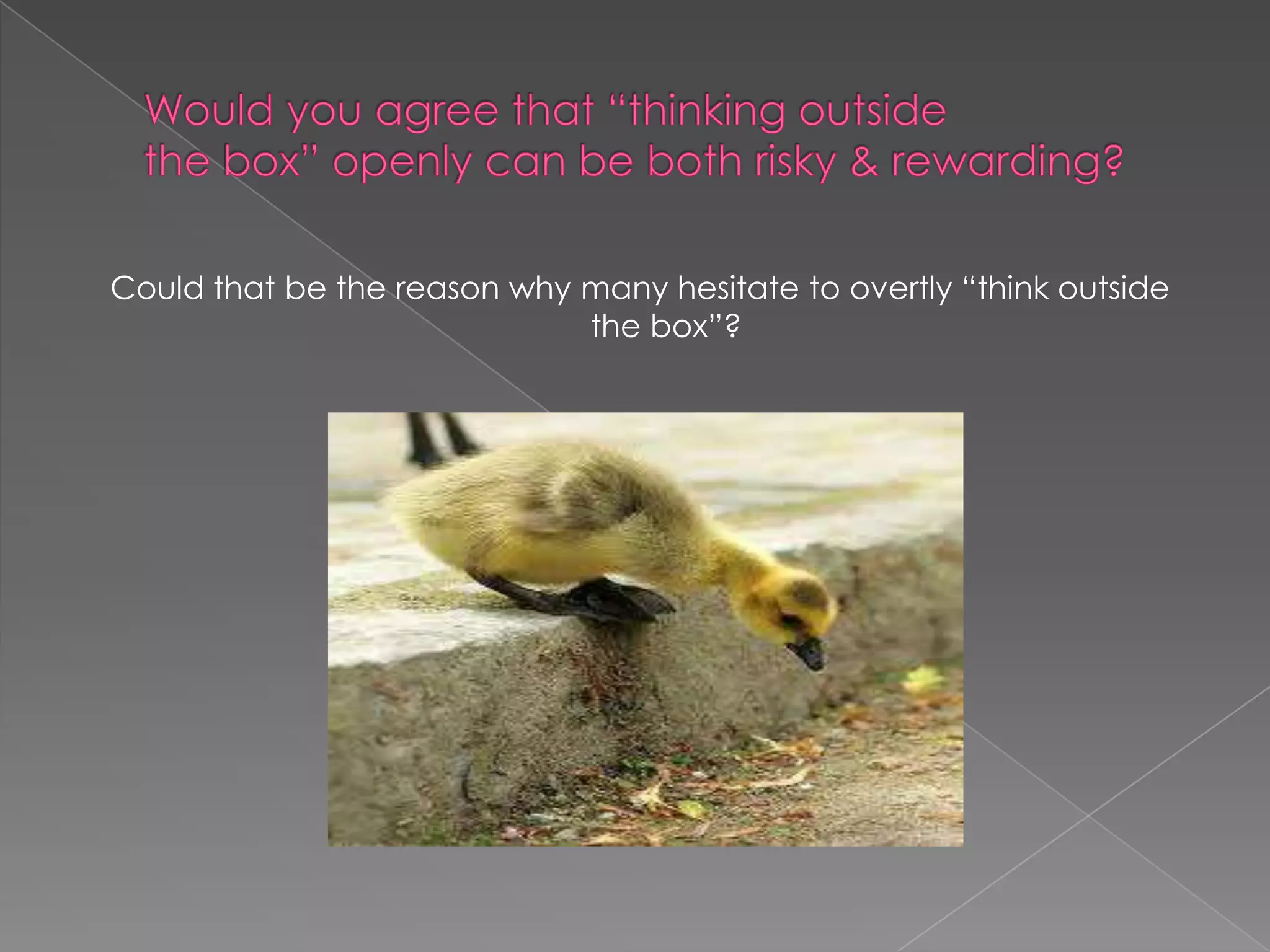
Could that be the reason why many hesitate to overtly “think outside
                             the box”?
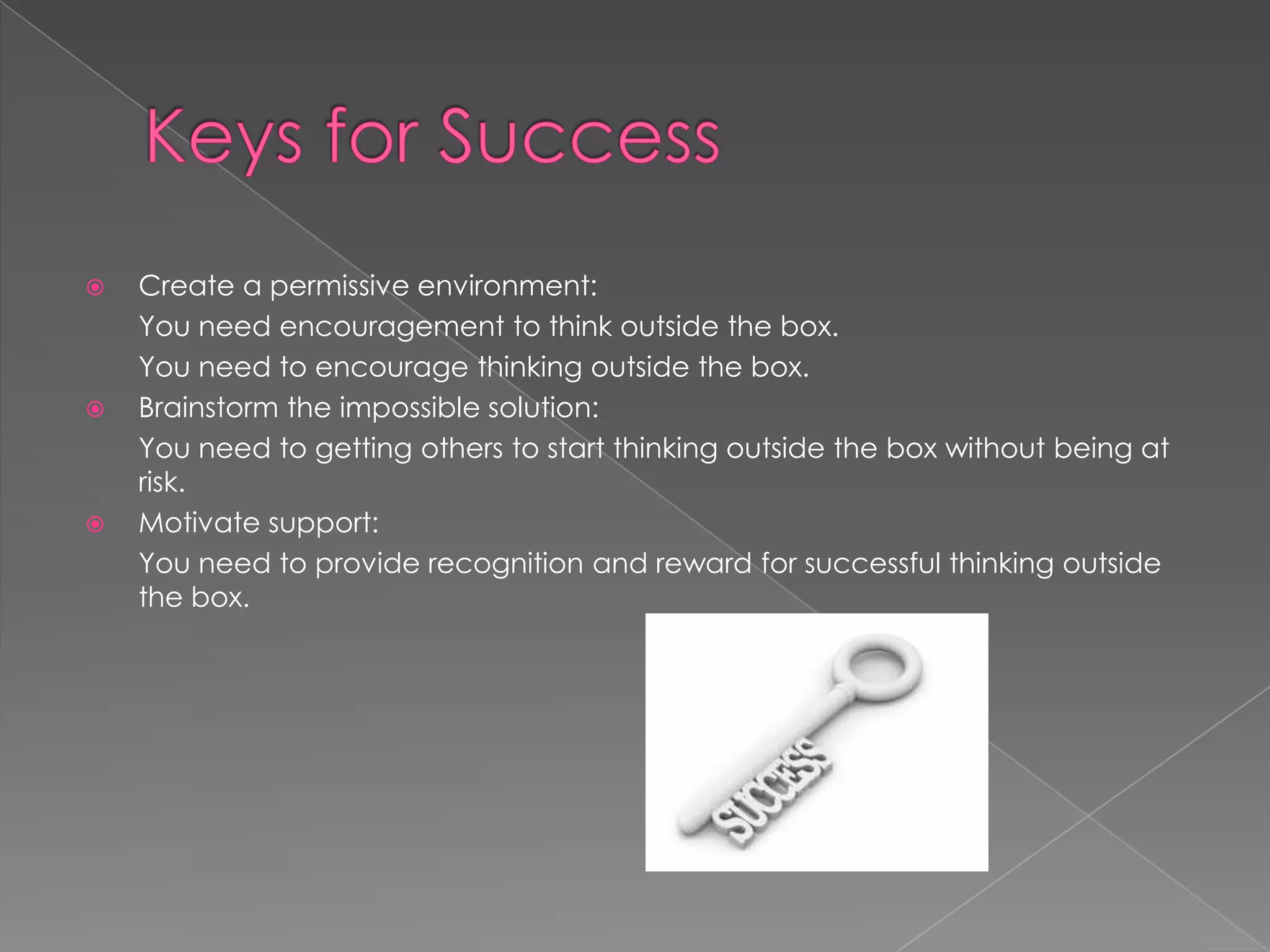
   Create a permissive environment:
    You need encouragement to think outside the box.
    You need to encourage thinking outside the box.
   Brainstorm the impossible solution:
    You need to getting others to start thinking outside the box without being at
    risk.
   Motivate support:
    You need to provide recognition and reward for successful thinking outside
    the box.
Can You Think of an Example?

A teacher at a class at Stanford offers each team $5 of „funding‟ in an envelope. She tells them that once they open
                           the envelope, they have 2 hours to make as much money as they can.
                                                The three teams‟ approaches:
     1) First team opens a free stand that offers to check peoples bike tire pressure for free, then charges $1 to inflate
         if necessary. This team changes midstream to accepting donations instead of charging, and makes more
                                             money. Lauded for rapid iteration.
      2) Second team makes lots of reservations at local restaurants, and then sells them to people waiting in line for
     same restaurant. Didn‟t use the $5 at all. Lauded for realizing that the $5 constraint was artificial, and that using it
                                                  constrained their thinking.
     3) Third team skipped the exercise, and sold their 3 minute class presentation time as a advertisement to a local
       company. Made the most money. Instead of presenting, they recruited. Lauded for realizing that the 2 hours
                                       was also artificially hampering their thinking.
     She hands out two artificial constraints, and then praises the teams who ignore the constraints. “Thinking outside
      the box” is a great skill and all, but basically all these teams are doing is finding creative ways of breaking the
     rules. It means the puzzle isn‟t “make the most money in 2 hours with $5″, it means the puzzle is “find out how far
                                    you can stretch these rules without being disqualified”.
           Ignore the rules that don‟t matter. Is that something holding you back real? or is it just in your head?
                                  What artificial constraints will you chose to ignore today?

                                             Our only limits are in our minds.
Colgate Increased their sales in multiples by just increasing the
         diameter of the nozzle of the toothpaste tube.

Out of box thinking

  • 2.
    Einstein once saidthat Imagination Is More Important Than Knowledge. He then went about proving it by completely re-imagining the concepts of space, time, gravity, matter, and energy
  • 3.
    First of all----- What Do You Mean By “The Box” ? The range of thought and action in a workplace that is deemed “acceptable”. Constraints, developed by cultures and organizations to govern behavior , to govern behavior Professional standards and procedures determined to be “best practices”.
  • 4.
    Do existing constraintspreclude your options for success? Is the thinking that has gotten you into trouble able to get you out? Does continuous improvement require creativity?
  • 5.
    Inside the box?: Using tried and true practices Relying on prior experiences – confidence Having common understanding – support  Outside the box?: Open to change - something new Accepting increased risk Having a vision of success in spite of problems being faced.
  • 6.
    Positive: Innovative and creative? Progressive and forward thinking?  Negative: Threatening to you or the organization? Destabilizing to daily activities? Risky? Careless?
  • 7.
    Skeptical?: A risk to stability unless controlled. First step toward a loss of control. Supporting the “thinker” may prompt criticism elsewhere in the organization.  Supportive?: Fresh approach – innovative. Path to accelerated growth or recovery.
  • 8.
    Could that bethe reason why many hesitate to overtly “think outside the box”?
  • 9.
    Create a permissive environment: You need encouragement to think outside the box. You need to encourage thinking outside the box.  Brainstorm the impossible solution: You need to getting others to start thinking outside the box without being at risk.  Motivate support: You need to provide recognition and reward for successful thinking outside the box.
  • 10.
    Can You Thinkof an Example? A teacher at a class at Stanford offers each team $5 of „funding‟ in an envelope. She tells them that once they open the envelope, they have 2 hours to make as much money as they can. The three teams‟ approaches: 1) First team opens a free stand that offers to check peoples bike tire pressure for free, then charges $1 to inflate if necessary. This team changes midstream to accepting donations instead of charging, and makes more money. Lauded for rapid iteration. 2) Second team makes lots of reservations at local restaurants, and then sells them to people waiting in line for same restaurant. Didn‟t use the $5 at all. Lauded for realizing that the $5 constraint was artificial, and that using it constrained their thinking. 3) Third team skipped the exercise, and sold their 3 minute class presentation time as a advertisement to a local company. Made the most money. Instead of presenting, they recruited. Lauded for realizing that the 2 hours was also artificially hampering their thinking. She hands out two artificial constraints, and then praises the teams who ignore the constraints. “Thinking outside the box” is a great skill and all, but basically all these teams are doing is finding creative ways of breaking the rules. It means the puzzle isn‟t “make the most money in 2 hours with $5″, it means the puzzle is “find out how far you can stretch these rules without being disqualified”. Ignore the rules that don‟t matter. Is that something holding you back real? or is it just in your head? What artificial constraints will you chose to ignore today? Our only limits are in our minds.
  • 11.
    Colgate Increased theirsales in multiples by just increasing the diameter of the nozzle of the toothpaste tube.