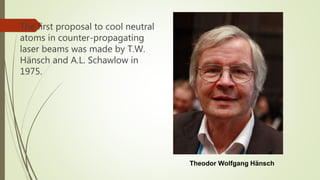
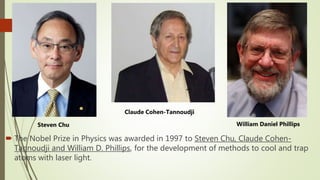
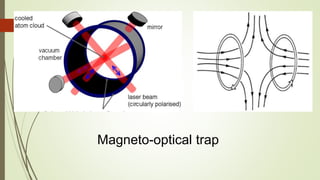
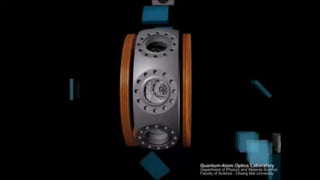
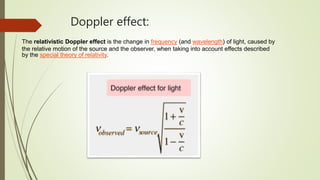
Laser cooling allows atoms to be slowed and trapped using laser light. The first proposal for cooling neutral atoms with counter-propagating laser beams was made in 1975 by T.W. Hänsch and A.L. Schawlow. When atoms move towards a laser, they see a higher frequency due to the Doppler effect which allows them to absorb photons, slowing the atoms. Atoms are cooled to a few millikelvins through this process. However, limitations exist such as a minimum temperature due to spontaneous emission and a maximum concentration to prevent photon absorption as heat. Laser cooling has applications in atomic clocks, atom optics, and observing Bose-Einstein condensation.