LARYNGOPHARYNGEAL
REFLUX (LPR)
Prepared by: Diaa M. Srahin
Submitted to: Dr. Adel Adwan
1
What is the LPR
 is the retrograde movement of gastric
contents (acid and enzymes such as
pepsin) into the laryngopharynx leading to
symptoms referable to the
larynx/hypopharynx.
 60% of patients with GERD have LPR.
 Damage is caused by the acidic gastric juice,
pepsin, bile salts, bacteria and pancreatic
proteolytic enzymes
 GERD: an abnormal amount of reflux up
through the lower sphincters and into the
esophagus.
 LPRD: when the reflux passes all the way
through the upper sphincter reaching the
larynx and pharynx without belching or vomiting
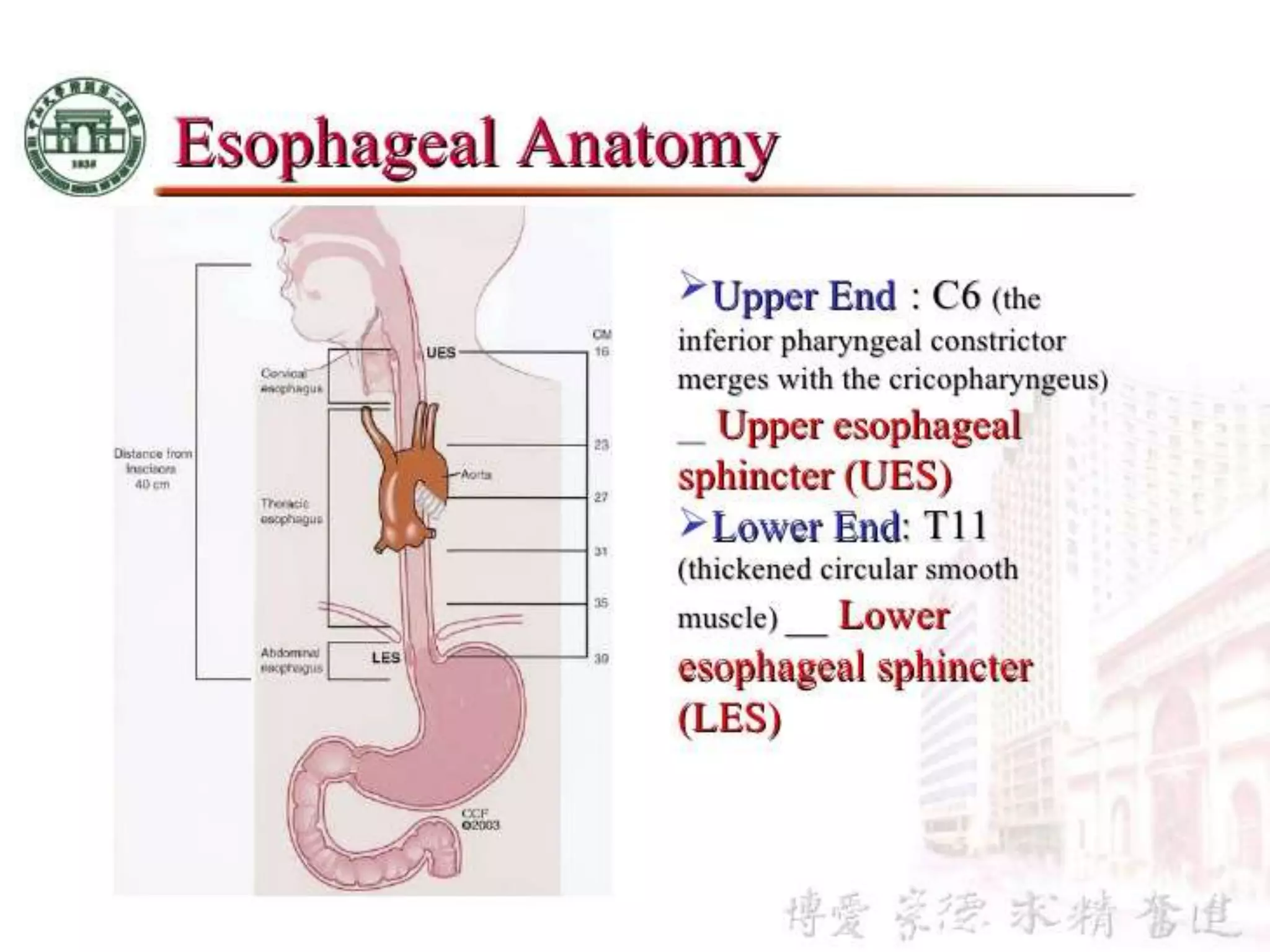
 Upper esophageal sphincter :
 The upper esophageal sphincter (UES) is composed of the
cricopharyngeus (CP), thyropharyngeus (TP; inferior pharyngeal
constrictor [IPC] in humans), and cranial cervical esophagus. All
3 muscles may at times function to maintain tone in the UES, but
only the CP contracts and relaxes in all physiologic states
consistent with the UES, it’s 3 cm in length
 Lower esophageal sphincter :
 Thickened circuler smooth muscle
 3 cm in length
Pathophysiology
8
 Regardless of the pathway, factors such
as the resting tone of the upper and lower
esophageal sphincters (UES and LES)
and the duration and magnitude of
increases in intraabdominal pressure are
important to the creation of the refluxate
bolus.
Risk factors
 GERD
 Smoking
 Alcohol
CLINICAL
MANIFESTATIONS
 Hoarseness – 70%
 Voice fatigue, breaking of the voice
 Cough – 50%
 Globus pharyngeus – 47%
 Frequent throat clearing, dysphagia, sore throat,
wheezing, laryngospasm, halitosis
 Reinke’s edema : swelling of the vocal cords due
to fluid (edema) collected within the Reinke's
space “ a potential space between the vocal
ligament and the overlying mucosa “
11
Reinke’s edema
12
Patterns and Mechanism of LPR
and GERD
13
LPR
 No heartburn
 Daytime (“upright”)
refluxers
 Normal esophageal
motility
 Normal acid
clearance
 Majority without
esophagitis
GERD
 Heartburn
 Nocturnal (“supine”)
refluxers
 Esophageal
dysmotility
 Prolonged acid
clearance
 Can present with
esophagitis
DIAGNOSIS
 There is significant controversy over the appropriate way to
diagnose LPR and there is no test that is both easy to perform
and highly reliable.
 Clinical diagnosis — common LPR complaints with
laryngoscopic findings associated with LPR
 Dual sensor pH probe — The 24-hour dual sensor pH probe is
considered by many to be the gold standard for diagnosing LPR
 Trial of therapy
 Molecular and histologic evaluation — salivary epidermal
growth factor (EGF), immunologic markers, laryngeal mucosa
gene expression, and histologic changes.
Symptom Questionnaire:
15
The Reflux
Symptom Index
• A score > 10
may indicate
significant
reflux
• A score > 13
definitely
abnormal
Laryngoscopic Findings
 Red, irritated arytenoids
 Red, irritated larynx
 Small laryngeal ulcers
 Swelling of the VF
 Granulomas in the larynx
 pseudosulcus
Therapeutic Trial for LPR
 H2 receptor blockers
 Work great for GERD
 Proton pump inhibitors
 Must use double dose PPI for therapeutic trial
 Duration: 2 weeks – 6 months (one month should be
sufficient to see improvement
 May still fail…
 Remember: Non-acid reflux!
17
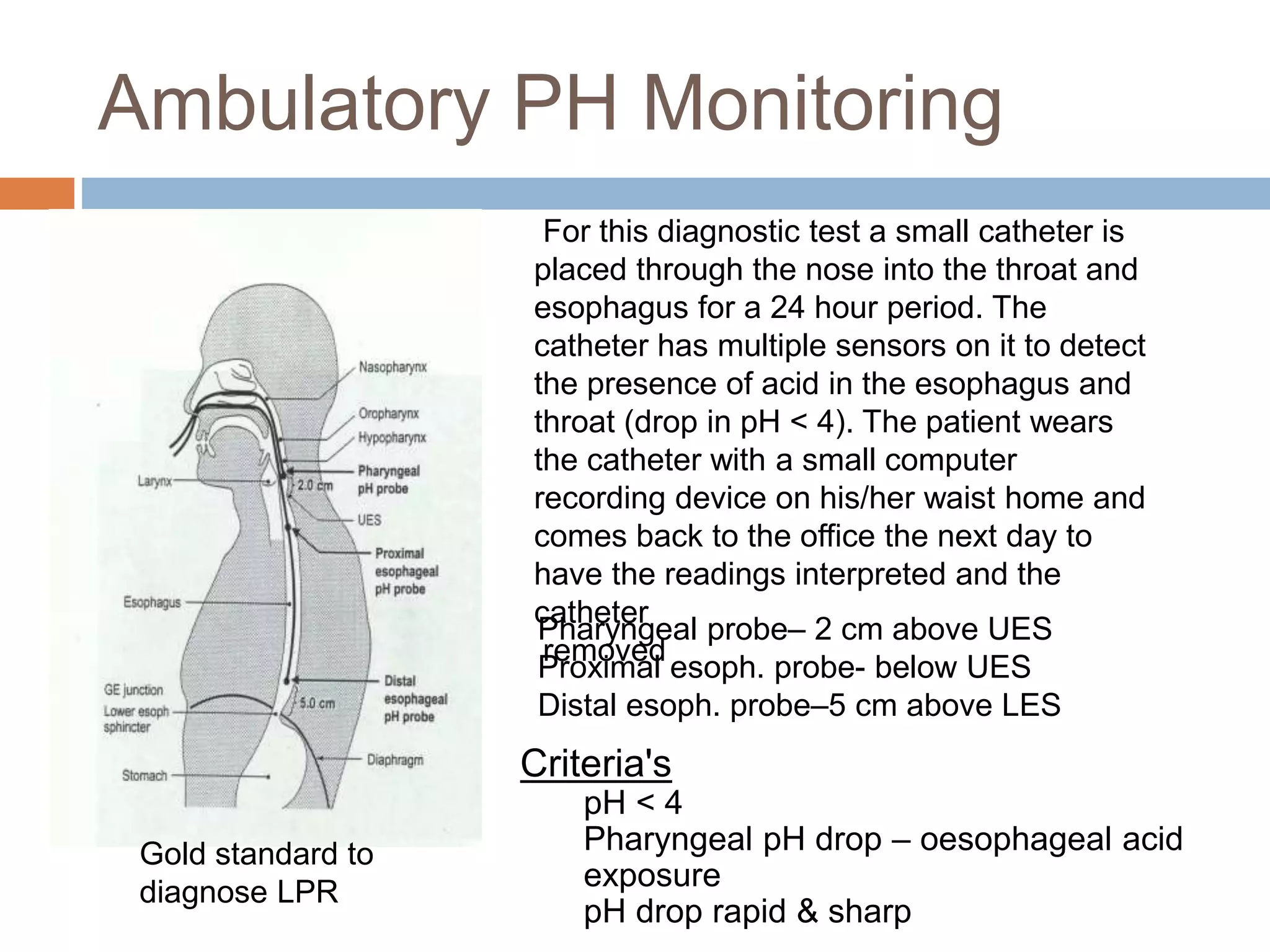
Ambulatory PH Monitoring
18
Pharyngeal probe– 2 cm above UES
Proximal esoph. probe- below UES
Distal esoph. probe–5 cm above LES
Gold standard to
diagnose LPR
Criteria's
pH < 4
Pharyngeal pH drop – oesophageal acid
exposure
pH drop rapid & sharp
For this diagnostic test a small catheter is
placed through the nose into the throat and
esophagus for a 24 hour period. The
catheter has multiple sensors on it to detect
the presence of acid in the esophagus and
throat (drop in pH < 4). The patient wears
the catheter with a small computer
recording device on his/her waist home and
comes back to the office the next day to
have the readings interpreted and the
catheter
removed
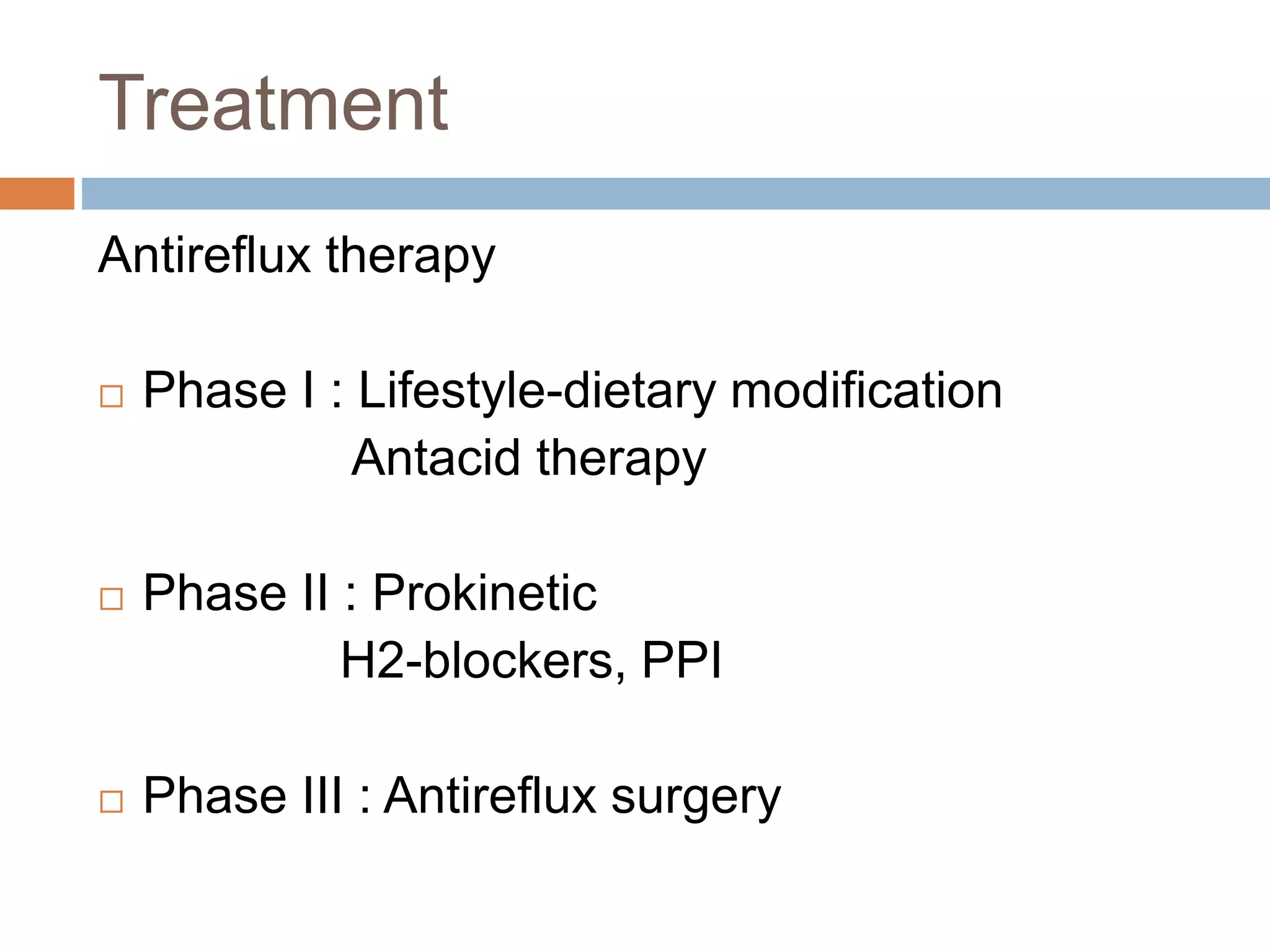
Treatment
Antireflux therapy
 Phase I : Lifestyle-dietary modification
Antacid therapy
 Phase II : Prokinetic
H2-blockers, PPI
 Phase III : Antireflux surgery
19
Lifestyle modifications
 Stop smoking
 Elevate the head of the bed on blocks(15-
20cm)
 Reduce body weight
 Avoid tight-fitting clothing
 Avoid lying down after meals
20
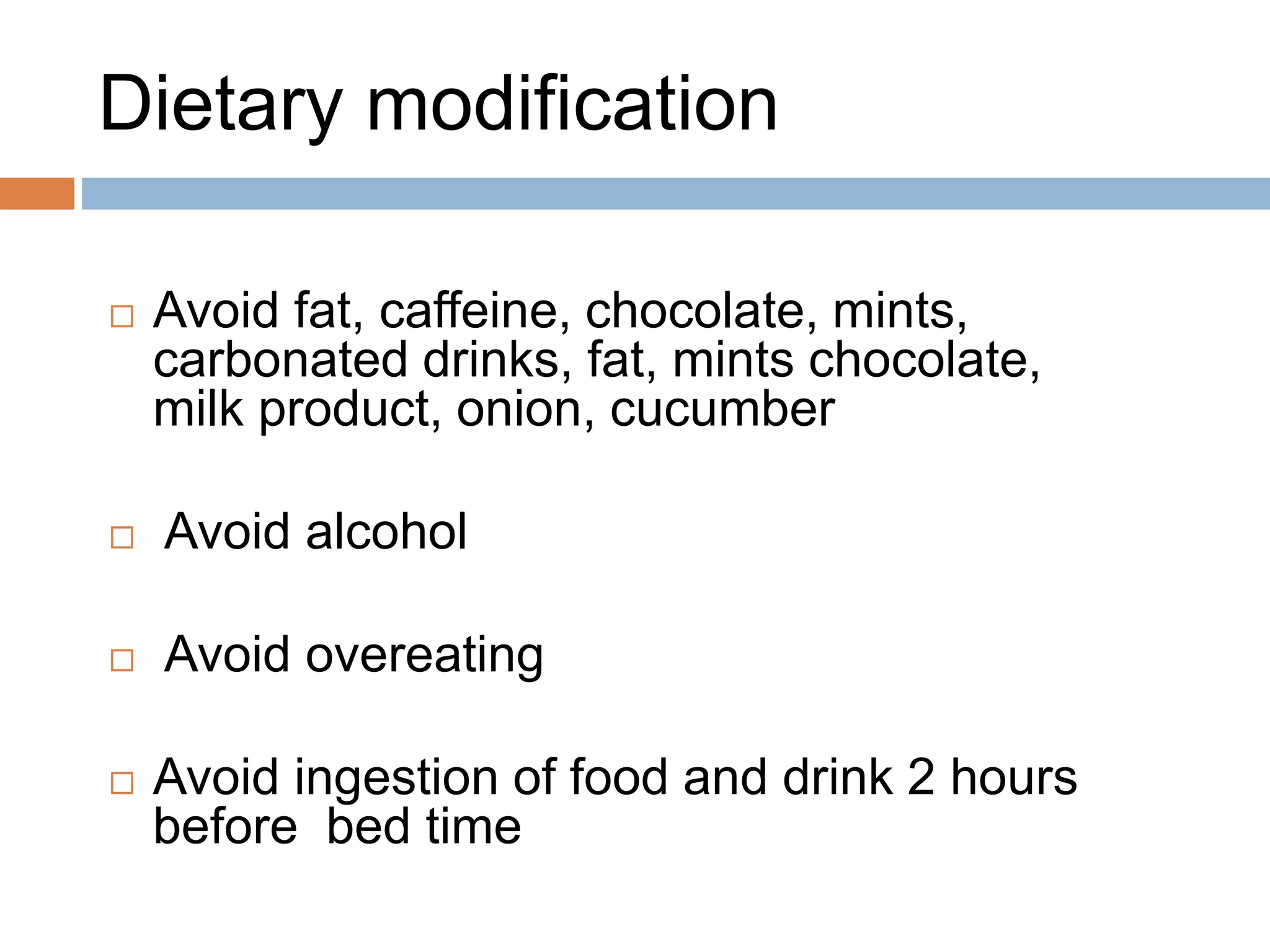
Dietary modification
 Avoid fat, caffeine, chocolate, mints,
carbonated drinks, fat, mints chocolate,
milk product, onion, cucumber
 Avoid alcohol
 Avoid overeating
 Avoid ingestion of food and drink 2 hours
before bed time 21
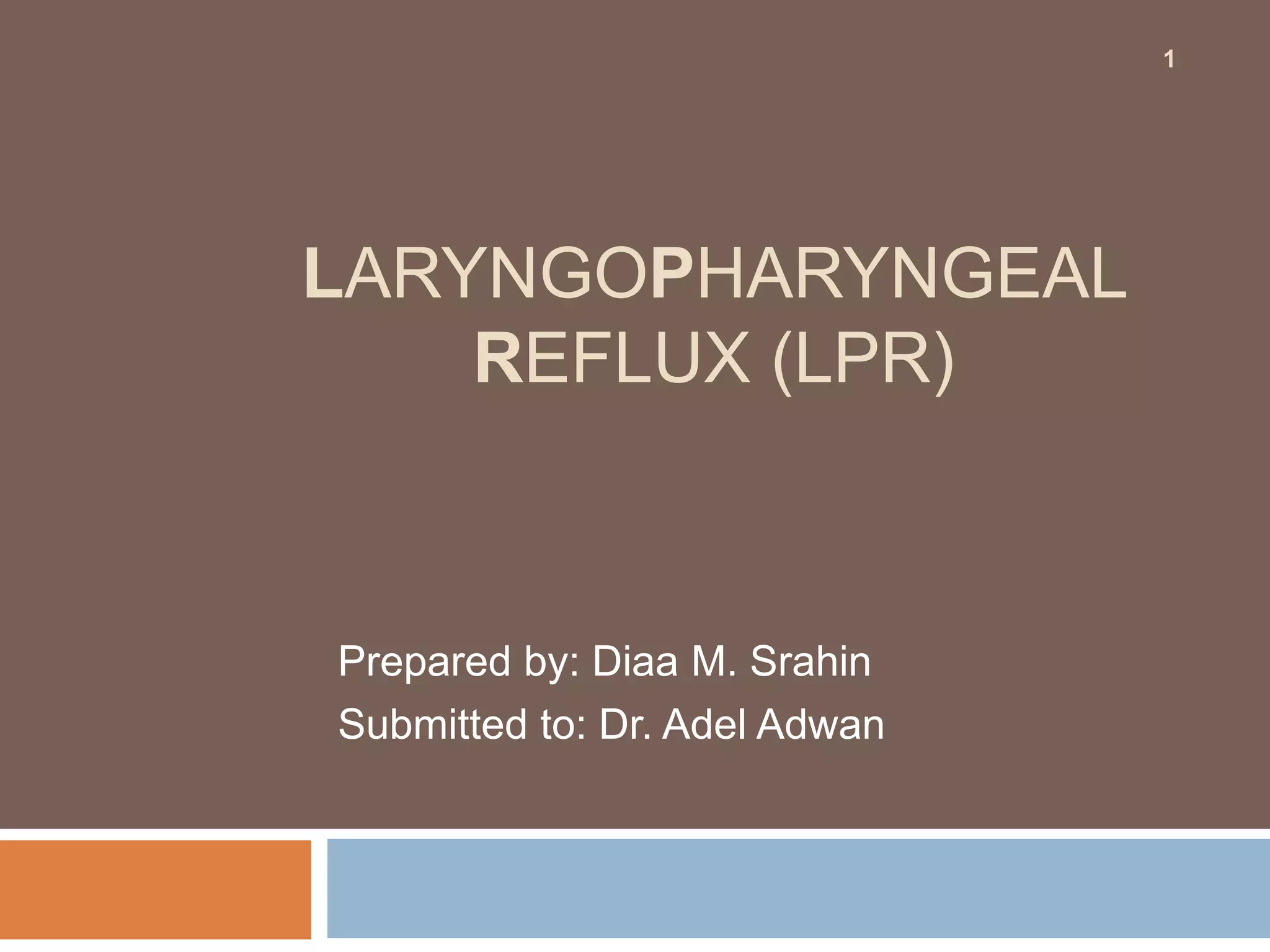
PHARMACOLOGICAL
DRUGS
Antacids
Mixture of aluminum
hydroxide
& magnesium trisilicate
Antisecretory
H2 Blockers
PPI’s
Mucosal protective
Prokinetics
Metoclopramide
Domperidone
Cisapride
22
Drug therapy
 Antisecretory
 H2 Blockers
 Ranitidine, Famotidine,
 Reversibly reduces acid secretion, not
helps in healing
 PPI’s
 Near total acid suppression, promotes
healing
 Omeprazole (20-40mg OD)
 Mucosal protective
 Sucralfate, alginic acid
23
Drug therapy
 Antacids
 Immediate relief of symptoms
 Reduces acidity
 Not helps in healing
 Antacid mixture
 Prokinetic
 Symptomatic relief, not helps in healing
 Increases gastric emptying
 Metoclopramide (5-10mg tds), Domperidone
(10-20mg tds) 24
Surgery
 Laparoscopic Nissen
Fundoplication
 Indications
 Failed drug treatment
 Complications
 Goal
 Restore natural
integrity of LES &
maintain normal
deglutition
25
Laryngo pharyngeal reflux (lpr)

Laryngo pharyngeal reflux (lpr)

  • 1.
    LARYNGOPHARYNGEAL REFLUX (LPR) Prepared by:Diaa M. Srahin Submitted to: Dr. Adel Adwan 1
  • 2.
    What is theLPR  is the retrograde movement of gastric contents (acid and enzymes such as pepsin) into the laryngopharynx leading to symptoms referable to the larynx/hypopharynx.
  • 4.
     60% ofpatients with GERD have LPR.  Damage is caused by the acidic gastric juice, pepsin, bile salts, bacteria and pancreatic proteolytic enzymes
  • 5.
     GERD: anabnormal amount of reflux up through the lower sphincters and into the esophagus.  LPRD: when the reflux passes all the way through the upper sphincter reaching the larynx and pharynx without belching or vomiting
  • 7.
     Upper esophagealsphincter :  The upper esophageal sphincter (UES) is composed of the cricopharyngeus (CP), thyropharyngeus (TP; inferior pharyngeal constrictor [IPC] in humans), and cranial cervical esophagus. All 3 muscles may at times function to maintain tone in the UES, but only the CP contracts and relaxes in all physiologic states consistent with the UES, it’s 3 cm in length  Lower esophageal sphincter :  Thickened circuler smooth muscle  3 cm in length
  • 8.
  • 9.
     Regardless ofthe pathway, factors such as the resting tone of the upper and lower esophageal sphincters (UES and LES) and the duration and magnitude of increases in intraabdominal pressure are important to the creation of the refluxate bolus.
  • 10.
    Risk factors  GERD Smoking  Alcohol
  • 11.
    CLINICAL MANIFESTATIONS  Hoarseness –70%  Voice fatigue, breaking of the voice  Cough – 50%  Globus pharyngeus – 47%  Frequent throat clearing, dysphagia, sore throat, wheezing, laryngospasm, halitosis  Reinke’s edema : swelling of the vocal cords due to fluid (edema) collected within the Reinke's space “ a potential space between the vocal ligament and the overlying mucosa “ 11
  • 12.
  • 13.
    Patterns and Mechanismof LPR and GERD 13 LPR  No heartburn  Daytime (“upright”) refluxers  Normal esophageal motility  Normal acid clearance  Majority without esophagitis GERD  Heartburn  Nocturnal (“supine”) refluxers  Esophageal dysmotility  Prolonged acid clearance  Can present with esophagitis
  • 14.
    DIAGNOSIS  There issignificant controversy over the appropriate way to diagnose LPR and there is no test that is both easy to perform and highly reliable.  Clinical diagnosis — common LPR complaints with laryngoscopic findings associated with LPR  Dual sensor pH probe — The 24-hour dual sensor pH probe is considered by many to be the gold standard for diagnosing LPR  Trial of therapy  Molecular and histologic evaluation — salivary epidermal growth factor (EGF), immunologic markers, laryngeal mucosa gene expression, and histologic changes.
  • 15.
    Symptom Questionnaire: 15 The Reflux SymptomIndex • A score > 10 may indicate significant reflux • A score > 13 definitely abnormal
  • 16.
    Laryngoscopic Findings  Red,irritated arytenoids  Red, irritated larynx  Small laryngeal ulcers  Swelling of the VF  Granulomas in the larynx  pseudosulcus
  • 17.
    Therapeutic Trial forLPR  H2 receptor blockers  Work great for GERD  Proton pump inhibitors  Must use double dose PPI for therapeutic trial  Duration: 2 weeks – 6 months (one month should be sufficient to see improvement  May still fail…  Remember: Non-acid reflux! 17
  • 18.
    Ambulatory PH Monitoring 18 Pharyngealprobe– 2 cm above UES Proximal esoph. probe- below UES Distal esoph. probe–5 cm above LES Gold standard to diagnose LPR Criteria's pH < 4 Pharyngeal pH drop – oesophageal acid exposure pH drop rapid & sharp For this diagnostic test a small catheter is placed through the nose into the throat and esophagus for a 24 hour period. The catheter has multiple sensors on it to detect the presence of acid in the esophagus and throat (drop in pH < 4). The patient wears the catheter with a small computer recording device on his/her waist home and comes back to the office the next day to have the readings interpreted and the catheter removed
  • 19.
    Treatment Antireflux therapy  PhaseI : Lifestyle-dietary modification Antacid therapy  Phase II : Prokinetic H2-blockers, PPI  Phase III : Antireflux surgery 19
  • 20.
    Lifestyle modifications  Stopsmoking  Elevate the head of the bed on blocks(15- 20cm)  Reduce body weight  Avoid tight-fitting clothing  Avoid lying down after meals 20
  • 21.
    Dietary modification  Avoidfat, caffeine, chocolate, mints, carbonated drinks, fat, mints chocolate, milk product, onion, cucumber  Avoid alcohol  Avoid overeating  Avoid ingestion of food and drink 2 hours before bed time 21
  • 22.
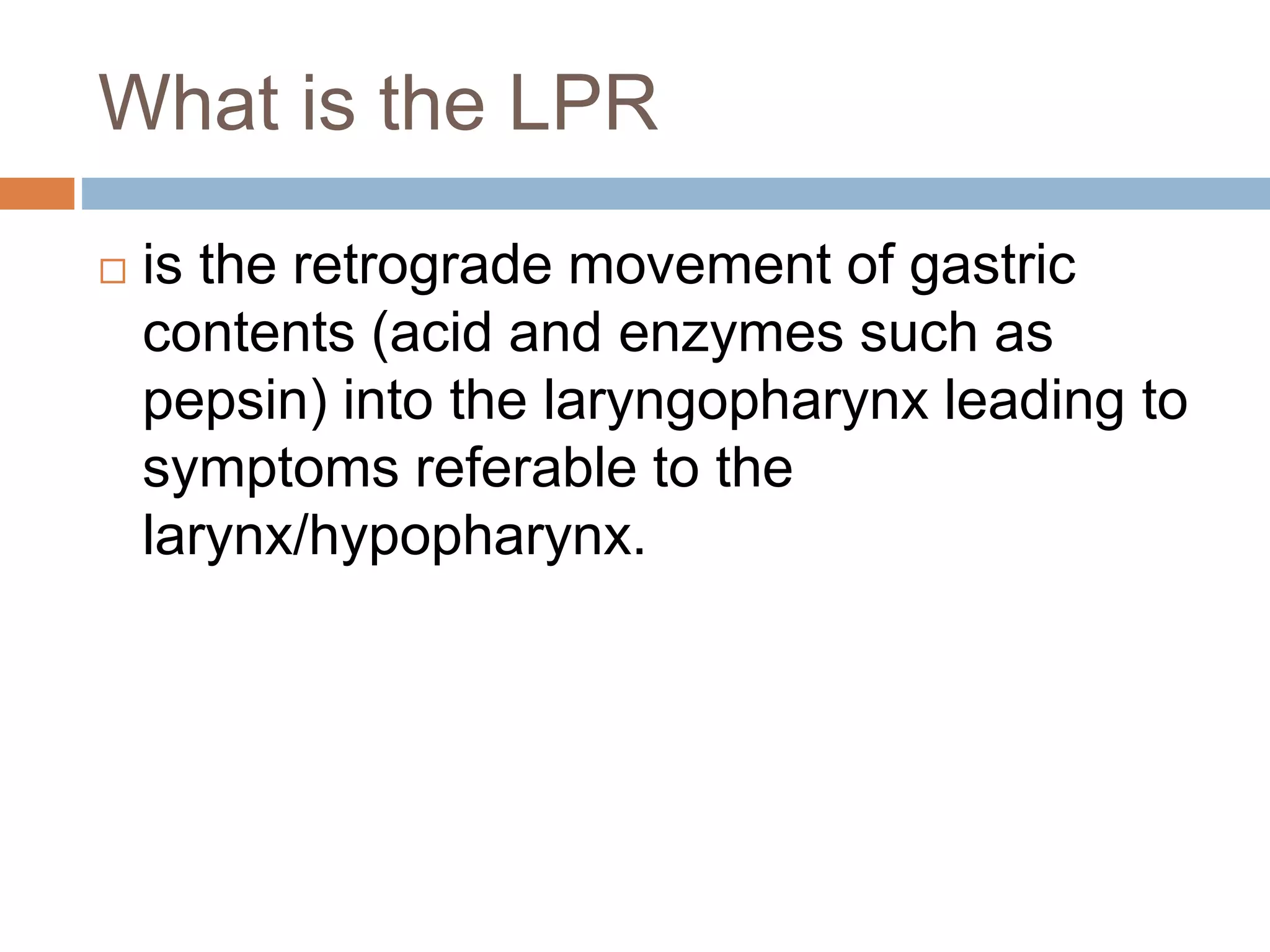
    PHARMACOLOGICAL DRUGS Antacids Mixture of aluminum hydroxide &magnesium trisilicate Antisecretory H2 Blockers PPI’s Mucosal protective Prokinetics Metoclopramide Domperidone Cisapride 22
  • 23.
    Drug therapy  Antisecretory H2 Blockers  Ranitidine, Famotidine,  Reversibly reduces acid secretion, not helps in healing  PPI’s  Near total acid suppression, promotes healing  Omeprazole (20-40mg OD)  Mucosal protective  Sucralfate, alginic acid 23
  • 24.
    Drug therapy  Antacids Immediate relief of symptoms  Reduces acidity  Not helps in healing  Antacid mixture  Prokinetic  Symptomatic relief, not helps in healing  Increases gastric emptying  Metoclopramide (5-10mg tds), Domperidone (10-20mg tds) 24
  • 25.
    Surgery  Laparoscopic Nissen Fundoplication Indications  Failed drug treatment  Complications  Goal  Restore natural integrity of LES & maintain normal deglutition 25