Literacy, Language and
Communication
Module leader: Nicole Brown
nicole.brown@ucl.ac.uk
Module aims
• collaborative and provisional nature of learning-related literacy
practices in educational settings
• literacy and language studies as these pertain to education
• significance of digital and traditional forms of ‘composition’
• critical reflection on key concepts as they relate to own experiences
Four main themes
• multimodality and contemporary literacy practices
• language histories in the context of diverse linguistic and cultural
education settings
• film and media in education
• digital mobility and collaborative knowledge building
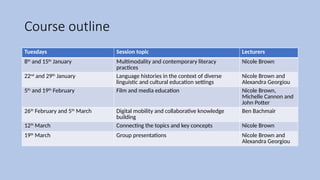
Course outline
Tuesdays Session topic Lecturers
8th
and 15th
January Multimodality and contemporary literacy
practices
Nicole Brown
22nd
and 29th
January Language histories in the context of diverse
linguistic and cultural education settings
Nicole Brown and
Alexandra Georgiou
5th
and 19th
February Film and media education Nicole Brown,
Michelle Cannon and
John Potter
26th
February and 5th
March Digital mobility and collaborative knowledge
building
Ben Bachmair
12th
March Connecting the topics and key concepts Nicole Brown
19th
March Group presentations Nicole Brown and
Alexandra Georgiou
Assessment
• A group presentation (15 minutes) (30%) in class on the 19th
March
• Fully prepared presentation (5-10 mins)
• Questions on the day (5-10 mins)
• An essay (2,000 words ± 10% excl. bibliography) (70%) due on 7th
May
How to get the most out of the module
• Readings
• Discussions
• Reflections
Overview of the first “lecture”
• What is literacy?
• What is multimodal communication?
What is literacy?
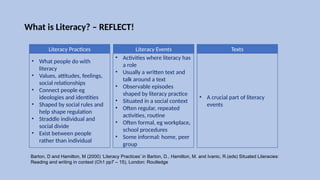
What is Literacy? – REFLECT!
Literacy Practices Literacy Events Texts
• What people do with
literacy
• Values, attitudes, feelings,
social relationships
• Connect people eg
ideologies and identities
• Shaped by social rules and
help shape regulation
• Straddle individual and
social divide
• Exist between people
rather than individual
• Activities where literacy has
a role
• Usually a written text and
talk around a text
• Observable episodes
shaped by literacy practice
• Situated in a social context
• Often regular, repeated
activities, routine
• Often formal, eg workplace,
school procedures
• Some informal: home, peer
group
• A crucial part of literacy
events
Barton, D and Hamilton, M (2000) ‘Literacy Practices’ in Barton, D., Hamilton, M. and Ivanic, R.(eds) Situated Literacies:
Reading and writing in context (Ch1 pp7 – 15), London: Routledge
What is multimodal
communication?
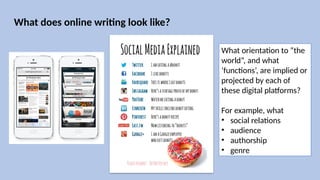
What does online writing look like?
What orientation to “the
world”, and what
‘functions’, are implied or
projected by each of
these digital platforms?
For example, what
• social relations
• audience
• authorship
• genre
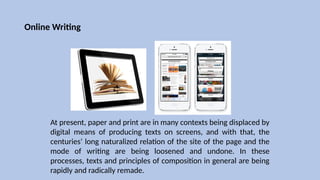
Online Writing
At present, paper and print are in many contexts being displaced by
digital means of producing texts on screens, and with that, the
centuries’ long naturalized relation of the site of the page and the
mode of writing are being loosened and undone. In these
processes, texts and principles of composition in general are being
rapidly and radically remade.
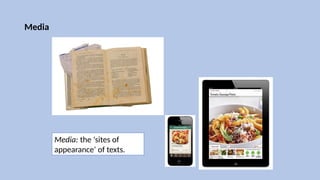
Media
Media: the ‘sites of
appearance’ of texts.
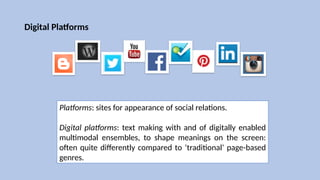
Digital Platforms
Platforms: sites for appearance of social relations.
Digital platforms: text making with and of digitally enabled
multimodal ensembles, to shape meanings on the screen:
often quite differently compared to ‘traditional’ page-based
genres.
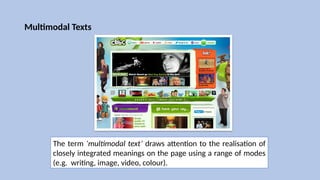
Multimodal Texts
The term ‘multimodal text’ draws attention to the realisation of
closely integrated meanings on the page using a range of modes
(e.g. writing, image, video, colour).
MULTIMODALITY & LEARNING
How content is represented, as well as
the modes and platforms chosen, is a
significant aspect of knowledge
construction.
The ways in which content is represented
shape both what is to be learned – the
curriculum, and how it is to be learned –
the pedagogy.
Domingo, M. (2016). Multimodality in virtual learning environments: exploring traces of the page in designs of screens.
In Andrews, R. & Haythornwaite, C. (Eds.) The Sage Handbook of E-Learning Research. London: Sage.
How do we learn? – REFLECT!
ACQUISITION
Listen to a lecture, podcast,
reading, watching demos or videos
DISCUSSION
Articulate ideas and questions,
challenge and respond to ideas and
questions
PRACTICE
Adapt actions to task goals and use
feedback to improve
PRODUCTION
Consolidating what is learnt by
articulating current conceptual
understanding and how it is used in
practice
INVESTIGATION
Explore, compare and critique the
texts, documents and resources
that reflect the concepts being
taught
COLLABORATION
Taking part in the process of
knowledge building itself
Modal shaping of Learning and Knowing
Modes
• Suggest forms and structures
• Put constraints on and provide
potentials for demonstrating
learning
• Shape learning
Different modes
• Bring a specific lens to an
engagement with the world
• Drawing attention to features
• Shape and structure
engagement and potentials for
learning
• E.g. speaking, writing, drawing
a map or acting out – all
provide distinct potentials for
learning, showing and
experiencing the world newly,
differently
Bezemer, J. & Kress, G. (2016). ‘Transformative Engagement’, in Multimodality, Learning and Communication. A social
semiotic frame. Abingdon, Oxon:Roultedge. Pgs. 37 - 61
Institutional Settings
• How the learner’s demonstration of learning was shaped by the modes available to the learner /
re-maker
• ‘Evidence’ of learning: The modes provided to the learner to produce that evidence need to be
considered carefully
• Any limitation on the modes available to the learner leads to a limitation on the learner’s
potential to demonstrate what he has learned e.g. Asking someone to ‘write up’ what they know
can put severe constraints on ‘evidencing’ their tacit, embodied knowledge
• By allowing learners to demonstrate learning in different modes the range of what is and can be
recognised can be vastly expanded
Bezemer, J. & Kress, G. (2016). ‘Transformative Engagement’, in Multimodality, Learning and Communication. A social
semiotic frame. Abingdon, Oxon:Roultedge. Pgs. 37 - 61
Three theoretical assumptions underpin the
concept of multimodality:
(1)all communication draws on a multiplicity of
modes to make meaning;
(2)meanings realised by any mode are always
interwoven with other co-present modes to
produce meaning; and
(3)the more a set of resources (modes) has
been utilised in the everyday social life of a
particular community, the more fully
articulated it will have become for members
of that community.
What is Multimodality – REFLECT!
Domingo, M., Jewitt, C. and Kress, G. (2016) 'Multimodal social semiotics: Writing in online contexts' in K. Pahl and Rowsel (eds.)
The Routledge Handbook of Contemporary Literacy Studies, London: Routledge.
What’s next?
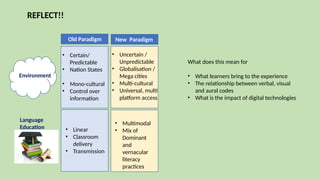
REFLECT!!
Old Paradigm New Paradigm
Environment
Language
Education
• Certain/
Predictable
• Nation States
• Mono-cultural
• Control over
information
• Linear
• Classroom
delivery
• Transmission
• Uncertain /
Unpredictable
• Globalisation /
Mega cities
• Multi-cultural
• Universal, multi
platform access
• Multimodal
• Mix of
Dominant
and
vernacular
literacy
practices
What does this mean for
• What learners bring to the experience
• The relationship between verbal, visual
and aural codes
• What is the impact of digital technologies
Modal shaping of Learning and Knowing (Contd)
Distinct learning potentials of
different modes are
recognised across different
communities
Different modes Translation from one mode to another
• Carpenter’s sketch
• Architect’s 3D model
• Police investigator’s
reconstruction
• Researcher’s diagrams and
transcripts
• ‘fix’ a specific ‘take’ on the
matter in focus
• Provide different insights
into the world in focus, the
world framed
• Can never be ‘perfect’
• Always produce different ‘takes’
• Also produce different epistemologies on the world
• Hence a distinction made between re-
arrangements of modes: Inter-modal; Intra-modal
• Intra-modal changes: Transformation in which the
elements remain the same, though their re-
arrangements differ (entities, units, elements
remain the same
• Inter-modal changes: Changes from one mode to
another: ‘Can someone tell me about a cell?’ ‘Come
to the front and draw what you have said’
Alteration of entities, units , elements not simply a
rearrangement
Bezemer, J. & Kress, G. (2016). ‘Transformative Engagement’, in Multimodality, Learning and Communication. A social
semiotic frame. Abingdon, Oxon:Roultedge. Pgs. 37 - 61
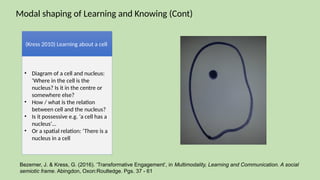
(Kress 2010) Learning about a cell
• Diagram of a cell and nucleus:
‘Where in the cell is the
nucleus? Is it in the centre or
somewhere else?
• How / what is the relation
between cell and the nucleus?
• Is it possessive e.g. ‘a cell has a
nucleus’…
• Or a spatial relation: ‘There is a
nucleus in a cell
Modal shaping of Learning and Knowing (Cont)
Bezemer, J. & Kress, G. (2016). ‘Transformative Engagement’, in Multimodality, Learning and Communication. A social
semiotic frame. Abingdon, Oxon:Roultedge. Pgs. 37 - 61
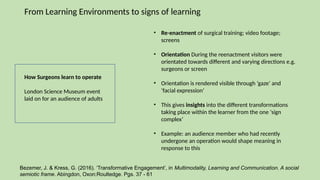
From Learning Environments to signs of learning
• Re-enactment of surgical training; video footage;
screens
• Orientation During the reenactment visitors were
orientated towards different and varying directions e.g.
surgeons or screen
• Orientation is rendered visible through ‘gaze’ and
‘facial expression’
• This gives insights into the different transformations
taking place within the learner from the one ‘sign
complex’
• Example: an audience member who had recently
undergone an operation would shape meaning in
response to this
Bezemer, J. & Kress, G. (2016). ‘Transformative Engagement’, in Multimodality, Learning and Communication. A social
semiotic frame. Abingdon, Oxon:Roultedge. Pgs. 37 - 61
How Surgeons learn to operate
London Science Museum event
laid on for an audience of adults

Multimodality and contemporary literacy.pptx

  • 1.
    Literacy, Language and Communication Moduleleader: Nicole Brown nicole.brown@ucl.ac.uk
  • 2.
    Module aims • collaborativeand provisional nature of learning-related literacy practices in educational settings • literacy and language studies as these pertain to education • significance of digital and traditional forms of ‘composition’ • critical reflection on key concepts as they relate to own experiences
  • 3.
    Four main themes •multimodality and contemporary literacy practices • language histories in the context of diverse linguistic and cultural education settings • film and media in education • digital mobility and collaborative knowledge building
  • 4.
    Course outline Tuesdays Sessiontopic Lecturers 8th and 15th January Multimodality and contemporary literacy practices Nicole Brown 22nd and 29th January Language histories in the context of diverse linguistic and cultural education settings Nicole Brown and Alexandra Georgiou 5th and 19th February Film and media education Nicole Brown, Michelle Cannon and John Potter 26th February and 5th March Digital mobility and collaborative knowledge building Ben Bachmair 12th March Connecting the topics and key concepts Nicole Brown 19th March Group presentations Nicole Brown and Alexandra Georgiou
  • 5.
    Assessment • A grouppresentation (15 minutes) (30%) in class on the 19th March • Fully prepared presentation (5-10 mins) • Questions on the day (5-10 mins) • An essay (2,000 words ± 10% excl. bibliography) (70%) due on 7th May
  • 6.
    How to getthe most out of the module • Readings • Discussions • Reflections
  • 7.
    Overview of thefirst “lecture” • What is literacy? • What is multimodal communication?
  • 8.
  • 12.
    What is Literacy?– REFLECT! Literacy Practices Literacy Events Texts • What people do with literacy • Values, attitudes, feelings, social relationships • Connect people eg ideologies and identities • Shaped by social rules and help shape regulation • Straddle individual and social divide • Exist between people rather than individual • Activities where literacy has a role • Usually a written text and talk around a text • Observable episodes shaped by literacy practice • Situated in a social context • Often regular, repeated activities, routine • Often formal, eg workplace, school procedures • Some informal: home, peer group • A crucial part of literacy events Barton, D and Hamilton, M (2000) ‘Literacy Practices’ in Barton, D., Hamilton, M. and Ivanic, R.(eds) Situated Literacies: Reading and writing in context (Ch1 pp7 – 15), London: Routledge
  • 13.
  • 14.
    What does onlinewriting look like? What orientation to “the world”, and what ‘functions’, are implied or projected by each of these digital platforms? For example, what • social relations • audience • authorship • genre
  • 15.
    Online Writing At present,paper and print are in many contexts being displaced by digital means of producing texts on screens, and with that, the centuries’ long naturalized relation of the site of the page and the mode of writing are being loosened and undone. In these processes, texts and principles of composition in general are being rapidly and radically remade.
  • 16.
    Media Media: the ‘sitesof appearance’ of texts.
  • 17.
    Digital Platforms Platforms: sitesfor appearance of social relations. Digital platforms: text making with and of digitally enabled multimodal ensembles, to shape meanings on the screen: often quite differently compared to ‘traditional’ page-based genres.
  • 18.
    Multimodal Texts The term‘multimodal text’ draws attention to the realisation of closely integrated meanings on the page using a range of modes (e.g. writing, image, video, colour).
  • 19.
    MULTIMODALITY & LEARNING Howcontent is represented, as well as the modes and platforms chosen, is a significant aspect of knowledge construction. The ways in which content is represented shape both what is to be learned – the curriculum, and how it is to be learned – the pedagogy. Domingo, M. (2016). Multimodality in virtual learning environments: exploring traces of the page in designs of screens. In Andrews, R. & Haythornwaite, C. (Eds.) The Sage Handbook of E-Learning Research. London: Sage.
  • 20.
    How do welearn? – REFLECT! ACQUISITION Listen to a lecture, podcast, reading, watching demos or videos DISCUSSION Articulate ideas and questions, challenge and respond to ideas and questions PRACTICE Adapt actions to task goals and use feedback to improve PRODUCTION Consolidating what is learnt by articulating current conceptual understanding and how it is used in practice INVESTIGATION Explore, compare and critique the texts, documents and resources that reflect the concepts being taught COLLABORATION Taking part in the process of knowledge building itself
  • 21.
    Modal shaping ofLearning and Knowing Modes • Suggest forms and structures • Put constraints on and provide potentials for demonstrating learning • Shape learning Different modes • Bring a specific lens to an engagement with the world • Drawing attention to features • Shape and structure engagement and potentials for learning • E.g. speaking, writing, drawing a map or acting out – all provide distinct potentials for learning, showing and experiencing the world newly, differently Bezemer, J. & Kress, G. (2016). ‘Transformative Engagement’, in Multimodality, Learning and Communication. A social semiotic frame. Abingdon, Oxon:Roultedge. Pgs. 37 - 61
  • 22.
    Institutional Settings • Howthe learner’s demonstration of learning was shaped by the modes available to the learner / re-maker • ‘Evidence’ of learning: The modes provided to the learner to produce that evidence need to be considered carefully • Any limitation on the modes available to the learner leads to a limitation on the learner’s potential to demonstrate what he has learned e.g. Asking someone to ‘write up’ what they know can put severe constraints on ‘evidencing’ their tacit, embodied knowledge • By allowing learners to demonstrate learning in different modes the range of what is and can be recognised can be vastly expanded Bezemer, J. & Kress, G. (2016). ‘Transformative Engagement’, in Multimodality, Learning and Communication. A social semiotic frame. Abingdon, Oxon:Roultedge. Pgs. 37 - 61
  • 23.
    Three theoretical assumptionsunderpin the concept of multimodality: (1)all communication draws on a multiplicity of modes to make meaning; (2)meanings realised by any mode are always interwoven with other co-present modes to produce meaning; and (3)the more a set of resources (modes) has been utilised in the everyday social life of a particular community, the more fully articulated it will have become for members of that community. What is Multimodality – REFLECT! Domingo, M., Jewitt, C. and Kress, G. (2016) 'Multimodal social semiotics: Writing in online contexts' in K. Pahl and Rowsel (eds.) The Routledge Handbook of Contemporary Literacy Studies, London: Routledge.
  • 24.
  • 25.
    REFLECT!! Old Paradigm NewParadigm Environment Language Education • Certain/ Predictable • Nation States • Mono-cultural • Control over information • Linear • Classroom delivery • Transmission • Uncertain / Unpredictable • Globalisation / Mega cities • Multi-cultural • Universal, multi platform access • Multimodal • Mix of Dominant and vernacular literacy practices What does this mean for • What learners bring to the experience • The relationship between verbal, visual and aural codes • What is the impact of digital technologies
  • 26.
    Modal shaping ofLearning and Knowing (Contd) Distinct learning potentials of different modes are recognised across different communities Different modes Translation from one mode to another • Carpenter’s sketch • Architect’s 3D model • Police investigator’s reconstruction • Researcher’s diagrams and transcripts • ‘fix’ a specific ‘take’ on the matter in focus • Provide different insights into the world in focus, the world framed • Can never be ‘perfect’ • Always produce different ‘takes’ • Also produce different epistemologies on the world • Hence a distinction made between re- arrangements of modes: Inter-modal; Intra-modal • Intra-modal changes: Transformation in which the elements remain the same, though their re- arrangements differ (entities, units, elements remain the same • Inter-modal changes: Changes from one mode to another: ‘Can someone tell me about a cell?’ ‘Come to the front and draw what you have said’ Alteration of entities, units , elements not simply a rearrangement Bezemer, J. & Kress, G. (2016). ‘Transformative Engagement’, in Multimodality, Learning and Communication. A social semiotic frame. Abingdon, Oxon:Roultedge. Pgs. 37 - 61
  • 27.
    (Kress 2010) Learningabout a cell • Diagram of a cell and nucleus: ‘Where in the cell is the nucleus? Is it in the centre or somewhere else? • How / what is the relation between cell and the nucleus? • Is it possessive e.g. ‘a cell has a nucleus’… • Or a spatial relation: ‘There is a nucleus in a cell Modal shaping of Learning and Knowing (Cont) Bezemer, J. & Kress, G. (2016). ‘Transformative Engagement’, in Multimodality, Learning and Communication. A social semiotic frame. Abingdon, Oxon:Roultedge. Pgs. 37 - 61
  • 28.
    From Learning Environmentsto signs of learning • Re-enactment of surgical training; video footage; screens • Orientation During the reenactment visitors were orientated towards different and varying directions e.g. surgeons or screen • Orientation is rendered visible through ‘gaze’ and ‘facial expression’ • This gives insights into the different transformations taking place within the learner from the one ‘sign complex’ • Example: an audience member who had recently undergone an operation would shape meaning in response to this Bezemer, J. & Kress, G. (2016). ‘Transformative Engagement’, in Multimodality, Learning and Communication. A social semiotic frame. Abingdon, Oxon:Roultedge. Pgs. 37 - 61 How Surgeons learn to operate London Science Museum event laid on for an audience of adults

Editor's Notes

  • #12 Literacy is shaped by social regulations Texts,images,pictures Literacy events: Messages, formal and informal letters, movies, vlog, books, manga
  • #14 Myrrh
  • #15 Myrrh
  • #16 Through different types of medias
  • #17 Myrrh
  • #18 Gunther Text can also be an image.
  • #19 What are the potentials and constraints of each of these structures?
  • #23 MYRRH
  • #25 MYRRH