Speaking Test -Part 1
A conversation between the interlocutor and each candidate (spoken questions)
(2 minutes)
1. Always be polite and friendly to the examiners.
2. Relax! You can imagine you are talking to a person you know.
3. Listen carefully to the questions so you can give an appropriate answer
4. Make eye contact with the interlocutor.
5. It is OK to ask the interlocutor to repeat the question.
6. Give extended answers. Do not answer just ‘Yes’ or ‘No’.
7. It is not useful to learn prepared answers by heart.
8. You don’t have to be truthful if you do not know the vocabulary for a
totally honest answer.
9. Remember to speak loudly and clearly so everyone can hear you.
5
6.
Part 1 -Practice
1. What do you do?
2. How long have you been studying English?
3. Tell us about a short trip you’ve taken recently.
4. Do you enjoy travelling to new places? Why / Why not?
5. What do you enjoy doing with your friends in your free time? Why?
6. Do you go to the cinema very often? Why? Why not?
7. Do you play any kind of sport? Why / Why not?
8. Do you play any kind of sport? Why / Why not?
9. What kind of job would you like to have in the future? Why?
10. Do you often text on your mobile phone? Why? Why not?
6
7.
Speaking Test -Part 2
An individual ‘long turn’ for each candidate with a response from the second candidate. In turn, the
candidates are given 3 photographs and have to talk about any 2 of them
(4 minutes)
1. Listen to the interlocutor’s instructions.
2. It is essential to answer the questions above the pictures, giving
examples and reasons where appropriate.
3. Remember that you must select two pictures. Don’t talk about the
three pictures you are shown.
4. It is not necessary to say which pictures you will be talking about. It
will be obvious from what you say about them.
5. Speculate what might be happening in the pictures. This is better than
describing the pictures in detail.
6. Speak clearly and continue talking until the interlocutor stops you.
7. Be ready to answer the question the interlocutor will ask you after your
partner talks about his/ her pictures.
8. Never interrupt your partner when he or she is speaking.
7
8.
Part 2 -Practice
In this part of the test, I’m going to give
each of you three pictures. I’d like you to
talk about two of them on your own for
about a minute and also to answer a
question about your partner’s pictures.
8
9.
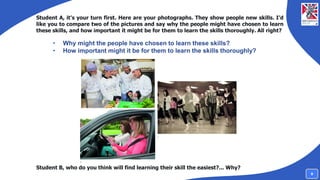
Student A, it’syour turn first. Here are your photographs. They show people new skills. I’d
like you to compare two of the pictures and say why the people might have chosen to learn
these skills, and how important it might be for them to learn the skills thoroughly. All right?
Student B, who do you think will find learning their skill the easiest?... Why?
• Why might the people have chosen to learn these skills?
• How important might it be for them to learn the skills thoroughly?
9
10.
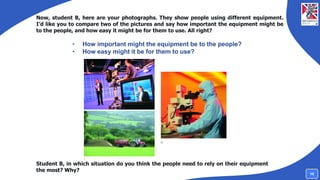
Now, student B,here are your photographs. They show people using different equipment.
I’d like you to compare two of the pictures and say how important the equipment might be
to the people, and how easy it might be for them to use. All right?
Student B, in which situation do you think the people need to rely on their equipment
the most? Why?
• How important might the equipment be to the people?
• How easy might it be for them to use?
10
11.
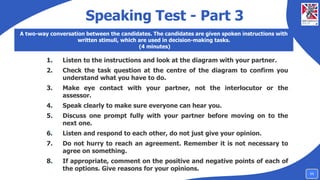
Speaking Test -Part 3
A two-way conversation between the candidates. The candidates are given spoken instructions with
written stimuli, which are used in decision-making tasks.
(4 minutes)
1. Listen to the instructions and look at the diagram with your partner.
2. Check the task question at the centre of the diagram to confirm you
understand what you have to do.
3. Make eye contact with your partner, not the interlocutor or the
assessor.
4. Speak clearly to make sure everyone can hear you.
5. Discuss one prompt fully with your partner before moving on to the
next one.
6. Listen and respond to each other, do not just give your opinion.
7. Do not hurry to reach an agreement. Remember it is not necessary to
agree on something.
8. If appropriate, comment on the positive and negative points of each of
the options. Give reasons for your opinions.
11
12.
Part 3 -Practice
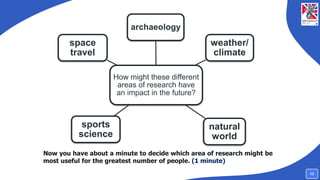
Now I’d like you to talk about something together
for about two minutes.
Here are some areas of research that might have an
impact in the future, and a question for you to
discuss. First you have some time to look at the
task. (15 seconds)
Now, talk to each other about how these different
areas of research might have an impact in the
future. (2 minutes)
12
13.
Now you haveabout a minute to decide which area of research might be
most useful for the greatest number of people. (1 minute)
How might these different
areas of research have
an impact in the future?
archaeology
weather/
climate
natural
world
sports
science
space
travel
13
14.
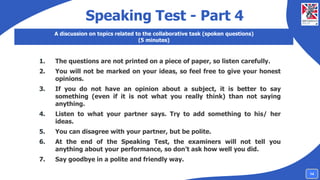
Speaking Test -Part 4
A discussion on topics related to the collaborative task (spoken questions)
(5 minutes)
1. The questions are not printed on a piece of paper, so listen carefully.
2. You will not be marked on your ideas, so feel free to give your honest
opinions.
3. If you do not have an opinion about a subject, it is better to say
something (even if it is not what you really think) than not saying
anything.
4. Listen to what your partner says. Try to add something to his/ her
ideas.
5. You can disagree with your partner, but be polite.
6. At the end of the Speaking Test, the examiners will not tell you
anything about your performance, so don’t ask how well you did.
7. Say goodbye in a polite and friendly way.
14
15.
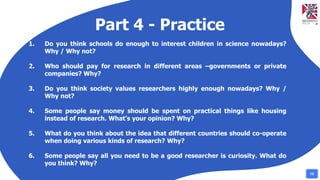
Part 4 -Practice
1. Do you think schools do enough to interest children in science nowadays?
Why / Why not?
2. Who should pay for research in different areas –governments or private
companies? Why?
3. Do you think society values researchers highly enough nowadays? Why /
Why not?
4. Some people say money should be spent on practical things like housing
instead of research. What’s your opinion? Why?
5. What do you think about the idea that different countries should co-operate
when doing various kinds of research? Why?
6. Some people say all you need to be a good researcher is curiosity. What do
you think? Why?
15
16.
Reflection
How did youfeel during
the Speaking Test?
In which part do you
think you need more
practice?
16
17.
What do youremember about the C1
Advanced Writing Paper?
17
18.
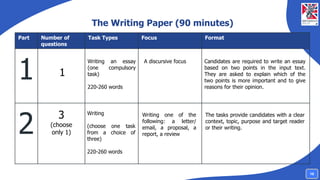
The Writing Paper(90 minutes)
Part Number of
questions
Task Types Focus Format
1
2
1
Writing an essay
(one compulsory
task)
220-260 words
3
(choose
only 1)
A discursive focus Candidates are required to write an essay
based on two points in the input text.
They are asked to explain which of the
two points is more important and to give
reasons for their opinion.
Writing
(choose one task
from a choice of
three)
220-260 words
Writing one of the
following: a letter/
email, a proposal, a
report, a review
The tasks provide candidates with a clear
context, topic, purpose and target reader
or their writing.
18
19.
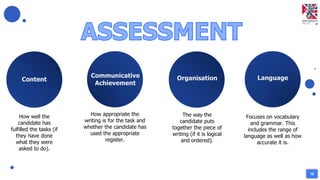
Content
Communicative
Achievement
Organisation Language
How wellthe
candidate has
fulfilled the tasks (if
they have done
what they were
asked to do).
The way the
candidate puts
together the piece of
writing (if it is logical
and ordered).
How appropriate the
writing is for the task and
whether the candidate has
used the appropriate
register.
Focuses on vocabulary
and grammar. This
includes the range of
language as well as how
accurate it is.
19
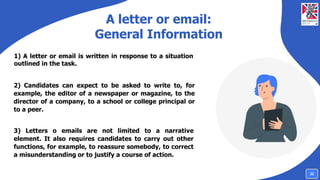
A letter oremail:
General Information
1) A letter or email is written in response to a situation
outlined in the task.
2) Candidates can expect to be asked to write to, for
example, the editor of a newspaper or magazine, to the
director of a company, to a school or college principal or
to a peer.
3) Letters o emails are not limited to a narrative
element. It also requires candidates to carry out other
functions, for example, to reassure somebody, to correct
a misunderstanding or to justify a course of action.
22
23.
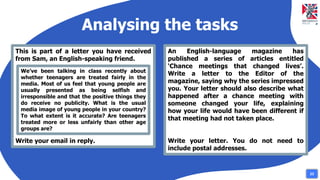
Analysing the tasks
Thisis part of a letter you have received
from Sam, an English-speaking friend.
Write your email in reply.
We’ve been talking in class recently about
whether teenagers are treated fairly in the
media. Most of us feel that young people are
usually presented as being selfish and
irresponsible and that the positive things they
do receive no publicity. What is the usual
media image of young people in your country?
To what extent is it accurate? Are teenagers
treated more or less unfairly than other age
groups are?
An English-language magazine has
published a series of articles entitled
‘Chance meetings that changed lives’.
Write a letter to the Editor of the
magazine, saying why the series impressed
you. Your letter should also describe what
happened after a chance meeting with
someone changed your life, explaining
how your life would have been different if
that meeting had not taken place.
Write your letter. You do not need to
include postal addresses.
23
24.
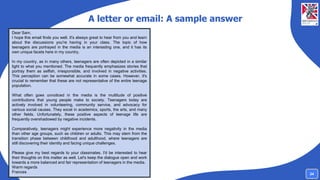
A letter oremail: A sample answer
Dear Sam,
I hope this email finds you well. It's always great to hear from you and learn
about the discussions you're having in your class. The topic of how
teenagers are portrayed in the media is an interesting one, and it has its
own unique facets here in my country.
In my country, as in many others, teenagers are often depicted in a similar
light to what you mentioned. The media frequently emphasizes stories that
portray them as selfish, irresponsible, and involved in negative activities.
This perception can be somewhat accurate in some cases. However, it's
crucial to remember that these are not representative of the entire teenage
population.
What often goes unnoticed in the media is the multitude of positive
contributions that young people make to society. Teenagers today are
actively involved in volunteering, community service, and advocacy for
various social causes. They excel in academics, sports, the arts, and many
other fields. Unfortunately, these positive aspects of teenage life are
frequently overshadowed by negative incidents.
Comparatively, teenagers might experience more negativity in the media
than other age groups, such as children or adults. This may stem from the
transition phase between childhood and adulthood, where teenagers are
still discovering their identity and facing unique challenges.
Please give my best regards to your classmates. I'd be interested to hear
their thoughts on this matter as well. Let's keep the dialogue open and work
towards a more balanced and fair representation of teenagers in the media.
Warm regards
Frances 24
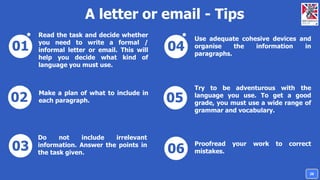
A letter oremail - Tips
01
02
03
Read the task and decide whether
you need to write a formal /
informal letter or email. This will
help you decide what kind of
language you must use.
Make a plan of what to include in
each paragraph.
Do not include irrelevant
information. Answer the points in
the task given.
04
05
06
Use adequate cohesive devices and
organise the information in
paragraphs.
Try to be adventurous with the
language you use. To get a good
grade, you must use a wide range of
grammar and vocabulary.
Proofread your work to correct
mistakes.
26
A report:
General Information
1)A report may be written for a superior (a boss or
college principal) or a peer group (club members or
colleagues)
2) The content of a report is to some extent factual and
draws on the prompt material, but there will be scope for
candidates to make use of their own ideas and
experience.
3) Candidates should do more than describe a situation;
they will be asked to evaluate to what extent a particular
aim has been achieved, or to suggest an alternative
course of action.
28
29.
Analysing the task
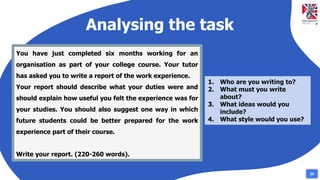
Youhave just completed six months working for an
organisation as part of your college course. Your tutor
has asked you to write a report of the work experience.
Your report should describe what your duties were and
should explain how useful you felt the experience was for
your studies. You should also suggest one way in which
future students could be better prepared for the work
experience part of their course.
Write your report. (220-260 words).
1. Who are you writing to?
2. What must you write
about?
3. What ideas would you
include?
4. What style would you use?
29
30.
A report: Asample answer
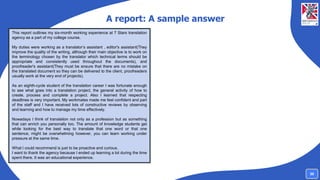
This report outlines my six-month working experience at 7 Stars translation
agency as a part of my college course.
My duties were working as a translator’s assistant , editor's assistant(They
improve the quality of the writing, although their main objective is to work on
the terminology chosen by the translator which technical terms should be
appropriate and consistently used throughout the documents), and
proofreader's assistant(They must be ensure that there are no mistake on
the translated document so they can be delivered to the client, proofreaders
usually work at the very end of projects).
As an eighth-cycle student of the translation career I was fortunate enough
to see what goes into a translation project, the general activity of how to
create, process and complete a project. Also I learned that respecting
deadlines is very important. My workmates made me feel confident and part
of the staff and I have received lots of constructive reviews by observing
and learning and how to manage my time effectively.
Nowadays I think of translation not only as a profession but as something
that can enrich you personally too. The amount of knowledge students get
while looking for the best way to translate that one word or that one
sentence, might be overwhelming however, you can learn working under
pressure at the same time.
What I could recommend is just to be proactive and curious.
I want to thank the agency because I ended up learning a lot during the time
spent there. It was an educational experience.
30
31.
A report: Asample answer
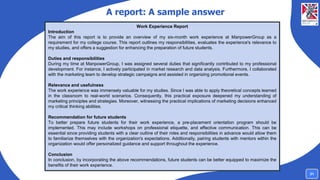
Work Experience Report
Introduction
The aim of this report is to provide an overview of my six-month work experience at ManpowerGroup as a
requirement for my college course. This report outlines my responsibilities, evaluates the experience's relevance to
my studies, and offers a suggestion for enhancing the preparation of future students.
Duties and responsibilities
During my time at ManpowerGroup, I was assigned several duties that significantly contributed to my professional
development. For instance, I actively participated in market research and data analysis. Furthermore, I collaborated
with the marketing team to develop strategic campaigns and assisted in organizing promotional events.
Relevance and usefulness
The work experience was immensely valuable for my studies. Since I was able to apply theoretical concepts learned
in the classroom to real-world scenarios. Consequently, this practical exposure deepened my understanding of
marketing principles and strategies. Moreover, witnessing the practical implications of marketing decisions enhanced
my critical thinking abilities.
Recommendation for future students
To better prepare future students for their work experience, a pre-placement orientation program should be
implemented. This may include workshops on professional etiquette, and effective communication. This can be
essential since providing students with a clear outline of their roles and responsibilities in advance would allow them
to familiarize themselves with the organization's expectations. Additionally, pairing students with mentors within the
organization would offer personalized guidance and support throughout the experience.
Conclusion
In conclusion, by incorporating the above recommendations, future students can be better equipped to maximize the
benefits of their work experience.
31
32.
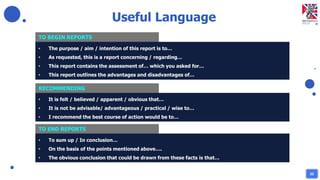
Useful Language
TO BEGINREPORTS
• The purpose / aim / intention of this report is to…
• As requested, this is a report concerning / regarding…
• This report contains the assessment of… which you asked for…
• This report outlines the advantages and disadvantages of…
RECOMMENDING
• It is felt / believed / apparent / obvious that…
• It is not be advisable/ advantageous / practical / wise to…
• I recommend the best course of action would be to…
TO END REPORTS
• To sum up / In conclusion…
• On the basis of the points mentioned above….
• The obvious conclusion that could be drawn from these facts is that…
32
33.
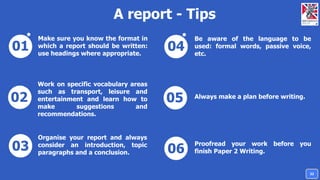
A report -Tips
01
02
03
Make sure you know the format in
which a report should be written:
use headings where appropriate.
Work on specific vocabulary areas
such as transport, leisure and
entertainment and learn how to
make suggestions and
recommendations.
Organise your report and always
consider an introduction, topic
paragraphs and a conclusion.
04
05
06
Be aware of the language to be
used: formal words, passive voice,
etc.
Always make a plan before writing.
Proofread your work before you
finish Paper 2 Writing.
33
34.
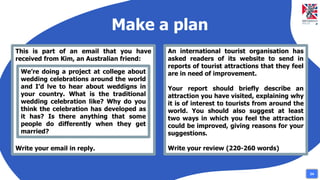
Make a plan
Thisis part of an email that you have
received from Kim, an Australian friend:
Write your email in reply.
We’re doing a project at college about
wedding celebrations around the world
and I’d lve to hear about weddigns in
your country. What is the traditional
wedding celebration like? Why do you
think the celebration has developed as
it has? Is there anything that some
people do differently when they get
married?
An international tourist organisation has
asked readers of its website to send in
reports of tourist attractions that they feel
are in need of improvement.
Your report should briefly describe an
attraction you have visited, explaining why
it is of interest to tourists from around the
world. You should also suggest at least
two ways in which you feel the attraction
could be improved, giving reasons for your
suggestions.
Write your review (220-260 words)
34
35.
Homework
▪ Write youranswers to the two
tasks (the letter and the report)
and send them to your teacher’s
email (the two pieces of writing
in one email).
▪ Deadline: Next Wednesday
35