Second Language Acquisition
By : Kristin Earley
Rebekah Hale
Sarah Collins
Samanda F. F de Adams
What is Second Language Acquisition?
 Second language acquisition (SLA) is
the process of learning other languages
in addition to the native language.
 For example, a child who speaks
Portuguese as the mother tongue starts
learning English when he starts going
to school or is exposed to this new
language; thus, English is learned by
the process of second language
acquisition.
 In fact, a young child can learn a
second language faster than an adult
can learn the same language but this
does not mean that as adults we cannot
learn a second language, just this will
take lots of practice.
Education.com & Bright hub education
Rachel. ratings
Importance of Second Language Acquisition
 Respect for other ethnic groups
 Teaches
understanding, tolerance, and
patience
 Improves abilities in
mathematics, writing, & reading
 New ways to see the world
 To understand the background of
their students
 Opens job opportunities
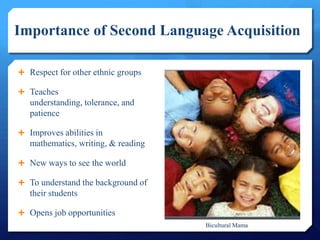
Bicultural Mama
Application to 21st Century Education
 The world is changing faster that we
can imagine. Thus, as educators, in
today’s world, we need to provide
clear examples of learning in the
classroom.
 We need to have assignments that
actually allow the learner to see their
progress – bringing chips and salsa is
not the way to teach Spanish.
 We need to actually get them
involved.
Global-Trends-in-Language-Learning-in-the-21st-Century
In the Jonatan Academy it's not teachers, but
children who create educational movies
Application to 21st Century Education
Cont.
How to do that?
 Let our students demonstrate their skills creating their own electronic portfolio.
Students made videos, student blogs, Wikis and podcasts, etc. All of it is in.
Thus, using technology will be to demonstrate students' learning in order to
show how they themselves reflect upon the impact language learning has had
on them. And they can share their projects with others through technology
showing their work using this to create their own projects.
 There are technologies that facilitate student learning. These technologies may
be synchronous (done in real time), such as Skype, Moodle or virtual live
classes.
 Mobile technology for learning . It’s called ―MALL‖ (mobile assisted language
learning) and it is quickly gaining as much buzz today as ―CALL‖ (computer-
assisted language learning) created in the 1980s and 90s (Chinnery, 2006;
Collins, 2005; Kukulska-Hulme & Shield, 2007, 2008).
Global-Trends-in-Language-Learning-in-the-21st-Century
Example of its Application
 We can organize a weekly meeting where
our students can interact with other students
from around the world using Skype. For
this example we will have a Skype
conversation with students from Quito
Ecuador that has the same age of our
students and speak Spanish .
 First of all, we assign our students to write
about a specific topic in Spanish. They
could write about their city where they
live, food, tourist attractions, holidays, etc.
Then, we can check their writing
assignment and ask for revision and
practice at home; thus when the meet the
students by Skype they can talk about the
topic with the Ecuadorians students
speaking, of course, Spanish.
Role of Technology
 Language learners become more
engaged in computer-mediated contact
with others.
For example, in chat rooms where writing
becomes speaking—tend to produce more
language than in face-to-face discussions.
 In addition, participation appears to be
equalized across learner populations;
that is, the discussion is not dominated
by a small number of students, as
often occurs in the regular classroom.
This may be due to the reduction of social
context clues and nonverbal clues that tend
to inhibit participation.
 There is also a greater ratio of student
talk to teacher talk.
Source: CAL.org:digest
High Language School
Role of Technology Cont.
 Language learners report a positive attitude toward computer use
overall when engaged in language learning tasks.
 Use of email for interaction, for example, appears to reduce anxiety
and increase motivation. Indeed, nearly all studies in the literature
reviews report positive student attitudes as defined by lower anxiety
levels, higher interest, and greater student participation.
 In particular, learners express a preference for tasks that promote
social interaction between and among native speakers and nonnative
speakers.
Work Cited
 Eaton, S.E. (2010). Global Trends in Language Learning in the Twenty-first Century.
Calgary: Onate Press.
http://www.cal.org/resources/digest/0311leloup.html
 Leloup, Jean W., Ponteiro, Robert. Cortland, Sunny.(2003.) Second Language
Acquisition and Technology: A Review of the Research: Center for Applying linguistic
http://www.cal.org/resources/digest/0311leloup.html
 Singhal, Vandana.(2012). Defining Second Language Acquisition. Bright Hub
Education.
http://www.brighthubeducation.com/language-learning-tips/70729-defining-second-
language-acquisition/
 Second Language Acquisition. (1997-2013).American Speech-Language-Hearing
Association. http://www.asha.org/public/speech/development/second/
Work Cited
Pictures:
 Bicultural Mama.
http://www.biculturalmama.com/2012/02/learning-second-language-why-its-
easier.html
 Hi-Language School.
http://www.hi-language.com/content/classroom-management-first-technology-second
 Microsoft Partners in Learning.
http://www.pil-network.com/Resources/LearningActivities/Details/23e85f7d-5397-
45e1-b09a-83a4e81bc465
 Rachel’s Ratings. http://rachelsrantings.com/?p=2777

Language adquisition 1

  • 1.
    Second Language Acquisition By: Kristin Earley Rebekah Hale Sarah Collins Samanda F. F de Adams
  • 2.
    What is SecondLanguage Acquisition?  Second language acquisition (SLA) is the process of learning other languages in addition to the native language.  For example, a child who speaks Portuguese as the mother tongue starts learning English when he starts going to school or is exposed to this new language; thus, English is learned by the process of second language acquisition.  In fact, a young child can learn a second language faster than an adult can learn the same language but this does not mean that as adults we cannot learn a second language, just this will take lots of practice. Education.com & Bright hub education Rachel. ratings
  • 3.
    Importance of SecondLanguage Acquisition  Respect for other ethnic groups  Teaches understanding, tolerance, and patience  Improves abilities in mathematics, writing, & reading  New ways to see the world  To understand the background of their students  Opens job opportunities Bicultural Mama
  • 4.
    Application to 21stCentury Education  The world is changing faster that we can imagine. Thus, as educators, in today’s world, we need to provide clear examples of learning in the classroom.  We need to have assignments that actually allow the learner to see their progress – bringing chips and salsa is not the way to teach Spanish.  We need to actually get them involved. Global-Trends-in-Language-Learning-in-the-21st-Century In the Jonatan Academy it's not teachers, but children who create educational movies
  • 5.
    Application to 21stCentury Education Cont. How to do that?  Let our students demonstrate their skills creating their own electronic portfolio. Students made videos, student blogs, Wikis and podcasts, etc. All of it is in. Thus, using technology will be to demonstrate students' learning in order to show how they themselves reflect upon the impact language learning has had on them. And they can share their projects with others through technology showing their work using this to create their own projects.  There are technologies that facilitate student learning. These technologies may be synchronous (done in real time), such as Skype, Moodle or virtual live classes.  Mobile technology for learning . It’s called ―MALL‖ (mobile assisted language learning) and it is quickly gaining as much buzz today as ―CALL‖ (computer- assisted language learning) created in the 1980s and 90s (Chinnery, 2006; Collins, 2005; Kukulska-Hulme & Shield, 2007, 2008). Global-Trends-in-Language-Learning-in-the-21st-Century
  • 6.
    Example of itsApplication  We can organize a weekly meeting where our students can interact with other students from around the world using Skype. For this example we will have a Skype conversation with students from Quito Ecuador that has the same age of our students and speak Spanish .  First of all, we assign our students to write about a specific topic in Spanish. They could write about their city where they live, food, tourist attractions, holidays, etc. Then, we can check their writing assignment and ask for revision and practice at home; thus when the meet the students by Skype they can talk about the topic with the Ecuadorians students speaking, of course, Spanish.
  • 7.
    Role of Technology Language learners become more engaged in computer-mediated contact with others. For example, in chat rooms where writing becomes speaking—tend to produce more language than in face-to-face discussions.  In addition, participation appears to be equalized across learner populations; that is, the discussion is not dominated by a small number of students, as often occurs in the regular classroom. This may be due to the reduction of social context clues and nonverbal clues that tend to inhibit participation.  There is also a greater ratio of student talk to teacher talk. Source: CAL.org:digest High Language School
  • 8.
    Role of TechnologyCont.  Language learners report a positive attitude toward computer use overall when engaged in language learning tasks.  Use of email for interaction, for example, appears to reduce anxiety and increase motivation. Indeed, nearly all studies in the literature reviews report positive student attitudes as defined by lower anxiety levels, higher interest, and greater student participation.  In particular, learners express a preference for tasks that promote social interaction between and among native speakers and nonnative speakers.
  • 9.
    Work Cited  Eaton,S.E. (2010). Global Trends in Language Learning in the Twenty-first Century. Calgary: Onate Press. http://www.cal.org/resources/digest/0311leloup.html  Leloup, Jean W., Ponteiro, Robert. Cortland, Sunny.(2003.) Second Language Acquisition and Technology: A Review of the Research: Center for Applying linguistic http://www.cal.org/resources/digest/0311leloup.html  Singhal, Vandana.(2012). Defining Second Language Acquisition. Bright Hub Education. http://www.brighthubeducation.com/language-learning-tips/70729-defining-second- language-acquisition/  Second Language Acquisition. (1997-2013).American Speech-Language-Hearing Association. http://www.asha.org/public/speech/development/second/
  • 10.
    Work Cited Pictures:  BiculturalMama. http://www.biculturalmama.com/2012/02/learning-second-language-why-its- easier.html  Hi-Language School. http://www.hi-language.com/content/classroom-management-first-technology-second  Microsoft Partners in Learning. http://www.pil-network.com/Resources/LearningActivities/Details/23e85f7d-5397- 45e1-b09a-83a4e81bc465  Rachel’s Ratings. http://rachelsrantings.com/?p=2777