SOURCE: GOOGLE IMAGES
TOK: THE KNOWLEDGE
FRAMEWORK
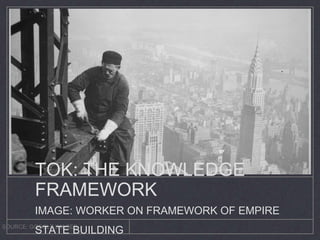
IMAGE: WORKER ON FRAMEWORK OF EMPIRE
STATE BUILDING
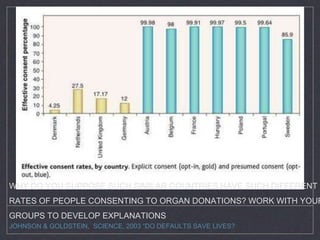
WHY DO YOU SUPPOSE SUCH SIMILAR COUNTRIES HAVE SUCH DIFFERENT
RATES OF PEOPLE CONSENTING TO ORGAN DONATIONS? WORK WITH YOUR
GROUPS TO DEVELOP EXPLANATIONS
JOHNSON & GOLDSTEIN, SCIENCE, 2003 “DO DEFAULTS SAVE LIVES?
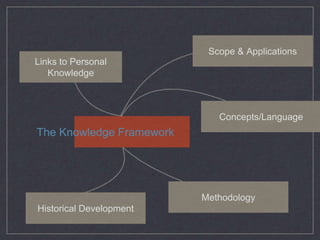
The Knowledge Framework
Concepts/Language
Scope & Applications
Links to Personal
Knowledge
Methodology
Historical Development
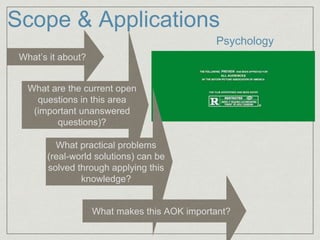
Scope & Applications
What’s it about?
What are the current open
questions in this area
(important unanswered
questions)?
What practical problems
(real-world solutions) can be
solved through applying this
knowledge?
What makes this AOK important?
Psychology
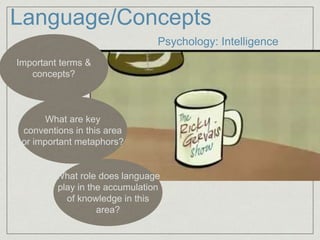
Language/Concepts
Important terms &
concepts?
What are key
conventions in this area
or important metaphors?
What role does language
play in the accumulation
of knowledge in this
area?
Psychology: Intelligence
Methodology
What methods and
procedures are used and
how do they generate
knowledge?
What counts as an
explanation?
What are the roles of the
ways of knowing in these
procedures?
What assumptions are
underlying these methods?
What role do models play
in the discipline?
Psychology: Experiments
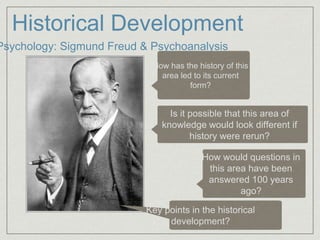
Historical Development
How has the history of this
area led to its current
form?
How would questions in
this area have been
answered 100 years
ago?
Is it possible that this area of
knowledge would look different if
history were rerun?
Key points in the historical
development?
Psychology: Sigmund Freud & Psychoanalysis
Links to Personal Knowledge
What responsibilities
may rest upon the
knower by virtue of
her knowledge in this
area?
How might this
AOK be
significant to
me?
What are the
implications of
shared
knowledge for
me?
Do I have
assumptions
about this
AOK?
TOK Quiz
How can we understand the phrase “the map is not the
territory”? Link this to our TOK discussions and briefly
discuss the implications of this for us as knowers.
How many Areas of Knowledge can you list?
How many Ways of Knowing can you list?
What are some differences between shared and personal
knowledge?
Briefly explain the knowledge framework. If you can
identify any aspects of it, then do so.
Knowledge Questions
Are particle colliders safe?
Is it possible to ask a neutral question?
Is there some knowledge we should not seek?
What are the differences between GDP and GNP
for the economist?
What kind of knowledge can we gain from the arts?

Tok knowledge framework_day 5

  • 1.
    SOURCE: GOOGLE IMAGES TOK:THE KNOWLEDGE FRAMEWORK IMAGE: WORKER ON FRAMEWORK OF EMPIRE STATE BUILDING
  • 2.
    WHY DO YOUSUPPOSE SUCH SIMILAR COUNTRIES HAVE SUCH DIFFERENT RATES OF PEOPLE CONSENTING TO ORGAN DONATIONS? WORK WITH YOUR GROUPS TO DEVELOP EXPLANATIONS JOHNSON & GOLDSTEIN, SCIENCE, 2003 “DO DEFAULTS SAVE LIVES?
  • 3.
    The Knowledge Framework Concepts/Language Scope& Applications Links to Personal Knowledge Methodology Historical Development
  • 4.
    Scope & Applications What’sit about? What are the current open questions in this area (important unanswered questions)? What practical problems (real-world solutions) can be solved through applying this knowledge? What makes this AOK important? Psychology
  • 5.
    Language/Concepts Important terms & concepts? Whatare key conventions in this area or important metaphors? What role does language play in the accumulation of knowledge in this area? Psychology: Intelligence
  • 6.
    Methodology What methods and proceduresare used and how do they generate knowledge? What counts as an explanation? What are the roles of the ways of knowing in these procedures? What assumptions are underlying these methods? What role do models play in the discipline? Psychology: Experiments
  • 7.
    Historical Development How hasthe history of this area led to its current form? How would questions in this area have been answered 100 years ago? Is it possible that this area of knowledge would look different if history were rerun? Key points in the historical development? Psychology: Sigmund Freud & Psychoanalysis
  • 8.
    Links to PersonalKnowledge What responsibilities may rest upon the knower by virtue of her knowledge in this area? How might this AOK be significant to me? What are the implications of shared knowledge for me? Do I have assumptions about this AOK?
  • 9.
    TOK Quiz How canwe understand the phrase “the map is not the territory”? Link this to our TOK discussions and briefly discuss the implications of this for us as knowers. How many Areas of Knowledge can you list? How many Ways of Knowing can you list? What are some differences between shared and personal knowledge? Briefly explain the knowledge framework. If you can identify any aspects of it, then do so.
  • 10.
    Knowledge Questions Are particlecolliders safe? Is it possible to ask a neutral question? Is there some knowledge we should not seek? What are the differences between GDP and GNP for the economist? What kind of knowledge can we gain from the arts?

Editor's Notes

  • #3 The graph represents consent rates for organ donation for different countries in Europe. You will notice that pairs of countries, such as Germany & Austria, Denmark & Sweden, Netherlands & Belgium, despite sharing many similarities have strikingly different rates. What explanations can you develop to account for this? I would ask students in groups to come up with ideas and then not tell them the answer until end of class. The answer is explained by Psychologist Dan Ariely on this Freakonomics blog (scroll down about half way) http://freakonomics.com/2008/04/08/how-much-progress-have-psychology-and-psychiatry-really-made-a-freakonomics-quorum/
  • #4 The KF is way to explore the disciplines or areas of knowledge. Each aspect of the KF allows us to pose questions and get at issues unique to each discipline.
  • #5 We’ll use the lens of psychology to look at the KF. You could use any area of knowledge or discipline. I inserted the clip of the trailer for the movie Kinsey—human behaviour, how and why we do the things we do as an “answer” to What is it about? in this case, study human sexuality.
  • #6 There are many key concepts in psychology (motivation, behavior, intentions, intelligence, cognition). I am just trying to capture one of these-a traditional test of human “intelligence” through an old logic puzzle. The answer is: "What would the other guard say if I asked him which door leads to Heaven--door #1 or door #2?." Assuming door # 2 leads to Heaven, if you ask the liar, he will say "the other guard will say door #1". If you ask the truthful guard, who knows the other guard always lies, he will say "the other guard will say door #1". You then know, through logical deduction, that door #2 actually leads to Heaven. It makes no difference which doors the liar and the truth-teller are guarding. It works the same either way. The important element is that the guards are talking about the nature of the doors themselves, not the nature of the doors they're guarding. But Ricky stipulates at the start that the liar is guarding the door to Hell, and the truth-teller guards the door to Heaven. The way Ricky frames the "right" question - "What would the other guard say if I asked him which door he was guarding?" - would result in one guard answering "Hell", and the other "Heaven"-- the liar standing in front of the door to Hell would lie and say "the other guard would say he is guarding the door to Hell', while the truthful guard in front of the door to Heaven, knowing the other would lie, would tell the truth and say "the other guard would say he is guarding the door to Heaven". You would then logically assume that the guard who said "The other guard would say "Heaven" was standing in front of the door to Heaven, and the one who said "The other guard would say "Hell" is actually guarding Hell. But I don't think any of them, including Ricky, realize that a much simpler way to solve Ricky's version of the puzzle is to ask either of the guards if they're standing on their heads.
  • #7 The video clip shows the delayed gratification test done with sextuplets from the Dilley family who ALL are able to delay gratification, when on average 1/3 to 1/2 of children cannot. A brief discussion about experiments in psychology could be held.
  • #8 If there is time and you are in the lab or students have computers, ask different groups of students to find out a few quick facts about the history of psychology. How old is the discipline? What were some early forms of treatment for the mentally ill? The DSM and definitions of homosexuality/abnormal behaviour?
  • #9 Here’s a short activity that can be done to illustrate the psychological truth that the language we use to frame a decision process greatly influences our perception. Judge scenario-both teams usually pick the same person to both award AND deny custody. In one case we focus on the positives and in the other on the negatives b/cause of how the question is framed. What implications might this have for us as knowers?