



INDOOR AIR QUALITY 
JUDY MURPHY 
Industrial Hygienist 
Montana Department of Labor 
Occupational Safety and Health 
Bureau
Introducing…………… 
• Please tell us 
o Your name 
o Where you work 
o What you do 
o Your indoor air quality experience & 
concerns
Is IAQ Important? 
• 30% of newly constructed or 
remodeled facilities have IAQ problems 
• Indoor contaminants are responsible 
for half of all illnesses 
• Liability issues
Liability 
• Owners and managers 
• Architects, builders and developers 
• Product manufacturers 
• Insurers 
• Unions 
• Real estate agents, bankers and sellers
Why is There an Increase in IAQ 
problems? 
• More time indoors 
• More chemical pollutants in buildings 
• Tighter buildings and reduced ventilation 
• Deferred maintenance
Common Health Effects of Indoor 
Contaminants 
• Eye, nose and throat irritation 
• Coughing and sneezing 
• Headaches 
• Fatigue 
• Irritability 
• Allergies, sinus congestion 
• Dizziness 
• Difficulty in concentrating
Health Effects Depend on Several 
Factors 
• The contaminant 
• The amount of the contaminant 
present 
• The length of time a person is exposed 
to the contaminant 
• The vulnerability of the person
Sick Building Syndrome 
• Symptoms include eye, nose and throat 
irritation, headache, allergies, fatigue 
• 20% or more of occupants experience same 
symptoms 
• No medically diagnosable symptoms 
• Complaints persist for more than two weeks 
• Symptoms often lessen after person leaves 
building
Building-Related Illness 
• Clinically defined illness or disease 
o E.g. Asthma, Legionaires’ Disease, 
Hypersensitivity Pneumonitis 
• Symptoms depend on the disease
QUIZ 
• What are some of the most common 
IAQ health effects? 
• What four factors determine the health 
effects of an exposure to hazardous 
compounds?
Regulations and Standards 
• Outdoor airborne contaminant levels 
o Environmental Protection Agency (EPA) 
o National Ambient Air Quality Standards (NAAQS) 
• Indoor airborne contaminant levels in the 
workplace 
o Occupational Safety and Health Administration 
(OSHA) 
• ASHRAE Standards 62-1989, 62-2001, 62- 
2004, 62.1-2007
ASHRAE Ventilation Standards 
• ASHRAE 62-1989 – Objective of 
ventilation is satisfaction of 80% of 
inhabitants
OSHA Permissible Exposure 
Levels (PELs) 
• “Time-weighted average 
concentrations that must not be 
exceeded during any 8-hour workshift 
of a 40-hour workweek” 
• Legally enforceable 
• Measured in parts per million (ppm) or 
milligrams per cubic meter (mg/m3)
Threshold Limit Values (TLVs) 
• “Time-weighted average concentration for a 
conventional 8-hour workday and a 40-hour 
workweek, to which it is believed that nearly 
all workers can be repeatedly exposed, day 
after day, without adverse effect” 
• Guidelines 
• Generally more conservative than PELs
Problem - Causing 
Compounds 
• Chemicals 
• Combustion products 
• Respirable particles and gases 
• Biological aerosols
CHEMICALS
Volatile Organic Compounds 
(VOCs) 
• Carbon-containing compounds that 
evaporate rapidly 
• Examples 
o Benzene 
o Toluene 
o Styrene 
o Perchloroethylene 
o Pesticides
Volatile Organic Compounds 
(Sources) 
• Paints, stains, 
varnishes 
• Waxes 
• Polishes 
• Solvents 
• Pesticides 
• Adhesives 
• Wood preservatives 
• Cleansers 
• Lubricants 
• Air fresheners 
• Fuels 
• Plastics 
• Copy machines, 
printers 
• Tobacco products 
• Perfumes 
• Dry cleaned clothing
PESTICIDES - Symptoms 
• Headache 
• Dizziness 
• Lack of coordination 
• Nervousness 
• Irritability 
• Insomnia 
• Confusion 
• Loss of concentration 
• Speech difficulties 
• Depression 
• Impaired judgment 
• Memory deficits 
• Visual disturbances 
• ECG changes 
• Weakness 
• Fatigue 
• Paralysis
Integrated Pest Management 
• IPM Steps 
o Set action thresholds 
o Monitor and identify pests 
o Prevention 
o Control
Formaldehyde 
• Used in plywood, paneling, particleboard, 
wallboard, fiberglass, adhesives 
• Sometimes in ceiling tiles, wallpaper, 
furniture, draperies, clothing 
• Even low levels can cause difficulties in 
breathing, burning of eyes nose and throat, 
coughing; a human carcinogen 
• PEL 0.75 ppm; TLV ceiling limit 0.3 ppm
Perchloroethylene 
• Solvent used in dry cleaning, metal 
cleaning and degreasing 
• Can cause irritation of eyes, nose, 
throat and skin, liver and kidney 
damage, CNS depression 
• Considered an animal carcinogen and 
probable human carcinogen 
• PEL 100 ppm; TLV 25 ppm
Perchloroethylene 
MSDS Exercise
QUIZ 
• What are VOCs? 
• What are some sources of VOCs 
• What are some alternatives to 
pesticides?
COMBUSTION PRODUCTS
Combustion Products 
• Carbon monoxide (CO) 
• Oxides of nitrogen (NOx) 
• Oxides of sulfur (SOx) 
• Carbon dioxide (CO2) 
• Polycyclic Aromatic Hydrocarbons (PAH) 
• Tobacco Smoke components
Carbon Monoxide (CO) 
• Colorless, odorless, tasteless 
poisonous gas 
• Produced as a by-product of 
combustion 
• Deprives the body of oxygen by 
binding to blood hemoglobin and 
displacing oxygen molecules
Carbon Monoxide 
• Symptoms are headache, dizziness, 
drowsiness and nausea 
• Severe exposure results in vomiting, 
collapse, coma and death 
• PEL 50 ppm; TLV 25 ppm 
• Body systems most affected are the 
brain, the heart, and the developing 
fetus
Carbon Monoxide 
• Low levels of exposure - more frequent 
attacks of angina, reduced athletic 
performance, heart attacks 
• Moderate exposures - loss of attentiveness, 
decreased visual perception, manual 
dexterity, learning ability and driving ability 
• Smoking – cause of the greatest human 
exposure
Carbon Dioxide (CO2) 
• Colorless, odorless, tasteless gas at 
room temperature 
• Present in exhaled human breath 
• Combustion by-product 
• Naturally present in an unpolluted 
environment at about 300 ppm
Carbon Dioxide 
• CO2 levels above 800 ppm may indicate 
inadequate ventilation 
• ASHRAE recommended indoor air 
quality limit for CO2 is 1000 ppm 
• PEL 5000 ppm; TLV 5000 ppm
Tobacco Smoke 
• Respirable particles and gases, including 
benzene, carbon monoxide, formaldehyde, 
hydrogen cyanide, ammonia and VOCs 
• Sidestream smoke from cigarette contains 
higher concentrations of some toxic and 
carcinogenic substances than mainstream 
smoke inhaled by smoker
Tobacco Smoke 
• Causes lung cancer in nonsmokers as 
well as smokers 
• Increased respiratory infections in 
children 
• Irritation of upper respiratory tract, 
coughing, wheezing, sneezing, 
headache, sinus problems, asthma, 
increased cardiovascular risk
QUIZ 
• Which combustion by-products would 
you expect to see in smog? 
• Which compound is sometimes used 
as a measure of ventilation efficiency?
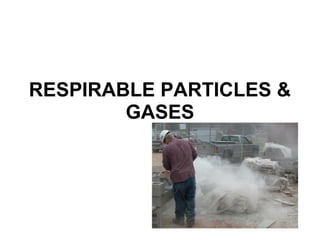
RESPIRABLE PARTICLES & 
GASES
Respirable Particles & Gases 
• Asbestos 
• Fiberglass 
• Silica 
• Metal dust 
• Tobacco smoke components 
• Organic dust 
o Pollen 
o Mold spores 
o Paper dust 
• Radon
Asbestos 
• Group of indestructable highly fibrous 
minerals 
• Separated fibers are long, thin, flexible, heat 
resistant, able to be spun and woven 
• Health effects: lung cancer, mesothelioma, 
asbestosis, pleural plaques 
• Airborne concentration in homes and schools 
30 to 6,000 fibers/m3 
• PEL 0.1 fiber/cc; TLV 0.1 fiber/cc
Lead 
• Indestructable, non-biodegradable, 
adaptable metal 
• Romans used lead to line aqueducts, 
as mortar, in plumbing and to sweeten 
wine 
• Was used in gasoline, batteries, paints, 
ceramic glazes, ammunition, fishing 
sinkers, metal toys
Lead 
• Three quarters of the nation’s housing 
contains lead-based paint 
• Children are at greater risk for lead 
poisoning than adults 
o Hand to mouth activity 
o Developing body systems more easily 
affected 
o Action level is 10 micrograms per deciliter 
(μg/dl)
Lead – Chronic Exposure 
Health Effects 
• Loss of appetite 
• Metallic taste in mouth 
• Anxiety 
• Constipation 
• Nausea 
• Palor 
• Excessive tiredness 
• Weakness 
• Insomnia 
• Headache 
• Nervous irritability 
• Muscle and joint pain or 
soreness 
• Fine tremors 
• Numbness 
• Dizziness 
• Hyperactivity 
• Colic, with severe 
abdominal pain
Chronic Effects of Lead 
Poisoning in Children 
• Fetal development abnormalities 
• Decreased intelligence 
• Slowed neurological development 
• Reading and learning problems 
• Reduced attention span
Chronic Effects of Lead 
Poisoning in Children (cont.) 
• Hearing loss 
• Behavioral problems such as 
hyperactivity 
• Stunted growth 
• Permanent damage to the brain, 
nervous system and kidneys
Sources of Potential Exposure 
to Lead 
• Lead-based paint 
• Lead-contaminated dust 
• Lead-contaminated soil 
• Candle wicks 
• Pewter and silver products 
• Lead crystal 
• Some lead-glazed pottery and porcelain 
• Some imported mini-blinds
Radon 
• Naturally occurring radioactive gas 
• Colorless, odorless, tasteless 
• Causes no symptoms of irritation or 
discomfort 
• No early signs of exposure 
• Testing a building is the only way to evaluate 
exposure 
• Action level is 4 picocuries per liter (pCi/L)
Radon Health Effects 
• Damage by alpha radiation to tissue of 
lungs and respiratory tract 
• 20,000 lung cancer deaths per year 
• Non-smokers risk of lung cancer at 4 
pCi/L is 2 in 1000 
• Smokers risk of lung cancer at 4 pCi/L 
is 20 in 1000
Testing for Radon 
• Test in lowest livable area in building 
• Close all doors and windows 12 hours 
before testing 
• Do not test in kitchen or bathroom 
• Place monitor at least 20 inches above 
floor 
• Test during coldest months of the year
Radon Control Measures 
• Increasing the ventilation in the 
building 
• Sealing the foundation 
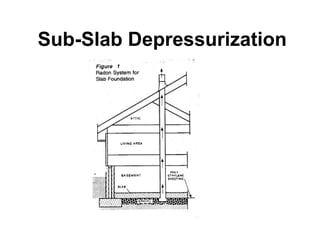
• Sub-slab depressurization
Sub-Slab Depressurization
QUIZ 
• What are some of the health effects of 
lead exposure? 
• How can you tell if a building has 
elevated radon levels?
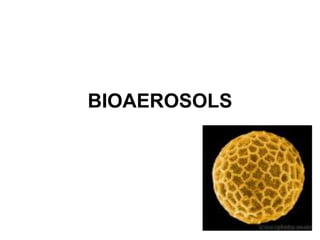
BIOAEROSOLS
Bioaerosols 
• Substances that are living or were 
released from a living organism 
• Examples 
o Bacteria 
o Fungi 
o Pollen 
o Viruses 
o Dust mites
Dust Mites
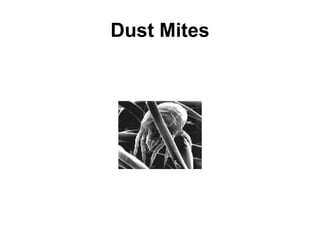
Dust Mites 
• Microscopic relatives of spiders 
• Feed on dead skin scales and other organic 
debris 
• 2,000,000 in an average bed 
• Dust mite feces - a common allergen 
• Prefer relative humidity level above 55%
Viruses 
• Smallest and simplest of all life forms 
• Depend completely on their hosts for 
reproduction 
• Continually undergo evolutionary change 
• Examples 
o Influenza 
o HIV 
o Rhinovirus
Hanta Virus 
• Carried in wild rodents, especially deer mice 
• Can cause respiratory failure and death 
• Approximately 43 % of diagnosed cases have 
been fatal 
• Infection is caused by inhalation of airborne 
particles of infected urine, droppings or 
saliva from infected animals
Hanta Virus Precautions 
• Seal any holes larger than a dime 
• Air out unused buildings before entering 
• Wear a NIOSH-approved mask when cleaning 
• Spray surfaces with disinfectant, leave for 15 
minutes, then sweep 
• Wash hard surfaces with disinfectant
Bacteria 
• Single-celled prokaryotic organisms 
• Most are very small spheres, rods or 
filaments 
• Reproduce by simple cell division 
• Some produce endospores, which are 
extremely resistant to harsh conditions 
• A few require living hosts
Bacteria in Indoor 
Environments 
• Higher concentrations indoors than outdoors 
• Majority of bacteria in air are shed from 
human skin and respiratory tracts 
• Examples of infectious bacteria 
o Legionella spp. 
o Staphlococcus aureus 
o Mycobacterium tuberculosis
Bacterial Toxins 
• Exotoxins 
o Excreted 
o Clostridium botulinum exotoxin - one of the most 
powerful poisons known 
• Endotoxins 
o Part of cell wall of gram negative bacteria 
o Highly toxic – fever, malaise, changes in white 
blood cell counts, respiratory distress, shock, 
even death
Mold
Mold? Where??
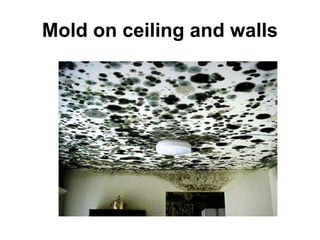
Mold on ceiling and walls
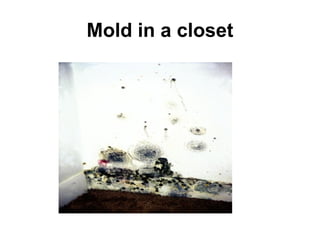
Mold in a closet
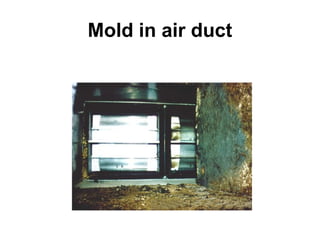
Mold in air duct
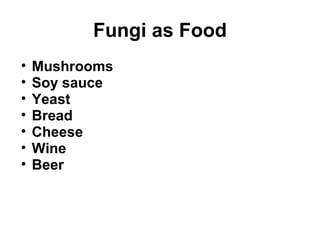
Fungi as Food 
• Mushrooms 
• Soy sauce 
• Yeast 
• Bread 
• Cheese 
• Wine 
• Beer
Mucor species
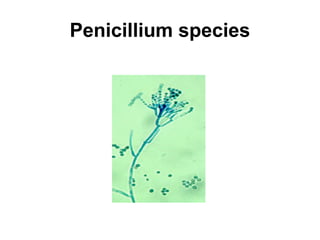
Penicillium species
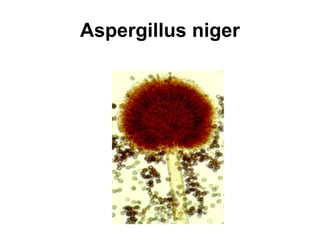
Aspergillus niger
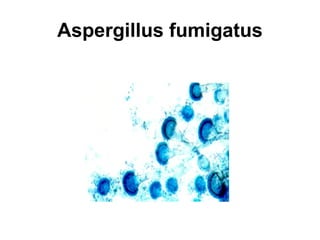
Aspergillus fumigatus
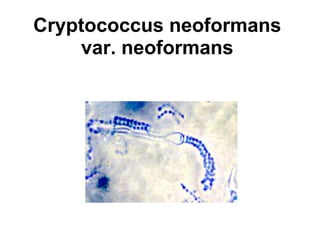
Cryptococcus neoformans 
var. neoformans
Growing Conditions 
• Optimum water activity 
o Above 0.90 in substrate, for most species 
• Optimum temperature range 
o 56°F to 86°F, for most species 
• Light 
o Inhibits growth of some types of molds 
o Stimulates spore production in many 
species
Fungal Metabolism 
• Enzymes secreted to digest external 
food sources, which are then absorbed 
• Must have adequate moisture available
Metabolic Products 
• Carbon dioxide, water, ethanol 
• Microbial Volatile Organic 
Compounds (MVOCs) 
• Mycotoxins and antibiotics
MVOCs 
• VOCs with distinctive offensive odors 
• Possibly responsible for some illnesses 
• Different compounds emitted on different 
media 
• Type and quantity change with phases of 
growth 
• Highest MVOC production is prior to and 
during spore production and mycotoxin 
production
Mycotoxins 
• Produced to inhibit or kill competitors 
• May cause serious short term and long 
term health effects 
• Over 200 recognized mycotoxins, and 
many more not yet discovered 
• Toxins production varies with the 
species, the conditions and the 
substrate
General Health Effects 
• Sinus congestion 
• Sneezing 
• Coughing, 
• Eye irritation 
• Asthma 
• Bronchitis 
• Hypersensitivity pneumonitis 
• Infectious diseases, e.g. ringworm, 
athletes foot, nail infections, 
Histoplasmosis, Valley Fever
Mycotoxin Health Effects 
• Mucous membrane 
irritation 
• Cold and flu symptoms 
• Sore throat 
• Headache 
• Fatigue 
• Diarrhea 
• Skin rashes 
• Dizziness 
• Nausea 
• Immunosuppression 
• Birth defects 
• Tremors 
• Hemorrhaging 
• Cytotoxicity 
• Hepatotoxicity 
• Nephrotoxicity 
• Cancer
Aflatoxin 
• One of the most potent carcinogens 
known to man 
• Linked to a variety of health problems 
• FDA maximum allowable level is 20 
ppb 
• Produced by some species of 
Aspergillus
T-2 Toxin 
• A tricothecene toxin 
• Produced by species of Fusarium mold 
• One of the more deadly toxins 
• Ingestion in sufficient quantity can cause 
rapid death due to internal hemorrhage 
• Implicated in alimentary toxic aleukia and 
pulmonary hemosiderosis 
• Damage is often permanent
Fumonisin 
• Associated with some species of Fusarium 
mold 
• Commonly found in corn 
• Has resulted in dozens of deaths of horses 
and swine 
• Causes “crazy horse disease” or 
leukoencephalomalcia, a liquifaction of the 
brain 
• Chronic low-level exposure in humans has 
been linked to esophageal cancer
Satratoxin H 
• Produced by Stachybotrys, 
Trichoderma and other molds 
• High doses or chronic low doses are 
lethal 
• Abortogenic in animals 
• Believed to alter the immune system 
function
Stachybotrys chartarum (atra) 
• Grows on building material with high 
cellulose content and low nitrogen content 
• Optimum water activity is 0.94 
• Areas with relative humidity above 55% and 
subject to temperature fluctuations are ideal 
for toxin production 
• Changing humidity may induce heavy 
sporulation 
• Spores are covered with slime; not easily 
airborne
Stachybotrys Effects 
• Chronic exposure effects: cold and 
flu symptoms, sore throats, diarrhea, 
headaches, fatigue, dermatitis, 
intermittent local hair loss, 
generalized malaise 
• Toxins suppress the immune 
system, affecting lymphoid tissue 
and bone marrow
Stachybotrys Effects (cont.) 
• Animals injected with Stachybotrys 
exhibited necrosis and hemorrhage 
within the brain, thymus, spleen, 
intestine, lung, heart, lymph node, liver 
and kidney 
• Toxin is reported to be a liver and 
kidney carcinogen
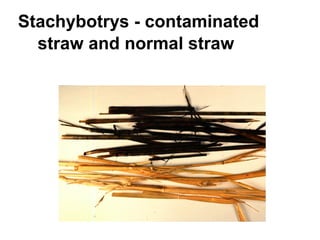
Stachybotrys - contaminated 
straw and normal straw
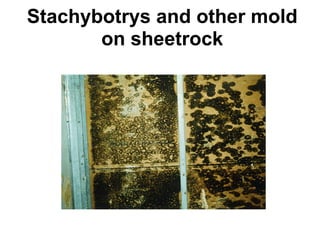
Stachybotrys and other mold 
on sheetrock
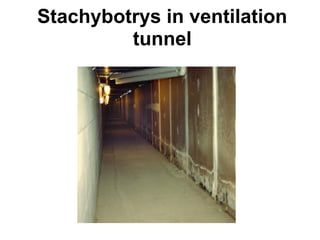
Stachybotrys in ventilation 
tunnel
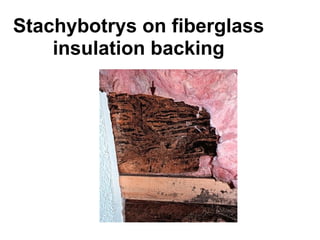
Stachybotrys on fiberglass 
insulation backing
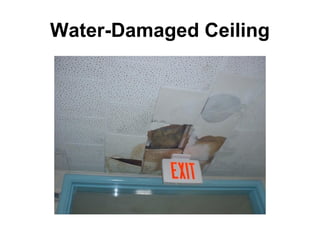
Water-Damaged Ceiling
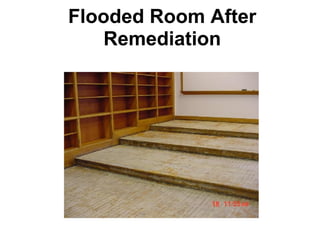
Flooded Room After 
Remediation
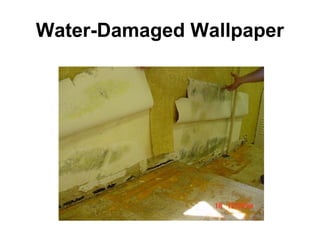
Water-Damaged Wallpaper
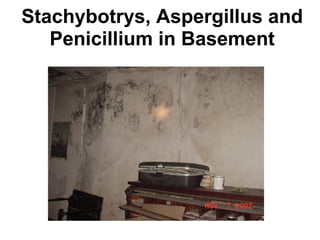
Stachybotrys, Aspergillus and 
Penicillium in Basement
MOLD SAMPLING
Difficulties in Mold Sampling 
• No TLVs or PELs 
• Fungus might not be producing spores at the 
time of sampling 
• Spores might be adhering to surfaces rather 
than airborne 
• Spores might not survive impaction 
• Spores might not grow on the media used 
• Colonies might be overgrown by others and 
not detected 
• Organism might be very slow growing
Types of Mold Sampling 
• Bulk samples 
• Surface samples - tape 
• Surface samples - swab 
• Air samples using impaction onto 
agar 
• Air samples using spore trap 
methods
When Sampling Results Indicate 
Serious Mold Problem 
• Total indoor levels are higher than total 
outdoor levels 
• Fungi indoors are different from 
outdoors or non-complaint areas 
• Fungi are allergenic or toxigenic 
• Area is likely to be disturbed 
• Present or past water or high humidity
Key Remediation Steps 
• Correct the moisture problem that 
led to the mold growth 
• Remove all contaminated porous 
materials 
o Use proper PPE 
o Containment and negative pressure to 
prevent spread of spores 
o Minimize dust production 
o Decontamination
Key Remediation Steps (cont.) 
• Clean all contaminated non-porous 
materials 
o HEPA vacuum 
o Disinfectant or soap and water
Personal Protective Equipment 
for Remediation Work 
• For minimal mold growth 
o N-95 respirator 
o Gloves 
• For moderate to extensive mold growth 
o N-95 respirator 
o Gloves 
o Eye protection 
o Full-body covering
Remediation Resources 
NY City Department of Health Guidelines on 
Assessment and Remediation of Fungi in 
Indoor Environments 
• http://www.ci.nyc.ny.us/html/doh/html/epi/ 
moldrpt1.html 
Mold Remediation in School and Commercial 
Buildings (EPA) 
• http://www.epa.gov/iaq/molds/index.html
Remediation and General 
Information Resources 
Mold in My Home: What Do I Do? 
http://www.cal-iaq.org/mold0107.htm 
Mold in My School: What Do I do? 
http://www.cal-iaq.org//MoldinMySchool.pdf 
Mold in Indoor Workplaces 
http://www.dhs.ca.gov/ohb/HESIS/molds.pdf
QUIZ 
• What is the first thing you should look 
for when there is a suspected mold 
problem? 
• What kind of personal protective 
equipment should you wear if you are 
removing moldy sheetrock?
VENTILATION
Ventilation 
• Purpose - Remove or dilute airborne 
contaminants 
• Supply air - mixture of outside air and 
re-circulated air
HVAC Systems 
• Components 
o Air intakes, dampers, filters 
o Heating & cooling units, coils, drain pans 
o Ductwork 
o Supply vents 
o Exhaust vents 
o Plenum
ASHRAE Outdoor Airflow 
Requirements, 62.1-2004 
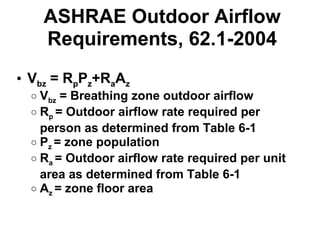
• Vbz = RpPz+RaAz 
o Vbz = Breathing zone outdoor airflow 
o Rp = Outdoor airflow rate required per 
person as determined from Table 6-1 
o Pz = zone population 
o Ra = Outdoor airflow rate required per unit 
area as determined from Table 6-1 
o Az = zone floor area
Acceptable Temperature 
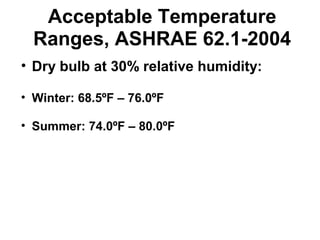
Ranges, ASHRAE 62.1-2004 
• Dry bulb at 30% relative humidity: 
• Winter: 68.5ºF – 76.0ºF 
• Summer: 74.0ºF – 80.0ºF
When Good HVAC Systems Go 
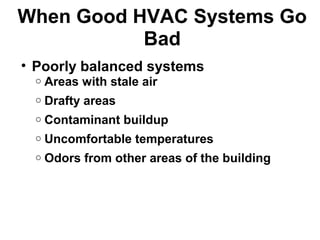
Bad 
• Poorly balanced systems 
o Areas with stale air 
o Drafty areas 
o Contaminant buildup 
o Uncomfortable temperatures 
o Odors from other areas of the building
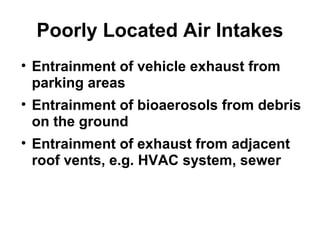
Poorly Located Air Intakes 
• Entrainment of vehicle exhaust from 
parking areas 
• Entrainment of bioaerosols from debris 
on the ground 
• Entrainment of exhaust from adjacent 
roof vents, e.g. HVAC system, sewer
Poor Filters or 
Poor Filter Maintenance 
• Excessive dust and dirt in the supplied 
air 
• Insects 
• Mold spores
Ductwork 
• Leaks 
o Energy loss 
o Can draw contaminants into ducts 
• Duct liners 
o Can degrade; particles enter supplied air
Backdrafting 
• Pressure imbalance 
o Air to air heat exchanger cracks 
o Duct leakage 
o Tight building 
• Combustion contaminants are drawn 
into the building
Ventilation to Meet Occupant 
Needs 
• ASHRAE Standards 
• Temperature 
• Relative Humidity 
• Minimum outdoor air requirements 
• CO2 levels below 1000 ppm 
• Outdoor air supplied at 15 cfm/person
Ventilation – Engineering 
Controls 
• Modify ventilation system 
• Modify pressure relationships 
• Filters 
• Ion generators 
• Humidification systems
IAQ Inspection DVD
QUIZ 
• How often should ducts be cleaned? 
• What level of carbon dioxide indicates 
adequate ventilation? 
• Should a shop area be at positive or 
negative pressure relative to the rest of 
the building?
IAQ INVESTIGATION
Challenges When Evaluating 
IAQ Problems 
• Contaminants and their sources are 
not always obvious 
• Problems may be cyclical or episodic 
• Only a few employees may complain of 
a problem 
• The situation may become emotionally 
charged
IAQ Inspection Steps 
• Building history 
• Brief walk-through 
• Symptoms 
• Inspection 
• Air monitoring 
• Report, with recommendations
Questionnaires 
• Can identify the cause of many IAQ 
problems 
• Building history questionnaires 
• Symptoms questionnaires 
• HVAC questionnaires
EPA’s I-BEAM Software 
• Available on the Internet at: 
http://www.epa.gov/iaq/largebldgs/i-beam/ 
index.html
Walk-Through Inspection 
• Outside sources 
• Building exterior 
• HVAC system 
• Boiler room 
• Attic 
• Crawlspace 
• Occupied spaces 
• Wall cavities 
• Storage spaces
Look Into: 
• Ceilings, walls, floors, furnishings 
• Water damage 
• Odors 
• Remodeling 
• Insulation falling into work area 
• Plumbing leaks and mold in 
crawlspaces
Look Into: 
• Fluorescent light fixtures 
• Frequently damp areas 
• Pets & aquariums 
• Humidifiers 
• Backdrafting possiblilities 
• Ergonomic factors 
• Stress & tension
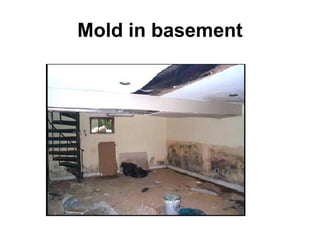
Mold in basement
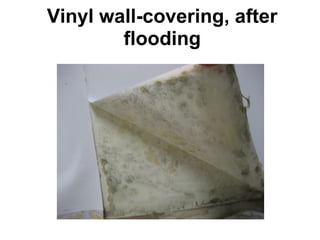
Vinyl wall-covering, after 
flooding
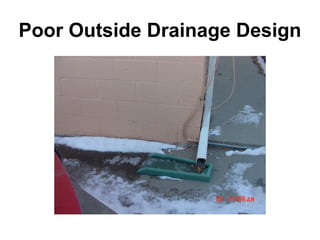
Poor Outside Drainage Design
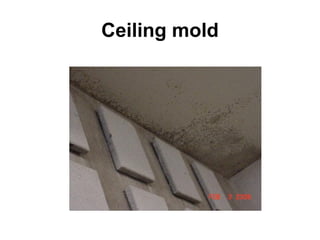
Ceiling mold
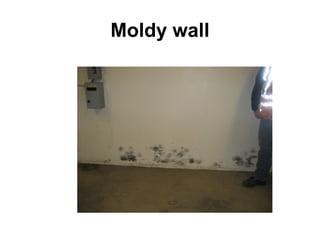
Moldy wall
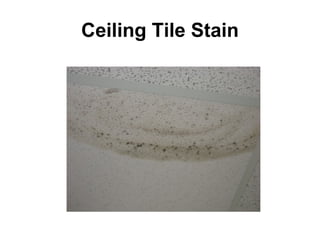
Ceiling Tile Stain
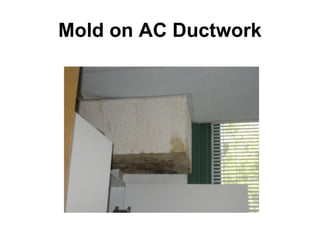
Mold on AC Ductwork
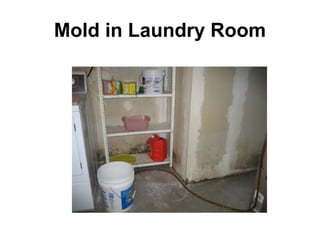
Mold in Laundry Room
IAQ Tools 
• EPA’s “Building Air Quality” 
• EPA’s “Tools for Schools” 
• I-BEAM software 
• Monitoring equipment
Monitoring Basic Parameters 
• CO 
• CO2 
• Temperature 
• Relative humidity 
• Air flow rates
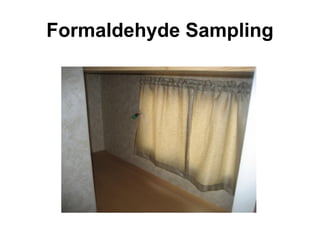
Formaldehyde Sampling
Ventilation 
• “Dilution is the solution” 
• “When all else fails, ventilate”
QUESTIONS???

Indoor air-quality

  • 2.
    INDOOR AIR QUALITY JUDY MURPHY Industrial Hygienist Montana Department of Labor Occupational Safety and Health Bureau
  • 3.
    Introducing…………… • Pleasetell us o Your name o Where you work o What you do o Your indoor air quality experience & concerns
  • 4.
    Is IAQ Important? • 30% of newly constructed or remodeled facilities have IAQ problems • Indoor contaminants are responsible for half of all illnesses • Liability issues
  • 5.
    Liability • Ownersand managers • Architects, builders and developers • Product manufacturers • Insurers • Unions • Real estate agents, bankers and sellers
  • 6.
    Why is Therean Increase in IAQ problems? • More time indoors • More chemical pollutants in buildings • Tighter buildings and reduced ventilation • Deferred maintenance
  • 7.
    Common Health Effectsof Indoor Contaminants • Eye, nose and throat irritation • Coughing and sneezing • Headaches • Fatigue • Irritability • Allergies, sinus congestion • Dizziness • Difficulty in concentrating
  • 8.
    Health Effects Dependon Several Factors • The contaminant • The amount of the contaminant present • The length of time a person is exposed to the contaminant • The vulnerability of the person
  • 9.
    Sick Building Syndrome • Symptoms include eye, nose and throat irritation, headache, allergies, fatigue • 20% or more of occupants experience same symptoms • No medically diagnosable symptoms • Complaints persist for more than two weeks • Symptoms often lessen after person leaves building
  • 10.
    Building-Related Illness •Clinically defined illness or disease o E.g. Asthma, Legionaires’ Disease, Hypersensitivity Pneumonitis • Symptoms depend on the disease
  • 11.
    QUIZ • Whatare some of the most common IAQ health effects? • What four factors determine the health effects of an exposure to hazardous compounds?
  • 12.
    Regulations and Standards • Outdoor airborne contaminant levels o Environmental Protection Agency (EPA) o National Ambient Air Quality Standards (NAAQS) • Indoor airborne contaminant levels in the workplace o Occupational Safety and Health Administration (OSHA) • ASHRAE Standards 62-1989, 62-2001, 62- 2004, 62.1-2007
  • 13.
    ASHRAE Ventilation Standards • ASHRAE 62-1989 – Objective of ventilation is satisfaction of 80% of inhabitants
  • 14.
    OSHA Permissible Exposure Levels (PELs) • “Time-weighted average concentrations that must not be exceeded during any 8-hour workshift of a 40-hour workweek” • Legally enforceable • Measured in parts per million (ppm) or milligrams per cubic meter (mg/m3)
  • 15.
    Threshold Limit Values(TLVs) • “Time-weighted average concentration for a conventional 8-hour workday and a 40-hour workweek, to which it is believed that nearly all workers can be repeatedly exposed, day after day, without adverse effect” • Guidelines • Generally more conservative than PELs
  • 16.
    Problem - Causing Compounds • Chemicals • Combustion products • Respirable particles and gases • Biological aerosols
  • 17.
  • 18.
    Volatile Organic Compounds (VOCs) • Carbon-containing compounds that evaporate rapidly • Examples o Benzene o Toluene o Styrene o Perchloroethylene o Pesticides
  • 19.
    Volatile Organic Compounds (Sources) • Paints, stains, varnishes • Waxes • Polishes • Solvents • Pesticides • Adhesives • Wood preservatives • Cleansers • Lubricants • Air fresheners • Fuels • Plastics • Copy machines, printers • Tobacco products • Perfumes • Dry cleaned clothing
  • 20.
    PESTICIDES - Symptoms • Headache • Dizziness • Lack of coordination • Nervousness • Irritability • Insomnia • Confusion • Loss of concentration • Speech difficulties • Depression • Impaired judgment • Memory deficits • Visual disturbances • ECG changes • Weakness • Fatigue • Paralysis
  • 21.
    Integrated Pest Management • IPM Steps o Set action thresholds o Monitor and identify pests o Prevention o Control
  • 22.
    Formaldehyde • Usedin plywood, paneling, particleboard, wallboard, fiberglass, adhesives • Sometimes in ceiling tiles, wallpaper, furniture, draperies, clothing • Even low levels can cause difficulties in breathing, burning of eyes nose and throat, coughing; a human carcinogen • PEL 0.75 ppm; TLV ceiling limit 0.3 ppm
  • 23.
    Perchloroethylene • Solventused in dry cleaning, metal cleaning and degreasing • Can cause irritation of eyes, nose, throat and skin, liver and kidney damage, CNS depression • Considered an animal carcinogen and probable human carcinogen • PEL 100 ppm; TLV 25 ppm
  • 24.
  • 25.
    QUIZ • Whatare VOCs? • What are some sources of VOCs • What are some alternatives to pesticides?
  • 26.
  • 27.
    Combustion Products •Carbon monoxide (CO) • Oxides of nitrogen (NOx) • Oxides of sulfur (SOx) • Carbon dioxide (CO2) • Polycyclic Aromatic Hydrocarbons (PAH) • Tobacco Smoke components
  • 28.
    Carbon Monoxide (CO) • Colorless, odorless, tasteless poisonous gas • Produced as a by-product of combustion • Deprives the body of oxygen by binding to blood hemoglobin and displacing oxygen molecules
  • 29.
    Carbon Monoxide •Symptoms are headache, dizziness, drowsiness and nausea • Severe exposure results in vomiting, collapse, coma and death • PEL 50 ppm; TLV 25 ppm • Body systems most affected are the brain, the heart, and the developing fetus
  • 30.
    Carbon Monoxide •Low levels of exposure - more frequent attacks of angina, reduced athletic performance, heart attacks • Moderate exposures - loss of attentiveness, decreased visual perception, manual dexterity, learning ability and driving ability • Smoking – cause of the greatest human exposure
  • 31.
    Carbon Dioxide (CO2) • Colorless, odorless, tasteless gas at room temperature • Present in exhaled human breath • Combustion by-product • Naturally present in an unpolluted environment at about 300 ppm
  • 32.
    Carbon Dioxide •CO2 levels above 800 ppm may indicate inadequate ventilation • ASHRAE recommended indoor air quality limit for CO2 is 1000 ppm • PEL 5000 ppm; TLV 5000 ppm
  • 33.
    Tobacco Smoke •Respirable particles and gases, including benzene, carbon monoxide, formaldehyde, hydrogen cyanide, ammonia and VOCs • Sidestream smoke from cigarette contains higher concentrations of some toxic and carcinogenic substances than mainstream smoke inhaled by smoker
  • 34.
    Tobacco Smoke •Causes lung cancer in nonsmokers as well as smokers • Increased respiratory infections in children • Irritation of upper respiratory tract, coughing, wheezing, sneezing, headache, sinus problems, asthma, increased cardiovascular risk
  • 35.
    QUIZ • Whichcombustion by-products would you expect to see in smog? • Which compound is sometimes used as a measure of ventilation efficiency?
  • 36.
  • 37.
    Respirable Particles &Gases • Asbestos • Fiberglass • Silica • Metal dust • Tobacco smoke components • Organic dust o Pollen o Mold spores o Paper dust • Radon
  • 38.
    Asbestos • Groupof indestructable highly fibrous minerals • Separated fibers are long, thin, flexible, heat resistant, able to be spun and woven • Health effects: lung cancer, mesothelioma, asbestosis, pleural plaques • Airborne concentration in homes and schools 30 to 6,000 fibers/m3 • PEL 0.1 fiber/cc; TLV 0.1 fiber/cc
  • 39.
    Lead • Indestructable,non-biodegradable, adaptable metal • Romans used lead to line aqueducts, as mortar, in plumbing and to sweeten wine • Was used in gasoline, batteries, paints, ceramic glazes, ammunition, fishing sinkers, metal toys
  • 40.
    Lead • Threequarters of the nation’s housing contains lead-based paint • Children are at greater risk for lead poisoning than adults o Hand to mouth activity o Developing body systems more easily affected o Action level is 10 micrograms per deciliter (μg/dl)
  • 41.
    Lead – ChronicExposure Health Effects • Loss of appetite • Metallic taste in mouth • Anxiety • Constipation • Nausea • Palor • Excessive tiredness • Weakness • Insomnia • Headache • Nervous irritability • Muscle and joint pain or soreness • Fine tremors • Numbness • Dizziness • Hyperactivity • Colic, with severe abdominal pain
  • 42.
    Chronic Effects ofLead Poisoning in Children • Fetal development abnormalities • Decreased intelligence • Slowed neurological development • Reading and learning problems • Reduced attention span
  • 43.
    Chronic Effects ofLead Poisoning in Children (cont.) • Hearing loss • Behavioral problems such as hyperactivity • Stunted growth • Permanent damage to the brain, nervous system and kidneys
  • 44.
    Sources of PotentialExposure to Lead • Lead-based paint • Lead-contaminated dust • Lead-contaminated soil • Candle wicks • Pewter and silver products • Lead crystal • Some lead-glazed pottery and porcelain • Some imported mini-blinds
  • 45.
    Radon • Naturallyoccurring radioactive gas • Colorless, odorless, tasteless • Causes no symptoms of irritation or discomfort • No early signs of exposure • Testing a building is the only way to evaluate exposure • Action level is 4 picocuries per liter (pCi/L)
  • 46.
    Radon Health Effects • Damage by alpha radiation to tissue of lungs and respiratory tract • 20,000 lung cancer deaths per year • Non-smokers risk of lung cancer at 4 pCi/L is 2 in 1000 • Smokers risk of lung cancer at 4 pCi/L is 20 in 1000
  • 47.
    Testing for Radon • Test in lowest livable area in building • Close all doors and windows 12 hours before testing • Do not test in kitchen or bathroom • Place monitor at least 20 inches above floor • Test during coldest months of the year
  • 48.
    Radon Control Measures • Increasing the ventilation in the building • Sealing the foundation • Sub-slab depressurization
  • 49.
  • 50.
    QUIZ • Whatare some of the health effects of lead exposure? • How can you tell if a building has elevated radon levels?
  • 51.
  • 52.
    Bioaerosols • Substancesthat are living or were released from a living organism • Examples o Bacteria o Fungi o Pollen o Viruses o Dust mites
  • 53.
  • 54.
    Dust Mites •Microscopic relatives of spiders • Feed on dead skin scales and other organic debris • 2,000,000 in an average bed • Dust mite feces - a common allergen • Prefer relative humidity level above 55%
  • 55.
    Viruses • Smallestand simplest of all life forms • Depend completely on their hosts for reproduction • Continually undergo evolutionary change • Examples o Influenza o HIV o Rhinovirus
  • 56.
    Hanta Virus •Carried in wild rodents, especially deer mice • Can cause respiratory failure and death • Approximately 43 % of diagnosed cases have been fatal • Infection is caused by inhalation of airborne particles of infected urine, droppings or saliva from infected animals
  • 57.
    Hanta Virus Precautions • Seal any holes larger than a dime • Air out unused buildings before entering • Wear a NIOSH-approved mask when cleaning • Spray surfaces with disinfectant, leave for 15 minutes, then sweep • Wash hard surfaces with disinfectant
  • 58.
    Bacteria • Single-celledprokaryotic organisms • Most are very small spheres, rods or filaments • Reproduce by simple cell division • Some produce endospores, which are extremely resistant to harsh conditions • A few require living hosts
  • 59.
    Bacteria in Indoor Environments • Higher concentrations indoors than outdoors • Majority of bacteria in air are shed from human skin and respiratory tracts • Examples of infectious bacteria o Legionella spp. o Staphlococcus aureus o Mycobacterium tuberculosis
  • 60.
    Bacterial Toxins •Exotoxins o Excreted o Clostridium botulinum exotoxin - one of the most powerful poisons known • Endotoxins o Part of cell wall of gram negative bacteria o Highly toxic – fever, malaise, changes in white blood cell counts, respiratory distress, shock, even death
  • 61.
  • 62.
  • 63.
    Mold on ceilingand walls
  • 64.
    Mold in acloset
  • 65.
  • 66.
    Fungi as Food • Mushrooms • Soy sauce • Yeast • Bread • Cheese • Wine • Beer
  • 67.
  • 68.
  • 69.
  • 70.
  • 71.
  • 72.
    Growing Conditions •Optimum water activity o Above 0.90 in substrate, for most species • Optimum temperature range o 56°F to 86°F, for most species • Light o Inhibits growth of some types of molds o Stimulates spore production in many species
  • 73.
    Fungal Metabolism •Enzymes secreted to digest external food sources, which are then absorbed • Must have adequate moisture available
  • 74.
    Metabolic Products •Carbon dioxide, water, ethanol • Microbial Volatile Organic Compounds (MVOCs) • Mycotoxins and antibiotics
  • 75.
    MVOCs • VOCswith distinctive offensive odors • Possibly responsible for some illnesses • Different compounds emitted on different media • Type and quantity change with phases of growth • Highest MVOC production is prior to and during spore production and mycotoxin production
  • 76.
    Mycotoxins • Producedto inhibit or kill competitors • May cause serious short term and long term health effects • Over 200 recognized mycotoxins, and many more not yet discovered • Toxins production varies with the species, the conditions and the substrate
  • 77.
    General Health Effects • Sinus congestion • Sneezing • Coughing, • Eye irritation • Asthma • Bronchitis • Hypersensitivity pneumonitis • Infectious diseases, e.g. ringworm, athletes foot, nail infections, Histoplasmosis, Valley Fever
  • 78.
    Mycotoxin Health Effects • Mucous membrane irritation • Cold and flu symptoms • Sore throat • Headache • Fatigue • Diarrhea • Skin rashes • Dizziness • Nausea • Immunosuppression • Birth defects • Tremors • Hemorrhaging • Cytotoxicity • Hepatotoxicity • Nephrotoxicity • Cancer
  • 79.
    Aflatoxin • Oneof the most potent carcinogens known to man • Linked to a variety of health problems • FDA maximum allowable level is 20 ppb • Produced by some species of Aspergillus
  • 80.
    T-2 Toxin •A tricothecene toxin • Produced by species of Fusarium mold • One of the more deadly toxins • Ingestion in sufficient quantity can cause rapid death due to internal hemorrhage • Implicated in alimentary toxic aleukia and pulmonary hemosiderosis • Damage is often permanent
  • 81.
    Fumonisin • Associatedwith some species of Fusarium mold • Commonly found in corn • Has resulted in dozens of deaths of horses and swine • Causes “crazy horse disease” or leukoencephalomalcia, a liquifaction of the brain • Chronic low-level exposure in humans has been linked to esophageal cancer
  • 82.
    Satratoxin H •Produced by Stachybotrys, Trichoderma and other molds • High doses or chronic low doses are lethal • Abortogenic in animals • Believed to alter the immune system function
  • 83.
    Stachybotrys chartarum (atra) • Grows on building material with high cellulose content and low nitrogen content • Optimum water activity is 0.94 • Areas with relative humidity above 55% and subject to temperature fluctuations are ideal for toxin production • Changing humidity may induce heavy sporulation • Spores are covered with slime; not easily airborne
  • 84.
    Stachybotrys Effects •Chronic exposure effects: cold and flu symptoms, sore throats, diarrhea, headaches, fatigue, dermatitis, intermittent local hair loss, generalized malaise • Toxins suppress the immune system, affecting lymphoid tissue and bone marrow
  • 85.
    Stachybotrys Effects (cont.) • Animals injected with Stachybotrys exhibited necrosis and hemorrhage within the brain, thymus, spleen, intestine, lung, heart, lymph node, liver and kidney • Toxin is reported to be a liver and kidney carcinogen
  • 86.
    Stachybotrys - contaminated straw and normal straw
  • 87.
    Stachybotrys and othermold on sheetrock
  • 88.
  • 89.
    Stachybotrys on fiberglass insulation backing
  • 90.
  • 91.
    Flooded Room After Remediation
  • 92.
  • 93.
    Stachybotrys, Aspergillus and Penicillium in Basement
  • 94.
  • 95.
    Difficulties in MoldSampling • No TLVs or PELs • Fungus might not be producing spores at the time of sampling • Spores might be adhering to surfaces rather than airborne • Spores might not survive impaction • Spores might not grow on the media used • Colonies might be overgrown by others and not detected • Organism might be very slow growing
  • 96.
    Types of MoldSampling • Bulk samples • Surface samples - tape • Surface samples - swab • Air samples using impaction onto agar • Air samples using spore trap methods
  • 97.
    When Sampling ResultsIndicate Serious Mold Problem • Total indoor levels are higher than total outdoor levels • Fungi indoors are different from outdoors or non-complaint areas • Fungi are allergenic or toxigenic • Area is likely to be disturbed • Present or past water or high humidity
  • 98.
    Key Remediation Steps • Correct the moisture problem that led to the mold growth • Remove all contaminated porous materials o Use proper PPE o Containment and negative pressure to prevent spread of spores o Minimize dust production o Decontamination
  • 99.
    Key Remediation Steps(cont.) • Clean all contaminated non-porous materials o HEPA vacuum o Disinfectant or soap and water
  • 100.
    Personal Protective Equipment for Remediation Work • For minimal mold growth o N-95 respirator o Gloves • For moderate to extensive mold growth o N-95 respirator o Gloves o Eye protection o Full-body covering
  • 101.
    Remediation Resources NYCity Department of Health Guidelines on Assessment and Remediation of Fungi in Indoor Environments • http://www.ci.nyc.ny.us/html/doh/html/epi/ moldrpt1.html Mold Remediation in School and Commercial Buildings (EPA) • http://www.epa.gov/iaq/molds/index.html
  • 102.
    Remediation and General Information Resources Mold in My Home: What Do I Do? http://www.cal-iaq.org/mold0107.htm Mold in My School: What Do I do? http://www.cal-iaq.org//MoldinMySchool.pdf Mold in Indoor Workplaces http://www.dhs.ca.gov/ohb/HESIS/molds.pdf
  • 103.
    QUIZ • Whatis the first thing you should look for when there is a suspected mold problem? • What kind of personal protective equipment should you wear if you are removing moldy sheetrock?
  • 104.
  • 105.
    Ventilation • Purpose- Remove or dilute airborne contaminants • Supply air - mixture of outside air and re-circulated air
  • 106.
    HVAC Systems •Components o Air intakes, dampers, filters o Heating & cooling units, coils, drain pans o Ductwork o Supply vents o Exhaust vents o Plenum
  • 107.
    ASHRAE Outdoor Airflow Requirements, 62.1-2004 • Vbz = RpPz+RaAz o Vbz = Breathing zone outdoor airflow o Rp = Outdoor airflow rate required per person as determined from Table 6-1 o Pz = zone population o Ra = Outdoor airflow rate required per unit area as determined from Table 6-1 o Az = zone floor area
  • 108.
    Acceptable Temperature Ranges,ASHRAE 62.1-2004 • Dry bulb at 30% relative humidity: • Winter: 68.5ºF – 76.0ºF • Summer: 74.0ºF – 80.0ºF
  • 109.
    When Good HVACSystems Go Bad • Poorly balanced systems o Areas with stale air o Drafty areas o Contaminant buildup o Uncomfortable temperatures o Odors from other areas of the building
  • 110.
    Poorly Located AirIntakes • Entrainment of vehicle exhaust from parking areas • Entrainment of bioaerosols from debris on the ground • Entrainment of exhaust from adjacent roof vents, e.g. HVAC system, sewer
  • 111.
    Poor Filters or Poor Filter Maintenance • Excessive dust and dirt in the supplied air • Insects • Mold spores
  • 112.
    Ductwork • Leaks o Energy loss o Can draw contaminants into ducts • Duct liners o Can degrade; particles enter supplied air
  • 113.
    Backdrafting • Pressureimbalance o Air to air heat exchanger cracks o Duct leakage o Tight building • Combustion contaminants are drawn into the building
  • 114.
    Ventilation to MeetOccupant Needs • ASHRAE Standards • Temperature • Relative Humidity • Minimum outdoor air requirements • CO2 levels below 1000 ppm • Outdoor air supplied at 15 cfm/person
  • 115.
    Ventilation – Engineering Controls • Modify ventilation system • Modify pressure relationships • Filters • Ion generators • Humidification systems
  • 116.
  • 117.
    QUIZ • Howoften should ducts be cleaned? • What level of carbon dioxide indicates adequate ventilation? • Should a shop area be at positive or negative pressure relative to the rest of the building?
  • 118.
  • 119.
    Challenges When Evaluating IAQ Problems • Contaminants and their sources are not always obvious • Problems may be cyclical or episodic • Only a few employees may complain of a problem • The situation may become emotionally charged
  • 120.
    IAQ Inspection Steps • Building history • Brief walk-through • Symptoms • Inspection • Air monitoring • Report, with recommendations
  • 121.
    Questionnaires • Canidentify the cause of many IAQ problems • Building history questionnaires • Symptoms questionnaires • HVAC questionnaires
  • 122.
    EPA’s I-BEAM Software • Available on the Internet at: http://www.epa.gov/iaq/largebldgs/i-beam/ index.html
  • 123.
    Walk-Through Inspection •Outside sources • Building exterior • HVAC system • Boiler room • Attic • Crawlspace • Occupied spaces • Wall cavities • Storage spaces
  • 124.
    Look Into: •Ceilings, walls, floors, furnishings • Water damage • Odors • Remodeling • Insulation falling into work area • Plumbing leaks and mold in crawlspaces
  • 125.
    Look Into: •Fluorescent light fixtures • Frequently damp areas • Pets & aquariums • Humidifiers • Backdrafting possiblilities • Ergonomic factors • Stress & tension
  • 126.
  • 127.
  • 128.
  • 129.
  • 130.
  • 131.
  • 132.
    Mold on ACDuctwork
  • 133.
  • 134.
    IAQ Tools •EPA’s “Building Air Quality” • EPA’s “Tools for Schools” • I-BEAM software • Monitoring equipment
  • 135.
    Monitoring Basic Parameters • CO • CO2 • Temperature • Relative humidity • Air flow rates
  • 136.
  • 137.
    Ventilation • “Dilutionis the solution” • “When all else fails, ventilate”
  • 138.

Editor's Notes

  • #11 Hypersensitivity pneumonitis: allergic alveolitis; a pulmonary response to exposure to organic particles or gases; may also occur with exposure to isocyanates and cobalt. Classical acute episode starts with fever, muscular aches, and general malaise some 4 to 8 hours after exposure to the antigen. Occasionally, this is preceded or accompanied by wheeze or tightness in the chest and a dry cough. Shortness of breath is a feature of more severe attacks and may occasionally be dramatic and disabling or even fatal. Symptoms typically reach a peak at about 8 to 12 hours after exposure and then improve over another 12 to 24 hours in the absence of further exposure. Humidifier fever is an example of H.P.; usually worse on Monday morning if humidifier is at workplace.
  • #22 Action thresholds – point where pest control action must be taken Monitor & identify – not all pests are harmful; some are beneficial Prevention – e.g. crop rotation, pest-resistant varieties Control – mechanical controls, traps, habitat control, pheromones
  • #24 OSHA PEL: 100 ppm CEILING LIMIT: 200 ppm ACGIH TLV: 25 ppm SHORT TERM EXPOSURE LIMIT: 100 ppm
  • #36 Smog: CO, CO2, ozone, particulates, VOCs, NOx, SO2
  • #68 Example of Zygomycetes: Mucor species showing sporangia, columella and sporangiospores; asexual stage
  • #69 Ascomycetes example: Penicillium conidiospores; asexual stage
  • #70 Ascomycetes example: conidia of Aspergillus niger Most frequently associated agent of otomycosis. Third most common species associated with invasive pulmonary aspergillosis. Most frequently associated agent of otomycosis.
  • #71 Example of Ascomycetes: conidial head of Aspergillus fumigatus Most common cause of invasive and non-invasive aspergillosis. Thermotolerant, grows at temperatures up to 55 degrees C. Has been found everywhere, on every conceivable substrate, especially soil and decaying organic matter.
  • #72 Found in pigeon and bat droppings. Not usually infectious. May affect CNS, particularly in immunocompromised persons. Sept. 2001 25 cases of cryptococcal disease in Vancouver, B.C. Four died. Symptoms: fever, chills, vomiting, headache, dizziness, chest pain, confusion, dementia
  • #73 Water activity – 0.90 is soaking wet; preferred by most species, not all Temp – 15 to 30 degrees C is 59 to 86 degrees F; preferred by most species, not all Light – dark areas are often also damp Some areas that meet these criteria: inside walls backing of sheetrock inner surface of wallpaper upper side of ceiling tiles under floor tiles or carpet inside ventilation systems areas of debris by air intakes humidifiers AC drip pans
  • #75 Primary metabolism Necessary for maintaining life e.g. extracting energy from nutrients, building and repairing cells e.g. aerobic respiration, digestion Secondary metabolism Gives the fungi or bacteria a competitive advantage over other organisms Iincludes mycotoxins, antibiotics, and some VOCs
  • #78 Histoplasmosis Caused by Histoplasma capsulatum Organism often found in soil enriched by bird droppings; Effects are usually mild flu-like illness; possibly pneumonia, blindness, and death Valley Fever – caused by Coccidioides immites; carried in dust
  • #85 Produces several highly toxic tricothecene mycotoxins, including Satratoxin G Horses in Ukraine in 1930’s had outbreak of disease characterized by shock, dermal necrosis, leukopenia, hemorrhage, nervous disorders and death. Scientists determined that the disease was caused by Stachybotrys growing on the straw and grain fed to the animals. Contents of one petri plate resulted in sickness, and contents of 30 plates resulted in death. 1mg. of pure toxin is reported to cause death. People working with the contaminated hay or feed had dermatitis, pain and inflammation of the mucous membranes of the mouth and throat, a burning sensation of the nasal passages, tightness of the chest, cough, bloody rhinitis, fever, headache and fatigue Outbreak in 1993-1994 of hemosiderosis in Cleveland infants. Ten cases reported. Age range 4 weeks to 16 weeks. One infant died, age 9 weeks. All homes of the infants had high levels of total fungi and Stachybotrys. The homes had previously sustained water damage, resulting in mold contamination.
  • #88 Stachybotrys and other fungi on sheetrock of flooded school basement. Growth occurred about one week after flooding.
  • #89 Stachy on gypsum wallboard (covering insulation on a concrete wall), inside ventilation tunnel around the base of an elementary school. Tunnel was flooded about 6 inches deep.
  • #90 Building had roof leak that dripped onto ceiling (left) and insulation. Paper backing of insulation was against paper backing of sheetrock of ceiling.
  • #99 Correct problem, e.g. roof leaks, drainage situation that causes flooding Remove porous materials, according to NY City and EPA Guidelines
  • #124 Outside air – nearby farming or disturbance of plant materials excavation or construction wastewater treatment irrigation composting Building exterior – Poor grading or water drainage perforations cracks in building blocked rain gutters wood rot animal infestations near or below building sprinklers that wet exterior walls HVAC – Air intakes filters heat exchangers dirty coils excessive water in condensate pans dampness and growth on acoustical lining poorly maintained air washers or humidifiers supply plenums and ductwork supply air diffusers Occupied space – water damage chronic condensation window air conditioners and evaporative air coolers fancoil and induction units potted plants carpet fabric office partitions wall coverings drapes upholstered furniture portable humidifiers return air plenums