Indoor Environment
Quality
SUMIT KUMAR JHA
BARCH/15006/14
What is Indoor Environment
Quality
 Indoor environmental quality (IEQ)
refers to the quality of a building's
environment in relation to the health and
well being of those who occupy space
within it. IEQ is determined by many
factors, including
 lighting,
 air quality
 damp conditions
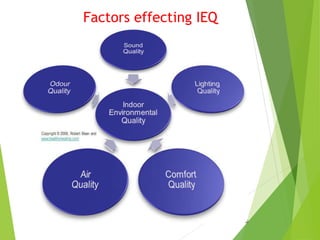
Factors effecting IEQ
Importance of Indoor Air
Indoor Air Quality
 IEQ encompasses indoor air quality (IAQ),
which focuses on airborne contaminants, as
well as other health, safety, and comfort
issues such as aesthetics, potable water
surveillance, ergonomics, acoustics, lighting,
and electromagnetic frequency levels.
 IEQ improvements to an existing building can
occur at any point during the use of a
building.
Importance of air quality
 Value aesthetic decisions, such as the importance of
views and the integration of natural and man-made
elements;
 Provide thermal comfort with a maximum degree of
personal control over temperature and airflow;
 Supply adequate levels and quality of ventilation and
outside air for acceptable indoor air quality;
 Prevent airborne bacteria, through building envelope
design that properly manages moisture sources from
outside and inside the building, and with heating,
ventilating, air-conditioning (HVAC) system designs that
are effective at controlling indoor humidity.
 Assure acoustic privacy and comfort through the use of
sound absorbing material and equipment isolation;
 Control disturbing odors through contaminant isolation
and removal.
 Create a high-performance luminous environment through
the careful integration of natural and artificial light
sources.
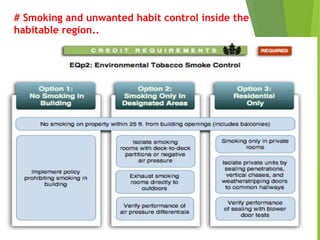
# Smoking and unwanted habit control inside the
habitable region..
Outdoor Air Delivery Monitoring
 Outdoor air delivery monitoring ensures that the ventilation
system, whether natural or mechanical, provides enough fresh
air to occupants.
 The credit requires carbon dioxide (CO2) and outdoor airflow
monitors that signal when fresh air is needed according to
minimum set points defined by ASHRAE 62.1-2004.
 Typical ventilation design (without monitors) tends to
encourage increased ventilation that may result in increased
energy use and added cost for conditioning increased amounts
of outside air.
 However, the addition of sensors and monitors allows
ventilation to be delivered on demand only when required,
potentially saving a lot of energy during unoccupied hours in
spaces with varying occupancy.
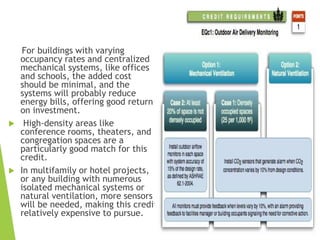
For buildings with varying
occupancy rates and centralized
mechanical systems, like offices
and schools, the added cost
should be minimal, and the
systems will probably reduce
energy bills, offering good return
on investment.
 High-density areas like
conference rooms, theaters, and
congregation spaces are a
particularly good match for this
credit.
 In multifamily or hotel projects,
or any building with numerous
isolated mechanical systems or
natural ventilation, more sensors
will be needed, making this credit
relatively expensive to pursue.
Construction Indoor Air Quality
Management Plans (during constr.)
 What is a Construction Indoor Air Quality
Management Plan? ƒ
 Plan to reduce indoor air quality (IAQ) problems resulting from
construction
 ƒPromotes the comfort and well being of building occupants and
construction workers
 Document that defines construction scope! ƒIncluded scope, ƒExcluded
scope
 Construction IAQ Management Plan During
Construction
 ƒDevelop and Implement an IAQ Management Plan for the
construction and preoccupancy phases of the building as follows:
 ƒMeet or exceed the recommended control measures of the SMACNA
IAQ Guidelines for Occupied Buildings Under Construction
 ƒProtect stored on-site and installed absorptive materials from
moisture damage
 ƒIf permanently installed air handlers are used during construction,
filtration media with a MERV of 8 must be used at each return air grill.
 ƒMeet or exceed the recommended control measures of the SMACNA IAQ
Guidelines for Occupied Buildings Under Construction ƒHVAC Protection ƒSource
Control ƒPathway Interruption ƒHousekeeping ƒScheduling
 HVAC Protection
 ƒAvoid using permanently installed HVAC systems during construction if possible
 Protect all HVAC equipment from both dust and odors and seal all duct and
equipment openings with plastic
 Source Control ƒ
 Recover, isolate, and ventilate containers housing toxic materials. ƒ
 Exhaust fumes from idling vehicles and gasoline and diesel fueled tools.
 Pathway Interruption ƒ
 Isolate areas of work to prevent contamination of clean or occupied spaces ƒ
Provide temporary barriers ƒ
 Maintain negative pressure relative to other spaces
 Protect stored on-site and installed absorptive materials from moisture
damage
 If permanently installed air handlers are used during construction, filtration
media with a MERV of 8 must be used at each return air grill.
Construction IAQ Management
Plan Before Occupancy
ƒOption 1 - Flush-Out
ƒPath 1 – Completed pre-occupancy
OR
ƒPath 2 – Completed post-occupancy ƒ
Option 2 – Air Testing
Option 1 - Flush-Out Path 1
ƒAfter construction ends, prior to occupancy and with all interior
finishes installed, install new filtration media and perform a
building flush-out by supplying a total air volume of 14,000 cubic
feet of outdoor air per square foot of floor area while maintaining
an internal temperature of at least 60°F and relative humidity no
higher than 60%.
ƒOption 1 - Flush-Out Path 2
 ƒIf occupancy is desired prior to completion of the flushout, the
space may be occupied following delivery of a minimum of 3,500
cubic feet of outdoor air per square foot of floor area. Once the
space is occupied, it must be ventilated at a minimum rate of 0.30
cubic feet per minute per square foot of outside air or the design
minimum outside air rate, whichever is greater. During each day of
the flush-out period ventilation must begin a minimum of 3 hours
prior to occupancy and continue during occupancy. These
conditions must be maintained until a total of 14,000 cubic feet of
outdoor air per square foot of floor area has been delivered to the
space.
Option 2 – Air Testing
 ƒConduct baseline IAQ testing after construction ends and prior to
occupancy. Demonstrate that maximum allowable concentrations
of contaminants are not exceeded.
Low emitting materials
 Intent
 To reduce concentrations of chemical contaminants that can damage
air quality, human health, productivity, and the environment
 Requirements
- This credit includes requirements for product manufacturing as
well as project teams. It covers volatile organic compound (VOC)
emissions into indoor air and the VOC content of materials, as well as
the testing methods by which indoor VOC emissions are determined.
- Different materials must meet different requirements to be
considered compliant for this credit.
The building interior and exterior are organized in seven categories,
each with different thresholds of compliance.
- The building interior is defined as everything within the
waterproofing membrane. - The building exterior is defined as
everything outside and inclusive of the primary and secondary
weatherproofing system, such as waterproofing membranes and air-
and water-resistive barrier materials.
Paints & Coatings
 Our first priority should be to specify only paints and
coatings that comply with the credit’s VOC limits, and enforce
those specifications on the jobsite. Research low-VOC paints
and coatings before construction begins and provide lists of
acceptable materials to contractors to help ensure that the
right products are used.
 Major manufacturers offer paints and coatings that are just
as durable and perform just as well as their higher-VOC
counterparts. Performance of low-VOC products has
sometimes been an issue in the past, but the market has
largely moved beyond this point.
 Low-VOC acrylic paint is readily available. While it may be
more difficult, it is not impossible to find low-VOC oil-
based and high-gloss paints.
 Darker shades of paints also tend to have higher VOC
levels. Rust proofing coatings also tend to have higher VOC
content, but several name brand providers have low-VOC
alternatives.
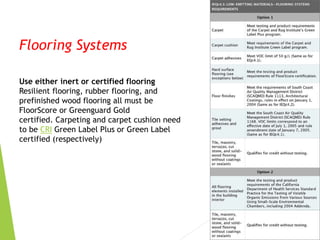
Flooring Systems
Use either inert or certified flooring
Resilient flooring, rubber flooring, and
prefinished wood flooring all must be
FloorScore or Greenguard Gold
certified. Carpeting and carpet cushion need
to be CRI Green Label Plus or Green Label
certified (respectively)
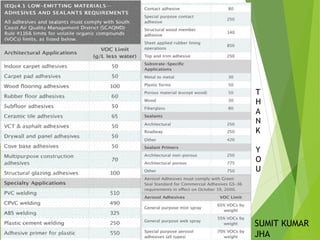
Adhesives and sealants
Research low-VOC adhesives and sealants before
construction begins and provide lists of acceptable
materials to contractors to help ensure that the
right products are used.
 Making sure that VOC limits are observed demands
proactive communication between the designer,
contractor, and all subcontractors who do work
inside the building.
 Subcontractors have to be educated about the
requirements, and their contracts should require
that they document their compliance.
T
H
A
N
K
Y
O
U
SUMIT KUMAR
JHA

Indoor air quality

  • 1.
  • 2.
    What is IndoorEnvironment Quality  Indoor environmental quality (IEQ) refers to the quality of a building's environment in relation to the health and well being of those who occupy space within it. IEQ is determined by many factors, including  lighting,  air quality  damp conditions
  • 3.
  • 4.
  • 5.
    Indoor Air Quality IEQ encompasses indoor air quality (IAQ), which focuses on airborne contaminants, as well as other health, safety, and comfort issues such as aesthetics, potable water surveillance, ergonomics, acoustics, lighting, and electromagnetic frequency levels.  IEQ improvements to an existing building can occur at any point during the use of a building.
  • 6.
    Importance of airquality  Value aesthetic decisions, such as the importance of views and the integration of natural and man-made elements;  Provide thermal comfort with a maximum degree of personal control over temperature and airflow;  Supply adequate levels and quality of ventilation and outside air for acceptable indoor air quality;  Prevent airborne bacteria, through building envelope design that properly manages moisture sources from outside and inside the building, and with heating, ventilating, air-conditioning (HVAC) system designs that are effective at controlling indoor humidity.  Assure acoustic privacy and comfort through the use of sound absorbing material and equipment isolation;  Control disturbing odors through contaminant isolation and removal.  Create a high-performance luminous environment through the careful integration of natural and artificial light sources.
  • 7.
    # Smoking andunwanted habit control inside the habitable region..
  • 8.
    Outdoor Air DeliveryMonitoring  Outdoor air delivery monitoring ensures that the ventilation system, whether natural or mechanical, provides enough fresh air to occupants.  The credit requires carbon dioxide (CO2) and outdoor airflow monitors that signal when fresh air is needed according to minimum set points defined by ASHRAE 62.1-2004.  Typical ventilation design (without monitors) tends to encourage increased ventilation that may result in increased energy use and added cost for conditioning increased amounts of outside air.  However, the addition of sensors and monitors allows ventilation to be delivered on demand only when required, potentially saving a lot of energy during unoccupied hours in spaces with varying occupancy.
  • 9.
    For buildings withvarying occupancy rates and centralized mechanical systems, like offices and schools, the added cost should be minimal, and the systems will probably reduce energy bills, offering good return on investment.  High-density areas like conference rooms, theaters, and congregation spaces are a particularly good match for this credit.  In multifamily or hotel projects, or any building with numerous isolated mechanical systems or natural ventilation, more sensors will be needed, making this credit relatively expensive to pursue.
  • 10.
    Construction Indoor AirQuality Management Plans (during constr.)  What is a Construction Indoor Air Quality Management Plan? ƒ  Plan to reduce indoor air quality (IAQ) problems resulting from construction  ƒPromotes the comfort and well being of building occupants and construction workers  Document that defines construction scope! ƒIncluded scope, ƒExcluded scope  Construction IAQ Management Plan During Construction  ƒDevelop and Implement an IAQ Management Plan for the construction and preoccupancy phases of the building as follows:  ƒMeet or exceed the recommended control measures of the SMACNA IAQ Guidelines for Occupied Buildings Under Construction  ƒProtect stored on-site and installed absorptive materials from moisture damage  ƒIf permanently installed air handlers are used during construction, filtration media with a MERV of 8 must be used at each return air grill.
  • 11.
     ƒMeet orexceed the recommended control measures of the SMACNA IAQ Guidelines for Occupied Buildings Under Construction ƒHVAC Protection ƒSource Control ƒPathway Interruption ƒHousekeeping ƒScheduling  HVAC Protection  ƒAvoid using permanently installed HVAC systems during construction if possible  Protect all HVAC equipment from both dust and odors and seal all duct and equipment openings with plastic  Source Control ƒ  Recover, isolate, and ventilate containers housing toxic materials. ƒ  Exhaust fumes from idling vehicles and gasoline and diesel fueled tools.  Pathway Interruption ƒ  Isolate areas of work to prevent contamination of clean or occupied spaces ƒ Provide temporary barriers ƒ  Maintain negative pressure relative to other spaces  Protect stored on-site and installed absorptive materials from moisture damage  If permanently installed air handlers are used during construction, filtration media with a MERV of 8 must be used at each return air grill.
  • 12.
    Construction IAQ Management PlanBefore Occupancy ƒOption 1 - Flush-Out ƒPath 1 – Completed pre-occupancy OR ƒPath 2 – Completed post-occupancy ƒ Option 2 – Air Testing Option 1 - Flush-Out Path 1 ƒAfter construction ends, prior to occupancy and with all interior finishes installed, install new filtration media and perform a building flush-out by supplying a total air volume of 14,000 cubic feet of outdoor air per square foot of floor area while maintaining an internal temperature of at least 60°F and relative humidity no higher than 60%.
  • 13.
    ƒOption 1 -Flush-Out Path 2  ƒIf occupancy is desired prior to completion of the flushout, the space may be occupied following delivery of a minimum of 3,500 cubic feet of outdoor air per square foot of floor area. Once the space is occupied, it must be ventilated at a minimum rate of 0.30 cubic feet per minute per square foot of outside air or the design minimum outside air rate, whichever is greater. During each day of the flush-out period ventilation must begin a minimum of 3 hours prior to occupancy and continue during occupancy. These conditions must be maintained until a total of 14,000 cubic feet of outdoor air per square foot of floor area has been delivered to the space. Option 2 – Air Testing  ƒConduct baseline IAQ testing after construction ends and prior to occupancy. Demonstrate that maximum allowable concentrations of contaminants are not exceeded.
  • 14.
    Low emitting materials Intent  To reduce concentrations of chemical contaminants that can damage air quality, human health, productivity, and the environment  Requirements - This credit includes requirements for product manufacturing as well as project teams. It covers volatile organic compound (VOC) emissions into indoor air and the VOC content of materials, as well as the testing methods by which indoor VOC emissions are determined. - Different materials must meet different requirements to be considered compliant for this credit. The building interior and exterior are organized in seven categories, each with different thresholds of compliance. - The building interior is defined as everything within the waterproofing membrane. - The building exterior is defined as everything outside and inclusive of the primary and secondary weatherproofing system, such as waterproofing membranes and air- and water-resistive barrier materials.
  • 15.
    Paints & Coatings Our first priority should be to specify only paints and coatings that comply with the credit’s VOC limits, and enforce those specifications on the jobsite. Research low-VOC paints and coatings before construction begins and provide lists of acceptable materials to contractors to help ensure that the right products are used.  Major manufacturers offer paints and coatings that are just as durable and perform just as well as their higher-VOC counterparts. Performance of low-VOC products has sometimes been an issue in the past, but the market has largely moved beyond this point.  Low-VOC acrylic paint is readily available. While it may be more difficult, it is not impossible to find low-VOC oil- based and high-gloss paints.  Darker shades of paints also tend to have higher VOC levels. Rust proofing coatings also tend to have higher VOC content, but several name brand providers have low-VOC alternatives.
  • 16.
    Flooring Systems Use eitherinert or certified flooring Resilient flooring, rubber flooring, and prefinished wood flooring all must be FloorScore or Greenguard Gold certified. Carpeting and carpet cushion need to be CRI Green Label Plus or Green Label certified (respectively)
  • 17.
    Adhesives and sealants Researchlow-VOC adhesives and sealants before construction begins and provide lists of acceptable materials to contractors to help ensure that the right products are used.  Making sure that VOC limits are observed demands proactive communication between the designer, contractor, and all subcontractors who do work inside the building.  Subcontractors have to be educated about the requirements, and their contracts should require that they document their compliance.
  • 18.