
Indoor Air Quality for Buildings
For Health , Personal Comfort and
Working Efficiency

Peter Dyment

Ltd March 2014
Indoor Air Quality for Buildings
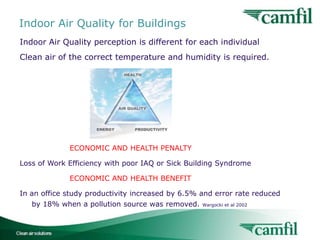
Indoor Air Quality perception is different for each individual
Clean air of the correct temperature and humidity is required.

ECONOMIC AND HEALTH PENALTY
Loss of Work Efficiency with poor IAQ or Sick Building Syndrome
ECONOMIC AND HEALTH BENEFIT
In an office study productivity increased by 6.5% and error rate reduced
by 18% when a pollution source was removed.
Indoor Air Quality for buildings

Wargocki et al 2002

2
Indoor Air Quality for Buildings
What are the key elements that make

Good IAQ
1.

Clean Air that has the minimal
levels of air pollution

2.

Comfortable Air Temperature

3.

Comfortable level of Humidity

4.

Ventilation rate is able to dilute
Carbon Dioxide and replace
Oxygen

5.

An Air tight building envelope with
tested performance

6.

Planned maintenance that includes
AHU and Air Duct Hygiene
inspection and cleaning

Indoor Air Quality for Buildings

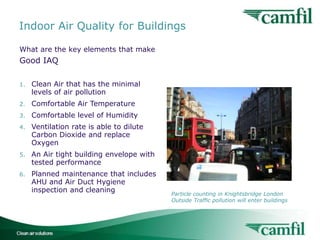
Particle counting in Knightsbridge London
Outside Traffic pollution will enter buildings

3
Indoor Air Quality for Buildings
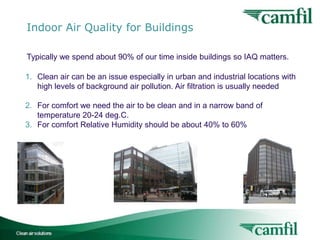
Typically we spend about 90% of our time inside buildings so IAQ matters.

1. Clean air can be an issue especially in urban and industrial locations with
high levels of background air pollution. Air filtration is usually needed
2. For comfort we need the air to be clean and in a narrow band of
temperature 20-24 deg.C.
3. For comfort Relative Humidity should be about 40% to 60%

Indoor Air Quality for Buildings

4
Indoor Air Quality for Buildings

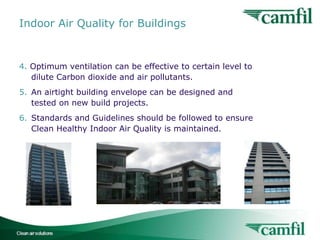
4. Optimum ventilation can be effective to certain level to
dilute Carbon dioxide and air pollutants.
5. An airtight building envelope can be designed and
tested on new build projects.
6. Standards and Guidelines should be followed to ensure
Clean Healthy Indoor Air Quality is maintained.

Indoor Air Quality for Buildings

5
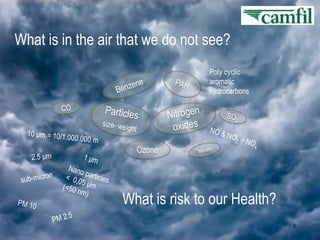
What is in the air that we do not see?
Poly cyclic
aromatic
hydrocarbons

Ozone

What is risk to our Health?
6
What is the major risk to health?
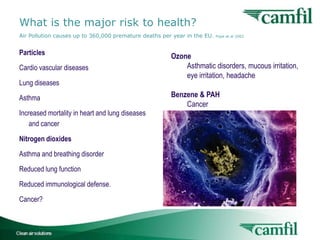
Air Pollution causes up to 360,000 premature deaths per year in the EU.

Particles
Cardio vascular diseases
Lung diseases
Asthma
Increased mortality in heart and lung diseases
and cancer

Pope et al 2002

Ozone
Asthmatic disorders, mucous irritation,
eye irritation, headache
Benzene & PAH
Cancer

Nitrogen dioxides
Asthma and breathing disorder
Reduced lung function
Reduced immunological defense.
Cancer?

Indoor Air Quality for Buildings

7
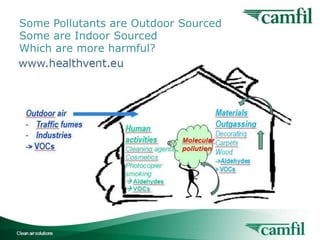
Some Pollutants are Outdoor Sourced
Some are Indoor Sourced
Which are more harmful?

Indoor Air Quality for Buildings

8
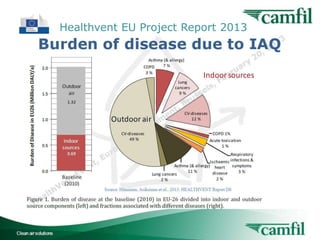
Healthvent EU Project Report 2013

Indoor Air Quality for Buildings

9
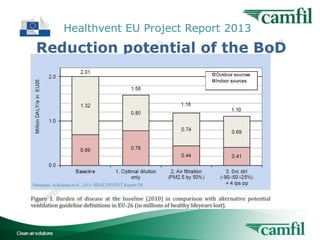
Healthvent EU Project Report 2013

Indoor Air Quality for Buildings

10
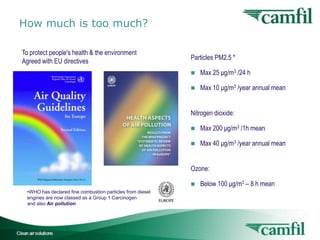
How much is too much?
To protect people's health & the environment
Agreed with EU directives

Particles PM2.5 *


Max 25 μg/m3 /24 h



Max 10 μg/m3 /year annual mean

Nitrogen dioxide:


Max 200 μg/m3 /1h mean



Max 40 μg/m3 /year annual mean

Ozone:


Below 100 μg/m3 – 8 h mean

•WHO has declared fine combustion particles from diesel
engines are now classed as a Group 1 Carcinogen
and also Air pollution

Indoor Air Quality for Buildings

11
Indoor Air Quality problems can be
determined by Air Quality testing
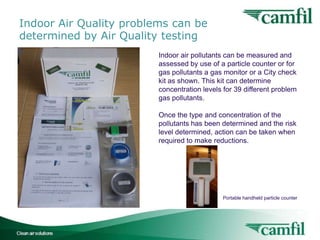
Indoor air pollutants can be measured and
assessed by use of a particle counter or for
gas pollutants a gas monitor or a City check
kit as shown. This kit can determine
concentration levels for 39 different problem
gas pollutants.
Once the type and concentration of the
pollutants has been determined and the risk
level determined, action can be taken when
required to make reductions.

Portable handheld particle counter

Indoor Air Quality for Buildings

12
Low Energy Air Filters consistent and effective IAQ performance
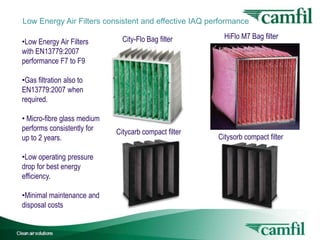
•Low Energy Air Filters
with EN13779:2007
performance F7 to F9

City-Flo Bag filter

HiFlo M7 Bag filter

•Gas filtration also to
EN13779:2007 when
required.
• Micro-fibre glass medium
performs consistently for
up to 2 years.

Citycarb compact filter

Citysorb compact filter

•Low operating pressure
drop for best energy
efficiency.
•Minimal maintenance and
disposal costs
Indoor Air Quality for Buildings

13
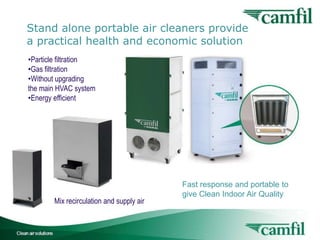
Stand alone portable air cleaners provide
a practical health and economic solution
•Particle filtration
•Gas filtration
•Without upgrading
the main HVAC system
•Energy efficient

Mix recirculation and supply air
Indoor Air Quality for Buildings

Fast response and portable to
give Clean Indoor Air Quality

14
Air Duct hygiene inspection and cleaning
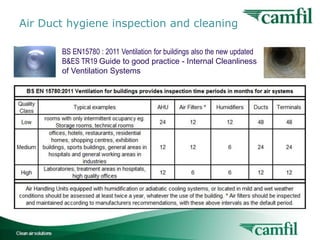
BS EN15780 : 2011 Ventilation for buildings also the new updated
B&ES TR19 Guide to good practice - Internal Cleanliness
of Ventilation Systems

Indoor Air Quality for Buildings

15
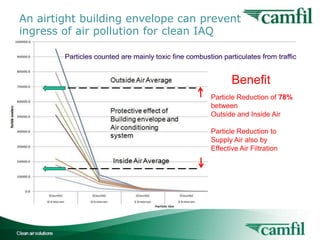
An airtight building envelope can prevent
ingress of air pollution for clean IAQ
Particles counted are mainly toxic fine combustion particulates from traffic

Benefit
Particle Reduction of 78%
between
Outside and Inside Air

Particle Reduction to
Supply Air also by
Effective Air Filtration

Indoor Air Quality for Buildings

16
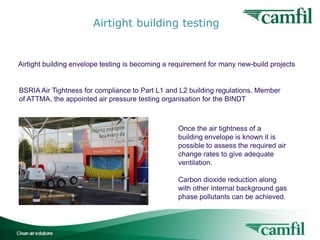
Airtight building testing

Airtight building envelope testing is becoming a requirement for many new-build projects

BSRIA Air Tightness for compliance to Part L1 and L2 building regulations. Member
of ATTMA, the appointed air pressure testing organisation for the BINDT

Once the air tightness of a
building envelope is known it is
possible to assess the required air
change rates to give adequate
ventilation.
Carbon dioxide reduction along
with other internal background gas
phase pollutants can be achieved.

Indoor Air Quality for Buildings

17
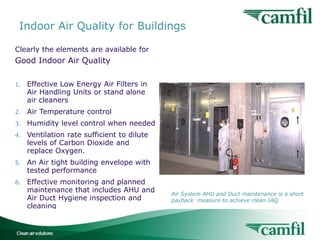
Indoor Air Quality for Buildings
Clearly the elements are available for

Good Indoor Air Quality
1.

Effective Low Energy Air Filters in
Air Handling Units or stand alone
air cleaners

2.

Air Temperature control

3.

Humidity level control when needed

4.

Ventilation rate sufficient to dilute
levels of Carbon Dioxide and
replace Oxygen.

5.

An Air tight building envelope with
tested performance

6.

Effective monitoring and planned
maintenance that includes AHU and
Air Duct Hygiene inspection and
cleaning

Indoor Air Quality for Buildings

Air System AHU and Duct maintenance is a short
payback measure to achieve clean IAQ.

18
Questions?
peter.dyment@camfil.co.uk

Indoor Air Quality for Buildings

19

Indoor Air Quality for Buildings

  • 1.
    Indoor Air Qualityfor Buildings For Health , Personal Comfort and Working Efficiency Peter Dyment Ltd March 2014
  • 2.
    Indoor Air Qualityfor Buildings Indoor Air Quality perception is different for each individual Clean air of the correct temperature and humidity is required. ECONOMIC AND HEALTH PENALTY Loss of Work Efficiency with poor IAQ or Sick Building Syndrome ECONOMIC AND HEALTH BENEFIT In an office study productivity increased by 6.5% and error rate reduced by 18% when a pollution source was removed. Indoor Air Quality for buildings Wargocki et al 2002 2
  • 3.
    Indoor Air Qualityfor Buildings What are the key elements that make Good IAQ 1. Clean Air that has the minimal levels of air pollution 2. Comfortable Air Temperature 3. Comfortable level of Humidity 4. Ventilation rate is able to dilute Carbon Dioxide and replace Oxygen 5. An Air tight building envelope with tested performance 6. Planned maintenance that includes AHU and Air Duct Hygiene inspection and cleaning Indoor Air Quality for Buildings Particle counting in Knightsbridge London Outside Traffic pollution will enter buildings 3
  • 4.
    Indoor Air Qualityfor Buildings Typically we spend about 90% of our time inside buildings so IAQ matters. 1. Clean air can be an issue especially in urban and industrial locations with high levels of background air pollution. Air filtration is usually needed 2. For comfort we need the air to be clean and in a narrow band of temperature 20-24 deg.C. 3. For comfort Relative Humidity should be about 40% to 60% Indoor Air Quality for Buildings 4
  • 5.
    Indoor Air Qualityfor Buildings 4. Optimum ventilation can be effective to certain level to dilute Carbon dioxide and air pollutants. 5. An airtight building envelope can be designed and tested on new build projects. 6. Standards and Guidelines should be followed to ensure Clean Healthy Indoor Air Quality is maintained. Indoor Air Quality for Buildings 5
  • 6.
    What is inthe air that we do not see? Poly cyclic aromatic hydrocarbons Ozone What is risk to our Health? 6
  • 7.
    What is themajor risk to health? Air Pollution causes up to 360,000 premature deaths per year in the EU. Particles Cardio vascular diseases Lung diseases Asthma Increased mortality in heart and lung diseases and cancer Pope et al 2002 Ozone Asthmatic disorders, mucous irritation, eye irritation, headache Benzene & PAH Cancer Nitrogen dioxides Asthma and breathing disorder Reduced lung function Reduced immunological defense. Cancer? Indoor Air Quality for Buildings 7
  • 8.
    Some Pollutants areOutdoor Sourced Some are Indoor Sourced Which are more harmful? Indoor Air Quality for Buildings 8
  • 9.
    Healthvent EU ProjectReport 2013 Indoor Air Quality for Buildings 9
  • 10.
    Healthvent EU ProjectReport 2013 Indoor Air Quality for Buildings 10
  • 11.
    How much istoo much? To protect people's health & the environment Agreed with EU directives Particles PM2.5 *  Max 25 μg/m3 /24 h  Max 10 μg/m3 /year annual mean Nitrogen dioxide:  Max 200 μg/m3 /1h mean  Max 40 μg/m3 /year annual mean Ozone:  Below 100 μg/m3 – 8 h mean •WHO has declared fine combustion particles from diesel engines are now classed as a Group 1 Carcinogen and also Air pollution Indoor Air Quality for Buildings 11
  • 12.
    Indoor Air Qualityproblems can be determined by Air Quality testing Indoor air pollutants can be measured and assessed by use of a particle counter or for gas pollutants a gas monitor or a City check kit as shown. This kit can determine concentration levels for 39 different problem gas pollutants. Once the type and concentration of the pollutants has been determined and the risk level determined, action can be taken when required to make reductions. Portable handheld particle counter Indoor Air Quality for Buildings 12
  • 13.
    Low Energy AirFilters consistent and effective IAQ performance •Low Energy Air Filters with EN13779:2007 performance F7 to F9 City-Flo Bag filter HiFlo M7 Bag filter •Gas filtration also to EN13779:2007 when required. • Micro-fibre glass medium performs consistently for up to 2 years. Citycarb compact filter Citysorb compact filter •Low operating pressure drop for best energy efficiency. •Minimal maintenance and disposal costs Indoor Air Quality for Buildings 13
  • 14.
    Stand alone portableair cleaners provide a practical health and economic solution •Particle filtration •Gas filtration •Without upgrading the main HVAC system •Energy efficient Mix recirculation and supply air Indoor Air Quality for Buildings Fast response and portable to give Clean Indoor Air Quality 14
  • 15.
    Air Duct hygieneinspection and cleaning BS EN15780 : 2011 Ventilation for buildings also the new updated B&ES TR19 Guide to good practice - Internal Cleanliness of Ventilation Systems Indoor Air Quality for Buildings 15
  • 16.
    An airtight buildingenvelope can prevent ingress of air pollution for clean IAQ Particles counted are mainly toxic fine combustion particulates from traffic Benefit Particle Reduction of 78% between Outside and Inside Air Particle Reduction to Supply Air also by Effective Air Filtration Indoor Air Quality for Buildings 16
  • 17.
    Airtight building testing Airtightbuilding envelope testing is becoming a requirement for many new-build projects BSRIA Air Tightness for compliance to Part L1 and L2 building regulations. Member of ATTMA, the appointed air pressure testing organisation for the BINDT Once the air tightness of a building envelope is known it is possible to assess the required air change rates to give adequate ventilation. Carbon dioxide reduction along with other internal background gas phase pollutants can be achieved. Indoor Air Quality for Buildings 17
  • 18.
    Indoor Air Qualityfor Buildings Clearly the elements are available for Good Indoor Air Quality 1. Effective Low Energy Air Filters in Air Handling Units or stand alone air cleaners 2. Air Temperature control 3. Humidity level control when needed 4. Ventilation rate sufficient to dilute levels of Carbon Dioxide and replace Oxygen. 5. An Air tight building envelope with tested performance 6. Effective monitoring and planned maintenance that includes AHU and Air Duct Hygiene inspection and cleaning Indoor Air Quality for Buildings Air System AHU and Duct maintenance is a short payback measure to achieve clean IAQ. 18
  • 19.