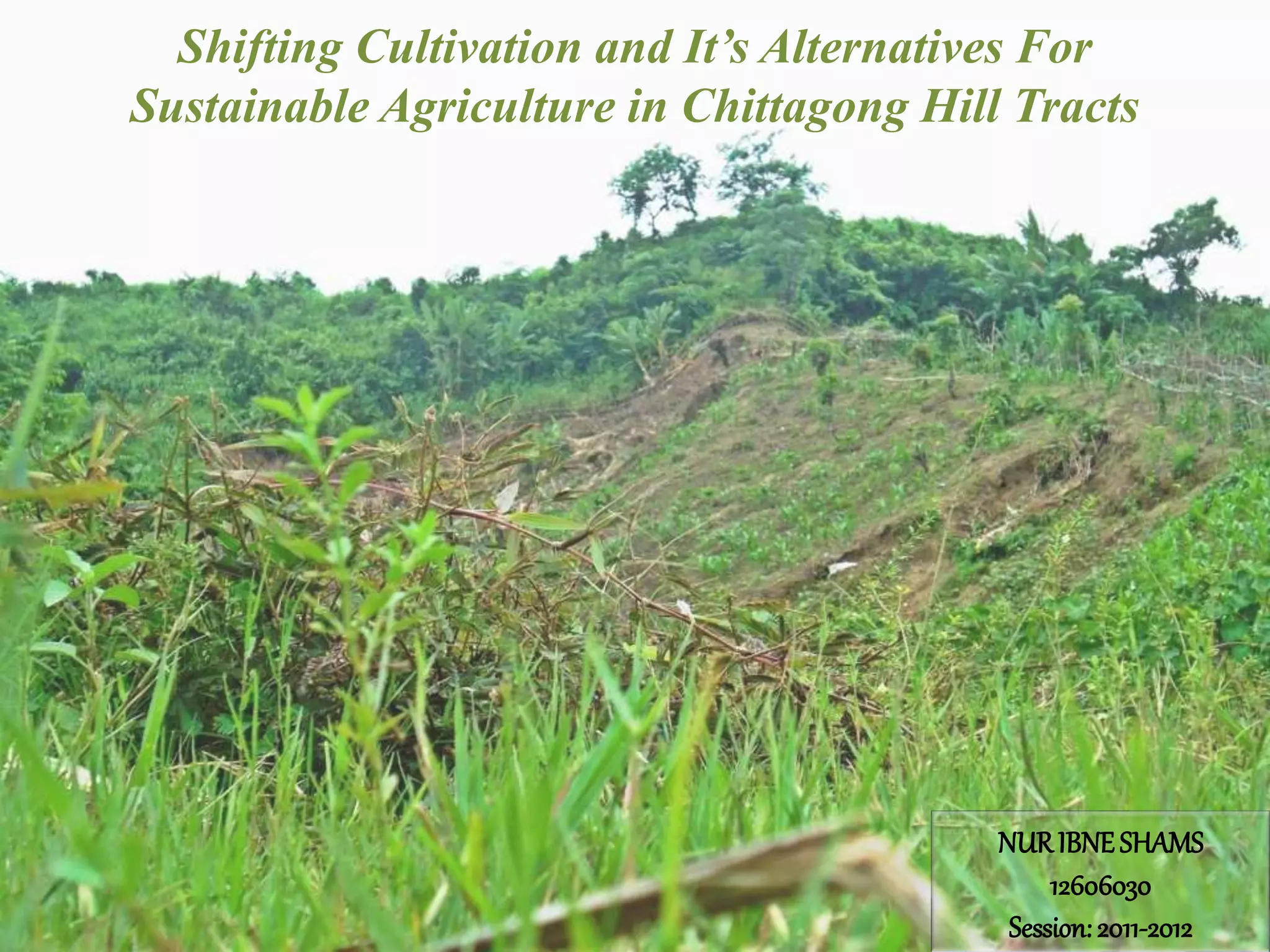
Shifting Cultivation and It’s Alternatives For
Sustainable Agriculture in Chittagong Hill Tracts
shams2hin@yahoo.com
Introduction
• Shifting cultivation(SC) in Bangladesh locally known
as Jhum cultivation, is the land use practice in which
indigenous communities clear and cultivate secondary
forests in plots of different sizes, leave these plots to
regenerate naturally through fallow.
• It is also popularly known as cultivation of slash and
burn, is the most prevalent form of cultivation in the
hilly areas of tropical Asian countries including BD.
• The Jhum cultivation lead to decline of productivity by
50%, an amount of 100-250 metric tons of topsoil per
hectare are depleted per year due to shifting cultivation.
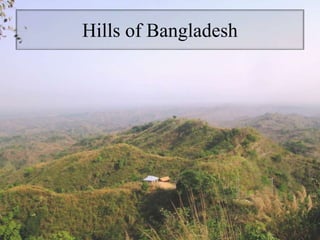
Hills of Bangladesh
Hills constitute about 12% of total area of BD.
having alternating beds of little consolidated sands
and shale providing a basis for the formation of the
complex mixtures of deep and shallow soils.
Hills of BD could be broadly classified in two
classes depending on the formation high hills i.e.
tipam-surma(57%) and low hill i.e. dupi-
tila(43%) distributed in different districts.
Major areas covered by hills occur in Chittagong
Hill Tracts (CHT) (Rangamati, Bandarban and
Khagrachari hill districts) which is about 70%.
Chittagong and Sylhet hills occupy about 18% and
11%, respectively.
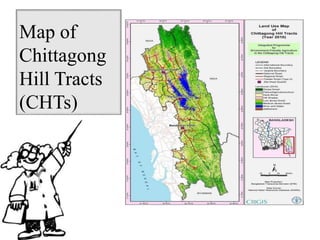
Map of
Chittagong
Hill Tracts
(CHTs)
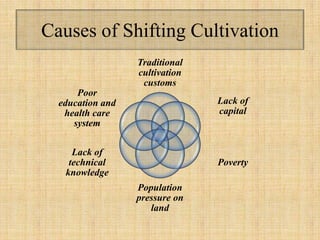
Causes of Shifting Cultivation
Traditional
cultivation
customs
Lack of
capital
Poverty
Population
pressure on
land
Lack of
technical
knowledge
Poor
education and
health care
system
Duration and Species Grown in
Shifting Cultivation
• The main species grown in Jhum cultivation are rice,
turmeric, cucumber, chili and ginger, although many
others are also frequently intercropped.
• . Many crops grown in the Jhum system have a
potential commercial value such as cereals, medicinal
plants, aromatic plants, spices and various legumes.
• Slashing and subsequent burning are preconditions for
Jhum cultivation. Slashing of vegetation for cultivation
is done during January-February. The dry vegetation is
burnt and the hill is cleaned for sowing seeds in April-
May.
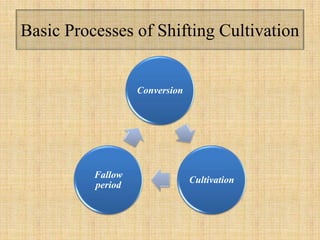
Basic Processes of Shifting Cultivation
Conversion
Cultivation
Fallow
period
Shifting Cultivation and Its Impact
• SC may be detrimental to the environment, especially as the
fallow period between cultivation cycles declines.
• In the past, they practiced Jhum in the same area with a
fallow period of 15-20 years, which ensured long term
sustainability of soil fertility.
• . With the rapid growth of population, the fallow period has
been reduced to 3-4 years, allowing very little time for
regeneration.
• The decrease in fallow period has led to the deterioration
of faunal and microbial organisms, top soil loss, and
land degradation due to slashing and burning during the
period of heavy rainfall.
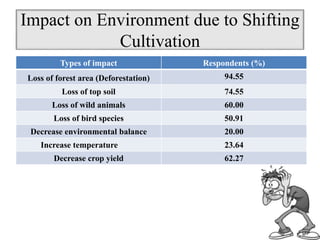
Impact on Environment due to Shifting
Cultivation
Types of impact Respondents (%)
Loss of forest area (Deforestation) 94.55
Loss of top soil 74.55
Loss of wild animals 60.00
Loss of bird species 50.91
Decrease environmental balance 20.00
Increase temperature 23.64
Decrease crop yield 62.27
Improving Shifting Cultivation in BD
• Multi Strata Food Orchard (MSFO)
• Native techniques
• Using mulch for soil protection
• Managing trees for biodiversity conservation
• Managing the coppices of some tree species
• Some others sustainable modern
techniques/methods for soil conservation
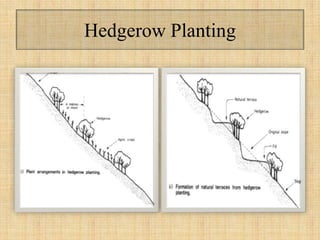
• Hedgerow planting, Terracing
• Geo-jute technology
Hedgerow Planting
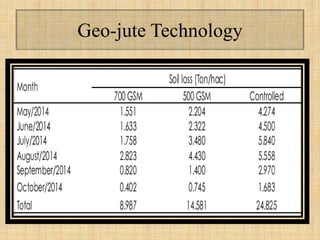
Geo-jute Technology
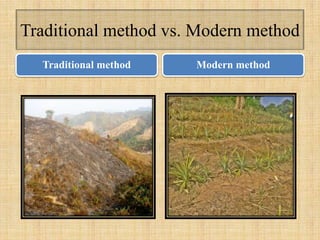
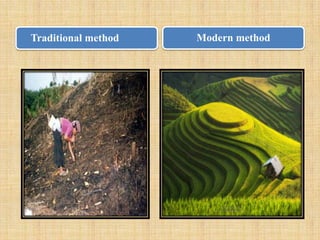
Traditional method vs. Modern method
Traditional method Modern method
Comparison Between Traditional and
Modern Method (soil erosion basis)
Species In traditional method,
soil erosion in
percentage
In modern method, soil
erosion
In percentage
Ginger 77.05 22.94
Turmeric 65.68 15.2
Taro 58.8 11.36
Conclusion
The people are still practicing shifting cultivation mainly because of their
customs and traditions. The cycle is exacerbated by poverty coupled with
persistent food shortages. Shifting cultivation is their way to ensure food
supply for the families. The actual unsustainable shifting cultivation creates
a lot of inverse consequences.
Although it has been criticized for being wasteful and inefficient and for
causing soil degradation and declines in soil fertility, it is the most
widespread farming system in the tropics, supporting over 250 million
people, about 8 percent of the world’s population (FAO/SIDA, 1974). It
will not be realistic if we think substitute for Jhum/SC cultivation but it is
possible to conserve soil erosion and degradation by practicing modern
shifting cultivation methods and inducing Jhumais inured to these methods
as well.
Shifting Cultivation & Its Alternatives for Sustainable Agriculture

Shifting Cultivation & Its Alternatives for Sustainable Agriculture

  • 1.
    Shifting Cultivation andIt’s Alternatives For Sustainable Agriculture in Chittagong Hill Tracts shams2hin@yahoo.com
  • 2.
    Introduction • Shifting cultivation(SC)in Bangladesh locally known as Jhum cultivation, is the land use practice in which indigenous communities clear and cultivate secondary forests in plots of different sizes, leave these plots to regenerate naturally through fallow. • It is also popularly known as cultivation of slash and burn, is the most prevalent form of cultivation in the hilly areas of tropical Asian countries including BD. • The Jhum cultivation lead to decline of productivity by 50%, an amount of 100-250 metric tons of topsoil per hectare are depleted per year due to shifting cultivation.
  • 3.
  • 4.
    Hills constitute about12% of total area of BD. having alternating beds of little consolidated sands and shale providing a basis for the formation of the complex mixtures of deep and shallow soils. Hills of BD could be broadly classified in two classes depending on the formation high hills i.e. tipam-surma(57%) and low hill i.e. dupi- tila(43%) distributed in different districts. Major areas covered by hills occur in Chittagong Hill Tracts (CHT) (Rangamati, Bandarban and Khagrachari hill districts) which is about 70%. Chittagong and Sylhet hills occupy about 18% and 11%, respectively.
  • 5.
  • 6.
    Causes of ShiftingCultivation Traditional cultivation customs Lack of capital Poverty Population pressure on land Lack of technical knowledge Poor education and health care system
  • 7.
    Duration and SpeciesGrown in Shifting Cultivation • The main species grown in Jhum cultivation are rice, turmeric, cucumber, chili and ginger, although many others are also frequently intercropped. • . Many crops grown in the Jhum system have a potential commercial value such as cereals, medicinal plants, aromatic plants, spices and various legumes. • Slashing and subsequent burning are preconditions for Jhum cultivation. Slashing of vegetation for cultivation is done during January-February. The dry vegetation is burnt and the hill is cleaned for sowing seeds in April- May.
  • 8.
    Basic Processes ofShifting Cultivation Conversion Cultivation Fallow period
  • 9.
    Shifting Cultivation andIts Impact • SC may be detrimental to the environment, especially as the fallow period between cultivation cycles declines. • In the past, they practiced Jhum in the same area with a fallow period of 15-20 years, which ensured long term sustainability of soil fertility. • . With the rapid growth of population, the fallow period has been reduced to 3-4 years, allowing very little time for regeneration. • The decrease in fallow period has led to the deterioration of faunal and microbial organisms, top soil loss, and land degradation due to slashing and burning during the period of heavy rainfall.
  • 10.
    Impact on Environmentdue to Shifting Cultivation Types of impact Respondents (%) Loss of forest area (Deforestation) 94.55 Loss of top soil 74.55 Loss of wild animals 60.00 Loss of bird species 50.91 Decrease environmental balance 20.00 Increase temperature 23.64 Decrease crop yield 62.27
  • 11.
    Improving Shifting Cultivationin BD • Multi Strata Food Orchard (MSFO) • Native techniques • Using mulch for soil protection • Managing trees for biodiversity conservation • Managing the coppices of some tree species • Some others sustainable modern techniques/methods for soil conservation • Hedgerow planting, Terracing • Geo-jute technology
  • 12.
  • 13.
  • 14.
    Traditional method vs.Modern method Traditional method Modern method
  • 15.
  • 16.
    Comparison Between Traditionaland Modern Method (soil erosion basis) Species In traditional method, soil erosion in percentage In modern method, soil erosion In percentage Ginger 77.05 22.94 Turmeric 65.68 15.2 Taro 58.8 11.36
  • 17.
    Conclusion The people arestill practicing shifting cultivation mainly because of their customs and traditions. The cycle is exacerbated by poverty coupled with persistent food shortages. Shifting cultivation is their way to ensure food supply for the families. The actual unsustainable shifting cultivation creates a lot of inverse consequences. Although it has been criticized for being wasteful and inefficient and for causing soil degradation and declines in soil fertility, it is the most widespread farming system in the tropics, supporting over 250 million people, about 8 percent of the world’s population (FAO/SIDA, 1974). It will not be realistic if we think substitute for Jhum/SC cultivation but it is possible to conserve soil erosion and degradation by practicing modern shifting cultivation methods and inducing Jhumais inured to these methods as well.