LAMP PCR
ABBREVIATION
LAMPLAMP
INTRODUCTION
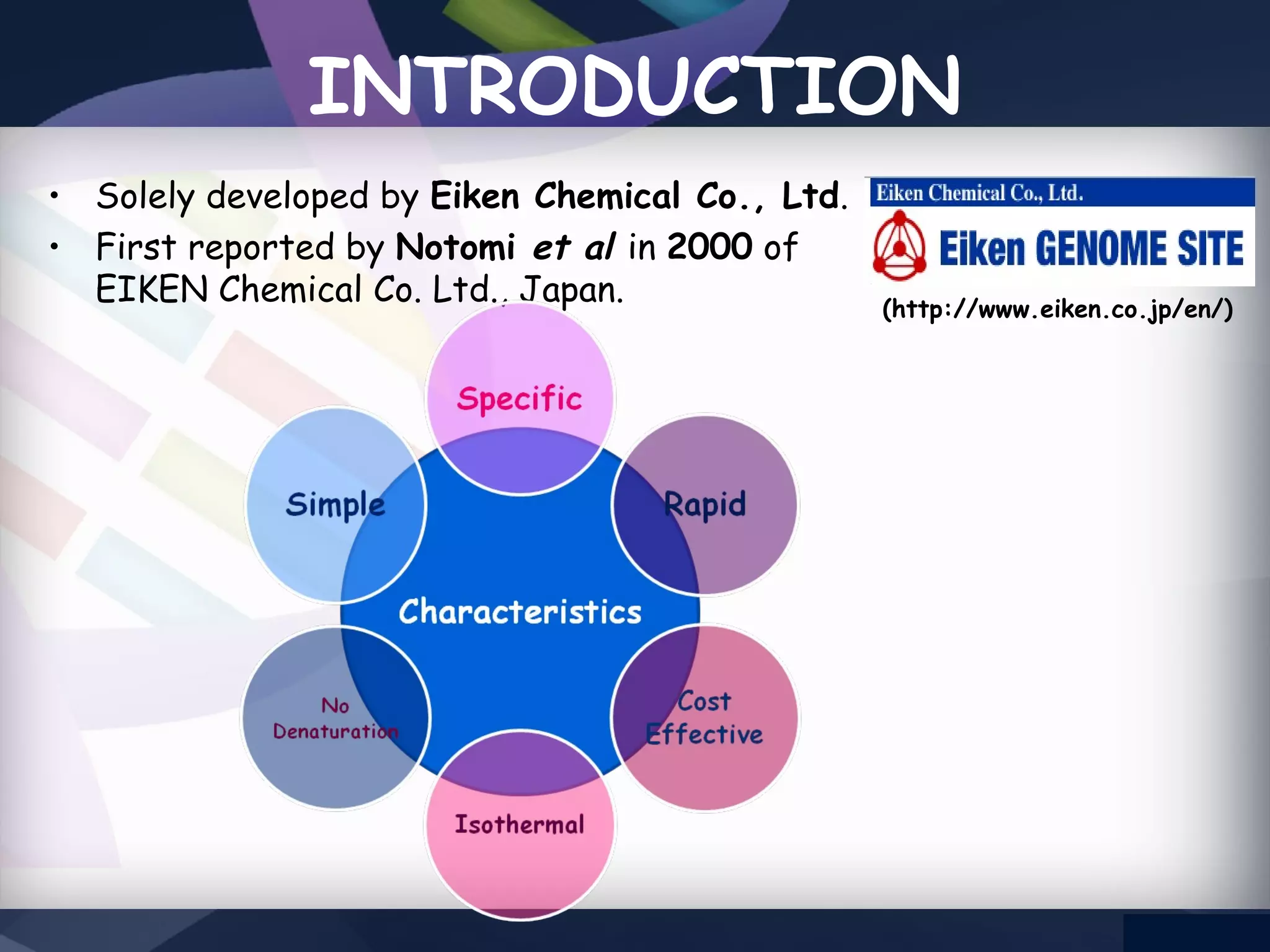
• Solely developed by Eiken Chemical Co., Ltd.
• First reported by Notomi et al in 2000 of
EIKEN Chemical Co. Ltd., Japan. (http://www.eiken.co.jp/en/)
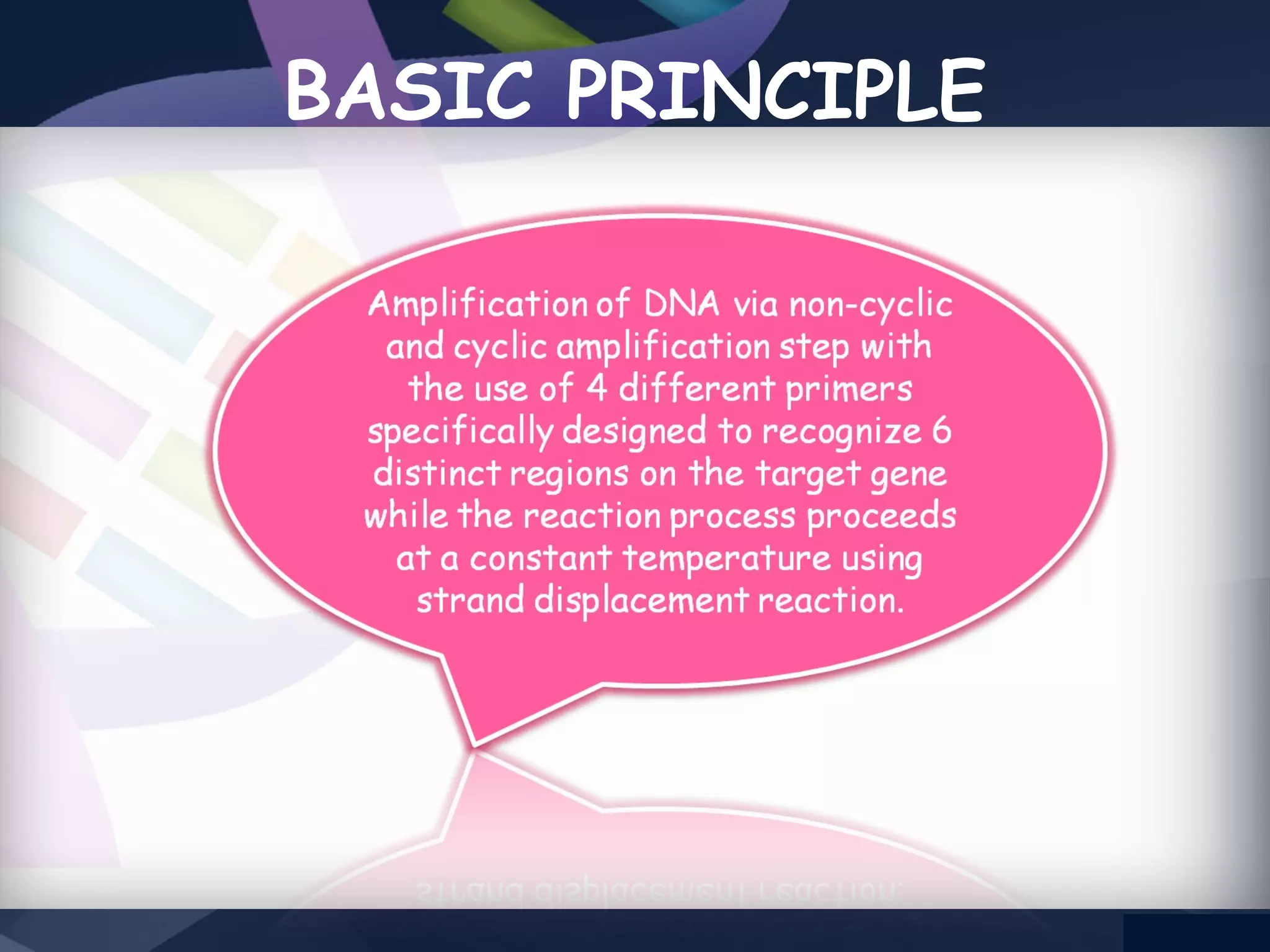
BASIC PRINCIPLE
Procedure of LAMP PCR
1- Design of Primers
• 4 types of primers based on the 6 distinct regions of the target
gene: the F3c, F2c and F1c regions at the 3' side and the B1, B2 and
B3 regions at the 5' side
Continued…
2- Amplification
• Is of two types;
A. Non-cycling Amplification
B. Cycling Amplification
A.Non-cycling Amplification:
• Generation of stem loop DNA with dumbbell-shaped structure at
both ends.
B. Cycling Amplification:
• Dumbbell-shaped DNA is quickly amplified by the use of loop
primers.
NON-CYCLING AMPLIFICATION
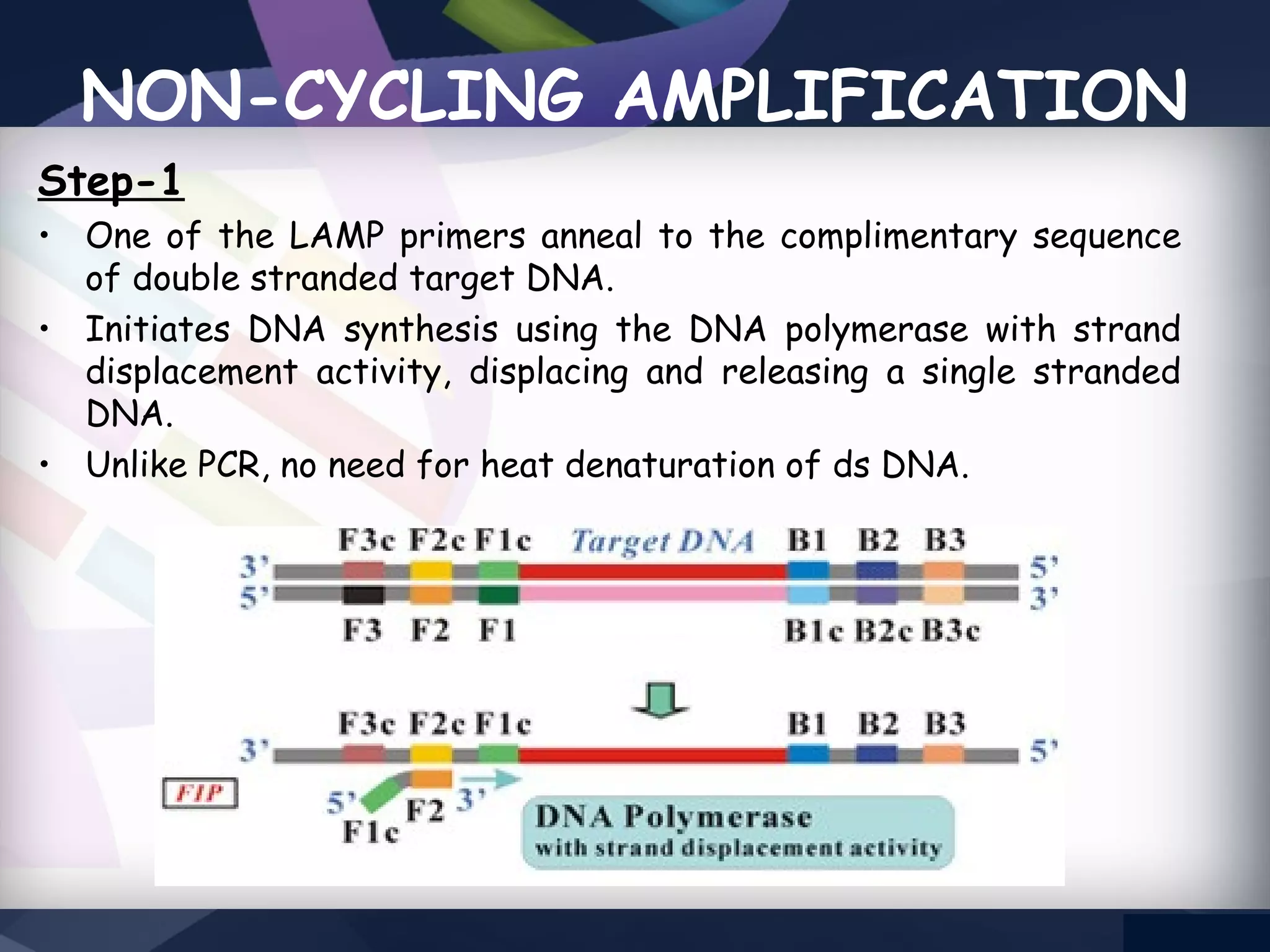
Step-1
• One of the LAMP primers anneal to the complimentary sequence
of double stranded target DNA.
• Initiates DNA synthesis using the DNA polymerase with strand
displacement activity, displacing and releasing a single stranded
DNA.
• Unlike PCR, no need for heat denaturation of ds DNA.
Continued…
Step-2
• Through the strand displacement
activity of DNA polymerase, a DNA
strand complementary to the
template DNA is synthesized,
starting from the 3' end of the F2
region of the FIP.
Step-3
• The F3 Primer anneals to the F3c
region, outside of FIP, on the
target DNA and
• Initiates strand displacement DNA
synthesis, releasing the FIP-linked
complementary strand.
Continued…
Step-4
• A double strand is formed from
the DNA strand synthesized
from the F3 Primer and the
template DNA strand.
Step-5
• The FIP-linked complementary
strand is released as a single
strand because of the
displacement by the DNA strand
synthesized from the F3 Primer.
• Released single strand forms a
stem-loop structure at the 5'
end because of the
complementary F1c and F1
regions.
Continued…
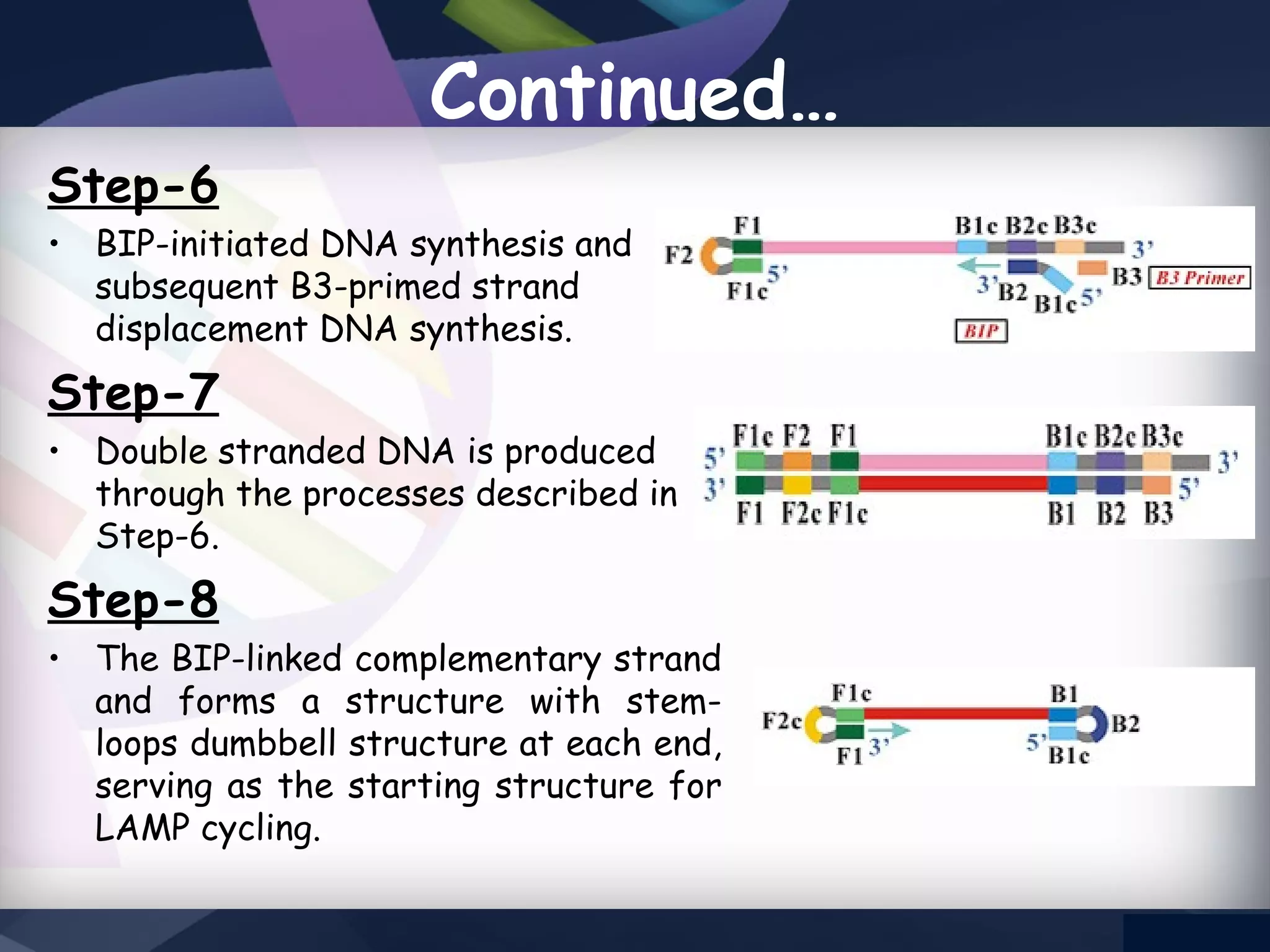
Step-6
• BIP-initiated DNA synthesis and
subsequent B3-primed strand
displacement DNA synthesis.
Step-7
• Double stranded DNA is produced
through the processes described in
Step-6.
Step-8
• The BIP-linked complementary strand
and forms a structure with stem-
loops dumbbell structure at each end,
serving as the starting structure for
LAMP cycling.
CYCLING AMPLIFICTAION
Continued…
3- Detection
i. Visual Detection
• Turbidity - Magnesium pyrophosphate
• Fluorescence – Calcein
ii. Gel Electrophoresis
• Lane 1 and 3 has target DNA.
• Lane 2 and 4 has non-target DNA.
• Lane M has DNA Ladder.
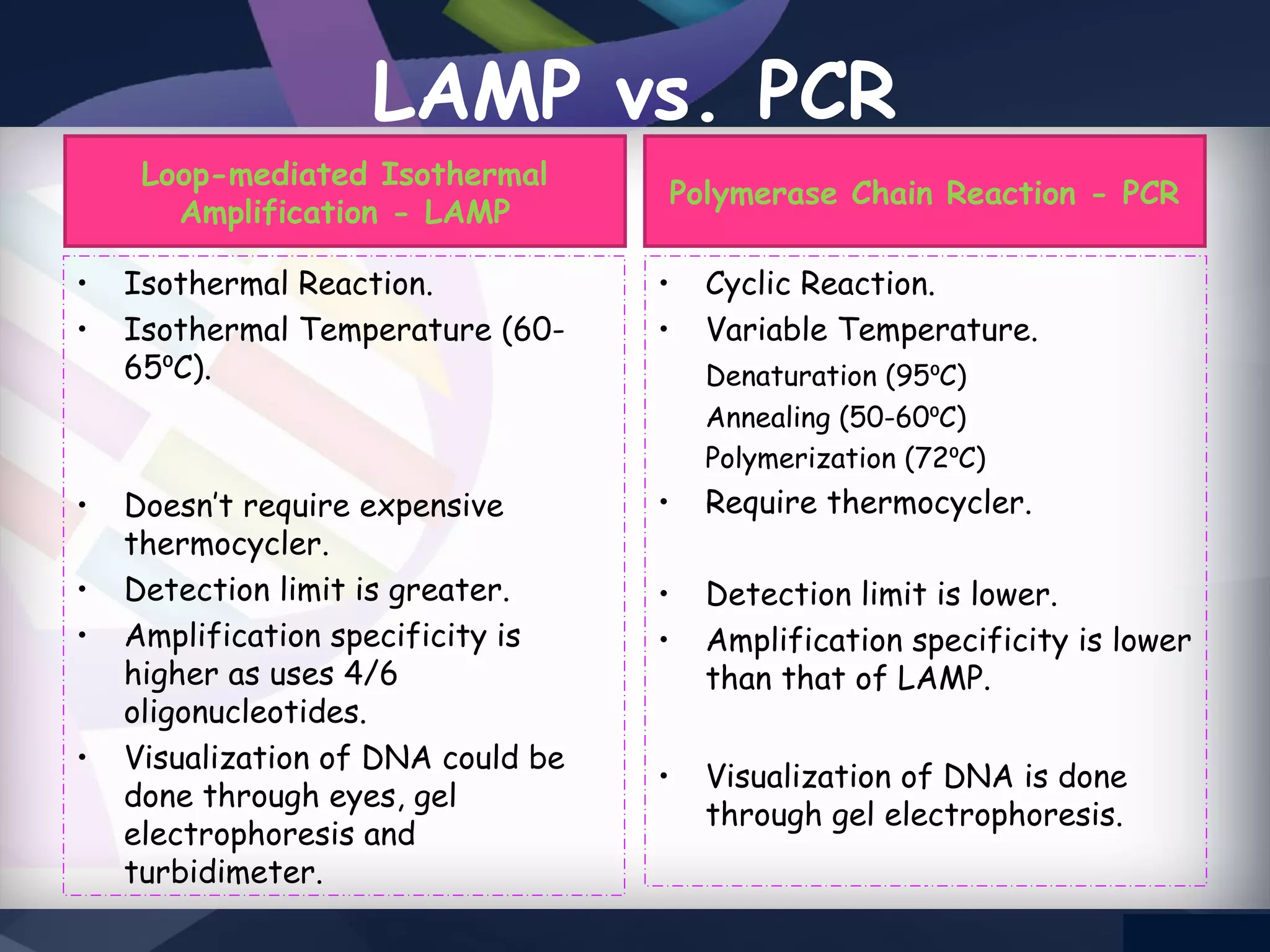
LAMP vs. PCR
• Isothermal Reaction.
• Isothermal Temperature (60-
65 C).⁰
• Doesn’t require expensive
thermocycler.
• Detection limit is greater.
• Amplification specificity is
higher as uses 4/6
oligonucleotides.
• Visualization of DNA could be
done through eyes, gel
electrophoresis and
turbidimeter.
• Cyclic Reaction.
• Variable Temperature.
Denaturation (95 C)⁰
Annealing (50-60 C)⁰
Polymerization (72 C)⁰
• Require thermocycler.
• Detection limit is lower.
• Amplification specificity is lower
than that of LAMP.
• Visualization of DNA is done
through gel electrophoresis.
Loop-mediated Isothermal
Amplification - LAMP
Polymerase Chain Reaction - PCR
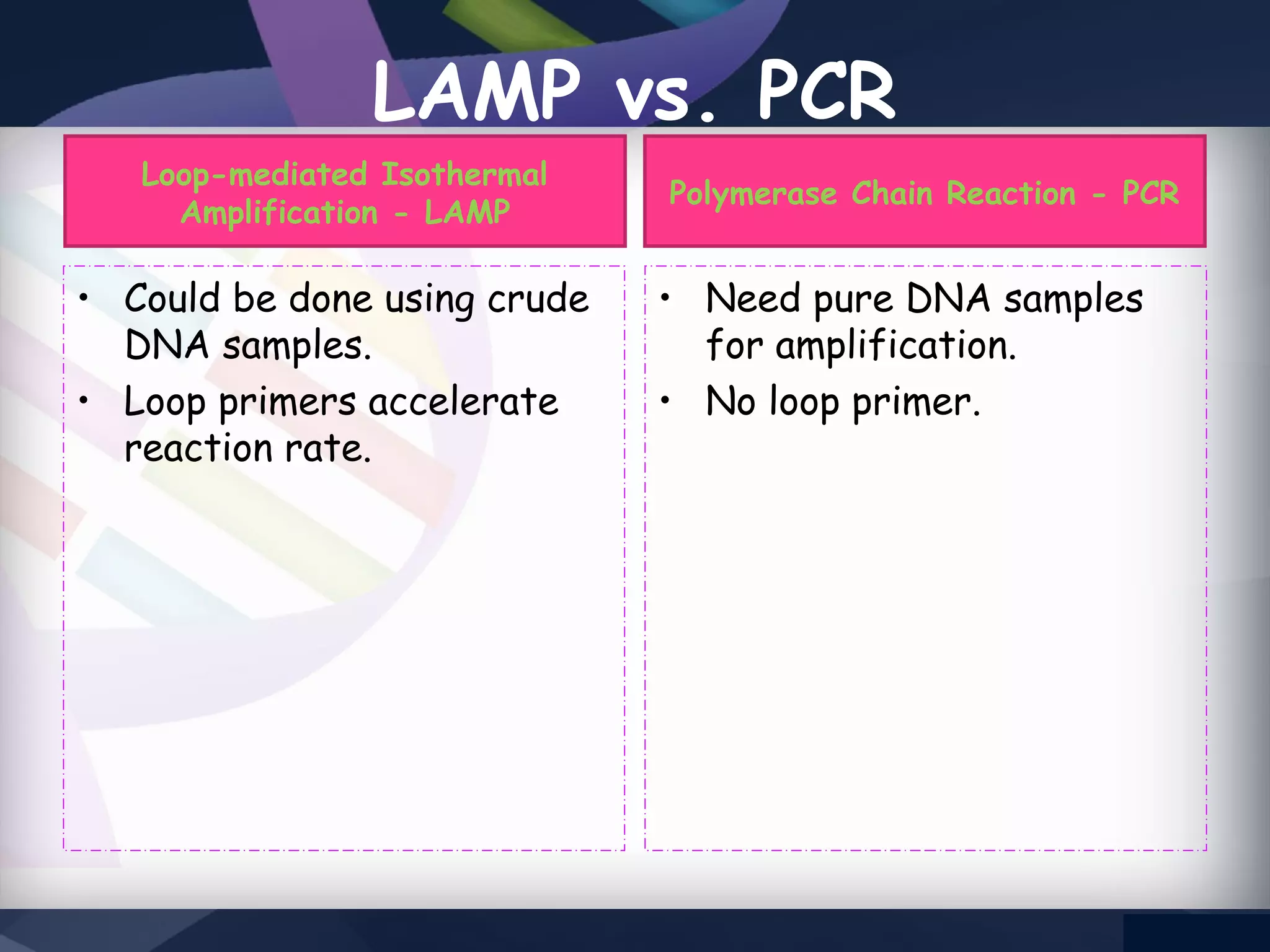
• Could be done using crude
DNA samples.
• Loop primers accelerate
reaction rate.
• Need pure DNA samples
for amplification.
• No loop primer.
LAMP vs. PCR
Loop-mediated Isothermal
Amplification - LAMP
Polymerase Chain Reaction - PCR
APPLICATIONS OF LAMP
CONCLUSION
• LAMP is highly sensitive and specific DNA/RNA
amplification technique.
• It works on isothermal conditions and doesn't require
expensive operational machinery.
• It is simple, cost effective technique.
• LAMP is an innovation molecular diagnostic field and can
be used for the diagnosis of infectious diseases, food
inspection, environmental testing and so on.
• Innovations in biotechnology that combine molecular
biology, microfabrication and bioinformatics are moving
nucleic acid technologies from futuristic possibilities to
common laboratory techniques and modes for diagnoses.
LAMP PCR
LAMP PCR

LAMP PCR

  • 1.
  • 2.
  • 3.
    INTRODUCTION • Solely developedby Eiken Chemical Co., Ltd. • First reported by Notomi et al in 2000 of EIKEN Chemical Co. Ltd., Japan. (http://www.eiken.co.jp/en/)
  • 4.
  • 6.
    Procedure of LAMPPCR 1- Design of Primers • 4 types of primers based on the 6 distinct regions of the target gene: the F3c, F2c and F1c regions at the 3' side and the B1, B2 and B3 regions at the 5' side
  • 7.
    Continued… 2- Amplification • Isof two types; A. Non-cycling Amplification B. Cycling Amplification A.Non-cycling Amplification: • Generation of stem loop DNA with dumbbell-shaped structure at both ends. B. Cycling Amplification: • Dumbbell-shaped DNA is quickly amplified by the use of loop primers.
  • 8.
    NON-CYCLING AMPLIFICATION Step-1 • Oneof the LAMP primers anneal to the complimentary sequence of double stranded target DNA. • Initiates DNA synthesis using the DNA polymerase with strand displacement activity, displacing and releasing a single stranded DNA. • Unlike PCR, no need for heat denaturation of ds DNA.
  • 9.
    Continued… Step-2 • Through thestrand displacement activity of DNA polymerase, a DNA strand complementary to the template DNA is synthesized, starting from the 3' end of the F2 region of the FIP. Step-3 • The F3 Primer anneals to the F3c region, outside of FIP, on the target DNA and • Initiates strand displacement DNA synthesis, releasing the FIP-linked complementary strand.
  • 10.
    Continued… Step-4 • A doublestrand is formed from the DNA strand synthesized from the F3 Primer and the template DNA strand. Step-5 • The FIP-linked complementary strand is released as a single strand because of the displacement by the DNA strand synthesized from the F3 Primer. • Released single strand forms a stem-loop structure at the 5' end because of the complementary F1c and F1 regions.
  • 11.
    Continued… Step-6 • BIP-initiated DNAsynthesis and subsequent B3-primed strand displacement DNA synthesis. Step-7 • Double stranded DNA is produced through the processes described in Step-6. Step-8 • The BIP-linked complementary strand and forms a structure with stem- loops dumbbell structure at each end, serving as the starting structure for LAMP cycling.
  • 12.
  • 14.
    Continued… 3- Detection i. VisualDetection • Turbidity - Magnesium pyrophosphate • Fluorescence – Calcein ii. Gel Electrophoresis • Lane 1 and 3 has target DNA. • Lane 2 and 4 has non-target DNA. • Lane M has DNA Ladder.
  • 15.
    LAMP vs. PCR •Isothermal Reaction. • Isothermal Temperature (60- 65 C).⁰ • Doesn’t require expensive thermocycler. • Detection limit is greater. • Amplification specificity is higher as uses 4/6 oligonucleotides. • Visualization of DNA could be done through eyes, gel electrophoresis and turbidimeter. • Cyclic Reaction. • Variable Temperature. Denaturation (95 C)⁰ Annealing (50-60 C)⁰ Polymerization (72 C)⁰ • Require thermocycler. • Detection limit is lower. • Amplification specificity is lower than that of LAMP. • Visualization of DNA is done through gel electrophoresis. Loop-mediated Isothermal Amplification - LAMP Polymerase Chain Reaction - PCR
  • 16.
    • Could bedone using crude DNA samples. • Loop primers accelerate reaction rate. • Need pure DNA samples for amplification. • No loop primer. LAMP vs. PCR Loop-mediated Isothermal Amplification - LAMP Polymerase Chain Reaction - PCR
  • 17.
  • 18.
    CONCLUSION • LAMP ishighly sensitive and specific DNA/RNA amplification technique. • It works on isothermal conditions and doesn't require expensive operational machinery. • It is simple, cost effective technique. • LAMP is an innovation molecular diagnostic field and can be used for the diagnosis of infectious diseases, food inspection, environmental testing and so on. • Innovations in biotechnology that combine molecular biology, microfabrication and bioinformatics are moving nucleic acid technologies from futuristic possibilities to common laboratory techniques and modes for diagnoses.