RUNCOM MOBILE’S END-TO-END
MESSAGING SOLUTION (MMGS)

Lahav Savir   Back-end Systems Architect
Alon Klein    VP R&D
                                           26 June 2009

                                                          1
What is MMGS?
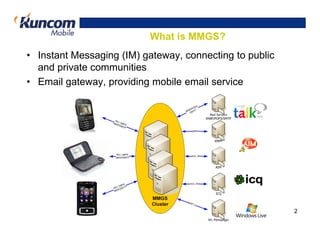
• Instant Messaging (IM) gateway, connecting to public
  and private communities
• Email gateway, providing mobile email service


                                                         2
Introduction
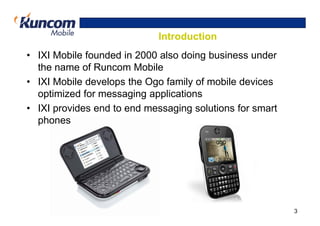
• IXI Mobile founded in 2000 also doing business under
  the name of Runcom Mobile
• IXI Mobile develops the Ogo family of mobile devices
  optimized for messaging applications
• IXI provides end to end messaging solutions for smart
  phones


                                                          3
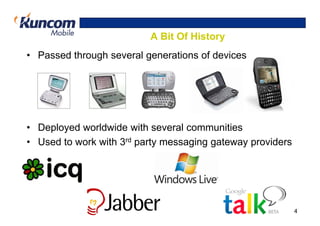
A Bit Of History
• Passed through several generations of devices


• Deployed worldwide with several communities
• Used to work with 3rd party messaging gateway providers


                                                            4
We want our own solution !
•   Control service quality
•   Control roadmap features
•   Maximum visibility to the system status
•   Ability to add unique optimizations for mobile networks
•   Self hosting
•   Own the IP
•   Time to market
•   Learn from past experience…
•   Royalty free


                                                              5
High Level Requirements
• Keep it simple!             •   (Almost) Zero downtime
• Huge capacity and           •   No single point of failure
  throughput (100K’s users)   •   Error recovery
• Scalable, Extendable        •   Transparent failovers
• Low spec machines           •   Distributed architecture
  (<3K$)                      •   Security
• Minimum data replication    •   Log file writing (no DB)
  among clusters for best
  performance                 •   No Relational Database


                                                               6
Technology and market survey
• Reviewed several vendor offerings
• Reviewed several technologies
   – ‘Standard’ C/C++
   – Java based
   – Erlang


                                                   7
And the winner is… Erlang
• Strengths of Erlang that helped with this decision
   –   Native concurrency support
   –   Native distributed architecture for scalability and redundancy
   –   Reference products
   –   Quick POC
   –   Short time to market


                                                                        8
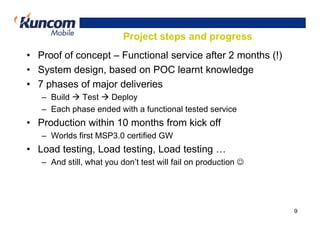
Project steps and progress
• Proof of concept – Functional service after 2 months (!)
• System design, based on POC learnt knowledge
• 7 phases of major deliveries
   – Build  Test   Deploy
   – Each phase ended with a functional tested service
• Production within 10 months from kick off
   – Worlds first MSP3.0 certified GW
• Load testing, Load testing, Load testing …
   – And still, what you don’t test will fail on production ☺


                                                                9
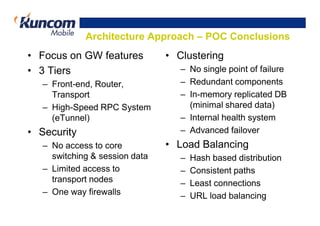
Architecture Approach – POC Conclusions
• Focus on GW features          • Clustering
• 3 Tiers                          – No single point of failure
   – Front-end, Router,            – Redundant components
     Transport                     – In-memory replicated DB
   – High-Speed RPC System           (minimal shared data)
     (eTunnel)                     – Internal health system
• Security                         – Advanced failover
   – No access to core          • Load Balancing
     switching & session data      –   Hash based distribution
   – Limited access to             –   Consistent paths
     transport nodes               –   Least connections
   – One way firewalls             –   URL load balancing
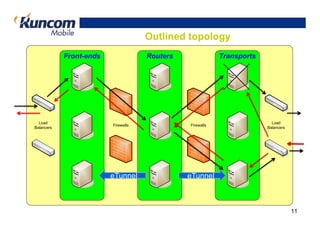
Outlined topology
            Front-ends               Routers               Transports


  Load                                                                    Load
                         Firewalls             Firewalls
Balancers                                                               Balancers


                         eTunnel               eTunnel


                                                                                    11
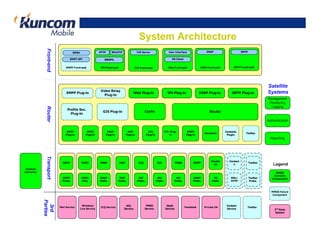
System Architecture
Performance Benchmark Measures
Setup
• Basic cluster built of 11 servers
   – Dual core, 2Gb RAM machines


Instant Messaging performance
• 150,000 Connected users
• 12,600 Messages per second
• 45,000,000 Messages an hour

System resources
• 50%-60% system utilization
What Made the Difference?
•   High speed socket based RPC – eTunnel
•   Resource pools (eBalancer)
•   Minimal data sharing
•   Hash based distribution between layers makes consistent path
    through layers
•   Integration with 3rd party load balancer (URL SLB, health)
•   Reduce destructive DB operations, especially on replicated tables
•   Forced GC
•   Network interface pools
•   No front end firewalls
•   Internal health system integrated with topology manager
•   Extensive SNMP MIBs
•   Throttling – Control concurrency
Satellite Systems
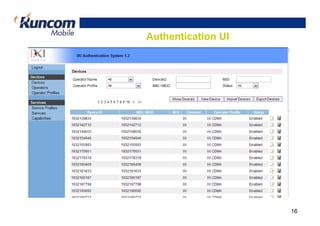
• Authentication
   – Authentication, Authorization & Control over the service delivered
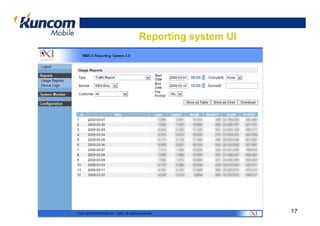
• Reporting
   – Nearly real-time usage reports aggregated to an hour cycle
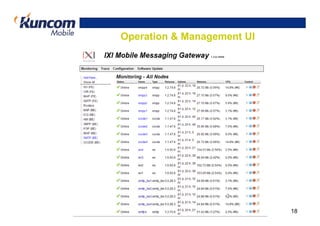
• Operation and Maintanance
   –   Stop / Start, Watch real-time alarms, configuration
   –   Traceability and troubleshooting
   –   Software update - hot patch distribution and loading
   –   Central log console
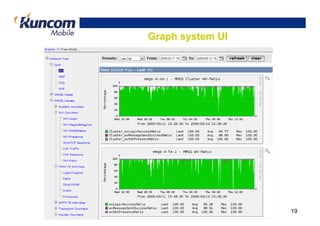
   –   Central graphing system
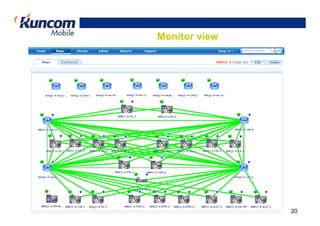
• Real Time Monitoring – Infrastructure, OS and App
Authentication UI


                    16
Reporting system UI


                      17
Operation & Management UI


                            18
Graph system UI


                  19
Monitor view


               20
Thank you

Lahav Savir - Massively Scaleable Mobile Gateways

  • 1.
    RUNCOM MOBILE’S END-TO-END MESSAGINGSOLUTION (MMGS) Lahav Savir Back-end Systems Architect Alon Klein VP R&D 26 June 2009 1
  • 2.
    What is MMGS? •Instant Messaging (IM) gateway, connecting to public and private communities • Email gateway, providing mobile email service 2
  • 3.
    Introduction • IXI Mobilefounded in 2000 also doing business under the name of Runcom Mobile • IXI Mobile develops the Ogo family of mobile devices optimized for messaging applications • IXI provides end to end messaging solutions for smart phones 3
  • 4.
    A Bit OfHistory • Passed through several generations of devices • Deployed worldwide with several communities • Used to work with 3rd party messaging gateway providers 4
  • 5.
    We want ourown solution ! • Control service quality • Control roadmap features • Maximum visibility to the system status • Ability to add unique optimizations for mobile networks • Self hosting • Own the IP • Time to market • Learn from past experience… • Royalty free 5
  • 6.
    High Level Requirements •Keep it simple! • (Almost) Zero downtime • Huge capacity and • No single point of failure throughput (100K’s users) • Error recovery • Scalable, Extendable • Transparent failovers • Low spec machines • Distributed architecture (<3K$) • Security • Minimum data replication • Log file writing (no DB) among clusters for best performance • No Relational Database 6
  • 7.
    Technology and marketsurvey • Reviewed several vendor offerings • Reviewed several technologies – ‘Standard’ C/C++ – Java based – Erlang 7
  • 8.
    And the winneris… Erlang • Strengths of Erlang that helped with this decision – Native concurrency support – Native distributed architecture for scalability and redundancy – Reference products – Quick POC – Short time to market 8
  • 9.
    Project steps andprogress • Proof of concept – Functional service after 2 months (!) • System design, based on POC learnt knowledge • 7 phases of major deliveries – Build Test Deploy – Each phase ended with a functional tested service • Production within 10 months from kick off – Worlds first MSP3.0 certified GW • Load testing, Load testing, Load testing … – And still, what you don’t test will fail on production ☺ 9
  • 10.
    Architecture Approach –POC Conclusions • Focus on GW features • Clustering • 3 Tiers – No single point of failure – Front-end, Router, – Redundant components Transport – In-memory replicated DB – High-Speed RPC System (minimal shared data) (eTunnel) – Internal health system • Security – Advanced failover – No access to core • Load Balancing switching & session data – Hash based distribution – Limited access to – Consistent paths transport nodes – Least connections – One way firewalls – URL load balancing
  • 11.
    Outlined topology Front-ends Routers Transports Load Load Firewalls Firewalls Balancers Balancers eTunnel eTunnel 11
  • 12.
  • 13.
    Performance Benchmark Measures Setup •Basic cluster built of 11 servers – Dual core, 2Gb RAM machines Instant Messaging performance • 150,000 Connected users • 12,600 Messages per second • 45,000,000 Messages an hour System resources • 50%-60% system utilization
  • 14.
    What Made theDifference? • High speed socket based RPC – eTunnel • Resource pools (eBalancer) • Minimal data sharing • Hash based distribution between layers makes consistent path through layers • Integration with 3rd party load balancer (URL SLB, health) • Reduce destructive DB operations, especially on replicated tables • Forced GC • Network interface pools • No front end firewalls • Internal health system integrated with topology manager • Extensive SNMP MIBs • Throttling – Control concurrency
  • 15.
    Satellite Systems • Authentication – Authentication, Authorization & Control over the service delivered • Reporting – Nearly real-time usage reports aggregated to an hour cycle • Operation and Maintanance – Stop / Start, Watch real-time alarms, configuration – Traceability and troubleshooting – Software update - hot patch distribution and loading – Central log console – Central graphing system • Real Time Monitoring – Infrastructure, OS and App
  • 16.
  • 17.
  • 18.
  • 19.
  • 20.
  • 21.