Maximize Messaging
   Performance and
Lowering Infrastructure
       Footprint
    Senior Software Architect, WSO2 Inc.
    Visiting Faculty, University of Moratuwa
    Member, Apache Software Foundation
 Research Scientist, Lanka Software Foundation
Outline
 Goals: Optimizing the deployments
  o Message performance
  o Reduce footprint
 Design and Capacity Planning
 Design for Performance and Minimal footprint
  o Select right transport
  o Minimize footprint and maximize sharing
    - MT
    - Using Carbon
  o Tuning
 Wrapping Up
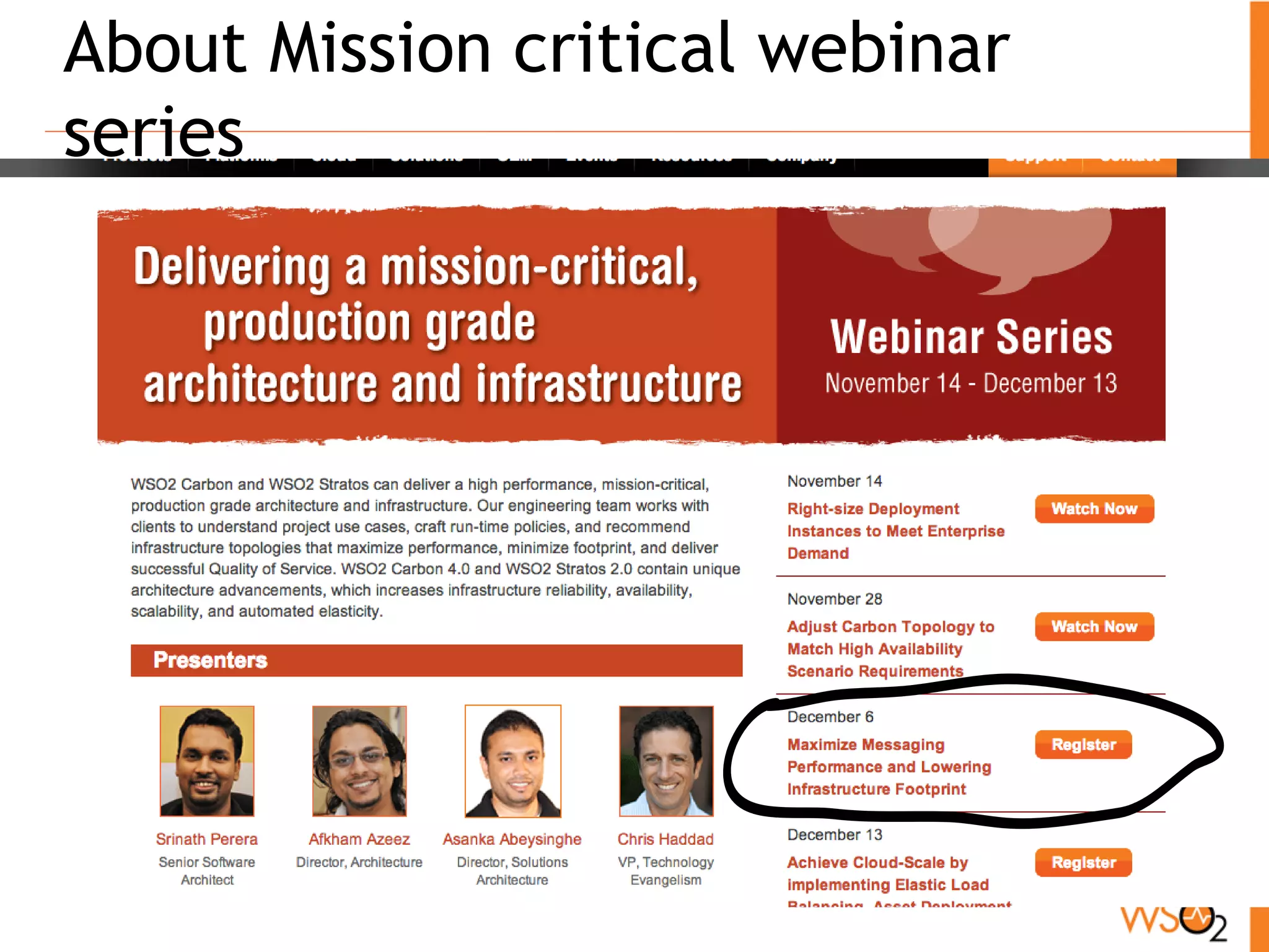
About Mission critical webinar
series
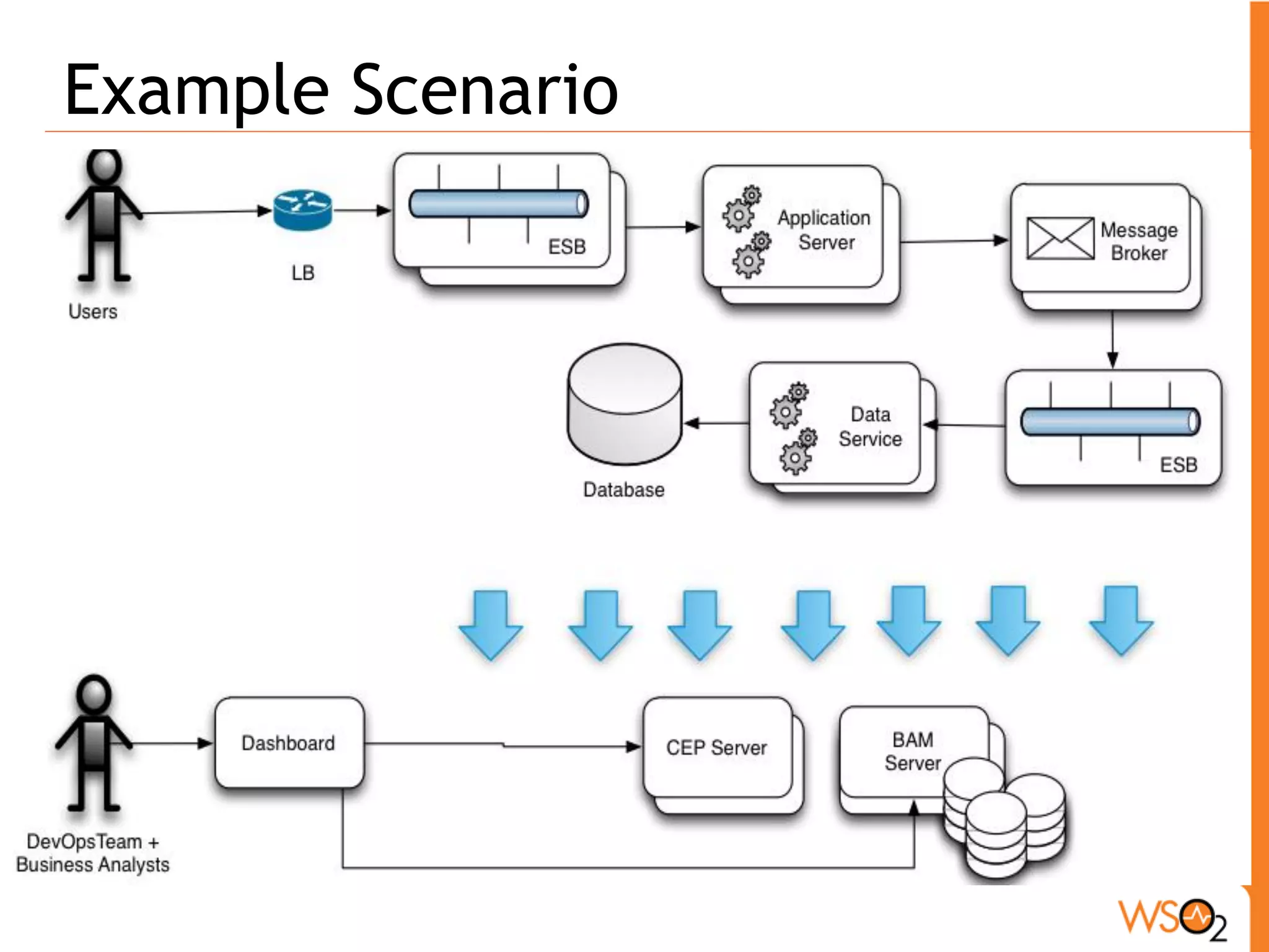
Example Scenario
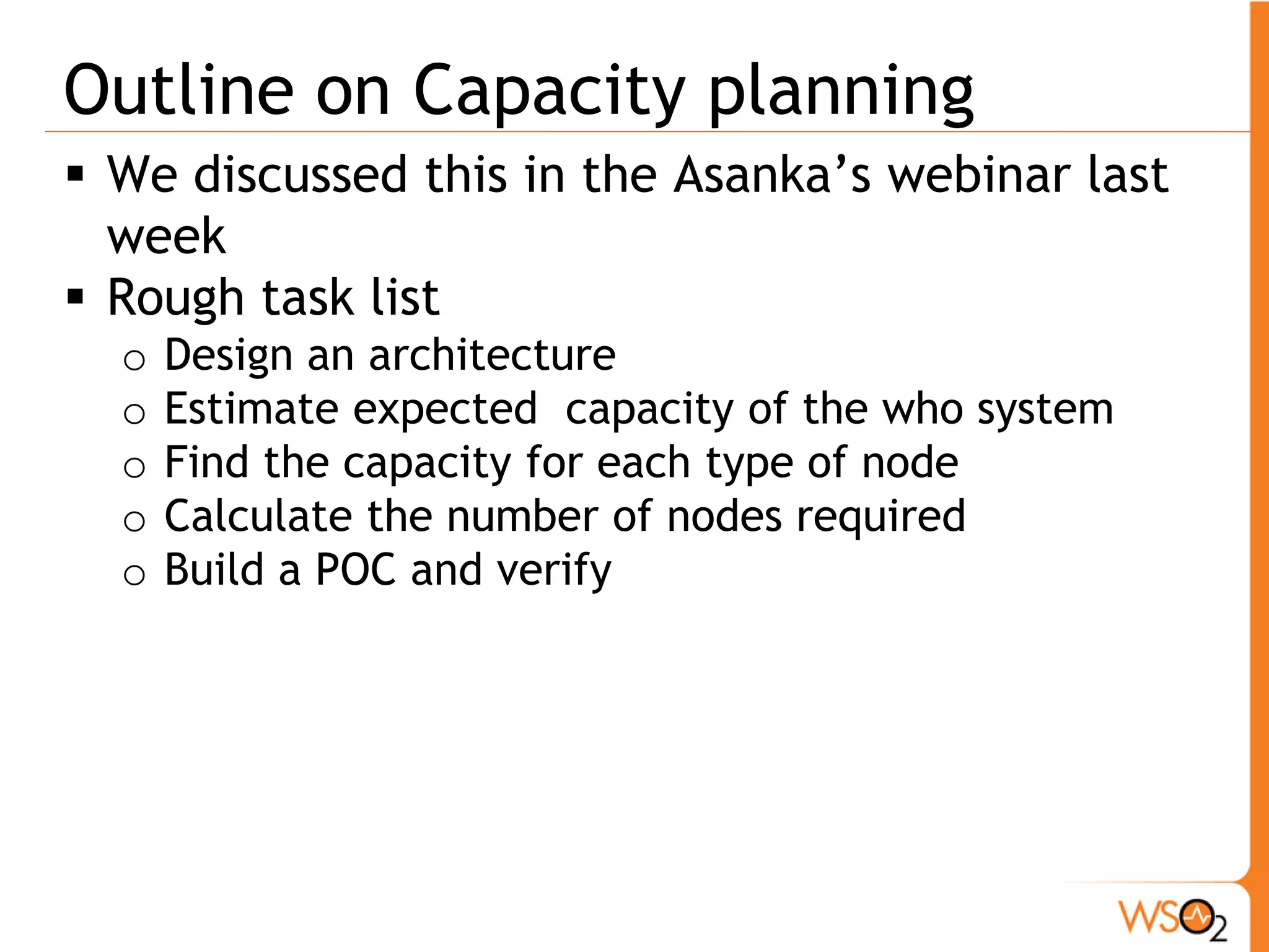
Outline on Capacity planning
 We discussed this in the Asanka’s webinar last
  week
 Rough task list
  o   Design an architecture
  o   Estimate expected capacity of the who system
  o   Find the capacity for each type of node
  o   Calculate the number of nodes required
  o   Build a POC and verify
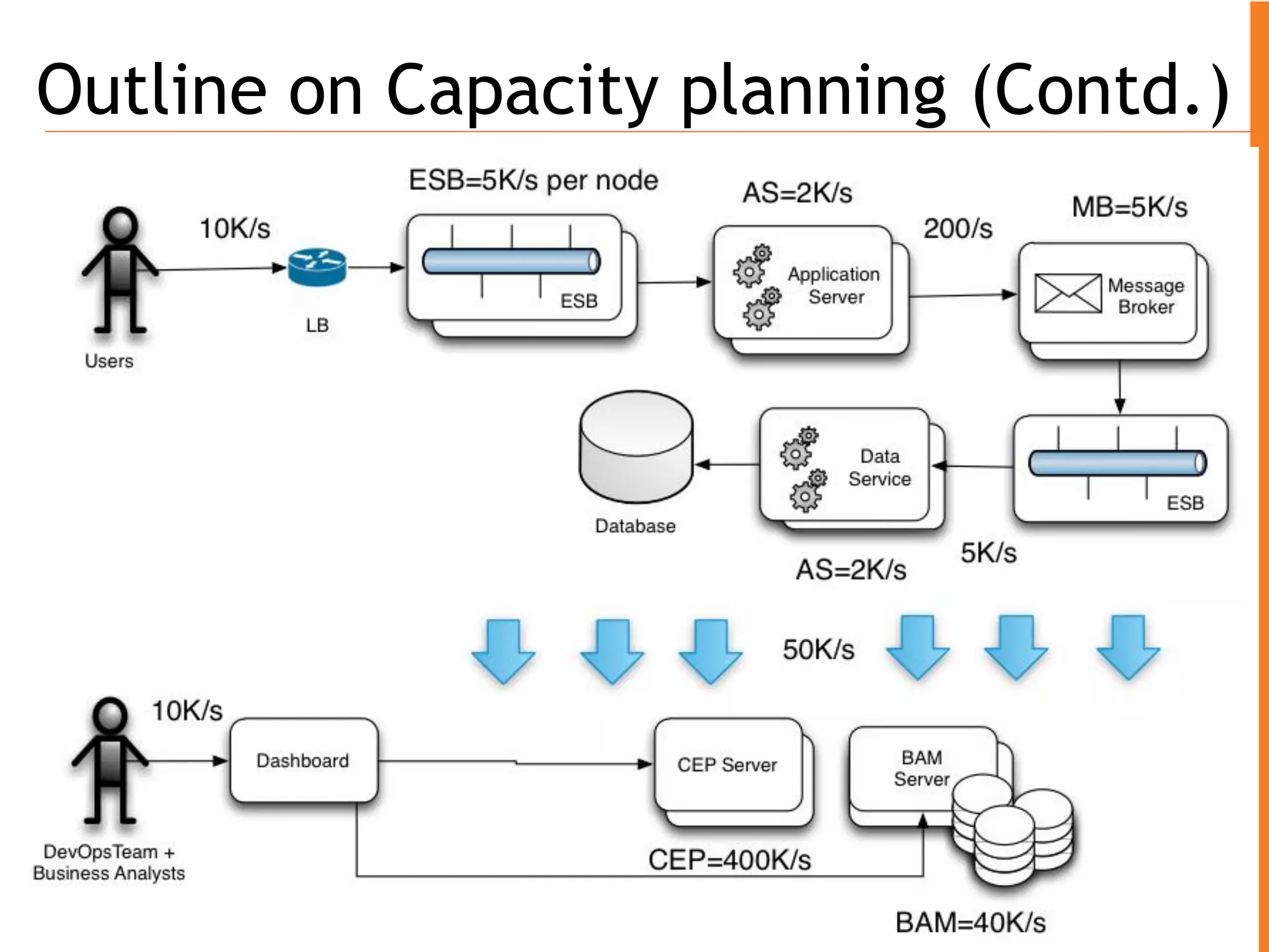
Outline on Capacity planning (Contd.)
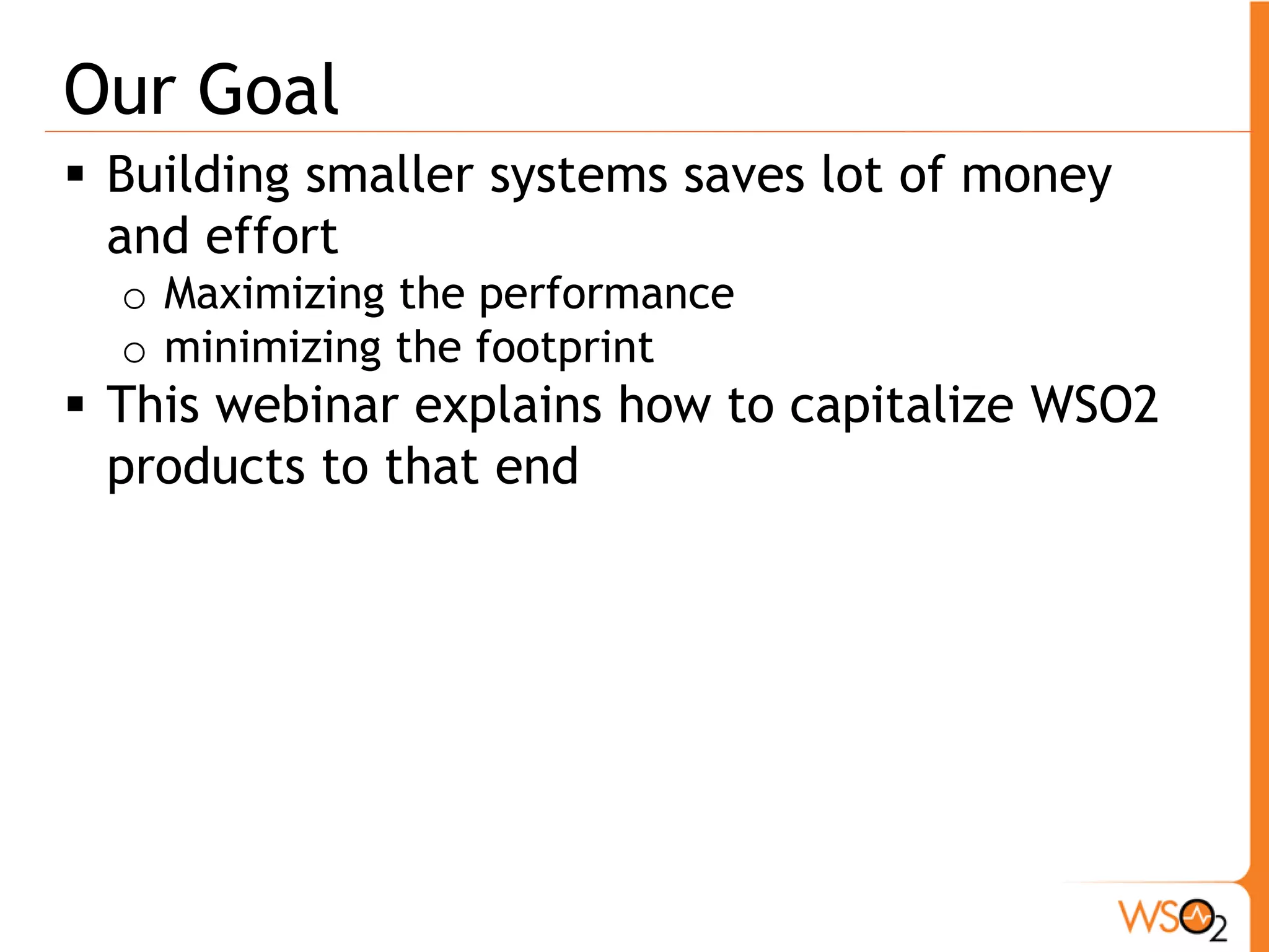
Our Goal
 Building smaller systems saves lot of money
  and effort
  o Maximizing the performance
  o minimizing the footprint
 This webinar explains how to capitalize WSO2
  products to that end
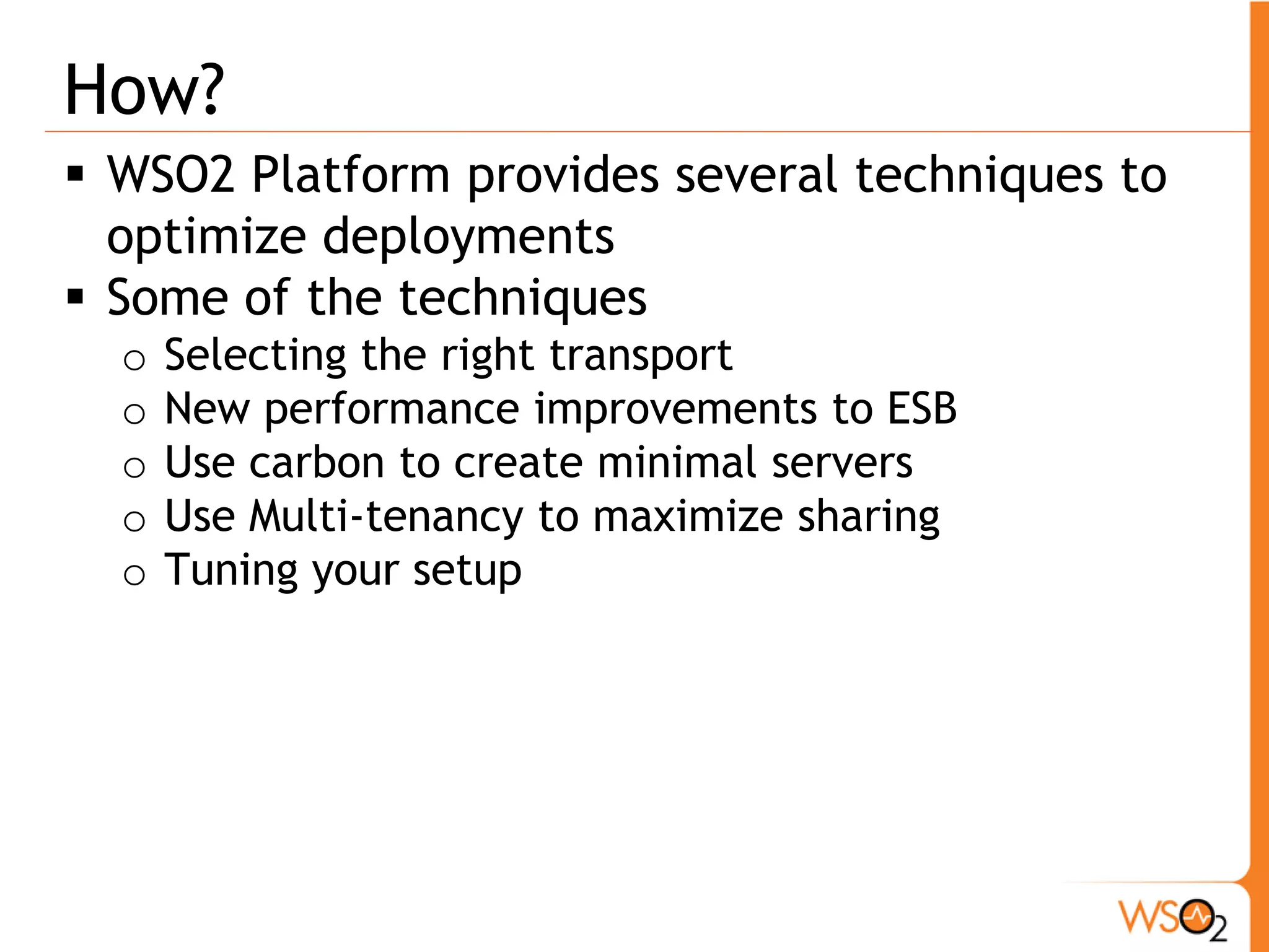
How?
 WSO2 Platform provides several techniques to
  optimize deployments
 Some of the techniques
  o   Selecting the right transport
  o   New performance improvements to ESB
  o   Use carbon to create minimal servers
  o   Use Multi-tenancy to maximize sharing
  o   Tuning your setup
Select the right Message Transport
 WSO2 platform provide several choices for your
  system to communicate
  o   SOAP
  o   HTTP/JSON
  o   Thrift
  o   AMQP
  o   Others
      -   XMPP
      -   TCP
      -   Mail/ SMTP
      -   FTP
      -   Domain specific formats like FIX
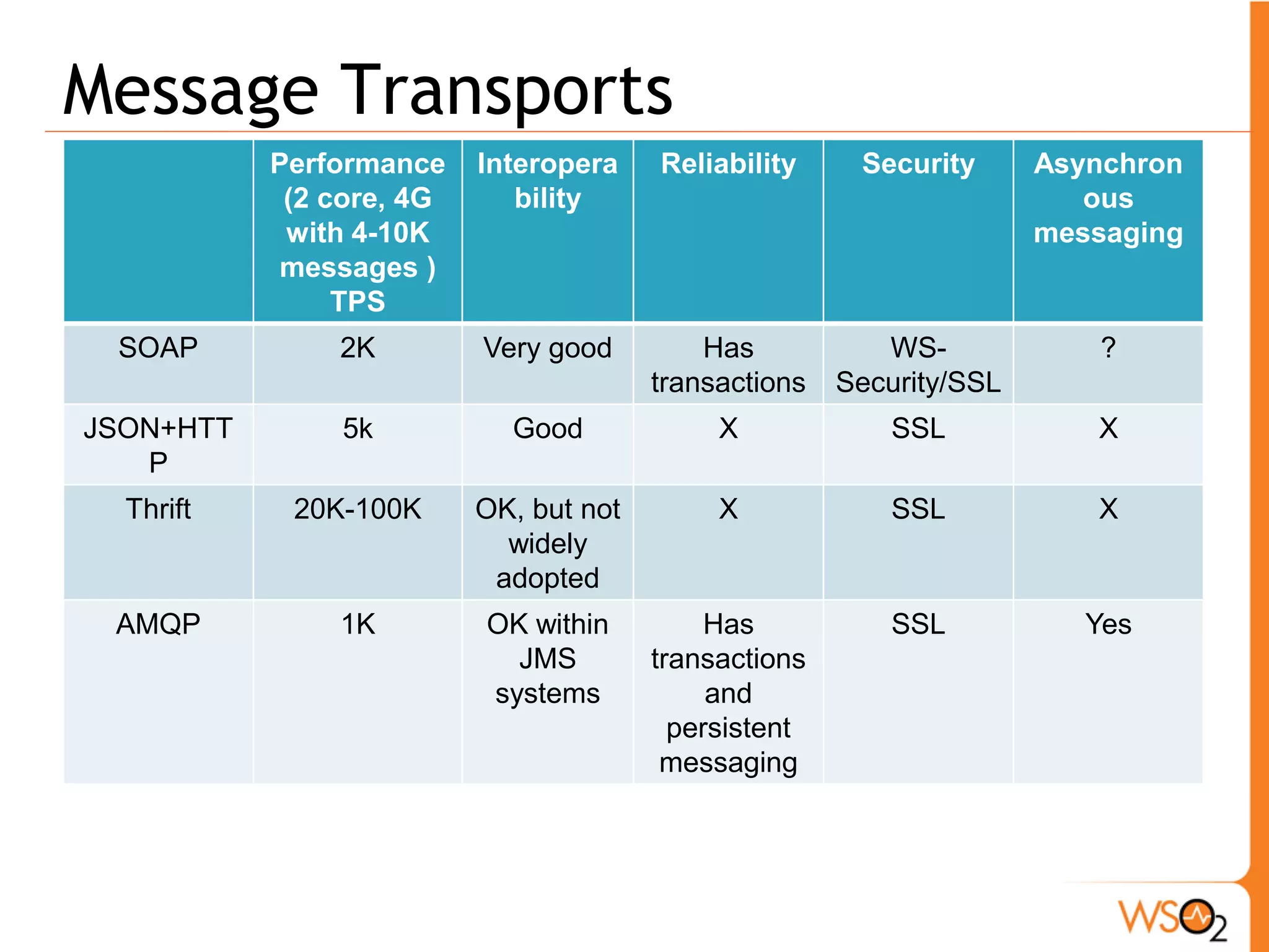
Message Transports
           Performance    Interopera    Reliability     Security      Asynchron
            (2 core, 4G      bility                                      ous
            with 4-10K                                                messaging
           messages )
                TPS
 SOAP          2K         Very good         Has           WS-             ?
                                        transactions   Security/SSL
JSON+HTT       5k           Good             X             SSL           X
   P
  Thrift    20K-100K      OK, but not        X             SSL           X
                            widely
                           adopted
 AMQP          1K         OK within          Has           SSL           Yes
                            JMS         transactions
                          systems            and
                                          persistent
                                         messaging
Select the right Message Transport
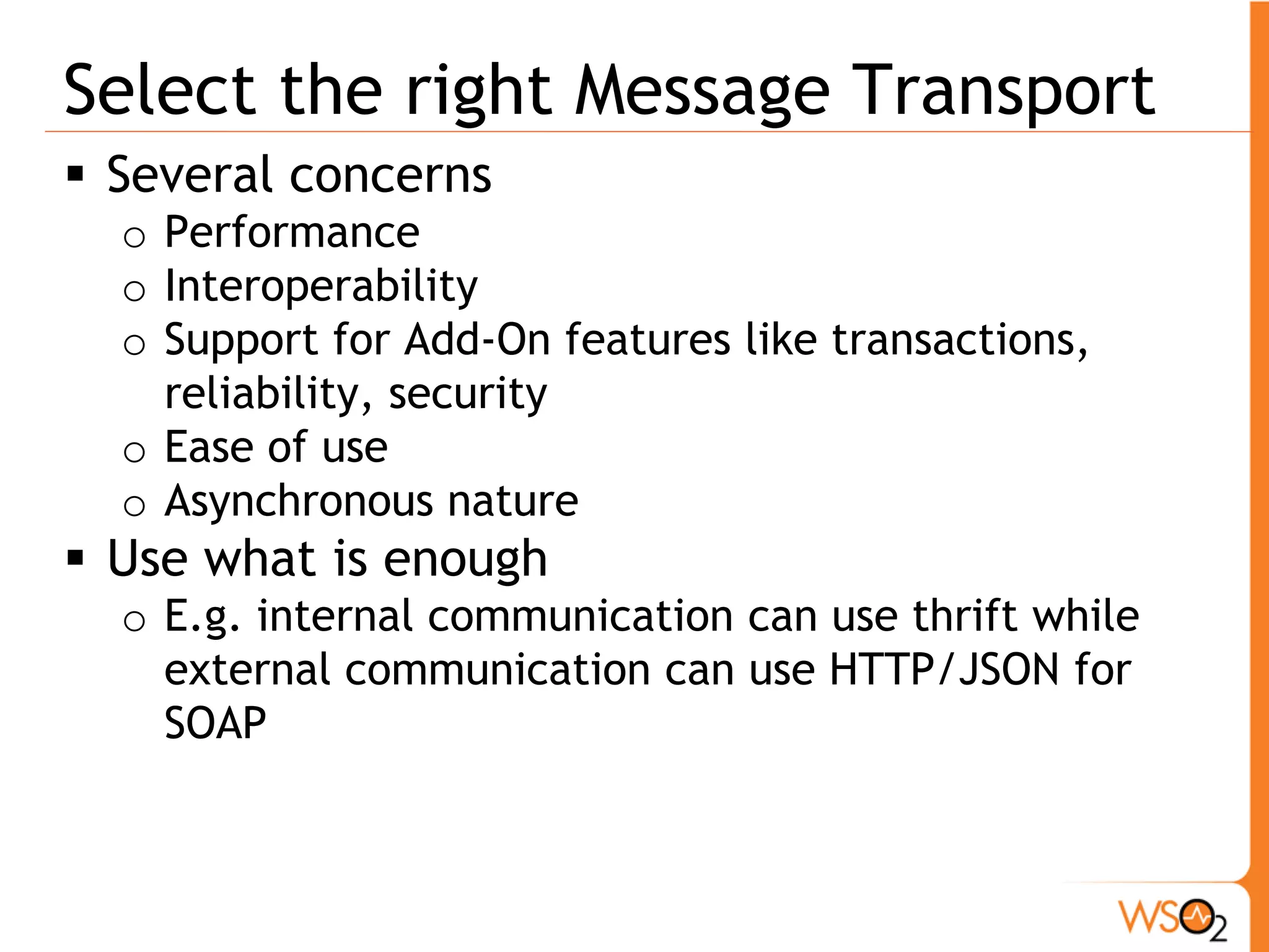
 Several concerns
  o Performance
  o Interoperability
  o Support for Add-On features like transactions,
    reliability, security
  o Ease of use
  o Asynchronous nature
 Use what is enough
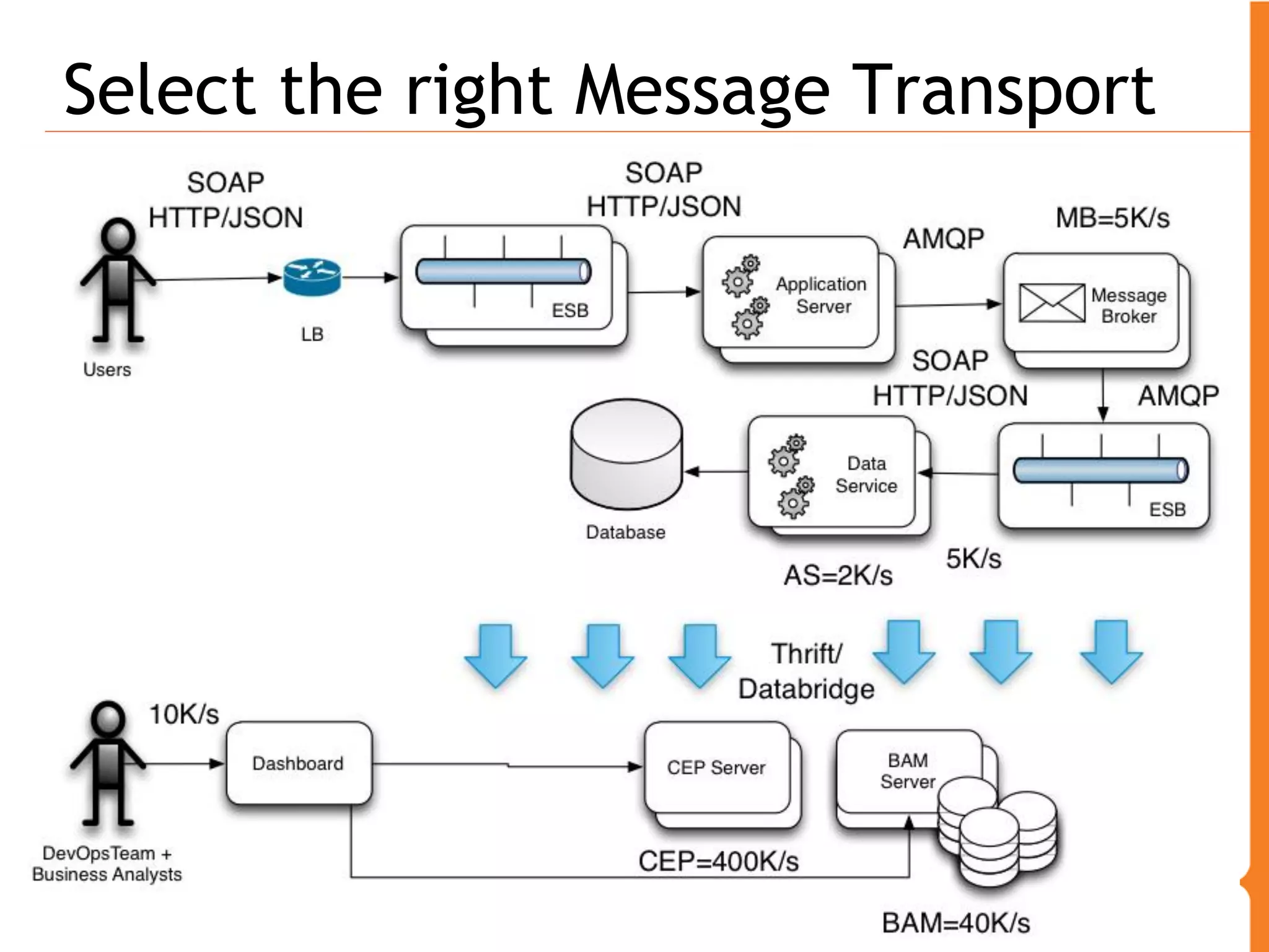
  o E.g. internal communication can use thrift while
    external communication can use HTTP/JSON for
    SOAP
Select the right Message Transport
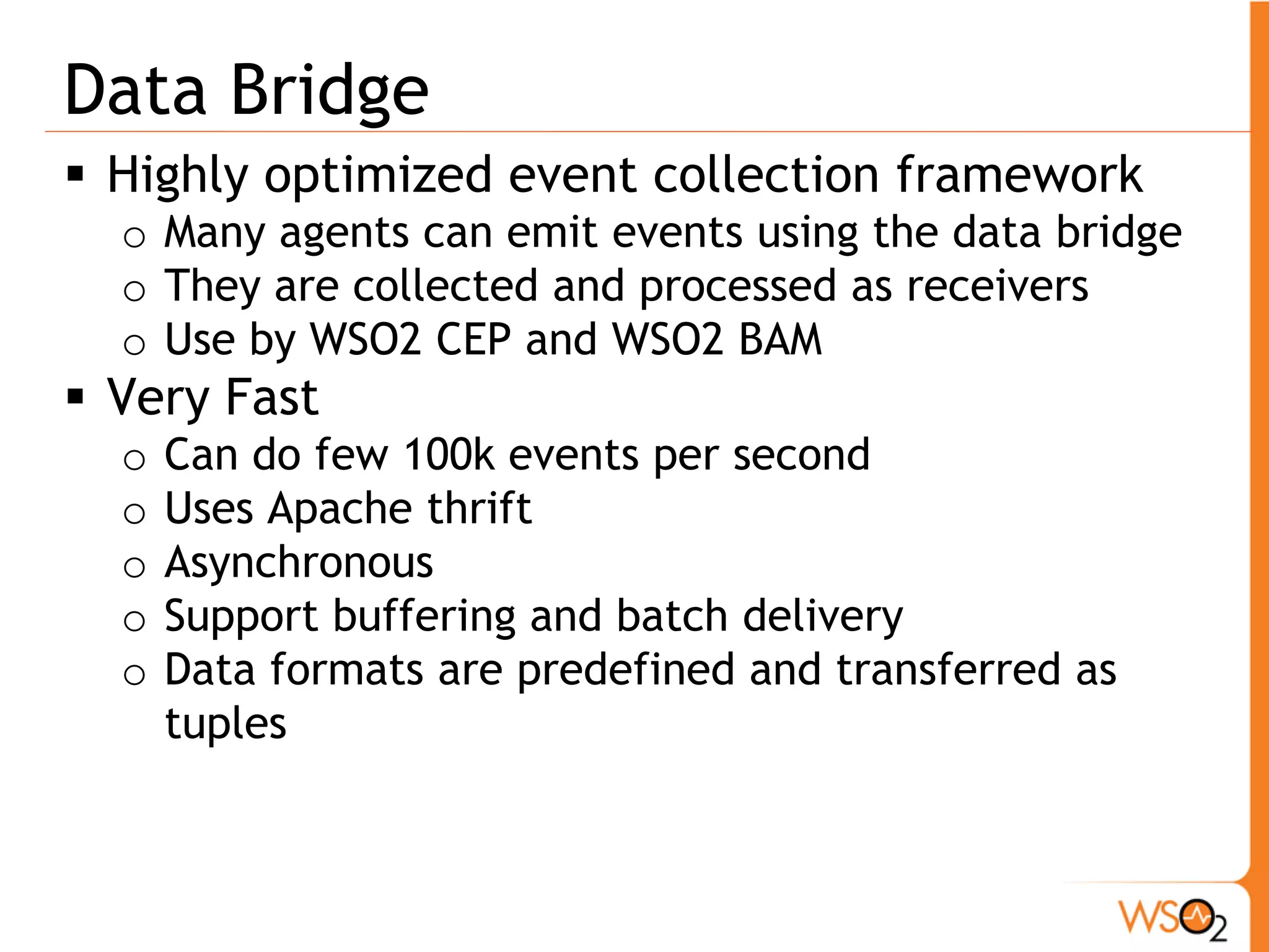
Data Bridge
 Highly optimized event collection framework
  o Many agents can emit events using the data bridge
  o They are collected and processed as receivers
  o Use by WSO2 CEP and WSO2 BAM
 Very Fast
  o   Can do few 100k events per second
  o   Uses Apache thrift
  o   Asynchronous
  o   Support buffering and batch delivery
  o   Data formats are predefined and transferred as
      tuples
Minimize the Product Footprint
 What do we mean by foot print?
  o Product size (disk space, download)
  o Memory foot print
  o Unused functionality
 Two main ideas
  o Remove what is not needed
  o Maximize sharing
 WSO2 platform provides 2 choices to minimize
  the footprint
  o Use carbon to build a minimal Product
  o Use Multi-tenancy to maximize sharing
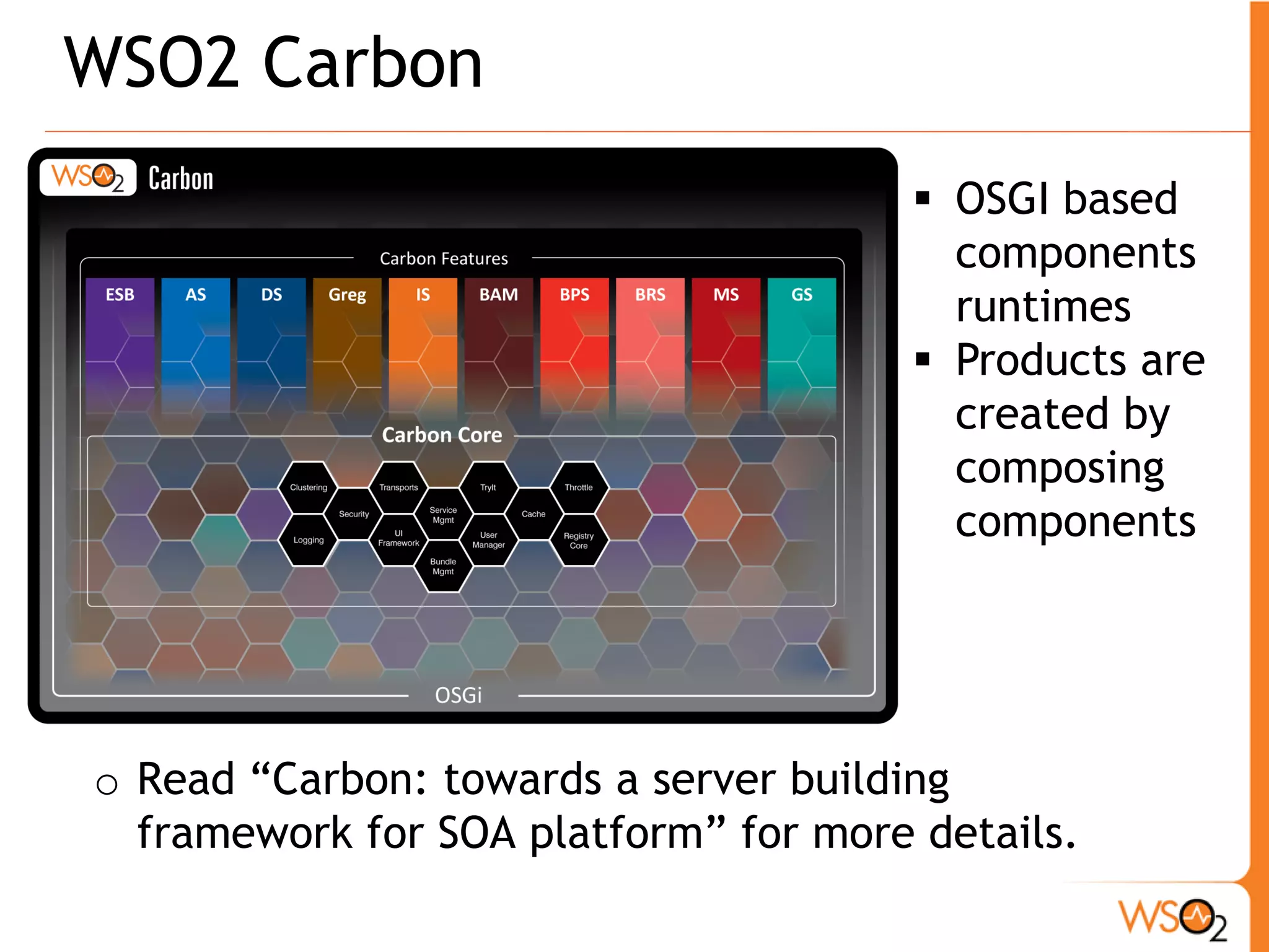
WSO2 Carbon
                                        OSGI based
                                         components
                                         runtimes
                                        Products are
                                         created by
                                         composing
                                         components


o Read “Carbon: towards a server building
  framework for SOA platform” for more details.
Build Minimal Product
 So you can customize and create a minimal
  product by adding and removing components
   E.g. We were able to make WSO2 IS with 64MB heap this
    way for a given scenario.
 In smaller load cases, you can combine
  multiple products to a one product
  o E.g. Add service hosting to BPS
What is Multi-tenancy ?


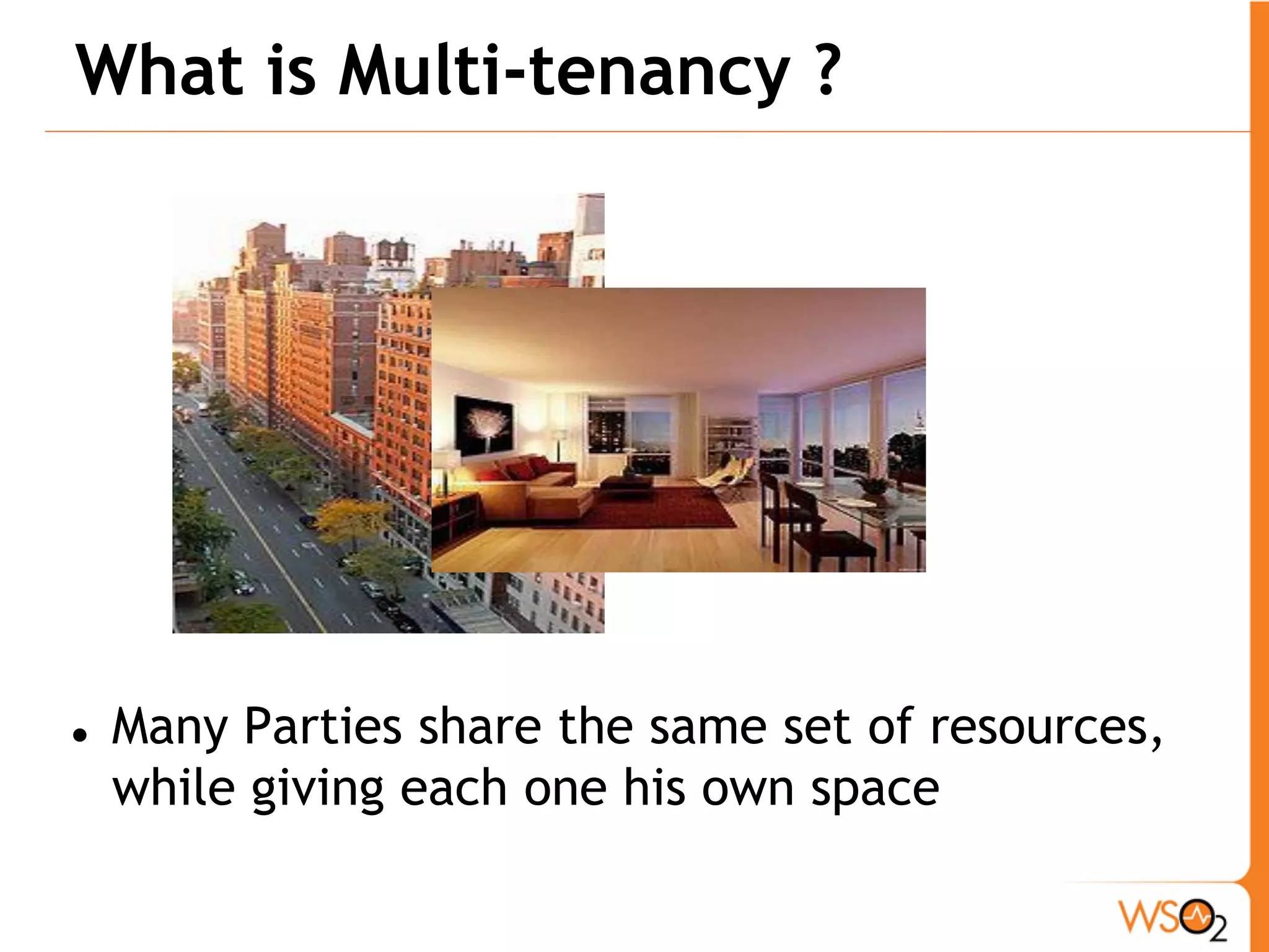
   Many Parties share the same set of resources,
    while giving each one his own space
Why Multi-tenancy? 1. Increased sharing

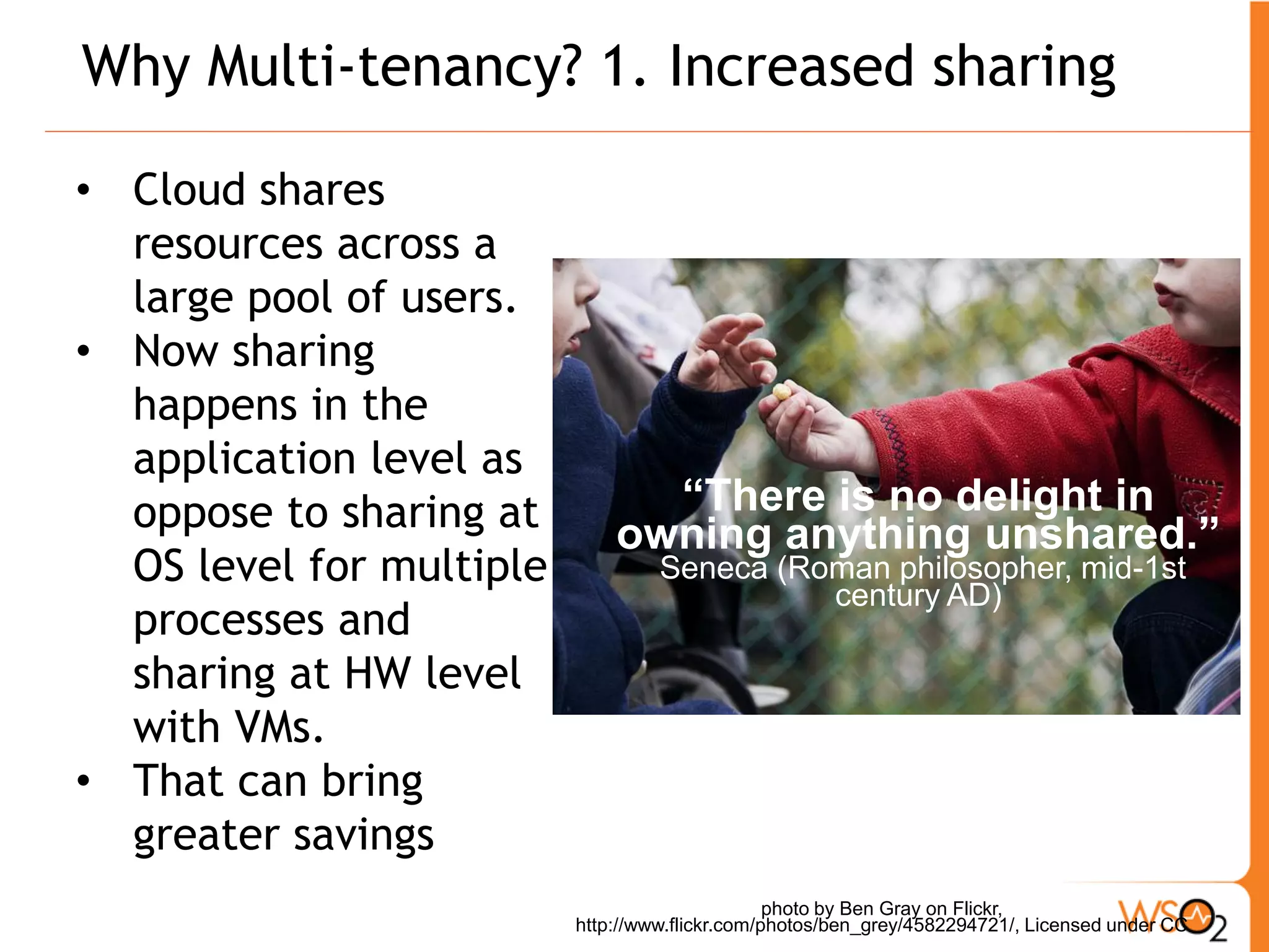
• Cloud shares
  resources across a
  large pool of users.
• Now sharing
  happens in the
  application level as
  oppose to sharing at          “There is no delight in
                              owning anything unshared.”
  OS level for multiple            Seneca (Roman philosopher, mid-1st
                                             century AD)
  processes and
  sharing at HW level
  with VMs.
• That can bring
  greater savings
                                                 photo by Ben Gray on Flickr,
                          http://www.flickr.com/photos/ben_grey/4582294721/, Licensed under CC
Why Multi-tenancy? 2. Provide “pay for what you
use”

  •   Often there will be many accounts
      in a PaaS or a SaaS, but only a
      fraction of them will be in use.
  •   We cannot allocate runtime
      resource per account (disk may be
      ok, as it is cheap). For example,
      we cannot run a VM per account.
  •   By sharing the same server with
      many users, Multi-tenancy provides
      much reduced runtime cost per
      server.
How does it Help?
• All WSO2 products support
  • multi-tenancy
  • Running in the cloud in pay as you go fashion
• So you can share same physical server across
  many (e.g. departments) logically
• Or you can outsource some parts of the design
  to a PaaS (e.g. Stratos Live)
Recent Performance Improvements
   Native support for JSON
   Pass-through support for ESB
   Streaming Xpath and XSLT
   CEP 2.0
Native Support for JSON
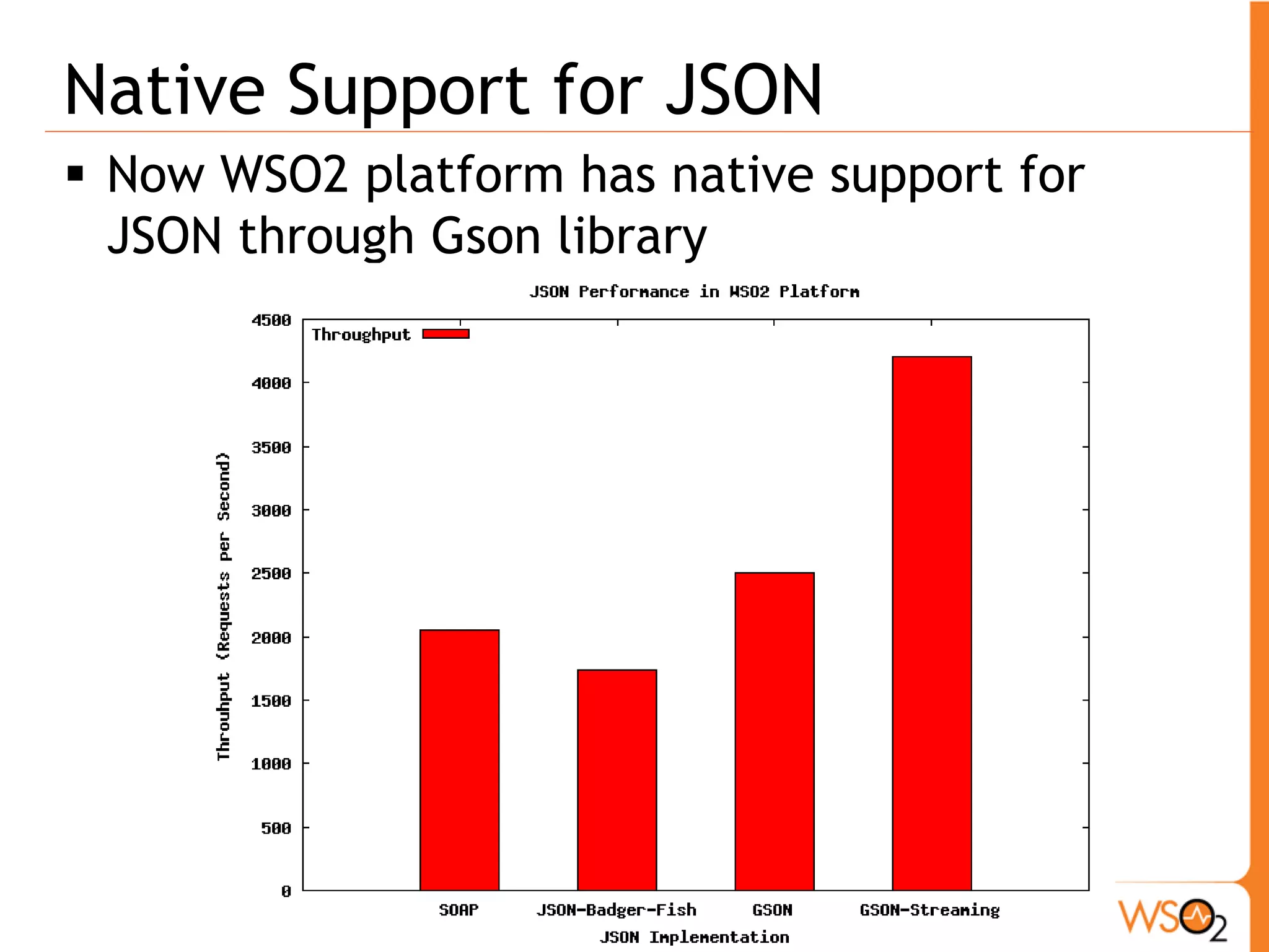
 Now WSO2 platform has native support for
  JSON through Gson library
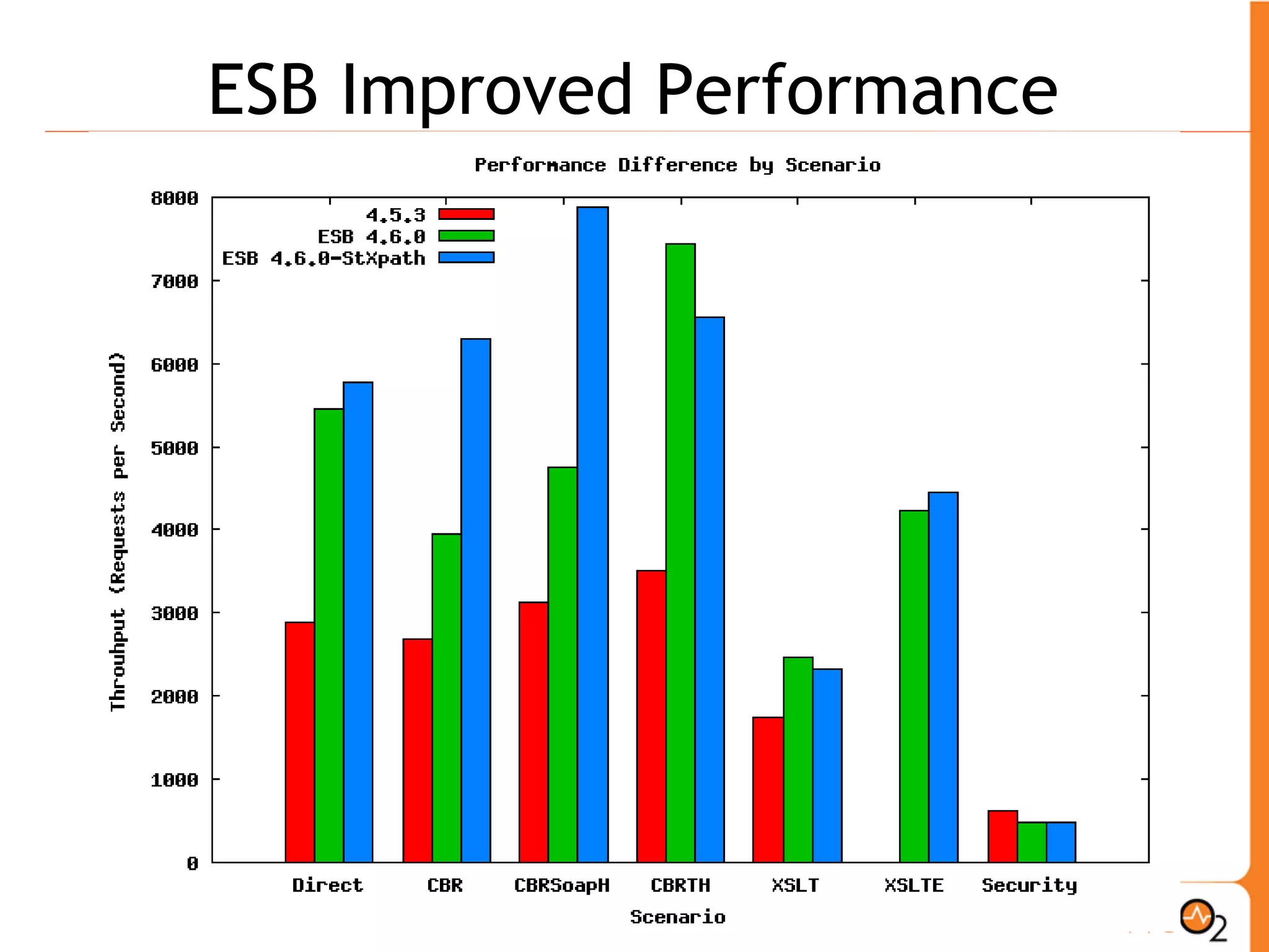
ESB Passthrough and Streaming XSLT
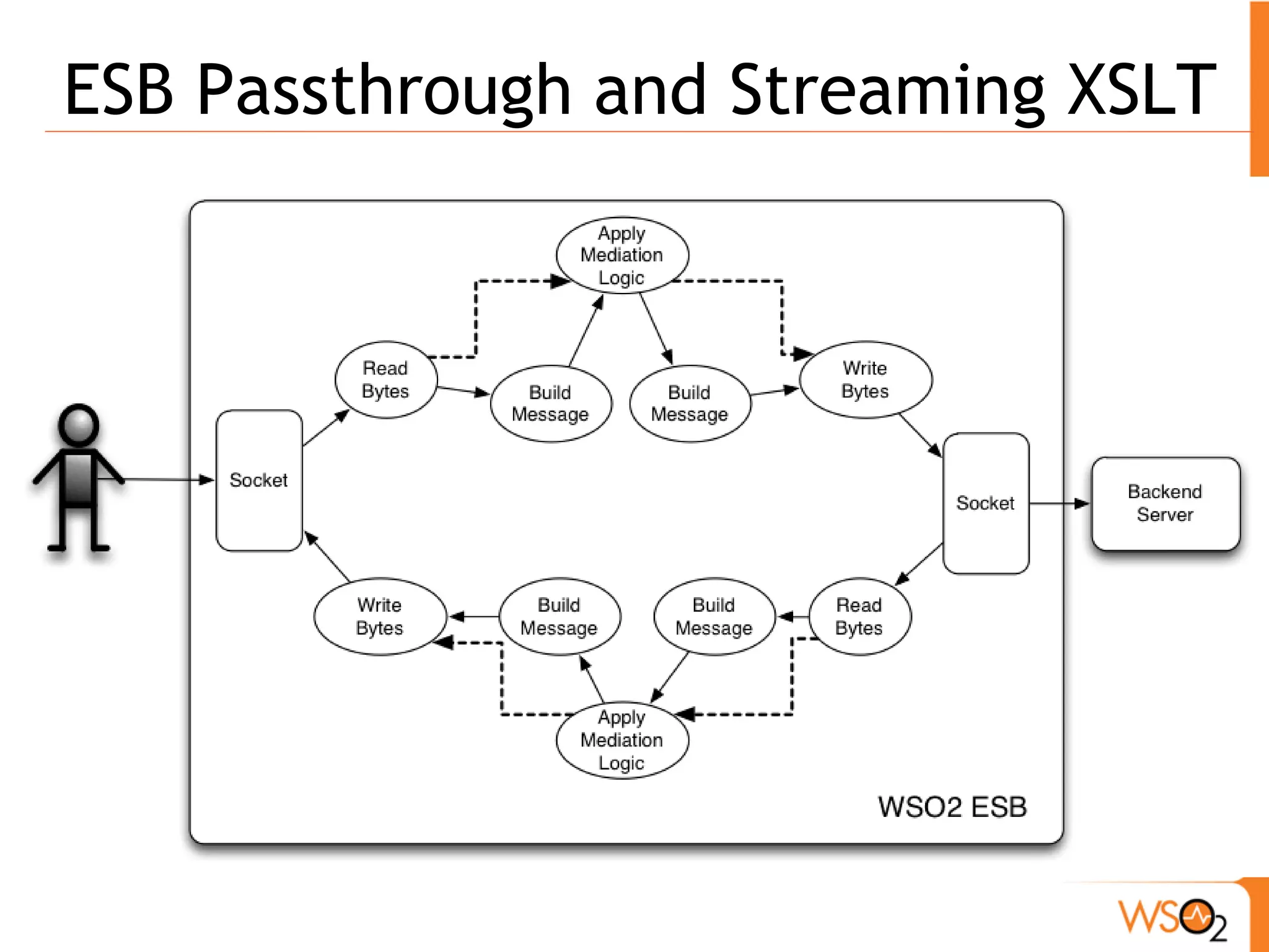
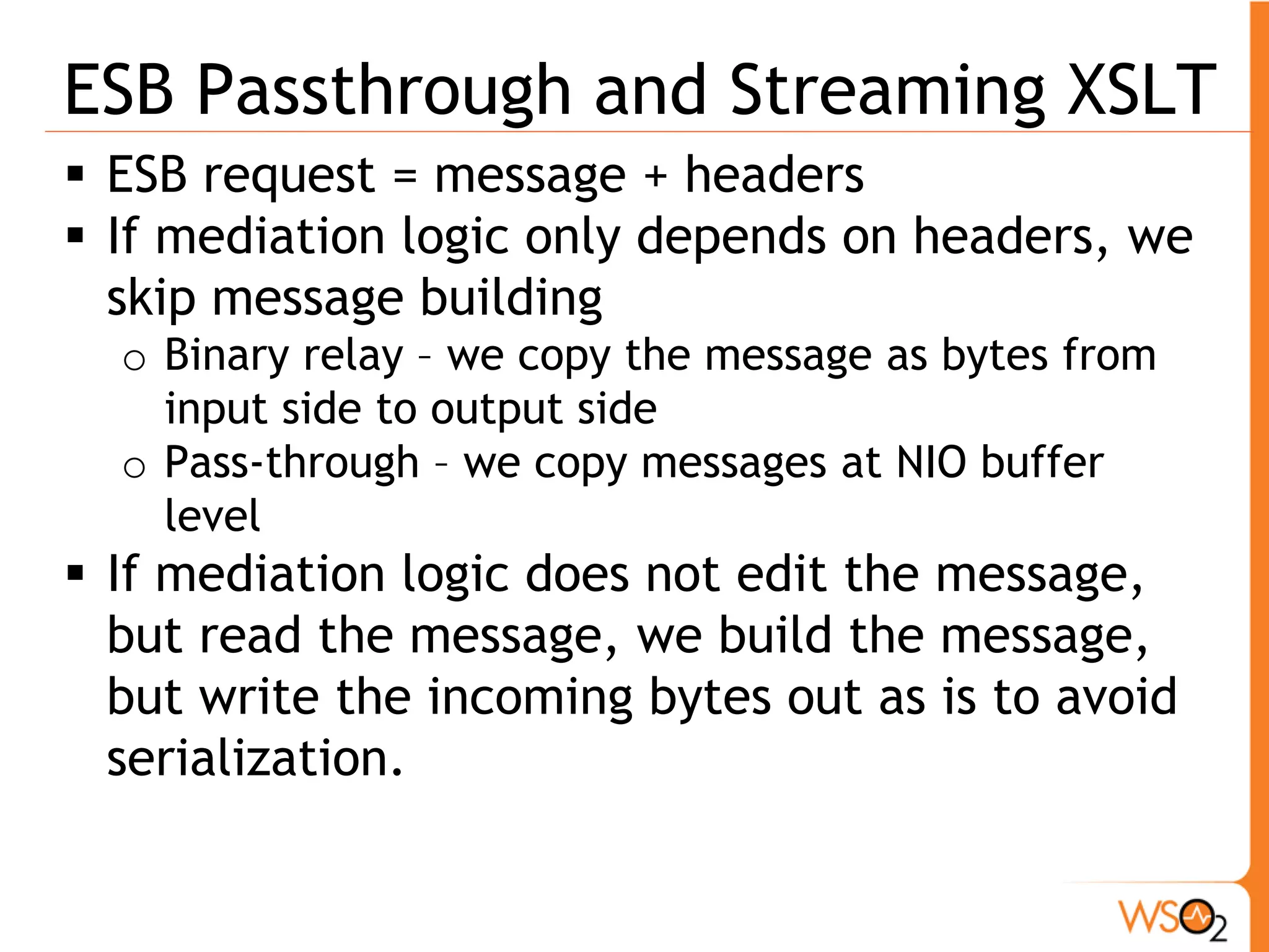
 ESB request = message + headers
 If mediation logic only depends on headers, we
  skip message building
  o Binary relay – we copy the message as bytes from
    input side to output side
  o Pass-through – we copy messages at NIO buffer
    level
 If mediation logic does not edit the message,
  but read the message, we build the message,
  but write the incoming bytes out as is to avoid
  serialization.
ESB Improved Performance
Complex Event Processor 2.0
 Now CEP server 2.0 comes with a new runtime
  called Siddhi
 Very fast
  o About 2.5M events/sec with java events
  o About 250k events/sec over data bridge
 Supports Distributed Cache and Persistence for
  HA
 More details from
  o http://wso2.com/products/complex-event-
    processor/
Tuning
 OS Level Tuning
  o For example,
    http://www.lognormal.com/blog/2012/09/27/linu
    x-tcpip-tuning/
  o Generally available with the product
  o It depends on OS etc.
 Product Tuning
  o Thread pools sizes mainly, there may be others
 Application Tuning
  o This is your application, it is good idea to do a
    profile and see.
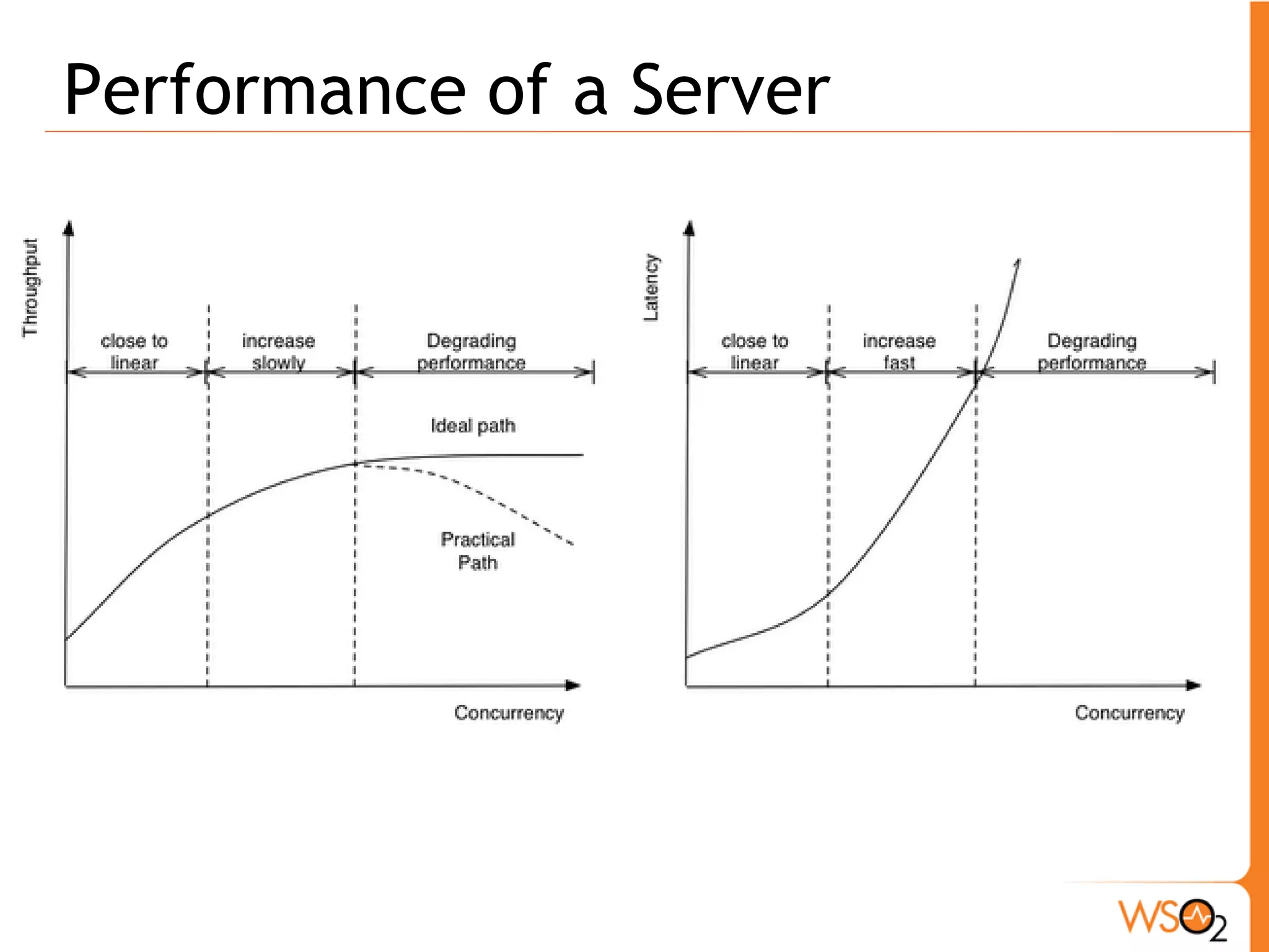
Performance of a Server
What we expect from Tuning
 Goals
  o Max Throughput
  o Within Given Latency
 How do we know we are at Max?
  o Does resource consumption is high?
  o What are the resources
     - CPU
     - Memory
     - IO (Network and Disk)
  o At last one should max out
  o E.g. if you have too many locks, all above 3 may be
    low and you get sub-optimal throughput
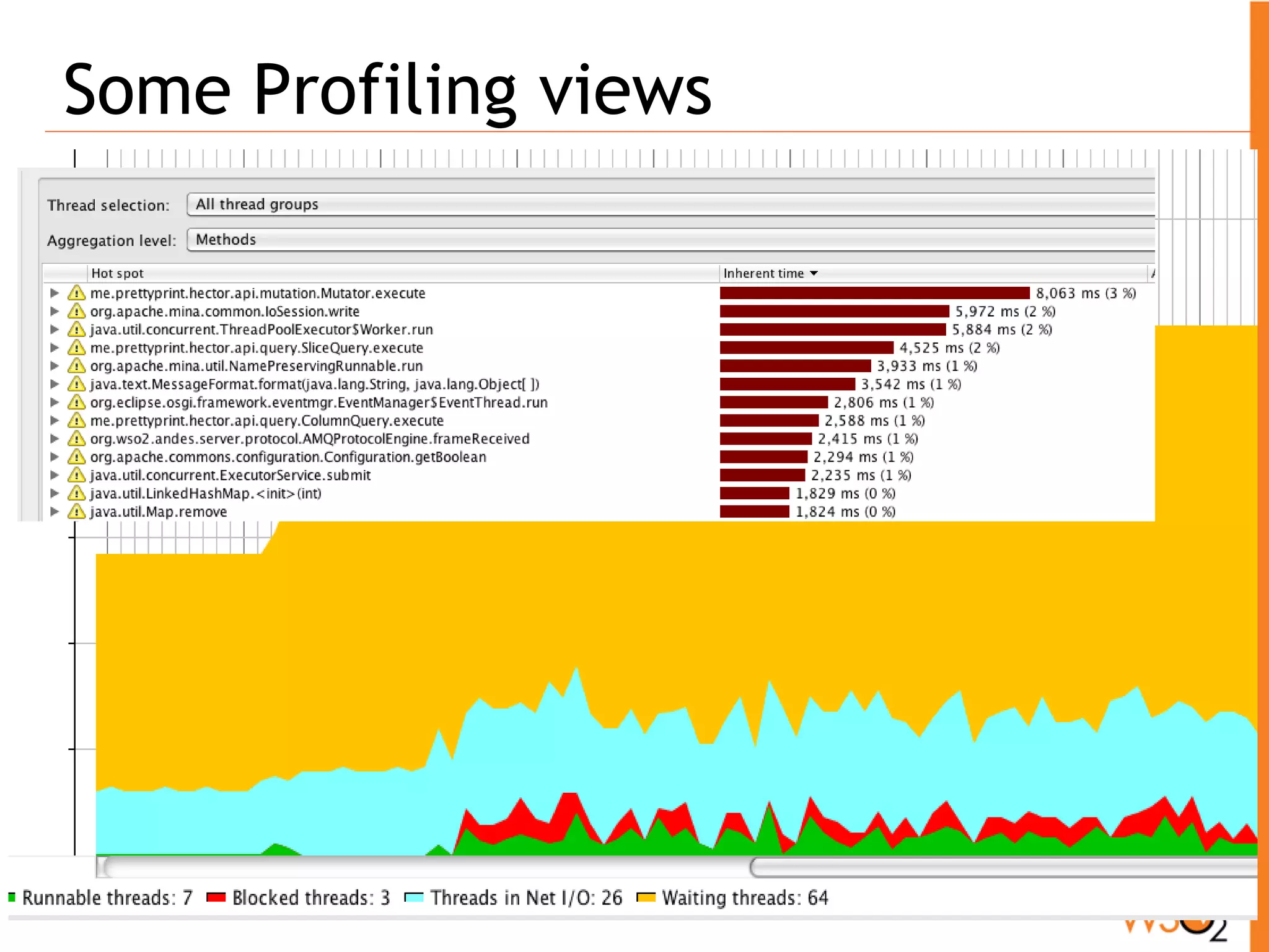
 We fix problems via profiling
  o Detective time!!
Profiling
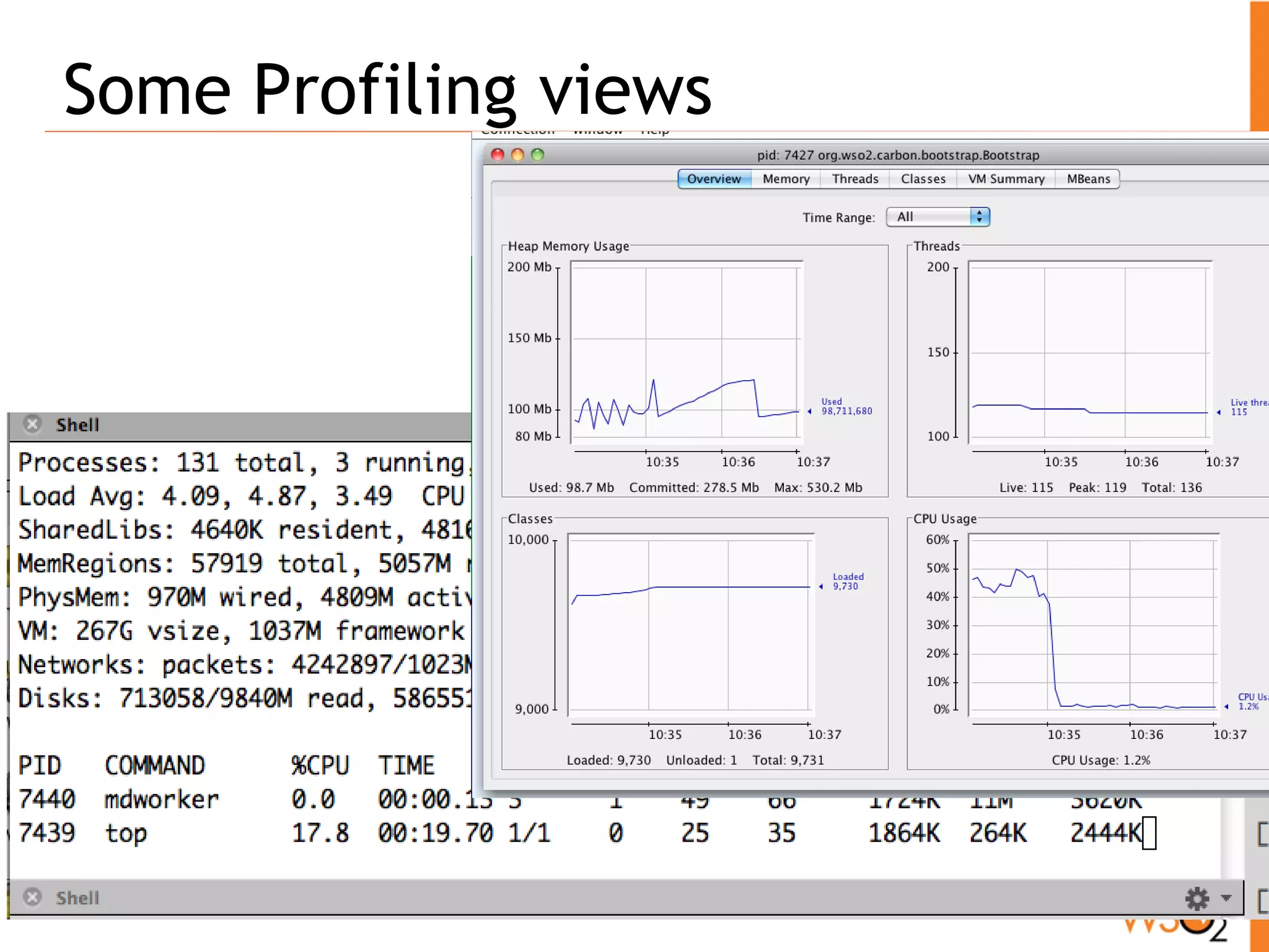
 First step is connect through JConsole, and get
  basic idea.
 Also monitor the load average, CPU usage, and
  IO operations (via top or Sar)
 Then you can switch to tools like JProfiler,
  Yourkit
 Important views
  o   CPU views (bottlenecks)
  o   Thread views and monitor views
  o   Memory views (GC, allocations, and memory leaks)
  o   IO and JDBC tracing
Some Profiling views
Conclusion
 Goals: Optimizing the deployments
  o Message performance
  o Reduce footprint
 Design and Capacity Planning
 Design for Performance and Minimal footprint
  o Select right transport
  o Minimize footprint and maximize sharing
     - MT
     - Using Carbon
  o Tuning
 We also discussed some of the new
  performance improvements.
Questions?

Maximize Messaging and Performance and Lowering Infrastructure Footprint

  • 1.
    Maximize Messaging Performance and Lowering Infrastructure Footprint Senior Software Architect, WSO2 Inc. Visiting Faculty, University of Moratuwa Member, Apache Software Foundation Research Scientist, Lanka Software Foundation
  • 2.
    Outline  Goals: Optimizingthe deployments o Message performance o Reduce footprint  Design and Capacity Planning  Design for Performance and Minimal footprint o Select right transport o Minimize footprint and maximize sharing - MT - Using Carbon o Tuning  Wrapping Up
  • 3.
    About Mission criticalwebinar series
  • 4.
  • 5.
    Outline on Capacityplanning  We discussed this in the Asanka’s webinar last week  Rough task list o Design an architecture o Estimate expected capacity of the who system o Find the capacity for each type of node o Calculate the number of nodes required o Build a POC and verify
  • 6.
    Outline on Capacityplanning (Contd.)
  • 7.
    Our Goal  Buildingsmaller systems saves lot of money and effort o Maximizing the performance o minimizing the footprint  This webinar explains how to capitalize WSO2 products to that end
  • 8.
    How?  WSO2 Platformprovides several techniques to optimize deployments  Some of the techniques o Selecting the right transport o New performance improvements to ESB o Use carbon to create minimal servers o Use Multi-tenancy to maximize sharing o Tuning your setup
  • 9.
    Select the rightMessage Transport  WSO2 platform provide several choices for your system to communicate o SOAP o HTTP/JSON o Thrift o AMQP o Others - XMPP - TCP - Mail/ SMTP - FTP - Domain specific formats like FIX
  • 10.
    Message Transports Performance Interopera Reliability Security Asynchron (2 core, 4G bility ous with 4-10K messaging messages ) TPS SOAP 2K Very good Has WS- ? transactions Security/SSL JSON+HTT 5k Good X SSL X P Thrift 20K-100K OK, but not X SSL X widely adopted AMQP 1K OK within Has SSL Yes JMS transactions systems and persistent messaging
  • 11.
    Select the rightMessage Transport  Several concerns o Performance o Interoperability o Support for Add-On features like transactions, reliability, security o Ease of use o Asynchronous nature  Use what is enough o E.g. internal communication can use thrift while external communication can use HTTP/JSON for SOAP
  • 12.
    Select the rightMessage Transport
  • 13.
    Data Bridge  Highlyoptimized event collection framework o Many agents can emit events using the data bridge o They are collected and processed as receivers o Use by WSO2 CEP and WSO2 BAM  Very Fast o Can do few 100k events per second o Uses Apache thrift o Asynchronous o Support buffering and batch delivery o Data formats are predefined and transferred as tuples
  • 14.
    Minimize the ProductFootprint  What do we mean by foot print? o Product size (disk space, download) o Memory foot print o Unused functionality  Two main ideas o Remove what is not needed o Maximize sharing  WSO2 platform provides 2 choices to minimize the footprint o Use carbon to build a minimal Product o Use Multi-tenancy to maximize sharing
  • 15.
    WSO2 Carbon  OSGI based components runtimes  Products are created by composing components o Read “Carbon: towards a server building framework for SOA platform” for more details.
  • 16.
    Build Minimal Product So you can customize and create a minimal product by adding and removing components  E.g. We were able to make WSO2 IS with 64MB heap this way for a given scenario.  In smaller load cases, you can combine multiple products to a one product o E.g. Add service hosting to BPS
  • 17.
    What is Multi-tenancy?  Many Parties share the same set of resources, while giving each one his own space
  • 18.
    Why Multi-tenancy? 1.Increased sharing • Cloud shares resources across a large pool of users. • Now sharing happens in the application level as oppose to sharing at “There is no delight in owning anything unshared.” OS level for multiple Seneca (Roman philosopher, mid-1st century AD) processes and sharing at HW level with VMs. • That can bring greater savings photo by Ben Gray on Flickr, http://www.flickr.com/photos/ben_grey/4582294721/, Licensed under CC
  • 19.
    Why Multi-tenancy? 2.Provide “pay for what you use” • Often there will be many accounts in a PaaS or a SaaS, but only a fraction of them will be in use. • We cannot allocate runtime resource per account (disk may be ok, as it is cheap). For example, we cannot run a VM per account. • By sharing the same server with many users, Multi-tenancy provides much reduced runtime cost per server.
  • 20.
    How does itHelp? • All WSO2 products support • multi-tenancy • Running in the cloud in pay as you go fashion • So you can share same physical server across many (e.g. departments) logically • Or you can outsource some parts of the design to a PaaS (e.g. Stratos Live)
  • 21.
    Recent Performance Improvements  Native support for JSON  Pass-through support for ESB  Streaming Xpath and XSLT  CEP 2.0
  • 22.
    Native Support forJSON  Now WSO2 platform has native support for JSON through Gson library
  • 23.
    ESB Passthrough andStreaming XSLT
  • 24.
    ESB Passthrough andStreaming XSLT  ESB request = message + headers  If mediation logic only depends on headers, we skip message building o Binary relay – we copy the message as bytes from input side to output side o Pass-through – we copy messages at NIO buffer level  If mediation logic does not edit the message, but read the message, we build the message, but write the incoming bytes out as is to avoid serialization.
  • 25.
  • 26.
    Complex Event Processor2.0  Now CEP server 2.0 comes with a new runtime called Siddhi  Very fast o About 2.5M events/sec with java events o About 250k events/sec over data bridge  Supports Distributed Cache and Persistence for HA  More details from o http://wso2.com/products/complex-event- processor/
  • 27.
    Tuning  OS LevelTuning o For example, http://www.lognormal.com/blog/2012/09/27/linu x-tcpip-tuning/ o Generally available with the product o It depends on OS etc.  Product Tuning o Thread pools sizes mainly, there may be others  Application Tuning o This is your application, it is good idea to do a profile and see.
  • 28.
  • 29.
    What we expectfrom Tuning  Goals o Max Throughput o Within Given Latency  How do we know we are at Max? o Does resource consumption is high? o What are the resources - CPU - Memory - IO (Network and Disk) o At last one should max out o E.g. if you have too many locks, all above 3 may be low and you get sub-optimal throughput  We fix problems via profiling o Detective time!!
  • 30.
    Profiling  First stepis connect through JConsole, and get basic idea.  Also monitor the load average, CPU usage, and IO operations (via top or Sar)  Then you can switch to tools like JProfiler, Yourkit  Important views o CPU views (bottlenecks) o Thread views and monitor views o Memory views (GC, allocations, and memory leaks) o IO and JDBC tracing
  • 31.
  • 32.
  • 33.
    Conclusion  Goals: Optimizingthe deployments o Message performance o Reduce footprint  Design and Capacity Planning  Design for Performance and Minimal footprint o Select right transport o Minimize footprint and maximize sharing - MT - Using Carbon o Tuning  We also discussed some of the new performance improvements.
  • 34.