Dr. Vinay Kumar
Assistant Professor
Department of Physics
COBS&H, CCS HAU, Hisar
Electronic Contact; vinay23@hau.ac.in;
ORIENTATION PROGRAM ON “LABORATORY SAFTEY”
Safety Precaution and handling of smart
materials and Instrumentation
3/10/2024
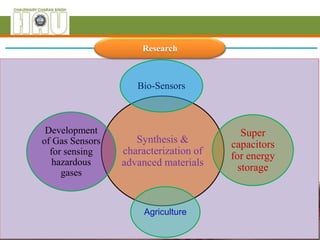
Research
Synthesis &
characterization of
advanced materials
Development
of Gas Sensors
for sensing
hazardous
gases
Super
capacitors
for energy
storage
Bio-Sensors
Agriculture
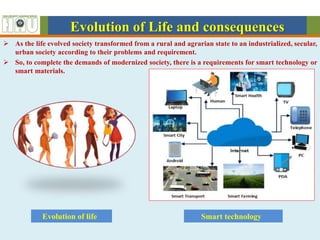
Evolution of Life and consequences
 As the life evolved society transformed from a rural and agrarian state to an industrialized, secular,
urban society according to their problems and requirement.
 So, to complete the demands of modernized society, there is a requirements for smart technology or
smart materials.
Smart technology
Evolution of life
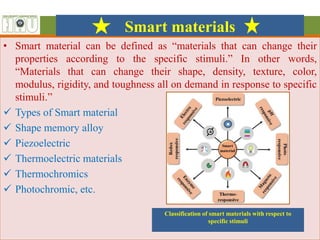
Smart materials
• Smart material can be defined as “materials that can change their
properties according to the specific stimuli.” In other words,
“Materials that can change their shape, density, texture, color,
modulus, rigidity, and toughness all on demand in response to specific
stimuli.”
 Types of Smart material
 Shape memory alloy
 Piezoelectric
 Thermoelectric materials
 Thermochromics
 Photochromic, etc.
Classification of smart materials with respect to
specific stimuli
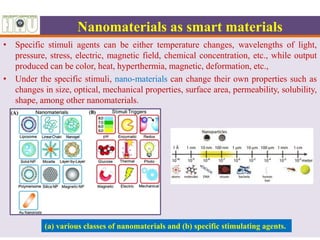
Nanomaterials as smart materials
• Specific stimuli agents can be either temperature changes, wavelengths of light,
pressure, stress, electric, magnetic field, chemical concentration, etc., while output
produced can be color, heat, hyperthermia, magnetic, deformation, etc.,
• Under the specific stimuli, nano-materials can change their own properties such as
changes in size, optical, mechanical properties, surface area, permeability, solubility,
shape, among other nanomaterials.
(a) various classes of nanomaterials and (b) specific stimulating agents.
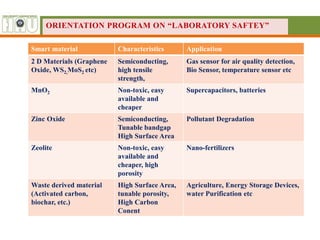
Smart material Characteristics Application
2 D Materials (Graphene
Oxide, WS2,MoS2 etc)
Semiconducting,
high tensile
strength,
Gas sensor for air quality detection,
Bio Sensor, temperature sensor etc
MnO2 Non-toxic, easy
available and
cheaper
Supercapacitors, batteries
Zinc Oxide Semiconducting,
Tunable bandgap
High Surface Area
Pollutant Degradation
Zeolite Non-toxic, easy
available and
cheaper, high
porosity
Nano-fertilizers
Waste derived material
(Activated carbon,
biochar, etc.)
High Surface Area,
tunable porosity,
High Carbon
Conent
Agriculture, Energy Storage Devices,
water Purification etc
ORIENTATION PROGRAM ON “LABORATORY SAFTEY”
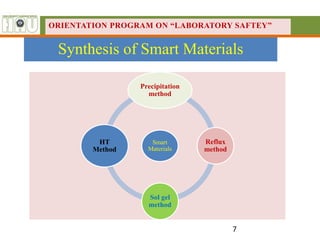
Synthesis of Smart Materials
7
Smart
Materials
Precipitation
method
Reflux
method
Sol gel
method
HT
Method
ORIENTATION PROGRAM ON “LABORATORY SAFTEY”
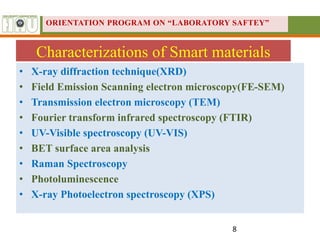
Characterizations of Smart materials
• X-ray diffraction technique(XRD)
• Field Emission Scanning electron microscopy(FE-SEM)
• Transmission electron microscopy (TEM)
• Fourier transform infrared spectroscopy (FTIR)
• UV-Visible spectroscopy (UV-VIS)
• BET surface area analysis
• Raman Spectroscopy
• Photoluminescence
• X-ray Photoelectron spectroscopy (XPS)
8
ORIENTATION PROGRAM ON “LABORATORY SAFTEY”
Safety Precaution
During Synthesis of smart material
Analysis of synthesized material using Advanced
Techniques
ORIENTATION PROGRAM ON “LABORATORY SAFTEY”
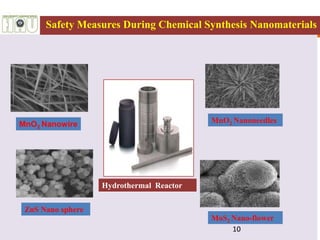
10
MnO2 Nanowire
ZnS Nano sphere
MoS2 Nano-flower
MnO2 Nanoneedles
Hydrothermal Reactor
Safety Measures During Chemical Synthesis Nanomaterials
11
Precaution for Autoclave
 Do not operate the autoclave without water.
Avoid using hard-water in the unit.
 Clean Teflon reaction vessel properly before
use to avoid contamination.
 Do not put any extra weight on the
autoclave.
 Close the autoclave caps properly, never try
to open it by force without first loosening of
primary SS cap with the help of tightening
rod.
 Clean and Dry the hydrothermal reactor
unit after a day uses.
 Use Autoclave only for its intended purpose.
 Ensure that the pressure gauge is operating
correctly.
 Make sure the both stainless steel gaskets
are in a good Shape & condition.
 Clean the surface of the base unit where
gasket rests.
 Do not lubricate Gasket.
Sol-Gel Method
12
Safety Measures During Chemical Synthesis Nanomaterials
 Use hand gloves, mask, lab coat
properly
 The flammable material kept away
during the synthesis process
 Know the existing toxicity information available for your nanomaterial
 Preplan the experiments and determine equipment and procedures
needed
 Prevent Inhalation Exposure during All Handling of Nanomaterials
 Biosafety Cabinets
 Fume Hood
 Ventilation for furnaces and reactors
 Ventilation for large equipment or engineering processes
 Nanomaterial Transport in the Lab
 Prevent Dermal Exposure to Nanomaterials
 Use Eye Protection
 Be Aware of Possible Fire and Explosion Hazards
 Prevent Contamination of Laboratory Surfaces
 Spill Cleanup
13
Safety Measures During Chemical Synthesis Nanomaterials
 Never rely on corks, rubber stoppers or plastic tubing as
pressure-relief devices.
 Glass vacuum desiccators should be made of Pyrex or
similar glass and wrapped partially with friction tape to
guard against flying glass. Plastic desiccators are a good
alternative to glass, but still require shielding.
 Never carry or move an evacuated desiccator.
Dewar Flasks
 Dewar flasks are under vacuum to provide insulation and
can collapse from thermal shock or slight mechanical
shock.
 Shield flasks with friction tape or enclose in a wooden or
metal container to reduce the risk of flying glass.
 Use metal flasks if there is a significant possibility of
breakage.
 Styrofoam buckets offer a short-term alternative to dewar
flasks.
ORIENTATION PROGRAM ON “LABORATORY SAFTEY”
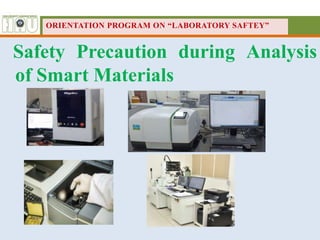
Safety Precaution during Analysis
of Smart Materials
ORIENTATION PROGRAM ON “LABORATORY SAFTEY”
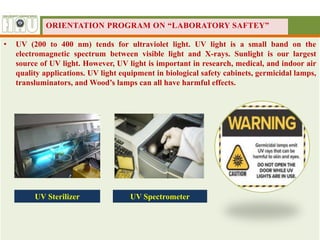
• UV (200 to 400 nm) tends for ultraviolet light. UV light is a small band on the
electromagnetic spectrum between visible light and X-rays. Sunlight is our largest
source of UV light. However, UV light is important in research, medical, and indoor air
quality applications. UV light equipment in biological safety cabinets, germicidal lamps,
transluminators, and Wood’s lamps can all have harmful effects.
UV Sterilizer UV Spectrometer
ORIENTATION PROGRAM ON “LABORATORY SAFTEY”
UV exposure
• Cover up (Wear long pants and long sleeves when
working in the UV)
• Use a sunscreen with a sun protection factor of 15 or
higher
• Wear face shield
• Wear UV protecting glasses that block UV rays:
• Disposal of UV tubes: The tubes from UV sources
contain mercury and therefore require specialist disposal.
Contact the Safety Office for information.
Harmful effect due to UV exposure
 Damage to the skin
 Skin Cancer
 Weaken the immune system
 Eye problems
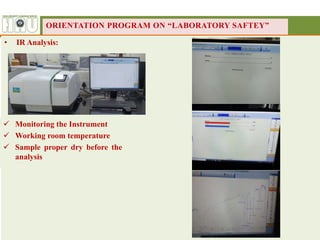
• IR Analysis:
ORIENTATION PROGRAM ON “LABORATORY SAFTEY”
 Monitoring the Instrument
 Working room temperature
 Sample proper dry before the
analysis
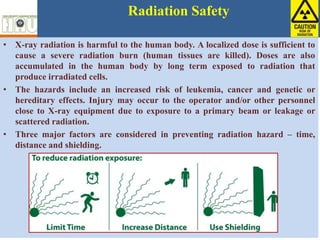
Radiation Safety
• X-ray radiation is harmful to the human body. A localized dose is sufficient to
cause a severe radiation burn (human tissues are killed). Doses are also
accumulated in the human body by long term exposed to radiation that
produce irradiated cells.
• The hazards include an increased risk of leukemia, cancer and genetic or
hereditary effects. Injury may occur to the operator and/or other personnel
close to X-ray equipment due to exposure to a primary beam or leakage or
scattered radiation.
• Three major factors are considered in preventing radiation hazard – time,
distance and shielding.
Radiation Safety
20
Eating, drinking and smoking are not permitted in
laboratory areas where radionuclides in liquid form are
being used or stored.
Wash hands after handling any radioactive material and
before going about any other work.
Never pipette anything by mouth
All cabinets, refrigerators and freezers
which contain radioactive materials shall
be labelled
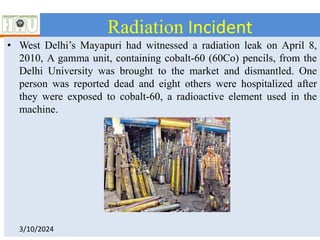
Radiation Incident
• West Delhi’s Mayapuri had witnessed a radiation leak on April 8,
2010, A gamma unit, containing cobalt-60 (60Co) pencils, from the
Delhi University was brought to the market and dismantled. One
person was reported dead and eight others were hospitalized after
they were exposed to cobalt-60, a radioactive element used in the
machine.
3/10/2024
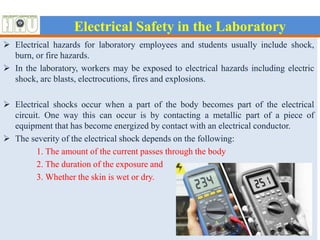
Electrical Safety in the Laboratory
 Electrical hazards for laboratory employees and students usually include shock,
burn, or fire hazards.
 In the laboratory, workers may be exposed to electrical hazards including electric
shock, arc blasts, electrocutions, fires and explosions.
 Electrical shocks occur when a part of the body becomes part of the electrical
circuit. One way this can occur is by contacting a metallic part of a piece of
equipment that has become energized by contact with an electrical conductor.
 The severity of the electrical shock depends on the following:
1. The amount of the current passes through the body
2. The duration of the exposure and
3. Whether the skin is wet or dry.
22
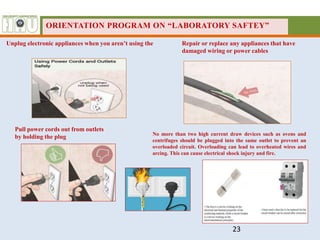
Unplug electronic appliances when you aren’t using the
23
Pull power cords out from outlets
by holding the plug
Repair or replace any appliances that have
damaged wiring or power cables
No more than two high current draw devices such as ovens and
centrifuges should be plugged into the same outlet to prevent an
overloaded circuit. Overloading can lead to overheated wires and
arcing. This can cause electrical shock injury and fire.
ORIENTATION PROGRAM ON “LABORATORY SAFTEY”
The handling of gases
 Leakage of gases may cause rapid contamination of
the atmosphere, giving rise to toxicity, anesthetic
effects, asphyxiation, and rapid formation of
explosive concentrations of flammable gases.
Precautions
 Always wear proper mask
 How to handle the gauge instrument
 Check the leakage of gases with bubbler
Data Security and Transfer
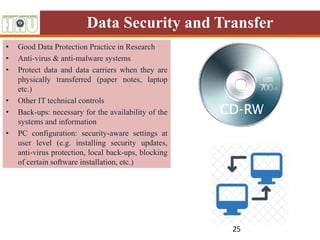
• Good Data Protection Practice in Research
• Anti-virus & anti-malware systems
• Protect data and data carriers when they are
physically transferred (paper notes, laptop
etc.)
• Other IT technical controls
• Back-ups: necessary for the availability of the
systems and information
• PC configuration: security-aware settings at
user level (e.g. installing security updates,
anti-virus protection, local back-ups, blocking
of certain software installation, etc.)
25
Photoluminence Spectrophotometer
Department’s Instruments
Thermal Evaporation Deposition Unit
Dielectric Measurement System Electrochemical Workstation
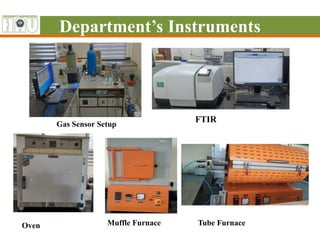
Muffle Furnace
Department’s Instruments
FTIR
Oven
Gas Sensor Setup
Tube Furnace
28
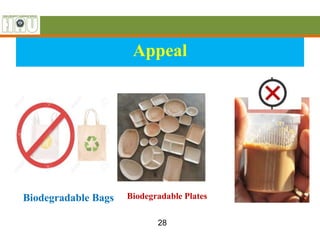
Biodegradable Bags Biodegradable Plates
Appeal
SYMBOL OF TRUST

Lab safety Presentation by Dr Vinay Kumar

  • 1.
    Dr. Vinay Kumar AssistantProfessor Department of Physics COBS&H, CCS HAU, Hisar Electronic Contact; vinay23@hau.ac.in; ORIENTATION PROGRAM ON “LABORATORY SAFTEY” Safety Precaution and handling of smart materials and Instrumentation
  • 2.
    3/10/2024 Research Synthesis & characterization of advancedmaterials Development of Gas Sensors for sensing hazardous gases Super capacitors for energy storage Bio-Sensors Agriculture
  • 3.
    Evolution of Lifeand consequences  As the life evolved society transformed from a rural and agrarian state to an industrialized, secular, urban society according to their problems and requirement.  So, to complete the demands of modernized society, there is a requirements for smart technology or smart materials. Smart technology Evolution of life
  • 4.
    Smart materials • Smartmaterial can be defined as “materials that can change their properties according to the specific stimuli.” In other words, “Materials that can change their shape, density, texture, color, modulus, rigidity, and toughness all on demand in response to specific stimuli.”  Types of Smart material  Shape memory alloy  Piezoelectric  Thermoelectric materials  Thermochromics  Photochromic, etc. Classification of smart materials with respect to specific stimuli
  • 5.
    Nanomaterials as smartmaterials • Specific stimuli agents can be either temperature changes, wavelengths of light, pressure, stress, electric, magnetic field, chemical concentration, etc., while output produced can be color, heat, hyperthermia, magnetic, deformation, etc., • Under the specific stimuli, nano-materials can change their own properties such as changes in size, optical, mechanical properties, surface area, permeability, solubility, shape, among other nanomaterials. (a) various classes of nanomaterials and (b) specific stimulating agents.
  • 6.
    Smart material CharacteristicsApplication 2 D Materials (Graphene Oxide, WS2,MoS2 etc) Semiconducting, high tensile strength, Gas sensor for air quality detection, Bio Sensor, temperature sensor etc MnO2 Non-toxic, easy available and cheaper Supercapacitors, batteries Zinc Oxide Semiconducting, Tunable bandgap High Surface Area Pollutant Degradation Zeolite Non-toxic, easy available and cheaper, high porosity Nano-fertilizers Waste derived material (Activated carbon, biochar, etc.) High Surface Area, tunable porosity, High Carbon Conent Agriculture, Energy Storage Devices, water Purification etc ORIENTATION PROGRAM ON “LABORATORY SAFTEY”
  • 7.
    Synthesis of SmartMaterials 7 Smart Materials Precipitation method Reflux method Sol gel method HT Method ORIENTATION PROGRAM ON “LABORATORY SAFTEY”
  • 8.
    Characterizations of Smartmaterials • X-ray diffraction technique(XRD) • Field Emission Scanning electron microscopy(FE-SEM) • Transmission electron microscopy (TEM) • Fourier transform infrared spectroscopy (FTIR) • UV-Visible spectroscopy (UV-VIS) • BET surface area analysis • Raman Spectroscopy • Photoluminescence • X-ray Photoelectron spectroscopy (XPS) 8 ORIENTATION PROGRAM ON “LABORATORY SAFTEY”
  • 9.
    Safety Precaution During Synthesisof smart material Analysis of synthesized material using Advanced Techniques ORIENTATION PROGRAM ON “LABORATORY SAFTEY”
  • 10.
    10 MnO2 Nanowire ZnS Nanosphere MoS2 Nano-flower MnO2 Nanoneedles Hydrothermal Reactor Safety Measures During Chemical Synthesis Nanomaterials
  • 11.
    11 Precaution for Autoclave Do not operate the autoclave without water. Avoid using hard-water in the unit.  Clean Teflon reaction vessel properly before use to avoid contamination.  Do not put any extra weight on the autoclave.  Close the autoclave caps properly, never try to open it by force without first loosening of primary SS cap with the help of tightening rod.  Clean and Dry the hydrothermal reactor unit after a day uses.  Use Autoclave only for its intended purpose.  Ensure that the pressure gauge is operating correctly.  Make sure the both stainless steel gaskets are in a good Shape & condition.  Clean the surface of the base unit where gasket rests.  Do not lubricate Gasket.
  • 12.
    Sol-Gel Method 12 Safety MeasuresDuring Chemical Synthesis Nanomaterials  Use hand gloves, mask, lab coat properly  The flammable material kept away during the synthesis process
  • 13.
     Know theexisting toxicity information available for your nanomaterial  Preplan the experiments and determine equipment and procedures needed  Prevent Inhalation Exposure during All Handling of Nanomaterials  Biosafety Cabinets  Fume Hood  Ventilation for furnaces and reactors  Ventilation for large equipment or engineering processes  Nanomaterial Transport in the Lab  Prevent Dermal Exposure to Nanomaterials  Use Eye Protection  Be Aware of Possible Fire and Explosion Hazards  Prevent Contamination of Laboratory Surfaces  Spill Cleanup 13 Safety Measures During Chemical Synthesis Nanomaterials
  • 14.
     Never relyon corks, rubber stoppers or plastic tubing as pressure-relief devices.  Glass vacuum desiccators should be made of Pyrex or similar glass and wrapped partially with friction tape to guard against flying glass. Plastic desiccators are a good alternative to glass, but still require shielding.  Never carry or move an evacuated desiccator. Dewar Flasks  Dewar flasks are under vacuum to provide insulation and can collapse from thermal shock or slight mechanical shock.  Shield flasks with friction tape or enclose in a wooden or metal container to reduce the risk of flying glass.  Use metal flasks if there is a significant possibility of breakage.  Styrofoam buckets offer a short-term alternative to dewar flasks. ORIENTATION PROGRAM ON “LABORATORY SAFTEY”
  • 15.
    Safety Precaution duringAnalysis of Smart Materials ORIENTATION PROGRAM ON “LABORATORY SAFTEY”
  • 16.
    • UV (200to 400 nm) tends for ultraviolet light. UV light is a small band on the electromagnetic spectrum between visible light and X-rays. Sunlight is our largest source of UV light. However, UV light is important in research, medical, and indoor air quality applications. UV light equipment in biological safety cabinets, germicidal lamps, transluminators, and Wood’s lamps can all have harmful effects. UV Sterilizer UV Spectrometer ORIENTATION PROGRAM ON “LABORATORY SAFTEY”
  • 17.
    UV exposure • Coverup (Wear long pants and long sleeves when working in the UV) • Use a sunscreen with a sun protection factor of 15 or higher • Wear face shield • Wear UV protecting glasses that block UV rays: • Disposal of UV tubes: The tubes from UV sources contain mercury and therefore require specialist disposal. Contact the Safety Office for information. Harmful effect due to UV exposure  Damage to the skin  Skin Cancer  Weaken the immune system  Eye problems
  • 18.
    • IR Analysis: ORIENTATIONPROGRAM ON “LABORATORY SAFTEY”  Monitoring the Instrument  Working room temperature  Sample proper dry before the analysis
  • 19.
    Radiation Safety • X-rayradiation is harmful to the human body. A localized dose is sufficient to cause a severe radiation burn (human tissues are killed). Doses are also accumulated in the human body by long term exposed to radiation that produce irradiated cells. • The hazards include an increased risk of leukemia, cancer and genetic or hereditary effects. Injury may occur to the operator and/or other personnel close to X-ray equipment due to exposure to a primary beam or leakage or scattered radiation. • Three major factors are considered in preventing radiation hazard – time, distance and shielding.
  • 20.
    Radiation Safety 20 Eating, drinkingand smoking are not permitted in laboratory areas where radionuclides in liquid form are being used or stored. Wash hands after handling any radioactive material and before going about any other work. Never pipette anything by mouth All cabinets, refrigerators and freezers which contain radioactive materials shall be labelled
  • 21.
    Radiation Incident • WestDelhi’s Mayapuri had witnessed a radiation leak on April 8, 2010, A gamma unit, containing cobalt-60 (60Co) pencils, from the Delhi University was brought to the market and dismantled. One person was reported dead and eight others were hospitalized after they were exposed to cobalt-60, a radioactive element used in the machine. 3/10/2024
  • 22.
    Electrical Safety inthe Laboratory  Electrical hazards for laboratory employees and students usually include shock, burn, or fire hazards.  In the laboratory, workers may be exposed to electrical hazards including electric shock, arc blasts, electrocutions, fires and explosions.  Electrical shocks occur when a part of the body becomes part of the electrical circuit. One way this can occur is by contacting a metallic part of a piece of equipment that has become energized by contact with an electrical conductor.  The severity of the electrical shock depends on the following: 1. The amount of the current passes through the body 2. The duration of the exposure and 3. Whether the skin is wet or dry. 22
  • 23.
    Unplug electronic applianceswhen you aren’t using the 23 Pull power cords out from outlets by holding the plug Repair or replace any appliances that have damaged wiring or power cables No more than two high current draw devices such as ovens and centrifuges should be plugged into the same outlet to prevent an overloaded circuit. Overloading can lead to overheated wires and arcing. This can cause electrical shock injury and fire. ORIENTATION PROGRAM ON “LABORATORY SAFTEY”
  • 24.
    The handling ofgases  Leakage of gases may cause rapid contamination of the atmosphere, giving rise to toxicity, anesthetic effects, asphyxiation, and rapid formation of explosive concentrations of flammable gases. Precautions  Always wear proper mask  How to handle the gauge instrument  Check the leakage of gases with bubbler
  • 25.
    Data Security andTransfer • Good Data Protection Practice in Research • Anti-virus & anti-malware systems • Protect data and data carriers when they are physically transferred (paper notes, laptop etc.) • Other IT technical controls • Back-ups: necessary for the availability of the systems and information • PC configuration: security-aware settings at user level (e.g. installing security updates, anti-virus protection, local back-ups, blocking of certain software installation, etc.) 25
  • 26.
    Photoluminence Spectrophotometer Department’s Instruments ThermalEvaporation Deposition Unit Dielectric Measurement System Electrochemical Workstation
  • 27.
  • 28.
  • 29.