Behaviour Management
and Local Anesthesia
Who is more afraid?
• Child
• Dentist
Objectives of treating a
child patient
• Perform the necessary
task
– Efficiently
– Safely
• Instill positive attitude
towards the dental
team and oral habits
How can we do this?
• Pharmacological
techniques
– Sedatives
– General anesthesia
• Non-pharmacologic
– Restraint
– Behaviour
Managment
Behavior Management
Techniques:
• Humour
• Distraction
• Tell Show Do
• Positive reinforcement
• Adverse reinforcement
– Voice Control
– Parental Abscence
IF THE PARENT
IS AFRAID ...
THE CHILD
WILL ALSO BE
AFRAID.
Word Substitute
Shot Pinch, push
Anaesthetic Sleepy water
Drill Cleaner, Tickler
Explorer Tooth counter
Rubber dam Raincoat
Child Psychology
• Many publictions in the psychological
literature on parent-child relationship.
• We can learn 2 major skills:
– Reflective listening
– Using descriptive praise
Communication through
reflective listening:
• 1951, Carl Rogers introduced us to
reflective listening or 'active'
listening as it is referred to today.
• It is the process where you mirror the
emotional communication of the child
through verbal or nonverbal means.
'active' listening
• In a situation where there are
strong emotional overtones
• Unlike adults who are socialized
to conceal their fears of oral
health, children do not.
• As clinicians treating children, we
all too often deny kids their
feelings instead of acknowledging
them.
• Child: “I'm scared”
• Dentist: “there is nothing to be scared of”
• Children feel what they feel. Their feelings
are a fact. Do not deny them this.
• These feelings must be mirrored by the
clinical staff so that they appreciate that
their feelings are being recognized.
• Accepting the child's emotions permits
them to develop the sense that their
feelings are not all that strange.
• Feelings must be addressed before
behavior can be improved.
• Child: “I'm scared”
• Dentist: “I understand. Sometimes
new things are scary. It is okay to be
scared. Sometimes I'm scared of
things I do not understand or have not
done before”
• Reflective listening has the positive
effect of reassuring children that
what they are going through is a
normal part of the human experience.
• It permits children to 'own' their
feelings, thus respecting a child's
autonomy.
• Never argue with what the children
are feeling – don't attempt to convince
them what they are feeling or sensing
is not so.
Reinforcing behavior through
descriptive phrase
• Positive reinforcement as we know is a very
useful tool to promote good behavior
• There are however, appropriate and
inappropriate ways of doing so.
• According to Ginott, “The single most
important rule is that the praise deal only
with the child's efforts and
accomplishments . . . not with their
character and personality”
• All too often, in attempting to gain
children's cooperation, we use phrases such
as “good boy” or “you're a wonderful kid”
• Praise of desirable behaviors is consistent
with the principle of operant conditioning as
outlined by Skinner.
• However, with kids, the child understands
that the clinician is in an evaluative role
relative to their behavior and that the
child's behavior can easily be 'bad' at a
future point in time.
• Such evaluative praise can create a
sense of anxiety in the child over
possible failure in the future.
• Use descriptive praise, where you are
not judging the character of the child
but more their actions.
• Rather than saying “good boy”, say “It
make my job so easy when you hold
still like that, we can work so much
faster as a team”.
Local
Anesthesia . . .
Objectives…
• Local Anaesthetics &
Behaviour Management
– When do you need to use
LA?
– Acceptable language?
– How do you make an
injection less painful?
– Adequate anaesthesia?
– Anaesthetizing a
frightened/ anxious child
Objectives…
• Properties of Common Local
Anaesthetics
– Topical anaesthetics
– Types & duration of anaesthesia
– Calculating the maximum dose of local
anaesthetic
• Complications
– Local
– Systemic
When to use LA?
• Not required for:
– Sealants
– Preventive resin restorations
– Buccal restorations (majority)
– Disking teeth
– Fitting bands or cementing appliances
• Required for:
– Amalgam or composite restorations extending > ¼
of the way into dentin
– Stainless steel crowns
– Pulpotomy / pulpectomy
– Extractions
Never lie to a child . . .
• Need to gain child’s trust
• Side step any questions such as “am I
getting a needle?”
– “Good question, let me count your teeth
first”
• Never surprise a child.
• “Ok now, I’m going to push here . . .”
• use terminology you feel will be better
received by the child -- e.g. “Sleepy juice”
• Let the child know what the anaesthetic
will make their cheek/lip/tongue feel like
– Puffy, soft, tingly, fat, etc…
• AVOID the words hurt, pain, pinch,
mosquito bite, etc…
How to make an injection less painful
• Most important: DISTRACT
• Use topical
• Warm the anesthesia solution, makes a
huge difference
• Infiltrate with 30 gauge, block with 27
gauge
• Shake the cheek
• Inject slowly and smoothly, do not rush
Adequate anaesthesia?
• Ask the child where it feels - numb, tingly,
sleepy, fat, itchy, weird, different – and any
other word you think they might choose to
describe it…
• Have them point to the area that feels
“different”
• Gold standard: induce a painful stimulus in
the area you believe is anaesthetized (e.g.
explorer tip into the gingiva) – watch
eyes/reaction
Anatomic Variations
• Mandible
- Mandibular foramen in children 4 years old and less is
below the plane of occlusion. The foramen moves
superiorly in the ramus with the eruption of 6’s
Adults
Children
Approximate duration of action of Local
Anaesthetics
• Use the shortest acting
local that will allow you
to complete the job
• Soft tissue anesthesia
always longer than
pulpal
• I block with mepivicaine
(no epi) lasts 2-3 hours
• Infiltrate with
lidocaine 3-4 hours
Calculating the maximum dose of
Local Anaesthetic for a child
Maximum Recommended Dose (mg/kg) x Child’s Weight (kg)
Anaesthetic Concentration (mg/ml) x Volume of Carpule (ml)
e.g. The maximum amount of 2% Lidocaine with 1:100,000 epi for a 17
kg child would be:
4.4 mg/kg x 17 kg = 74.8 mg = 2.08 carpules
20 mg/ml x 1.8 ml 36 mg
Rule of thumb – 1 carpule per 20 pounds
Complications - Local
• Masticatory trauma
– Use short acting local
anaesthetics; post-op
instructions
• Needle breakage in soft tissue
– Avoid bending needle; minimize
movement in tissue; don’t
submerge needle to the hub
• Haematomas
• Trismus
• Infections
• Nerve damage from needle
Complications – Systemic
• Allergic Reaction
– Extremely rare with amide anaesthetics
– Methylparaben is a preservative used to
increase the shelf-life of epinephrine
containing anaesthetics – possible allergen
– If the patient/parent is truly worried about
an allergy to local anaesthetic, refer them
to their physician for testing
Local Anaesthetic Toxicity Cont’d
• Minimal to moderate overdose levels:
- Talkativeness, apprehension, excitability, sweating, vomiting,
disorientation, increased blood pressure, heart rate, and
respiratory rate
• Moderate to high overdose levels:
– Tonic-clonic seizure activity followed by generalized CNS
depression, depressed blood pressure, heart rate, and respiratory
rate
– Death.
• Treatment of anaesthetic overdose:
– #1 treatment - prevent it from occurring!
– Mild cases: stop LA, administer O2
– Moderate-severe: activate EMS, administer O2
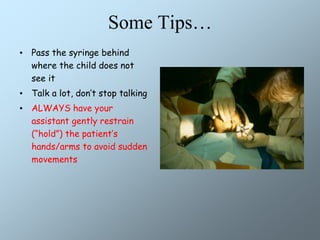
Some Tips…
• Pass the syringe behind
where the child does not
see it
• Talk a lot, don’t stop talking
• ALWAYS have your
assistant gently restrain
(“hold”) the patient’s
hands/arms to avoid sudden
movements
Thank You

LA and behavior management

  • 1.
  • 2.
    Who is moreafraid? • Child • Dentist
  • 3.
    Objectives of treatinga child patient • Perform the necessary task – Efficiently – Safely • Instill positive attitude towards the dental team and oral habits
  • 4.
    How can wedo this? • Pharmacological techniques – Sedatives – General anesthesia • Non-pharmacologic – Restraint – Behaviour Managment
  • 5.
    Behavior Management Techniques: • Humour •Distraction • Tell Show Do • Positive reinforcement • Adverse reinforcement – Voice Control – Parental Abscence
  • 6.
    IF THE PARENT ISAFRAID ... THE CHILD WILL ALSO BE AFRAID.
  • 7.
    Word Substitute Shot Pinch,push Anaesthetic Sleepy water Drill Cleaner, Tickler Explorer Tooth counter Rubber dam Raincoat
  • 8.
    Child Psychology • Manypublictions in the psychological literature on parent-child relationship. • We can learn 2 major skills: – Reflective listening – Using descriptive praise
  • 9.
    Communication through reflective listening: •1951, Carl Rogers introduced us to reflective listening or 'active' listening as it is referred to today. • It is the process where you mirror the emotional communication of the child through verbal or nonverbal means.
  • 10.
    'active' listening • Ina situation where there are strong emotional overtones • Unlike adults who are socialized to conceal their fears of oral health, children do not. • As clinicians treating children, we all too often deny kids their feelings instead of acknowledging them.
  • 11.
    • Child: “I'mscared” • Dentist: “there is nothing to be scared of” • Children feel what they feel. Their feelings are a fact. Do not deny them this. • These feelings must be mirrored by the clinical staff so that they appreciate that their feelings are being recognized. • Accepting the child's emotions permits them to develop the sense that their feelings are not all that strange.
  • 12.
    • Feelings mustbe addressed before behavior can be improved. • Child: “I'm scared” • Dentist: “I understand. Sometimes new things are scary. It is okay to be scared. Sometimes I'm scared of things I do not understand or have not done before”
  • 13.
    • Reflective listeninghas the positive effect of reassuring children that what they are going through is a normal part of the human experience. • It permits children to 'own' their feelings, thus respecting a child's autonomy. • Never argue with what the children are feeling – don't attempt to convince them what they are feeling or sensing is not so.
  • 14.
    Reinforcing behavior through descriptivephrase • Positive reinforcement as we know is a very useful tool to promote good behavior • There are however, appropriate and inappropriate ways of doing so. • According to Ginott, “The single most important rule is that the praise deal only with the child's efforts and accomplishments . . . not with their character and personality”
  • 15.
    • All toooften, in attempting to gain children's cooperation, we use phrases such as “good boy” or “you're a wonderful kid” • Praise of desirable behaviors is consistent with the principle of operant conditioning as outlined by Skinner. • However, with kids, the child understands that the clinician is in an evaluative role relative to their behavior and that the child's behavior can easily be 'bad' at a future point in time.
  • 16.
    • Such evaluativepraise can create a sense of anxiety in the child over possible failure in the future. • Use descriptive praise, where you are not judging the character of the child but more their actions. • Rather than saying “good boy”, say “It make my job so easy when you hold still like that, we can work so much faster as a team”.
  • 17.
  • 18.
    Objectives… • Local Anaesthetics& Behaviour Management – When do you need to use LA? – Acceptable language? – How do you make an injection less painful? – Adequate anaesthesia? – Anaesthetizing a frightened/ anxious child
  • 19.
    Objectives… • Properties ofCommon Local Anaesthetics – Topical anaesthetics – Types & duration of anaesthesia – Calculating the maximum dose of local anaesthetic • Complications – Local – Systemic
  • 20.
    When to useLA? • Not required for: – Sealants – Preventive resin restorations – Buccal restorations (majority) – Disking teeth – Fitting bands or cementing appliances • Required for: – Amalgam or composite restorations extending > ¼ of the way into dentin – Stainless steel crowns – Pulpotomy / pulpectomy – Extractions
  • 21.
    Never lie toa child . . . • Need to gain child’s trust • Side step any questions such as “am I getting a needle?” – “Good question, let me count your teeth first” • Never surprise a child. • “Ok now, I’m going to push here . . .”
  • 22.
    • use terminologyyou feel will be better received by the child -- e.g. “Sleepy juice” • Let the child know what the anaesthetic will make their cheek/lip/tongue feel like – Puffy, soft, tingly, fat, etc… • AVOID the words hurt, pain, pinch, mosquito bite, etc…
  • 23.
    How to makean injection less painful • Most important: DISTRACT • Use topical • Warm the anesthesia solution, makes a huge difference • Infiltrate with 30 gauge, block with 27 gauge • Shake the cheek • Inject slowly and smoothly, do not rush
  • 24.
    Adequate anaesthesia? • Askthe child where it feels - numb, tingly, sleepy, fat, itchy, weird, different – and any other word you think they might choose to describe it… • Have them point to the area that feels “different” • Gold standard: induce a painful stimulus in the area you believe is anaesthetized (e.g. explorer tip into the gingiva) – watch eyes/reaction
  • 25.
    Anatomic Variations • Mandible -Mandibular foramen in children 4 years old and less is below the plane of occlusion. The foramen moves superiorly in the ramus with the eruption of 6’s Adults Children
  • 26.
    Approximate duration ofaction of Local Anaesthetics • Use the shortest acting local that will allow you to complete the job • Soft tissue anesthesia always longer than pulpal • I block with mepivicaine (no epi) lasts 2-3 hours • Infiltrate with lidocaine 3-4 hours
  • 27.
    Calculating the maximumdose of Local Anaesthetic for a child Maximum Recommended Dose (mg/kg) x Child’s Weight (kg) Anaesthetic Concentration (mg/ml) x Volume of Carpule (ml) e.g. The maximum amount of 2% Lidocaine with 1:100,000 epi for a 17 kg child would be: 4.4 mg/kg x 17 kg = 74.8 mg = 2.08 carpules 20 mg/ml x 1.8 ml 36 mg Rule of thumb – 1 carpule per 20 pounds
  • 28.
    Complications - Local •Masticatory trauma – Use short acting local anaesthetics; post-op instructions • Needle breakage in soft tissue – Avoid bending needle; minimize movement in tissue; don’t submerge needle to the hub • Haematomas • Trismus • Infections • Nerve damage from needle
  • 29.
    Complications – Systemic •Allergic Reaction – Extremely rare with amide anaesthetics – Methylparaben is a preservative used to increase the shelf-life of epinephrine containing anaesthetics – possible allergen – If the patient/parent is truly worried about an allergy to local anaesthetic, refer them to their physician for testing
  • 30.
    Local Anaesthetic ToxicityCont’d • Minimal to moderate overdose levels: - Talkativeness, apprehension, excitability, sweating, vomiting, disorientation, increased blood pressure, heart rate, and respiratory rate • Moderate to high overdose levels: – Tonic-clonic seizure activity followed by generalized CNS depression, depressed blood pressure, heart rate, and respiratory rate – Death. • Treatment of anaesthetic overdose: – #1 treatment - prevent it from occurring! – Mild cases: stop LA, administer O2 – Moderate-severe: activate EMS, administer O2
  • 31.
    Some Tips… • Passthe syringe behind where the child does not see it • Talk a lot, don’t stop talking • ALWAYS have your assistant gently restrain (“hold”) the patient’s hands/arms to avoid sudden movements
  • 32.

Editor's Notes

  • #29 Masticatory trauma – explain risks of lip/cheek/tongue biting to child and caregiver; avoid eating until anaesthetic wears off; have child close on a cotton roll as a reminder Haematomas, trismus, infections, and nerve damage from the needle are “luck of the draw” – not preventable by dentist…