Local Anesthesia in Pediatric
Dentistry
By:
Khalid Khater – Kholoud Mamdouh – Hoda Hambouta
Introduction
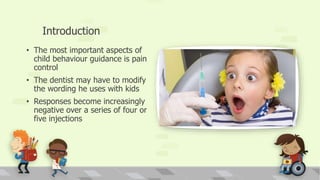
• The most important aspects of
child behaviour guidance is pain
control
• The dentist may have to modify
the wording he uses with kids
• Responses become increasingly
negative over a series of four or
five injections
Outline:
• Pain management
during injection
• Block VS Infiltration
• Anatomical Differences
• Position
• Dosage
• Complications
• Recent
Articles
Anatomical Differences
Maxillary
Mandibular
Anatomical Differences
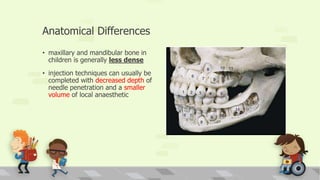
• maxillary and mandibular bone in
children is generally less dense
• injection techniques can usually be
completed with decreased depth of
needle penetration and a smaller
volume of local anaesthetic
Anatomical Differences
(Maxillary):
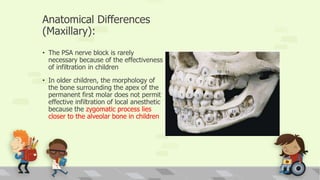
• The PSA nerve block is rarely
necessary because of the effectiveness
of infiltration in children
• In older children, the morphology of
the bone surrounding the apex of the
permanent first molar does not permit
effective infiltration of local anesthetic
because the zygomatic process lies
closer to the alveolar bone in children
Anatomical Differences
(Maxillary):
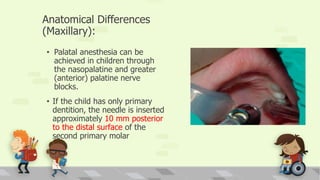
• Palatal anesthesia can be
achieved in children through
the nasopalatine and greater
(anterior) palatine nerve
blocks.
• If the child has only primary
dentition, the needle is inserted
approximately 10 mm posterior
to the distal surface of the
second primary molar
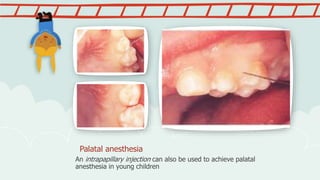
Palatal anesthesia
An intrapapillary injection can also be used to achieve palatal
anesthesia in young children
Anatomical Differences
(Mandibular)
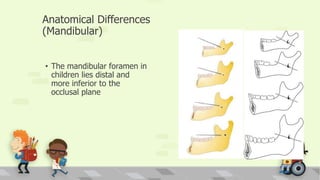
• The mandibular foramen in
children lies distal and
more inferior to the
occlusal plane
Anatomical Differences
(Mandibular)
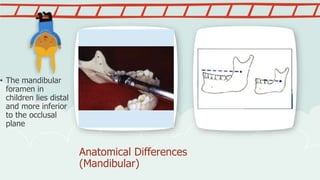
• The mandibular
foramen in
children lies distal
and more inferior
to the occlusal
plane
Anatomical Differences
(Mandibular)
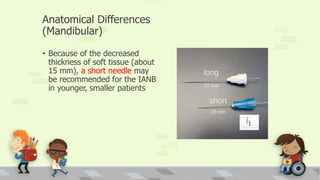
• Because of the decreased
thickness of soft tissue (about
15 mm), a short needle may
be recommended for the IANB
in younger, smaller patients
Anatomical Differences
(Mandibular)
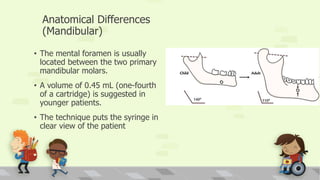
• The mental foramen is usually
located between the two primary
mandibular molars.
• A volume of 0.45 mL (one-fourth
of a cartridge) is suggested in
younger patients.
• The technique puts the syringe in
clear view of the patient
Position
Chair
Assistant
Dentist
Position
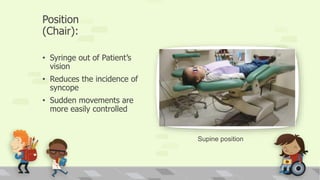
(Chair):
• Syringe out of Patient’s
vision
• Reduces the incidence of
syncope
• Sudden movements are
more easily controlled
Supine position
Position
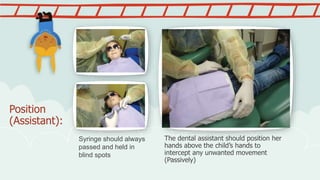
(Assistant):
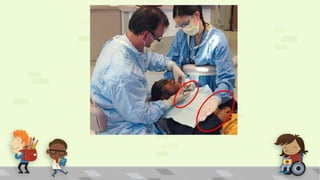
The dental assistant should position her
hands above the child’s hands to
intercept any unwanted movement
(Passively)
Syringe should always
passed and held in
blind spots
Position
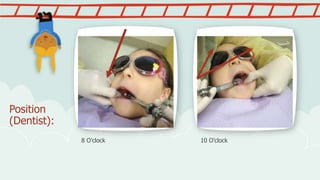
(Dentist):
8 O’clock 10 O’clock
Ways of minimizing the pain
during injection
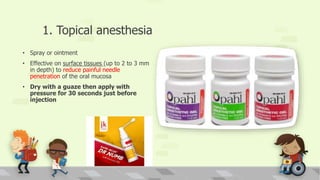
1. Topical anesthesia
• Spray or ointment
• Effective on surface tissues (up to 2 to 3 mm
in depth) to reduce painful needle
penetration of the oral mucosa
• Dry with a guaze then apply with
pressure for 30 seconds just before
injection
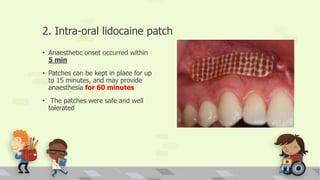
2. Intra-oral lidocaine patch
• Anaesthetic onset occurred within
5 min
• Patches can be kept in place for up
to 15 minutes, and may provide
anaesthesia for 60 minutes
• The patches were safe and well
tolerated
3. Cryo-anaesthesia
• Pre-cooled Anaesthetic gel’s temperature was maintained using a standard
drug refrigerator at 4°C
• Help control pain by inducing local anesthesia around the treatment area
• Have also shown that it decreases edema and local blood flow.
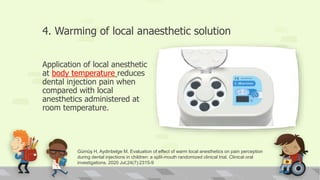
4. Warming of local anaesthetic solution
Application of local anesthetic
at body temperature reduces
dental injection pain when
compared with local
anesthetics administered at
room temperature.
Gümüş H, Aydinbelge M. Evaluation of effect of warm local anesthetics on pain perception
during dental injections in children: a split-mouth randomized clinical trial. Clinical oral
investigations. 2020 Jul;24(7):2315-9
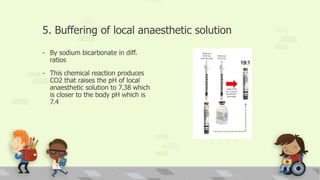
5. Buffering of local anaesthetic solution
- By sodium bicarbonate in diff.
ratios
- This chemical reaction produces
CO2 that raises the pH of local
anaesthetic solution to 7.38 which
is closer to the body pH which is
7.4
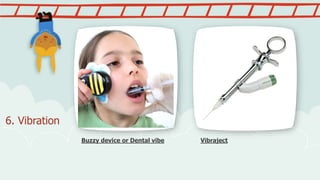
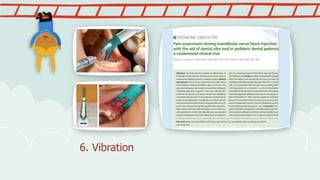
6. Vibration
Buzzy device or Dental vibe Vibraject
6. Vibration
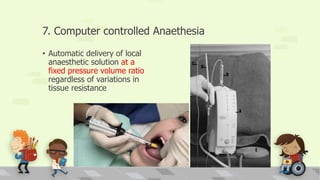
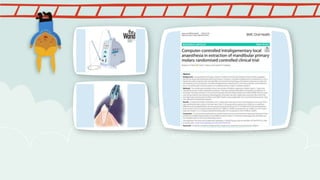
7. Computer controlled Anaethesia
• Automatic delivery of local
anaesthetic solution at a
fixed pressure volume ratio
regardless of variations in
tissue resistance
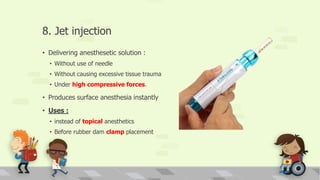
8. Jet injection
• Delivering anesthesetic solution :
• Without use of needle
• Without causing excessive tissue trauma
• Under high compressive forces.
• Produces surface anesthesia instantly
• Uses :
• instead of topical anesthetics
• Before rubber dam clamp placement
Nerve block VS Infiltration
In mandibular anesthesia in
pediatric dentistry
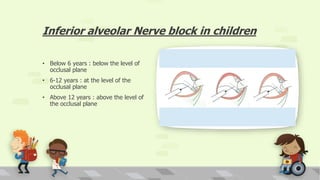
Inferior alveolar Nerve block in children
• Below 6 years : below the level of
occlusal plane
• 6-12 years : at the level of the
occlusal plane
• Above 12 years : above the level of
the occlusal plane
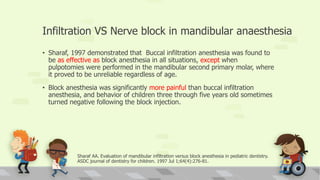
Infiltration VS Nerve block in mandibular anaesthesia
• Sharaf, 1997 demonstrated that Buccal infiltration anesthesia was found to
be as effective as block anesthesia in all situations, except when
pulpotomies were performed in the mandibular second primary molar, where
it proved to be unreliable regardless of age.
• Block anesthesia was significantly more painful than buccal infiltration
anesthesia, and behavior of children three through five years old sometimes
turned negative following the block injection.
Sharaf AA. Evaluation of mandibular infiltration versus block anesthesia in pediatric dentistry.
ASDC journal of dentistry for children. 1997 Jul 1;64(4):276-81.
Dosage
Dosage
The maximum safe
dosage of local
anesthetics, whether
topical or injected, is
generally increased when
used in combination with
a vasoconstrictor.
Vasoconstrictor
Constrict blood
vessels
Allow the
maximum total
dose of the
anesthetic agent to
be increased
Provide a
bloodless field for
surgical
procedures
Counteract the
vasodilatory
effects of the local
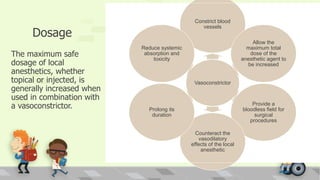
anesthetic
Prolong its
duration
Reduce systemic
absorption and
toxicity
Dosage
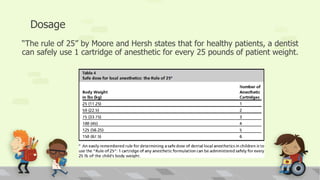
“The rule of 25” by Moore and Hersh states that for healthy patients, a dentist
can safely use 1 cartridge of anesthetic for every 25 pounds of patient weight.
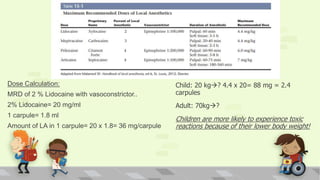
Child: 20 kg? 4.4 x 20= 88 mg = 2.4
carpules
Adult: 70kg?
Children are more likely to experience toxic
reactions because of their lower body weight!
Dose Calculation:
MRD of 2 % Lidocaine with vasoconstrictor..
2% Lidocaine= 20 mg/ml
1 carpule= 1.8 ml
Amount of LA in 1 carpule= 20 x 1.8= 36 mg/carpule
Complications
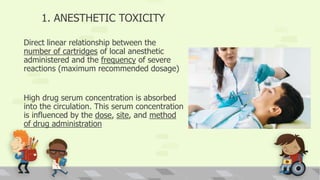
Direct linear relationship between the
number of cartridges of local anesthetic
administered and the frequency of severe
reactions (maximum recommended dosage)
High drug serum concentration is absorbed
into the circulation. This serum concentration
is influenced by the dose, site, and method
of drug administration
1. ANESTHETIC TOXICITY
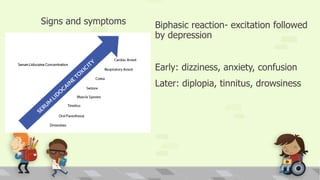
Signs and symptoms Biphasic reaction- excitation followed
by depression
Early: dizziness, anxiety, confusion
Later: diplopia, tinnitus, drowsiness
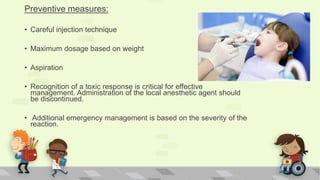
Preventive measures:
• Careful injection technique
• Maximum dosage based on weight
• Aspiration
• Recognition of a toxic response is critical for effective
management. Administration of the local anesthetic agent should
be discontinued.
• Additional emergency management is based on the severity of the
reaction.
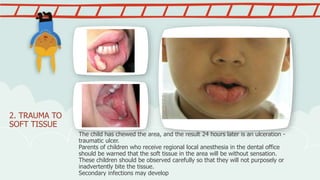
2. TRAUMA TO
SOFT TISSUE
The child has chewed the area, and the result 24 hours later is an ulceration -
traumatic ulcer.
Parents of children who receive regional local anesthesia in the dental office
should be warned that the soft tissue in the area will be without sensation.
These children should be observed carefully so that they will not purposely or
inadvertently bite the tissue.
Secondary infections may develop
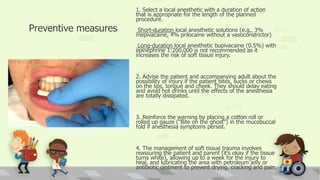
Preventive measures
1. Select a local anesthetic with a duration of action
that is appropriate for the length of the planned
procedure.
Short-duration local anesthetic solutions (e.g., 3%
mepivacaine, 4% prilocaine without a vasoconstrictor)
Long-duration local anesthetic bupivacaine (0.5%) with
epinephrine 1:200,000 is not recommended as it
increases the risk of soft tissue injury.
2. Advise the patient and accompanying adult about the
possibility of injury if the patient bites, sucks or chews
on the lips, tongue and cheek. They should delay eating
and avoid hot drinks until the effects of the anesthesia
are totally dissipated.
3. Reinforce the warning by placing a cotton roll or
rolled up gauze (“Bite on the ghost”) in the mucobuccal
fold if anesthesia symptoms persist.
4. The management of soft tissue trauma involves
reassuring the patient and parent (it’s okay if the tissue
turns white), allowing up to a week for the injury to
heal, and lubricating the area with petroleum jelly or
antibiotic ointment to prevent drying, cracking and pain.
REVERSAL OF DENTAL
ANESTHESIA
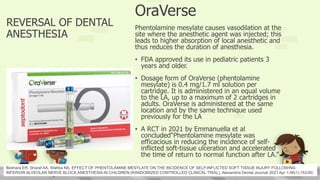
OraVerse
Phentolamine mesylate causes vasodilation at the
site where the anesthetic agent was injected; this
leads to higher absorption of local anesthetic and
thus reduces the duration of anesthesia.
• FDA approved its use in pediatric patients 3
years and older.
• Dosage form of OraVerse (phentolamine
mesylate) is 0.4 mg/1.7 ml solution per
cartridge. It is administered in an equal volume
to the LA, up to a maximum of 2 cartridges in
adults. OraVerse is administered at the same
location and by the same technique used
previously for the LA
• A RCT in 2021 by Emmanuella et al
concluded“Phentolamine mesylate was
efficacious in reducing the incidence of self-
inflicted soft-tissue ulceration and accelerated
the time of return to normal function after LA.”
Beshara ER, Sharaf AA, Wahba NA. EFFECT OF PHENTOLAMINE MESYLATE ON THE INCIDENCE OF SELF-INFLICTED SOFT TISSUE INJURY FOLLOWING
INFERIOR ALVEOLAR NERVE BLOCK ANESTHESIA IN CHILDREN:(RANDOMIZED CONTROLLED CLINICAL TRIAL). Alexandria Dental Journal.2021 Apr 1;46(1):153-60.
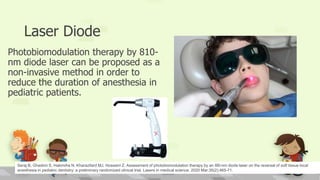
Laser Diode
Photobiomodulation therapy by 810-
nm diode laser can be proposed as a
non-invasive method in order to
reduce the duration of anesthesia in
pediatric patients.
Seraj B, Ghadimi S, Hakimiha N, Kharazifard MJ, Hosseini Z. Assessment of photobiomodulation therapy by an 8l0-nm diode laser on the reversal of soft tissue local
anesthesia in pediatric dentistry: a preliminary randomized clinical trial. Lasers in medical science. 2020 Mar;35(2):465-71.
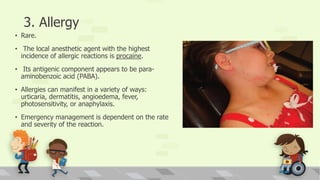
3. Allergy
• Rare.
• The local anesthetic agent with the highest
incidence of allergic reactions is procaine.
• Its antigenic component appears to be para-
aminobenzoic acid (PABA).
• Allergies can manifest in a variety of ways:
urticaria, dermatitis, angioedema, fever,
photosensitivity, or anaphylaxis.
• Emergency management is dependent on the rate
and severity of the reaction.
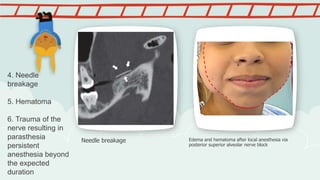
Needle breakage Edema and hematoma after local anesthesia via
posterior superior alveolar nerve block
4. Needle
breakage
5. Hematoma
6. Trauma of the
nerve resulting in
parasthesia
persistent
anesthesia beyond
the expected
duration
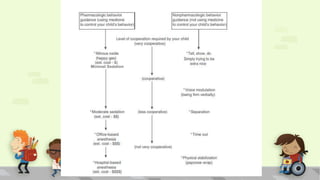
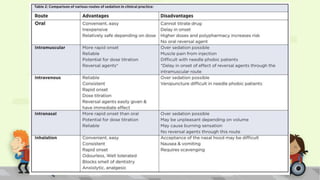
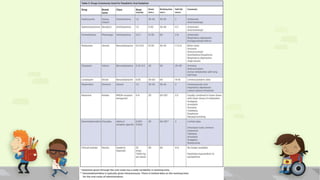
Pain Management
Local anesthesia
Non-
pharmacological
approach
Pharmacological
approach
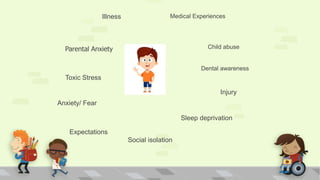
Each child is unique and exists in the context of his family.
Parental Anxiety
Toxic Stress
Medical Experiences
Child abuse
Dental awareness
Anxiety/ Fear
Sleep deprivation
Injury
Illness
Expectations
Social isolation
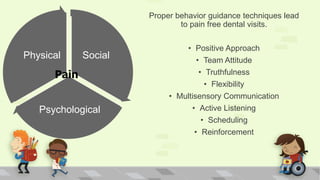
Social
Psychological
Physical
Pain
Proper behavior guidance techniques lead
to pain free dental visits.
• Positive Approach
• Team Attitude
• Truthfulness
• Flexibility
• Multisensory Communication
• Active Listening
• Scheduling
• Reinforcement
Minimal Sedation
Thank You !

local anesthesiainpediatricdentistry.ppt

  • 1.
    Local Anesthesia inPediatric Dentistry By: Khalid Khater – Kholoud Mamdouh – Hoda Hambouta
  • 2.
    Introduction • The mostimportant aspects of child behaviour guidance is pain control • The dentist may have to modify the wording he uses with kids • Responses become increasingly negative over a series of four or five injections
  • 3.
    Outline: • Pain management duringinjection • Block VS Infiltration • Anatomical Differences • Position • Dosage • Complications • Recent Articles
  • 4.
  • 5.
    Anatomical Differences • maxillaryand mandibular bone in children is generally less dense • injection techniques can usually be completed with decreased depth of needle penetration and a smaller volume of local anaesthetic
  • 6.
    Anatomical Differences (Maxillary): • ThePSA nerve block is rarely necessary because of the effectiveness of infiltration in children • In older children, the morphology of the bone surrounding the apex of the permanent first molar does not permit effective infiltration of local anesthetic because the zygomatic process lies closer to the alveolar bone in children
  • 7.
    Anatomical Differences (Maxillary): • Palatalanesthesia can be achieved in children through the nasopalatine and greater (anterior) palatine nerve blocks. • If the child has only primary dentition, the needle is inserted approximately 10 mm posterior to the distal surface of the second primary molar
  • 8.
    Palatal anesthesia An intrapapillaryinjection can also be used to achieve palatal anesthesia in young children
  • 9.
    Anatomical Differences (Mandibular) • Themandibular foramen in children lies distal and more inferior to the occlusal plane
  • 10.
    Anatomical Differences (Mandibular) • Themandibular foramen in children lies distal and more inferior to the occlusal plane
  • 11.
    Anatomical Differences (Mandibular) • Becauseof the decreased thickness of soft tissue (about 15 mm), a short needle may be recommended for the IANB in younger, smaller patients
  • 12.
    Anatomical Differences (Mandibular) • Themental foramen is usually located between the two primary mandibular molars. • A volume of 0.45 mL (one-fourth of a cartridge) is suggested in younger patients. • The technique puts the syringe in clear view of the patient
  • 13.
  • 14.
    Position (Chair): • Syringe outof Patient’s vision • Reduces the incidence of syncope • Sudden movements are more easily controlled Supine position
  • 15.
    Position (Assistant): The dental assistantshould position her hands above the child’s hands to intercept any unwanted movement (Passively) Syringe should always passed and held in blind spots
  • 17.
  • 18.
    Ways of minimizingthe pain during injection
  • 19.
    1. Topical anesthesia •Spray or ointment • Effective on surface tissues (up to 2 to 3 mm in depth) to reduce painful needle penetration of the oral mucosa • Dry with a guaze then apply with pressure for 30 seconds just before injection
  • 20.
    2. Intra-oral lidocainepatch • Anaesthetic onset occurred within 5 min • Patches can be kept in place for up to 15 minutes, and may provide anaesthesia for 60 minutes • The patches were safe and well tolerated
  • 21.
    3. Cryo-anaesthesia • Pre-cooledAnaesthetic gel’s temperature was maintained using a standard drug refrigerator at 4°C • Help control pain by inducing local anesthesia around the treatment area • Have also shown that it decreases edema and local blood flow.
  • 22.
    4. Warming oflocal anaesthetic solution Application of local anesthetic at body temperature reduces dental injection pain when compared with local anesthetics administered at room temperature. Gümüş H, Aydinbelge M. Evaluation of effect of warm local anesthetics on pain perception during dental injections in children: a split-mouth randomized clinical trial. Clinical oral investigations. 2020 Jul;24(7):2315-9
  • 23.
    5. Buffering oflocal anaesthetic solution - By sodium bicarbonate in diff. ratios - This chemical reaction produces CO2 that raises the pH of local anaesthetic solution to 7.38 which is closer to the body pH which is 7.4
  • 24.
    6. Vibration Buzzy deviceor Dental vibe Vibraject
  • 25.
  • 26.
    7. Computer controlledAnaethesia • Automatic delivery of local anaesthetic solution at a fixed pressure volume ratio regardless of variations in tissue resistance
  • 28.
    8. Jet injection •Delivering anesthesetic solution : • Without use of needle • Without causing excessive tissue trauma • Under high compressive forces. • Produces surface anesthesia instantly • Uses : • instead of topical anesthetics • Before rubber dam clamp placement
  • 29.
    Nerve block VSInfiltration In mandibular anesthesia in pediatric dentistry
  • 30.
    Inferior alveolar Nerveblock in children • Below 6 years : below the level of occlusal plane • 6-12 years : at the level of the occlusal plane • Above 12 years : above the level of the occlusal plane
  • 31.
    Infiltration VS Nerveblock in mandibular anaesthesia • Sharaf, 1997 demonstrated that Buccal infiltration anesthesia was found to be as effective as block anesthesia in all situations, except when pulpotomies were performed in the mandibular second primary molar, where it proved to be unreliable regardless of age. • Block anesthesia was significantly more painful than buccal infiltration anesthesia, and behavior of children three through five years old sometimes turned negative following the block injection. Sharaf AA. Evaluation of mandibular infiltration versus block anesthesia in pediatric dentistry. ASDC journal of dentistry for children. 1997 Jul 1;64(4):276-81.
  • 32.
  • 33.
    Dosage The maximum safe dosageof local anesthetics, whether topical or injected, is generally increased when used in combination with a vasoconstrictor. Vasoconstrictor Constrict blood vessels Allow the maximum total dose of the anesthetic agent to be increased Provide a bloodless field for surgical procedures Counteract the vasodilatory effects of the local anesthetic Prolong its duration Reduce systemic absorption and toxicity
  • 34.
    Dosage “The rule of25” by Moore and Hersh states that for healthy patients, a dentist can safely use 1 cartridge of anesthetic for every 25 pounds of patient weight.
  • 35.
    Child: 20 kg?4.4 x 20= 88 mg = 2.4 carpules Adult: 70kg? Children are more likely to experience toxic reactions because of their lower body weight! Dose Calculation: MRD of 2 % Lidocaine with vasoconstrictor.. 2% Lidocaine= 20 mg/ml 1 carpule= 1.8 ml Amount of LA in 1 carpule= 20 x 1.8= 36 mg/carpule
  • 36.
  • 37.
    Direct linear relationshipbetween the number of cartridges of local anesthetic administered and the frequency of severe reactions (maximum recommended dosage) High drug serum concentration is absorbed into the circulation. This serum concentration is influenced by the dose, site, and method of drug administration 1. ANESTHETIC TOXICITY
  • 38.
    Signs and symptomsBiphasic reaction- excitation followed by depression Early: dizziness, anxiety, confusion Later: diplopia, tinnitus, drowsiness
  • 39.
    Preventive measures: • Carefulinjection technique • Maximum dosage based on weight • Aspiration • Recognition of a toxic response is critical for effective management. Administration of the local anesthetic agent should be discontinued. • Additional emergency management is based on the severity of the reaction.
  • 40.
    2. TRAUMA TO SOFTTISSUE The child has chewed the area, and the result 24 hours later is an ulceration - traumatic ulcer. Parents of children who receive regional local anesthesia in the dental office should be warned that the soft tissue in the area will be without sensation. These children should be observed carefully so that they will not purposely or inadvertently bite the tissue. Secondary infections may develop
  • 41.
    Preventive measures 1. Selecta local anesthetic with a duration of action that is appropriate for the length of the planned procedure. Short-duration local anesthetic solutions (e.g., 3% mepivacaine, 4% prilocaine without a vasoconstrictor) Long-duration local anesthetic bupivacaine (0.5%) with epinephrine 1:200,000 is not recommended as it increases the risk of soft tissue injury. 2. Advise the patient and accompanying adult about the possibility of injury if the patient bites, sucks or chews on the lips, tongue and cheek. They should delay eating and avoid hot drinks until the effects of the anesthesia are totally dissipated. 3. Reinforce the warning by placing a cotton roll or rolled up gauze (“Bite on the ghost”) in the mucobuccal fold if anesthesia symptoms persist. 4. The management of soft tissue trauma involves reassuring the patient and parent (it’s okay if the tissue turns white), allowing up to a week for the injury to heal, and lubricating the area with petroleum jelly or antibiotic ointment to prevent drying, cracking and pain.
  • 42.
    REVERSAL OF DENTAL ANESTHESIA OraVerse Phentolaminemesylate causes vasodilation at the site where the anesthetic agent was injected; this leads to higher absorption of local anesthetic and thus reduces the duration of anesthesia. • FDA approved its use in pediatric patients 3 years and older. • Dosage form of OraVerse (phentolamine mesylate) is 0.4 mg/1.7 ml solution per cartridge. It is administered in an equal volume to the LA, up to a maximum of 2 cartridges in adults. OraVerse is administered at the same location and by the same technique used previously for the LA • A RCT in 2021 by Emmanuella et al concluded“Phentolamine mesylate was efficacious in reducing the incidence of self- inflicted soft-tissue ulceration and accelerated the time of return to normal function after LA.” Beshara ER, Sharaf AA, Wahba NA. EFFECT OF PHENTOLAMINE MESYLATE ON THE INCIDENCE OF SELF-INFLICTED SOFT TISSUE INJURY FOLLOWING INFERIOR ALVEOLAR NERVE BLOCK ANESTHESIA IN CHILDREN:(RANDOMIZED CONTROLLED CLINICAL TRIAL). Alexandria Dental Journal.2021 Apr 1;46(1):153-60.
  • 43.
    Laser Diode Photobiomodulation therapyby 810- nm diode laser can be proposed as a non-invasive method in order to reduce the duration of anesthesia in pediatric patients. Seraj B, Ghadimi S, Hakimiha N, Kharazifard MJ, Hosseini Z. Assessment of photobiomodulation therapy by an 8l0-nm diode laser on the reversal of soft tissue local anesthesia in pediatric dentistry: a preliminary randomized clinical trial. Lasers in medical science. 2020 Mar;35(2):465-71.
  • 44.
    3. Allergy • Rare. •The local anesthetic agent with the highest incidence of allergic reactions is procaine. • Its antigenic component appears to be para- aminobenzoic acid (PABA). • Allergies can manifest in a variety of ways: urticaria, dermatitis, angioedema, fever, photosensitivity, or anaphylaxis. • Emergency management is dependent on the rate and severity of the reaction.
  • 45.
    Needle breakage Edemaand hematoma after local anesthesia via posterior superior alveolar nerve block 4. Needle breakage 5. Hematoma 6. Trauma of the nerve resulting in parasthesia persistent anesthesia beyond the expected duration
  • 46.
  • 47.
    Each child isunique and exists in the context of his family.
  • 48.
    Parental Anxiety Toxic Stress MedicalExperiences Child abuse Dental awareness Anxiety/ Fear Sleep deprivation Injury Illness Expectations Social isolation
  • 49.
    Social Psychological Physical Pain Proper behavior guidancetechniques lead to pain free dental visits. • Positive Approach • Team Attitude • Truthfulness • Flexibility • Multisensory Communication • Active Listening • Scheduling • Reinforcement
  • 50.
  • 53.

Editor's Notes

  • #4 ملاحظة: لتغيير الصور على هذه الشريحة، حدد صورة واحذفها. ثم انقر فوق الأيقونة "إدراج صورة" في العنصر النائب لإدراج الصورة الخاصة بك.