The Circulatory System Homework:  Research and make half a page notes: how blood carries oxygen, how it transport glucose/food, and how blood helps fight against diseases .  Due by  Monday!!
Recap of last lesson In your books answer the following questions: Name three muscles that are working when throwing a cricket ball. Name the three types of muscles working in your body. Define the term prime movers/agonists. The o____ is where the muscle joins the stationary bone, e.g. the bicep is attached to the s_______.
What are you going to learn? The functions of the heart The movement of blood through the heart How the heart works The path of the circulatory system
Function of the heart The heart works for 24 hrs a day It carries  food & oxygen  to your body  cells Carries  carbon dioxide  & other  waste products away
 
Deoxygenated  blood at the heart Blood travels  to the lungs  via the  pulmonary artery Gaseous exchange  occurs in the lungs _______ travels back to the heart via the  pulmonary vein The  left ventricle  pumps the _______ blood to the body cells Gaseous exchange occurs in the body cells _________ blood returns to the heart (the cycle then repeats itself).
Draw and label septum http://www.bbc.co.uk/schools/gcsebitesize/biology/humansasorganisms/1circulationrev2.shtml
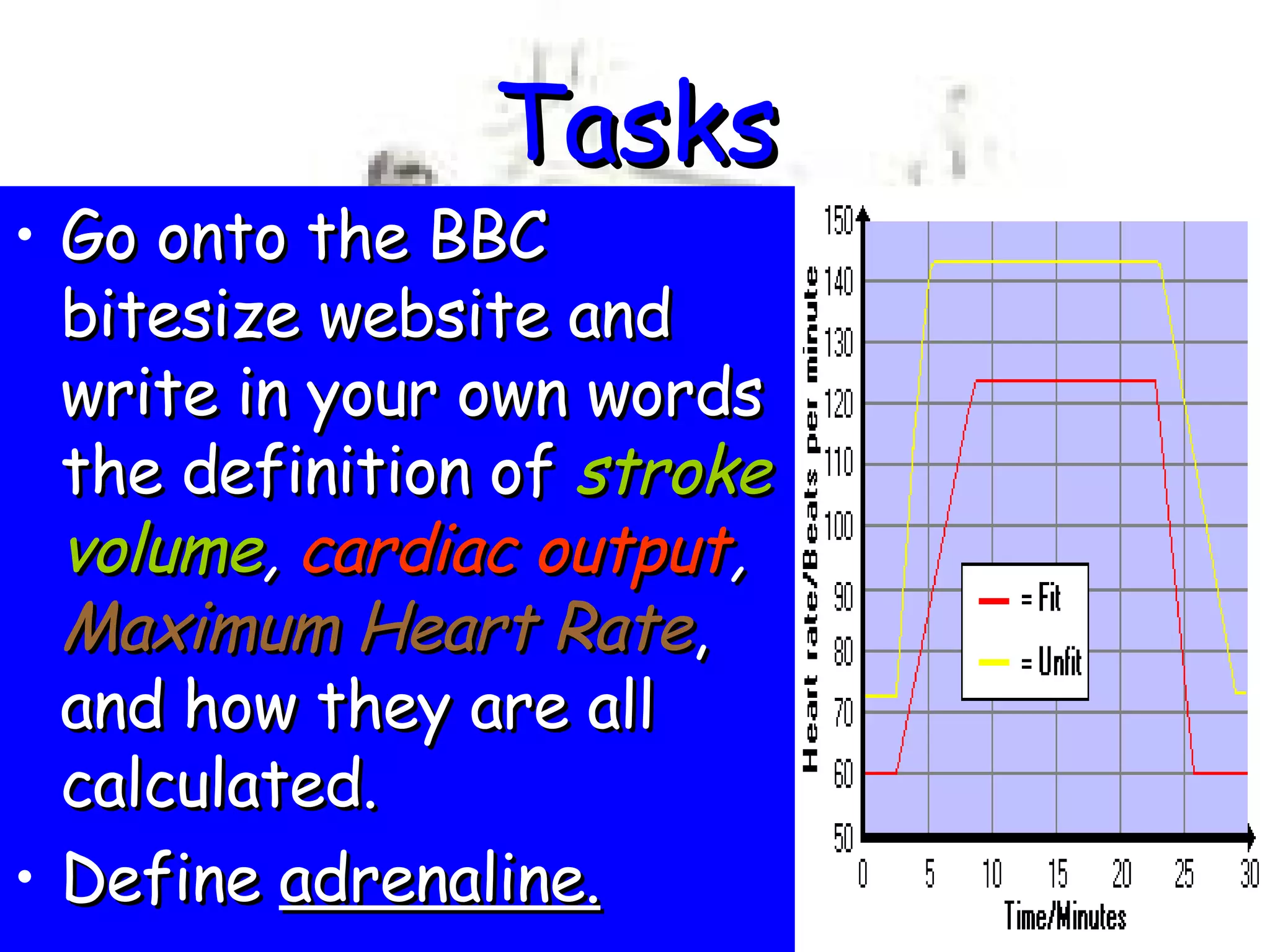
It is the number of times your heart beats per minute The intensity and duration of activity effects your heart rate. Heart Rate Radial Pulse Carotid Pulse Task: Choose one of the locations to take your pulse, and count how many times it beats in 30 seconds.
Tasks Go onto the BBC bitesize website and write in your own words the definition of  stroke volume ,  cardiac output ,  Maximum Heart Rate , and how they are all calculated. Define  adrenaline.
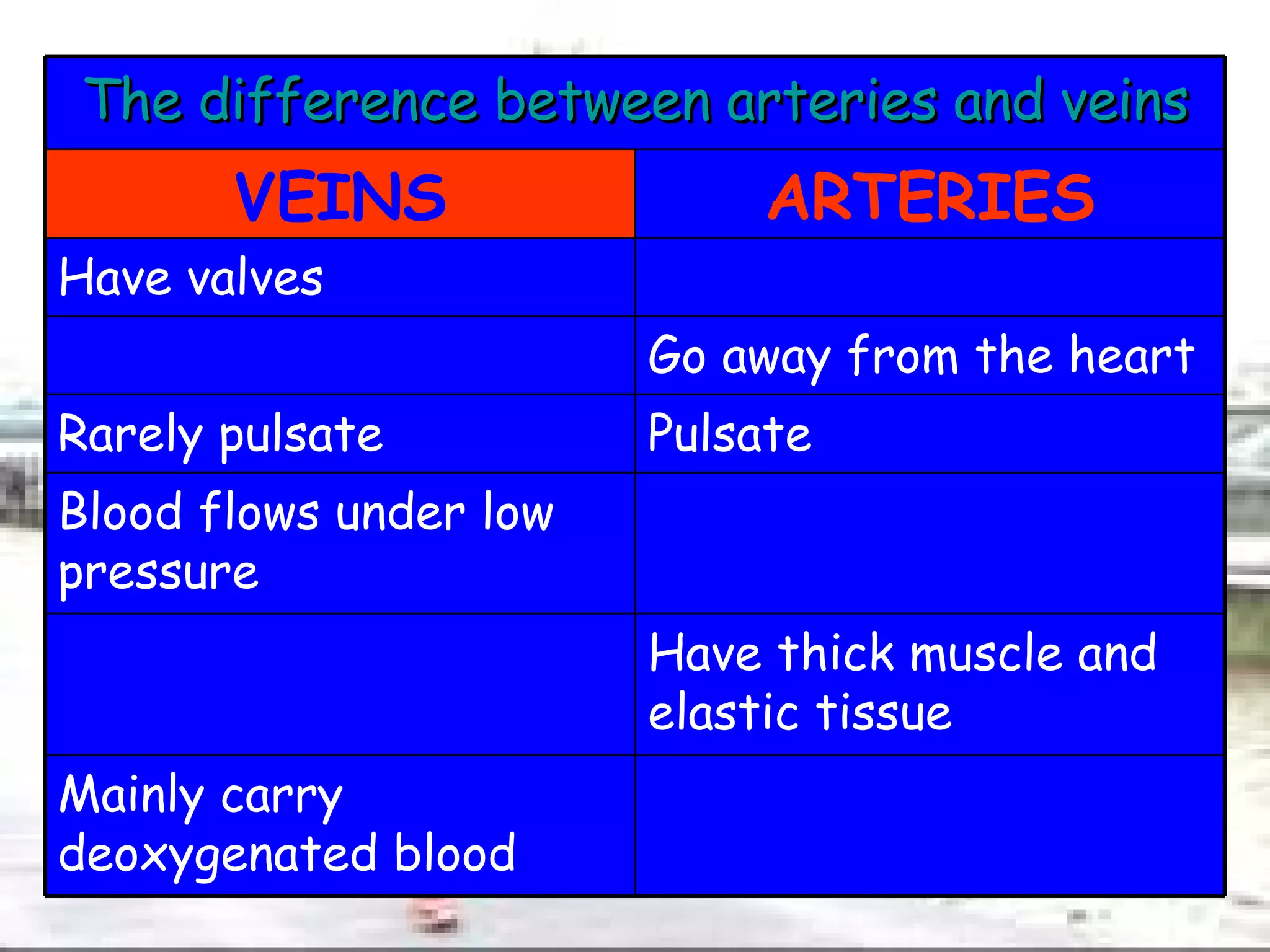
Mainly carry deoxygenated blood Have thick muscle and elastic tissue Blood flows under low pressure Pulsate Rarely pulsate Go away from the heart Have valves ARTERIES VEINS The difference between arteries and veins
Temperature Control Exercise causes your body to heat up above its normal 37 degrees Celsius. To help cool you down your body sweats.
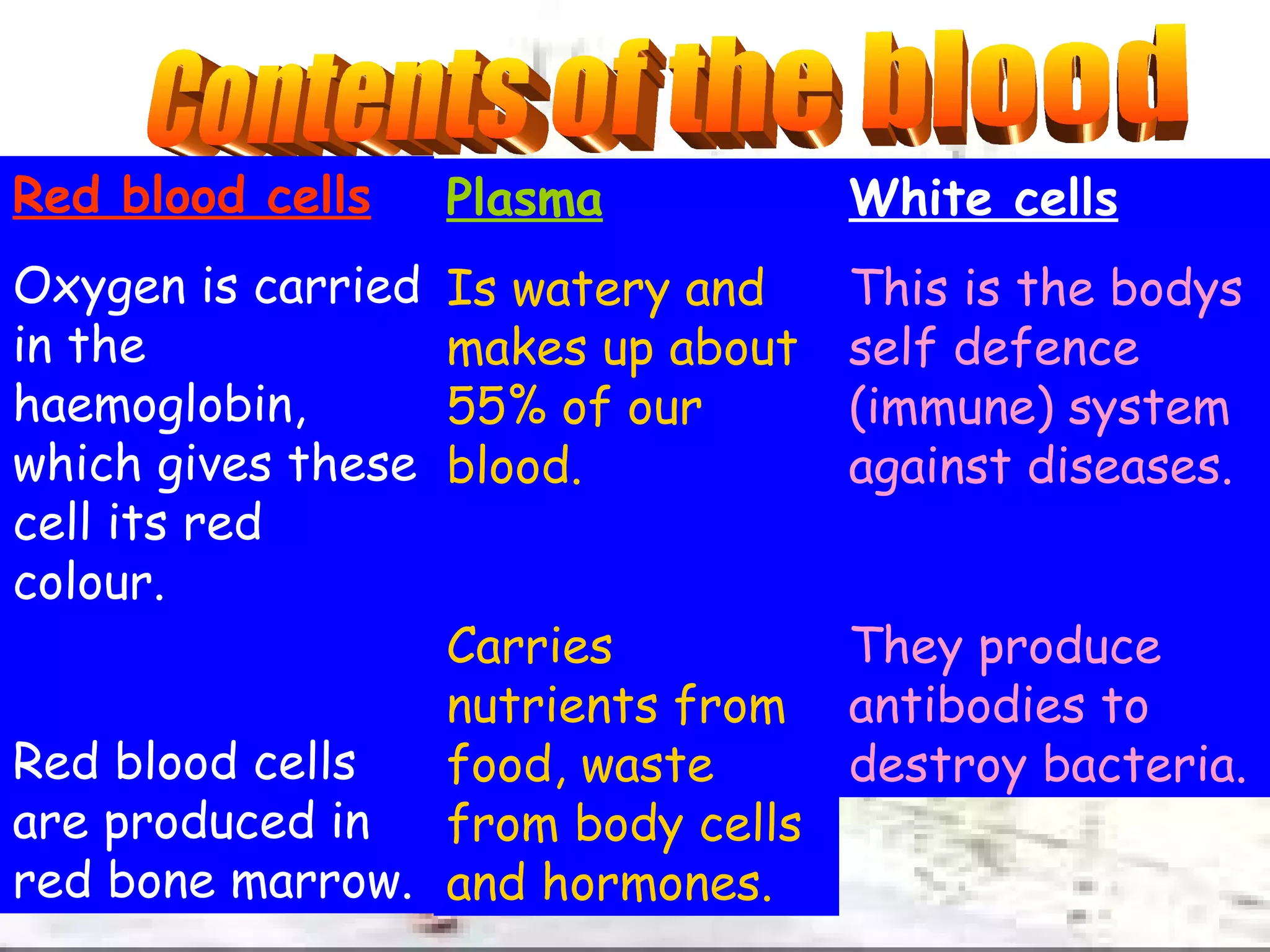
Contents of the blood Red blood cells Oxygen is carried in the haemoglobin, which gives these cell its red colour. Red blood cells are produced in red bone marrow. Plasma Is watery and makes up about 55% of our blood. Carries nutrients from food, waste from body cells and hormones. White cells This is the bodys self defence (immune) system against diseases. They produce antibodies to destroy bacteria.

L 12. The Circulatory System New

  • 1.
    The Circulatory SystemHomework: Research and make half a page notes: how blood carries oxygen, how it transport glucose/food, and how blood helps fight against diseases . Due by Monday!!
  • 2.
    Recap of lastlesson In your books answer the following questions: Name three muscles that are working when throwing a cricket ball. Name the three types of muscles working in your body. Define the term prime movers/agonists. The o____ is where the muscle joins the stationary bone, e.g. the bicep is attached to the s_______.
  • 3.
    What are yougoing to learn? The functions of the heart The movement of blood through the heart How the heart works The path of the circulatory system
  • 4.
    Function of theheart The heart works for 24 hrs a day It carries food & oxygen to your body cells Carries carbon dioxide & other waste products away
  • 5.
  • 6.
    Deoxygenated bloodat the heart Blood travels to the lungs via the pulmonary artery Gaseous exchange occurs in the lungs _______ travels back to the heart via the pulmonary vein The left ventricle pumps the _______ blood to the body cells Gaseous exchange occurs in the body cells _________ blood returns to the heart (the cycle then repeats itself).
  • 7.
    Draw and labelseptum http://www.bbc.co.uk/schools/gcsebitesize/biology/humansasorganisms/1circulationrev2.shtml
  • 8.
    It is thenumber of times your heart beats per minute The intensity and duration of activity effects your heart rate. Heart Rate Radial Pulse Carotid Pulse Task: Choose one of the locations to take your pulse, and count how many times it beats in 30 seconds.
  • 9.
    Tasks Go ontothe BBC bitesize website and write in your own words the definition of stroke volume , cardiac output , Maximum Heart Rate , and how they are all calculated. Define adrenaline.
  • 10.
    Mainly carry deoxygenatedblood Have thick muscle and elastic tissue Blood flows under low pressure Pulsate Rarely pulsate Go away from the heart Have valves ARTERIES VEINS The difference between arteries and veins
  • 11.
    Temperature Control Exercisecauses your body to heat up above its normal 37 degrees Celsius. To help cool you down your body sweats.
  • 12.
    Contents of theblood Red blood cells Oxygen is carried in the haemoglobin, which gives these cell its red colour. Red blood cells are produced in red bone marrow. Plasma Is watery and makes up about 55% of our blood. Carries nutrients from food, waste from body cells and hormones. White cells This is the bodys self defence (immune) system against diseases. They produce antibodies to destroy bacteria.