Digital Marketing/
Social Media Strategy
Meeting 2
Dr Jim Hamill
Alan Stevenson
Vincent Hamill
www.energise2-0.com
12th
December, 2011
ENERGISE2-0.COM
Project Background
• Digital Marketing/Social Media (DM/SM) Knowledge
Transfer
• Digital Marketing/Social Media Strategy
Development and Action Plans for ‘getting there’
• Implementation Support
• A six month project plus on-going Mentoring and
Performance Management for a further six months
The Approach
• Use of a simplified Balanced Scorecard approach to
ensure that future digital marketing/social media
actions and initiatives are fully aligned with and
supportive of core business goals and objectives
Scorecard Approach
• DM/SM Vision
• Objectives, Key Performance Indicators (KPIs) and
Targets
• Customer Segmentation
• Key Actions and Initiatives
• Organisation, People, Resource Issues
• Performance Measurement
Performance Driven Approach
• All future digital marketing/social media actions and
initiatives should be closely aligned with and
supportive of agreed business goals and objectives
for Kube
• Targets and KPIs should be agreed for evaluating on-
going performance and business impact
ENERGISE2-0.COM
Agenda for the Day
Based on Meeting 1 agree:
•Why? - The overall DM/SM Strategic Vision, Objectives, KPIs,
Targets, Customer Segments
•What? - The key DM/SM Actions and Initiatives to be
implemented
----------------------------------------------------------------------------
Then……….
•How? - Action Plan for ‘Getting There’
•Who? - Organisation, People and Resource issues
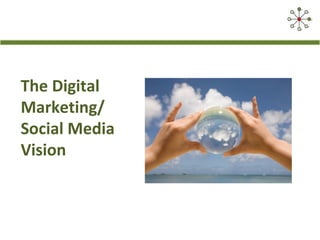
The Digital
Marketing/
Social Media
Vision
The Vision
• To fully leverage emerging online opportunities for building a
‘Quality Customer Base’ – a strong base of ‘High Value, High
Growth, High Margin Customers’ providing Kube with a solid
foundation for achieving sustained growth and profitability
• The development and successful implementation of an
integrated and coordinated Digital Marketing/Social Media
Strategy is critical to achieving the company’s ambitious
growth objectives and establishing Kube as a dominant player
in the Scottish market
• This will be achieved by using digital technology to ‘Identify,
Acquire, Retain and Grow Quality Customers’ – especially
customers with high annual repeat revenues
Business Objectives,
KPIs and Targets
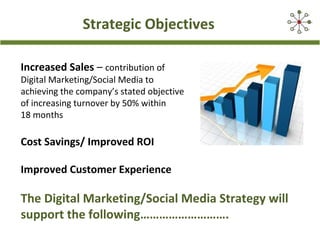
Strategic Objectives
Increased Sales – contribution of
Digital Marketing/Social Media to
achieving the company’s stated objective
of increasing turnover by 50% within
18 months
Cost Savings/ Improved ROI
Improved Customer Experience
The Digital Marketing/Social Media Strategy will
support the following……………………….
Digital Success Drivers
• Derive ‘actionable insights’ and improved market/customer
knowledge through ‘social media listening’ and two-way
dialogue
• Raise brand awareness and understanding of what Kube do
and the core value proposition
• ‘Tell the story’ and help to educate the market
• Build brand visibility, integrity and brand reputation
management
• Increase number of resellers (to some extent) but more
importantly to build direct to customer sales
• Support the repositioning of Kube as a market leader in
managed services
Digital Success Drivers
• Build the proposition and support the launch of new cloud
based products and services
• Build direct relationships and engagement with key decision-
makers (e.g. CFOs) by-passing the IT blockers (the Dept of
Unbusiness)
• Use of Digital/Social Media to deliver high levels of customer
service and to enhance the customer experience at low cost
• Increase new customer acquisition for ‘bread and butter’
services (calls, lines etc) – low margins but opportunity for
‘up’/‘cross’ selling
• Build strong relationships and loyalty with existing high value,
high growth potential customers
Digital Success Drivers
• Maximise the growth potential of existing customers through
‘up’ and ‘cross’ selling; development of managed cloud
services
• Build a quality online network of high value, high growth
potential customers/partners who become brand advocates
for Kube
• ‘Build the buzz’ – engage, energise, leverage the power of the
network
• Maximise company value through building a quality customer
base and maximising life time value
• Maximise marketing effectiveness, efficiency and ROI
• Internal cost savings and operational efficiencies
KPIs and specific targets should be
agreed for the above and used to
measure on-going business impact……
Customer
Segmentation
….. the key to Digital
Marketing/Social Media
success
Kube’s emerging DM/SM strategy should focus on
the following customer/market segments………
Customer Segmentation
• The Scottish Market
• Existing Customers
• New Customers
• Partners/Influencers (offline)
• Key Social Media Influencers
• Internal Customers
The Scottish Market
• Geographically, the main objective is to establish
Kube as a dominant player in the Scottish market
• Focus on key cities Glasgow/West of Scotland;
Edinburgh, Aberdeen, Perth etc
Existing Customers
• A major priority is to maximise ‘up’ and ‘cross’ selling
opportunities within the existing customer base - 200 to 300
existing customers
• Significant growth potential in the top 20/30 existing
customers – already taking the full range of connectivity services but
not ‘what sits on top’
• Generic Strategy – use DM/SM to ‘build strategic
relationships’ with this segment - maximising ‘up’ selling
opportunities
• Second tier of 100 companies – potential for ‘up’ selling more
connectivity services. Generic strategy – ‘target for
development’
• Remaining customers – use DM/SM to ‘selectively develop’/
‘service minimally’ (reduce customer servicing costs)
New Customer Acquisition
‘Build brand awareness’ and ‘target for development’
the following groups:
•Top 300 SMEs in Scotland
•Oil and Gas sector
•Other industries e.g. accountants, food and drink,
higher/further education etc
Entry point may be fixed line calls?
Partners/Influencers (offline)
‘Build brand awareness’ and ‘selectively develop’ the
following segments:
•Resellers (‘selectively develop’)
•Potential Strategic Partners e.g. suppliers of cloud
services/applications
•Niche Suppliers – e.g. Eureka, Data Specialists, Consultants
•Influencers – Trade Associations; Chambers/Business Clubs; SE
and the Scottish Government (broadband initiative); Affinity
Associations e.g. Master Bakers, RFC
•Strategy – seek joint approaches/collaboration for mutual
benefit e.g. Cloud/Social Media Workshops/Seminars
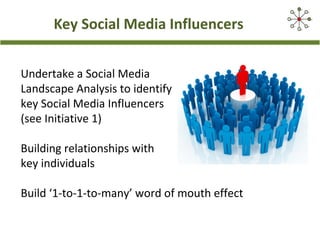
Key Social Media Influencers
Undertake a Social Media
Landscape Analysis to identify
key Social Media Influencers
(see Initiative 1)
Building relationships with
key individuals
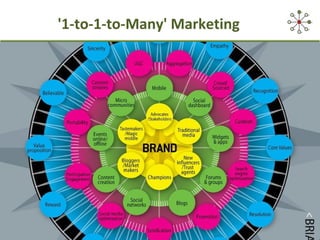
Build ‘1-to-1-to-many’ word of mouth effect
Internal Customers
Internal Customers
– Use of social media for customer service and
feedback
– Use of social media to improve internal
processes?
Based on a ‘Customer Value Analysis’
(Customer Attractiveness and Probability of Success)
priority customer groups for Kube are as
follows…….
Focus on High Value Customers
The DM/SM strategy for Kube should focus on the following
key objectives (at least short to medium term):
Build/Strengthen the ‘Strategic Partnership’ with – top 20/30
existing customers with significant growth potential
‘Target for Development’ – 100 existing customers with good
growth potential
‘Build Brand Awareness’/‘Target for Development’ – top 300
Scottish SMEs; oil and gas sector; other sectors as agreed
‘Build Brand Awareness’/‘Selectively Develop’ - Resellers;
Potential Strategic Partners; Niche Suppliers; Influencers ;
Affinity Associations e.g. Master Bakers, RFC
Key Decision Makers
Within each customer segment – focus on building
relationships with key decision-makers
•CFO
•IT
•Owners
•Functional Managers
•Staff
•Customers’ customers
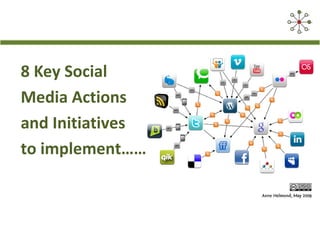
8 Key Social
Media Actions
and Initiatives
to implement…….
8 Key Actions and Initiatives
1. Undertake a Social Media Landscape Analysis
2. Build a Social Media Listening System
3. Undertake a strategic web site evaluation and
recommendations for improvement
4. Implement a proactive online (and offline) marketing
strategy to support the site
8 Key Actions and Initiatives
5. Explore collaborative social media opportunities with high
value, high growth potential customers/partners /build
relationships with key influencers
6. Search, join, lurk, participate in ‘external’ forums/
groups/blogs etc
7. Build proprietary social media channels
8. Medium-to-longer term developments – viral campaign,
internal use of social media
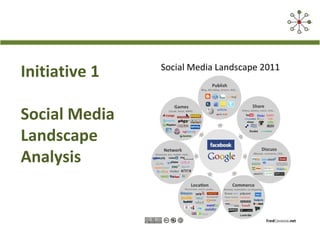
Initiative 1
Social Media
Landscape
Analysis
Social Media Landscape Analysis
• Identify the key ‘hubs’, forums, groups where
relevant conversations are taking place
• Identify where your customers (actual and potential)
are ‘hanging-out’
• Concentration of effort and resources….
Initiative 2
Social Media
Listening System
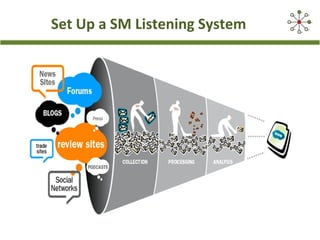
Set Up a SM Listening System
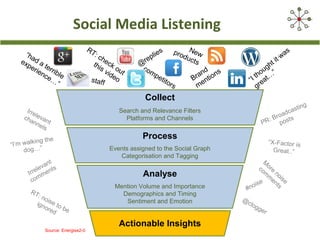
Social Media Listening
Search and Relevance Filters
Platforms and Channels
Brand
mentions
Collect
Actionable Insights
competitors
Newproducts@
replies
“I thought it was
great…
”
Events assigned to the Social Graph
Categorisation and Tagging
Process
Mention Volume and Importance
Demographics and Timing
Sentiment and Emotion
Analyse
#noise
@
clogger
Irrelevant
comments
“had a terrible
experience…
” staff
RT: check out
this video
RT: noise to be
ignored
PR: Broadcasting
posts
Irrelevant
channels
M
ore
noise
com
m
ents
Source: Energise2-0
“I’m walking the
dog…”
“X-Factor is
Great..”
Set Up a SM Listening System
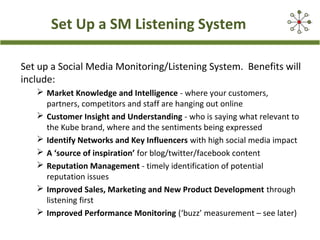
Set up a Social Media Monitoring/Listening System. Benefits will
include:
 Market Knowledge and Intelligence - where your customers,
partners, competitors and staff are hanging out online
 Customer Insight and Understanding - who is saying what relevant to
the Kube brand, where and the sentiments being expressed
 Identify Networks and Key Influencers with high social media impact
 A ‘source of inspiration’ for blog/twitter/facebook content
 Reputation Management - timely identification of potential
reputation issues
 Improved Sales, Marketing and New Product Development through
listening first
 Improved Performance Monitoring (‘buzz’ measurement – see later)
Set Up a SM Listening System
• Five key steps involved (see future Action Plan)
• At this stage, the key question is to agree the main
conversations you need to monitor
– your own brand
– product, industry, sector
– competitors (e.g. Iomart are moving into the cloud
market; PLC Awards)
– customer segments
– geography/location
– etc
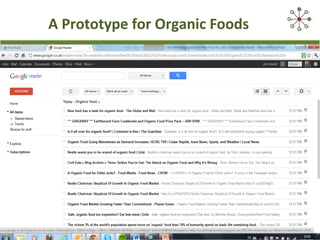
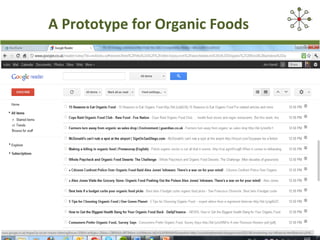
A Prototype for Organic Foods
Initiative 3
Strategic
Web Site
Evaluation and
Recommended Improvements
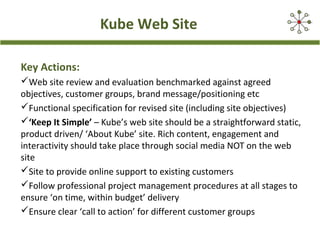
Kube Web Site
Key Actions:
Web site review and evaluation benchmarked against agreed
objectives, customer groups, brand message/positioning etc
Functional specification for revised site (including site objectives)
‘Keep It Simple’ – Kube’s web site should be a straightforward static,
product driven/ ‘About Kube’ site. Rich content, engagement and
interactivity should take place through social media NOT on the web
site
Site to provide online support to existing customers
Follow professional project management procedures at all stages to
ensure ‘on time, within budget’ delivery
Ensure clear ‘call to action’ for different customer groups
Kube Web Site
Key Actions (cont’d):
Ensure prominent links to Kube social media channels (top right
hand side of the site)
Embed social media feeds to add some additional value to the site
e.g. from the Kube twitter channel; some RSS feeds (‘cloud’ news)
Content/message tone/theme to be agreed as part of the functional
specification
Timescale – functional specification by the end of January, 2012; site
live by end of February
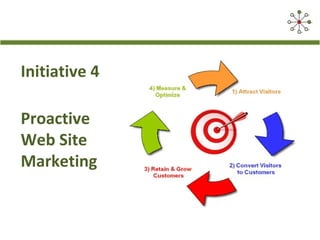
Initiative 4
Proactive
Web Site
Marketing
Web Site Marketing
The updated Kube web site should be supported by a
proactive online (Web 1.0) marketing strategy
Key Actions:
Search engine optimisation and positioning
Links strategy
Google analytics
eMail communications strategy
etc
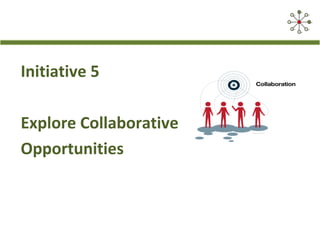
Initiative 5
Explore Collaborative
Opportunities
Collaborative Social Media
Key Action:
Discuss/explore collaborative social media
opportunities with High Value/High Growth Potential
Customers/Partners
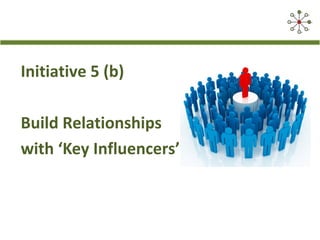
Initiative 5 (b)
Build Relationships
with ‘Key Influencers’
Key Influencers
Key Actions:
Search and identify ‘key influencers’ relevant to different
customer segments
Draw up a long list
Agree a short-list of the most strategically important ‘key
influencers’
Start to follow
Build knowledge and understanding of what makes them ‘tick’
Start to build relationships
Cultivate/leverage ‘one to one to many’ network
effects……..pto
'1-to-1-to-Many' Marketing
Key Influencers
• The Social Media Landscape Analysis will identified
the key influencers
Initiative 6
Group/Forum/
External Blog
Participation
Group/Forum/Blog Participation
Key Actions:
Search for relevant groups/forums/blogs etc
Draw up a long list
Agree a short-list of the most relevant groups/forums/blogs
Join
Lurk in the spaces for at least a month before posting (listen
and learn the netiquette of the group)
Start to participate BUT DON’T SELF PROMOTE OR SELL
Cultivate high value relationships
Group/Forum Participation
• The Social Media Landscape Analysis will identified
the main groups/forums etc
Initiative 7
Develop
Proprietary
Social Media Channels
• Fully develop ‘proprietary’ social media channels
• The following channels should be fully developed:
Kube Blog
Twitter (company and personal)
Linkedin Personal Pages
Linkedin Brand/Company Page
‘YouTube’
Facebook/Google + should be developed if and when
time/resources allow
Social Media Channels
• An integrated and coordinated approach should be
adopted to ensure consistency of brand message,
content tone, theme etc across all channels
• Action Plans will be developed for each channel
covering the following...........
Channel Action Plans
• Channel objectives and business benefits
• Channel KPIs and targets
• Key success factors – the 4Cs
– Customers
– Content
– Conversations
– Conversion
Channel Action Plans
• Channel Actions
– Channel set-up tasks
– Content Plan (see later)
– Channel management tools to be used
• Channel performance measurement and tools to be
used
• Organisation, Resources, People, ‘Mindset’ issues –
proper use ‘Policies and Guidelines’
Channel Set Up Issues
• Page Set Up
• Profile
• Design
• Basic Layout
• Terminology
• Features/Functions
• Integration options
Content Plan
A template is available for agreeing a Content Plan for
each channel covering:
•Frequency of updates
•Tone/Theme
•Topics
•Post Types (update, video, image)
•Own/Other Peoples Content (OPC)
•Sources of Inspiration
•Participation in other native places
•Response Policy
•Organisation, Resources and People
A brief word on each channel……..
Kube Blog
Will become the main ‘story telling’
channel for the brand; a key channel
for customer/market ‘education’
KPIs and targets will include – number/quality of page views per month
(target of 2,500 within six months would be realistic); quality of
feedback/comments made; actionable insight derived; referrals to the web
site; enquiries and engagement; impact of the blog on search engine position
of the main site; impact on brand awareness, visibility, integrity; personalise
the brand; number of email/RSS feed registrations etc
Kube Blog
Customers - at least initially, the blog
will focus mainly on existing 20/30 high
growth potential customers; the ‘Target for
Development 100’; Scotland’s top 300 SMEs;
potential partners
‘Key Influencers’ should be invited to do guest blogs
Content Policy – 3 to 5 times per week but not all posts need to be
‘organically prepared’; the Social Media Listening System will identify the
‘hot’ topics generating interest; vary the type of content posted e.g. text,
videos, images etc; use the Social Media Listening System as a ‘source of
inspiration’; refer to the very detailed Customer Segmentation Analysis; posts
should be kept short and concise; as well as promoting the brand, blog
content should establish Kube as a ‘thought leader’ in ‘Managed Services’
Kube Blog
Build the blog using Wordpress
and ‘stand alone’ from the BN
web site
Wordpress provides an easy to use
Content Management System for blog updates
Blog address should be www.kubeblog.com or similar
Kube Blog
Wordpress stats provide a useful
snapshot of blog performance
Google Analytics can be embedded to
provide a more detailed performance
Analysis
Important blog management issues need to be decided in terms
of roles and responsibilities
The blog should be closely integrated with all other social media
channels
Twitter
Twitter has major potential to be
developed as a key platform for
customer interaction and engagement
Will require a proactive, hands-on approach
and the right ‘organisational mindset’
KPIs and targets – the performance and impact of the Kube Twitter
channel can be measured to a very high degree of accuracy. KPIs would
include: number/quality of followers; you follow; growth in numbers;
number and type of tweet sent; number/per cent of RTs; reach, influence,
amplification; visits to the web site/blog from Twitter etc. A range of tools
are available to support on-going performance measurement
Twitter
A key issue to address is the balance
between ‘personal’ and ‘Kube brand’
accounts – see recent Twitter brand page
changes
Basic lay-out of the pages
Profile, Messages, Who to Follow, Account
Settings, Search, Design – can be customised
to some extent
Customers - at least initially, the Twitter accounts will focus on the same
customer groups as the Kube blog. A key priority should be to identify and
connect with ‘Key Influencers’ i.e. those tweeting about ‘cloud’ issues. Tools
are available for identifying the right type of person to follow but be very
careful in their us
Twitter
Content Policy – as for the blog, an agreed
Content Policy should be put in place covering
frequency of posts, topic, tone, theme, type of
tweet (e.g. plain tweet, reply, link, retweet etc)
Some Advice – don’t tweet too often or too many
tweets at the same time; your tweets should add value, people will
unfollow if you constantly talk about ‘YOU’; balance your tweets
between plain tweets, replies, links, RTs etc; twitter is NOT a broadcast
channel, engage in two-way dialogue – this will require time and effort
and some staff training; be ‘customer led’
Linkedin
A key issue to address is the balance between
‘personal’ and ‘Kube brand’ Linkedin profiles
Just very recently, Linkedin have considerably
improved the functionality of their Company
Pages – see - http://learn.linkedin.com/company-pages/ - this
provides interesting opportunities for Kube to establish a strong
brand profile on Linkedin. We are currently exploring the best
way to do this and will revert back with clear recommendations
very soon
Linkedin can also be used to research and identify key
individuals that Kube should connect with
You Tube
Initially, YouTube should be set up as a
‘supporting channel’. In other words, with little
time and effort, a Kube YouTube
Channel could be set up using existing content
e.g. ‘cloud’ related videos already on Youtube
and anything currently available internally
Where appropriate, some of these videos can be used to provide
embedded content on the other channels – mainly the blog
Medium-to-longer term there is significant potential for using
YouTube to educate the market
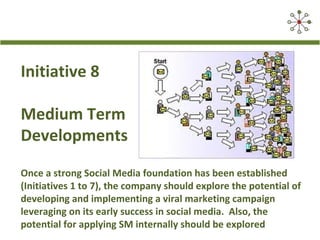
Initiative 8
Medium Term
Developments
Once a strong Social Media foundation has been established
(Initiatives 1 to 7), the company should explore the potential of
developing and implementing a viral marketing campaign
leveraging on its early success in social media. Also, the
potential for applying SM internally should be explored
Organisation, People,
Resource Issues
The Main Obstacle
In our experience, organisational, people and resource issues
become the main barriers to achieving the business benefits to
be derived from a successful Social Media Strategy
If the company is in general agreement with the main thrust of
the recommendations contained in this presentation then a
number of key questions need to be addressed…….
Key Organisational Questions
• Do we have the right organisational ‘culture’ and ‘mindset’
for Social Media? ‘Be social before doing social!’
• Is the right organisational and decision-making structure in
place?
• Has agreement been reached on resource allocation?
• Who will be responsible for your social media activities?
• What balance has been agreed between internal and external
roles and responsibilities?
• Who is the Social Media Champion?
• Do you have agreed Social Media Policies and Guidelines in
place covering ‘Proper Use’, ‘Content Management’,
‘Customer Response Times/Quality’ and ‘Legal’ aspects?
Performance Measurement
and Business Impact
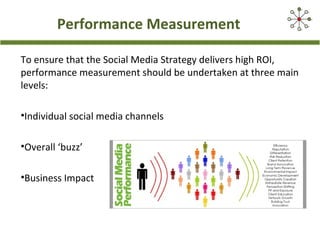
Performance Measurement
To ensure that the Social Media Strategy delivers high ROI,
performance measurement should be undertaken at three main
levels:
•Individual social media channels
•Overall ‘buzz’
•Business Impact
Next Steps
 Agree Key Objectives, Targets, KPIs, Customer Groups
 Agree the Key Initiatives and Actions to be taken
 Undertake the Social Media Landscape Analysis
 Set up the Social Media Listening System (Requirements
Spec)
 Build proprietary channels
 Agree Organisational, Resource and People Issues
Thank You

Kube Networks

  • 1.
    Digital Marketing/ Social MediaStrategy Meeting 2 Dr Jim Hamill Alan Stevenson Vincent Hamill www.energise2-0.com 12th December, 2011
  • 2.
    ENERGISE2-0.COM Project Background • DigitalMarketing/Social Media (DM/SM) Knowledge Transfer • Digital Marketing/Social Media Strategy Development and Action Plans for ‘getting there’ • Implementation Support • A six month project plus on-going Mentoring and Performance Management for a further six months
  • 3.
    The Approach • Useof a simplified Balanced Scorecard approach to ensure that future digital marketing/social media actions and initiatives are fully aligned with and supportive of core business goals and objectives
  • 4.
    Scorecard Approach • DM/SMVision • Objectives, Key Performance Indicators (KPIs) and Targets • Customer Segmentation • Key Actions and Initiatives • Organisation, People, Resource Issues • Performance Measurement
  • 5.
    Performance Driven Approach •All future digital marketing/social media actions and initiatives should be closely aligned with and supportive of agreed business goals and objectives for Kube • Targets and KPIs should be agreed for evaluating on- going performance and business impact
  • 6.
    ENERGISE2-0.COM Agenda for theDay Based on Meeting 1 agree: •Why? - The overall DM/SM Strategic Vision, Objectives, KPIs, Targets, Customer Segments •What? - The key DM/SM Actions and Initiatives to be implemented ---------------------------------------------------------------------------- Then………. •How? - Action Plan for ‘Getting There’ •Who? - Organisation, People and Resource issues
  • 7.
  • 8.
    The Vision • Tofully leverage emerging online opportunities for building a ‘Quality Customer Base’ – a strong base of ‘High Value, High Growth, High Margin Customers’ providing Kube with a solid foundation for achieving sustained growth and profitability • The development and successful implementation of an integrated and coordinated Digital Marketing/Social Media Strategy is critical to achieving the company’s ambitious growth objectives and establishing Kube as a dominant player in the Scottish market • This will be achieved by using digital technology to ‘Identify, Acquire, Retain and Grow Quality Customers’ – especially customers with high annual repeat revenues
  • 9.
  • 10.
    Strategic Objectives Increased Sales– contribution of Digital Marketing/Social Media to achieving the company’s stated objective of increasing turnover by 50% within 18 months Cost Savings/ Improved ROI Improved Customer Experience The Digital Marketing/Social Media Strategy will support the following……………………….
  • 11.
    Digital Success Drivers •Derive ‘actionable insights’ and improved market/customer knowledge through ‘social media listening’ and two-way dialogue • Raise brand awareness and understanding of what Kube do and the core value proposition • ‘Tell the story’ and help to educate the market • Build brand visibility, integrity and brand reputation management • Increase number of resellers (to some extent) but more importantly to build direct to customer sales • Support the repositioning of Kube as a market leader in managed services
  • 12.
    Digital Success Drivers •Build the proposition and support the launch of new cloud based products and services • Build direct relationships and engagement with key decision- makers (e.g. CFOs) by-passing the IT blockers (the Dept of Unbusiness) • Use of Digital/Social Media to deliver high levels of customer service and to enhance the customer experience at low cost • Increase new customer acquisition for ‘bread and butter’ services (calls, lines etc) – low margins but opportunity for ‘up’/‘cross’ selling • Build strong relationships and loyalty with existing high value, high growth potential customers
  • 13.
    Digital Success Drivers •Maximise the growth potential of existing customers through ‘up’ and ‘cross’ selling; development of managed cloud services • Build a quality online network of high value, high growth potential customers/partners who become brand advocates for Kube • ‘Build the buzz’ – engage, energise, leverage the power of the network • Maximise company value through building a quality customer base and maximising life time value • Maximise marketing effectiveness, efficiency and ROI • Internal cost savings and operational efficiencies
  • 14.
    KPIs and specifictargets should be agreed for the above and used to measure on-going business impact……
  • 15.
    Customer Segmentation ….. the keyto Digital Marketing/Social Media success Kube’s emerging DM/SM strategy should focus on the following customer/market segments………
  • 16.
    Customer Segmentation • TheScottish Market • Existing Customers • New Customers • Partners/Influencers (offline) • Key Social Media Influencers • Internal Customers
  • 17.
    The Scottish Market •Geographically, the main objective is to establish Kube as a dominant player in the Scottish market • Focus on key cities Glasgow/West of Scotland; Edinburgh, Aberdeen, Perth etc
  • 18.
    Existing Customers • Amajor priority is to maximise ‘up’ and ‘cross’ selling opportunities within the existing customer base - 200 to 300 existing customers • Significant growth potential in the top 20/30 existing customers – already taking the full range of connectivity services but not ‘what sits on top’ • Generic Strategy – use DM/SM to ‘build strategic relationships’ with this segment - maximising ‘up’ selling opportunities • Second tier of 100 companies – potential for ‘up’ selling more connectivity services. Generic strategy – ‘target for development’ • Remaining customers – use DM/SM to ‘selectively develop’/ ‘service minimally’ (reduce customer servicing costs)
  • 19.
    New Customer Acquisition ‘Buildbrand awareness’ and ‘target for development’ the following groups: •Top 300 SMEs in Scotland •Oil and Gas sector •Other industries e.g. accountants, food and drink, higher/further education etc Entry point may be fixed line calls?
  • 20.
    Partners/Influencers (offline) ‘Build brandawareness’ and ‘selectively develop’ the following segments: •Resellers (‘selectively develop’) •Potential Strategic Partners e.g. suppliers of cloud services/applications •Niche Suppliers – e.g. Eureka, Data Specialists, Consultants •Influencers – Trade Associations; Chambers/Business Clubs; SE and the Scottish Government (broadband initiative); Affinity Associations e.g. Master Bakers, RFC •Strategy – seek joint approaches/collaboration for mutual benefit e.g. Cloud/Social Media Workshops/Seminars
  • 21.
    Key Social MediaInfluencers Undertake a Social Media Landscape Analysis to identify key Social Media Influencers (see Initiative 1) Building relationships with key individuals Build ‘1-to-1-to-many’ word of mouth effect
  • 22.
    Internal Customers Internal Customers –Use of social media for customer service and feedback – Use of social media to improve internal processes?
  • 23.
    Based on a‘Customer Value Analysis’ (Customer Attractiveness and Probability of Success) priority customer groups for Kube are as follows…….
  • 24.
    Focus on HighValue Customers The DM/SM strategy for Kube should focus on the following key objectives (at least short to medium term): Build/Strengthen the ‘Strategic Partnership’ with – top 20/30 existing customers with significant growth potential ‘Target for Development’ – 100 existing customers with good growth potential ‘Build Brand Awareness’/‘Target for Development’ – top 300 Scottish SMEs; oil and gas sector; other sectors as agreed ‘Build Brand Awareness’/‘Selectively Develop’ - Resellers; Potential Strategic Partners; Niche Suppliers; Influencers ; Affinity Associations e.g. Master Bakers, RFC
  • 25.
    Key Decision Makers Withineach customer segment – focus on building relationships with key decision-makers •CFO •IT •Owners •Functional Managers •Staff •Customers’ customers
  • 26.
    8 Key Social MediaActions and Initiatives to implement…….
  • 27.
    8 Key Actionsand Initiatives 1. Undertake a Social Media Landscape Analysis 2. Build a Social Media Listening System 3. Undertake a strategic web site evaluation and recommendations for improvement 4. Implement a proactive online (and offline) marketing strategy to support the site
  • 28.
    8 Key Actionsand Initiatives 5. Explore collaborative social media opportunities with high value, high growth potential customers/partners /build relationships with key influencers 6. Search, join, lurk, participate in ‘external’ forums/ groups/blogs etc 7. Build proprietary social media channels 8. Medium-to-longer term developments – viral campaign, internal use of social media
  • 29.
  • 30.
    Social Media LandscapeAnalysis • Identify the key ‘hubs’, forums, groups where relevant conversations are taking place • Identify where your customers (actual and potential) are ‘hanging-out’ • Concentration of effort and resources….
  • 31.
  • 32.
    Set Up aSM Listening System
  • 33.
    Social Media Listening Searchand Relevance Filters Platforms and Channels Brand mentions Collect Actionable Insights competitors Newproducts@ replies “I thought it was great… ” Events assigned to the Social Graph Categorisation and Tagging Process Mention Volume and Importance Demographics and Timing Sentiment and Emotion Analyse #noise @ clogger Irrelevant comments “had a terrible experience… ” staff RT: check out this video RT: noise to be ignored PR: Broadcasting posts Irrelevant channels M ore noise com m ents Source: Energise2-0 “I’m walking the dog…” “X-Factor is Great..”
  • 34.
    Set Up aSM Listening System Set up a Social Media Monitoring/Listening System. Benefits will include:  Market Knowledge and Intelligence - where your customers, partners, competitors and staff are hanging out online  Customer Insight and Understanding - who is saying what relevant to the Kube brand, where and the sentiments being expressed  Identify Networks and Key Influencers with high social media impact  A ‘source of inspiration’ for blog/twitter/facebook content  Reputation Management - timely identification of potential reputation issues  Improved Sales, Marketing and New Product Development through listening first  Improved Performance Monitoring (‘buzz’ measurement – see later)
  • 35.
    Set Up aSM Listening System • Five key steps involved (see future Action Plan) • At this stage, the key question is to agree the main conversations you need to monitor – your own brand – product, industry, sector – competitors (e.g. Iomart are moving into the cloud market; PLC Awards) – customer segments – geography/location – etc
  • 36.
    A Prototype forOrganic Foods
  • 37.
    A Prototype forOrganic Foods
  • 38.
    Initiative 3 Strategic Web Site Evaluationand Recommended Improvements
  • 39.
    Kube Web Site KeyActions: Web site review and evaluation benchmarked against agreed objectives, customer groups, brand message/positioning etc Functional specification for revised site (including site objectives) ‘Keep It Simple’ – Kube’s web site should be a straightforward static, product driven/ ‘About Kube’ site. Rich content, engagement and interactivity should take place through social media NOT on the web site Site to provide online support to existing customers Follow professional project management procedures at all stages to ensure ‘on time, within budget’ delivery Ensure clear ‘call to action’ for different customer groups
  • 40.
    Kube Web Site KeyActions (cont’d): Ensure prominent links to Kube social media channels (top right hand side of the site) Embed social media feeds to add some additional value to the site e.g. from the Kube twitter channel; some RSS feeds (‘cloud’ news) Content/message tone/theme to be agreed as part of the functional specification Timescale – functional specification by the end of January, 2012; site live by end of February
  • 41.
  • 42.
    Web Site Marketing Theupdated Kube web site should be supported by a proactive online (Web 1.0) marketing strategy Key Actions: Search engine optimisation and positioning Links strategy Google analytics eMail communications strategy etc
  • 43.
  • 44.
    Collaborative Social Media KeyAction: Discuss/explore collaborative social media opportunities with High Value/High Growth Potential Customers/Partners
  • 45.
    Initiative 5 (b) BuildRelationships with ‘Key Influencers’
  • 46.
    Key Influencers Key Actions: Searchand identify ‘key influencers’ relevant to different customer segments Draw up a long list Agree a short-list of the most strategically important ‘key influencers’ Start to follow Build knowledge and understanding of what makes them ‘tick’ Start to build relationships Cultivate/leverage ‘one to one to many’ network effects……..pto
  • 47.
  • 48.
    Key Influencers • TheSocial Media Landscape Analysis will identified the key influencers
  • 49.
  • 50.
    Group/Forum/Blog Participation Key Actions: Searchfor relevant groups/forums/blogs etc Draw up a long list Agree a short-list of the most relevant groups/forums/blogs Join Lurk in the spaces for at least a month before posting (listen and learn the netiquette of the group) Start to participate BUT DON’T SELF PROMOTE OR SELL Cultivate high value relationships
  • 51.
    Group/Forum Participation • TheSocial Media Landscape Analysis will identified the main groups/forums etc
  • 52.
  • 53.
    Social Media Channels •Fully develop ‘proprietary’ social media channels • The following channels should be fully developed: Kube Blog Twitter (company and personal) Linkedin Personal Pages Linkedin Brand/Company Page ‘YouTube’ Facebook/Google + should be developed if and when time/resources allow
  • 54.
    Social Media Channels •An integrated and coordinated approach should be adopted to ensure consistency of brand message, content tone, theme etc across all channels • Action Plans will be developed for each channel covering the following...........
  • 55.
    Channel Action Plans •Channel objectives and business benefits • Channel KPIs and targets • Key success factors – the 4Cs – Customers – Content – Conversations – Conversion
  • 56.
    Channel Action Plans •Channel Actions – Channel set-up tasks – Content Plan (see later) – Channel management tools to be used • Channel performance measurement and tools to be used • Organisation, Resources, People, ‘Mindset’ issues – proper use ‘Policies and Guidelines’
  • 57.
    Channel Set UpIssues • Page Set Up • Profile • Design • Basic Layout • Terminology • Features/Functions • Integration options
  • 58.
    Content Plan A templateis available for agreeing a Content Plan for each channel covering: •Frequency of updates •Tone/Theme •Topics •Post Types (update, video, image) •Own/Other Peoples Content (OPC) •Sources of Inspiration •Participation in other native places •Response Policy •Organisation, Resources and People
  • 59.
    A brief wordon each channel……..
  • 60.
    Kube Blog Will becomethe main ‘story telling’ channel for the brand; a key channel for customer/market ‘education’ KPIs and targets will include – number/quality of page views per month (target of 2,500 within six months would be realistic); quality of feedback/comments made; actionable insight derived; referrals to the web site; enquiries and engagement; impact of the blog on search engine position of the main site; impact on brand awareness, visibility, integrity; personalise the brand; number of email/RSS feed registrations etc
  • 61.
    Kube Blog Customers -at least initially, the blog will focus mainly on existing 20/30 high growth potential customers; the ‘Target for Development 100’; Scotland’s top 300 SMEs; potential partners ‘Key Influencers’ should be invited to do guest blogs Content Policy – 3 to 5 times per week but not all posts need to be ‘organically prepared’; the Social Media Listening System will identify the ‘hot’ topics generating interest; vary the type of content posted e.g. text, videos, images etc; use the Social Media Listening System as a ‘source of inspiration’; refer to the very detailed Customer Segmentation Analysis; posts should be kept short and concise; as well as promoting the brand, blog content should establish Kube as a ‘thought leader’ in ‘Managed Services’
  • 62.
    Kube Blog Build theblog using Wordpress and ‘stand alone’ from the BN web site Wordpress provides an easy to use Content Management System for blog updates Blog address should be www.kubeblog.com or similar
  • 63.
    Kube Blog Wordpress statsprovide a useful snapshot of blog performance Google Analytics can be embedded to provide a more detailed performance Analysis Important blog management issues need to be decided in terms of roles and responsibilities The blog should be closely integrated with all other social media channels
  • 64.
    Twitter Twitter has majorpotential to be developed as a key platform for customer interaction and engagement Will require a proactive, hands-on approach and the right ‘organisational mindset’ KPIs and targets – the performance and impact of the Kube Twitter channel can be measured to a very high degree of accuracy. KPIs would include: number/quality of followers; you follow; growth in numbers; number and type of tweet sent; number/per cent of RTs; reach, influence, amplification; visits to the web site/blog from Twitter etc. A range of tools are available to support on-going performance measurement
  • 65.
    Twitter A key issueto address is the balance between ‘personal’ and ‘Kube brand’ accounts – see recent Twitter brand page changes Basic lay-out of the pages Profile, Messages, Who to Follow, Account Settings, Search, Design – can be customised to some extent Customers - at least initially, the Twitter accounts will focus on the same customer groups as the Kube blog. A key priority should be to identify and connect with ‘Key Influencers’ i.e. those tweeting about ‘cloud’ issues. Tools are available for identifying the right type of person to follow but be very careful in their us
  • 66.
    Twitter Content Policy –as for the blog, an agreed Content Policy should be put in place covering frequency of posts, topic, tone, theme, type of tweet (e.g. plain tweet, reply, link, retweet etc) Some Advice – don’t tweet too often or too many tweets at the same time; your tweets should add value, people will unfollow if you constantly talk about ‘YOU’; balance your tweets between plain tweets, replies, links, RTs etc; twitter is NOT a broadcast channel, engage in two-way dialogue – this will require time and effort and some staff training; be ‘customer led’
  • 67.
    Linkedin A key issueto address is the balance between ‘personal’ and ‘Kube brand’ Linkedin profiles Just very recently, Linkedin have considerably improved the functionality of their Company Pages – see - http://learn.linkedin.com/company-pages/ - this provides interesting opportunities for Kube to establish a strong brand profile on Linkedin. We are currently exploring the best way to do this and will revert back with clear recommendations very soon Linkedin can also be used to research and identify key individuals that Kube should connect with
  • 68.
    You Tube Initially, YouTubeshould be set up as a ‘supporting channel’. In other words, with little time and effort, a Kube YouTube Channel could be set up using existing content e.g. ‘cloud’ related videos already on Youtube and anything currently available internally Where appropriate, some of these videos can be used to provide embedded content on the other channels – mainly the blog Medium-to-longer term there is significant potential for using YouTube to educate the market
  • 69.
    Initiative 8 Medium Term Developments Oncea strong Social Media foundation has been established (Initiatives 1 to 7), the company should explore the potential of developing and implementing a viral marketing campaign leveraging on its early success in social media. Also, the potential for applying SM internally should be explored
  • 70.
  • 71.
    The Main Obstacle Inour experience, organisational, people and resource issues become the main barriers to achieving the business benefits to be derived from a successful Social Media Strategy If the company is in general agreement with the main thrust of the recommendations contained in this presentation then a number of key questions need to be addressed…….
  • 72.
    Key Organisational Questions •Do we have the right organisational ‘culture’ and ‘mindset’ for Social Media? ‘Be social before doing social!’ • Is the right organisational and decision-making structure in place? • Has agreement been reached on resource allocation? • Who will be responsible for your social media activities? • What balance has been agreed between internal and external roles and responsibilities? • Who is the Social Media Champion? • Do you have agreed Social Media Policies and Guidelines in place covering ‘Proper Use’, ‘Content Management’, ‘Customer Response Times/Quality’ and ‘Legal’ aspects?
  • 73.
  • 74.
    Performance Measurement To ensurethat the Social Media Strategy delivers high ROI, performance measurement should be undertaken at three main levels: •Individual social media channels •Overall ‘buzz’ •Business Impact
  • 75.
    Next Steps  AgreeKey Objectives, Targets, KPIs, Customer Groups  Agree the Key Initiatives and Actions to be taken  Undertake the Social Media Landscape Analysis  Set up the Social Media Listening System (Requirements Spec)  Build proprietary channels  Agree Organisational, Resource and People Issues
  • 76.