




E D I T I O N 4
A friendly guide to farming
www.groupindogulf.comwww.groupindogulf.comwww.groupindogulf.comwww.groupindogulf.comwww.groupindogulf.comwww.groupindogulf.com
KRISHI MITRAKRISHI MITRAKRISHI MITRA
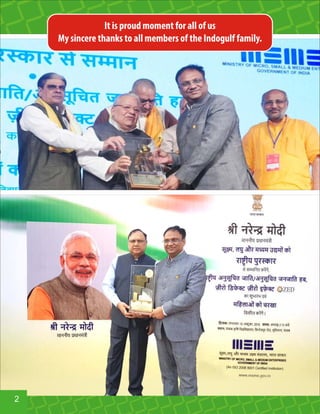
It is proud moment for all of us
My sincere thanks to all members of the Indogulf family.
2
Late Sh. Shri Krishan Dass Aggarwal laid down foundation of the
organization in 1972 with determination and commitment to fulfil
the requirements of the farmer by providing them the world class
productataffordableprice.
The Legend
Late Sh. Shri Krishan Dass Aggarwal
Founder
Shri Om Prakash Aggarwal
Group Chairman
INDOGULF CROPSCIENCES LTD.
Indogulf Cropsciences Ltd. (formerly known as Jai Shree Rasayan
Udyog Ltd.) was established by Shri Om Prakash Aggarwal,
having vision of modern agriculture technology for higher
production of good grain, vegetable and fruits along with
minimumagronomiclosses.
Chairman
Message
3
DearReaders,
I have immense pleasure in presenting to you the 4th edition of Krishi Mitra. We have updated all the
informationgiveninthelasteditionandalsoincludedmanyrelevanttopics.
Indian Agriculture is on the verge of transformation and we understand our responsibility to help the farmers
adopt the best agricultural practices in order to keep up with the rapid changes in Agricultural knowhow.
KrishiMitraisonesuchtolltohelpfarmersgettheinformationinanEasytounderstandformat.
Thisguidewillalsoimmenselyhelpourchannelpartnersinrecommendingtherightsolutionstothefarmers.
Ourbestqualityproductswillhelpfarmersinimplementingthesesolutiontotheirbestadvantage
ThanksandRegards
SanjayAggarwal
ManagingDirector,IndogulfCropsciencesLtd.
From the Desk of
Group Managing Director
4
Approved by
ECOCERT
INPUTS
IARI1905
Accredited Lab
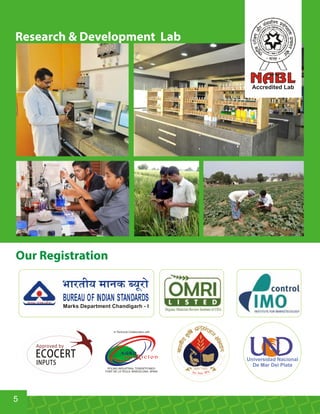
Research  Development Lab
Our Registration
5
Research  Development
Our team is continuously working with over 25 highly qualified and experienced research
scientists focusing on Bio-efficacy and Toxicology studies, Chemistry for development of
newformulation,formulationtypes,packagingmethods andmanufacturingmethods.Our
RD wing interacts closely with the Central Agricultural Research and teaching Institutes
like ICAR, IARI, CRRI, CPRI, TRAI, IPFT etc. as well as State Agricultural Universities like HAU,
PAU  International bodies like Lentiz Educational Group, Holland etc and work in close
coordination with them for the generation of scientific data, evolution of new molecules
and organizingscientific
New state of art the Product  Process R  D center in Nathupur, Haryana is well equipped
with advanced instruments, our technical team have updated knowledge of FAO, BIS, EPA
etc.
Having own Research  Development fields for bio-efficacy  products testing in Delhi,
Punjab, Haryana, Uttar Pardesh, Madya Pradesh, Karnataka  Tamilnadu for doing trials of
new/developedmoleculesonvariouscropsindifferentclimaticzonessoilstructures.
RDcenterandQCLabisNABLaccreditedandinprocessforDSIRGLPaccreditation.
Successfully registered more than 410 formulations for Domestic , 30 Technical Indigenous
mfg.,75forexportsandmanymoreinthepipeline.
Focus Area for R  D:
Ÿ Technology tie-ups for manufacturing of Technical in India.
Ÿ Cooperation for Intermediates and other Raw materials
Ÿ Research  Development tie-up in India.
Ÿ New molecules with least / No residue.
Ÿ Eco friendly products with higher efficacy as per Indian  Global environment.
Our Certifications
6
COSTA RICA
Orlando USA
MALDIVES
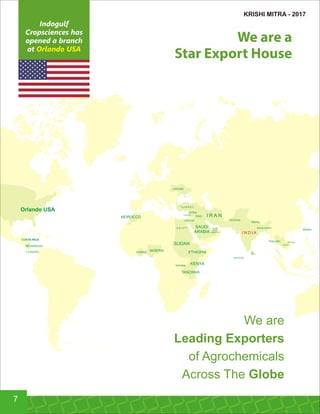
Indogulf
Cropsciences has
opened a branch
at Orlando USA
We are a
Star Export House
We are
Leading Exporters
of Agrochemicals
Across The Globe
7
KRISHI MITRA - 2017
Pesticides and Their Uses
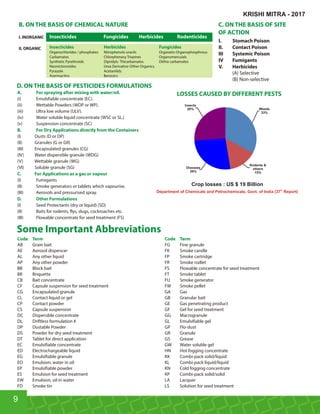
Type Action
Algicides Control algae in lakes, canals, swimming pools, water tanks, and other sites
Antifouling agents Kill or repel organisms that attach to underwater surfaces, such as boat bottoms
Antimicrobials Kill microorganisms (such as bacteria and viruses)
Attractants Attract pests (for example, to lure an insect or rodent to a trap). (However, food is not considered a
pesticide when used as an attractant.)
Biopesticides Biopesticides are certain types of pesticides derived from such natural materials as animals, plants,
bacteria, and certain minerals
Biocides Kill microorganisms
Disinfectants Kill or inactivate disease-producing microorganisms on inanimate objects
and sanitisers
Fungicides Kill fungi (including blights, mildews, molds, and rusts)
Fumigants Produce gas or vapour intended to destroy pests in buildings or soil
Herbicides Kill weeds and other plants that grow where they are not wanted
Insecticides Kill insects and other arthropods
Miticides Kill mites that feed on plants and animals
Microbial pesticides Microorganisms that kill, inhibit, or out compete pests, including insects or other microorganisms
Molluscicides Kill snails and slugs
Nematicides Kill nematodes (microscopic, worm-like organisms that feed on plant roots)
Ovicides Kill eggs of insects and mites
Pheromones Biochemicals used to disrupt the mating behaviour of insects
Repellents Repel pests, including insects (such as mosquitoes) and birds
Rodenticides Control mice and other rodents
FurthertypesofPesticides
Thetermpesticidealsoincludethesesubstances:
Defoliants: Causeleavesorotherfoliagetodropfromaplant,usuallytofacilitateharvest.
Desiccants: Promotedryingoflivingtissues,suchasunwantedplanttops.
Insectgrowthregulators: Disruptthemolting,maturityfrompupalstagetoadult,orotherlifeprocessesofinsects.
Plantgrowthregulators: Substances (excluding fertilizers or other plant nutrients) that alter the expected growth, flowering, or
reproductionrateofplants.
Categorization of Pesticides
A. ON THE BASIS OF TARGET SPECIES
I. MICRO-ORGANISM
II. INSECTS
III. RODENTS
IV. NEMATODES
V. BIRDS
VI. PLANTS
Fungi
Algae
Bacteria
Fungicides
Algicide
Bactericide
Mites  Ticks
Others
Accaricides or Miticides
Insecticide
Rats Rodenticide
Nematicides
Avicides
Weedicides or HerbicidesHerbs
Nematods
Birds
8
INDOGULF CROPSCIENCES LTD.
B. ON THE BASIS OF CHEMICAL NATURE
I. INORGANIC
II. ORGANIC
Insecticides Fungicides Rodenticides
Insecticides
Organochlorides / phosphates
Carbamates
Synthetic Pyrethroids
Neonictionoides
Pyrazole
Avermactins
Herbicides
Nitrophenols-uracils
Chlorphenaxy Triazines
Dipridyls- Thicarbamates
Urea Derivative-Other Organics.
Acetanilids
Benzoics
Fungicides
Organatis-Organophosphrous
Organomercuials
Dithio carbamates
I. Stomach Poison
II. Contact Poison
III Systemic Poison
IV Fumigants
V. Herbicides
(A) Selective
(B) Non-selective
C. ON THE BASIS OF SITE
OF ACTION
Herbicides
A. For spraying after mixing with water/oil.
(i) Emulsfiable concentrate (EC).
(ii) Wettable Powders (WDP or WP).
(iii) Ultra low volume (ULV).
(iv) Water soluble liquid concentrate (WSC or SL.)
(v) Suspension concentrate (SC)
B. For Dry Applications directly from the Containers
(I) Dusts (D or DP)
(II) Granules (G or GR)
(III) Encapsulated granules (CG)
(IV) Water dispersible granule (WDG)
(V) Wettable granule (WG)
(VI) Soluble granule (SG)
C. For Applications as a gas or vapour
(I) Fumigants
(II) Smoke generators or tablets which vapourise.
(III) Aerosols and pressurised spray.
D. Other Formulations
(I) Seed Protectants (dry or liquid) (SD)
(II) Baits for rodents, flys, slugs, cockroaches etc.
(III) Flowable concentrate for seed treatment (FS)
D. ON THE BASIS OF PESTICIDES FORMULATIONS
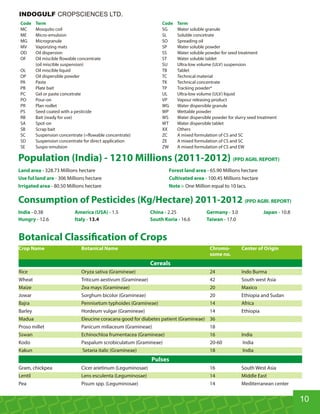
LOSSES CAUSED BY DIFFERENT PESTS
Insects
26% Weeds
33%
Rodents 
others
15%
Diseases
26%
Crop losses : US $ 19 Billion
th
Department of Chemicals and Petrochemicals, Govt. of India (37 Report)
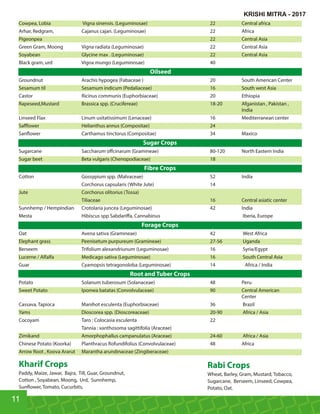
Code Term
AB Grain bait
AE Aerosol dispencer
AL Any other liquid
AP Any other powder
BB Block bait
BR Briquette
CB Bait concentrate
CF Capsule suspension for seed treatment
CG Encapsulated granule
CL Contact liquid or gel
CP Contact powder
CS Capsule suspension
DC Dispersible concentrate
DL Driftless formulation #
DP Dustable Powder
DS Powder for dry seed treatment
DT Tablet for direct application
EC Emulsifiable concentrate
ED Electrochargeable liquid
EG Emulsifiable granule
EO Emulsion, water in oil
EP Emulsifiable powder
ES Emulsion for seed treatment
EW Emulsion, oil in water
FD Smoke tin
Some Important Abbreviations
Code Term
FG Fine granule
FK Smoke candle
FP Smoke cartridge
FR Smoke rodlet
FS Flowable concentrate for seed treatment
FT Smoke tablet
FU Smoke generator
FW Smoke pellet
GA Gas
GB Granular bait
GE Gas penetrating product
GF Gel for seed treatment
GG Macrogranule
GL Emulsifiable gel
GP Flo-dust
GR Granule
GS Grease
GW Water soluble gel
HN Hot fogging concentrate
KK Combi-pack solid/liquid
KL Combi-pack liquid/liquid
KN Cold fogging concentrate
KP Combi-pack solid/solid
LA Lacquer
LS Solution for seed treatment
KRISHI MITRA - 2017
9
Land area - Forest land area -328.73 Millions hectare 65.90 Millions hectare
306 Millions hectare 100.45 Millions hectareUse ful land are - Cultivated area -
80.50 Millions hectare One Million equal to 10 lacs.Irrigated area - Note :-
Population (India) - 1210 Millions (2011-2012) (PPD AGRI. REPORT)
India - America (USA) - China - Germany - Japan -0.38 1.5 2.25 3.0 10.8
Hungry - Italy - South Koria -12.6 13.4 16.6 17.0Taiwan -
Consumption of Pesticides (Kg/Hectare) 2011-2012 (PPD AGRI. REPORT)
Botanical Classi cation of Crops
Crop Name Botanical Name Chromo- Center of Origin
some no.
Cereals
Rice Oryza sativa (Gramineae) 24 Indo Burma
Wheat Triticum aestivum (Gramineae) 42 South west Asia
Maize Zea mays (Gramineae) 20 Maxico
Jowar Sorghum bicolor (Gramineae) 20 Ethiopia and Sudan
Bajra Pennisetum typhoides (Gramineae) 14 Africa
Barley Hordeum vulgar (Gramineae) 14 Ethiopia
Madua Eleucine coracana good for diabetes patient (Gramineae) 36
Proso millet Panicum miliaceum (Gramineae) 18
Sswan Echinochloa frumentacea (Gramineae) 16 India
Kodo Paspalum scrobiculatum (Gramineae) 20-60 India
Kakun Setaria italic (Gramineae) 18 India
Pulses
Gram, chickpea Cicer arietinum (Leguminosae) 16 South West Asia
Lentil Lens esculenta (Leguminosae) 14 Middle East
Pea Pisum spp. (Leguminosae) 14 Mediterranean center
10
INDOGULF CROPSCIENCES LTD.
Code Term
MC Mosquito coil
ME Micro-emulsion
MG Microgranule
MV Vaporizing mats
OD Oil dispersion
OF Oil miscible flowable concentrate
(oil miscible suspension)
OL Oil miscible liquid
OP Oil dispersible powder
PA Paste
PB Plate bait
PC Gel or paste concetrate
PO Pour-on
PR Plan rodlet
PS Seed coated with a pesticide
RB Bait (ready for use)
SA Spot-on
SB Scrap bait
SC Suspension concentrate (=flowable concentrate)
SD Suspension concentrate for direct application
SE Suspo-emulsion
Code Term
SG Water soluble granule
SL Soluble concetrate
SO Spreading oil
SP Water soluble powder
SS Water soluble powder for seed treatment
ST Water soluble tablet
SU Ultra-low volume (ULV) suspension
TB Tablet
TC Technical material
TK Technical concentrate
TP Tracking powder*
UL Ultra-low volume (ULV) liquid
VP Vapour releasing product
WG Water dispersible granule
WP Wettable powder
WS Water dispersible powder for slurry seed treatment
WT Water dispersible tablet
XX Others
ZC A mixed formulation of CS and SC
ZE A mixed formulation of CS and SC
ZW A mixed formulation of CS and EW
Cowpea, Lobia Vigna sinensis. (Leguminosae) 22 Central africa
Arhar, Redgram, Cajanus cajan. (Leguminosae) 22 Africa
Pigeonpea 22 Central Asia
Green Gram, Moong Vigna radiata (Leguminosae) 22 Central Asia
Soyabean Glycine max . (Leguminosae) 22 Central Asia
Black gram, urd Vigna mungo (Leguminosae) 40
Oilseed
Groundnut Arachis hypogea (Fabaceae ) 20 South American Center
Sesamum til Sesamum indicum (Pedaliaceae) 16 South west Asia
Castor Ricinus communis (Euphorbiaceae) 20 Ethiopia
Rapeseed,Mustard Brassica spp. (Crucifereae) 18-20 Afganistan , Pakistan ,
India
Linseed Flax Linum usitatissimum (Lenaceae) 16 Mediterranean center
Safflower Helianthus annus (Compositae) 24
San ower Carthamus tinctorus (Compositae) 34 Maxico
Sugar Crops
Sugarcane Saccharum offcinarum (Gramineae) 80-120 North Eastern India
Sugar beet Beta vulgaris (Chenopodiaceae) 18
Fibre Crops
Cotton Gossypium spp. (Malvaceae) 52 India
Corchorus capsularis (White Jute) 14
Jute Corchorus olitorius (Tossa)
Tiliaceae 16 Central asiatic center
Sunnhemp / HempIndian Crotolaria juncea (Leguminosae) 42 India
Mesta Hibiscus spp Sabdariffa, Cannabinus Iberia, Europe
Forage Crops
Oat Avena sativa (Gramineae) 42 West Africa
Elephant grass Peenisetum purpureum (Gramineae) 27-56 Uganda
Berseem Trifolium alexandriunum (Leguminosae) 16 Syria/Egypt
Lucerne / Alfalfa Medicago sativa (Leguminosae) 16 South Central Asia
Guar Cyamopsis tetragonoloba (Leguminosae) 14 Africa / India
Root and Tuber Crops
Potato Solanum tuberosum (Solanaceae) 48 Peru
Sweet Potato Ipomea batatas (Convolvulaceae) 90 Central American
Center
Cassava, Tapioca Manihot esculenta (Euphorbiaceae) 36 Brazil
Yams Dioscorea spp. (Dioscoreaceae) 20-90 Africa / Asia
Cocoyam Taro : Colocasia esculenta 22
Tannia : xanthosoma sagittifolia (Araceae)
Zimikand Amorphophallus campanulatus (Araceae) 24-60 Africa / Asia
Chinese Potato (Koorka) Planthracus Rofundifolius (Convolvulaceae) 48 Africa
Arrow Root , Koova Ararut Marantha arundinaceae (Zingiberaceae)
Kharif Crops
Paddy, Maize, Jawar, Bajra, Till, Guar, Groundnut,
Cotton , Soyabean, Moong, Urd, Sunnhemp,
Sunflower, Tomato, Cucurbits,
Rabi Crops
Wheat, Barley, Gram, Mustard, Tobacco,
Sugarcane, Berseem, Linseed, Cowpea,
Potato, Oat.
11
KRISHI MITRA - 2017
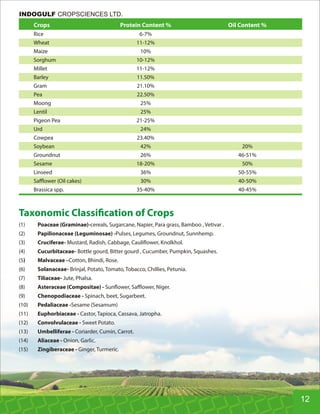
Crops Protein Content % Oil Content %
Rice 6-7%
Wheat 11-12%
Maize 10%
Sorghum 10-12%
Millet 11-12%
Barley 11.50%
Gram 21.10%
Pea 22.50%
Moong 25%
Lentil 25%
Pigeon Pea 21-25%
Urd 24%
Cowpea 23.40%
Soybean 42% 20%
Groundnut 26% 46-51%
Sesame 18-20% 50%
Linseed 36% 50-55%
Safflower (Oil cakes) 30% 40-50%
Brassica spp. 35-40% 40-45%
Taxonomic Classi cation of Crops
(1) Poaceae (Graminae)-cereals, Sugarcane, Napier, Para grass, Bamboo , Vetivar .
(2) Papilionaceae (Leguminosae) -Pulses, Legumes, Groundnut, Sunnhemp.
(3) Cruciferae- Mustard, Radish, Cabbage, Cauli ower, Knolkhol.
(4) Cucurbitaceae- Bottle gourd, Bitter gourd , Cucumber, Pumpkin, Squashes.
(5) Malvaceae –Cotton, Bhindi, Rose.
(6) Solanaceae- Brinjal, Potato, Tomato, Tobacco, Chillies, Petunia.
(7) Tiliaceae- Jute, Phalsa.
(8) Asteraceae (Compositae) - Sun ower, Safflower, Niger.
(9) Chenopodiaceae - Spinach, beet, Sugarbeet.
(10) Pedaliaceae -Sesame (Sesamum)
(11) Euphorbiaceae - Castor, Tapioca, Cassava, Jatropha.
(12) Convolvulaceae - Sweet Potato.
(13) Umbelliferae - Coriarder, Cumin, Carrot.
(14) Aliaceae - Onion, Garlic.
(15) Zingiberaceae - Ginger, Turmeric.
12
INDOGULF CROPSCIENCES LTD.
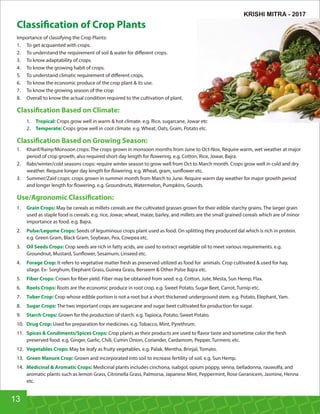
Classi cation of Crop Plants
Importance of classifying the Crop Plants:
1. To get acquainted with crops.
2. To understand the requirement of soil  water for different crops.
3. To know adaptability of crops.
4. To know the growing habit of crops.
5. To understand climatic requirement of different crops.
6. To know the economic produce of the crop plant  its use.
7. To know the growing season of the crop
8. Overall to know the actual condition required to the cultivation of plant.
Classi cation Based on Climate:
1. Crops grow well in warm  hot climate. e.g. Rice, sugarcane, Jowar etcTropical:
2. Crops grow well in cool climate. e.g. Wheat, Oats, Gram, Potato etc.Temperate:
Classi cation Based on Growing Season:
1. Kharif/Rainy/Monsoon crops: The crops grown in monsoon months from June to Oct-Nov, Require warm, wet weather at major
period of crop growth, also required short day length for owering. e.g. Cotton, Rice, Jowar, Bajra.
2. Rabi/winter/cold seasons crops: require winter season to grow well from Oct to March month. Crops grow well in cold and dry
weather. Require longer day length for owering. e.g. Wheat, gram, sun ower etc.
3. Summer/Zaid crops: crops grown in summer month from March to June. Require warm day weather for major growth period
and longer length for owering. e.g. Groundnuts, Watermelon, Pumpkins, Gourds.
Use/Agronomic Classi cation:
1. May be cereals as millets cereals are the cultivated grasses grown for their edible starchy grains. The larger grainGrain Crops:
used as staple food is cereals. e.g. rice, Jowar, wheat, maize, barley, and millets are the small grained cereals which are of minor
importance as food. e.g. Bajra.
2. Seeds of leguminous crops plant used as food. On splitting they produced dal which is rich in protein.Pulse/Legume Crops:
e.g. Green Gram, Black Gram, Soybean, Pea, Cowpea etc.
3. Crop seeds are rich in fatty acids, are used to extract vegetable oil to meet various requirements. e.g.Oil Seeds Crops:
Groundnut, Mustard, Sun ower, Sesamum, Linseed etc.
4. It refers to vegetative matter fresh as preserved utilized as food for animals. Crop cultivated  used for hay,Forage Crop:
silage. Ex- Sorghum, Elephant Grass, Guinea Grass, Berseem  Other Pulse Bajra etc.
5. Crown for ber yield. Fiber may be obtained from seed. e.g. Cotton, Jute, Mesta, Sun Hemp, Flax.Fiber Crops:
6. Roots are the economic produce in root crop. e.g. Sweet Potato, Sugar Beet, Carrot, Turnip etc.Roots Crops:
7. Crop whose edible portion is not a root but a short thickened underground stem. e.g. Potato, Elephant, Yam.Tuber Crop:
8. The two important crops are sugarcane and sugar beet cultivated for production for sugar.Sugar Crops:
9. Grown for the production of starch. e.g. Tapioca, Potato, Sweet Potato.Starch Crops:
10. Used for preparation for medicines. e.g. Tobacco, Mint, Pyrethrum.Drug Crop:
11. Crop plants as their products are used to avor taste and sometime color the freshSpices  Condiments/Spices Crops:
preserved food. e.g. Ginger, Garlic, Chili, Cumin Onion, Coriander, Cardamom, Pepper, Turmeric etc.
12. May be leafy as fruity vegetables. e.g. Palak, Mentha, Brinjal, Tomato.Vegetables Crops:
13. Grown and incorporated into soil to increase fertility of soil. e.g. Sun Hemp.Green Manure Crop:
14. Medicinal plants includes cinchona, isabgol, opium poppy, senna, belladonna, rauwolfa, andMedicinal  Aromatic Crops:
aromatic plants such as lemon Grass, Citronella Grass, Palmorsa, Japanese Mint, Peppermint, Rose Geranicem, Jasmine, Henna
etc.
13
KRISHI MITRA - 2017
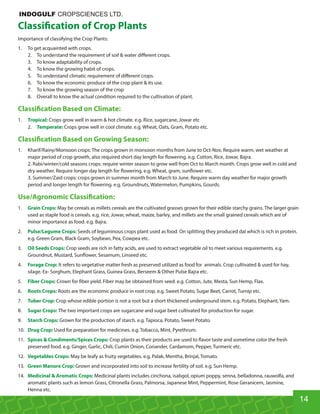
Classi cation of Crop Plants
Importance of classifying the Crop Plants:
1. To get acquainted with crops.
2. To understand the requirement of soil  water different crops.
3. To know adaptability of crops.
4. To know the growing habit of crops.
5. To understand climatic requirement of different crops.
6. To know the economic produce of the crop plant  its use.
7. To know the growing season of the crop
8. Overall to know the actual condition required to the cultivation of plant.
Classi cation Based on Climate:
1. Crops grow well in warm  hot climate. e.g. Rice, sugarcane, Jowar etcTropical:
2. Crops grow well in cool climate. e.g. Wheat, Oats, Gram, Potato etc.Temperate:
Classi cation Based on Growing Season:
1. Kharif/Rainy/Monsoon crops: The crops grown in monsoon months from June to Oct-Nov, Require warm, wet weather at
major period of crop growth, also required short day length for owering. e.g. Cotton, Rice, Jowar, Bajra.
2. Rabi/winter/cold seasons crops: require winter season to grow well from Oct to March month. Crops grow well in cold and
dry weather. Require longer day length for owering. e.g. Wheat, gram, sun ower etc.
3. Summer/Zaid crops: crops grown in summer month from March to June. Require warm day weather for major growth
period and longer length for owering. e.g. Groundnuts, Watermelon, Pumpkins, Gourds.
Use/Agronomic Classi cation:
1. May be cereals as millets cereals are the cultivated grasses grown for their edible starchy grains. The larger grainGrain Crops:
used as staple food is cereals. e.g. rice, Jowar, wheat, maize, barley, and millets are the small grained cereals which are of
minor importance as food. e.g. Bajra.
2. Seeds of leguminous crops plant used as food. On splitting they produced dal which is rich in protein.Pulse/Legume Crops:
e.g. Green Gram, Black Gram, Soybean, Pea, Cowpea etc.
3. Crop seeds are rich in fatty acids, are used to extract vegetable oil to meet various requirements. e.g.Oil Seeds Crops:
Groundnut, Mustard, Sun ower, Sesamum, Linseed etc.
4. It refers to vegetative matter fresh as preserved utilized as food for animals. Crop cultivated  used for hay,Forage Crop:
silage. Ex- Sorghum, Elephant Grass, Guinea Grass, Berseem  Other Pulse Bajra etc.
5. Crown for ber yield. Fiber may be obtained from seed. e.g. Cotton, Jute, Mesta, Sun Hemp, Flax.Fiber Crops:
6. Roots are the economic produce in root crop. e.g. Sweet Potato, Sugar Beet, Carrot, Turnip etc.Roots Crops:
7. Crop whose edible portion is not a root but a short thickened underground stem. e.g. Potato, Elephant, Yam.Tuber Crop:
8. The two important crops are sugarcane and sugar beet cultivated for production for sugar.Sugar Crops:
9. Grown for the production of starch. e.g. Tapioca, Potato, Sweet Potato.Starch Crops:
10. Used for preparation for medicines. e.g. Tobacco, Mint, Pyrethrum.Drug Crop:
11. Crop plants as their products are used to avor taste and sometime color the freshSpices  Condiments/Spices Crops:
preserved food. e.g. Ginger, Garlic, Chili, Cumin Onion, Coriander, Cardamom, Pepper, Turmeric etc.
12. May be leafy as fruity vegetables. e.g. Palak, Mentha, Brinjal, Tomato.Vegetables Crops:
13. Grown and incorporated into soil to increase fertility of soil. e.g. Sun Hemp.Green Manure Crop:
14. Medicinal plants includes cinchona, isabgol, opium poppy, senna, belladonna, rauwolfa, andMedicinal  Aromatic Crops:
aromatic plants such as lemon Grass, Citronella Grass, Palmorsa, Japanese Mint, Peppermint, Rose Geranicem, Jasmine,
Henna etc.
14
INDOGULF CROPSCIENCES LTD.
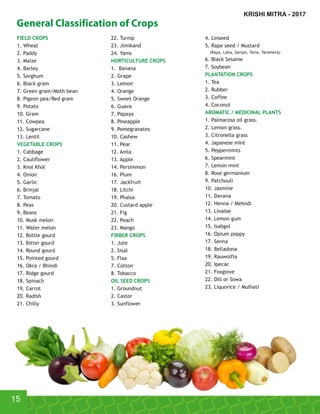
FIELD CROPS
1. Wheat
2. Paddy
3. Maize
4. Barley
5. Sorghum
6. Black gram
7. Green gram/Moth bean
8. Pigeon pea/Red gram
9. Potato
10. Gram
11. Cowpea
12. Sugarcane
13. Lentil
VEGETABLE CROPS
1. Cabbage
2. Cauliflower
3. Knol Khol
4. Onion
5. Garlic
6. Brinjal
7. Tomato
8. Peas
9. Beans
10. Musk melon
11. Water melon
12. Bottle gourd
13. Bitter gourd
14. Round gourd
15. Pointed gourd
16. Okra / Bhindi
17. Ridge gourd
18. Spinach
19. Carrot
20. Radish
21. Chilly
22. Turnip
23. Jimikand
24. Yams
HORTICULTURE CROPS
1. Banana
2. Grape
3. Lemon
4. Orange
5. Sweet Orange
6. Guava
7. Papaya
8. Pineapple
9. Pomegranates
10. Cashew
11. Pear
12. Amla
13. Apple
14. Persimmon
16. Plum
17. Jackfruit
18. Litchi
19. Phalsa
20. Custard apple
21. Fig
22. Peach
23. Mango
FIBBER CROPS
1. Jute
2. Sisal
5. Flax
7. Cotton
8. Tobacco
OIL SEED CROPS
1. Groundnut
2. Castor
3. Sunflower
4. Linseed
5. Rape seed / Mustard
(Raya, Laha, Sarson, Toria, Taramera)
6. Black Sesame
7. Soybean
PLANTATION CROPS
1. Tea
2. Rubber
3. Coffee
4. Coconut
AROMATIC / MEDICINAL PLANTS
1. Palmarosa oil grass.
2. Lemon grass.
3. Citronella grass
4. Japanese mint
5. Peppermints
6. Spearmint
7. Lemon mint
8. Rose germanium
9. Patchouli
10. Jasmine
11. Davana
12. Henna / Mehndi
13. Linaloe
14. Lemon gum
15. Isabgol
16. Opium poppy
17. Senna
18. Belladona
19. Rauwolfia
20. Ipecac
21. Foxgiove
22. Dill or Sowa
23. Liquorice / Mulhati
General Classification of Crops
15
KRISHI MITRA - 2017
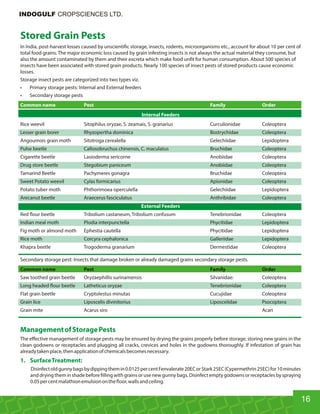
Stored Grain Pests
In India, post-harvest losses caused by unscienti c storage, insects, rodents, microorganisms etc., account for about 10 per cent of
total food grains. The major economic loss caused by grain infesting insects is not always the actual material they consume, but
also the amount contaminated by them and their excreta which make food un t for human consumption. About 500 species of
insects have been associated with stored grain products. Nearly 100 species of insect pests of stored products cause economic
losses.
Storage insect pests are categorized into two types viz.
• Primary storage pests: Internal and External feeders
• Secondary storage pests cts that damages sound grains are primary storage pests
Common name Pest Family Order
Internal Feeders
Rice weevil Sitophilus oryzae, S. zeamais, S. granarius Curculionidae Coleoptera
Lesser grain borer Rhyzopertha dominica Bostrychidae Coleoptera
Angoumois grain moth Sitotroga cerealella Gelechiidae Lepidoptera
Pulse beetle Callosobruchus chinensis, C. maculatus Bruchidae Coleoptera
Cigarette beetle Lasioderma sericorne Anobiidae Coleoptera
Drug store beetle Stegobium paniceum Anobiidae Coleoptera
Tamarind Beetle Pachymeres gonagra Bruchidae Coleoptera
Sweet Potato weevil Cylas formicarius Apionidae Coleoptera
Potato tuber moth Phthorimoea operculella Gelechiidae Lepidoptera
Arecanut beetle Araecerus fasciculatus Anthribidae Coleoptera
External Feeders
Red our beetle Tribolium castaneum, Tribolium confusum Tenebrionidae Coleoptera
Indian meal moth Plodia interpunctella Phycitidae Lepidoptera
Fig moth or almond moth Ephestia cautella Phycitidae Lepidoptera
Rice moth Corcyra cephalonica Galleriidae Lepidoptera
Khapra beetle Trogoderma granarium Dermestidae Coleoptera
Secondary storage pest: Insects that damage broken or already damaged grains secondary storage pests.
Common name Pest Family Order
Saw toothed grain beetle Oryzaephillis surinamensis Silvanidae: Coleoptera
Long headed our beetle Latheticus oryzae Tenebrionidae Coleoptera
Flat grain beetle Cryptolestus minutas Cucujidae Coleoptera
Grain lice Liposcelis divinitorius Liposcelidae Psocoptera
Grain mite Acarus siro Acari
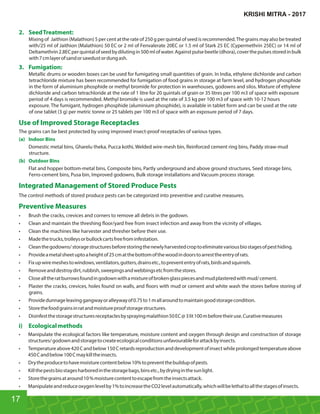
ManagementofStoragePests
The effective management of storage pests may be ensured by drying the grains properly before storage, storing new grains in the
clean godowns or receptacles and plugging all cracks, crevices and holes in the godowns thoroughly. If infestation of grain has
alreadytakenplace,thenapplicationofchemicalsbecomesnecessary.
1. SurfaceTreatment:
Disinfectoldgunnybagsbydippingthemin0.0125percentFenvalerate20ECorStark25EC(Cypermethrin25EC)for10minutes
anddryingtheminshadebefore llingwithgrainsorusenewgunnybags.Disinfectemptygodownsorreceptaclesbyspraying
0.05percentmalathionemulsiononthe oor,wallsandceiling.
16
INDOGULF CROPSCIENCES LTD.
2. SeedTreatment:
Mixing of Jaithion (Malathion) 5 per cent at the rate of 250 g per quintal of seed is recommended.The grains may also be treated
with/25 ml of Jaithion (Malathion) 50 EC or 2 ml of Fenvalerate 20EC or 1.5 ml of Stark 25 EC (Cypermethrin 25EC) or 14 ml of
Deltamethrin 2.8ECperquintalofseedbydilutingin500mlofwater.Againstpulsebeetle(dhora),coverthepulsesstoredinbulk
with7cmlayerofsandorsawdustordungash.
3. Fumigation:
Metallic drums or wooden boxes can be used for fumigating small quantities of grain. In India, ethylene dichloride and carbon
tetrachloride mixture has been recommended for fumigation of food grains in storage at farm level, and hydrogen phosphide
in the form of aluminium phosphide or methyl bromide for protection in warehouses, godowns and silos. Mixture of ethylene
dichloride and carbon tetrachloride at the rate of 1 litre for 20 quintals of grain or 35 litres per 100 m3 of space with exposure
period of 4 days is recommended. Methyl bromide is used at the rate of 3.5 kg per 100 m3 of space with 10-12 hours
exposure. The fumigant, hydrogen phosphide (aluminium phosphide), is available in tablet form and can be used at the rate
of one tablet (3 g) per metric tonne or 25 tablets per 100 m3 of space with an exposure period of 7 days.
Use of Improved Storage Receptacles
The grains can be best protected by using improved insect-proof receptacles of various types.
(a) Indoor Bins
Domestic metal bins, Gharelu theka, Pucca kothi, Welded wire-mesh bin, Reinforced cement ring bins, Paddy straw-mud
structure.
(b) Outdoor Bins
Flat and hopper bottom-metal bins, Composite bins, Partly underground and above ground structures, Seed storage bins,
Ferro-cement bins, Pusa bin, Improved godowns, Bulk storage installations and Vacuum process storage.
Integrated Management of Stored Produce Pests
The control methods of stored produce pests can be categorized into preventive and curative measures.
Preventive Measures
• Brush the cracks, crevices and corners to remove all debris in the godown.
• Clean and maintain the threshing oor/yard free from insect infection and away from the vicinity of villages.
• Clean the machines like harvester and thresher before their use.
• Madethetrucks,trolleysorbullockcartsfreefrominfestation.
• Cleanthegodowns/storagestructuresbeforestoringthenewlyharvestedcroptoeliminatevariousbiostagesofpesthiding.
• Provideametalsheetuptoaheightof25cmatthebottomofthewoodindoorstoarresttheentryofrats.
• Fixupwiremeshestowindows,ventilators,gutters,drainsetc.,toprevententryofrats,birdsandsquirrels.
• Removeanddestroydirt,rubbish,sweepingsandwebbingsetcfromthestores.
• Closealltheratburrowsfoundingodownwithamixtureofbrokenglasspiecesandmudplasteredwithmud/cement.
• Plaster the cracks, crevices, holes found on walls, and oors with mud or cement and white wash the stores before storing of
grains.
• Providedunnageleavinggangwayoralleywayof0.75to1mallaroundtomaintaingoodstoragecondition.
• Storethefoodgrainsinratandmoistureproofstoragestructures.
• Disinfestthestoragestructuresreceptaclesbysprayingmalathion50EC@3lit100mbeforetheiruse.Curativemeasures
i) Ecologicalmethods
• Manipulate the ecological factors like temperature, moisture content and oxygen through design and construction of storage
structures/godownandstoragetocreateecologicalconditionsunfavourableforattackbyinsects.
• Temperatureabove420Candbelow150Cretardsreproductionanddevelopmentofinsectwhileprolongedtemperatureabove
450Candbelow100Cmaykilltheinsects.
• Drytheproducetohavemoisturecontentbelow10%topreventthebuildupofpests.
• Killthepestsbiostagesharboredinthestoragebags,binsetc.,bydryinginthesunlight.
• Storethegrainsataround10%moisturecontenttoescapefromtheinsectsattack.
• Manipulateandreduceoxygenlevelby1%toincreasetheCO2levelautomatically,whichwillbelethaltoallthestagesofinsects.
17
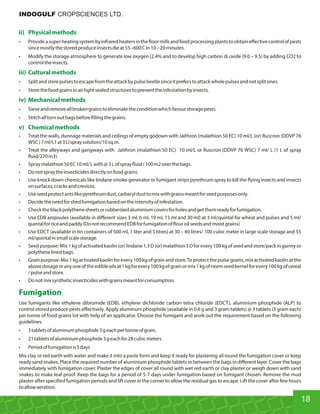
KRISHI MITRA - 2017
ii) Physicalmethods
• Provideasuperheatingsystembyinfraredheatersinthe oormillsandfoodprocessingplantstoobtaineffectivecontrolofpests
sincemostlythestoredproduceinsectsdieat55–600Cin10–20minutes.
• Modify the storage atmosphere to generate low oxygen (2.4% and to develop high carbon di oxide (9.0 – 9.5) by adding CO2 to
controltheinsects.
iii) Culturalmethods
• Splitandstorepulsestoescapefromtheattackbypulsebeetlesinceitpreferstoattackwholepulsesandnotsplitones.
• Storethefoodgrainsinairtightsealedstructurestopreventtheinfestationbyinsects.
iv) Mechanicalmethods
• Sieveandremoveallbrokengrainstoeliminatetheconditionwhichfavourstoragepests.
• Stitchalltornoutbagsbefore llingthegrains.
v) Chemicalmethods
• Treat the walls, dunnage materials and ceilings of empty godown with Jaithron (malathion 50 EC) 10 ml/L (or) Ruscron (DDVP 76
WSC)7ml/L1at3Llspraysolution/10sq.m.
• Treat the alleyways and gangways with Jaithron (malathion 50 EC) 10 ml/L or Ruscron (DDVP 76 WSC) 7 ml/ L (1 L of spray
uid/270m3).
• Spraymalathion50EC10ml/Lwith@3Lofspray uid/100m2overthebags.
• Donotspraytheinsecticidesdirectlyonfoodgrains.
• Use knock down chemicals like lindane smoke generator or fumigant strips pyrethrum spray to kill the ying insects and insects
onsurfaces,cracksandcrevices.
• Useseedprotectantslikepyrethrumdust,carbaryldusttomixwithgrainsmeantforseedpurposesonly.
• Decidetheneedforshedfumigationbasedontheintensityofinfestation.
• Checktheblackpolythenesheetsorrubberizedaluminiumcoversforholesandgetthemreadyforfumigation.
• Use EDB ampoules (available in different sizes 3 ml, 6 ml, 10 ml, 15 ml and 30 ml) at 3 ml/quintal for wheat and pulses and 5 ml/
quintalforriceandpaddy(DonotrecommendEDBforfumigationof ouroilseedsandmoistgrains)
• Use EDCT (available in tin containers of 500 ml, 1 liter and 5 litres) at 30 – 40 litres/ 100 cubic meter in large scale storage and 55
ml/quintalinsmallscalestorage.
• Seedpurpose:Mix1kgofactivatedkaolin(or)lindane1.3D(or)malathion5Dforevery100kgofseedandstore/packingunnyor
polythenelinedbags.
• Grainpurpose:Mix1kgactivatedkaolinforevery100kgofgrainandstore.Toprotectthepulsegrains,mixactivatedkaolinatthe
abovedosageoranyoneoftheedibleoilsat1kgforevery100kgofgrainormix1kgofneemseedkernelforevery100kgofcereal
/pulseandstore.
• Donotmixsyntheticinsecticideswithgrainsmeantforconsumption.
Fumigation
Use fumigants like ethylene dibromide (EDB), ethylene dichloride carbon tetra chloride (EDCT), aluminium phosphide (ALP) to
control stored produce pests effectively. Apply aluminum phosphide (available in 0.6 g and 3 gram tablets) @ 3 tablets (3 gram each)
per tonne of food grains lot with help of an applicator. Choose the fumigant and work out the requirement based on the following
guidelines.
• 3tabletsofaluminumphosphide3geachpertonneofgrain.
• 21tabletsofaluminiumphosphide3geachfor28cubicmeters
• Periodoffumigationis5days
Mix clay or red earth with water and make it into a paste form and keep it ready for plastering all round the fumigation cover or keep
ready sand snakes. Place the required number of aluminium phosphide tablets in between the bags in different layer. Cover the bags
immediately with fumigation cover. Plaster the edges of cover all round with wet red earth or clay plaster or weigh down with sand
snakes to make leaf proof. Keep the bags for a period of 5-7 days under fumigation based on fumigant chosen. Remove the mud
plaster after speci ed fumigation periods and lift cover in the corner to allow the residual gas to escape. Lift the cover after few hours
toallowaeration.
18
INDOGULF CROPSCIENCES LTD.
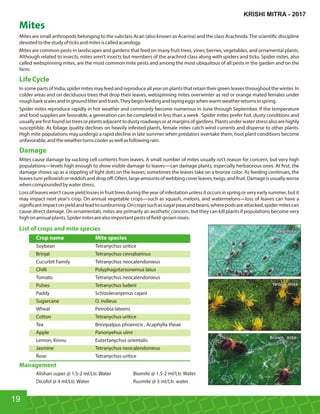
Mites
Mites are small arthropods belonging to the subclass Acari (also known as Acarina) and the class Arachnida.The scienti c discipline
devotedtothestudyofticksandmitesiscalledacarology.
Mites are common pests in landscapes and gardens that feed on many fruit trees, vines, berries, vegetables, and ornamental plants.
Although related to insects, mites aren’t insects but members of the arachnid class along with spiders and ticks. Spider mites, also
called webspinning mites, are the most common mite pests and among the most ubiquitous of all pests in the garden and on the
farm.
LifeCycle
InsomepartsofIndia,spidermitesmayfeedandreproduceallyearonplantsthatretaintheirgreenleavesthroughoutthewinter.In
colder areas and on deciduous trees that drop their leaves, webspinning mites overwinter as red or orange mated females under
roughbarkscalesandingroundlitterandtrash.Theybeginfeedingandlayingeggswhenwarmweatherreturnsinspring.
Spider mites reproduce rapidly in hot weather and commonly become numerous in June through September. If the temperature
and food supplies are favorable, a generation can be completed in less than a week . Spider mites prefer hot, dusty conditions and
usuallyare rstfoundontreesorplantsadjacenttodustyroadwaysoratmarginsofgardens.Plantsunderwaterstressalsoarehighly
susceptible. As foliage quality declines on heavily infested plants, female mites catch wind currents and disperse to other plants.
High mite populations may undergo a rapid decline in late summer when predators overtake them, host plant conditions become
unfavorable,andtheweatherturnscooleraswellasfollowingrain.
Damage
Mites cause damage by sucking cell contents from leaves. A small number of mites usually isn’t reason for concern, but very high
populations—levels high enough to show visible damage to leaves—can damage plants, especially herbaceous ones. At rst, the
damage shows up as a stippling of light dots on the leaves; sometimes the leaves take on a bronze color. As feeding continues, the
leavesturnyellowishorreddishanddropoff.Often,largeamountsofwebbingcoverleaves,twigs,andfruit.Damageisusuallyworse
whencompoundedbywaterstress.
Lossofleaveswon’tcauseyieldlossesinfruittreesduring theyearofinfestationunlessitoccursinspring orveryearly summer,butit
may impact next year’s crop. On annual vegetable crops—such as squash, melons, and watermelons—loss of leaves can have a
signi cantimpactonyieldandleadtosunburning.Oncropssuchassugarpeasandbeans,wherepodsareattacked,spidermitescan
cause direct damage. On ornamentals, mites are primarily an aesthetic concern, but they can kill plants if populations become very
highonannualplants.Spidermitesarealsoimportantpestsof eld-grownroses.
List of crops and mite species
Crop name Mite species
Soybean Tetranychus uritice
Brinjal Tetranychus cinnabarinus
Cucurbit Family Tetranychus neocalendonieus
Chilli Polyphagotarsonemus latus
Tomato Tetranychus neocalendonieus
Pulses Tetranychus ludeni
Paddy Schizoleranyenus cajani
Sugarcane O. indieus
Wheat Petrobia lateens
Cotton Tetranychus uritice
Tea Brevipalpus phoenicis , Acaphylla theae
Apple Panonyehus ulmi
Lemon, Kinnu Eutertanychus orientalis
Jasmine Tetranychus neocalendonieus
Rose Tetranychus uritice
Management
Alishan super @ 1.5-2 ml/Ltr. Water Biomite @ 1.5-2 ml/Ltr. Water
Dicofol @ 4 ml/Ltr. Water Rusmite @ 3 ml/Ltr. water
19
Red miteRed miteRed mite
Yellow miteYellow miteYellow mite
Brown miteBrown miteBrown mite
KRISHI MITRA - 2017
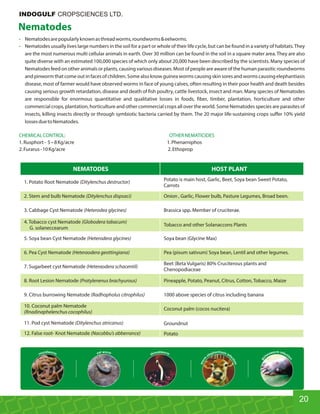
· Nematodesarepopularlyknownasthreadworms,roundwormseelworms.
· Nematodes usually lives large numbers in the soil for a part or whole of their life cycle, but can be found in a variety of habitats.They
are the most numerous multi cellular animals in earth. Over 30 million can be found in the soil in a square mater area. They are also
quite diverse with an estimated 100,000 species of which only about 20,000 have been described by the scientists. Many species of
Nematodes feed on other animals or plants, causing various diseases. Most of people are aware of the human parasitic roundworms
and pinworm thatcome out in faces of children. Some also know guinea worms causing skin sores and worms causing elephantiasis
disease, most of farmer would have observed worms in face of young calves, often resulting in their poor health and death besides
causing serious growth retardation, disease and death of fish poultry, cattle livestock, insect and man. Many species of Nematodes
are responsible for enormous quantitative and qualitative losses in foods, fiber, timber, plantation, horticulture and other
commercial crops, plantation, horticulture and other commercial crops all over the world. Some Nematodes species are parasites of
insects, killing insects directly or through symbiotic bacteria carried by them. The 20 major life-sustaining crops suffer 10% yield
lossesduetoNematodes.
CHEMICALCONTROL: OTHERNEMATICIDES
1.Rusphort- 5–8Kg/acre 1.Phenarniphos
2.Furarus-10Kg/acre 2.Ethoprop
Nematodes
3. Cabbage Cyst Nematode (Heterodea glycines)
4. Tobacco cyst Nematode (Globodera tabacum)
G. solaneccearum
5. Soya bean Cyst Nematode (Heterodera glycines)
6. Pea Cyst Nematode (Heteraodera geottingiana)
7. Sugarbeet cyst Nematode (Heteraodera schacentil)
8. Root Lesion Nematode (Pratylenenus brachyurous)
9. Citrus burrowing Nematode (Radhopholus citrophilus)
10. Coconut palm Nematode
(Rnadinaphelenchus cocophilus)
11. Pod cyst Nematode (Ditylenchus atricanus)
12. False root- Knot Nematode (Nacobbu’s abberrance)
NEMATODES HOST PLANT
Onion , Garlic, Flower bulb, Pasture Legumes, Broad been.
Brassica spp. Member of cruciterae.
Tobacco and other Solanaccons Plants
Soya bean (Glycine Max)
Pea (pisum sativum) Soya bean, Lentil and other legumes.
Beet (Beta Vulgaris) 80% Cruciterous plants and
Chenopodiaceae
Pineapple, Potato, Peanut, Citrus, Cotton, Tobacco, Maize
1000 above species of citrus including banana
Coconut palm (cocos nucitera)
Groundnut
Potato
1. Potato Root Nematode (Ditylenchus destructor) Potato is main host, Garlic, Beet, Soya bean Sweet Potato,
Carrots
2. Stem and bulb Nematode (Ditylenchus dispsaci)
mro inw fea ce tn ii o
n
ug
dwa oe rmrht
wol rmeedwon ru mor
ntiaa sh isp ie nl fe e
c
m
t
r
io
o
n
w
20
INDOGULF CROPSCIENCES LTD.
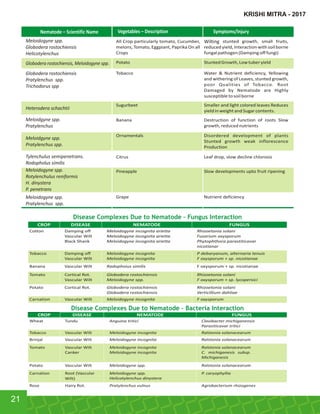
CROP DISEASE NEMATODE FUNGUS
Wheat Tundu Anguina tritici Clavibacter michiganensis
Parasiticavar tritici
Tobacco Vascular Wilt Meloidogyne incognita Ralstonia solanacearum
Brinjal Vascular Wilt Meloidogyne incognita Ralstonia solanacearum
Tomato Vascular Wilt
Canker
Meloidogyne incognita
Ralstonia solanacearum
C. michiganesis subsp.
Michiganesis
Potato Vascular Wilt Meloidogyne spp. Ralstonia solanacearum
Carnation Root (Vascular
Wilt)
Meloidogyne spp.
Helicotylenchus dinystera
P. caryophyllia
Rose Hairy Rot. Pratylenchus vulnus Agrobacterium rhizogenes
CROP DISEASE NEMATODE FUNGUS
Cotton Damping off
Vascular Wilt
Black Shank
Meloidogyne incognita arietta
Rhizoetonia solani
Fusarium oxysporum
Phytophthora parastiticavar
nicotianar
Tobacco Damping off
Vascular Wilt
Meloidogyne incognita
P debaryanum, alternaria tenuis
F oxysporum + sp. nicotianae
Banana Vascular Wilt Radophoius similis F oxysporum + sp. nicotianae
Tomato Cortical Rot.
Vascular Wilt
Globodera rostochiensis
Meloidogyne spp.
Rhizoetonia solani
F oxysporum + sp. lycopersici
Potato Cortical Rot. Globodera rostochiensis
Globodera rostochiensis
Rhizoetonia solani
Verticillium dahliae
Carnation Vascular Wilt Meloidogyne incognita F oxysporum
Disease Complexes Due to Nematode – Bacteria Interaction
Disease Complexes Due to Nematode – Fungus Interaction
Meloidogyne spp.
Globodera rostochiensis
Helicotylenchus
Globodera rostochiensis, Meloidogyne spp.
Globodera rostochiensis
Pratylenchus spp.
Trichodorus spp
Heterodera schachtii
Meloidgyne spp.
Pratylenchus
Meloidgyne spp.
Pratylenchus spp.
Tylenchulus semipenetrans.
Rodopholus similis
Meloidogyne spp.
Rotylenchulus reniformis
H. dinystera
P. penetrans
Meloidogyne spp.
Pratylenchus spp.
21
KRISHI MITRA - 2017
Wilting
Nutrient Classi cation
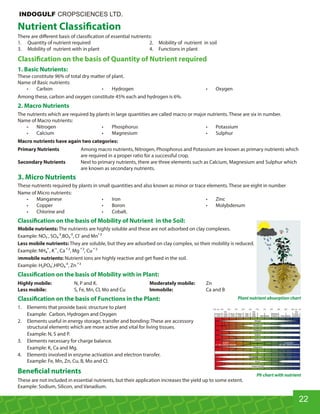
There are different basis of classi cation of essential nutrients:
1. Quantity of nutrient required 2. Mobility of nutrient in soil
3. Mobility of nutrient with in plant 4. Functions in plant
Classi cation on the basis of Quantity of Nutrient required
1. Basic Nutrients:
These constitute 96% of total dry matter of plant.
Name of Basic nutrients:
• Carbon • Hydrogen • Oxygen
Among these, carbon and oxygen constitute 45% each and hydrogen is 6%.
2. Macro Nutrients
The nutrients which are required by plants in large quantities are called macro or major nutrients. These are six in number.
Name of Macro nutrients:
• Nitrogen • Phosphorus • Potassium
• Calcium • Magnesium • Sulphur
Macro nutrients have again two categories:
Primary Nutrients Among macro nutrients, Nitrogen, Phosphorus and Potassium are known as primary nutrients which
are required in a proper ratio for a successful crop.
Secondary Nutrients Next to primary nutrients, there are three elements such as Calcium, Magnesium and Sulphur which
are known as secondary nutrients.
3. Micro Nutrients
These nutrients required by plants in small quantities and also known as minor or trace elements. These are eight in number
Name of Micro nutrients:
• Manganese • Iron • Zinc
• Copper • Boron • Molybdenum
• Chlorine and • Cobalt.
Classi cation on the basis of Mobility of Nutrient in the Soil:
Mobile nutrients: The nutrients are highly soluble and these are not adsorbed on clay complexes.
+
Example: NO₃, SO₄ ,BO₃ , Cl and Mn
Less mobile nutrients: They are soluble, but they are adsorbed on clay complex, so their mobility is reduced.
+ + + + +
Example: NH₄ , K , Ca , Mg , Cu
Immobile nutrients: Nutrient ions are highly reactive and get xed in the soil.
+
Example: H₂PO₄,HPO₄ , Zn
Classi cation on the basis of Mobility with in Plant:
Highly mobile: N, P and K. Moderately mobile: Zn
Less mobile: S, Fe, Mn, Cl, Mo and Cu Immobile: Ca and B
Classi cation on the basis of Functions in the Plant:
1. Elements that provide basic structure to plant
Example: Carbon, Hydrogen and Oxygen
2. Elements useful in energy storage, transfer and bonding: These are accessory
structural elements which are more active and vital for living tissues.
Example: N, S and P.
3. Elements necessary for charge balance.
Example: K, Ca and Mg.
4. Elements involved in enzyme activation and electron transfer.
Example: Fe, Mn, Zn, Cu, B, Mo and Cl.
Bene cial nutrients
These are not included in essential nutrients, but their application increases the yield up to some extent.
Example: Sodium, Silicon, and Vanadium.
22
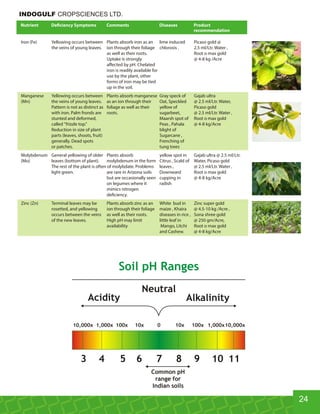
Ph chart with nutrient
Plant nutrient absorption chart
INDOGULF CROPSCIENCES LTD.
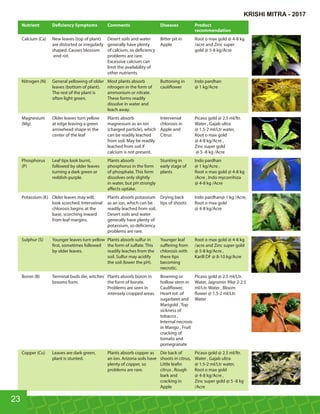
Nutrient De ciency Symptoms Comments Diseases Product
recommendation
Calcium (Ca) New leaves (top of plant) Desert soils and water Bitter pit in Root o max gold @ 4-8 kg
are distorted or irregularly generally have plenty Apple /acre and Zinc super
shaped. Causes blossom of calcium, so de ciency gold @ 5-8 kg/Acre
-end rot. problems are rare.
Excessive calcium can
limit the availability of
other nutrients.
Nitrogen (N) General yellowing of older Most plants absorb Buttoning in Indo pardhan
leaves (bottom of plant). nitrogen in the form of cauli ower @ 1 kg/Acre
The rest of the plant is ammonium or nitrate.
often light green. These forms readily
dissolve in water and
leach away.
Magnesium Older leaves turn yellow Plants absorb Intervenial Picaso gold @ 2.5 ml/ltr.
(Mg) at edge leaving a green magnesium as an ion chlorosis in Water , Gajab ultra
arrowhead shape in the (charged particle), which Apple and @ 1.5-2 ml/Ltr water,
center of the leaf can be readily leached Citrus Root o max gold
from soil. May be readily @ 4-8 kg/Acre ,
leached from soil if Zinc super gold
calcium is not present. @ 5 -8 kg /Acre
Phosphorus Leaf tips look burnt, Plants absorb Stunting in Indo pardhan
(P) followed by older leaves phosphorus in the form early stage of @ 1 kg/Acre ,
turning a dark green or of phosphate. This form plants Root o max gold @ 4-8 kg
reddish-purple. dissolves only slightly /Acre , Indo mycorrihiza
in water, but pH strongly @ 4-8 kg /Acre
affects uptake.
Potassium (K) Older leaves may wilt, Plants absorb potassium Drying back Indo pardhan@ 1 kg /Acre,
look scorched. Interveinal as an ion, which can be tips of shoots Root o max gold
chlorosis begins at the readily leached from soil. @ 4-8 kg/Acre
base, scorching inward Desert soils and water
from leaf margins. generally have plenty of
potassium, so de ciency
problems are rare.
Sulphur (S) Younger leaves turn yellow Plants absorb sulfur in Younger leaf Root o max gold @ 4-8 kg
rst, sometimes followed the form of sulfate. This suffering from /acre and Zinc super gold
by older leaves. readily leaches from the chlorosis with @ 5-8 kg/Acre ,
soil. Sulfur may acidify there tips Karill DF @ 8-10 kg/Acre
the soil (lower the pH). becoming
necrotic.
Boron (B) Terminal buds die, witches' Plants absorb boron in Bowning or Picaso gold @ 2.5 ml/Ltr.
brooms form. the form of borate. hollow stem in Water, Jagromin 99@ 2-2.5
Problems are seen in Cauli ower, ml/Ltr. Water , Bloom
intensely cropped areas. Heart rot of ower @ 1.5-2 ml/Ltr.
sugarbeet and Water
Marigold , Top
sickness of
tobacco ,
Internal necrosis
in Mango , Fruit
cracking of
tomato and
pomegranate
Copper (Cu) Leaves are dark green, Plants absorb copper as Die back of Picaso gold @ 2.5 ml/ltr.
plant is stunted. an ion. Arizona soils have shoots in citrus, Water , Gajab ultra
plenty of copper, so Little lea n @ 1.5-2 ml/Ltr water,
problems are rare. citrus , Rough Root o max gold
bark and @ 4-8 kg/Acre ,
cracking in Zinc super gold @ 5 -8 kg
Apple /Acre
23
KRISHI MITRA - 2017
24
Iron (Fe) Yellowing occurs between Plants absorb iron as an lime induced Picaso gold @
the veins of young leaves. ion through their foliage chlorosis . 2.5 ml/Ltr. Water ,
as well as their roots. Root o max gold
Uptake is strongly @ 4-8 kg /Acre
affected by pH. Chelated
iron is readily available for
use by the plant, other
forms of iron may be tied
up in the soil.
Manganese Yellowing occurs between Plants absorb manganese Gray speck of Gajab ultra
(Mn) the veins of young leaves. as an ion through their Oat, Speckled @ 2.5 ml/Ltr. Water,
Pattern is not as distinct as foliage as well as their yellow of Picaso gold
with iron. Palm fronds are roots. sugarbeet, @ 2.5 ml/Ltr. Water ,
stunted and deformed, Maarsh spot of Root o max gold
called frizzle top. Peas , Pahala @ 4-8 kg/Acre
Reduction in size of plant blight of
parts (leaves, shoots, fruit) Sugarcane ,
generally. Dead spots Frenching of
or patches. tung trees
Molybdenum General yellowing of older Plants absorb yellow spot in Gajab ultra @ 2.5 ml/Ltr.
(Mo) leaves (bottom of plant). molybdenum in the form Citrus , Scald of Water, Picaso gold
The rest of the plant is often of molybdate. Problems leaves , @ 2.5 ml/Ltr. Water ,
light green. are rare in Arizona soils Downward Root o max gold
but are occasionally seen cupping in @ 4-8 kg/Acre
on legumes where it radish
mimics nitrogen
de ciency.
Zinc (Zn) Terminal leaves may be Plants absorb zinc as an White bud in Zinc super gold
rosetted, and yellowing ion through their foliage maize , Khaira @ 4.5-10 kg /Acre ,
occurs between the veins as well as their roots. diseases in rice , Sona shree gold
of the new leaves. High pH may limit little leaf in @ 250 gm/Acre,
availability Mango, Litchi Root o max gold
and Cashew. @ 4-8 kg/Acre
Nutrient De ciency Symptoms Comments Diseases Product
recommendation
Soil pH Ranges
Neutral
Acidity Alkalinity
10,000x 1,000x 100x 10x 0 10x 100x 1,000x10,000x
3 4 5 6 7 8 9 10 11
Common pH
range for
Indian soils
INDOGULF CROPSCIENCES LTD.
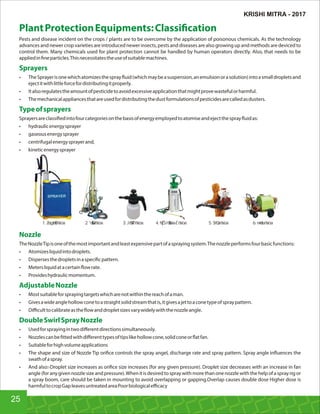
1. ZongoH$ ñào`a 2. w$Q ñào`a 3. JmS©Z ñào`a 4. h¡ÊS H$åàoeZ ñào`a 5. SñQa ñào`a 6. nmda ñào`a
PlantProtectionEquipments:Classi cation
Pests and disease incident on the crops / plants are to be overcome by the application of poisonous chemicals. As the technology
advances and newer crop varieties are introduced newer insects, pests and diseases are also growing up and methods are deviced to
control them. Many chemicals used for plant protection cannot be handled by human operators directly. Also, that needs to be
appliedin neparticles.Thisnecessitatestheuseofsuitablemachines.
Sprayers
• TheSprayerisonewhichatomizesthespray uid(whichmaybeasuspension,anemulsionorasolution)intoasmalldropletsand
ejectitwithlittleforcefordistributingitproperly.
• Italsoregulatestheamountofpesticidetoavoidexcessiveapplicationthatmightprovewastefulorharmful.
• Themechanicalappliancesthatareusedfordistributingthedustformulationsofpesticidesarecalledasdusters.
Typeofsprayers
Sprayersareclassi edintofourcategoriesonthebasisofenergyemployedtoatomiseandejectthespray uidas:
• hydraulicenergysprayer
• gaseousenergysprayer
• centrifugalenergysprayerand,
• kineticenergysprayer
Nozzle
TheNozzleTipisoneofthemostimportantandleastexpensivepartofasprayingsystem.Thenozzleperformsfourbasicfunctions:
• Atomizesliquidintodroplets.
• Dispersesthedropletsinaspeci cpattern.
• Metersliquidatacertain owrate.
• Provideshydraulicmomentum.
AdjustableNozzle
• Mostsuitableforsprayingtargetswhicharenotwithinthereachofaman.
• Givesawideanglehollowconetoastraightsolidstreamthatis,itgivesajettoaconetypeofspraypattern.
• Difficulttocalibrateasthe owanddropletsizesvarywidelywiththenozzleangle.
DoubleSwirlSprayNozzle
• Usedforsprayingintwodifferentdirectionssimultaneously.
• Nozzlescanbe ttedwithdifferenttypesoftipslikehollowcone,solidconeor atfan.
• Suitableforhighvolumeapplications
• The shape and size of Nozzle Tip ori ce controls the spray angel, discharge rate and spray pattern. Spray angle in uences the
swathofaspray.
• And also:-Droplet size increases as ori ce size increases (for any given pressure). Droplet size decreases with an increase in fan
angle (for any given nozzle size and pressure).Whenit is desired to spray with more than one nozzle with the help of a spray rig or
a spray boom, care should be taken in mounting to avoid overlapping or gapping.Overlap causes double dose Higher dose is
harmfultocropGapleavesuntreatedareaPoorbiologicalefficacy
25
KRISHI MITRA - 2017
SelectingASprayNozzle
• Theproperselectionanduseofspraynozzleisthemostimportantpartofpesticideapplication.
• The nozzle determines the amount of spray that is generated over a given area, the uniformity of the spray produced, the
coverageobtainedandtheamountofdriftthatoccurs.
• The nozzle selected must optimize coverage application rate and pressure and minimize loss through drift. For each kind of
application,dependentuptothephysicalconditionsprevailing,adifferentnozzledesignisavailable.
• Nozzle tips are usually available in brass, stainless steel, and engineering plastic. Steel tips are most resistant to corrosion and
abrasion.
• Brasstipsareverycommonlyused,butearoutmoreeasilyandcanbecorrodedbysomechemicals.Engineeringplasticislikelyto
becomethemostserviceablematerialforspraynozzles,beinghighlyresistanttowear-and-tearandcorrosion.
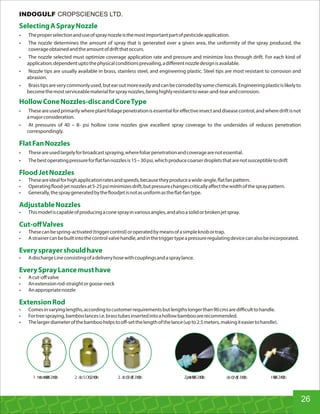
HollowConeNozzles-discandCoreType
• Theseareusedprimarilywhereplantfoliagepenetrationisessentialforeffectiveinsectanddiseasecontrol,andwheredriftisnot
amajorconsideration.
• At pressures of 40 – 8- psi hollow cone nozzles give excellent spray coverage to the undersides of reduces penetration
correspondingly.
FlatFanNozzles
• Theseareusedlargelyforbroadcastspraying,wherefoliarpenetrationandcoveragearenotessential.
• Thebestoperatingpressurefor atfannozzlesis15–30psi,whichproducecoarserdropletsthatarenotsusceptibletodrift
FloodJetNozzles
• Theseareidealforhighapplicationratesandspeeds,becausetheyproduceawide-angle, atfanpattern.
• Operating ood-jetnozzlesat5-25psiminimizesdrift,butpressurechangescriticallyaffectthewidthofthespraypattern.
• Generally,thespraygeneratedbythe oodjetisnotasuniformasthe at-fantype.
AdjustableNozzles
• Thismodeliscapableofproducingaconesprayinvariousangles,andalsoasolidorbrokenjetspray.
Cut-offValves
• Thesecanbespring-activated(triggercontrol)oroperatedbymeansofasimpleknobortrap.
• Astrainercanbebuiltintothecontrolvalvehandle,andinthetriggertypeapressureregulatingdevicecanalsobeincorporated.
Everysprayershouldhave
• AdischargeLineconsistingofadeliveryhosewithcouplingsandaspraylance.
EverySprayLancemusthave
• Acut-offvalve
• Anextensionrod-straightorgoose-neck
• Anappropriatenozzle
ExtensionRod
• Comesinvaryinglengths,accordingtocustomerrequirementsbutlengthslongerthan90cmsaredifficulttohandle.
• Fortreespraying,bamboolancesi.e.brasstubesinsertedintoahollowbambooarerecommended.
• Thelargerdiameterofthebamboohelpstooff-setthelengthofthelance(upto2.5meters,makingiteasiertohandle).
3. âboQ o$Z ZmoOb2. âbS OoQ ZmoOb1. hmobmoH$moZ ZmoOb Z¡amo H$moZ ZmoOb âboQ o$Z ZmoOb H$moZ ZmoOb
26
INDOGULF CROPSCIENCES LTD.
27
KRISHI MITRA - 2017
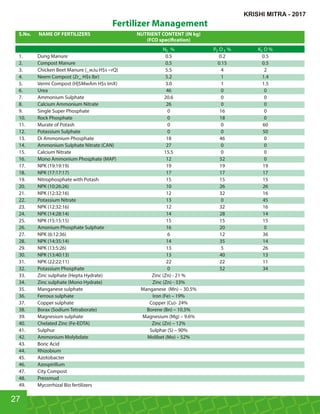
Fertilizer Management
S.No. NAME OF FERTILIZERS NUTRIENT CONTENT (IN kg)
(FCO speci cation)
N % P O % K O %2 2 5 2
1. Dung Manure 0.5 0.2 0.5
2. Compost Manure 0.5 0.15 0.5
3. Chicken Beet Manure (_wJu H$s ~rQ) 5.5 4 2
4. Neem Compost (Zr_ H$s Ibr) 5.2 1 1.4
5. Vermi Compost (H|$MwAm H$s ImX) 3.0 1 1.5
6. Urea 46 0 0
7. Ammonium Sulphate 20.6 0 0
8. Calcium Ammonium Nitrate 26 0 0
9. Single Super Phosphate 0 16 0
10. Rock Phosphate 0 18 0
11. Murate of Potash 0 0 60
12. Potassium Sulphate 0 0 50
13. Di Ammonium Phosphate 18 46 0
14. Ammonium Sulphate Nitrate (CAN) 27 0 0
15. Calcium Nitrate 15.5 0 0
16. Mono Ammonium Phosphate (MAP) 12 52 0
17. NPK (19:19:19) 19 19 19
18. NPK (17:17:17) 17 17 17
19. Nitrophosphate with Potash 15 15 15
20. NPK (10:26:26) 10 26 26
21. NPK (12:32:16) 12 32 16
22. Potassium Nitrate 13 0 45
23. NPK (12:32:16) 12 32 16
24. NPK (14:28:14) 14 28 14
25. NPK (15:15:15) 15 15 15
26. Amonium Phosphate Sulphate 16 20 0
27. NPK (6:12:36) 6 12 36
28. NPK (14:35:14) 14 35 14
29. NPK (13:5:26) 13 5 26
30. NPK (13:40:13) 13 40 13
31. NPK (22:22:11) 22 22 11
32. Potassium Phosphate 0 52 34
33. Zinc sulphate (Hepta Hydrate) Zinc (Zn) - 21 %
34. Zinc sulphate (Mono Hydrate) Zinc (Zn) - 33%
35. Manganese sulphate Manganese (Mn) – 30.5%
36. Ferrous sulphate Iron (Fe) – 19%
37. Copper sulphate Copper (Cu)- 24%
38. Borax (Sodium Tetraborate) Borene (Bn) – 10.5%
39. Magnesium sulphate Magnesium (Mg) – 9.6%
40. Chelated Zinc (Fe-EDTA) Zinc (Zn) – 12%
41. Sulphur Sulphar (S) – 90%
42. Ammonium Molybdate Molibet (Mo) – 52%
43. Boric Acid
44. Rhizobium
45. Azotobacter
46. Azospirillum
47. City Compost
48. Pressmud
49. Mycorrhizal Bio fertilizers
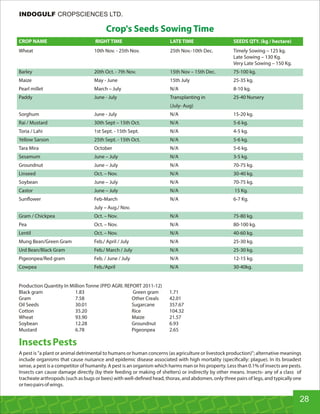
Crop's Seeds Sowing Time
CROP NAME RIGHT TIME LATE TIME SEEDS QTY. (kg / hectare)
Wheat 10th Nov. - 25th Nov. 25th Nov.-10th Dec. Timely Sowing – 125 kg.
Late Sowing – 130 Kg.
Very Late Sowing – 150 Kg.
Barley 20th Oct. - 7th Nov. 15th Nov – 15th Dec. 75-100 kg.
Maize May - June 15th July 25-35 kg.
Pearl millet March – July N/A 8-10 kg.
Paddy June - July Transplanting in 25-40 Nursery
(July- Aug)
Sorghum June - July N/A 15-20 kg.
Rai / Mustard 30th Sept – 15th Oct. N/A 5-6 kg.
Toria / Lahi 1st Sept. - 15th Sept. N/A 4-5 kg.
Yellow Sarson 25th Sept. - 15th Oct. N/A 5-6 kg.
Tara Mira October N/A 5-6 kg.
Sesamum June – July N/A 3-5 kg.
Groundnut June – July N/A 70-75 kg.
Linseed Oct. – Nov. N/A 30-40 kg.
Soybean June – July N/A 70-75 kg.
Castor June – July N/A 15 Kg.
Sun ower Feb-March N/A 6-7 Kg.
July – Aug./ Nov.
Gram / Chickpea Oct. – Nov. N/A 75-80 kg.
Pea Oct. – Nov. N/A 80-100 kg.
Lentil Oct. – Nov. N/A 40-60 kg.
Mung Bean/Green Gram Feb./ April / July N/A 25-30 kg.
Urd Bean/Black Gram Feb./ March / July N/A 25-30 kg.
Pigeonpea/Red gram Feb. / June / July N/A 12-15 kg.
Cowpea Feb./April N/A 30-40kg.
Production Quantity In Million Tonne (PPD AGRI. REPORT 2011-12)
Black gram 1.83 Green gram 1.71
Gram 7.58 Other Creals 42.01
Oil Seeds 30.01 Sugarcane 357.67
Cotton 35.20 Rice 104.32
Wheat 93.90 Maize 21.57
Soybean 12.28 Groundnut 6.93
Mustard 6.78 Pigeonpea 2.65
InsectsPests
A pest is a plant or animal detrimental to humans or human concerns (as agriculture or livestock production); alternative meanings
include organisms that cause nuisance and epidemic disease associated with high mortality (speci cally: plague). In its broadest
sense, a pest is a competitor of humanity. A pest is an organism which harms man or his property. Less than 0.1% of insects are pests.
Insects can cause damage directly (by their feeding or making of shelters) or indirectly by other means. Insects- any of a class of
tracheate arthropods (such as bugs or bees) with well-de ned head, thorax, and abdomen, only three pairs of legs, and typically one
ortwopairsofwings.
28
INDOGULF CROPSCIENCES LTD.
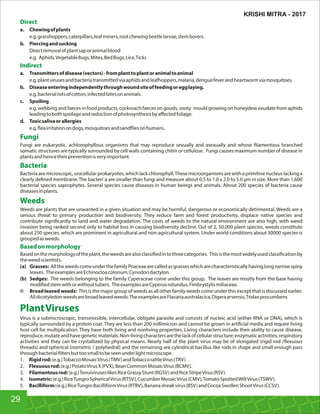
Direct
a. Chewingofplants
e.g.grasshoppers,caterpillars,leafminers,rootchewingbeetlelarvae,stemborers.
b. Piercingandsucking
Directremovalofplantsaporanimalblood
e.g. Aphids,VegetableBugs,Mites,BedBugs,Lice,Ticks
Indirect
a. Transmittersofdisease(vectors)-fromplanttoplantoranimaltoanimal
e.g.plantvirusesandbacteriatransmittedviaaphidsandleafhoppers,malaria,denguefeverandheartwormviamosquitoes.
b. Diseaseenteringindependentlythroughwoundsiteoffeedingoregglaying.
e.g.bacterialrotsofcotton,infectedbitesonanimals.
c. Spoiling
e.g. webbing and faeces in food products, cockroach faeces on goods, sooty mould growing on honeydew exudate from aphids
leadingtobothspoilageandreductionofphotosynthesisbyaffectedfoliage.
d. Toxicsalivaorallergies
e.g. eairritationondogs,mosquitoesandsand iesonhumans.
Fungi
Fungi are eukaryotic, achlorophyllous organisms that may reproduce sexually and asexually and whose lamentous branched
somatic structures are typically surrounded by cell walls containing chitin or cellulose. Fungi causes maximum number of disease in
plantsandhencetheirpreventionisveryimportant.
Bacteria
Bacteriaaremicroscopic,unicellularprokaryotes,whichlackchlorophyll.Thesemicroorganismsarewithaprimitivenucleuslackinga
clearly de ned membrane. The bacteri`a are smaller than fungi and measure about 0.5 to 1.0 x 2.0 to 5.0 μm in size. More than 1,600
bacterial species saprophytes. Several species cause diseases in human beings and animals. About 200 species of bacteria cause
diseasesinplants.
Weeds
Weeds are plants that are unwanted in a given situation and may be harmful, dangerous or economically detrimental. Weeds are a
serious threat to primary production and biodiversity. They reduce farm and forest productivity, displace native species and
contribute signi cantly to land and water degradation. The costs of weeds to the natural environment are also high, with weed
invasion being ranked second only to habitat loss in causing biodiversity decline. Out of 2, 50,000 plant species, weeds constitute
about 250 species, which are prominent in agricultural and non-agricultural system. Under world conditions about 30000 species is
groupedasweeds.
Basedonmorphology
Basedonthemorphologyoftheplant,theweedsarealsoclassi edintothreecategories. Thisisthemostwidelyusedclassi cationby
theweedscientists.
(a) Grasses: AlltheweedscomeunderthefamilyPoaceaearecalledasgrasseswhicharecharacteristicallyhavinglongnarrowspiny
leaves. TheexamplesareEchinocloacolonum,Cynodondactylon.
(b) Sedges: The weeds belonging to the family Cyperaceae come under this group. The leaves are mostly from the base having
modi edstemwithorwithouttubers. TheexamplesareCyperusrotundus,Fimbrystylismiliaceae.
© Broad leaved weeds: This is the major group of weeds as all other family weeds come under this except that is discussed earlier.
Alldicotyledonweedsarebroadleavedweeds.TheexamplesareFlavariaaustralacica,Digeraarvensis,Tridaxprocumbens
PlantViruses
Virus is a submicroscopic, transmissible, intercellular, obligate parasite and consists of nucleic acid (either RNA or DNA), which is
typically surrounded by a protein coat. They are less than 200 millimicron and cannot be grown in arti cial media and require living
host cell for multiplication. They have both living and nonliving properties. Living characters include their ability to cause disease,
reproduce,mutateandhavegeneticmaterials.Non-livingcharactersarethelackofcellularstructure;enzymaticactivities,respiratory
activities and they can be crystallized by physical means. Nearly half of the plant virus may be of elongated (rigid rod / exuous
threads) and spherical (isometric / polyhedral) and the remaining are cylindrical bacillus like rods in shape and small enough pass
throughbacterial ltersbuttoosmalltobeseenunderlightmicroscope.
1. Rigidrod:(e.g.)TobaccoMosaicVirus(TMV)andTobaccorattleVirus(TRV)
2. Flexuousrod:(e.g.)PotatoVirusX(PVX),BeanCommonMosaicVirus(BCMV).
3. Filamentousrod:(e.g.)TenuiviruseslikesRiceGrassyStunt(RGSV)andRiceStripeVirus(RSV).
4. Isometric:(e.g.)RiceTungroSphericalVirus(RTSV),CucumberMosaicVirus(CMV),TomatoSpottedWiltVirus(TSWV).
5. Bacilliform:(e.g.)RiceTungroBacilliformVirus(RTBV),Bananastreakvirus(BSV)andCocoaSwollenShootVirus(CCSV).
29
KRISHI MITRA - 2017
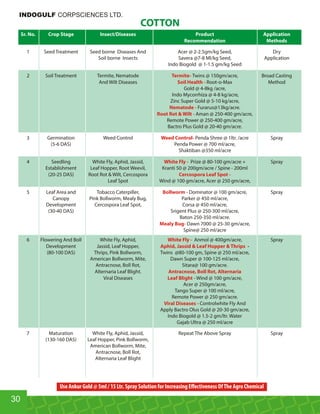
COTTON
Sr. No. Crop Stage Insect/Diseases Product Application
Recommendation Methods
1 Seed Treatment Seed borne Diseases And Acer @ 2-2.5gm/kg Seed, Dry
Soil borne Insects Savera @7-8 Ml/kg Seed, Application
Indo Biogold @ 1-1.5 gm/kg Seed
2 Soil Treatment Termite, Nematode Twins @ 150gm/acre, Broad CastingTermite-
And Wilt Diseases Root-o-Max MethodSoil Health -
Gold @ 4-8kg /acre,
Indo Mycorrhiza @ 4-8 kg/acre,
Zinc Super Gold @ 5-10 kg/acre,
Furarus@13kg/acre.Nematode -
Aman @ 250-400 gm/acre,Root Rot  Wilt -
Remote Power @ 250-400 gm/acre,
Bactro Plus Gold @ 20-40 gm/acre.
3 Germination Weed Control Penda Shree @ 1ltr. /acre SprayWeed Control-
(5-6 DAS) Penda Power @ 700 ml/acre,
Shaktiban @350 ml/acre
4 Seedling White Fly, Aphid, Jassid, Prize @ 80-100 gm/acre + SprayWhite Fly -
Establishment Leaf Hopper, Root Weevil, Kranti 50 @ 200gm/acre / Spine - 200ml
(20-25 DAS) Root Rot  Wilt, Cercospora Cercospora Leaf Spot -
Leaf Spot Wind @ 100 gm/acre, Acer @ 250 gm/acre,
5 Leaf Area and Tobacco Caterpiller, Dominator @ 100 gm/acre, SprayBollworm -
Canopy Pink Bollworm, Mealy Bug, Parker @ 450 ml/acre,
Development Cercospora Leaf Spot, Corsa @ 450 ml/acre,
(30-40 DAS) Srigent Plus @ 250-300 ml/acre,
Baton 250-350 ml/acre.
Dawn 7000 @ 25-30 gm/acre,Mealy Bug-
Spine@ 250 ml/acre
6 Flowering And Boll White Fly, Aphid, Anmol @ 400gm/acre, SprayWhite Fly -
Development Jassid, Leaf Hopper, -Aphid, Jassid  Leaf Hopper  Thrips
(80-100 DAS) Thrips, Pink Bollworm, Twins @80-100 gm, Spine @ 250 ml/acre,
American Bollworm, Mite, Dawn Super @ 100-125 ml/acre,
Antracnose, Boll Rot, Sitara@ 100 gm/acre.
Alternaria Leaf Blight. Antracnose, Boll Rot, Alternaria
Viral Diseases - Wind @ 100 gm/acre,Leaf Blight
Acer @ 250gm/acre,
Tango Super @ 100 ml/acre,
Remote Power @ 250 gm/acre.
Controlwhite Fly AndViral Diseases -
Apply Bactro Olus Gold @ 20-30 gm/acre,
Indo Biogold @ 1.5-2 gm/ltr. Water
Gajab Ultra @ 250 ml/acre
7 Maturation White Fly, Aphid, Jassid, Repeat The Above Spray Spray
(130-160 DAS) Leaf Hopper, Pink Bollworm,
American Bollworm, Mite,
Antracnose, Boll Rot,
Alternaria Leaf Blight
30
INDOGULF CORPSCIENCES LTD.
Use Ankur Gold @ 5ml / 15 Ltr. Spray Solution for Increasing Effectiveness OfThe Agro Chemical
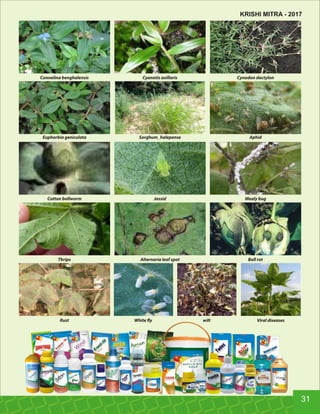
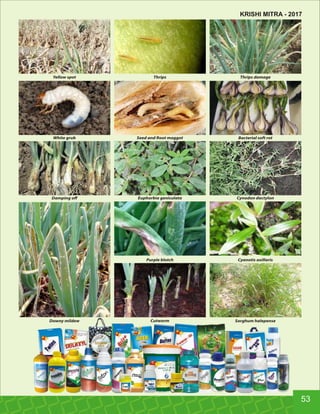
Connelina benghalensis Cyanotis axillaris Cynodon dactylon
Euphorbia geniculata Sorghum_halepense Aphid
Cotton bollworm Jassid Mealy bug
Thrips Alternaria leaf spot Boll rot
Rust White y wilt Viral diseases
31
KRISHI MITRA - 2017
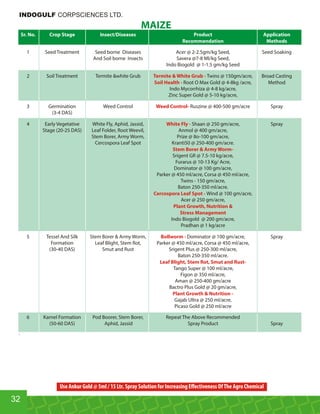
MAIZE
Sr. No. Crop Stage Insect/Diseases Product Application
Recommendation Methods
1 Seed Treatment Seed borne Diseases Acer @ 2-2.5gm/kg Seed, Seed Soaking
And Soil borne Insects Savera @7-8 Ml/kg Seed,
Indo Biogold @ 1-1.5 gm/kg Seed
2 Soil Treatment Termite white Grub Twins @ 150gm/acre, Broad CastingTermite  White Grub -
Root O Max Gold @ 4-8kg /acre, MethodSoil Health -
Indo Mycorrhiza @ 4-8 kg/acre,
Zinc Super Gold @ 5-10 kg/acre,
3 Germination Weed Control Ruszine @ 400-500 gm/acre SprayWeed Control-
(3-4 DAS)
4 Early Vegetative White Fly, Aphid, Jassid, Shaan @ 250 gm/acre, SprayWhite Fly -
Stage (20-25 DAS) Leaf Folder, Root Weevil, Anmol @ 400 gm/acre,
Stem Borer, Army Worm, Prize @ 8o-100 gm/acre,
Cercospora Leaf Spot Kranti50 @ 250-400 gm/acre.
Stem Borer  Army Worm-
Srigent GR @ 7.5-10 kg/acre,
Furarus @ 10-13 Kg/ Acre,
Dominator @ 100 gm/acre,
Parker @ 450 ml/acre, Corsa @ 450 ml/acre,
Twins - 150 gm/acre,
Baton 250-350 ml/acre.
Wind @ 100 gm/acre,Cercospora Leaf Spot -
Acer @ 250 gm/acre,
Plant Growth, Nutrition 
Stress Management
Indo Biogold @ 200 gm/acre,
Pradhan @ 1 kg/acre
5 Tessel And Silk Stem Borer  Army Worm, Dominator @ 100 gm/acre, SprayBollworm -
Formation Leaf Blight, Stem Rot, Parker @ 450 ml/acre, Corsa @ 450 ml/acre,
(30-40 DAS) Smut and Rust Srigent Plus @ 250-300 ml/acre,
Baton 250-350 ml/acre.
Leaf Blight, Stem Rot, Smut and Rust-
Tango Super @ 100 ml/acre,
Figon @ 350 ml/acre,
Aman @ 250-400 gm/acre
Bactro Plus Gold @ 20 gm/acre,
Plant Growth  Nutrition -
Gajab Ultra @ 250 ml/acre,
Picaso Gold @ 250 ml/acre
6 Karnel Formation Pod Boorer, Stem Borer, Repeat The Above Recommended
(50-60 DAS) Aphid, Jassid Spray Product Spray
`
32
INDOGULF CORPSCIENCES LTD.
Use Ankur Gold @ 5ml / 15 Ltr. Spray Solution for Increasing Effectiveness OfThe Agro Chemical
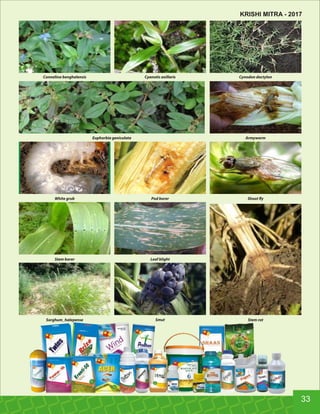
Connelina benghalensis Cyanotis axillaris Cynodon dactylon
Euphorbia geniculata Armyworm
White grub Pod borer Shoot y
Stem borer Leaf blight
Sorghum_halepense Smut Stem rot
33
KRISHI MITRA - 2017
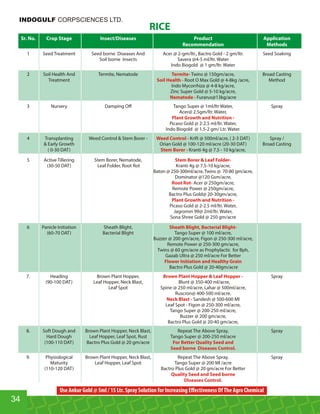
RICE
Sr. No. Crop Stage Insect/Diseases Product Application
Recommendation Methods
1 Seed Treatment Seed borne Diseases And Acer @ 2-gm/ltr., Bactro Gold - 2 gm/ltr. Seed Soaking
Soil borne Insects Savera @4-5 ml/ltr. Water
Indo Biogold @ 1 gm/ltr. Water
2 Soil Health And Termite, Nematode Twins @ 150gm/acre, Broad CastingTermite-
Treatment Root O Max Gold @ 4-8kg /acre, MethodSoil Health -
Indo Mycorrhiza @ 4-8 kg/acre,
Zinc Super Gold @ 5-10 kg/acre,
Furarus@13kg/acreNematode -
3 Nursery Damping Off Tango Super @ 1ml/ltr Water, Spray
Acer@ 2.5gm/ltr. Water,
Plant Growth and Nutrition -
Picaso Gold @ 2-2.5 ml/ltr. Water,
Indo Biogold @ 1.5-2 gm/ Ltr. Water.
4 Transplanting Weed Control  Stem Borer - Krift @ 500ml/acre, ( 2-3 DAT) Spray /Weed Control -
 Early Growth Orian Gold @ 100-120 ml/acre (20-30 DAT) Broad Casting
( 0-30 DAT) Kranti 4g @ 7.5 - 10 kg/acre,Stem Borer -
5 Active Tillering Stem Borer, Nematode, Stem Borer  Leaf Folder-
(30-50 DAT) Leaf Folder, Root Rot Kranti 4g @ 7.5-10 kg/acre,
Baton @ 250-300ml/acre,Twins @ 70-80 gm/acre,
Dominator @120 Gsm/acre,
Acer @ 250gm/acre,Root Rot-
Remote Power @ 250gm/acre,
Bactro Plus Gold@ 20-30gm/acre,
Plant Growth and Nutrition -
Picaso Gold @ 2-2.5 ml/ltr. Water,
Jagromin 99@ 2ml/ltr. Water,
Sona Shree Gold @ 250 gm/acre
6 Panicle Initiation Sheath Blight, Sheath Blight, Bacterial Blight-
(60-70 DAT) Bacterial Blight Tango Super @ 100 ml/acre,
Buzzer @ 200 gm/acre, Figon @ 250-300 ml/acre,
Remote Power @ 250-300 gm/acre,
Twins @ 60 gm/acre as Prophylactic for Bph,
Gazab Ultra @ 250 ml/acre For Better
Flower Initiation and Healthy Grain
Bactro Plus Gold @ 20-40gm/acre
7. Heading Brown Plant Hopper, SprayBrown Plant Hopper  Leaf Hopper -
(90-100 DAT) Leaf Hopper, Neck Blast, Blunt @ 350-400 ml/acre,
Leaf Spot Spine @ 250 ml/acre, Lahar @ 500ml/acre,
Ruscron@ 400-500 ml/acre.
Sandesh @ 500-600 MlNeck Blast -
Leaf Spot - Figon @ 250-300 ml/acre,
Tango Super @ 200-250 ml/acre,
Buzzer @ 200 gm/acre,
Bactro Plus Gold @ 20-40 gm/acre,
8. Soft Dough and Brown Plant Hopper, Neck Blast, Repeat The Above Spray, Spray
Hard Dough Leaf Hopper, Leaf Spot, Rust Tango Super @ 200-250 ml/acre
(100-110 DAT) Bactro Plus Gold @ 20 gm/acre For Better Quality Seed and
Seed borne Diseases Control.
9. Physiological Brown Plant Hopper, Neck Blast, Repeat The Above Spray, Spray
Maturity Leaf Hopper, Leaf Spot Tango Super @ 200 Ml /acre
(110-120 DAT) Bactro Plus Gold @ 20 gm/acre For Better
Quality Seed and Seed borne
Diseases Control.
34
INDOGULF CORPSCIENCES LTD.
Use Ankur Gold @ 5ml / 15 Ltr. Spray Solution for Increasing Effectiveness OfThe Agro Chemical
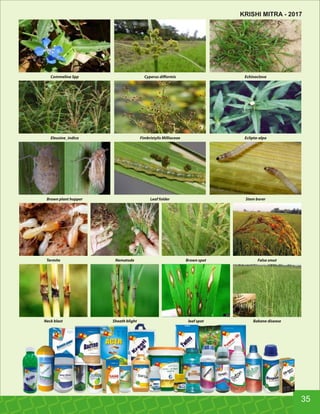
Commelina Spp Cyperus difformis Echinoclova
Eleusine_indica Fimbristylis Milliaceae Eclipta-alpa
Brown plant hopper Leaf folder Stem borer
Termite Nematode Brown spot False smut
Neck blast Sheath blight leaf spot Bakane disease
35
KRISHI MITRA - 2017
SOYABEAN
Sr. No. Crop Stage Insect/Diseases Product Application
Recommendation Methods
1 Seed Treatment Seed borne Diseases Acer @ 2-2.5gm/kg Seed, Semi Dry
And Soil borne Insects Savera @7-8 Ml/kg Seed, Application
Indo Biogold @ 1gm/ltr. Water
2 Soil Treatment Termite  Stem Borer Twins @ 150gm/acre, Broad CastingTermite -
Root O Max Gold @ 4-8kg /acre, MethodSoil Health -
Indo Mycorrhiza @ 4-8 kg/acre,
Zinc Super Gold @ 5-10 kg/acre,
Furarus@13kg/acreNematode -
3 Germination Weed Control, Penda Shree @ 1ltr. /acre SprayWeed Control -
(4-5 DAS) Penda Power @ 700 ml/acre,
Shaktiban @350 ml/acre
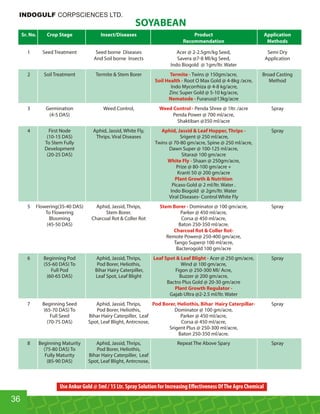
4 First Node Aphid, Jassid, White Fly, SprayAphid, Jassid  Leaf Hopper, Thrips -
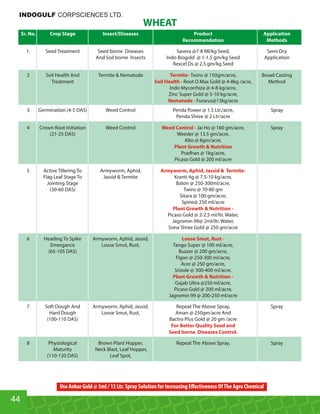
(10-15 DAS) Thrips. Viral Diseases Srigent @ 250 ml/acre,
To Stem Fully Twins @ 70-80 gm/acre, Spine @ 250 ml/acre,
Development Dawn Super @ 100-125 ml/acre,
(20-25 DAS) Sitara@ 100 gm/acre
Shaan @ 250gm/acre,White Fly -
Prize @ 80-100 gm/acre +
Kranti 50 @ 200 gm/acre
Plant Growth  Nutrition
Picaso Gold @ 2 ml/ltr. Water .
Indo Biogold @ 2gm/ltr. Water
Viral Diseases- Control White Fly
5 Flowering(35-40 DAS) Aphid, Jassid, Thrips, Dominator @ 100 gm/acre, SprayStem Borer -
To Flowering Stem Borer. Parker @ 450 ml/acre,
Blooming Charcoal Rot  Coller Rot Corsa @ 450 ml/acre,
(45-50 DAS) Baton 250-350 ml/acre.
Charcoal Rot  Coller Rot-
Remote Power@ 250-400 gm/acre,
Tango Super@ 100 ml/acre,
Bacterogold 100 gm/acre
6 Beginning Pod Aphid, Jassid, Thrips, Acer @ 250 gm/acre, SprayLeaf Spot  Leaf Blight -
(55-60 DAS) To Pod Borer, Heliothis, Wind @ 100 gm/acre,
Full Pod Bihar Hairy Caterpiller, Figon @ 250-300 Ml/ Acre,
(60-65 DAS) Leaf Spot, Leaf Blight Buzzer @ 200 gm/acre,
Bactro Plus Gold @ 20-30 gm/acre
Plant Growth Regulator -
Gajab Ultra @2-2.5 ml/ltr. Water
7 Beginning Seed Aphid, Jassid, Thrips, SprayPod Borer, Heliothis, Bihar Hairy Caterpillar-
(65-70 DAS) To Pod Borer, Heliothis, Dominator @ 100 gm/acre,
Full Seed Bihar Hairy Caterpiller, Leaf Parker @ 450 ml/acre,
(70-75 DAS) Spot, Leaf Blight, Antrcnose, Corsa @ 450 ml/acre,
Srigent Plus @ 250-300 ml/acre,
Baton 250-350 ml/acre.
8 Beginning Maturity Aphid, Jassid, Thrips, Repeat The Above Spary Spray
(75-80 DAS) To Pod Borer, Heliothis,
Fully Maturity Bihar Hairy Caterpiller, Leaf
(85-90 DAS) Spot, Leaf Blight, Antrcnose,
36
INDOGULF CORPSCIENCES LTD.
Use Ankur Gold @ 5ml / 15 Ltr. Spray Solution for Increasing Effectiveness OfThe Agro Chemical
Connelina benghalensis Cyanotis axillaris Cynodon dactylon
Euphorbia geniculata Sorghum_halepense Helicoverpa armigera
Semilooper Tobacco caterpiller White y
Charcoal rot Root rot leaf curl virus
Cercospora leaf spot
37
KRISHI MITRA - 2017
Sr. No. Crop Stage Insect/Diseases Product Application
Recommendation Methods
1 Seed Treatment Seed borne Diseases Acer @ 1-2 gm/ltr. Water, Spray Over
and Soil borne Insects Savera @4-5 ml/ltr. Water, Setts
Indo Biogold @ 2-3 gm/ltr. Water
2 Soil Treatment Termite, Nematode and Twins @ 150gm/acre, Broad CastingTermite-
Red Rot Diseases Root O Max Gold @ 8kg /acre, MethodSoil Health -
Indo Mycorrhiza @ 8 kg/acre,
Zinc Super Gold @ 5-10 kg/acre,
Furarus@13kg/acre.Nematode -
Aman @ 250-400 gm/acre,Root Rot  Wilt -
Remote Power @ 250-400 gm/acre,
Bactro Plus Gold @ 20-40 gm/acre.
3 Germination Weed Control, Penda Power @ 750 ml/acre, Spray
(6-7 DAS) Penda Shree @ 1 Ltr. Acre,
Cut Off 58@ 600-1000 ml/acre,
Trick 2 200 gm/acre,
Ruszine @ 500 gm/acre
4 Tillering Stage Scale Insect, Early Shoot Broad Casting/Scale Insect, Early Shoot Borer,
(15-20 DAS) Borer, Wooly Aphid Srigent GR @ 7.5-10 kg/acre, SprayWooly Aphid-
Sitara @ 200 gm/acre,
Dawn 7000 @ 75-100 gm/acre.
Plant Growth  Nutrition -
Zinc Super Gold @ 7.5-10 Kg /acre,
Picaso Gold @ 2.5 ml/ltr. Water
Pradhan @ 1 kg/acre,
Zinc Super Gold ( Broadcasting)
5 Tillering To Grand Scale Insect, Early Shoot SprayTop Stem Borer, Root Borer, Wooly Aphid,
Growth Stage Borer, Top Stem Borer, Pyrilla, Leaf Hopper, White Fly-
(20-120 DAS) Root Borer, Wooly Aphid, Corsa @ 450-500 ml/acre,
Pyrilla, Leaf Hopper, Spine @ 400ml/acre, Twins @ 150 gm/acre,
White Fly Kranti 50 @ 250 gm/acre
6 Grand Tillering Scale Insect, Earlt Shoot Repeat The Spray of Above Spray
Growth Phase Borer, Root Borer, Wooly Recommended Products.
(120-270 DAS) Aphid, Pyrilla, Leaf Hopper, Plant Growth  Nutrition -
White Fly Picaso Gold@ 350 ml/acre
Gajab Ultra @ 250-300 ml/acre
Indo Biogold @ 2-2.5 gm/ltr. Water
7 Maturation  Scale Insect, Earlt Shoot Repeat The Spray Of Above Spray
Ripening Borer, Root Borer, Wooly, Recommended Products.
(270 Above DAS) Aphid, Pyrilla, Leaf Hopper, Plant Growth  Nutrition -
White Fly Picaso Gold@ 350 ml/acre
Gajab Ultra@ 250-300 ml/acre
Indo Biogold @ 2-2.5 gm/ltr. Water
38
SUGARCANE
INDOGULF CORPSCIENCES LTD.
Use Ankur Gold @ 5ml / 15 Ltr. Spray Solution for Increasing Effectiveness OfThe Agro Chemical
Krishan neel Sorghum Helepans Early stem borer
Pyrilla Termite White grub
Sugarcane top borer Wilt
Red rot Grassy stunt virus
Convolvulus arvensis Ecinoclova Jagli palak
39
KRISHI MITRA - 2017
Sr. No. Crop Stage Insect/Diseases Product Application
Recommendation Methods
1 Seed Treatment Seed borne Diseases Acer @ 2-2.5gm/kg Seed, Semi Dry
And Soil borne Insects Savera @7-8 Ml/kg Seed, Application
Indo Biogold @ 1gm/ltr. Water
2 Soil Treatment Termite  White Grub Twins @ 150gm/acre, broad Casting
termite  White Grub - Srigent GR @ 7.5 -10 kg/acre. Method
Root O Max Gold @ 4-8kg /acre,Soil Health -
Indo Mycorrhiza @ 4-8 kg/acre,
Zinc Super Gold @ 5-10 kg/acre,
Furarus@13kg/acre.Nematode -
Acer @ 250-400 gm/acre, SprayRoot Rot  Wilt -
Remote Power @ 250-400 gm/acre,
Bactro Plus Gold @ 20-30 gm/acre.
3 Germination Weed Control, Penda Shree @ 1ltr. /acre SprayWeed Control-
(6-7 DAS) Penda Power @ 700 ml/acre,
Shaktiban @350 ml/acre
4 First Leaf To White Fly, Aphid, Jassid, Shaan @ 250 gm/acre, SprayWhite Fly -
Beginning Of Thrips, Leaf Hopper, Early Prize @ 80-100 gm/acre +
Blooming Leaf Spot, Late Leaf Spot Kranti 50 SP @ 200 gm/acre.
Aphid, Jassid  Leaf Hopper  Thrips -
Twins 70-80 gm/acre,
Spine @ 250 ml/acre,
Dawn 7000 @ 25-30 gm/acre,
Sitara@ 100 gm/acre.
Early Leaf Spot, Late Leaf Spot -
Acer @ 250 gm/acre,
Buzzer @ 200 ml/acre,
Tango Super @ 200 ml/acre,
Srizole @ 150-250 ml/acre
5 Pegging, Beginning Spodoptera, Hairy Caterpillar, SpraySpodoptera  Hairy Caterpillar -
Pod To Full Pod Leaf Hopper, Aphid, Jassid, Dominator @ 100 gm/acre,
Thrips, White Fly, Leaf Hopper, Parker @ 450 ml/acre,
Leaf Minor, Early Leaf Spot, Corsa @ 450 ml/acre,
Late Leaf Spot, Twins 70-80 gm/acre,
Baton 250-350 ml/acre.
6 Beginning Spodoptera, Hairy Caterpillar, Repeat The Above Spray Spray
Seed To Full Seed White Grub, Leaf Hopper, Twins @ 150gm/acre, BroadcastingWhite Grub -
Aphid, Jassid, Thrips, Srigent GR @ 7.5 -10 kg/acre.
White Fly, Leaf Hopper, Figon @ 350 ml/acre, SprayRust -
Leaf Minor, Early Leaf Spot, Tango Super @ 200 ml/acre,
Late Leaf Spot, Rust Srizole @ 350-400 ml/acre
7 Harvest Maturity White Grub Broadcasting
GROUND NUT
40
Use Ankur Gold @ 5ml / 15 Ltr. Spray Solution for Increasing Effectiveness OfThe Agro Chemical
SpodopteraRust Late Leaf Spot
ThripsEarly Leaf Spot Hairy Caterpillar
Trianthema portulacastrum White grub
Jassid
Amaranthus viridisAphid Cyperus rotundus
41
KRISHI MITRA - 2017
Sr. No. Crop Stage Insect/Diseases Product Application
Recommendation Methods
1 Seed Treatment Seed borne Diseases Acer @ 2-2.5gm/kg Seed, Seed Soaking
And Soil borne Insects Savera @7-8 Ml/kg Seed,
Biogold @ 1-1.5 gm/ltr. Water
2 Soil Treatment Termite  Nematode Twins @ 150gm/acre, Broad CastingTermite-
Root O Max Gold @ 4-8kg /acre, MethodSoil Health -
Indo Mycorrhiza @ 4-8kg / Acre,
Zinc Super Gold @ 5-10kg/acre,
Sriculan Gold @ 7.5-10 kg/acre.
Furarus@13kg/acre.Nematode -
3 Germination(3-4 DAS) Weed Control. Penda Shree @ 1ltr. /acre SprayWeed Control-
Penda Power @ 750 ml/acre,
4 Seedling White Fly, Aphid, SprayWhite Fly, Aphid, Jassid and Leaf Minor
Establishment Jassid, Leaf Hopper. - Shaan @ 250gm/acre,
Prize @ 8o-100gm/acre,
(20-25 DAS) Kranti50 @ 250-400gm/acre.
Spine @ 250 gm/acre,
Sitara @ 100gm/acre,
Plant Growth  Nutrition -
Gajab Ultra @ 250 ml/acre,
Picaso Gold @ 250 ml/acre,
Indo Pradhan @ 1kg/acre
5 Vegetative Leaf Blight, Wilt, Rust . SprayLeaf Blight, Wilt, Rust -
Growth Wind @ 100gm/acre,
(30-40 DAS) Acer @ 250gm/acre,
Tango Super @ 100ml/acre,
Remote Power @ 250gm/acre.
Bactro Plus Gold @ 20-30gm/acre,
Refery @ 240-300 ml/acre.
Plant Growth  Nutrition
Gajab Ultra @ 250ml/acre,
Picaso Gold @ 250ml/acre,
Indo Biogold @ 100-150gm/acre
6 Vegetative Heliothis, Moth SprayHeliothis, Moth-
Growth Dominator @ 100 gm/ acre,
(50-55 DAS) Parker @ 450 ml/acre,
Corsa @ 450 ml/acre,
Srigent Plus @ 250-300 ml/acre,
Baton 250-350 ml/acre.
Plant Growth  Nutrition -
Gajab Ultra @ 250 ml/acre,
Picaso Gold @ 250 ml/acre,
Indo Biogold @ 100-150 gm/acre
PEPPERMINT
42
Use Ankur Gold @ 5ml / 15 Ltr. Spray Solution for Increasing Effectiveness OfThe Agro Chemical
Aphid
Cynodon dactylon
Euphorbia geniculata Heliothis
Jassid
Leaf hopperRust
Sorghum halepense
Termite
Verticillum wiltYellow spot
White fly
43
KRISHI MITRA - 2017
Sr. No. Crop Stage Insect/Diseases Product Application
Recommendation Methods
1. Seed Treatment Seed borne Diseases Savera @7-8 Ml/kg Seed, Semi Dry
And Soil borne Insects Indo Biogold @ 1-1.5 gm/kg Seed Application
Rexcel Ds @ 2.5 gm/kg Seed
2 Soil Health And Termite  Nematode Twins @ 150gm/acre, Broad CastingTermite-
Treatment Root O Max Gold @ 4-8kg /acre, MethodSoil Health -
Indo Mycorrhiza @ 4-8 kg/acre,
Zinc Super Gold @ 5-10 kg/acre,
Furarus@13kg/acreNematode -
3 Germination (4-5 DAS) Weed Control Penda Power @ 1.5 Ltr./acre, Spray
Penda Shree @ 2 Ltr/acre
4 Crown Root Initiation Weed Control Jai Ho @ 160 gm/acre, SprayWeed Control -
(21-25 DAS) Weeder @ 13.5 gm/acre,
Alto @ 8gm/acre,
Plant Growth  Nutrition
Pradhan @ 1kg/acre,
Picaso Gold @ 200 ml/acre
5 Active Tillering To Armyworm, Aphid, Armyworm, Aphid, Jassid  Termite-
Flag Leaf Stage To Jassid  Termite Kranti 4g @ 7.5-10 kg/acre,
Jointing Stage Baton @ 250-300ml/acre,
(30-60 DAS) Twins @ 70-80 gm
Sitara @ 100 gm/acre,
Spine@ 250 ml/acre
Plant Growth  Nutrition -
Picaso Gold @ 2-2.5 ml/ltr. Water,
Jagromin 99@ 2ml/ltr. Water,
Sona Shree Gold @ 250 gm/acre
6 Heading To Spike Armyworm, Aphid, Jassid, Loose Smut, Rust -
Emergance Loose Smut, Rust, Tango Super @ 100 ml/acre,
(65-105 DAS) Buzzer @ 200 gm/acre,
Figon @ 250-300 ml/acre,
Acer @ 250 gm/acre,
Srizole @ 300-400 ml/acre.
Plant Growth  Nutrition -
Gajab Ultra @250 ml/acre,
Picaso Gold @ 200 ml/acre,
Jagromin 99 @ 200-250 ml/acre
7 Soft Dough And Armyworm, Aphid, Jassid, Repeat The Above Spray, Spray
Hard Dough Loose Smut, Rust, Aman @ 250gm/acre And
(100-110 DAS) Bactro Plus Gold @ 20 gm /acre
For Better Quality Seed and
Seed borne Diseases Control.
8 Physiological Brown Plant Hopper, Repeat The Above Spray, Spray
Maturity Neck Blast, Leaf Hopper,
(110-120 DAS) Leaf Spot,
44
WHEAT
INDOGULF CORPSCIENCES LTD.
Use Ankur Gold @ 5ml / 15 Ltr. Spray Solution for Increasing Effectiveness OfThe Agro Chemical
Anagallis arvensis Chenopodium album Convolvulus arvensis
Phalais minor Medicago denticulate Aphid
Armyworm Termite
Brown rust Yellow rust Loose smut
Karnal bunt Nematode
45
KRISHI MITRA - 2017
POTATO
Sr. No. Crop Stage Insect/Diseases Product Application
Recommendation Methods
1 Tuber Treatment Seed Borne Diseases Acer @ 1-2 gm/ltr. Water, Spray Over
And Soil Borne Insects Savera @4-5 ml/ltr. Water, Tuber
Indo Biogold @ 2-3 gm/ltr. Water
2 Soil Treatment Termite, Nematode And Twins @ 150gm/acre, Broad CastingTermite-
Wilt Diseases And Root O Max Gold @ 4-8kg /acre, MethodSoil Health -
Soil Conditioning Indo Mycorrhiza @ 4-8 kg/acre,
And Health Zinc Super Gold @ 5-10 kg/acre,
Furarus@13kg/acre.Nematode -
Acer @ 250-400 gm/acre,Wilt -
Remote Power @ 250-400 gm/acre,
Bactro Plus Gold @ 20-30 gm/acre.
3 Sprout Weed Control Penda Shree @ 1 Ltr./acre, Spray
Development Penda Power @ 750 ml/acre,
Fire @ 1 Ltr./acre, (between Rows Only)
Trick @ 150 gm/acre.
4 Vegetative Aphid, Jassid, Thrips, SprayAphid, Jassid  Leaf Hopper,
Growth Leaf Hopper, Early Blight White Fly  Thrips -
(15-20 DAP) Srigent @250 ml/acre, Twins - 70-80 gm/acre
Spine @ 250 ml/acre,
Dawn Super @ 100-125 ml/acre,
Sitara@ 100 gm/acre
Shaan @ 250gm/acre,
Kranti 50 @ 250 gm/acre.
Plant Growth, Nutrition 
Stress Management
Picaso Gold @2-2.5 ml/acre,
Pradhan @ 1kg/acre,
Indo Biogold @ 150-200 gm/acre
5 Tube Initiation Early Blight, Powdery Acer @ 250 gm/acre, SprayEarly Blight -
(30-40 DAP) Mildew, Leaf Spot, Mite, Figon @ 250 ml/acre,
White Grub, Tango Super @ 100 ml/acre .
Srilaxyl @300-350 gm/acre,Powdery Mildew-
Srilaxyl @ 250 gm/acre,
Refrey@ 300 ml/acre, Wind @ 100 gm/acre
Alishan Super 1.5-2 Ml/ltr Water.Mite -
Twins @ 150 gm/acre,White Grub -
Srigent GR @ 7.5 -100 kg/acre
6 Tuber Bulking Late Blight, Aphid, Repeat The Spray As Per Spray
(60-70 DAP) White Fly Recommended Above,
Plant Growth Regulator -
Gajab Ultra @ 2ml/ltr. Water,
Gajab @ 5 gm/acre
7 Maturation Late Blight, Aphid, Repeat The Spray As Per
White Fly Recommended Above
Ruspon @200 ml/acre
46
INDOGULF CORPSCIENCES LTD.
Use Ankur Gold @ 5ml / 15 Ltr. Spray Solution for Increasing Effectiveness OfThe Agro Chemical
Convolvulus arvensis Cynodon dactylon Echinochloa
Aphid Armyworm White y
White grub Blacvk scruf Early blight
Late blight Powdery Mildew Viral diseases
47
KRISHI MITRA - 2017
Sr. No. Crop Stage Insect/Diseases Product Application
Recommendation Methods
1 Seed Treatment Seed Borne Diseases Acer @ 2-2.5gm/ 100 gm Seed, Seed Soaking
And Soil Borne Insects Savera @4-5 Ml/ 100 gm Seed,
Indo Biogold @ 5 gm/ 100 gm Seed
2 Soil Treatment Termite, Nematode Twins @ 150gm/acre, Broad CastingTermite-
And Wilt Diseases Soil Health -root O Max Gold @ 8kg /acre, Method
Indo Mycorrhiza @ 8 kg/acre,
Zinc Super Gold @ 5-10 kg/acre,
Furarus@13kg/acre.Nematode -
Acer @ 250-400 gm/acre,Root Rot  Wilt -
Remote Power @ 250-400 gm/acre,
Bactro Plus Gold @ 40-60 gm/acre.
3 Germination Weed Control. Penda Shree @ 1ltr. /acre SprayWeed Control-
(5-6 DAS) Damping Off Penda Power @ 750 ml/acre,
Aman @ 250 gm/acre,Damping Off -
Remote Power @ 250 gm/aacre,
Buzzer @ 200 gm/acre, Tango Super @ 100 ml/acre
4 Seedling White Fly, Aphid, Shaan @ 250 gm/acre, SprayWhite Fly -
Establishment Jassid, Leaf Hopper, Prize @ 8o-100 gm/acre +
(20-25 DAS) Anthracnose Kranti50 SP @ 200 gm/acre Or
Spine @ 200 ml/acre,
Aphid, Jassid And Leaf Miner
- Sitara @ 100 gm/acre, Twins @ 70-80 gm/acre
Wind @ 100 gm/acre,Anthracnose -
Acer @ 250 gm/acre,
Remote Power @ 250-400 gm/acre,
Bactro Plus Gold @ 40-50 gm/acre,
Plant Growth  Nutrition -
Gajab Ultra @ 250 ml/acre,
Picaso Gold @ 250 ml/acre
5 Vegetative Tobacco Caterpiller, SprayTobacco Caterpillar -
Growth Bacterial Leaf Spot, Dominator @ 100 gm/acre,
(30-40 DAS) Parker @ 450 ml/acre, Corsa @ 450 ml/acre,
Baton 250-350 ml/acre.
Dawn 7000 @ 25-30 gm/acre,Mealy Bug-
Spine @ 250 ml/acre
6 Flowering And White Fly, Aphid, Jassid, SprayAphid, Jassid  Leaf Hopper  Thrips -
(40-50 DAS) Leaf Hopper,thrips, Srigent @ 250 ml/acre, Spine @ 250 ml/acre,
Mite, Antracnose, Dawn Super @ 100-125 ml/acre,
Bacterial Leaf Blight. Sitara@ 100 gm/acre,
Viral Diseases Leaf Spot  Powdery Mildew -
Wind @ 100 gm/acre, Acer @ 250gm/acre,
Refery @ 240-300 ml/acre,
Tango Super @ 100 ml/acre,
Remote Power @ 250 gm/acre.
Bactro Plus Gold @ 20-30 gm/acre,
Control White Fly and ApplyViral Diseases -
Indo Indo Biogold @ 1.5-2 gm/ltr. Water 
Gazab Ultra @ 250 ml/acre,
Alishan Super 1.5-2 Ml/10 Ltr. WaterMite -
7 Maturation Fruit Borer, Tobacco SprayFruit Borer  Tobacco Caterpillar -
(60-70 DAS) Caterpiller Dominator @ 100 gm/acre,
Parker @ 450 ml/acre, Corsa @ 450 ml/acre,
Baton 250-350 ml/acre.
Gajab Ultra @ 250 ml/acre,Plant Growth  Nutrition -
Bio Gold @ 1.5-2 ml/acre, Picaso Gold @ 250 ml/acre
CHILLI
48
Use Ankur Gold @ 5ml / 15 Ltr. Spray Solution for Increasing Effectiveness OfThe Agro Chemical
Fruit borerWilt Aphid
ThripsDactyloctenium aegyptium Tobacco caterpiller
Cynodone dactylon Echinochloa crusgalli
Bacterial leaf spotDamping off Anthracnose
49
KRISHI MITRA - 2017
Sr. No. Crop Stage Insect/Diseases Product Application
Recommendation Methods
1 Seed Treatment Seed Borne Diseases Acer @ 2-2.5gm/ 100 gm Seed, Seed Soaking
And Soil Borne Insects Savera @4-5 Ml/ 100 gm Seed,
Indo Biogold @ 5 gm/ 100 gm Seed
2 Soil Health Termite, Nematode Twins @ 150gm/acre, Broad CastingTermite-
And Treatment Srigent GR @ 7.5-10 kg/acre. Method
Root O Max Gold @ 8kg /acre,Soil Health -
Indo Mycorrhiza @ 8 kg/acre,
Zinc Super Gold @ 5-10 kg/acre,
Furarus@13kg/acreNematode -
3 Nursery Damping Off Tango Super @ 1ml/ltr Water, Spray
Acer@ 2.5gm/ltr. Water,
Srilaxyl 35 @ 2 gm/ltr. Water
Plant Growth  Nutrition -
Picaso Gold @ 2-2.5 ml/ltr. Water,
Indo Biogold @ 1.5-2 gm/ Ltr. Water
4 Transplanting(3-5 DAT) Weed Control Penda Shree @ 1 Ltr./acre, SprayWeed Control -
Penda Power @ 750 ml/acre
5 Vegetative Growth Aphid, Jassid, Thrips Aphid, Jassid  Thrips -
(25-30 DAT) Twins @ 70-80 gm/acre,
Spine @ 250 ml/acre,
Dawn Super @ 100-125 ml/acre,
Sitara@ 100 gm/acre.
Plant Growth Regulator  Nutrition
Picaso Gold @ 2-2.5 ml/ltr. Water,
Sriculan Gold @ 5-8 kg/acre
Sona Shree Gold @ 250 gm/acre
6 Floweering Downey Mildew, Black Rot, - Srilaxyl @ 2-2.5 ml/acre, SprayDowney Mildew
(35-45 DAT) Soft Rot, Diamond Back Moth, Srilaxyl 35 @ 150 -200 gm/acre,
Butter Fly . Jannat @ 250 gm/acre.
Aman @ 250gm/acre,Black Rot  Soft Rot -
Aman @ 250-400 gm/acre,
Diamond Back Moth, Butter Fly -
Dominator @ 100 gm/acre,
Kranti 50 SP @ 250-300 gm/acre
Parker @ 450 ml/acre, Corsa @ 450 ml/acre,
Baton 250-350 ml/acre,
Kranti 4g @ 7.5- 10 kg/acre .
Plant Growth Regulator  Nutrition -
Picaso Gold @ 2-2.5 ml/ltr. Water,
Sona Shree Gold @ 250 gm/acre
7 Fruiting Cauli ower  Cabbage SprayCauli ower  Cabbage Worm-
(50-60 DAS) Worm Dominator @ 100 gm/acre,
Parker @ 450 ml/acre,
Corsa @ 450 ml/acre,
Srigent Plus @ 250-300 ml/acre,
Baton 250-350 ml/acre,
Kranti 4g @ 7.5- 10 kg/acre .
COLE CROP
50
Use Ankur Gold @ 5ml / 15 Ltr. Spray Solution for Increasing Effectiveness OfThe Agro Chemical
Bacerial Soft RotWorm Butter y Dactyloctenium Aegyptium
AphidDiamond Back Moth
Cynodone dactylon Echinochloa crusgalli
Back moth caterpillerSpodopetra
Black rotDowney mildew Sorghum halepense
51
KRISHI MITRA - 2017
Sr. No. Crop Stage Insect/Diseases Product Application
Recommendation Methods
1 Seed Treatment Seed Borne Diseases Acer @ 2-2.5gm/100 gm Seed, Seed Soaking
And Soil Borne Insects Savera @4-5 Ml/100 gm Seed,
Indo Biogold @ 2 gm/100 gm Seed,
2 Soil Treatment Termite  White Grub, Twins @ 150gm/acre, Broad CastingTermite-
Nematode Root O Max Gold @ 4-8kg /acre,Soil Health -
Indo Mycorrhiza @ 4-8 kg/acre,
Zinc Super Gold @ 5-10 kg/acre,
Sriculan Gold @ 7.5- 10 kg/acre
Furarus@13kg/acre.Nematode -
3 Redical  Flag Weed Control, Penda Shree @ 1ltr. /acre SprayWeed Control-
Leaf Emergance Damping Off Penda Power @ 700 ml/acre,
(10-30 DAS) Tango Super @ 200 ml/acre,Damping Off -
Acer @ 2.5 gm/ltr. Water,
Srilaxyl 35 @ 100-150 gm/acre
Refery @ 2.4-3 ml/ltr. Water .
Plant Growth  Nutrition-
Picaso Gold @ 2.5 ml/ltr. Water,
Indo Biogold @ 1-1.5 gm/ltr. Water,
Gajab Ultra @ 2.5 ml/ltr. Water Broadcasting
4 One Or Two Thrips, Maggots, Twins @ 70-80 gm/acre, Spray
True Leaves Downy Mildew, Spine @ 250 ml/acre,
(30-50 DAS) To Purple Blotch, White Grub, Dawn Super @ 100-125 ml/acre,
Eight To Twelve Cutworm, Spodoptera. Sitara @ 100 gm/acre,
True Leaves Kranti 50 Sp@ 250 gm/acre.
Bulb Initiation Refery @ 240-300 ml/acre,Purple Blotch -
(90-110 DAS) Tango Super @ 200 ml/acre,
Buzzer @ 200 ml/acre,
Remote Power @ 250-300 gm/acre.
Plant Growth Nutrition-
Picaso Gold @ 2.5 ml/ltr. Water,
Indo Biogold @ 1-1.5 gm/ltr. Water,
Jagromin 99 @ 500-600 ml/acre,
Bloom Flower N @ 300-400 ml/acre
5 Bulb Diameter Downy Mildew, Acer @ 250 gm/acre, SprayDowny Mildew -
2.5-4.0 cm Purple Blotch, White Grub, Srilaxyle @ 250-400 Ml,
(110-130 DAS) to Cutworm, Spodoptera Buzzer @ 300 ml/acre,Purple Blotch -
Bulb Diameter Cutworm, Spodoptera-
7.5 cm Dominator @ 100 gm/acre,
(150-170 DAS) Parker @ 450 ml/acre,
Corsa @ 450 ml/acre,
Baton 250-350 ml/acre.
Kranti 4g @7.5-10 kg/acre Broadcasting
6 Bulb Emergance SprayPlant Growth Hormones-
Complete Over Gajab Ultra @ 2 ml/ltr. Water,
50% (170 DAS) Ruspone @ 1-1.5 Ml/ Ltr. Water
ONION
52
Use Ankur Gold @ 5ml / 15 Ltr. Spray Solution for Increasing Effectiveness OfThe Agro Chemical
Yellow spot Thrips Thrips damage
White grub Seed and Root maggot Bacterial soft rot
Damping off Euphorbia geniculata Cynodon dactylon
Purple blotch Cyanotis axillaris
Cutworm Sorghum halepenseDowny mildew
53
KRISHI MITRA - 2017
Sr. No. Crop Stage Insect/Diseases Product Application
Recommendation Methods
1 Seed Treatment Seed Borne Diseases Acer @ 2-2.5gm/100gm Seed, Seed Soaking
and Soil Borne Insects Savera @4-5 gm/100gm Seed,
Indo Biogold @ 2 gm/100gm Seed
2 Soil Treatment Termite, Nematode Twins @ 150gm/acre, Broad CastingTermite-
and Wilt Diseases Root O Max Gold @ 4-8kg /acre, MethodSoil Health -
Indo Mycorrhiza @ 4-8 kg/acre,
Zinc Super Gold @ 5-10 kg/acre,
Furarus@13kg/acre.Nematode -
Aman @ 250-400 gm/acre,Root Rot  Wilt -
Remote Power @ 250-400 gm/acre,
Bactro Plus Gold @ 20-30 gm/acre.
3 Germination Weed Control. Penda Shree @ 1ltr. /acre SprayWeed Control-
(5-6 DAS) Damping Off Penda Power @ 750 ml/acre,
Aman @ 250 gm/acre ,Damping Off -
Remote Power @ 250 gm/aacre ,
Buzzer @ 200 gm/acre,
Tango Super @ 100 ml/acre
4 Seedling White Fly , Aphid , SprayWhite Fly , Aphid , Jassid And Leaf Minor -
Establishment Jassid, Leaf Hopper, Shaan @ 250 gm/acre, Prize @ 80-100 gm/acre,
(20-25 DAS) Early Blight , Kranti 50 SP @ 250-400 gm/acre.
Anthracnose Spine @ 250 gm/acre,
Aphid , Jassid And Leaf Minor-
Sitara @ 100 gm/acre , Twins @ 70-80 gm/acre
Anthracnose  Early Blight -
Tango Super @ 100 ml/acre, Buzzer @ 200 gm/acre ,
Figon @ 350 ml/acre, Wind @ 100 gm/acre,
Acer @ 250 gm/acre ,
Gajab Ultra @ 250 ml/acre ,Plant Growth  Nutrition -
Picaso Gold @ 250 ml/acre
5 Vegetative Tobacco Caterpiller, Dominator @ 100 gm/acre, SprayTobacco Caterpiller -
Growth Bacterial Leaf Spot, Parker @ 450 ml/acre, Corsa @ 450 ml/acre,
(30-40 DAS) Powdery Mildew Baton 250-350 ml/acre.
Powdery Mildew @ Bacterial Leaf Spot -
Kargill WDG @ 7-10 Kg, Kargill N @ 1 kg/acre
Wind @ 100 gm/acre, Remote Power @ 250 gm/acre
6 Flowering and White Fly , Aphid , Aphid , Jassid  Leaf Hopper  Thrips -
(40-50 DAS) Jassid, Leaf Hopper, Srigent @ 250 ml/acre , Spine @ 250 ml/acre,
Thrips ,mite , Antracnose, Dawn Super @ 100-125 ml/acre ,
Late Blight, Bacterial Sitara @ 100 gm/acre.
Leaf Blight. SprayAntracnose, Late Blight, Bactrial Leaf Spot -
Viral Diseases Wind @ 100 gm/acre , Acer @ 250gm/acre,
Tango Super @ 100 ml/acre,
Remote Power @ 250 gm/acre.
Bactro Plus Gold @ 20-30 gm/acre ,
Viral Diseases - Control White Fly and
Apply Bactro Plus Gold @ 20-30 gm/acre ,
Biogold@ 1.5-2 gm/ltr. Water ,
Gajab Ultra @ 250 ml/acre
Alishan Super 1.5-2 Ml/10 Ltr. WaterMite -
7 Maturation Fruit Borer , Tobacco SprayFruit Borer  Tobacco Caterpiller -
(60-70 DAS) Caterpiller Dominator @ 100gm/acre
Parker @ 450 ml/acre, Corsa @ 450 ml/acre,
Gajab Ultra @ 250 ml/acre ,Plant Growth Promotor -
Picaso Gold @ 250 ml/acre
TOMATO
54
Use Ankur Gold @ 5ml / 15 Ltr. Spray Solution for Increasing Effectiveness OfThe Agro Chemical
Stem rot
Echinochloa crusgalli Jassid
Moasic virus
White FlyWilt
Mite
Fruit Borer
Late blight
Dactyloctenium aegyptium AphidDamping off
Powdery mildew Early_blight_Cynodone dactylon
55
KRISHI MITRA - 2017
BRINJAL
Sr. No. Crop Stage Insect/Diseases Product Application
Recommendation Methods
1 Seed Treatment Seed Borne Diseases Acer @ 2-2.5gm/ 100 gm Seed, Seed Soaking
And Soil Borne Insects Savera @4-5 Ml/ 100 gm Seed,
Indo Biogold @ 5 gm/ 100 gm Seed
2 Soil Health And Termite, Nematode Twins @ 150gm/acre, Broad CastingTermite-
Treatment Srigent GR @ 7.5-10 kg/acre. Method
Root O Max Gold @ 8kg /acre,Soil Health -
Indo Mycorrhiza @ 8 kg/acre,
Zinc Super Gold @ 5-10 kg/acre,
Furarus@13kg/acreNematode -
3 Nursery Damping Off Tango Super @ 1ml/ltr Water, Spray
Acer@ 2.5gm/ltr. Water,
Srilaxyl 35 @ 2 gm/ltr. Water
Plant Growth  Nutrition
Picaso Gold @ 2-2.5 ml/ltr. Water,
Indo Biogold @ 1.5-2 gm/ Ltr. Water.
4 Transplanting Weed Control Penda Shree @ 1 Ltr./acre, SprayWeed Control -
(3-5 DAT) Penda Power @ 750 ml/acre
5 Vegetative Growth Stem Borer, Thrips, Dominator @ 100 gm/acre, SprayStem Borer -
( 25-30 DAT) Bacterial Blight, Leaf Spot Parker @ 450 ml/acre, Corsa @ 450 ml/acre,
Kranti 50 SP @ 250-300 gm/acer
Baton 250-350 ml/acre, Kranti 4g @ 7.5- 10 kg/acre,
Wind @ 100 gm/acre,Bacterial Blight  Leaf Spot-
Tango Super @ 200 ml/acre,
Refery @ 240-300 ml/acre,
Bactro Plus Gold @ 20-30 gm/acre.
Plant Growth  Nutrition
Picaso Gold @ 2-2.5 ml/ltr. Water,
Gazab Ultra @ 250 ml/acre
6 Grand Vegetative Mite, Spotted Beetle, Alishan Super @ 1.5-2 Ml/10 Ltr. waterMite -
Growth (35-45 DAT) Aphid, Thrips  Jassid - Baton 250-350 ml/acre,Spotted Beetle
Kranti 4g @ 7.5- 10 kg/acre .
Twins @ 70-80 gm/acre,Aphid, Jassid  Thrips-
Spine @ 250 ml/acre,
Dawn Super @ 100-125 ml/acre,
Sitara@ 100 gm/acre.
Plant Growth  Nutrition
Picaso Gold @ 2-2.5 ml/ltr. Water,
Sona Shree Gold @ 250 gm/acre
7. Flowering Shoot Borer, Fruit Borer, SprayShoot Borer  Fruit Borer -
(45-60 DAT) Collor Rot Dominator @ 100 gm/acre,
Parker @ 450 ml/acre, Corsa @ 450 ml/acre,
Baton 250-350 ml/acre, Kranti 4g @ 7.5- 10 kg/acre .,
Kranti 50sp @ 250-300 gm/acre,
Aman @ 250-400 gm/acre,Collor Rot -
Remote Power @ 250-400 gm/acre,
Tango Super @ 200 ml/acre.
Plant Growth  Nutrition
Picaso Gold @ 2-2.5 ml/ltr. Water,
Indo Biogold @ 1.5-2 gm/ Ltr. Water.
8. Fruiting Shoot Borer, Fruit Borer, SprayShoot Borer  Fruit Borer -
(65-70 DAT) Phomosis Dominator @ 100 gm/acre,
Parker @ 450 ml/acre, Corsa @ 450 ml/acre,
Kranti 50sp @ 250-300 gm/acre,
Baton 250-350 ml/acre,
Kranti 4g @ 7.5- 10 kg/acre .
Acer @ 250 gm/acre,Phomosis-
Tango Super @ 200 ml/acre,
56
INDOGULF CORPSCIENCES LTD.
Use Ankur Gold @ 5ml / 15 Ltr. Spray Solution for Increasing Effectiveness OfThe Agro Chemical
AphidBrinjal fruit borer Collar rot
MiteStem Borer Echinochloa Crusgalli
Leaf spotDamping off Cynodone dactylon
Jassid
Dactyloctenium aegyptiumSpotted beetle
57
KRISHI MITRA - 2017
Sr. No. Crop Stage Insect/Diseases Product Application
Recommendation Methods
1 Before Flowering Termite, Mealy Bug, Twins @ 150gm/150 Ltr. Water, SprayTermite -
(december-january Flower Webber. Sriculan Gr @ 100-1500 gm/plant
Month) Rusban  L-drint @ 100-150 Ml/plant,
Mealy Bug - Dawn 7000 @ 25-30 gm/acre,
Srigent Plus @ 2.5 ml/ltr. Water,
Webber /Mite -
Alishan Super @ 1.5 -2 Ml/10 Ltr. Water,
Plant Growth  Nutrition -
Picaso Gold @ 2.5 ml/ltr. Water,
Indo Biogold @ 1-1.5 gm/ltr. Water,
Sriculan Gold @ 5-7 kg/acre
2 Flowering Time Mango Hopper, Dawn 2000 @ 1-1.25 ml/ltr. Water, SprayMango Hopper -
(before 15 February) Flower Webber Srigent @ 250 ml/acre, Spine @ 250 ml/acre,
Sitara@ 100 gm/acre.
Plant Growth  Nutrition -
Zinc Super Gold @ 100-150 gm,
Kargil Df @ 1 ml/ltr. Water,
Ruspon @ 0.25-0.5 ml/ltr. Water
3 After Flowering Mango Malformation SprayPowdary Mildew/ Malformation-
(after 15 February ) Powdary Mildew, Nector Plus @ 1ml/ltr. Water, Wind @ 1 ml/ltr. Water,
Bactro Plus Gold @ 20-25 gm/100 Ltr. Water .
Refery @ 2.4-3 ml/ltr. Water,
Tango Super @ 2 ml/ltr. Water .
Plant Growth  Nutrition -
Picaso Gold @ 2.5 ml/ltr. Water,
Indo Biogold @ 1-1.5 gm/ltr. Water,
Jagromin 99 @ 500-600 ml/acre,
4 Fruit Setting Bud Mite, SprayPowdary Mildew/ Malformation-
Stage (before Anthracnose, Nector Plus @ 1ml/ltr. Water,
15 March ) Powdary Mildew Figon @ 1-1.5 ml/ltr. Water,
Wind @ 1 ml/ltr. Water, Aman @ 2.5 gm/acre
Tango Super @1.5 - 2 ml/ltr. Water,Anthracnose -
Refery @ 2.4-3 Ml/lyr. Water, Acer @ 2.5 ml/ltr. Water.
Plant Growth  Nutrition -
Picaso Gold @ 2.5 ml/ltr. Water,
Indo Biogold @ 1-1.5 gm/ltr. Water,
Jagromin 99 @ 500-600 ml/acre,
Bloom Flower N @ 300-400 ml/acre
5 Fruit Setting Gall Midge, Shree M 45 @ 250 gm/acre, SprayDowny Mildew-
Stage ( 15 March Leaf Feeder, Mealy Bug Srilaxyle @ 250-400 Ml,
To 15 April ) Dominator @ 100 gm/acre,Leaf Feeder / Mealy Bug -
Parker @ 450 ml/acre, Corsa @ 450 ml/acre,
Srigent Plus @ 250-300 ml/acre, Baton 250-350 ml/acre.
Plant Growth  Nutrition -
Picaso Gold @ 2.5 ml/ltr. Water,
Indo Biogold @ 1-1.5 gm/ltr. Water,
Jagromin 99 @ 500-600 ml/acre
6 Fruit Setting Gall Midge And SprayGall Midge and Fruit Fly -
Stage (after 15 April ) Fruit Fly Dawn 7000 @ 1.5-2 gm/ltr. Water
Monorus @ 1.5-2 ml/ltr. Water,
Plant Growth  Nutrition -
Picaso Gold @ 2.5 ml/ltr. Water,
Indo Biogold @ 1-1.5 gm/ltr. Water,
Jagromin 99 @ 500-600 ml/acre,
MANGO
58
Use Ankur Gold @ 5ml / 15 Ltr. Spray Solution for Increasing Effectiveness OfThe Agro Chemical
INDOGULF CORPSCIENCES LTD.
Anthracnose on fruitMite Mango hopper
Anthracnose Powdery mildew
Gall midge Mealy bug
Die Back Mango malformation
59
KRISHI MITRA - 2017
Sr. No. Crop Stage Insect/diseases Product Application
Recommendation Methods
1 Seed Treatment Seed Borne Diseases and Acer @ 2-2.5 gm/kg Seed Seed Soaking,
Soil Borne Insects Savera @7-8 ml/kg Seed,
Indo Biogold @ 1-1.5 gm/ltr. Water
2 Soil Treatment Termite  White Grub, - Twins @ 150gm/acre, Broad CastingTermite  White Grub
Nematode Srigent GR @ 7.5 -10 kg/acre
Root O Max Gold @ 4-8 kg /acre,Soil Health -
Indo Mycorrhiza @ 4-8 kg / Acre,
Zinc Super Gold @ 5-10 kg/acre,
Bioking @ 10-12 kg/acre ,
Furarus@13kg/acreNematode -
3 Germination Weed Control Penda Shree @ 1ltr. /acre Folier SprayWeed Control-
Penda Power @ 700 ml/acre,
4 Leaf Production Aphid , Jassid, Root Rot Folier SprayAphid , Jassid  Leaf Hopper  Thrips -
Srigent @ 250 ml/acre ,
Spine @ 250 ml/acre,
Dawn Super @ 100-125 ml/acre ,
Sitara @ 100 gm/acre.
Aman @ 250- 400 gm/acre ,Root Rot -
Remote Power@ 250 -400 gm/acre
Plant Growth Regulator and Micronutrients-
Picaso Gold @ 2-2.5 ml/ltr. Water ,
Indo Biogold @ 1.5-2 gm/ Ltr. Water,
Indo Pardhan @ 1 Kg/acre
5 Bud Development White Fly , Aphid, Shaan @ 250 gm/acre, Folier SprayWhite Fly -
 Floral Initiation Jassid , Pod Borer. Anmol @ 400 gm/acre,
Prize @ 8o-100 gm/acre,
Kranti50 @ 250-400 gm/acre.
Dominator @ 100 gm/acre,Pod Borer -
Parker @ 450 ml/acre,
Corsa @ 450 ml/acer,
Srigent Plus @ 250-300 ml/acre,
Baton 250-350 ml/acre.
6 Flowering Mite, Pod Borer, Folier SprayCercospora Leaf Spot, Alternaria Leaf Spot -
Cercospora Leaf Spot, Wind @ 100 gm/acre ,
Alternaria Leaf Spot, Acer @ 250 gm/acre,
Root Rot, Tango Super @ 100 ml/acre,
Viral Diseases Remote Power @ 250 gm/acre.
Control White Fly and ApplyViral Diseases -
Bactro Plus Gold @ 20-30 Gm/acre,
Biogold@ 1.5-2 Gm/ltr. Water ,
Alishan Super @ 1.5- 2 Ml/10 Ltr. WaterMite -
7 Pod Formation Mite, Cercospora Folier SprayMite, Cercospora Leaf Spot, Alternaria
Leaf Spot, Alternaria Leaf Spot- repeat The Above Spray,
Leaf Spot, Powdery Wind @ 100 Gm/acre,Powdery Mildew -
Mildew, Root Rot Kargill Df- 7.5- 10 Kg / Acre,
Kargil N @ 1 Kg/acre ,
Buzzer @ 200 Gm/acre.
Plant Growth Nutrition
Gajab Ultra @ 2.5 Ml/ltr. Water
PULSES
Use Ankur Gold @ 5ml / 15 Ltr. Spray Solution for Increasing Effectiveness OfThe Agro Chemical60
INDOGULF CORPSCIENCES LTD.
Root rot
Aphid
Chloris barbata Alternaria leaf spot
Powdery mildew
Cercospora leaf spotThrip
Pod borer
Mite
Cyperus rotundusYellow mosaic virus
Trianthema portulacastrum
Amaranthus viridis
Jassid
61
KRISHI MITRA - 2017
ROOT-O-MAX GOLDROOT-O-MAX GOLD
Root-O-Max Gold is a New generation Granular Rooting Stimulant and Soil
Conditionerthatprovidesalltheelementsnecessaryfortherootinitiation,vegetative
andreproductivegrowthoftheplant.
ItismanufacturedbyprocessingofRareSeaweedsusingadvancedtechnologyandis
fortifiedwith mineralssuchasIron, Zincand Sulphur.
Benefits
Ÿ Stimulates Root Development by providing the necessary nutrients and Plant
GrowthHormones necessaryforRapidRootdevelopment.
Ÿ Enables early establishment of plant :-Better No. of tillers, Green Foliage due to production of Chlorophyll.
Ÿ Conditionsthesoilbystabilisingthesoilstructureandincreasingthewaterholdingcapacityoftheplant.
Ÿ Protects Plants from Biotic and Abiotic Stress (Excessively High or Low temperature, Water Logging, Drought,
frostetc)
Field crops - 4-5 Kg per acres
(Wheat, Paddy, Pulses, Oil Seeds etc.)
Vegetables  commercial crops - 8-10 Kg per acre
Sugarcane - 8-10 kg per acre
Cotton - 8-10 kg per acre
Flowers - 15 kg per acre
Lawn  Kitchen Garden - 2-3 gms per square meter
Plantation crops - 100-250 gms per tree based on age
Usage- Recommended quantity to be applied as basal dressing. It can also be used in standing
crop mixed with Fertilizers
CROPS DOSAGE
GROWTH PARTNER OF YOUR CROPS
High Yield Best Quality Soil Conditioner
62
Features
Ÿ It Helps in Breakdown of complex Protients and Carbohydrates
andabsorptionofNitrogenfromthesoil
Ÿ It enhances immunity of the plant against insect pests and
diseasesanditsuseenhancesthequalityoftheproduce
Ÿ ItenhancestheFloweringandFruitingandpreventsfruitdrop
Ÿ ItincreasestheFertiliserUseEfficiency.
UseInstructions
Ÿ 250mlperacrePicassoGoldin120-150litwater
Ÿ Use after 25-30 days after sowing and r
repeat 15 days after the first spray.
Ÿ Crops- it can be used on all crops such as
Cereals, Vegetables, Pulses, Oilseeds,
Orchards, Plantation, Flower and
LandscapingandHomeGardeningetc.
Approved by
ECOCERT
INPUTS
Approved input for organic farming
as per NPOP standards
Attested by Ecocert India Pvt. Ltd.
(NPOP/NAB/002)
For Golden Harvest and Prosperity
Picaso Gold is a Liquid Formulation of Major and Micro Nutrients essential for plant
GrowthandProduction
Ÿ ItisinChelatedformforeasy andcompleteavailabilitytotheplant.
Ÿ PicassoGoldisManufacturedusingLatestProductionTechniques
with
Picaso Gold
without
Picaso Gold
Mb
Fe
B
Zn
Mn
Chelated Micro Nutrients
Bumper Harvest Growth Immunity
63
Ankur Gold is a new Generation Silicone Based Multipurpose Super Spreader and
Activator, that can be used to enhance the performance of any Insecticide,
Fungicide,Herbicide,WaterSolubleFertilizerorPlantGrowthRegulator
Features
Ÿ Itrapidlyspreadsthespraydropletsontheleafsurfacetomakeauniformlayerontheleaf
Ÿ ItreduceswastageofSprayLiquid,waterandSprayingcost.
Ÿ Ensures that every spray is effective and reliable within a few minutes of spraying, thus providing complete
peaceofmindtothefarmerevenduringrains
Ÿ It is Non Ionic in Nature, and hence doesn’t change the nature of any Agrochemical. Therefore can be mixed
withallagrochemicals
Ÿ Itisformoreeffectivethanordinarysurfactantsandstickingagents
Ÿ Italsoenhancesspreadofirrigationwater,thusmakingtheuseofwatermoreefficient
HowtoUse
Ÿ Fill the tank 90% with Agrochemical Mixture as
per the product Label, Add @ 2-3 mlAnkur gold
per liter of spray solution. Mix well and then top
upthespraytank
Quantity
Ÿ 4-8 ml per 15 Lit Spray tank or 60-100 ml per acre
mixed with 10 Kg sand for Irrigation water
spreading
Enhances the Performance of every spray
(A Multipurpose Silicone based Super Spreader and activator)
With Ankur GoldWith Ankur GoldWithout Ankur GoldWithout Ankur Gold
64
Can be applied in all crops and with all Agro Chemicals
WhatisBiogold??
• Superior combination of Cold water seaweeds taken from exclusive sources and
processedwithlatesttechnology.Itis100%Watersoluble
• Providesfullbalancedspectrumofnutrients(MicroandMacro)readilyforplants
• ItisanexcellentSoilConditioner
• Contains Natural Plant Growth Regulators- Cytokinins, Giberellins, Malatonin,
ZeatinandPolyscccharides
• ItisEffectivefor SeedTreatment,SoilApplicationaswellasFoliarspray.
• It can be applied in all crops- Cereals, Pulses, Oilseeds, Vegetables, Fruits and
Plantationcrops.
Advantages
• Increasesthegerminationpercentageandyieldofcrop.
• EnlargeandBalanceLeafgrowth,
• ImproveBioticandAbioticStressresistantcapability.
• Promote flower bud differentiation, improve blossom and fruit set rate, increase yield and quality of crops, make
fruitpre-mature3or7daysandprolongtheshelflife,providesuniformcolorationandsizeoffruits
Howtoapply
SeedDressing:
• ForseedswithhigherSeedratee.g.Wheat,Rice,Pea,grametc-use1gmBiogoldperkgseed.
• Forsmallto mediumsizedseed,use15-20gmforseedperkgseed
• Fortubers,Sugarcaneandseedlingdip,useaslurrycontaining5
• 10-20gmBiogold perlitwater.
Foliarspray
• use100gmBiogoldafter15-20daysofsowing/plantingandrepeatafter10-15days.
Drip-
• Use0.5-1gmperlitpfwaterappliedthroughdrip.
• IncaseofPhytotoxicity,useBiogold@200gmperacreandrepeatafter7days.
Compatibility
Biogold can be mixed with any Fungicide, Insecticide or fertiliser. For best results, use Ankur gold for ensuring quick
absorptionintheplantsystem
Biogold
Organic Sea weed soluble granules
Approved by
ECOCERT
INPUTS
65
ACER
Carbendazim 12%+
Mancozeb 63% WP
ALISHAN SUPER
(Bio-Extract)
INDOGULF ALTO
Metsulfuron Methyl 20% WP
INDOGULF
ANMOL
Diafenthiuron 50% WP
AMAN
Thiophanate
Methyl 70% WP
BACTRO
PLUS GOLD
Immuno Modulator
BATON
Lambda
Cyhalothrin 4.9% CS
BLUNT
Buprofezin 25% SC
BUZZER
Difenconazole 25% EC
CORSA
Profenofos 40%EC +
Cypermethrin 4%EC
DAWN SUPER
Imidacloprid 30.5% SC
DOMINATOR
Emamectin Benzoate
5% SG
FIGON
Tebuconazole 25.9 EC
DAWN 2000
Imidacloprid 30.5% SC
FURARUS
Carbofuran 3% CG
JAGROMIN 99
Micronutrient Mixture
INDO BIOGOLD
Organic Manure
GAJAB ULTRA
Gibberellic Acid 0.001% L
INDO
MYCHORIZA
Mycorrhiza
JANNAT
(Propineb 70% WP)
KARGIL-N
Sulphur 80% WDG
KRANTI-4G
Cartap Hydrochloride
4% GR
DAWN-7000
Imidacloprid 70% WG
INDOGULF
SITARA
Thiomethoxam 25% WG
KRANTI-50
Cartap
Hydrochloride 50% SP
66
MONORUS
Monocrotophos 36% SL
NECTOR PLUS
Hexaconazole 5% SC
PARKER
Triazophos 35% +
Deltamethrin 1% EC
PENDA POWER
Pendimethalin 38.7% CS
PENDA SHREE
Pendimethalin 30% EC
PRADHAN
N.P.K. 19:19:19
PRIZE
Acetamiprid 20% SP
REFERY
Azoxystrobin 11% +
Tebuconazole 18.3% SC
REMOTE POWER
Captan 70% WP +
Hexaconazole 5% WP
ROGORUS
Dimethoate 30% EC
RUSPON
Ethephon 39% SL
SANDESH
Isoprothiolane 40% EC
SAVERA
Thiomethoxam 30% FS
SHAAN
Diafenthiuron 50% WP
SHAKTIBAN
Imazethapyr 10% SL
SONA SHREE
GOLD
Zinc 12% (Chelated) EDTA
SPINE
Bifenthrin 10% EC
SRIGENT PLUS
Fipronil 5% SC
SRILAXYL
Metalaxyl 8% +
Mancozeb 64% WP
SRIZOL
Propiconazole 25% EC
TANGO SUPER
Propiconazole 13.9% +
Difenconazole 13.9% EC
INDO TWINS
Fipronil 40% +
Imidacloprid 40% WG
WEEDER
Sulfosulfuron 75% -
with Surfactant
WIND
Myclobutanil 10% WP
ZINC SUPER
GOLD
Micronutrient Mixture
67
Stressed cell Not stressed cell
DNA damage
Endoplasmic reticulum
damage
Cell membrane damage
The loss of cell
compartments and
disruption of all
cell function lead
to cell death
Vacuole damage
Vacuole
DNA
Endoplasmic reticulum
Cell membrane
PLANT STRESS
Any unfavorable condition or substance that affects or blocks a plants metabolism, growth or development (Kranner et al., 2010).
Reactive Oxygen Species (ROS) are chemically reactive molecules containing oxygen. ROS form as a natural byproduct of the
normal metabolism and have important roles in intracellular signaling cascades. Under stress conditions, ROS levels can increase
dramatically. This may result in signi cant damage to cell structures.
At Cellular Level
STRESS
STRESS
HIGH TEMPERATURE
LOW TEMPERATURE
DROUGHT
FLOODING
NUTRIENT DEFICIENCY
DISEASES AND INSECTS
WEEDS
CHEMICAL OVERAPPLICATION
COMMON RESPONSE
ROS PRODUCTION
O *2
Superoxide
H O2 2
Hydrogen
Peroxide
*OH
Hydroxyl
Radical
At The Plant Level
Tissue Damage. Comparison of Control and Treated leaves
Cross section of leaf under stress Cross section of leaf after control of stress
Cells damaged by excessive production of ROS lose their structure and
functions and can not support functions of the whole leaf leading to
disruption of the whole plant physiology. If this disruption occurs during
critical stages of plant growth and development like flowering or fruit set it
may lead to flower or fruit abortions resulting in severe yield reduction.
Sea Weed Extracts help to protect plants
from overproduction of ROS keeping cells
healthy and supporting functions of the whole leaf and the physiology of
the whole plant.
Closedstoma Stoma
68
INDOGULF CORPSCIENCES LTD.
Safe Use of Pesticides by The Farmers While Purchasing, Handling and Use
WhilePurchasing
ü Purchase pesticides/biopesticides only from Registered pesticide dealers having valid Licence. Do not purchase pesticides from
footpathdealersorfromun-licencedperson.
ü Purchase only just required quantity of pesticides for single operation in a speci ed area. Do not purchase pesticide in bulk for
wholeseason.
ü See approved labels on the containers/packets of pesticides. Do not purchase pesticides without approved label on the
containers.
ü SeeBatchNo.,RegistrationNumber,DateofManufacture/Expiryonthelabels.Neverpurchaseexpiredpesticide.
ü Purchasepesticideswellpackedincontainers.Donotpurchasepesticideswhosecontainersareleaking/loose/unsealed.
DuringStorage
ü Storethepesticidesawayfromhousepremises.Neverstorepesticideinhousepremises.
ü Keeppesticidesinoriginalcontainers.Nevertransferpesticidesfromoriginaltoanothercontainers.
ü Pesticides/weedicidesmustbestoredseparately.Donotstoreinsecticideswithweedicides.
ü Wherepesticideshavebeenstored,areashouldbemarkedwithwarningsigns.
ü Pesticidesbestoredawayfromthereachofthechildrenandlive stocks.Donotallowchildrentoenterthestorageplace.
ü Storageplaceshouldbewellprotectedfromdirectsunlightandrain.Pesticidesshouldnotbeexposedtosunlightorrainwater.
WhileHandling
ü Keep pesticides separate during transportation.
Never carry/transport pesticides along with
food/fodder/othereatablearticles.
ü Bulk pesticides should be carried tactfully to the site
of application. Never carry bulk pesticides on head,
shoulderorontheback.
WhilePreparingSpraySolution
ü Always use clean water. Do not use muddy or
stagnantwater.
ü Use protective clothing viz., hand gloves, face masks,
cap, apron, full trouser, etc. to cover whole body.
Never prepare spray solution without wearing
protectiveclothings.
ü Always protect your nose, eyes, ears, hands, etc. from spill of spray solution. Do not allow the pesticide/its solution to fall on any
bodyparts.
ü Readinstructionsonpesticidecontainerlabelcarefullybeforeuse.Neveravoidreadinginstructionsoncontainer'slabelforuse.
ü Preparethesolutionasperrequirement.Neveruseleftoutspraysolutionafter24hoursofitspreparation.
ü Granularpesticidesshouldbeusedassuch.Donotmixgranuleswithwater.
ü Avoidspillingofpesticidessolutionswhile llingthespraytank.Donotsmellthespraytank.
ü Alwaysuserecommendeddosageofpesticide.Donotuseoverdosewhichmayaffectplanthealthandenvironment.
ü No activities should be carried out which may affect your health. Do not eat, drink, smoke or chew during whole operation of
pesticides.
69
INDOGULF CORPSCIENCES LTD.
Selection of Equipments
ü Selectrightkindofequipments.Donotuseleakyordefectiveequipments.
ü Selectrightsizednozzles.Donotusedefective/non-recommendednozzles. Donot blow/cleancloggednozzleswithmouth.
Insteadusetoothbrushtiedwithsprayer.
ü Useseparatesprayerforinsecticidesandweedicides.Neverusesamesprayerforbothweedicidesandinsecticides.
WhileApplyingSpraySolutions
ü Applyonlyrecommendeddoseanddilution.Neverapplyover-doseandhighconcentrationsthanrecommended.
ü Sprayoperationshouldbeconducted oncoolandcalmday.Donotsprayonhotsunnydayorstrongwindyconditions.
ü Sprayoperationshouldbeconductedonsunnydayingeneral.Donotsprayjustbeforerainsandimmediatelyaftertherains.
ü Use recommended sprayer for each spray. Emulsi able concentrate formulations should not be used for spraying with battery
operatedULVsprayer.
ü Sprayoperationshouldbeconductedinthewinddirection.Donotsprayagainstwinddirection.
ü After spray operation, sprayer and buckets should be washed with clean water using detergent/soap. Containers and buckets
usedformixingpesticidesshouldneverbeusedfordomesticpurposeevenafterthoroughwashing.
ü Avoid the entry of animals/workers in the eld immediately after spray. Never enter in the treated eld immediate after spray
withoutbearing protectiveclothings.
AfterSprayOperation:
ü Left over spray solutions should be disposed off at safer place viz. barren isolated area. Left over spray solution should not be
drainedinornearpondsorwaterlinesetc.
ü The used/empty containers should be crushed with stone/stick and buried deep in soil away from water sources. Empty
containersofpesticidesshouldnotbere-usedforstoringotherarticles.
ü Wash hands and face with clean water and soap before eating/smoking. Never eat/smoke before washing clothes and taking
bath.
ü Onobservingpoisoningsymptomsgivethe rstaidandshowthepatienttodoctor.Alsoshowtheemptycontainertodoctor.Do
nottaketheriskbynotshowingthepoisoningsymptomstodoctorasitmayendangerthelifeofthepatient.
70
KRISHI MITRA - 2017
Pesticides Toxicity Symbols Denote Toxicity To
Human Beings And Animals
WARNINGS
CATEGORY -I
Keep out of reach of Children. If swallowed or
if symptoms of poisoning occur,call physician immediately.
LD (oral) (Mg/kg) 1to5050
CATEGORY -II
Keep out of reach of children
LD (oral) (Mg/kg) 51 to 50050
CATEGORY-III
Keep out of the reach of Children
LD (oral) (mg/kg) 501-500050
CATEGORY-IV
Keep out of the reach of children
LD (oral) (mg/kg) More than 500050
POISON
EXTREMELY TOXIC
POISON
HIGHLY TOXIC
DANGER
MODERATELY TOXIC
CAUTION
SLIGHTLY TOXIC
SYMBOLS
Ÿ Symptoms of poisoning are headache, giddiness, vertigo, nausea, vomiting,
blurred vision, sweating, excessive lacrimations and salivation.
Ÿ Incase of contact with skin, wash all the affected body parts thoroughly with
soap and water several times. Remove patient to fresh air. It eyes are
affected, drain with clear water for 15 minutes. Atropine sulphate is
antidote for severe poisoning.
Ÿ Atropinize the patient immediately by repeated doses of 2 to 4 gm at every
5-10 minutes interval til the symptoms disappear.
Ÿ 2 PAM is also an antidote.
Ÿ Administer 1-2 gm of 2-pyridine-2 aldoxime methyl iodine (2-PAM), dissolve
in 10 ml distilled water and inject intravenously taking 10-15 minutes.
Ÿ Storage/Disposal of pesticides :-
Ÿ Should be stored in separate well ventilated room under lock and key. do not
allow children pest or animals to enter the room. food and feed stuffs should
not be stored with the pesticides. Empty containers should not be reused for
any purpose and should be destroyed.
Antidote  Medical Aid
71
H.O. : 501, Gopal Heights, Netaji Subhash Place, Delhi - 110034 (INDIA) | Telephone : +91-11-40040400 (99 Line) Fax : +91-11-40040444
E-mail : info@groupindogulf.com (Domestic) exim@groupindogulf.com (International) Website : www.groupindogulf.com
Customer Care No. : +91-9311155087
Unit No.1: V.P.O. Nathupur, Distt. Sonepat, Harayana - 131029 (INDIA) Ph.: +91-0130-2219245
Unit No.2: Industrial Growth Centre, Samba Jammu, JK (INDIA) Ph.: +91-01923-246528
Unit No.3 : Khasra No.- 16/22/33, Nathupur, Distt. Sonepat, Harayana - 131029 (INDIA)
INDOGULF CROPSCIENCES LTD.

Krishi mitra

  • 1.
    E D IT I O N 4 A friendly guide to farming www.groupindogulf.comwww.groupindogulf.comwww.groupindogulf.comwww.groupindogulf.comwww.groupindogulf.comwww.groupindogulf.com KRISHI MITRAKRISHI MITRAKRISHI MITRA
  • 2.
    It is proudmoment for all of us My sincere thanks to all members of the Indogulf family. 2
  • 3.
    Late Sh. ShriKrishan Dass Aggarwal laid down foundation of the organization in 1972 with determination and commitment to fulfil the requirements of the farmer by providing them the world class productataffordableprice. The Legend Late Sh. Shri Krishan Dass Aggarwal Founder Shri Om Prakash Aggarwal Group Chairman INDOGULF CROPSCIENCES LTD. Indogulf Cropsciences Ltd. (formerly known as Jai Shree Rasayan Udyog Ltd.) was established by Shri Om Prakash Aggarwal, having vision of modern agriculture technology for higher production of good grain, vegetable and fruits along with minimumagronomiclosses. Chairman Message 3
  • 4.
    DearReaders, I have immensepleasure in presenting to you the 4th edition of Krishi Mitra. We have updated all the informationgiveninthelasteditionandalsoincludedmanyrelevanttopics. Indian Agriculture is on the verge of transformation and we understand our responsibility to help the farmers adopt the best agricultural practices in order to keep up with the rapid changes in Agricultural knowhow. KrishiMitraisonesuchtolltohelpfarmersgettheinformationinanEasytounderstandformat. Thisguidewillalsoimmenselyhelpourchannelpartnersinrecommendingtherightsolutionstothefarmers. Ourbestqualityproductswillhelpfarmersinimplementingthesesolutiontotheirbestadvantage ThanksandRegards SanjayAggarwal ManagingDirector,IndogulfCropsciencesLtd. From the Desk of Group Managing Director 4
  • 5.
  • 6.
    Research Development Ourteam is continuously working with over 25 highly qualified and experienced research scientists focusing on Bio-efficacy and Toxicology studies, Chemistry for development of newformulation,formulationtypes,packagingmethods andmanufacturingmethods.Our RD wing interacts closely with the Central Agricultural Research and teaching Institutes like ICAR, IARI, CRRI, CPRI, TRAI, IPFT etc. as well as State Agricultural Universities like HAU, PAU International bodies like Lentiz Educational Group, Holland etc and work in close coordination with them for the generation of scientific data, evolution of new molecules and organizingscientific New state of art the Product Process R D center in Nathupur, Haryana is well equipped with advanced instruments, our technical team have updated knowledge of FAO, BIS, EPA etc. Having own Research Development fields for bio-efficacy products testing in Delhi, Punjab, Haryana, Uttar Pardesh, Madya Pradesh, Karnataka Tamilnadu for doing trials of new/developedmoleculesonvariouscropsindifferentclimaticzonessoilstructures. RDcenterandQCLabisNABLaccreditedandinprocessforDSIRGLPaccreditation. Successfully registered more than 410 formulations for Domestic , 30 Technical Indigenous mfg.,75forexportsandmanymoreinthepipeline. Focus Area for R D: Ÿ Technology tie-ups for manufacturing of Technical in India. Ÿ Cooperation for Intermediates and other Raw materials Ÿ Research Development tie-up in India. Ÿ New molecules with least / No residue. Ÿ Eco friendly products with higher efficacy as per Indian Global environment. Our Certifications 6
  • 7.
    COSTA RICA Orlando USA MALDIVES Indogulf Cropscienceshas opened a branch at Orlando USA We are a Star Export House We are Leading Exporters of Agrochemicals Across The Globe 7 KRISHI MITRA - 2017
  • 8.
    Pesticides and TheirUses Type Action Algicides Control algae in lakes, canals, swimming pools, water tanks, and other sites Antifouling agents Kill or repel organisms that attach to underwater surfaces, such as boat bottoms Antimicrobials Kill microorganisms (such as bacteria and viruses) Attractants Attract pests (for example, to lure an insect or rodent to a trap). (However, food is not considered a pesticide when used as an attractant.) Biopesticides Biopesticides are certain types of pesticides derived from such natural materials as animals, plants, bacteria, and certain minerals Biocides Kill microorganisms Disinfectants Kill or inactivate disease-producing microorganisms on inanimate objects and sanitisers Fungicides Kill fungi (including blights, mildews, molds, and rusts) Fumigants Produce gas or vapour intended to destroy pests in buildings or soil Herbicides Kill weeds and other plants that grow where they are not wanted Insecticides Kill insects and other arthropods Miticides Kill mites that feed on plants and animals Microbial pesticides Microorganisms that kill, inhibit, or out compete pests, including insects or other microorganisms Molluscicides Kill snails and slugs Nematicides Kill nematodes (microscopic, worm-like organisms that feed on plant roots) Ovicides Kill eggs of insects and mites Pheromones Biochemicals used to disrupt the mating behaviour of insects Repellents Repel pests, including insects (such as mosquitoes) and birds Rodenticides Control mice and other rodents FurthertypesofPesticides Thetermpesticidealsoincludethesesubstances: Defoliants: Causeleavesorotherfoliagetodropfromaplant,usuallytofacilitateharvest. Desiccants: Promotedryingoflivingtissues,suchasunwantedplanttops. Insectgrowthregulators: Disruptthemolting,maturityfrompupalstagetoadult,orotherlifeprocessesofinsects. Plantgrowthregulators: Substances (excluding fertilizers or other plant nutrients) that alter the expected growth, flowering, or reproductionrateofplants. Categorization of Pesticides A. ON THE BASIS OF TARGET SPECIES I. MICRO-ORGANISM II. INSECTS III. RODENTS IV. NEMATODES V. BIRDS VI. PLANTS Fungi Algae Bacteria Fungicides Algicide Bactericide Mites Ticks Others Accaricides or Miticides Insecticide Rats Rodenticide Nematicides Avicides Weedicides or HerbicidesHerbs Nematods Birds 8 INDOGULF CROPSCIENCES LTD.
  • 9.
    B. ON THEBASIS OF CHEMICAL NATURE I. INORGANIC II. ORGANIC Insecticides Fungicides Rodenticides Insecticides Organochlorides / phosphates Carbamates Synthetic Pyrethroids Neonictionoides Pyrazole Avermactins Herbicides Nitrophenols-uracils Chlorphenaxy Triazines Dipridyls- Thicarbamates Urea Derivative-Other Organics. Acetanilids Benzoics Fungicides Organatis-Organophosphrous Organomercuials Dithio carbamates I. Stomach Poison II. Contact Poison III Systemic Poison IV Fumigants V. Herbicides (A) Selective (B) Non-selective C. ON THE BASIS OF SITE OF ACTION Herbicides A. For spraying after mixing with water/oil. (i) Emulsfiable concentrate (EC). (ii) Wettable Powders (WDP or WP). (iii) Ultra low volume (ULV). (iv) Water soluble liquid concentrate (WSC or SL.) (v) Suspension concentrate (SC) B. For Dry Applications directly from the Containers (I) Dusts (D or DP) (II) Granules (G or GR) (III) Encapsulated granules (CG) (IV) Water dispersible granule (WDG) (V) Wettable granule (WG) (VI) Soluble granule (SG) C. For Applications as a gas or vapour (I) Fumigants (II) Smoke generators or tablets which vapourise. (III) Aerosols and pressurised spray. D. Other Formulations (I) Seed Protectants (dry or liquid) (SD) (II) Baits for rodents, flys, slugs, cockroaches etc. (III) Flowable concentrate for seed treatment (FS) D. ON THE BASIS OF PESTICIDES FORMULATIONS LOSSES CAUSED BY DIFFERENT PESTS Insects 26% Weeds 33% Rodents others 15% Diseases 26% Crop losses : US $ 19 Billion th Department of Chemicals and Petrochemicals, Govt. of India (37 Report) Code Term AB Grain bait AE Aerosol dispencer AL Any other liquid AP Any other powder BB Block bait BR Briquette CB Bait concentrate CF Capsule suspension for seed treatment CG Encapsulated granule CL Contact liquid or gel CP Contact powder CS Capsule suspension DC Dispersible concentrate DL Driftless formulation # DP Dustable Powder DS Powder for dry seed treatment DT Tablet for direct application EC Emulsifiable concentrate ED Electrochargeable liquid EG Emulsifiable granule EO Emulsion, water in oil EP Emulsifiable powder ES Emulsion for seed treatment EW Emulsion, oil in water FD Smoke tin Some Important Abbreviations Code Term FG Fine granule FK Smoke candle FP Smoke cartridge FR Smoke rodlet FS Flowable concentrate for seed treatment FT Smoke tablet FU Smoke generator FW Smoke pellet GA Gas GB Granular bait GE Gas penetrating product GF Gel for seed treatment GG Macrogranule GL Emulsifiable gel GP Flo-dust GR Granule GS Grease GW Water soluble gel HN Hot fogging concentrate KK Combi-pack solid/liquid KL Combi-pack liquid/liquid KN Cold fogging concentrate KP Combi-pack solid/solid LA Lacquer LS Solution for seed treatment KRISHI MITRA - 2017 9
  • 10.
    Land area -Forest land area -328.73 Millions hectare 65.90 Millions hectare 306 Millions hectare 100.45 Millions hectareUse ful land are - Cultivated area - 80.50 Millions hectare One Million equal to 10 lacs.Irrigated area - Note :- Population (India) - 1210 Millions (2011-2012) (PPD AGRI. REPORT) India - America (USA) - China - Germany - Japan -0.38 1.5 2.25 3.0 10.8 Hungry - Italy - South Koria -12.6 13.4 16.6 17.0Taiwan - Consumption of Pesticides (Kg/Hectare) 2011-2012 (PPD AGRI. REPORT) Botanical Classi cation of Crops Crop Name Botanical Name Chromo- Center of Origin some no. Cereals Rice Oryza sativa (Gramineae) 24 Indo Burma Wheat Triticum aestivum (Gramineae) 42 South west Asia Maize Zea mays (Gramineae) 20 Maxico Jowar Sorghum bicolor (Gramineae) 20 Ethiopia and Sudan Bajra Pennisetum typhoides (Gramineae) 14 Africa Barley Hordeum vulgar (Gramineae) 14 Ethiopia Madua Eleucine coracana good for diabetes patient (Gramineae) 36 Proso millet Panicum miliaceum (Gramineae) 18 Sswan Echinochloa frumentacea (Gramineae) 16 India Kodo Paspalum scrobiculatum (Gramineae) 20-60 India Kakun Setaria italic (Gramineae) 18 India Pulses Gram, chickpea Cicer arietinum (Leguminosae) 16 South West Asia Lentil Lens esculenta (Leguminosae) 14 Middle East Pea Pisum spp. (Leguminosae) 14 Mediterranean center 10 INDOGULF CROPSCIENCES LTD. Code Term MC Mosquito coil ME Micro-emulsion MG Microgranule MV Vaporizing mats OD Oil dispersion OF Oil miscible flowable concentrate (oil miscible suspension) OL Oil miscible liquid OP Oil dispersible powder PA Paste PB Plate bait PC Gel or paste concetrate PO Pour-on PR Plan rodlet PS Seed coated with a pesticide RB Bait (ready for use) SA Spot-on SB Scrap bait SC Suspension concentrate (=flowable concentrate) SD Suspension concentrate for direct application SE Suspo-emulsion Code Term SG Water soluble granule SL Soluble concetrate SO Spreading oil SP Water soluble powder SS Water soluble powder for seed treatment ST Water soluble tablet SU Ultra-low volume (ULV) suspension TB Tablet TC Technical material TK Technical concentrate TP Tracking powder* UL Ultra-low volume (ULV) liquid VP Vapour releasing product WG Water dispersible granule WP Wettable powder WS Water dispersible powder for slurry seed treatment WT Water dispersible tablet XX Others ZC A mixed formulation of CS and SC ZE A mixed formulation of CS and SC ZW A mixed formulation of CS and EW
  • 11.
    Cowpea, Lobia Vignasinensis. (Leguminosae) 22 Central africa Arhar, Redgram, Cajanus cajan. (Leguminosae) 22 Africa Pigeonpea 22 Central Asia Green Gram, Moong Vigna radiata (Leguminosae) 22 Central Asia Soyabean Glycine max . (Leguminosae) 22 Central Asia Black gram, urd Vigna mungo (Leguminosae) 40 Oilseed Groundnut Arachis hypogea (Fabaceae ) 20 South American Center Sesamum til Sesamum indicum (Pedaliaceae) 16 South west Asia Castor Ricinus communis (Euphorbiaceae) 20 Ethiopia Rapeseed,Mustard Brassica spp. (Crucifereae) 18-20 Afganistan , Pakistan , India Linseed Flax Linum usitatissimum (Lenaceae) 16 Mediterranean center Safflower Helianthus annus (Compositae) 24 San ower Carthamus tinctorus (Compositae) 34 Maxico Sugar Crops Sugarcane Saccharum offcinarum (Gramineae) 80-120 North Eastern India Sugar beet Beta vulgaris (Chenopodiaceae) 18 Fibre Crops Cotton Gossypium spp. (Malvaceae) 52 India Corchorus capsularis (White Jute) 14 Jute Corchorus olitorius (Tossa) Tiliaceae 16 Central asiatic center Sunnhemp / HempIndian Crotolaria juncea (Leguminosae) 42 India Mesta Hibiscus spp Sabdariffa, Cannabinus Iberia, Europe Forage Crops Oat Avena sativa (Gramineae) 42 West Africa Elephant grass Peenisetum purpureum (Gramineae) 27-56 Uganda Berseem Trifolium alexandriunum (Leguminosae) 16 Syria/Egypt Lucerne / Alfalfa Medicago sativa (Leguminosae) 16 South Central Asia Guar Cyamopsis tetragonoloba (Leguminosae) 14 Africa / India Root and Tuber Crops Potato Solanum tuberosum (Solanaceae) 48 Peru Sweet Potato Ipomea batatas (Convolvulaceae) 90 Central American Center Cassava, Tapioca Manihot esculenta (Euphorbiaceae) 36 Brazil Yams Dioscorea spp. (Dioscoreaceae) 20-90 Africa / Asia Cocoyam Taro : Colocasia esculenta 22 Tannia : xanthosoma sagittifolia (Araceae) Zimikand Amorphophallus campanulatus (Araceae) 24-60 Africa / Asia Chinese Potato (Koorka) Planthracus Rofundifolius (Convolvulaceae) 48 Africa Arrow Root , Koova Ararut Marantha arundinaceae (Zingiberaceae) Kharif Crops Paddy, Maize, Jawar, Bajra, Till, Guar, Groundnut, Cotton , Soyabean, Moong, Urd, Sunnhemp, Sunflower, Tomato, Cucurbits, Rabi Crops Wheat, Barley, Gram, Mustard, Tobacco, Sugarcane, Berseem, Linseed, Cowpea, Potato, Oat. 11 KRISHI MITRA - 2017
  • 12.
    Crops Protein Content% Oil Content % Rice 6-7% Wheat 11-12% Maize 10% Sorghum 10-12% Millet 11-12% Barley 11.50% Gram 21.10% Pea 22.50% Moong 25% Lentil 25% Pigeon Pea 21-25% Urd 24% Cowpea 23.40% Soybean 42% 20% Groundnut 26% 46-51% Sesame 18-20% 50% Linseed 36% 50-55% Safflower (Oil cakes) 30% 40-50% Brassica spp. 35-40% 40-45% Taxonomic Classi cation of Crops (1) Poaceae (Graminae)-cereals, Sugarcane, Napier, Para grass, Bamboo , Vetivar . (2) Papilionaceae (Leguminosae) -Pulses, Legumes, Groundnut, Sunnhemp. (3) Cruciferae- Mustard, Radish, Cabbage, Cauli ower, Knolkhol. (4) Cucurbitaceae- Bottle gourd, Bitter gourd , Cucumber, Pumpkin, Squashes. (5) Malvaceae –Cotton, Bhindi, Rose. (6) Solanaceae- Brinjal, Potato, Tomato, Tobacco, Chillies, Petunia. (7) Tiliaceae- Jute, Phalsa. (8) Asteraceae (Compositae) - Sun ower, Safflower, Niger. (9) Chenopodiaceae - Spinach, beet, Sugarbeet. (10) Pedaliaceae -Sesame (Sesamum) (11) Euphorbiaceae - Castor, Tapioca, Cassava, Jatropha. (12) Convolvulaceae - Sweet Potato. (13) Umbelliferae - Coriarder, Cumin, Carrot. (14) Aliaceae - Onion, Garlic. (15) Zingiberaceae - Ginger, Turmeric. 12 INDOGULF CROPSCIENCES LTD.
  • 13.
    Classi cation ofCrop Plants Importance of classifying the Crop Plants: 1. To get acquainted with crops. 2. To understand the requirement of soil water for different crops. 3. To know adaptability of crops. 4. To know the growing habit of crops. 5. To understand climatic requirement of different crops. 6. To know the economic produce of the crop plant its use. 7. To know the growing season of the crop 8. Overall to know the actual condition required to the cultivation of plant. Classi cation Based on Climate: 1. Crops grow well in warm hot climate. e.g. Rice, sugarcane, Jowar etcTropical: 2. Crops grow well in cool climate. e.g. Wheat, Oats, Gram, Potato etc.Temperate: Classi cation Based on Growing Season: 1. Kharif/Rainy/Monsoon crops: The crops grown in monsoon months from June to Oct-Nov, Require warm, wet weather at major period of crop growth, also required short day length for owering. e.g. Cotton, Rice, Jowar, Bajra. 2. Rabi/winter/cold seasons crops: require winter season to grow well from Oct to March month. Crops grow well in cold and dry weather. Require longer day length for owering. e.g. Wheat, gram, sun ower etc. 3. Summer/Zaid crops: crops grown in summer month from March to June. Require warm day weather for major growth period and longer length for owering. e.g. Groundnuts, Watermelon, Pumpkins, Gourds. Use/Agronomic Classi cation: 1. May be cereals as millets cereals are the cultivated grasses grown for their edible starchy grains. The larger grainGrain Crops: used as staple food is cereals. e.g. rice, Jowar, wheat, maize, barley, and millets are the small grained cereals which are of minor importance as food. e.g. Bajra. 2. Seeds of leguminous crops plant used as food. On splitting they produced dal which is rich in protein.Pulse/Legume Crops: e.g. Green Gram, Black Gram, Soybean, Pea, Cowpea etc. 3. Crop seeds are rich in fatty acids, are used to extract vegetable oil to meet various requirements. e.g.Oil Seeds Crops: Groundnut, Mustard, Sun ower, Sesamum, Linseed etc. 4. It refers to vegetative matter fresh as preserved utilized as food for animals. Crop cultivated used for hay,Forage Crop: silage. Ex- Sorghum, Elephant Grass, Guinea Grass, Berseem Other Pulse Bajra etc. 5. Crown for ber yield. Fiber may be obtained from seed. e.g. Cotton, Jute, Mesta, Sun Hemp, Flax.Fiber Crops: 6. Roots are the economic produce in root crop. e.g. Sweet Potato, Sugar Beet, Carrot, Turnip etc.Roots Crops: 7. Crop whose edible portion is not a root but a short thickened underground stem. e.g. Potato, Elephant, Yam.Tuber Crop: 8. The two important crops are sugarcane and sugar beet cultivated for production for sugar.Sugar Crops: 9. Grown for the production of starch. e.g. Tapioca, Potato, Sweet Potato.Starch Crops: 10. Used for preparation for medicines. e.g. Tobacco, Mint, Pyrethrum.Drug Crop: 11. Crop plants as their products are used to avor taste and sometime color the freshSpices Condiments/Spices Crops: preserved food. e.g. Ginger, Garlic, Chili, Cumin Onion, Coriander, Cardamom, Pepper, Turmeric etc. 12. May be leafy as fruity vegetables. e.g. Palak, Mentha, Brinjal, Tomato.Vegetables Crops: 13. Grown and incorporated into soil to increase fertility of soil. e.g. Sun Hemp.Green Manure Crop: 14. Medicinal plants includes cinchona, isabgol, opium poppy, senna, belladonna, rauwolfa, andMedicinal Aromatic Crops: aromatic plants such as lemon Grass, Citronella Grass, Palmorsa, Japanese Mint, Peppermint, Rose Geranicem, Jasmine, Henna etc. 13 KRISHI MITRA - 2017
  • 14.
    Classi cation ofCrop Plants Importance of classifying the Crop Plants: 1. To get acquainted with crops. 2. To understand the requirement of soil water different crops. 3. To know adaptability of crops. 4. To know the growing habit of crops. 5. To understand climatic requirement of different crops. 6. To know the economic produce of the crop plant its use. 7. To know the growing season of the crop 8. Overall to know the actual condition required to the cultivation of plant. Classi cation Based on Climate: 1. Crops grow well in warm hot climate. e.g. Rice, sugarcane, Jowar etcTropical: 2. Crops grow well in cool climate. e.g. Wheat, Oats, Gram, Potato etc.Temperate: Classi cation Based on Growing Season: 1. Kharif/Rainy/Monsoon crops: The crops grown in monsoon months from June to Oct-Nov, Require warm, wet weather at major period of crop growth, also required short day length for owering. e.g. Cotton, Rice, Jowar, Bajra. 2. Rabi/winter/cold seasons crops: require winter season to grow well from Oct to March month. Crops grow well in cold and dry weather. Require longer day length for owering. e.g. Wheat, gram, sun ower etc. 3. Summer/Zaid crops: crops grown in summer month from March to June. Require warm day weather for major growth period and longer length for owering. e.g. Groundnuts, Watermelon, Pumpkins, Gourds. Use/Agronomic Classi cation: 1. May be cereals as millets cereals are the cultivated grasses grown for their edible starchy grains. The larger grainGrain Crops: used as staple food is cereals. e.g. rice, Jowar, wheat, maize, barley, and millets are the small grained cereals which are of minor importance as food. e.g. Bajra. 2. Seeds of leguminous crops plant used as food. On splitting they produced dal which is rich in protein.Pulse/Legume Crops: e.g. Green Gram, Black Gram, Soybean, Pea, Cowpea etc. 3. Crop seeds are rich in fatty acids, are used to extract vegetable oil to meet various requirements. e.g.Oil Seeds Crops: Groundnut, Mustard, Sun ower, Sesamum, Linseed etc. 4. It refers to vegetative matter fresh as preserved utilized as food for animals. Crop cultivated used for hay,Forage Crop: silage. Ex- Sorghum, Elephant Grass, Guinea Grass, Berseem Other Pulse Bajra etc. 5. Crown for ber yield. Fiber may be obtained from seed. e.g. Cotton, Jute, Mesta, Sun Hemp, Flax.Fiber Crops: 6. Roots are the economic produce in root crop. e.g. Sweet Potato, Sugar Beet, Carrot, Turnip etc.Roots Crops: 7. Crop whose edible portion is not a root but a short thickened underground stem. e.g. Potato, Elephant, Yam.Tuber Crop: 8. The two important crops are sugarcane and sugar beet cultivated for production for sugar.Sugar Crops: 9. Grown for the production of starch. e.g. Tapioca, Potato, Sweet Potato.Starch Crops: 10. Used for preparation for medicines. e.g. Tobacco, Mint, Pyrethrum.Drug Crop: 11. Crop plants as their products are used to avor taste and sometime color the freshSpices Condiments/Spices Crops: preserved food. e.g. Ginger, Garlic, Chili, Cumin Onion, Coriander, Cardamom, Pepper, Turmeric etc. 12. May be leafy as fruity vegetables. e.g. Palak, Mentha, Brinjal, Tomato.Vegetables Crops: 13. Grown and incorporated into soil to increase fertility of soil. e.g. Sun Hemp.Green Manure Crop: 14. Medicinal plants includes cinchona, isabgol, opium poppy, senna, belladonna, rauwolfa, andMedicinal Aromatic Crops: aromatic plants such as lemon Grass, Citronella Grass, Palmorsa, Japanese Mint, Peppermint, Rose Geranicem, Jasmine, Henna etc. 14 INDOGULF CROPSCIENCES LTD.
  • 15.
    FIELD CROPS 1. Wheat 2.Paddy 3. Maize 4. Barley 5. Sorghum 6. Black gram 7. Green gram/Moth bean 8. Pigeon pea/Red gram 9. Potato 10. Gram 11. Cowpea 12. Sugarcane 13. Lentil VEGETABLE CROPS 1. Cabbage 2. Cauliflower 3. Knol Khol 4. Onion 5. Garlic 6. Brinjal 7. Tomato 8. Peas 9. Beans 10. Musk melon 11. Water melon 12. Bottle gourd 13. Bitter gourd 14. Round gourd 15. Pointed gourd 16. Okra / Bhindi 17. Ridge gourd 18. Spinach 19. Carrot 20. Radish 21. Chilly 22. Turnip 23. Jimikand 24. Yams HORTICULTURE CROPS 1. Banana 2. Grape 3. Lemon 4. Orange 5. Sweet Orange 6. Guava 7. Papaya 8. Pineapple 9. Pomegranates 10. Cashew 11. Pear 12. Amla 13. Apple 14. Persimmon 16. Plum 17. Jackfruit 18. Litchi 19. Phalsa 20. Custard apple 21. Fig 22. Peach 23. Mango FIBBER CROPS 1. Jute 2. Sisal 5. Flax 7. Cotton 8. Tobacco OIL SEED CROPS 1. Groundnut 2. Castor 3. Sunflower 4. Linseed 5. Rape seed / Mustard (Raya, Laha, Sarson, Toria, Taramera) 6. Black Sesame 7. Soybean PLANTATION CROPS 1. Tea 2. Rubber 3. Coffee 4. Coconut AROMATIC / MEDICINAL PLANTS 1. Palmarosa oil grass. 2. Lemon grass. 3. Citronella grass 4. Japanese mint 5. Peppermints 6. Spearmint 7. Lemon mint 8. Rose germanium 9. Patchouli 10. Jasmine 11. Davana 12. Henna / Mehndi 13. Linaloe 14. Lemon gum 15. Isabgol 16. Opium poppy 17. Senna 18. Belladona 19. Rauwolfia 20. Ipecac 21. Foxgiove 22. Dill or Sowa 23. Liquorice / Mulhati General Classification of Crops 15 KRISHI MITRA - 2017
  • 16.
    Stored Grain Pests InIndia, post-harvest losses caused by unscienti c storage, insects, rodents, microorganisms etc., account for about 10 per cent of total food grains. The major economic loss caused by grain infesting insects is not always the actual material they consume, but also the amount contaminated by them and their excreta which make food un t for human consumption. About 500 species of insects have been associated with stored grain products. Nearly 100 species of insect pests of stored products cause economic losses. Storage insect pests are categorized into two types viz. • Primary storage pests: Internal and External feeders • Secondary storage pests cts that damages sound grains are primary storage pests Common name Pest Family Order Internal Feeders Rice weevil Sitophilus oryzae, S. zeamais, S. granarius Curculionidae Coleoptera Lesser grain borer Rhyzopertha dominica Bostrychidae Coleoptera Angoumois grain moth Sitotroga cerealella Gelechiidae Lepidoptera Pulse beetle Callosobruchus chinensis, C. maculatus Bruchidae Coleoptera Cigarette beetle Lasioderma sericorne Anobiidae Coleoptera Drug store beetle Stegobium paniceum Anobiidae Coleoptera Tamarind Beetle Pachymeres gonagra Bruchidae Coleoptera Sweet Potato weevil Cylas formicarius Apionidae Coleoptera Potato tuber moth Phthorimoea operculella Gelechiidae Lepidoptera Arecanut beetle Araecerus fasciculatus Anthribidae Coleoptera External Feeders Red our beetle Tribolium castaneum, Tribolium confusum Tenebrionidae Coleoptera Indian meal moth Plodia interpunctella Phycitidae Lepidoptera Fig moth or almond moth Ephestia cautella Phycitidae Lepidoptera Rice moth Corcyra cephalonica Galleriidae Lepidoptera Khapra beetle Trogoderma granarium Dermestidae Coleoptera Secondary storage pest: Insects that damage broken or already damaged grains secondary storage pests. Common name Pest Family Order Saw toothed grain beetle Oryzaephillis surinamensis Silvanidae: Coleoptera Long headed our beetle Latheticus oryzae Tenebrionidae Coleoptera Flat grain beetle Cryptolestus minutas Cucujidae Coleoptera Grain lice Liposcelis divinitorius Liposcelidae Psocoptera Grain mite Acarus siro Acari ManagementofStoragePests The effective management of storage pests may be ensured by drying the grains properly before storage, storing new grains in the clean godowns or receptacles and plugging all cracks, crevices and holes in the godowns thoroughly. If infestation of grain has alreadytakenplace,thenapplicationofchemicalsbecomesnecessary. 1. SurfaceTreatment: Disinfectoldgunnybagsbydippingthemin0.0125percentFenvalerate20ECorStark25EC(Cypermethrin25EC)for10minutes anddryingtheminshadebefore llingwithgrainsorusenewgunnybags.Disinfectemptygodownsorreceptaclesbyspraying 0.05percentmalathionemulsiononthe oor,wallsandceiling. 16 INDOGULF CROPSCIENCES LTD.
  • 17.
    2. SeedTreatment: Mixing ofJaithion (Malathion) 5 per cent at the rate of 250 g per quintal of seed is recommended.The grains may also be treated with/25 ml of Jaithion (Malathion) 50 EC or 2 ml of Fenvalerate 20EC or 1.5 ml of Stark 25 EC (Cypermethrin 25EC) or 14 ml of Deltamethrin 2.8ECperquintalofseedbydilutingin500mlofwater.Againstpulsebeetle(dhora),coverthepulsesstoredinbulk with7cmlayerofsandorsawdustordungash. 3. Fumigation: Metallic drums or wooden boxes can be used for fumigating small quantities of grain. In India, ethylene dichloride and carbon tetrachloride mixture has been recommended for fumigation of food grains in storage at farm level, and hydrogen phosphide in the form of aluminium phosphide or methyl bromide for protection in warehouses, godowns and silos. Mixture of ethylene dichloride and carbon tetrachloride at the rate of 1 litre for 20 quintals of grain or 35 litres per 100 m3 of space with exposure period of 4 days is recommended. Methyl bromide is used at the rate of 3.5 kg per 100 m3 of space with 10-12 hours exposure. The fumigant, hydrogen phosphide (aluminium phosphide), is available in tablet form and can be used at the rate of one tablet (3 g) per metric tonne or 25 tablets per 100 m3 of space with an exposure period of 7 days. Use of Improved Storage Receptacles The grains can be best protected by using improved insect-proof receptacles of various types. (a) Indoor Bins Domestic metal bins, Gharelu theka, Pucca kothi, Welded wire-mesh bin, Reinforced cement ring bins, Paddy straw-mud structure. (b) Outdoor Bins Flat and hopper bottom-metal bins, Composite bins, Partly underground and above ground structures, Seed storage bins, Ferro-cement bins, Pusa bin, Improved godowns, Bulk storage installations and Vacuum process storage. Integrated Management of Stored Produce Pests The control methods of stored produce pests can be categorized into preventive and curative measures. Preventive Measures • Brush the cracks, crevices and corners to remove all debris in the godown. • Clean and maintain the threshing oor/yard free from insect infection and away from the vicinity of villages. • Clean the machines like harvester and thresher before their use. • Madethetrucks,trolleysorbullockcartsfreefrominfestation. • Cleanthegodowns/storagestructuresbeforestoringthenewlyharvestedcroptoeliminatevariousbiostagesofpesthiding. • Provideametalsheetuptoaheightof25cmatthebottomofthewoodindoorstoarresttheentryofrats. • Fixupwiremeshestowindows,ventilators,gutters,drainsetc.,toprevententryofrats,birdsandsquirrels. • Removeanddestroydirt,rubbish,sweepingsandwebbingsetcfromthestores. • Closealltheratburrowsfoundingodownwithamixtureofbrokenglasspiecesandmudplasteredwithmud/cement. • Plaster the cracks, crevices, holes found on walls, and oors with mud or cement and white wash the stores before storing of grains. • Providedunnageleavinggangwayoralleywayof0.75to1mallaroundtomaintaingoodstoragecondition. • Storethefoodgrainsinratandmoistureproofstoragestructures. • Disinfestthestoragestructuresreceptaclesbysprayingmalathion50EC@3lit100mbeforetheiruse.Curativemeasures i) Ecologicalmethods • Manipulate the ecological factors like temperature, moisture content and oxygen through design and construction of storage structures/godownandstoragetocreateecologicalconditionsunfavourableforattackbyinsects. • Temperatureabove420Candbelow150Cretardsreproductionanddevelopmentofinsectwhileprolongedtemperatureabove 450Candbelow100Cmaykilltheinsects. • Drytheproducetohavemoisturecontentbelow10%topreventthebuildupofpests. • Killthepestsbiostagesharboredinthestoragebags,binsetc.,bydryinginthesunlight. • Storethegrainsataround10%moisturecontenttoescapefromtheinsectsattack. • Manipulateandreduceoxygenlevelby1%toincreasetheCO2levelautomatically,whichwillbelethaltoallthestagesofinsects. 17 KRISHI MITRA - 2017
  • 18.
    ii) Physicalmethods • Provideasuperheatingsystembyinfraredheatersintheoormillsandfoodprocessingplantstoobtaineffectivecontrolofpests sincemostlythestoredproduceinsectsdieat55–600Cin10–20minutes. • Modify the storage atmosphere to generate low oxygen (2.4% and to develop high carbon di oxide (9.0 – 9.5) by adding CO2 to controltheinsects. iii) Culturalmethods • Splitandstorepulsestoescapefromtheattackbypulsebeetlesinceitpreferstoattackwholepulsesandnotsplitones. • Storethefoodgrainsinairtightsealedstructurestopreventtheinfestationbyinsects. iv) Mechanicalmethods • Sieveandremoveallbrokengrainstoeliminatetheconditionwhichfavourstoragepests. • Stitchalltornoutbagsbefore llingthegrains. v) Chemicalmethods • Treat the walls, dunnage materials and ceilings of empty godown with Jaithron (malathion 50 EC) 10 ml/L (or) Ruscron (DDVP 76 WSC)7ml/L1at3Llspraysolution/10sq.m. • Treat the alleyways and gangways with Jaithron (malathion 50 EC) 10 ml/L or Ruscron (DDVP 76 WSC) 7 ml/ L (1 L of spray uid/270m3). • Spraymalathion50EC10ml/Lwith@3Lofspray uid/100m2overthebags. • Donotspraytheinsecticidesdirectlyonfoodgrains. • Use knock down chemicals like lindane smoke generator or fumigant strips pyrethrum spray to kill the ying insects and insects onsurfaces,cracksandcrevices. • Useseedprotectantslikepyrethrumdust,carbaryldusttomixwithgrainsmeantforseedpurposesonly. • Decidetheneedforshedfumigationbasedontheintensityofinfestation. • Checktheblackpolythenesheetsorrubberizedaluminiumcoversforholesandgetthemreadyforfumigation. • Use EDB ampoules (available in different sizes 3 ml, 6 ml, 10 ml, 15 ml and 30 ml) at 3 ml/quintal for wheat and pulses and 5 ml/ quintalforriceandpaddy(DonotrecommendEDBforfumigationof ouroilseedsandmoistgrains) • Use EDCT (available in tin containers of 500 ml, 1 liter and 5 litres) at 30 – 40 litres/ 100 cubic meter in large scale storage and 55 ml/quintalinsmallscalestorage. • Seedpurpose:Mix1kgofactivatedkaolin(or)lindane1.3D(or)malathion5Dforevery100kgofseedandstore/packingunnyor polythenelinedbags. • Grainpurpose:Mix1kgactivatedkaolinforevery100kgofgrainandstore.Toprotectthepulsegrains,mixactivatedkaolinatthe abovedosageoranyoneoftheedibleoilsat1kgforevery100kgofgrainormix1kgofneemseedkernelforevery100kgofcereal /pulseandstore. • Donotmixsyntheticinsecticideswithgrainsmeantforconsumption. Fumigation Use fumigants like ethylene dibromide (EDB), ethylene dichloride carbon tetra chloride (EDCT), aluminium phosphide (ALP) to control stored produce pests effectively. Apply aluminum phosphide (available in 0.6 g and 3 gram tablets) @ 3 tablets (3 gram each) per tonne of food grains lot with help of an applicator. Choose the fumigant and work out the requirement based on the following guidelines. • 3tabletsofaluminumphosphide3geachpertonneofgrain. • 21tabletsofaluminiumphosphide3geachfor28cubicmeters • Periodoffumigationis5days Mix clay or red earth with water and make it into a paste form and keep it ready for plastering all round the fumigation cover or keep ready sand snakes. Place the required number of aluminium phosphide tablets in between the bags in different layer. Cover the bags immediately with fumigation cover. Plaster the edges of cover all round with wet red earth or clay plaster or weigh down with sand snakes to make leaf proof. Keep the bags for a period of 5-7 days under fumigation based on fumigant chosen. Remove the mud plaster after speci ed fumigation periods and lift cover in the corner to allow the residual gas to escape. Lift the cover after few hours toallowaeration. 18 INDOGULF CROPSCIENCES LTD.
  • 19.
    Mites Mites are smallarthropods belonging to the subclass Acari (also known as Acarina) and the class Arachnida.The scienti c discipline devotedtothestudyofticksandmitesiscalledacarology. Mites are common pests in landscapes and gardens that feed on many fruit trees, vines, berries, vegetables, and ornamental plants. Although related to insects, mites aren’t insects but members of the arachnid class along with spiders and ticks. Spider mites, also called webspinning mites, are the most common mite pests and among the most ubiquitous of all pests in the garden and on the farm. LifeCycle InsomepartsofIndia,spidermitesmayfeedandreproduceallyearonplantsthatretaintheirgreenleavesthroughoutthewinter.In colder areas and on deciduous trees that drop their leaves, webspinning mites overwinter as red or orange mated females under roughbarkscalesandingroundlitterandtrash.Theybeginfeedingandlayingeggswhenwarmweatherreturnsinspring. Spider mites reproduce rapidly in hot weather and commonly become numerous in June through September. If the temperature and food supplies are favorable, a generation can be completed in less than a week . Spider mites prefer hot, dusty conditions and usuallyare rstfoundontreesorplantsadjacenttodustyroadwaysoratmarginsofgardens.Plantsunderwaterstressalsoarehighly susceptible. As foliage quality declines on heavily infested plants, female mites catch wind currents and disperse to other plants. High mite populations may undergo a rapid decline in late summer when predators overtake them, host plant conditions become unfavorable,andtheweatherturnscooleraswellasfollowingrain. Damage Mites cause damage by sucking cell contents from leaves. A small number of mites usually isn’t reason for concern, but very high populations—levels high enough to show visible damage to leaves—can damage plants, especially herbaceous ones. At rst, the damage shows up as a stippling of light dots on the leaves; sometimes the leaves take on a bronze color. As feeding continues, the leavesturnyellowishorreddishanddropoff.Often,largeamountsofwebbingcoverleaves,twigs,andfruit.Damageisusuallyworse whencompoundedbywaterstress. Lossofleaveswon’tcauseyieldlossesinfruittreesduring theyearofinfestationunlessitoccursinspring orveryearly summer,butit may impact next year’s crop. On annual vegetable crops—such as squash, melons, and watermelons—loss of leaves can have a signi cantimpactonyieldandleadtosunburning.Oncropssuchassugarpeasandbeans,wherepodsareattacked,spidermitescan cause direct damage. On ornamentals, mites are primarily an aesthetic concern, but they can kill plants if populations become very highonannualplants.Spidermitesarealsoimportantpestsof eld-grownroses. List of crops and mite species Crop name Mite species Soybean Tetranychus uritice Brinjal Tetranychus cinnabarinus Cucurbit Family Tetranychus neocalendonieus Chilli Polyphagotarsonemus latus Tomato Tetranychus neocalendonieus Pulses Tetranychus ludeni Paddy Schizoleranyenus cajani Sugarcane O. indieus Wheat Petrobia lateens Cotton Tetranychus uritice Tea Brevipalpus phoenicis , Acaphylla theae Apple Panonyehus ulmi Lemon, Kinnu Eutertanychus orientalis Jasmine Tetranychus neocalendonieus Rose Tetranychus uritice Management Alishan super @ 1.5-2 ml/Ltr. Water Biomite @ 1.5-2 ml/Ltr. Water Dicofol @ 4 ml/Ltr. Water Rusmite @ 3 ml/Ltr. water 19 Red miteRed miteRed mite Yellow miteYellow miteYellow mite Brown miteBrown miteBrown mite KRISHI MITRA - 2017
  • 20.
    · Nematodesarepopularlyknownasthreadworms,roundwormseelworms. · Nematodesusually lives large numbers in the soil for a part or whole of their life cycle, but can be found in a variety of habitats.They are the most numerous multi cellular animals in earth. Over 30 million can be found in the soil in a square mater area. They are also quite diverse with an estimated 100,000 species of which only about 20,000 have been described by the scientists. Many species of Nematodes feed on other animals or plants, causing various diseases. Most of people are aware of the human parasitic roundworms and pinworm thatcome out in faces of children. Some also know guinea worms causing skin sores and worms causing elephantiasis disease, most of farmer would have observed worms in face of young calves, often resulting in their poor health and death besides causing serious growth retardation, disease and death of fish poultry, cattle livestock, insect and man. Many species of Nematodes are responsible for enormous quantitative and qualitative losses in foods, fiber, timber, plantation, horticulture and other commercial crops, plantation, horticulture and other commercial crops all over the world. Some Nematodes species are parasites of insects, killing insects directly or through symbiotic bacteria carried by them. The 20 major life-sustaining crops suffer 10% yield lossesduetoNematodes. CHEMICALCONTROL: OTHERNEMATICIDES 1.Rusphort- 5–8Kg/acre 1.Phenarniphos 2.Furarus-10Kg/acre 2.Ethoprop Nematodes 3. Cabbage Cyst Nematode (Heterodea glycines) 4. Tobacco cyst Nematode (Globodera tabacum) G. solaneccearum 5. Soya bean Cyst Nematode (Heterodera glycines) 6. Pea Cyst Nematode (Heteraodera geottingiana) 7. Sugarbeet cyst Nematode (Heteraodera schacentil) 8. Root Lesion Nematode (Pratylenenus brachyurous) 9. Citrus burrowing Nematode (Radhopholus citrophilus) 10. Coconut palm Nematode (Rnadinaphelenchus cocophilus) 11. Pod cyst Nematode (Ditylenchus atricanus) 12. False root- Knot Nematode (Nacobbu’s abberrance) NEMATODES HOST PLANT Onion , Garlic, Flower bulb, Pasture Legumes, Broad been. Brassica spp. Member of cruciterae. Tobacco and other Solanaccons Plants Soya bean (Glycine Max) Pea (pisum sativum) Soya bean, Lentil and other legumes. Beet (Beta Vulgaris) 80% Cruciterous plants and Chenopodiaceae Pineapple, Potato, Peanut, Citrus, Cotton, Tobacco, Maize 1000 above species of citrus including banana Coconut palm (cocos nucitera) Groundnut Potato 1. Potato Root Nematode (Ditylenchus destructor) Potato is main host, Garlic, Beet, Soya bean Sweet Potato, Carrots 2. Stem and bulb Nematode (Ditylenchus dispsaci) mro inw fea ce tn ii o n ug dwa oe rmrht wol rmeedwon ru mor ntiaa sh isp ie nl fe e c m t r io o n w 20 INDOGULF CROPSCIENCES LTD.
  • 21.
    CROP DISEASE NEMATODEFUNGUS Wheat Tundu Anguina tritici Clavibacter michiganensis Parasiticavar tritici Tobacco Vascular Wilt Meloidogyne incognita Ralstonia solanacearum Brinjal Vascular Wilt Meloidogyne incognita Ralstonia solanacearum Tomato Vascular Wilt Canker Meloidogyne incognita Meloidogyne incognita Ralstonia solanacearum C. michiganesis subsp. Michiganesis Potato Vascular Wilt Meloidogyne spp. Ralstonia solanacearum Carnation Root (Vascular Wilt) Meloidogyne spp. Helicotylenchus dinystera P. caryophyllia Rose Hairy Rot. Pratylenchus vulnus Agrobacterium rhizogenes CROP DISEASE NEMATODE FUNGUS Cotton Damping off Vascular Wilt Black Shank Meloidogyne incognita arietta Meloidogyne incognita arietta Meloidogyne incognita arietta Rhizoetonia solani Fusarium oxysporum Phytophthora parastiticavar nicotianar Tobacco Damping off Vascular Wilt Meloidogyne incognita Meloidogyne incognita P debaryanum, alternaria tenuis F oxysporum + sp. nicotianae Banana Vascular Wilt Radophoius similis F oxysporum + sp. nicotianae Tomato Cortical Rot. Vascular Wilt Globodera rostochiensis Meloidogyne spp. Rhizoetonia solani F oxysporum + sp. lycopersici Potato Cortical Rot. Globodera rostochiensis Globodera rostochiensis Rhizoetonia solani Verticillium dahliae Carnation Vascular Wilt Meloidogyne incognita F oxysporum Disease Complexes Due to Nematode – Bacteria Interaction Disease Complexes Due to Nematode – Fungus Interaction Meloidogyne spp. Globodera rostochiensis Helicotylenchus Globodera rostochiensis, Meloidogyne spp. Globodera rostochiensis Pratylenchus spp. Trichodorus spp Heterodera schachtii Meloidgyne spp. Pratylenchus Meloidgyne spp. Pratylenchus spp. Tylenchulus semipenetrans. Rodopholus similis Meloidogyne spp. Rotylenchulus reniformis H. dinystera P. penetrans Meloidogyne spp. Pratylenchus spp. 21 KRISHI MITRA - 2017 Wilting
  • 22.
    Nutrient Classi cation Thereare different basis of classi cation of essential nutrients: 1. Quantity of nutrient required 2. Mobility of nutrient in soil 3. Mobility of nutrient with in plant 4. Functions in plant Classi cation on the basis of Quantity of Nutrient required 1. Basic Nutrients: These constitute 96% of total dry matter of plant. Name of Basic nutrients: • Carbon • Hydrogen • Oxygen Among these, carbon and oxygen constitute 45% each and hydrogen is 6%. 2. Macro Nutrients The nutrients which are required by plants in large quantities are called macro or major nutrients. These are six in number. Name of Macro nutrients: • Nitrogen • Phosphorus • Potassium • Calcium • Magnesium • Sulphur Macro nutrients have again two categories: Primary Nutrients Among macro nutrients, Nitrogen, Phosphorus and Potassium are known as primary nutrients which are required in a proper ratio for a successful crop. Secondary Nutrients Next to primary nutrients, there are three elements such as Calcium, Magnesium and Sulphur which are known as secondary nutrients. 3. Micro Nutrients These nutrients required by plants in small quantities and also known as minor or trace elements. These are eight in number Name of Micro nutrients: • Manganese • Iron • Zinc • Copper • Boron • Molybdenum • Chlorine and • Cobalt. Classi cation on the basis of Mobility of Nutrient in the Soil: Mobile nutrients: The nutrients are highly soluble and these are not adsorbed on clay complexes. + Example: NO₃, SO₄ ,BO₃ , Cl and Mn Less mobile nutrients: They are soluble, but they are adsorbed on clay complex, so their mobility is reduced. + + + + + Example: NH₄ , K , Ca , Mg , Cu Immobile nutrients: Nutrient ions are highly reactive and get xed in the soil. + Example: H₂PO₄,HPO₄ , Zn Classi cation on the basis of Mobility with in Plant: Highly mobile: N, P and K. Moderately mobile: Zn Less mobile: S, Fe, Mn, Cl, Mo and Cu Immobile: Ca and B Classi cation on the basis of Functions in the Plant: 1. Elements that provide basic structure to plant Example: Carbon, Hydrogen and Oxygen 2. Elements useful in energy storage, transfer and bonding: These are accessory structural elements which are more active and vital for living tissues. Example: N, S and P. 3. Elements necessary for charge balance. Example: K, Ca and Mg. 4. Elements involved in enzyme activation and electron transfer. Example: Fe, Mn, Zn, Cu, B, Mo and Cl. Bene cial nutrients These are not included in essential nutrients, but their application increases the yield up to some extent. Example: Sodium, Silicon, and Vanadium. 22 Ph chart with nutrient Plant nutrient absorption chart INDOGULF CROPSCIENCES LTD.
  • 23.
    Nutrient De ciencySymptoms Comments Diseases Product recommendation Calcium (Ca) New leaves (top of plant) Desert soils and water Bitter pit in Root o max gold @ 4-8 kg are distorted or irregularly generally have plenty Apple /acre and Zinc super shaped. Causes blossom of calcium, so de ciency gold @ 5-8 kg/Acre -end rot. problems are rare. Excessive calcium can limit the availability of other nutrients. Nitrogen (N) General yellowing of older Most plants absorb Buttoning in Indo pardhan leaves (bottom of plant). nitrogen in the form of cauli ower @ 1 kg/Acre The rest of the plant is ammonium or nitrate. often light green. These forms readily dissolve in water and leach away. Magnesium Older leaves turn yellow Plants absorb Intervenial Picaso gold @ 2.5 ml/ltr. (Mg) at edge leaving a green magnesium as an ion chlorosis in Water , Gajab ultra arrowhead shape in the (charged particle), which Apple and @ 1.5-2 ml/Ltr water, center of the leaf can be readily leached Citrus Root o max gold from soil. May be readily @ 4-8 kg/Acre , leached from soil if Zinc super gold calcium is not present. @ 5 -8 kg /Acre Phosphorus Leaf tips look burnt, Plants absorb Stunting in Indo pardhan (P) followed by older leaves phosphorus in the form early stage of @ 1 kg/Acre , turning a dark green or of phosphate. This form plants Root o max gold @ 4-8 kg reddish-purple. dissolves only slightly /Acre , Indo mycorrihiza in water, but pH strongly @ 4-8 kg /Acre affects uptake. Potassium (K) Older leaves may wilt, Plants absorb potassium Drying back Indo pardhan@ 1 kg /Acre, look scorched. Interveinal as an ion, which can be tips of shoots Root o max gold chlorosis begins at the readily leached from soil. @ 4-8 kg/Acre base, scorching inward Desert soils and water from leaf margins. generally have plenty of potassium, so de ciency problems are rare. Sulphur (S) Younger leaves turn yellow Plants absorb sulfur in Younger leaf Root o max gold @ 4-8 kg rst, sometimes followed the form of sulfate. This suffering from /acre and Zinc super gold by older leaves. readily leaches from the chlorosis with @ 5-8 kg/Acre , soil. Sulfur may acidify there tips Karill DF @ 8-10 kg/Acre the soil (lower the pH). becoming necrotic. Boron (B) Terminal buds die, witches' Plants absorb boron in Bowning or Picaso gold @ 2.5 ml/Ltr. brooms form. the form of borate. hollow stem in Water, Jagromin 99@ 2-2.5 Problems are seen in Cauli ower, ml/Ltr. Water , Bloom intensely cropped areas. Heart rot of ower @ 1.5-2 ml/Ltr. sugarbeet and Water Marigold , Top sickness of tobacco , Internal necrosis in Mango , Fruit cracking of tomato and pomegranate Copper (Cu) Leaves are dark green, Plants absorb copper as Die back of Picaso gold @ 2.5 ml/ltr. plant is stunted. an ion. Arizona soils have shoots in citrus, Water , Gajab ultra plenty of copper, so Little lea n @ 1.5-2 ml/Ltr water, problems are rare. citrus , Rough Root o max gold bark and @ 4-8 kg/Acre , cracking in Zinc super gold @ 5 -8 kg Apple /Acre 23 KRISHI MITRA - 2017
  • 24.
    24 Iron (Fe) Yellowingoccurs between Plants absorb iron as an lime induced Picaso gold @ the veins of young leaves. ion through their foliage chlorosis . 2.5 ml/Ltr. Water , as well as their roots. Root o max gold Uptake is strongly @ 4-8 kg /Acre affected by pH. Chelated iron is readily available for use by the plant, other forms of iron may be tied up in the soil. Manganese Yellowing occurs between Plants absorb manganese Gray speck of Gajab ultra (Mn) the veins of young leaves. as an ion through their Oat, Speckled @ 2.5 ml/Ltr. Water, Pattern is not as distinct as foliage as well as their yellow of Picaso gold with iron. Palm fronds are roots. sugarbeet, @ 2.5 ml/Ltr. Water , stunted and deformed, Maarsh spot of Root o max gold called frizzle top. Peas , Pahala @ 4-8 kg/Acre Reduction in size of plant blight of parts (leaves, shoots, fruit) Sugarcane , generally. Dead spots Frenching of or patches. tung trees Molybdenum General yellowing of older Plants absorb yellow spot in Gajab ultra @ 2.5 ml/Ltr. (Mo) leaves (bottom of plant). molybdenum in the form Citrus , Scald of Water, Picaso gold The rest of the plant is often of molybdate. Problems leaves , @ 2.5 ml/Ltr. Water , light green. are rare in Arizona soils Downward Root o max gold but are occasionally seen cupping in @ 4-8 kg/Acre on legumes where it radish mimics nitrogen de ciency. Zinc (Zn) Terminal leaves may be Plants absorb zinc as an White bud in Zinc super gold rosetted, and yellowing ion through their foliage maize , Khaira @ 4.5-10 kg /Acre , occurs between the veins as well as their roots. diseases in rice , Sona shree gold of the new leaves. High pH may limit little leaf in @ 250 gm/Acre, availability Mango, Litchi Root o max gold and Cashew. @ 4-8 kg/Acre Nutrient De ciency Symptoms Comments Diseases Product recommendation Soil pH Ranges Neutral Acidity Alkalinity 10,000x 1,000x 100x 10x 0 10x 100x 1,000x10,000x 3 4 5 6 7 8 9 10 11 Common pH range for Indian soils INDOGULF CROPSCIENCES LTD.
  • 25.
    1. ZongoH$ ñào`a2. w$Q ñào`a 3. JmS©Z ñào`a 4. h¡ÊS H$åàoeZ ñào`a 5. SñQa ñào`a 6. nmda ñào`a PlantProtectionEquipments:Classi cation Pests and disease incident on the crops / plants are to be overcome by the application of poisonous chemicals. As the technology advances and newer crop varieties are introduced newer insects, pests and diseases are also growing up and methods are deviced to control them. Many chemicals used for plant protection cannot be handled by human operators directly. Also, that needs to be appliedin neparticles.Thisnecessitatestheuseofsuitablemachines. Sprayers • TheSprayerisonewhichatomizesthespray uid(whichmaybeasuspension,anemulsionorasolution)intoasmalldropletsand ejectitwithlittleforcefordistributingitproperly. • Italsoregulatestheamountofpesticidetoavoidexcessiveapplicationthatmightprovewastefulorharmful. • Themechanicalappliancesthatareusedfordistributingthedustformulationsofpesticidesarecalledasdusters. Typeofsprayers Sprayersareclassi edintofourcategoriesonthebasisofenergyemployedtoatomiseandejectthespray uidas: • hydraulicenergysprayer • gaseousenergysprayer • centrifugalenergysprayerand, • kineticenergysprayer Nozzle TheNozzleTipisoneofthemostimportantandleastexpensivepartofasprayingsystem.Thenozzleperformsfourbasicfunctions: • Atomizesliquidintodroplets. • Dispersesthedropletsinaspeci cpattern. • Metersliquidatacertain owrate. • Provideshydraulicmomentum. AdjustableNozzle • Mostsuitableforsprayingtargetswhicharenotwithinthereachofaman. • Givesawideanglehollowconetoastraightsolidstreamthatis,itgivesajettoaconetypeofspraypattern. • Difficulttocalibrateasthe owanddropletsizesvarywidelywiththenozzleangle. DoubleSwirlSprayNozzle • Usedforsprayingintwodifferentdirectionssimultaneously. • Nozzlescanbe ttedwithdifferenttypesoftipslikehollowcone,solidconeor atfan. • Suitableforhighvolumeapplications • The shape and size of Nozzle Tip ori ce controls the spray angel, discharge rate and spray pattern. Spray angle in uences the swathofaspray. • And also:-Droplet size increases as ori ce size increases (for any given pressure). Droplet size decreases with an increase in fan angle (for any given nozzle size and pressure).Whenit is desired to spray with more than one nozzle with the help of a spray rig or a spray boom, care should be taken in mounting to avoid overlapping or gapping.Overlap causes double dose Higher dose is harmfultocropGapleavesuntreatedareaPoorbiologicalefficacy 25 KRISHI MITRA - 2017
  • 26.
    SelectingASprayNozzle • Theproperselectionanduseofspraynozzleisthemostimportantpartofpesticideapplication. • Thenozzle determines the amount of spray that is generated over a given area, the uniformity of the spray produced, the coverageobtainedandtheamountofdriftthatoccurs. • The nozzle selected must optimize coverage application rate and pressure and minimize loss through drift. For each kind of application,dependentuptothephysicalconditionsprevailing,adifferentnozzledesignisavailable. • Nozzle tips are usually available in brass, stainless steel, and engineering plastic. Steel tips are most resistant to corrosion and abrasion. • Brasstipsareverycommonlyused,butearoutmoreeasilyandcanbecorrodedbysomechemicals.Engineeringplasticislikelyto becomethemostserviceablematerialforspraynozzles,beinghighlyresistanttowear-and-tearandcorrosion. HollowConeNozzles-discandCoreType • Theseareusedprimarilywhereplantfoliagepenetrationisessentialforeffectiveinsectanddiseasecontrol,andwheredriftisnot amajorconsideration. • At pressures of 40 – 8- psi hollow cone nozzles give excellent spray coverage to the undersides of reduces penetration correspondingly. FlatFanNozzles • Theseareusedlargelyforbroadcastspraying,wherefoliarpenetrationandcoveragearenotessential. • Thebestoperatingpressurefor atfannozzlesis15–30psi,whichproducecoarserdropletsthatarenotsusceptibletodrift FloodJetNozzles • Theseareidealforhighapplicationratesandspeeds,becausetheyproduceawide-angle, atfanpattern. • Operating ood-jetnozzlesat5-25psiminimizesdrift,butpressurechangescriticallyaffectthewidthofthespraypattern. • Generally,thespraygeneratedbythe oodjetisnotasuniformasthe at-fantype. AdjustableNozzles • Thismodeliscapableofproducingaconesprayinvariousangles,andalsoasolidorbrokenjetspray. Cut-offValves • Thesecanbespring-activated(triggercontrol)oroperatedbymeansofasimpleknobortrap. • Astrainercanbebuiltintothecontrolvalvehandle,andinthetriggertypeapressureregulatingdevicecanalsobeincorporated. Everysprayershouldhave • AdischargeLineconsistingofadeliveryhosewithcouplingsandaspraylance. EverySprayLancemusthave • Acut-offvalve • Anextensionrod-straightorgoose-neck • Anappropriatenozzle ExtensionRod • Comesinvaryinglengths,accordingtocustomerrequirementsbutlengthslongerthan90cmsaredifficulttohandle. • Fortreespraying,bamboolancesi.e.brasstubesinsertedintoahollowbambooarerecommended. • Thelargerdiameterofthebamboohelpstooff-setthelengthofthelance(upto2.5meters,makingiteasiertohandle). 3. âboQ o$Z ZmoOb2. âbS OoQ ZmoOb1. hmobmoH$moZ ZmoOb Z¡amo H$moZ ZmoOb âboQ o$Z ZmoOb H$moZ ZmoOb 26 INDOGULF CROPSCIENCES LTD.
  • 27.
    27 KRISHI MITRA -2017 Fertilizer Management S.No. NAME OF FERTILIZERS NUTRIENT CONTENT (IN kg) (FCO speci cation) N % P O % K O %2 2 5 2 1. Dung Manure 0.5 0.2 0.5 2. Compost Manure 0.5 0.15 0.5 3. Chicken Beet Manure (_wJu H$s ~rQ) 5.5 4 2 4. Neem Compost (Zr_ H$s Ibr) 5.2 1 1.4 5. Vermi Compost (H|$MwAm H$s ImX) 3.0 1 1.5 6. Urea 46 0 0 7. Ammonium Sulphate 20.6 0 0 8. Calcium Ammonium Nitrate 26 0 0 9. Single Super Phosphate 0 16 0 10. Rock Phosphate 0 18 0 11. Murate of Potash 0 0 60 12. Potassium Sulphate 0 0 50 13. Di Ammonium Phosphate 18 46 0 14. Ammonium Sulphate Nitrate (CAN) 27 0 0 15. Calcium Nitrate 15.5 0 0 16. Mono Ammonium Phosphate (MAP) 12 52 0 17. NPK (19:19:19) 19 19 19 18. NPK (17:17:17) 17 17 17 19. Nitrophosphate with Potash 15 15 15 20. NPK (10:26:26) 10 26 26 21. NPK (12:32:16) 12 32 16 22. Potassium Nitrate 13 0 45 23. NPK (12:32:16) 12 32 16 24. NPK (14:28:14) 14 28 14 25. NPK (15:15:15) 15 15 15 26. Amonium Phosphate Sulphate 16 20 0 27. NPK (6:12:36) 6 12 36 28. NPK (14:35:14) 14 35 14 29. NPK (13:5:26) 13 5 26 30. NPK (13:40:13) 13 40 13 31. NPK (22:22:11) 22 22 11 32. Potassium Phosphate 0 52 34 33. Zinc sulphate (Hepta Hydrate) Zinc (Zn) - 21 % 34. Zinc sulphate (Mono Hydrate) Zinc (Zn) - 33% 35. Manganese sulphate Manganese (Mn) – 30.5% 36. Ferrous sulphate Iron (Fe) – 19% 37. Copper sulphate Copper (Cu)- 24% 38. Borax (Sodium Tetraborate) Borene (Bn) – 10.5% 39. Magnesium sulphate Magnesium (Mg) – 9.6% 40. Chelated Zinc (Fe-EDTA) Zinc (Zn) – 12% 41. Sulphur Sulphar (S) – 90% 42. Ammonium Molybdate Molibet (Mo) – 52% 43. Boric Acid 44. Rhizobium 45. Azotobacter 46. Azospirillum 47. City Compost 48. Pressmud 49. Mycorrhizal Bio fertilizers
  • 28.
    Crop's Seeds SowingTime CROP NAME RIGHT TIME LATE TIME SEEDS QTY. (kg / hectare) Wheat 10th Nov. - 25th Nov. 25th Nov.-10th Dec. Timely Sowing – 125 kg. Late Sowing – 130 Kg. Very Late Sowing – 150 Kg. Barley 20th Oct. - 7th Nov. 15th Nov – 15th Dec. 75-100 kg. Maize May - June 15th July 25-35 kg. Pearl millet March – July N/A 8-10 kg. Paddy June - July Transplanting in 25-40 Nursery (July- Aug) Sorghum June - July N/A 15-20 kg. Rai / Mustard 30th Sept – 15th Oct. N/A 5-6 kg. Toria / Lahi 1st Sept. - 15th Sept. N/A 4-5 kg. Yellow Sarson 25th Sept. - 15th Oct. N/A 5-6 kg. Tara Mira October N/A 5-6 kg. Sesamum June – July N/A 3-5 kg. Groundnut June – July N/A 70-75 kg. Linseed Oct. – Nov. N/A 30-40 kg. Soybean June – July N/A 70-75 kg. Castor June – July N/A 15 Kg. Sun ower Feb-March N/A 6-7 Kg. July – Aug./ Nov. Gram / Chickpea Oct. – Nov. N/A 75-80 kg. Pea Oct. – Nov. N/A 80-100 kg. Lentil Oct. – Nov. N/A 40-60 kg. Mung Bean/Green Gram Feb./ April / July N/A 25-30 kg. Urd Bean/Black Gram Feb./ March / July N/A 25-30 kg. Pigeonpea/Red gram Feb. / June / July N/A 12-15 kg. Cowpea Feb./April N/A 30-40kg. Production Quantity In Million Tonne (PPD AGRI. REPORT 2011-12) Black gram 1.83 Green gram 1.71 Gram 7.58 Other Creals 42.01 Oil Seeds 30.01 Sugarcane 357.67 Cotton 35.20 Rice 104.32 Wheat 93.90 Maize 21.57 Soybean 12.28 Groundnut 6.93 Mustard 6.78 Pigeonpea 2.65 InsectsPests A pest is a plant or animal detrimental to humans or human concerns (as agriculture or livestock production); alternative meanings include organisms that cause nuisance and epidemic disease associated with high mortality (speci cally: plague). In its broadest sense, a pest is a competitor of humanity. A pest is an organism which harms man or his property. Less than 0.1% of insects are pests. Insects can cause damage directly (by their feeding or making of shelters) or indirectly by other means. Insects- any of a class of tracheate arthropods (such as bugs or bees) with well-de ned head, thorax, and abdomen, only three pairs of legs, and typically one ortwopairsofwings. 28 INDOGULF CROPSCIENCES LTD.
  • 29.
    Direct a. Chewingofplants e.g.grasshoppers,caterpillars,leafminers,rootchewingbeetlelarvae,stemborers. b. Piercingandsucking Directremovalofplantsaporanimalblood e.g.Aphids,VegetableBugs,Mites,BedBugs,Lice,Ticks Indirect a. Transmittersofdisease(vectors)-fromplanttoplantoranimaltoanimal e.g.plantvirusesandbacteriatransmittedviaaphidsandleafhoppers,malaria,denguefeverandheartwormviamosquitoes. b. Diseaseenteringindependentlythroughwoundsiteoffeedingoregglaying. e.g.bacterialrotsofcotton,infectedbitesonanimals. c. Spoiling e.g. webbing and faeces in food products, cockroach faeces on goods, sooty mould growing on honeydew exudate from aphids leadingtobothspoilageandreductionofphotosynthesisbyaffectedfoliage. d. Toxicsalivaorallergies e.g. eairritationondogs,mosquitoesandsand iesonhumans. Fungi Fungi are eukaryotic, achlorophyllous organisms that may reproduce sexually and asexually and whose lamentous branched somatic structures are typically surrounded by cell walls containing chitin or cellulose. Fungi causes maximum number of disease in plantsandhencetheirpreventionisveryimportant. Bacteria Bacteriaaremicroscopic,unicellularprokaryotes,whichlackchlorophyll.Thesemicroorganismsarewithaprimitivenucleuslackinga clearly de ned membrane. The bacteri`a are smaller than fungi and measure about 0.5 to 1.0 x 2.0 to 5.0 μm in size. More than 1,600 bacterial species saprophytes. Several species cause diseases in human beings and animals. About 200 species of bacteria cause diseasesinplants. Weeds Weeds are plants that are unwanted in a given situation and may be harmful, dangerous or economically detrimental. Weeds are a serious threat to primary production and biodiversity. They reduce farm and forest productivity, displace native species and contribute signi cantly to land and water degradation. The costs of weeds to the natural environment are also high, with weed invasion being ranked second only to habitat loss in causing biodiversity decline. Out of 2, 50,000 plant species, weeds constitute about 250 species, which are prominent in agricultural and non-agricultural system. Under world conditions about 30000 species is groupedasweeds. Basedonmorphology Basedonthemorphologyoftheplant,theweedsarealsoclassi edintothreecategories. Thisisthemostwidelyusedclassi cationby theweedscientists. (a) Grasses: AlltheweedscomeunderthefamilyPoaceaearecalledasgrasseswhicharecharacteristicallyhavinglongnarrowspiny leaves. TheexamplesareEchinocloacolonum,Cynodondactylon. (b) Sedges: The weeds belonging to the family Cyperaceae come under this group. The leaves are mostly from the base having modi edstemwithorwithouttubers. TheexamplesareCyperusrotundus,Fimbrystylismiliaceae. © Broad leaved weeds: This is the major group of weeds as all other family weeds come under this except that is discussed earlier. Alldicotyledonweedsarebroadleavedweeds.TheexamplesareFlavariaaustralacica,Digeraarvensis,Tridaxprocumbens PlantViruses Virus is a submicroscopic, transmissible, intercellular, obligate parasite and consists of nucleic acid (either RNA or DNA), which is typically surrounded by a protein coat. They are less than 200 millimicron and cannot be grown in arti cial media and require living host cell for multiplication. They have both living and nonliving properties. Living characters include their ability to cause disease, reproduce,mutateandhavegeneticmaterials.Non-livingcharactersarethelackofcellularstructure;enzymaticactivities,respiratory activities and they can be crystallized by physical means. Nearly half of the plant virus may be of elongated (rigid rod / exuous threads) and spherical (isometric / polyhedral) and the remaining are cylindrical bacillus like rods in shape and small enough pass throughbacterial ltersbuttoosmalltobeseenunderlightmicroscope. 1. Rigidrod:(e.g.)TobaccoMosaicVirus(TMV)andTobaccorattleVirus(TRV) 2. Flexuousrod:(e.g.)PotatoVirusX(PVX),BeanCommonMosaicVirus(BCMV). 3. Filamentousrod:(e.g.)TenuiviruseslikesRiceGrassyStunt(RGSV)andRiceStripeVirus(RSV). 4. Isometric:(e.g.)RiceTungroSphericalVirus(RTSV),CucumberMosaicVirus(CMV),TomatoSpottedWiltVirus(TSWV). 5. Bacilliform:(e.g.)RiceTungroBacilliformVirus(RTBV),Bananastreakvirus(BSV)andCocoaSwollenShootVirus(CCSV). 29 KRISHI MITRA - 2017
  • 30.
    COTTON Sr. No. CropStage Insect/Diseases Product Application Recommendation Methods 1 Seed Treatment Seed borne Diseases And Acer @ 2-2.5gm/kg Seed, Dry Soil borne Insects Savera @7-8 Ml/kg Seed, Application Indo Biogold @ 1-1.5 gm/kg Seed 2 Soil Treatment Termite, Nematode Twins @ 150gm/acre, Broad CastingTermite- And Wilt Diseases Root-o-Max MethodSoil Health - Gold @ 4-8kg /acre, Indo Mycorrhiza @ 4-8 kg/acre, Zinc Super Gold @ 5-10 kg/acre, Furarus@13kg/acre.Nematode - Aman @ 250-400 gm/acre,Root Rot Wilt - Remote Power @ 250-400 gm/acre, Bactro Plus Gold @ 20-40 gm/acre. 3 Germination Weed Control Penda Shree @ 1ltr. /acre SprayWeed Control- (5-6 DAS) Penda Power @ 700 ml/acre, Shaktiban @350 ml/acre 4 Seedling White Fly, Aphid, Jassid, Prize @ 80-100 gm/acre + SprayWhite Fly - Establishment Leaf Hopper, Root Weevil, Kranti 50 @ 200gm/acre / Spine - 200ml (20-25 DAS) Root Rot Wilt, Cercospora Cercospora Leaf Spot - Leaf Spot Wind @ 100 gm/acre, Acer @ 250 gm/acre, 5 Leaf Area and Tobacco Caterpiller, Dominator @ 100 gm/acre, SprayBollworm - Canopy Pink Bollworm, Mealy Bug, Parker @ 450 ml/acre, Development Cercospora Leaf Spot, Corsa @ 450 ml/acre, (30-40 DAS) Srigent Plus @ 250-300 ml/acre, Baton 250-350 ml/acre. Dawn 7000 @ 25-30 gm/acre,Mealy Bug- Spine@ 250 ml/acre 6 Flowering And Boll White Fly, Aphid, Anmol @ 400gm/acre, SprayWhite Fly - Development Jassid, Leaf Hopper, -Aphid, Jassid Leaf Hopper Thrips (80-100 DAS) Thrips, Pink Bollworm, Twins @80-100 gm, Spine @ 250 ml/acre, American Bollworm, Mite, Dawn Super @ 100-125 ml/acre, Antracnose, Boll Rot, Sitara@ 100 gm/acre. Alternaria Leaf Blight. Antracnose, Boll Rot, Alternaria Viral Diseases - Wind @ 100 gm/acre,Leaf Blight Acer @ 250gm/acre, Tango Super @ 100 ml/acre, Remote Power @ 250 gm/acre. Controlwhite Fly AndViral Diseases - Apply Bactro Olus Gold @ 20-30 gm/acre, Indo Biogold @ 1.5-2 gm/ltr. Water Gajab Ultra @ 250 ml/acre 7 Maturation White Fly, Aphid, Jassid, Repeat The Above Spray Spray (130-160 DAS) Leaf Hopper, Pink Bollworm, American Bollworm, Mite, Antracnose, Boll Rot, Alternaria Leaf Blight 30 INDOGULF CORPSCIENCES LTD. Use Ankur Gold @ 5ml / 15 Ltr. Spray Solution for Increasing Effectiveness OfThe Agro Chemical
  • 31.
    Connelina benghalensis Cyanotisaxillaris Cynodon dactylon Euphorbia geniculata Sorghum_halepense Aphid Cotton bollworm Jassid Mealy bug Thrips Alternaria leaf spot Boll rot Rust White y wilt Viral diseases 31 KRISHI MITRA - 2017
  • 32.
    MAIZE Sr. No. CropStage Insect/Diseases Product Application Recommendation Methods 1 Seed Treatment Seed borne Diseases Acer @ 2-2.5gm/kg Seed, Seed Soaking And Soil borne Insects Savera @7-8 Ml/kg Seed, Indo Biogold @ 1-1.5 gm/kg Seed 2 Soil Treatment Termite white Grub Twins @ 150gm/acre, Broad CastingTermite White Grub - Root O Max Gold @ 4-8kg /acre, MethodSoil Health - Indo Mycorrhiza @ 4-8 kg/acre, Zinc Super Gold @ 5-10 kg/acre, 3 Germination Weed Control Ruszine @ 400-500 gm/acre SprayWeed Control- (3-4 DAS) 4 Early Vegetative White Fly, Aphid, Jassid, Shaan @ 250 gm/acre, SprayWhite Fly - Stage (20-25 DAS) Leaf Folder, Root Weevil, Anmol @ 400 gm/acre, Stem Borer, Army Worm, Prize @ 8o-100 gm/acre, Cercospora Leaf Spot Kranti50 @ 250-400 gm/acre. Stem Borer Army Worm- Srigent GR @ 7.5-10 kg/acre, Furarus @ 10-13 Kg/ Acre, Dominator @ 100 gm/acre, Parker @ 450 ml/acre, Corsa @ 450 ml/acre, Twins - 150 gm/acre, Baton 250-350 ml/acre. Wind @ 100 gm/acre,Cercospora Leaf Spot - Acer @ 250 gm/acre, Plant Growth, Nutrition Stress Management Indo Biogold @ 200 gm/acre, Pradhan @ 1 kg/acre 5 Tessel And Silk Stem Borer Army Worm, Dominator @ 100 gm/acre, SprayBollworm - Formation Leaf Blight, Stem Rot, Parker @ 450 ml/acre, Corsa @ 450 ml/acre, (30-40 DAS) Smut and Rust Srigent Plus @ 250-300 ml/acre, Baton 250-350 ml/acre. Leaf Blight, Stem Rot, Smut and Rust- Tango Super @ 100 ml/acre, Figon @ 350 ml/acre, Aman @ 250-400 gm/acre Bactro Plus Gold @ 20 gm/acre, Plant Growth Nutrition - Gajab Ultra @ 250 ml/acre, Picaso Gold @ 250 ml/acre 6 Karnel Formation Pod Boorer, Stem Borer, Repeat The Above Recommended (50-60 DAS) Aphid, Jassid Spray Product Spray ` 32 INDOGULF CORPSCIENCES LTD. Use Ankur Gold @ 5ml / 15 Ltr. Spray Solution for Increasing Effectiveness OfThe Agro Chemical
  • 33.
    Connelina benghalensis Cyanotisaxillaris Cynodon dactylon Euphorbia geniculata Armyworm White grub Pod borer Shoot y Stem borer Leaf blight Sorghum_halepense Smut Stem rot 33 KRISHI MITRA - 2017
  • 34.
    RICE Sr. No. CropStage Insect/Diseases Product Application Recommendation Methods 1 Seed Treatment Seed borne Diseases And Acer @ 2-gm/ltr., Bactro Gold - 2 gm/ltr. Seed Soaking Soil borne Insects Savera @4-5 ml/ltr. Water Indo Biogold @ 1 gm/ltr. Water 2 Soil Health And Termite, Nematode Twins @ 150gm/acre, Broad CastingTermite- Treatment Root O Max Gold @ 4-8kg /acre, MethodSoil Health - Indo Mycorrhiza @ 4-8 kg/acre, Zinc Super Gold @ 5-10 kg/acre, Furarus@13kg/acreNematode - 3 Nursery Damping Off Tango Super @ 1ml/ltr Water, Spray Acer@ 2.5gm/ltr. Water, Plant Growth and Nutrition - Picaso Gold @ 2-2.5 ml/ltr. Water, Indo Biogold @ 1.5-2 gm/ Ltr. Water. 4 Transplanting Weed Control Stem Borer - Krift @ 500ml/acre, ( 2-3 DAT) Spray /Weed Control - Early Growth Orian Gold @ 100-120 ml/acre (20-30 DAT) Broad Casting ( 0-30 DAT) Kranti 4g @ 7.5 - 10 kg/acre,Stem Borer - 5 Active Tillering Stem Borer, Nematode, Stem Borer Leaf Folder- (30-50 DAT) Leaf Folder, Root Rot Kranti 4g @ 7.5-10 kg/acre, Baton @ 250-300ml/acre,Twins @ 70-80 gm/acre, Dominator @120 Gsm/acre, Acer @ 250gm/acre,Root Rot- Remote Power @ 250gm/acre, Bactro Plus Gold@ 20-30gm/acre, Plant Growth and Nutrition - Picaso Gold @ 2-2.5 ml/ltr. Water, Jagromin 99@ 2ml/ltr. Water, Sona Shree Gold @ 250 gm/acre 6 Panicle Initiation Sheath Blight, Sheath Blight, Bacterial Blight- (60-70 DAT) Bacterial Blight Tango Super @ 100 ml/acre, Buzzer @ 200 gm/acre, Figon @ 250-300 ml/acre, Remote Power @ 250-300 gm/acre, Twins @ 60 gm/acre as Prophylactic for Bph, Gazab Ultra @ 250 ml/acre For Better Flower Initiation and Healthy Grain Bactro Plus Gold @ 20-40gm/acre 7. Heading Brown Plant Hopper, SprayBrown Plant Hopper Leaf Hopper - (90-100 DAT) Leaf Hopper, Neck Blast, Blunt @ 350-400 ml/acre, Leaf Spot Spine @ 250 ml/acre, Lahar @ 500ml/acre, Ruscron@ 400-500 ml/acre. Sandesh @ 500-600 MlNeck Blast - Leaf Spot - Figon @ 250-300 ml/acre, Tango Super @ 200-250 ml/acre, Buzzer @ 200 gm/acre, Bactro Plus Gold @ 20-40 gm/acre, 8. Soft Dough and Brown Plant Hopper, Neck Blast, Repeat The Above Spray, Spray Hard Dough Leaf Hopper, Leaf Spot, Rust Tango Super @ 200-250 ml/acre (100-110 DAT) Bactro Plus Gold @ 20 gm/acre For Better Quality Seed and Seed borne Diseases Control. 9. Physiological Brown Plant Hopper, Neck Blast, Repeat The Above Spray, Spray Maturity Leaf Hopper, Leaf Spot Tango Super @ 200 Ml /acre (110-120 DAT) Bactro Plus Gold @ 20 gm/acre For Better Quality Seed and Seed borne Diseases Control. 34 INDOGULF CORPSCIENCES LTD. Use Ankur Gold @ 5ml / 15 Ltr. Spray Solution for Increasing Effectiveness OfThe Agro Chemical
  • 35.
    Commelina Spp Cyperusdifformis Echinoclova Eleusine_indica Fimbristylis Milliaceae Eclipta-alpa Brown plant hopper Leaf folder Stem borer Termite Nematode Brown spot False smut Neck blast Sheath blight leaf spot Bakane disease 35 KRISHI MITRA - 2017
  • 36.
    SOYABEAN Sr. No. CropStage Insect/Diseases Product Application Recommendation Methods 1 Seed Treatment Seed borne Diseases Acer @ 2-2.5gm/kg Seed, Semi Dry And Soil borne Insects Savera @7-8 Ml/kg Seed, Application Indo Biogold @ 1gm/ltr. Water 2 Soil Treatment Termite Stem Borer Twins @ 150gm/acre, Broad CastingTermite - Root O Max Gold @ 4-8kg /acre, MethodSoil Health - Indo Mycorrhiza @ 4-8 kg/acre, Zinc Super Gold @ 5-10 kg/acre, Furarus@13kg/acreNematode - 3 Germination Weed Control, Penda Shree @ 1ltr. /acre SprayWeed Control - (4-5 DAS) Penda Power @ 700 ml/acre, Shaktiban @350 ml/acre 4 First Node Aphid, Jassid, White Fly, SprayAphid, Jassid Leaf Hopper, Thrips - (10-15 DAS) Thrips. Viral Diseases Srigent @ 250 ml/acre, To Stem Fully Twins @ 70-80 gm/acre, Spine @ 250 ml/acre, Development Dawn Super @ 100-125 ml/acre, (20-25 DAS) Sitara@ 100 gm/acre Shaan @ 250gm/acre,White Fly - Prize @ 80-100 gm/acre + Kranti 50 @ 200 gm/acre Plant Growth Nutrition Picaso Gold @ 2 ml/ltr. Water . Indo Biogold @ 2gm/ltr. Water Viral Diseases- Control White Fly 5 Flowering(35-40 DAS) Aphid, Jassid, Thrips, Dominator @ 100 gm/acre, SprayStem Borer - To Flowering Stem Borer. Parker @ 450 ml/acre, Blooming Charcoal Rot Coller Rot Corsa @ 450 ml/acre, (45-50 DAS) Baton 250-350 ml/acre. Charcoal Rot Coller Rot- Remote Power@ 250-400 gm/acre, Tango Super@ 100 ml/acre, Bacterogold 100 gm/acre 6 Beginning Pod Aphid, Jassid, Thrips, Acer @ 250 gm/acre, SprayLeaf Spot Leaf Blight - (55-60 DAS) To Pod Borer, Heliothis, Wind @ 100 gm/acre, Full Pod Bihar Hairy Caterpiller, Figon @ 250-300 Ml/ Acre, (60-65 DAS) Leaf Spot, Leaf Blight Buzzer @ 200 gm/acre, Bactro Plus Gold @ 20-30 gm/acre Plant Growth Regulator - Gajab Ultra @2-2.5 ml/ltr. Water 7 Beginning Seed Aphid, Jassid, Thrips, SprayPod Borer, Heliothis, Bihar Hairy Caterpillar- (65-70 DAS) To Pod Borer, Heliothis, Dominator @ 100 gm/acre, Full Seed Bihar Hairy Caterpiller, Leaf Parker @ 450 ml/acre, (70-75 DAS) Spot, Leaf Blight, Antrcnose, Corsa @ 450 ml/acre, Srigent Plus @ 250-300 ml/acre, Baton 250-350 ml/acre. 8 Beginning Maturity Aphid, Jassid, Thrips, Repeat The Above Spary Spray (75-80 DAS) To Pod Borer, Heliothis, Fully Maturity Bihar Hairy Caterpiller, Leaf (85-90 DAS) Spot, Leaf Blight, Antrcnose, 36 INDOGULF CORPSCIENCES LTD. Use Ankur Gold @ 5ml / 15 Ltr. Spray Solution for Increasing Effectiveness OfThe Agro Chemical
  • 37.
    Connelina benghalensis Cyanotisaxillaris Cynodon dactylon Euphorbia geniculata Sorghum_halepense Helicoverpa armigera Semilooper Tobacco caterpiller White y Charcoal rot Root rot leaf curl virus Cercospora leaf spot 37 KRISHI MITRA - 2017
  • 38.
    Sr. No. CropStage Insect/Diseases Product Application Recommendation Methods 1 Seed Treatment Seed borne Diseases Acer @ 1-2 gm/ltr. Water, Spray Over and Soil borne Insects Savera @4-5 ml/ltr. Water, Setts Indo Biogold @ 2-3 gm/ltr. Water 2 Soil Treatment Termite, Nematode and Twins @ 150gm/acre, Broad CastingTermite- Red Rot Diseases Root O Max Gold @ 8kg /acre, MethodSoil Health - Indo Mycorrhiza @ 8 kg/acre, Zinc Super Gold @ 5-10 kg/acre, Furarus@13kg/acre.Nematode - Aman @ 250-400 gm/acre,Root Rot Wilt - Remote Power @ 250-400 gm/acre, Bactro Plus Gold @ 20-40 gm/acre. 3 Germination Weed Control, Penda Power @ 750 ml/acre, Spray (6-7 DAS) Penda Shree @ 1 Ltr. Acre, Cut Off 58@ 600-1000 ml/acre, Trick 2 200 gm/acre, Ruszine @ 500 gm/acre 4 Tillering Stage Scale Insect, Early Shoot Broad Casting/Scale Insect, Early Shoot Borer, (15-20 DAS) Borer, Wooly Aphid Srigent GR @ 7.5-10 kg/acre, SprayWooly Aphid- Sitara @ 200 gm/acre, Dawn 7000 @ 75-100 gm/acre. Plant Growth Nutrition - Zinc Super Gold @ 7.5-10 Kg /acre, Picaso Gold @ 2.5 ml/ltr. Water Pradhan @ 1 kg/acre, Zinc Super Gold ( Broadcasting) 5 Tillering To Grand Scale Insect, Early Shoot SprayTop Stem Borer, Root Borer, Wooly Aphid, Growth Stage Borer, Top Stem Borer, Pyrilla, Leaf Hopper, White Fly- (20-120 DAS) Root Borer, Wooly Aphid, Corsa @ 450-500 ml/acre, Pyrilla, Leaf Hopper, Spine @ 400ml/acre, Twins @ 150 gm/acre, White Fly Kranti 50 @ 250 gm/acre 6 Grand Tillering Scale Insect, Earlt Shoot Repeat The Spray of Above Spray Growth Phase Borer, Root Borer, Wooly Recommended Products. (120-270 DAS) Aphid, Pyrilla, Leaf Hopper, Plant Growth Nutrition - White Fly Picaso Gold@ 350 ml/acre Gajab Ultra @ 250-300 ml/acre Indo Biogold @ 2-2.5 gm/ltr. Water 7 Maturation Scale Insect, Earlt Shoot Repeat The Spray Of Above Spray Ripening Borer, Root Borer, Wooly, Recommended Products. (270 Above DAS) Aphid, Pyrilla, Leaf Hopper, Plant Growth Nutrition - White Fly Picaso Gold@ 350 ml/acre Gajab Ultra@ 250-300 ml/acre Indo Biogold @ 2-2.5 gm/ltr. Water 38 SUGARCANE INDOGULF CORPSCIENCES LTD. Use Ankur Gold @ 5ml / 15 Ltr. Spray Solution for Increasing Effectiveness OfThe Agro Chemical
  • 39.
    Krishan neel SorghumHelepans Early stem borer Pyrilla Termite White grub Sugarcane top borer Wilt Red rot Grassy stunt virus Convolvulus arvensis Ecinoclova Jagli palak 39 KRISHI MITRA - 2017
  • 40.
    Sr. No. CropStage Insect/Diseases Product Application Recommendation Methods 1 Seed Treatment Seed borne Diseases Acer @ 2-2.5gm/kg Seed, Semi Dry And Soil borne Insects Savera @7-8 Ml/kg Seed, Application Indo Biogold @ 1gm/ltr. Water 2 Soil Treatment Termite White Grub Twins @ 150gm/acre, broad Casting termite White Grub - Srigent GR @ 7.5 -10 kg/acre. Method Root O Max Gold @ 4-8kg /acre,Soil Health - Indo Mycorrhiza @ 4-8 kg/acre, Zinc Super Gold @ 5-10 kg/acre, Furarus@13kg/acre.Nematode - Acer @ 250-400 gm/acre, SprayRoot Rot Wilt - Remote Power @ 250-400 gm/acre, Bactro Plus Gold @ 20-30 gm/acre. 3 Germination Weed Control, Penda Shree @ 1ltr. /acre SprayWeed Control- (6-7 DAS) Penda Power @ 700 ml/acre, Shaktiban @350 ml/acre 4 First Leaf To White Fly, Aphid, Jassid, Shaan @ 250 gm/acre, SprayWhite Fly - Beginning Of Thrips, Leaf Hopper, Early Prize @ 80-100 gm/acre + Blooming Leaf Spot, Late Leaf Spot Kranti 50 SP @ 200 gm/acre. Aphid, Jassid Leaf Hopper Thrips - Twins 70-80 gm/acre, Spine @ 250 ml/acre, Dawn 7000 @ 25-30 gm/acre, Sitara@ 100 gm/acre. Early Leaf Spot, Late Leaf Spot - Acer @ 250 gm/acre, Buzzer @ 200 ml/acre, Tango Super @ 200 ml/acre, Srizole @ 150-250 ml/acre 5 Pegging, Beginning Spodoptera, Hairy Caterpillar, SpraySpodoptera Hairy Caterpillar - Pod To Full Pod Leaf Hopper, Aphid, Jassid, Dominator @ 100 gm/acre, Thrips, White Fly, Leaf Hopper, Parker @ 450 ml/acre, Leaf Minor, Early Leaf Spot, Corsa @ 450 ml/acre, Late Leaf Spot, Twins 70-80 gm/acre, Baton 250-350 ml/acre. 6 Beginning Spodoptera, Hairy Caterpillar, Repeat The Above Spray Spray Seed To Full Seed White Grub, Leaf Hopper, Twins @ 150gm/acre, BroadcastingWhite Grub - Aphid, Jassid, Thrips, Srigent GR @ 7.5 -10 kg/acre. White Fly, Leaf Hopper, Figon @ 350 ml/acre, SprayRust - Leaf Minor, Early Leaf Spot, Tango Super @ 200 ml/acre, Late Leaf Spot, Rust Srizole @ 350-400 ml/acre 7 Harvest Maturity White Grub Broadcasting GROUND NUT 40 Use Ankur Gold @ 5ml / 15 Ltr. Spray Solution for Increasing Effectiveness OfThe Agro Chemical
  • 41.
    SpodopteraRust Late LeafSpot ThripsEarly Leaf Spot Hairy Caterpillar Trianthema portulacastrum White grub Jassid Amaranthus viridisAphid Cyperus rotundus 41 KRISHI MITRA - 2017
  • 42.
    Sr. No. CropStage Insect/Diseases Product Application Recommendation Methods 1 Seed Treatment Seed borne Diseases Acer @ 2-2.5gm/kg Seed, Seed Soaking And Soil borne Insects Savera @7-8 Ml/kg Seed, Biogold @ 1-1.5 gm/ltr. Water 2 Soil Treatment Termite Nematode Twins @ 150gm/acre, Broad CastingTermite- Root O Max Gold @ 4-8kg /acre, MethodSoil Health - Indo Mycorrhiza @ 4-8kg / Acre, Zinc Super Gold @ 5-10kg/acre, Sriculan Gold @ 7.5-10 kg/acre. Furarus@13kg/acre.Nematode - 3 Germination(3-4 DAS) Weed Control. Penda Shree @ 1ltr. /acre SprayWeed Control- Penda Power @ 750 ml/acre, 4 Seedling White Fly, Aphid, SprayWhite Fly, Aphid, Jassid and Leaf Minor Establishment Jassid, Leaf Hopper. - Shaan @ 250gm/acre, Prize @ 8o-100gm/acre, (20-25 DAS) Kranti50 @ 250-400gm/acre. Spine @ 250 gm/acre, Sitara @ 100gm/acre, Plant Growth Nutrition - Gajab Ultra @ 250 ml/acre, Picaso Gold @ 250 ml/acre, Indo Pradhan @ 1kg/acre 5 Vegetative Leaf Blight, Wilt, Rust . SprayLeaf Blight, Wilt, Rust - Growth Wind @ 100gm/acre, (30-40 DAS) Acer @ 250gm/acre, Tango Super @ 100ml/acre, Remote Power @ 250gm/acre. Bactro Plus Gold @ 20-30gm/acre, Refery @ 240-300 ml/acre. Plant Growth Nutrition Gajab Ultra @ 250ml/acre, Picaso Gold @ 250ml/acre, Indo Biogold @ 100-150gm/acre 6 Vegetative Heliothis, Moth SprayHeliothis, Moth- Growth Dominator @ 100 gm/ acre, (50-55 DAS) Parker @ 450 ml/acre, Corsa @ 450 ml/acre, Srigent Plus @ 250-300 ml/acre, Baton 250-350 ml/acre. Plant Growth Nutrition - Gajab Ultra @ 250 ml/acre, Picaso Gold @ 250 ml/acre, Indo Biogold @ 100-150 gm/acre PEPPERMINT 42 Use Ankur Gold @ 5ml / 15 Ltr. Spray Solution for Increasing Effectiveness OfThe Agro Chemical
  • 43.
    Aphid Cynodon dactylon Euphorbia geniculataHeliothis Jassid Leaf hopperRust Sorghum halepense Termite Verticillum wiltYellow spot White fly 43 KRISHI MITRA - 2017
  • 44.
    Sr. No. CropStage Insect/Diseases Product Application Recommendation Methods 1. Seed Treatment Seed borne Diseases Savera @7-8 Ml/kg Seed, Semi Dry And Soil borne Insects Indo Biogold @ 1-1.5 gm/kg Seed Application Rexcel Ds @ 2.5 gm/kg Seed 2 Soil Health And Termite Nematode Twins @ 150gm/acre, Broad CastingTermite- Treatment Root O Max Gold @ 4-8kg /acre, MethodSoil Health - Indo Mycorrhiza @ 4-8 kg/acre, Zinc Super Gold @ 5-10 kg/acre, Furarus@13kg/acreNematode - 3 Germination (4-5 DAS) Weed Control Penda Power @ 1.5 Ltr./acre, Spray Penda Shree @ 2 Ltr/acre 4 Crown Root Initiation Weed Control Jai Ho @ 160 gm/acre, SprayWeed Control - (21-25 DAS) Weeder @ 13.5 gm/acre, Alto @ 8gm/acre, Plant Growth Nutrition Pradhan @ 1kg/acre, Picaso Gold @ 200 ml/acre 5 Active Tillering To Armyworm, Aphid, Armyworm, Aphid, Jassid Termite- Flag Leaf Stage To Jassid Termite Kranti 4g @ 7.5-10 kg/acre, Jointing Stage Baton @ 250-300ml/acre, (30-60 DAS) Twins @ 70-80 gm Sitara @ 100 gm/acre, Spine@ 250 ml/acre Plant Growth Nutrition - Picaso Gold @ 2-2.5 ml/ltr. Water, Jagromin 99@ 2ml/ltr. Water, Sona Shree Gold @ 250 gm/acre 6 Heading To Spike Armyworm, Aphid, Jassid, Loose Smut, Rust - Emergance Loose Smut, Rust, Tango Super @ 100 ml/acre, (65-105 DAS) Buzzer @ 200 gm/acre, Figon @ 250-300 ml/acre, Acer @ 250 gm/acre, Srizole @ 300-400 ml/acre. Plant Growth Nutrition - Gajab Ultra @250 ml/acre, Picaso Gold @ 200 ml/acre, Jagromin 99 @ 200-250 ml/acre 7 Soft Dough And Armyworm, Aphid, Jassid, Repeat The Above Spray, Spray Hard Dough Loose Smut, Rust, Aman @ 250gm/acre And (100-110 DAS) Bactro Plus Gold @ 20 gm /acre For Better Quality Seed and Seed borne Diseases Control. 8 Physiological Brown Plant Hopper, Repeat The Above Spray, Spray Maturity Neck Blast, Leaf Hopper, (110-120 DAS) Leaf Spot, 44 WHEAT INDOGULF CORPSCIENCES LTD. Use Ankur Gold @ 5ml / 15 Ltr. Spray Solution for Increasing Effectiveness OfThe Agro Chemical
  • 45.
    Anagallis arvensis Chenopodiumalbum Convolvulus arvensis Phalais minor Medicago denticulate Aphid Armyworm Termite Brown rust Yellow rust Loose smut Karnal bunt Nematode 45 KRISHI MITRA - 2017
  • 46.
    POTATO Sr. No. CropStage Insect/Diseases Product Application Recommendation Methods 1 Tuber Treatment Seed Borne Diseases Acer @ 1-2 gm/ltr. Water, Spray Over And Soil Borne Insects Savera @4-5 ml/ltr. Water, Tuber Indo Biogold @ 2-3 gm/ltr. Water 2 Soil Treatment Termite, Nematode And Twins @ 150gm/acre, Broad CastingTermite- Wilt Diseases And Root O Max Gold @ 4-8kg /acre, MethodSoil Health - Soil Conditioning Indo Mycorrhiza @ 4-8 kg/acre, And Health Zinc Super Gold @ 5-10 kg/acre, Furarus@13kg/acre.Nematode - Acer @ 250-400 gm/acre,Wilt - Remote Power @ 250-400 gm/acre, Bactro Plus Gold @ 20-30 gm/acre. 3 Sprout Weed Control Penda Shree @ 1 Ltr./acre, Spray Development Penda Power @ 750 ml/acre, Fire @ 1 Ltr./acre, (between Rows Only) Trick @ 150 gm/acre. 4 Vegetative Aphid, Jassid, Thrips, SprayAphid, Jassid Leaf Hopper, Growth Leaf Hopper, Early Blight White Fly Thrips - (15-20 DAP) Srigent @250 ml/acre, Twins - 70-80 gm/acre Spine @ 250 ml/acre, Dawn Super @ 100-125 ml/acre, Sitara@ 100 gm/acre Shaan @ 250gm/acre, Kranti 50 @ 250 gm/acre. Plant Growth, Nutrition Stress Management Picaso Gold @2-2.5 ml/acre, Pradhan @ 1kg/acre, Indo Biogold @ 150-200 gm/acre 5 Tube Initiation Early Blight, Powdery Acer @ 250 gm/acre, SprayEarly Blight - (30-40 DAP) Mildew, Leaf Spot, Mite, Figon @ 250 ml/acre, White Grub, Tango Super @ 100 ml/acre . Srilaxyl @300-350 gm/acre,Powdery Mildew- Srilaxyl @ 250 gm/acre, Refrey@ 300 ml/acre, Wind @ 100 gm/acre Alishan Super 1.5-2 Ml/ltr Water.Mite - Twins @ 150 gm/acre,White Grub - Srigent GR @ 7.5 -100 kg/acre 6 Tuber Bulking Late Blight, Aphid, Repeat The Spray As Per Spray (60-70 DAP) White Fly Recommended Above, Plant Growth Regulator - Gajab Ultra @ 2ml/ltr. Water, Gajab @ 5 gm/acre 7 Maturation Late Blight, Aphid, Repeat The Spray As Per White Fly Recommended Above Ruspon @200 ml/acre 46 INDOGULF CORPSCIENCES LTD. Use Ankur Gold @ 5ml / 15 Ltr. Spray Solution for Increasing Effectiveness OfThe Agro Chemical
  • 47.
    Convolvulus arvensis Cynodondactylon Echinochloa Aphid Armyworm White y White grub Blacvk scruf Early blight Late blight Powdery Mildew Viral diseases 47 KRISHI MITRA - 2017
  • 48.
    Sr. No. CropStage Insect/Diseases Product Application Recommendation Methods 1 Seed Treatment Seed Borne Diseases Acer @ 2-2.5gm/ 100 gm Seed, Seed Soaking And Soil Borne Insects Savera @4-5 Ml/ 100 gm Seed, Indo Biogold @ 5 gm/ 100 gm Seed 2 Soil Treatment Termite, Nematode Twins @ 150gm/acre, Broad CastingTermite- And Wilt Diseases Soil Health -root O Max Gold @ 8kg /acre, Method Indo Mycorrhiza @ 8 kg/acre, Zinc Super Gold @ 5-10 kg/acre, Furarus@13kg/acre.Nematode - Acer @ 250-400 gm/acre,Root Rot Wilt - Remote Power @ 250-400 gm/acre, Bactro Plus Gold @ 40-60 gm/acre. 3 Germination Weed Control. Penda Shree @ 1ltr. /acre SprayWeed Control- (5-6 DAS) Damping Off Penda Power @ 750 ml/acre, Aman @ 250 gm/acre,Damping Off - Remote Power @ 250 gm/aacre, Buzzer @ 200 gm/acre, Tango Super @ 100 ml/acre 4 Seedling White Fly, Aphid, Shaan @ 250 gm/acre, SprayWhite Fly - Establishment Jassid, Leaf Hopper, Prize @ 8o-100 gm/acre + (20-25 DAS) Anthracnose Kranti50 SP @ 200 gm/acre Or Spine @ 200 ml/acre, Aphid, Jassid And Leaf Miner - Sitara @ 100 gm/acre, Twins @ 70-80 gm/acre Wind @ 100 gm/acre,Anthracnose - Acer @ 250 gm/acre, Remote Power @ 250-400 gm/acre, Bactro Plus Gold @ 40-50 gm/acre, Plant Growth Nutrition - Gajab Ultra @ 250 ml/acre, Picaso Gold @ 250 ml/acre 5 Vegetative Tobacco Caterpiller, SprayTobacco Caterpillar - Growth Bacterial Leaf Spot, Dominator @ 100 gm/acre, (30-40 DAS) Parker @ 450 ml/acre, Corsa @ 450 ml/acre, Baton 250-350 ml/acre. Dawn 7000 @ 25-30 gm/acre,Mealy Bug- Spine @ 250 ml/acre 6 Flowering And White Fly, Aphid, Jassid, SprayAphid, Jassid Leaf Hopper Thrips - (40-50 DAS) Leaf Hopper,thrips, Srigent @ 250 ml/acre, Spine @ 250 ml/acre, Mite, Antracnose, Dawn Super @ 100-125 ml/acre, Bacterial Leaf Blight. Sitara@ 100 gm/acre, Viral Diseases Leaf Spot Powdery Mildew - Wind @ 100 gm/acre, Acer @ 250gm/acre, Refery @ 240-300 ml/acre, Tango Super @ 100 ml/acre, Remote Power @ 250 gm/acre. Bactro Plus Gold @ 20-30 gm/acre, Control White Fly and ApplyViral Diseases - Indo Indo Biogold @ 1.5-2 gm/ltr. Water Gazab Ultra @ 250 ml/acre, Alishan Super 1.5-2 Ml/10 Ltr. WaterMite - 7 Maturation Fruit Borer, Tobacco SprayFruit Borer Tobacco Caterpillar - (60-70 DAS) Caterpiller Dominator @ 100 gm/acre, Parker @ 450 ml/acre, Corsa @ 450 ml/acre, Baton 250-350 ml/acre. Gajab Ultra @ 250 ml/acre,Plant Growth Nutrition - Bio Gold @ 1.5-2 ml/acre, Picaso Gold @ 250 ml/acre CHILLI 48 Use Ankur Gold @ 5ml / 15 Ltr. Spray Solution for Increasing Effectiveness OfThe Agro Chemical
  • 49.
    Fruit borerWilt Aphid ThripsDactylocteniumaegyptium Tobacco caterpiller Cynodone dactylon Echinochloa crusgalli Bacterial leaf spotDamping off Anthracnose 49 KRISHI MITRA - 2017
  • 50.
    Sr. No. CropStage Insect/Diseases Product Application Recommendation Methods 1 Seed Treatment Seed Borne Diseases Acer @ 2-2.5gm/ 100 gm Seed, Seed Soaking And Soil Borne Insects Savera @4-5 Ml/ 100 gm Seed, Indo Biogold @ 5 gm/ 100 gm Seed 2 Soil Health Termite, Nematode Twins @ 150gm/acre, Broad CastingTermite- And Treatment Srigent GR @ 7.5-10 kg/acre. Method Root O Max Gold @ 8kg /acre,Soil Health - Indo Mycorrhiza @ 8 kg/acre, Zinc Super Gold @ 5-10 kg/acre, Furarus@13kg/acreNematode - 3 Nursery Damping Off Tango Super @ 1ml/ltr Water, Spray Acer@ 2.5gm/ltr. Water, Srilaxyl 35 @ 2 gm/ltr. Water Plant Growth Nutrition - Picaso Gold @ 2-2.5 ml/ltr. Water, Indo Biogold @ 1.5-2 gm/ Ltr. Water 4 Transplanting(3-5 DAT) Weed Control Penda Shree @ 1 Ltr./acre, SprayWeed Control - Penda Power @ 750 ml/acre 5 Vegetative Growth Aphid, Jassid, Thrips Aphid, Jassid Thrips - (25-30 DAT) Twins @ 70-80 gm/acre, Spine @ 250 ml/acre, Dawn Super @ 100-125 ml/acre, Sitara@ 100 gm/acre. Plant Growth Regulator Nutrition Picaso Gold @ 2-2.5 ml/ltr. Water, Sriculan Gold @ 5-8 kg/acre Sona Shree Gold @ 250 gm/acre 6 Floweering Downey Mildew, Black Rot, - Srilaxyl @ 2-2.5 ml/acre, SprayDowney Mildew (35-45 DAT) Soft Rot, Diamond Back Moth, Srilaxyl 35 @ 150 -200 gm/acre, Butter Fly . Jannat @ 250 gm/acre. Aman @ 250gm/acre,Black Rot Soft Rot - Aman @ 250-400 gm/acre, Diamond Back Moth, Butter Fly - Dominator @ 100 gm/acre, Kranti 50 SP @ 250-300 gm/acre Parker @ 450 ml/acre, Corsa @ 450 ml/acre, Baton 250-350 ml/acre, Kranti 4g @ 7.5- 10 kg/acre . Plant Growth Regulator Nutrition - Picaso Gold @ 2-2.5 ml/ltr. Water, Sona Shree Gold @ 250 gm/acre 7 Fruiting Cauli ower Cabbage SprayCauli ower Cabbage Worm- (50-60 DAS) Worm Dominator @ 100 gm/acre, Parker @ 450 ml/acre, Corsa @ 450 ml/acre, Srigent Plus @ 250-300 ml/acre, Baton 250-350 ml/acre, Kranti 4g @ 7.5- 10 kg/acre . COLE CROP 50 Use Ankur Gold @ 5ml / 15 Ltr. Spray Solution for Increasing Effectiveness OfThe Agro Chemical
  • 51.
    Bacerial Soft RotWormButter y Dactyloctenium Aegyptium AphidDiamond Back Moth Cynodone dactylon Echinochloa crusgalli Back moth caterpillerSpodopetra Black rotDowney mildew Sorghum halepense 51 KRISHI MITRA - 2017
  • 52.
    Sr. No. CropStage Insect/Diseases Product Application Recommendation Methods 1 Seed Treatment Seed Borne Diseases Acer @ 2-2.5gm/100 gm Seed, Seed Soaking And Soil Borne Insects Savera @4-5 Ml/100 gm Seed, Indo Biogold @ 2 gm/100 gm Seed, 2 Soil Treatment Termite White Grub, Twins @ 150gm/acre, Broad CastingTermite- Nematode Root O Max Gold @ 4-8kg /acre,Soil Health - Indo Mycorrhiza @ 4-8 kg/acre, Zinc Super Gold @ 5-10 kg/acre, Sriculan Gold @ 7.5- 10 kg/acre Furarus@13kg/acre.Nematode - 3 Redical Flag Weed Control, Penda Shree @ 1ltr. /acre SprayWeed Control- Leaf Emergance Damping Off Penda Power @ 700 ml/acre, (10-30 DAS) Tango Super @ 200 ml/acre,Damping Off - Acer @ 2.5 gm/ltr. Water, Srilaxyl 35 @ 100-150 gm/acre Refery @ 2.4-3 ml/ltr. Water . Plant Growth Nutrition- Picaso Gold @ 2.5 ml/ltr. Water, Indo Biogold @ 1-1.5 gm/ltr. Water, Gajab Ultra @ 2.5 ml/ltr. Water Broadcasting 4 One Or Two Thrips, Maggots, Twins @ 70-80 gm/acre, Spray True Leaves Downy Mildew, Spine @ 250 ml/acre, (30-50 DAS) To Purple Blotch, White Grub, Dawn Super @ 100-125 ml/acre, Eight To Twelve Cutworm, Spodoptera. Sitara @ 100 gm/acre, True Leaves Kranti 50 Sp@ 250 gm/acre. Bulb Initiation Refery @ 240-300 ml/acre,Purple Blotch - (90-110 DAS) Tango Super @ 200 ml/acre, Buzzer @ 200 ml/acre, Remote Power @ 250-300 gm/acre. Plant Growth Nutrition- Picaso Gold @ 2.5 ml/ltr. Water, Indo Biogold @ 1-1.5 gm/ltr. Water, Jagromin 99 @ 500-600 ml/acre, Bloom Flower N @ 300-400 ml/acre 5 Bulb Diameter Downy Mildew, Acer @ 250 gm/acre, SprayDowny Mildew - 2.5-4.0 cm Purple Blotch, White Grub, Srilaxyle @ 250-400 Ml, (110-130 DAS) to Cutworm, Spodoptera Buzzer @ 300 ml/acre,Purple Blotch - Bulb Diameter Cutworm, Spodoptera- 7.5 cm Dominator @ 100 gm/acre, (150-170 DAS) Parker @ 450 ml/acre, Corsa @ 450 ml/acre, Baton 250-350 ml/acre. Kranti 4g @7.5-10 kg/acre Broadcasting 6 Bulb Emergance SprayPlant Growth Hormones- Complete Over Gajab Ultra @ 2 ml/ltr. Water, 50% (170 DAS) Ruspone @ 1-1.5 Ml/ Ltr. Water ONION 52 Use Ankur Gold @ 5ml / 15 Ltr. Spray Solution for Increasing Effectiveness OfThe Agro Chemical
  • 53.
    Yellow spot ThripsThrips damage White grub Seed and Root maggot Bacterial soft rot Damping off Euphorbia geniculata Cynodon dactylon Purple blotch Cyanotis axillaris Cutworm Sorghum halepenseDowny mildew 53 KRISHI MITRA - 2017
  • 54.
    Sr. No. CropStage Insect/Diseases Product Application Recommendation Methods 1 Seed Treatment Seed Borne Diseases Acer @ 2-2.5gm/100gm Seed, Seed Soaking and Soil Borne Insects Savera @4-5 gm/100gm Seed, Indo Biogold @ 2 gm/100gm Seed 2 Soil Treatment Termite, Nematode Twins @ 150gm/acre, Broad CastingTermite- and Wilt Diseases Root O Max Gold @ 4-8kg /acre, MethodSoil Health - Indo Mycorrhiza @ 4-8 kg/acre, Zinc Super Gold @ 5-10 kg/acre, Furarus@13kg/acre.Nematode - Aman @ 250-400 gm/acre,Root Rot Wilt - Remote Power @ 250-400 gm/acre, Bactro Plus Gold @ 20-30 gm/acre. 3 Germination Weed Control. Penda Shree @ 1ltr. /acre SprayWeed Control- (5-6 DAS) Damping Off Penda Power @ 750 ml/acre, Aman @ 250 gm/acre ,Damping Off - Remote Power @ 250 gm/aacre , Buzzer @ 200 gm/acre, Tango Super @ 100 ml/acre 4 Seedling White Fly , Aphid , SprayWhite Fly , Aphid , Jassid And Leaf Minor - Establishment Jassid, Leaf Hopper, Shaan @ 250 gm/acre, Prize @ 80-100 gm/acre, (20-25 DAS) Early Blight , Kranti 50 SP @ 250-400 gm/acre. Anthracnose Spine @ 250 gm/acre, Aphid , Jassid And Leaf Minor- Sitara @ 100 gm/acre , Twins @ 70-80 gm/acre Anthracnose Early Blight - Tango Super @ 100 ml/acre, Buzzer @ 200 gm/acre , Figon @ 350 ml/acre, Wind @ 100 gm/acre, Acer @ 250 gm/acre , Gajab Ultra @ 250 ml/acre ,Plant Growth Nutrition - Picaso Gold @ 250 ml/acre 5 Vegetative Tobacco Caterpiller, Dominator @ 100 gm/acre, SprayTobacco Caterpiller - Growth Bacterial Leaf Spot, Parker @ 450 ml/acre, Corsa @ 450 ml/acre, (30-40 DAS) Powdery Mildew Baton 250-350 ml/acre. Powdery Mildew @ Bacterial Leaf Spot - Kargill WDG @ 7-10 Kg, Kargill N @ 1 kg/acre Wind @ 100 gm/acre, Remote Power @ 250 gm/acre 6 Flowering and White Fly , Aphid , Aphid , Jassid Leaf Hopper Thrips - (40-50 DAS) Jassid, Leaf Hopper, Srigent @ 250 ml/acre , Spine @ 250 ml/acre, Thrips ,mite , Antracnose, Dawn Super @ 100-125 ml/acre , Late Blight, Bacterial Sitara @ 100 gm/acre. Leaf Blight. SprayAntracnose, Late Blight, Bactrial Leaf Spot - Viral Diseases Wind @ 100 gm/acre , Acer @ 250gm/acre, Tango Super @ 100 ml/acre, Remote Power @ 250 gm/acre. Bactro Plus Gold @ 20-30 gm/acre , Viral Diseases - Control White Fly and Apply Bactro Plus Gold @ 20-30 gm/acre , Biogold@ 1.5-2 gm/ltr. Water , Gajab Ultra @ 250 ml/acre Alishan Super 1.5-2 Ml/10 Ltr. WaterMite - 7 Maturation Fruit Borer , Tobacco SprayFruit Borer Tobacco Caterpiller - (60-70 DAS) Caterpiller Dominator @ 100gm/acre Parker @ 450 ml/acre, Corsa @ 450 ml/acre, Gajab Ultra @ 250 ml/acre ,Plant Growth Promotor - Picaso Gold @ 250 ml/acre TOMATO 54 Use Ankur Gold @ 5ml / 15 Ltr. Spray Solution for Increasing Effectiveness OfThe Agro Chemical
  • 55.
    Stem rot Echinochloa crusgalliJassid Moasic virus White FlyWilt Mite Fruit Borer Late blight Dactyloctenium aegyptium AphidDamping off Powdery mildew Early_blight_Cynodone dactylon 55 KRISHI MITRA - 2017
  • 56.
    BRINJAL Sr. No. CropStage Insect/Diseases Product Application Recommendation Methods 1 Seed Treatment Seed Borne Diseases Acer @ 2-2.5gm/ 100 gm Seed, Seed Soaking And Soil Borne Insects Savera @4-5 Ml/ 100 gm Seed, Indo Biogold @ 5 gm/ 100 gm Seed 2 Soil Health And Termite, Nematode Twins @ 150gm/acre, Broad CastingTermite- Treatment Srigent GR @ 7.5-10 kg/acre. Method Root O Max Gold @ 8kg /acre,Soil Health - Indo Mycorrhiza @ 8 kg/acre, Zinc Super Gold @ 5-10 kg/acre, Furarus@13kg/acreNematode - 3 Nursery Damping Off Tango Super @ 1ml/ltr Water, Spray Acer@ 2.5gm/ltr. Water, Srilaxyl 35 @ 2 gm/ltr. Water Plant Growth Nutrition Picaso Gold @ 2-2.5 ml/ltr. Water, Indo Biogold @ 1.5-2 gm/ Ltr. Water. 4 Transplanting Weed Control Penda Shree @ 1 Ltr./acre, SprayWeed Control - (3-5 DAT) Penda Power @ 750 ml/acre 5 Vegetative Growth Stem Borer, Thrips, Dominator @ 100 gm/acre, SprayStem Borer - ( 25-30 DAT) Bacterial Blight, Leaf Spot Parker @ 450 ml/acre, Corsa @ 450 ml/acre, Kranti 50 SP @ 250-300 gm/acer Baton 250-350 ml/acre, Kranti 4g @ 7.5- 10 kg/acre, Wind @ 100 gm/acre,Bacterial Blight Leaf Spot- Tango Super @ 200 ml/acre, Refery @ 240-300 ml/acre, Bactro Plus Gold @ 20-30 gm/acre. Plant Growth Nutrition Picaso Gold @ 2-2.5 ml/ltr. Water, Gazab Ultra @ 250 ml/acre 6 Grand Vegetative Mite, Spotted Beetle, Alishan Super @ 1.5-2 Ml/10 Ltr. waterMite - Growth (35-45 DAT) Aphid, Thrips Jassid - Baton 250-350 ml/acre,Spotted Beetle Kranti 4g @ 7.5- 10 kg/acre . Twins @ 70-80 gm/acre,Aphid, Jassid Thrips- Spine @ 250 ml/acre, Dawn Super @ 100-125 ml/acre, Sitara@ 100 gm/acre. Plant Growth Nutrition Picaso Gold @ 2-2.5 ml/ltr. Water, Sona Shree Gold @ 250 gm/acre 7. Flowering Shoot Borer, Fruit Borer, SprayShoot Borer Fruit Borer - (45-60 DAT) Collor Rot Dominator @ 100 gm/acre, Parker @ 450 ml/acre, Corsa @ 450 ml/acre, Baton 250-350 ml/acre, Kranti 4g @ 7.5- 10 kg/acre ., Kranti 50sp @ 250-300 gm/acre, Aman @ 250-400 gm/acre,Collor Rot - Remote Power @ 250-400 gm/acre, Tango Super @ 200 ml/acre. Plant Growth Nutrition Picaso Gold @ 2-2.5 ml/ltr. Water, Indo Biogold @ 1.5-2 gm/ Ltr. Water. 8. Fruiting Shoot Borer, Fruit Borer, SprayShoot Borer Fruit Borer - (65-70 DAT) Phomosis Dominator @ 100 gm/acre, Parker @ 450 ml/acre, Corsa @ 450 ml/acre, Kranti 50sp @ 250-300 gm/acre, Baton 250-350 ml/acre, Kranti 4g @ 7.5- 10 kg/acre . Acer @ 250 gm/acre,Phomosis- Tango Super @ 200 ml/acre, 56 INDOGULF CORPSCIENCES LTD. Use Ankur Gold @ 5ml / 15 Ltr. Spray Solution for Increasing Effectiveness OfThe Agro Chemical
  • 57.
    AphidBrinjal fruit borerCollar rot MiteStem Borer Echinochloa Crusgalli Leaf spotDamping off Cynodone dactylon Jassid Dactyloctenium aegyptiumSpotted beetle 57 KRISHI MITRA - 2017
  • 58.
    Sr. No. CropStage Insect/Diseases Product Application Recommendation Methods 1 Before Flowering Termite, Mealy Bug, Twins @ 150gm/150 Ltr. Water, SprayTermite - (december-january Flower Webber. Sriculan Gr @ 100-1500 gm/plant Month) Rusban L-drint @ 100-150 Ml/plant, Mealy Bug - Dawn 7000 @ 25-30 gm/acre, Srigent Plus @ 2.5 ml/ltr. Water, Webber /Mite - Alishan Super @ 1.5 -2 Ml/10 Ltr. Water, Plant Growth Nutrition - Picaso Gold @ 2.5 ml/ltr. Water, Indo Biogold @ 1-1.5 gm/ltr. Water, Sriculan Gold @ 5-7 kg/acre 2 Flowering Time Mango Hopper, Dawn 2000 @ 1-1.25 ml/ltr. Water, SprayMango Hopper - (before 15 February) Flower Webber Srigent @ 250 ml/acre, Spine @ 250 ml/acre, Sitara@ 100 gm/acre. Plant Growth Nutrition - Zinc Super Gold @ 100-150 gm, Kargil Df @ 1 ml/ltr. Water, Ruspon @ 0.25-0.5 ml/ltr. Water 3 After Flowering Mango Malformation SprayPowdary Mildew/ Malformation- (after 15 February ) Powdary Mildew, Nector Plus @ 1ml/ltr. Water, Wind @ 1 ml/ltr. Water, Bactro Plus Gold @ 20-25 gm/100 Ltr. Water . Refery @ 2.4-3 ml/ltr. Water, Tango Super @ 2 ml/ltr. Water . Plant Growth Nutrition - Picaso Gold @ 2.5 ml/ltr. Water, Indo Biogold @ 1-1.5 gm/ltr. Water, Jagromin 99 @ 500-600 ml/acre, 4 Fruit Setting Bud Mite, SprayPowdary Mildew/ Malformation- Stage (before Anthracnose, Nector Plus @ 1ml/ltr. Water, 15 March ) Powdary Mildew Figon @ 1-1.5 ml/ltr. Water, Wind @ 1 ml/ltr. Water, Aman @ 2.5 gm/acre Tango Super @1.5 - 2 ml/ltr. Water,Anthracnose - Refery @ 2.4-3 Ml/lyr. Water, Acer @ 2.5 ml/ltr. Water. Plant Growth Nutrition - Picaso Gold @ 2.5 ml/ltr. Water, Indo Biogold @ 1-1.5 gm/ltr. Water, Jagromin 99 @ 500-600 ml/acre, Bloom Flower N @ 300-400 ml/acre 5 Fruit Setting Gall Midge, Shree M 45 @ 250 gm/acre, SprayDowny Mildew- Stage ( 15 March Leaf Feeder, Mealy Bug Srilaxyle @ 250-400 Ml, To 15 April ) Dominator @ 100 gm/acre,Leaf Feeder / Mealy Bug - Parker @ 450 ml/acre, Corsa @ 450 ml/acre, Srigent Plus @ 250-300 ml/acre, Baton 250-350 ml/acre. Plant Growth Nutrition - Picaso Gold @ 2.5 ml/ltr. Water, Indo Biogold @ 1-1.5 gm/ltr. Water, Jagromin 99 @ 500-600 ml/acre 6 Fruit Setting Gall Midge And SprayGall Midge and Fruit Fly - Stage (after 15 April ) Fruit Fly Dawn 7000 @ 1.5-2 gm/ltr. Water Monorus @ 1.5-2 ml/ltr. Water, Plant Growth Nutrition - Picaso Gold @ 2.5 ml/ltr. Water, Indo Biogold @ 1-1.5 gm/ltr. Water, Jagromin 99 @ 500-600 ml/acre, MANGO 58 Use Ankur Gold @ 5ml / 15 Ltr. Spray Solution for Increasing Effectiveness OfThe Agro Chemical INDOGULF CORPSCIENCES LTD.
  • 59.
    Anthracnose on fruitMiteMango hopper Anthracnose Powdery mildew Gall midge Mealy bug Die Back Mango malformation 59 KRISHI MITRA - 2017
  • 60.
    Sr. No. CropStage Insect/diseases Product Application Recommendation Methods 1 Seed Treatment Seed Borne Diseases and Acer @ 2-2.5 gm/kg Seed Seed Soaking, Soil Borne Insects Savera @7-8 ml/kg Seed, Indo Biogold @ 1-1.5 gm/ltr. Water 2 Soil Treatment Termite White Grub, - Twins @ 150gm/acre, Broad CastingTermite White Grub Nematode Srigent GR @ 7.5 -10 kg/acre Root O Max Gold @ 4-8 kg /acre,Soil Health - Indo Mycorrhiza @ 4-8 kg / Acre, Zinc Super Gold @ 5-10 kg/acre, Bioking @ 10-12 kg/acre , Furarus@13kg/acreNematode - 3 Germination Weed Control Penda Shree @ 1ltr. /acre Folier SprayWeed Control- Penda Power @ 700 ml/acre, 4 Leaf Production Aphid , Jassid, Root Rot Folier SprayAphid , Jassid Leaf Hopper Thrips - Srigent @ 250 ml/acre , Spine @ 250 ml/acre, Dawn Super @ 100-125 ml/acre , Sitara @ 100 gm/acre. Aman @ 250- 400 gm/acre ,Root Rot - Remote Power@ 250 -400 gm/acre Plant Growth Regulator and Micronutrients- Picaso Gold @ 2-2.5 ml/ltr. Water , Indo Biogold @ 1.5-2 gm/ Ltr. Water, Indo Pardhan @ 1 Kg/acre 5 Bud Development White Fly , Aphid, Shaan @ 250 gm/acre, Folier SprayWhite Fly - Floral Initiation Jassid , Pod Borer. Anmol @ 400 gm/acre, Prize @ 8o-100 gm/acre, Kranti50 @ 250-400 gm/acre. Dominator @ 100 gm/acre,Pod Borer - Parker @ 450 ml/acre, Corsa @ 450 ml/acer, Srigent Plus @ 250-300 ml/acre, Baton 250-350 ml/acre. 6 Flowering Mite, Pod Borer, Folier SprayCercospora Leaf Spot, Alternaria Leaf Spot - Cercospora Leaf Spot, Wind @ 100 gm/acre , Alternaria Leaf Spot, Acer @ 250 gm/acre, Root Rot, Tango Super @ 100 ml/acre, Viral Diseases Remote Power @ 250 gm/acre. Control White Fly and ApplyViral Diseases - Bactro Plus Gold @ 20-30 Gm/acre, Biogold@ 1.5-2 Gm/ltr. Water , Alishan Super @ 1.5- 2 Ml/10 Ltr. WaterMite - 7 Pod Formation Mite, Cercospora Folier SprayMite, Cercospora Leaf Spot, Alternaria Leaf Spot, Alternaria Leaf Spot- repeat The Above Spray, Leaf Spot, Powdery Wind @ 100 Gm/acre,Powdery Mildew - Mildew, Root Rot Kargill Df- 7.5- 10 Kg / Acre, Kargil N @ 1 Kg/acre , Buzzer @ 200 Gm/acre. Plant Growth Nutrition Gajab Ultra @ 2.5 Ml/ltr. Water PULSES Use Ankur Gold @ 5ml / 15 Ltr. Spray Solution for Increasing Effectiveness OfThe Agro Chemical60 INDOGULF CORPSCIENCES LTD.
  • 61.
    Root rot Aphid Chloris barbataAlternaria leaf spot Powdery mildew Cercospora leaf spotThrip Pod borer Mite Cyperus rotundusYellow mosaic virus Trianthema portulacastrum Amaranthus viridis Jassid 61 KRISHI MITRA - 2017
  • 62.
    ROOT-O-MAX GOLDROOT-O-MAX GOLD Root-O-MaxGold is a New generation Granular Rooting Stimulant and Soil Conditionerthatprovidesalltheelementsnecessaryfortherootinitiation,vegetative andreproductivegrowthoftheplant. ItismanufacturedbyprocessingofRareSeaweedsusingadvancedtechnologyandis fortifiedwith mineralssuchasIron, Zincand Sulphur. Benefits Ÿ Stimulates Root Development by providing the necessary nutrients and Plant GrowthHormones necessaryforRapidRootdevelopment. Ÿ Enables early establishment of plant :-Better No. of tillers, Green Foliage due to production of Chlorophyll. Ÿ Conditionsthesoilbystabilisingthesoilstructureandincreasingthewaterholdingcapacityoftheplant. Ÿ Protects Plants from Biotic and Abiotic Stress (Excessively High or Low temperature, Water Logging, Drought, frostetc) Field crops - 4-5 Kg per acres (Wheat, Paddy, Pulses, Oil Seeds etc.) Vegetables commercial crops - 8-10 Kg per acre Sugarcane - 8-10 kg per acre Cotton - 8-10 kg per acre Flowers - 15 kg per acre Lawn Kitchen Garden - 2-3 gms per square meter Plantation crops - 100-250 gms per tree based on age Usage- Recommended quantity to be applied as basal dressing. It can also be used in standing crop mixed with Fertilizers CROPS DOSAGE GROWTH PARTNER OF YOUR CROPS High Yield Best Quality Soil Conditioner 62
  • 63.
    Features Ÿ It Helpsin Breakdown of complex Protients and Carbohydrates andabsorptionofNitrogenfromthesoil Ÿ It enhances immunity of the plant against insect pests and diseasesanditsuseenhancesthequalityoftheproduce Ÿ ItenhancestheFloweringandFruitingandpreventsfruitdrop Ÿ ItincreasestheFertiliserUseEfficiency. UseInstructions Ÿ 250mlperacrePicassoGoldin120-150litwater Ÿ Use after 25-30 days after sowing and r repeat 15 days after the first spray. Ÿ Crops- it can be used on all crops such as Cereals, Vegetables, Pulses, Oilseeds, Orchards, Plantation, Flower and LandscapingandHomeGardeningetc. Approved by ECOCERT INPUTS Approved input for organic farming as per NPOP standards Attested by Ecocert India Pvt. Ltd. (NPOP/NAB/002) For Golden Harvest and Prosperity Picaso Gold is a Liquid Formulation of Major and Micro Nutrients essential for plant GrowthandProduction Ÿ ItisinChelatedformforeasy andcompleteavailabilitytotheplant. Ÿ PicassoGoldisManufacturedusingLatestProductionTechniques with Picaso Gold without Picaso Gold Mb Fe B Zn Mn Chelated Micro Nutrients Bumper Harvest Growth Immunity 63
  • 64.
    Ankur Gold isa new Generation Silicone Based Multipurpose Super Spreader and Activator, that can be used to enhance the performance of any Insecticide, Fungicide,Herbicide,WaterSolubleFertilizerorPlantGrowthRegulator Features Ÿ Itrapidlyspreadsthespraydropletsontheleafsurfacetomakeauniformlayerontheleaf Ÿ ItreduceswastageofSprayLiquid,waterandSprayingcost. Ÿ Ensures that every spray is effective and reliable within a few minutes of spraying, thus providing complete peaceofmindtothefarmerevenduringrains Ÿ It is Non Ionic in Nature, and hence doesn’t change the nature of any Agrochemical. Therefore can be mixed withallagrochemicals Ÿ Itisformoreeffectivethanordinarysurfactantsandstickingagents Ÿ Italsoenhancesspreadofirrigationwater,thusmakingtheuseofwatermoreefficient HowtoUse Ÿ Fill the tank 90% with Agrochemical Mixture as per the product Label, Add @ 2-3 mlAnkur gold per liter of spray solution. Mix well and then top upthespraytank Quantity Ÿ 4-8 ml per 15 Lit Spray tank or 60-100 ml per acre mixed with 10 Kg sand for Irrigation water spreading Enhances the Performance of every spray (A Multipurpose Silicone based Super Spreader and activator) With Ankur GoldWith Ankur GoldWithout Ankur GoldWithout Ankur Gold 64 Can be applied in all crops and with all Agro Chemicals
  • 65.
    WhatisBiogold?? • Superior combinationof Cold water seaweeds taken from exclusive sources and processedwithlatesttechnology.Itis100%Watersoluble • Providesfullbalancedspectrumofnutrients(MicroandMacro)readilyforplants • ItisanexcellentSoilConditioner • Contains Natural Plant Growth Regulators- Cytokinins, Giberellins, Malatonin, ZeatinandPolyscccharides • ItisEffectivefor SeedTreatment,SoilApplicationaswellasFoliarspray. • It can be applied in all crops- Cereals, Pulses, Oilseeds, Vegetables, Fruits and Plantationcrops. Advantages • Increasesthegerminationpercentageandyieldofcrop. • EnlargeandBalanceLeafgrowth, • ImproveBioticandAbioticStressresistantcapability. • Promote flower bud differentiation, improve blossom and fruit set rate, increase yield and quality of crops, make fruitpre-mature3or7daysandprolongtheshelflife,providesuniformcolorationandsizeoffruits Howtoapply SeedDressing: • ForseedswithhigherSeedratee.g.Wheat,Rice,Pea,grametc-use1gmBiogoldperkgseed. • Forsmallto mediumsizedseed,use15-20gmforseedperkgseed • Fortubers,Sugarcaneandseedlingdip,useaslurrycontaining5 • 10-20gmBiogold perlitwater. Foliarspray • use100gmBiogoldafter15-20daysofsowing/plantingandrepeatafter10-15days. Drip- • Use0.5-1gmperlitpfwaterappliedthroughdrip. • IncaseofPhytotoxicity,useBiogold@200gmperacreandrepeatafter7days. Compatibility Biogold can be mixed with any Fungicide, Insecticide or fertiliser. For best results, use Ankur gold for ensuring quick absorptionintheplantsystem Biogold Organic Sea weed soluble granules Approved by ECOCERT INPUTS 65
  • 66.
    ACER Carbendazim 12%+ Mancozeb 63%WP ALISHAN SUPER (Bio-Extract) INDOGULF ALTO Metsulfuron Methyl 20% WP INDOGULF ANMOL Diafenthiuron 50% WP AMAN Thiophanate Methyl 70% WP BACTRO PLUS GOLD Immuno Modulator BATON Lambda Cyhalothrin 4.9% CS BLUNT Buprofezin 25% SC BUZZER Difenconazole 25% EC CORSA Profenofos 40%EC + Cypermethrin 4%EC DAWN SUPER Imidacloprid 30.5% SC DOMINATOR Emamectin Benzoate 5% SG FIGON Tebuconazole 25.9 EC DAWN 2000 Imidacloprid 30.5% SC FURARUS Carbofuran 3% CG JAGROMIN 99 Micronutrient Mixture INDO BIOGOLD Organic Manure GAJAB ULTRA Gibberellic Acid 0.001% L INDO MYCHORIZA Mycorrhiza JANNAT (Propineb 70% WP) KARGIL-N Sulphur 80% WDG KRANTI-4G Cartap Hydrochloride 4% GR DAWN-7000 Imidacloprid 70% WG INDOGULF SITARA Thiomethoxam 25% WG KRANTI-50 Cartap Hydrochloride 50% SP 66
  • 67.
    MONORUS Monocrotophos 36% SL NECTORPLUS Hexaconazole 5% SC PARKER Triazophos 35% + Deltamethrin 1% EC PENDA POWER Pendimethalin 38.7% CS PENDA SHREE Pendimethalin 30% EC PRADHAN N.P.K. 19:19:19 PRIZE Acetamiprid 20% SP REFERY Azoxystrobin 11% + Tebuconazole 18.3% SC REMOTE POWER Captan 70% WP + Hexaconazole 5% WP ROGORUS Dimethoate 30% EC RUSPON Ethephon 39% SL SANDESH Isoprothiolane 40% EC SAVERA Thiomethoxam 30% FS SHAAN Diafenthiuron 50% WP SHAKTIBAN Imazethapyr 10% SL SONA SHREE GOLD Zinc 12% (Chelated) EDTA SPINE Bifenthrin 10% EC SRIGENT PLUS Fipronil 5% SC SRILAXYL Metalaxyl 8% + Mancozeb 64% WP SRIZOL Propiconazole 25% EC TANGO SUPER Propiconazole 13.9% + Difenconazole 13.9% EC INDO TWINS Fipronil 40% + Imidacloprid 40% WG WEEDER Sulfosulfuron 75% - with Surfactant WIND Myclobutanil 10% WP ZINC SUPER GOLD Micronutrient Mixture 67
  • 68.
    Stressed cell Notstressed cell DNA damage Endoplasmic reticulum damage Cell membrane damage The loss of cell compartments and disruption of all cell function lead to cell death Vacuole damage Vacuole DNA Endoplasmic reticulum Cell membrane PLANT STRESS Any unfavorable condition or substance that affects or blocks a plants metabolism, growth or development (Kranner et al., 2010). Reactive Oxygen Species (ROS) are chemically reactive molecules containing oxygen. ROS form as a natural byproduct of the normal metabolism and have important roles in intracellular signaling cascades. Under stress conditions, ROS levels can increase dramatically. This may result in signi cant damage to cell structures. At Cellular Level STRESS STRESS HIGH TEMPERATURE LOW TEMPERATURE DROUGHT FLOODING NUTRIENT DEFICIENCY DISEASES AND INSECTS WEEDS CHEMICAL OVERAPPLICATION COMMON RESPONSE ROS PRODUCTION O *2 Superoxide H O2 2 Hydrogen Peroxide *OH Hydroxyl Radical At The Plant Level Tissue Damage. Comparison of Control and Treated leaves Cross section of leaf under stress Cross section of leaf after control of stress Cells damaged by excessive production of ROS lose their structure and functions and can not support functions of the whole leaf leading to disruption of the whole plant physiology. If this disruption occurs during critical stages of plant growth and development like flowering or fruit set it may lead to flower or fruit abortions resulting in severe yield reduction. Sea Weed Extracts help to protect plants from overproduction of ROS keeping cells healthy and supporting functions of the whole leaf and the physiology of the whole plant. Closedstoma Stoma 68 INDOGULF CORPSCIENCES LTD.
  • 69.
    Safe Use ofPesticides by The Farmers While Purchasing, Handling and Use WhilePurchasing ü Purchase pesticides/biopesticides only from Registered pesticide dealers having valid Licence. Do not purchase pesticides from footpathdealersorfromun-licencedperson. ü Purchase only just required quantity of pesticides for single operation in a speci ed area. Do not purchase pesticide in bulk for wholeseason. ü See approved labels on the containers/packets of pesticides. Do not purchase pesticides without approved label on the containers. ü SeeBatchNo.,RegistrationNumber,DateofManufacture/Expiryonthelabels.Neverpurchaseexpiredpesticide. ü Purchasepesticideswellpackedincontainers.Donotpurchasepesticideswhosecontainersareleaking/loose/unsealed. DuringStorage ü Storethepesticidesawayfromhousepremises.Neverstorepesticideinhousepremises. ü Keeppesticidesinoriginalcontainers.Nevertransferpesticidesfromoriginaltoanothercontainers. ü Pesticides/weedicidesmustbestoredseparately.Donotstoreinsecticideswithweedicides. ü Wherepesticideshavebeenstored,areashouldbemarkedwithwarningsigns. ü Pesticidesbestoredawayfromthereachofthechildrenandlive stocks.Donotallowchildrentoenterthestorageplace. ü Storageplaceshouldbewellprotectedfromdirectsunlightandrain.Pesticidesshouldnotbeexposedtosunlightorrainwater. WhileHandling ü Keep pesticides separate during transportation. Never carry/transport pesticides along with food/fodder/othereatablearticles. ü Bulk pesticides should be carried tactfully to the site of application. Never carry bulk pesticides on head, shoulderorontheback. WhilePreparingSpraySolution ü Always use clean water. Do not use muddy or stagnantwater. ü Use protective clothing viz., hand gloves, face masks, cap, apron, full trouser, etc. to cover whole body. Never prepare spray solution without wearing protectiveclothings. ü Always protect your nose, eyes, ears, hands, etc. from spill of spray solution. Do not allow the pesticide/its solution to fall on any bodyparts. ü Readinstructionsonpesticidecontainerlabelcarefullybeforeuse.Neveravoidreadinginstructionsoncontainer'slabelforuse. ü Preparethesolutionasperrequirement.Neveruseleftoutspraysolutionafter24hoursofitspreparation. ü Granularpesticidesshouldbeusedassuch.Donotmixgranuleswithwater. ü Avoidspillingofpesticidessolutionswhile llingthespraytank.Donotsmellthespraytank. ü Alwaysuserecommendeddosageofpesticide.Donotuseoverdosewhichmayaffectplanthealthandenvironment. ü No activities should be carried out which may affect your health. Do not eat, drink, smoke or chew during whole operation of pesticides. 69 INDOGULF CORPSCIENCES LTD.
  • 70.
    Selection of Equipments üSelectrightkindofequipments.Donotuseleakyordefectiveequipments. ü Selectrightsizednozzles.Donotusedefective/non-recommendednozzles. Donot blow/cleancloggednozzleswithmouth. Insteadusetoothbrushtiedwithsprayer. ü Useseparatesprayerforinsecticidesandweedicides.Neverusesamesprayerforbothweedicidesandinsecticides. WhileApplyingSpraySolutions ü Applyonlyrecommendeddoseanddilution.Neverapplyover-doseandhighconcentrationsthanrecommended. ü Sprayoperationshouldbeconducted oncoolandcalmday.Donotsprayonhotsunnydayorstrongwindyconditions. ü Sprayoperationshouldbeconductedonsunnydayingeneral.Donotsprayjustbeforerainsandimmediatelyaftertherains. ü Use recommended sprayer for each spray. Emulsi able concentrate formulations should not be used for spraying with battery operatedULVsprayer. ü Sprayoperationshouldbeconductedinthewinddirection.Donotsprayagainstwinddirection. ü After spray operation, sprayer and buckets should be washed with clean water using detergent/soap. Containers and buckets usedformixingpesticidesshouldneverbeusedfordomesticpurposeevenafterthoroughwashing. ü Avoid the entry of animals/workers in the eld immediately after spray. Never enter in the treated eld immediate after spray withoutbearing protectiveclothings. AfterSprayOperation: ü Left over spray solutions should be disposed off at safer place viz. barren isolated area. Left over spray solution should not be drainedinornearpondsorwaterlinesetc. ü The used/empty containers should be crushed with stone/stick and buried deep in soil away from water sources. Empty containersofpesticidesshouldnotbere-usedforstoringotherarticles. ü Wash hands and face with clean water and soap before eating/smoking. Never eat/smoke before washing clothes and taking bath. ü Onobservingpoisoningsymptomsgivethe rstaidandshowthepatienttodoctor.Alsoshowtheemptycontainertodoctor.Do nottaketheriskbynotshowingthepoisoningsymptomstodoctorasitmayendangerthelifeofthepatient. 70 KRISHI MITRA - 2017
  • 71.
    Pesticides Toxicity SymbolsDenote Toxicity To Human Beings And Animals WARNINGS CATEGORY -I Keep out of reach of Children. If swallowed or if symptoms of poisoning occur,call physician immediately. LD (oral) (Mg/kg) 1to5050 CATEGORY -II Keep out of reach of children LD (oral) (Mg/kg) 51 to 50050 CATEGORY-III Keep out of the reach of Children LD (oral) (mg/kg) 501-500050 CATEGORY-IV Keep out of the reach of children LD (oral) (mg/kg) More than 500050 POISON EXTREMELY TOXIC POISON HIGHLY TOXIC DANGER MODERATELY TOXIC CAUTION SLIGHTLY TOXIC SYMBOLS Ÿ Symptoms of poisoning are headache, giddiness, vertigo, nausea, vomiting, blurred vision, sweating, excessive lacrimations and salivation. Ÿ Incase of contact with skin, wash all the affected body parts thoroughly with soap and water several times. Remove patient to fresh air. It eyes are affected, drain with clear water for 15 minutes. Atropine sulphate is antidote for severe poisoning. Ÿ Atropinize the patient immediately by repeated doses of 2 to 4 gm at every 5-10 minutes interval til the symptoms disappear. Ÿ 2 PAM is also an antidote. Ÿ Administer 1-2 gm of 2-pyridine-2 aldoxime methyl iodine (2-PAM), dissolve in 10 ml distilled water and inject intravenously taking 10-15 minutes. Ÿ Storage/Disposal of pesticides :- Ÿ Should be stored in separate well ventilated room under lock and key. do not allow children pest or animals to enter the room. food and feed stuffs should not be stored with the pesticides. Empty containers should not be reused for any purpose and should be destroyed. Antidote Medical Aid 71
  • 72.
    H.O. : 501,Gopal Heights, Netaji Subhash Place, Delhi - 110034 (INDIA) | Telephone : +91-11-40040400 (99 Line) Fax : +91-11-40040444 E-mail : info@groupindogulf.com (Domestic) exim@groupindogulf.com (International) Website : www.groupindogulf.com Customer Care No. : +91-9311155087 Unit No.1: V.P.O. Nathupur, Distt. Sonepat, Harayana - 131029 (INDIA) Ph.: +91-0130-2219245 Unit No.2: Industrial Growth Centre, Samba Jammu, JK (INDIA) Ph.: +91-01923-246528 Unit No.3 : Khasra No.- 16/22/33, Nathupur, Distt. Sonepat, Harayana - 131029 (INDIA) INDOGULF CROPSCIENCES LTD.