Outline
Outline
 Security definitions
Security definitions
 Current 802.11 security
Current 802.11 security
 Weak IV problem
Weak IV problem
 Wi-Fi Protected WPA security
Wi-Fi Protected WPA security
 802.11i
802.11i
Security Definitions
 Security context between two (network)
Security context between two (network)
entities should provide
 Authentication - to prove identity
Authentication - to prove identity
 Integrity - to detect altered packets
Integrity - to detect altered packets
 Privacy - to prevent eavesdropping
Privacy - to prevent eavesdropping
..DesktopNAEavesdropping.docx
Current 802.11 Security
 (as per the 1999 spec)
(as per the 1999 spec)
 Authentication
Authentication
 Tied to association (session between station
Tied to association (session between station
and AP)
and AP)
 Open system - all stations may associate
Open system - all stations may associate
 Shared key - stations must know secret
Shared key - stations must know secret
 Integrity
Integrity
 Privacy
Privacy
Current 802.11 Security
 (as per the 1999 spec)
(as per the 1999 spec)
 Authentication
Authentication
 Integrity - Integrity Check (IC) field
Integrity - Integrity Check (IC) field
 32 bit CRC in encrypted payload
32 bit CRC in encrypted payload
 Not separately keyed
Not separately keyed
 Vulnerable to bit-flipping attacks
Vulnerable to bit-flipping attacks
 Privacy
Privacy
Current 802.11 Security
 (as per the 1999 spec)
(as per the 1999 spec)
 Authentication
Authentication
 Integrity
Integrity
 Privacy - Wired Equivalent Privacy (WEP)
Privacy - Wired Equivalent Privacy (WEP)
 RC4 cipher (relies on XOR)
RC4 cipher (relies on XOR)
 Up to 4 keys per station (40 bit or 104 bit)
Up to 4 keys per station (40 bit or 104 bit)
 Initialization Vector (IV)
Initialization Vector (IV)
 24 bit extension to key
24 bit extension to key
 Provides some randomization to key
Provides some randomization to key
 Unfortunately, keyspace is small!
Unfortunately, keyspace is small!
Big WEP Attack - Weak IV
 Say an AP constantly sends 1500 byte frames at
Say an AP constantly sends 1500 byte frames at
11 Mbps
11 Mbps
 Keyspace is exhausted in 5 hours
Keyspace is exhausted in 5 hours
 Will be quicker if packets are smaller
Will be quicker if packets are smaller
 Original IV algorithms made things much worse
Original IV algorithms made things much worse
 Some cards used same IV for multiple packets Some
Some cards used same IV for multiple packets Some
cards reset IV to 0 after initialization
 Some cards increment IV by 1 after each packet
Some cards increment IV by 1 after each packet
 WEP+ fixed these “Weak IV” issues
WEP+ fixed these “Weak IV” issues
Improving Security
Improving Security
 Improve authentication
Improve authentication
 System wide common login
System wide common login
 Improve integrity
Improve integrity
 Separate integrity key
Separate integrity key
 Stronger integrity algorithm
Stronger integrity algorithm
 Improve privacy
Improve privacy
 Increase keyspace size (make cracker analyze more
Increase keyspace size (make cracker analyze more
data in order to recover key)
 Per -user keys
Per -user keys
 Key rollover
Key rollover
 Stronger privacy algorithm
Stronger privacy algorithm
802.11i and WPA
802.11i and WPA
 IEEE 802.11i - IEEE 802.11 task group
IEEE 802.11i - IEEE 802.11 task group
“MAC enhancement for wireless security”
 Wi-Fi Alliance WPA - subset of 802.11i
Wi-Fi Alliance WPA - subset of 802.11i
 Compatible with earlier draft
Compatible with earlier draft
 Defined for BSS only
Defined for BSS only
 Defined for current hardware
Defined for current hardware
 WPA has two major components
WPA has two major components
 Authentication
Authentication
 TKIP encryption
TKIP encryption
WPA
WPA
 Authentication
Authentication
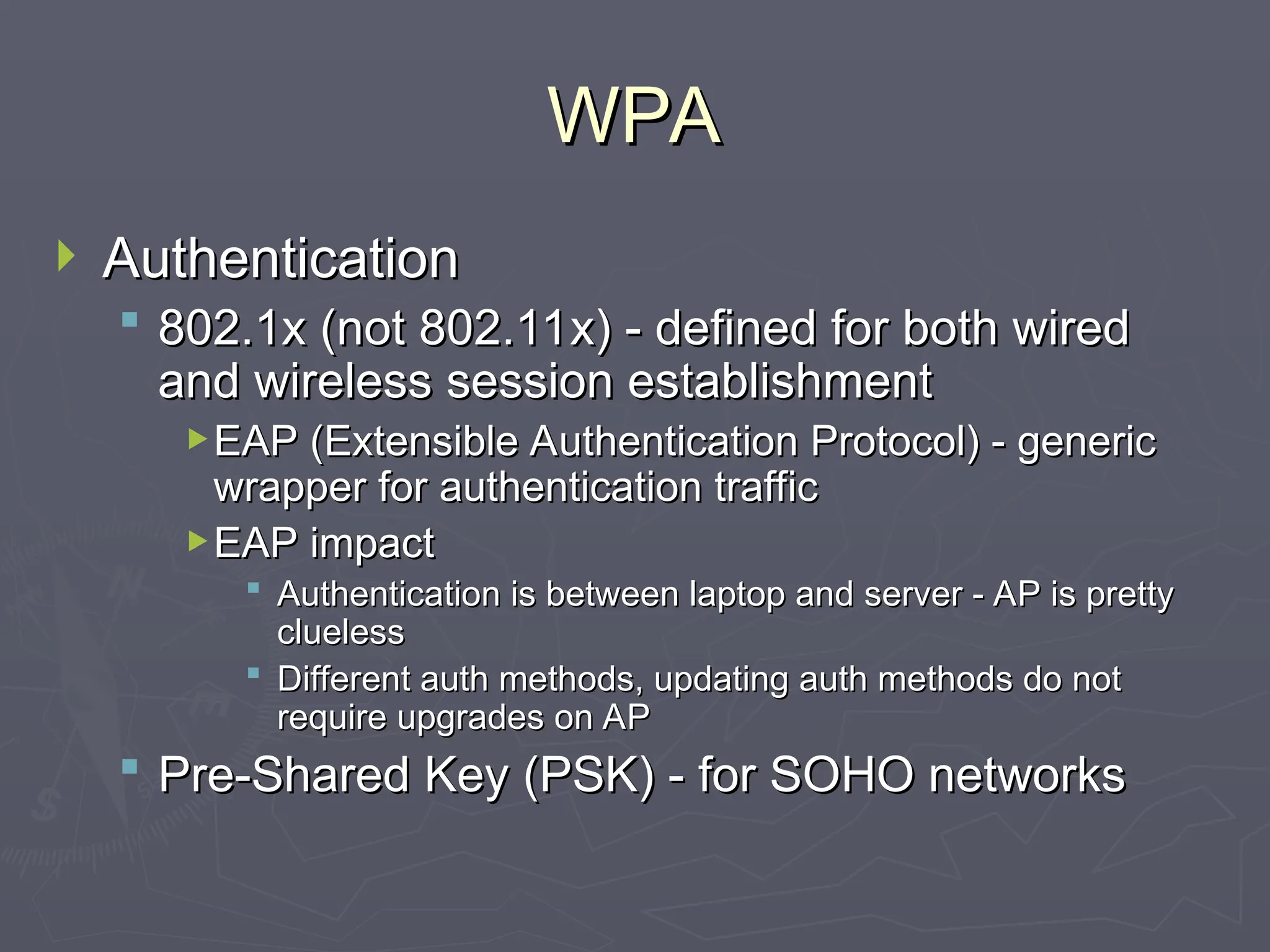
 802.1x (not 802.11x) - defined for both wired
802.1x (not 802.11x) - defined for both wired
and wireless session establishment
EAP (Extensible Authentication Protocol) - generic
EAP (Extensible Authentication Protocol) - generic
wrapper for authentication traffic
EAP impact
EAP impact
 Authentication is between laptop and server - AP is pretty
Authentication is between laptop and server - AP is pretty
clueless
clueless
 Different auth methods, updating auth methods do not
Different auth methods, updating auth methods do not
require upgrades on AP
 Pre-Shared Key (PSK) - for SOHO networks
Pre-Shared Key (PSK) - for SOHO networks
WPA
WPA
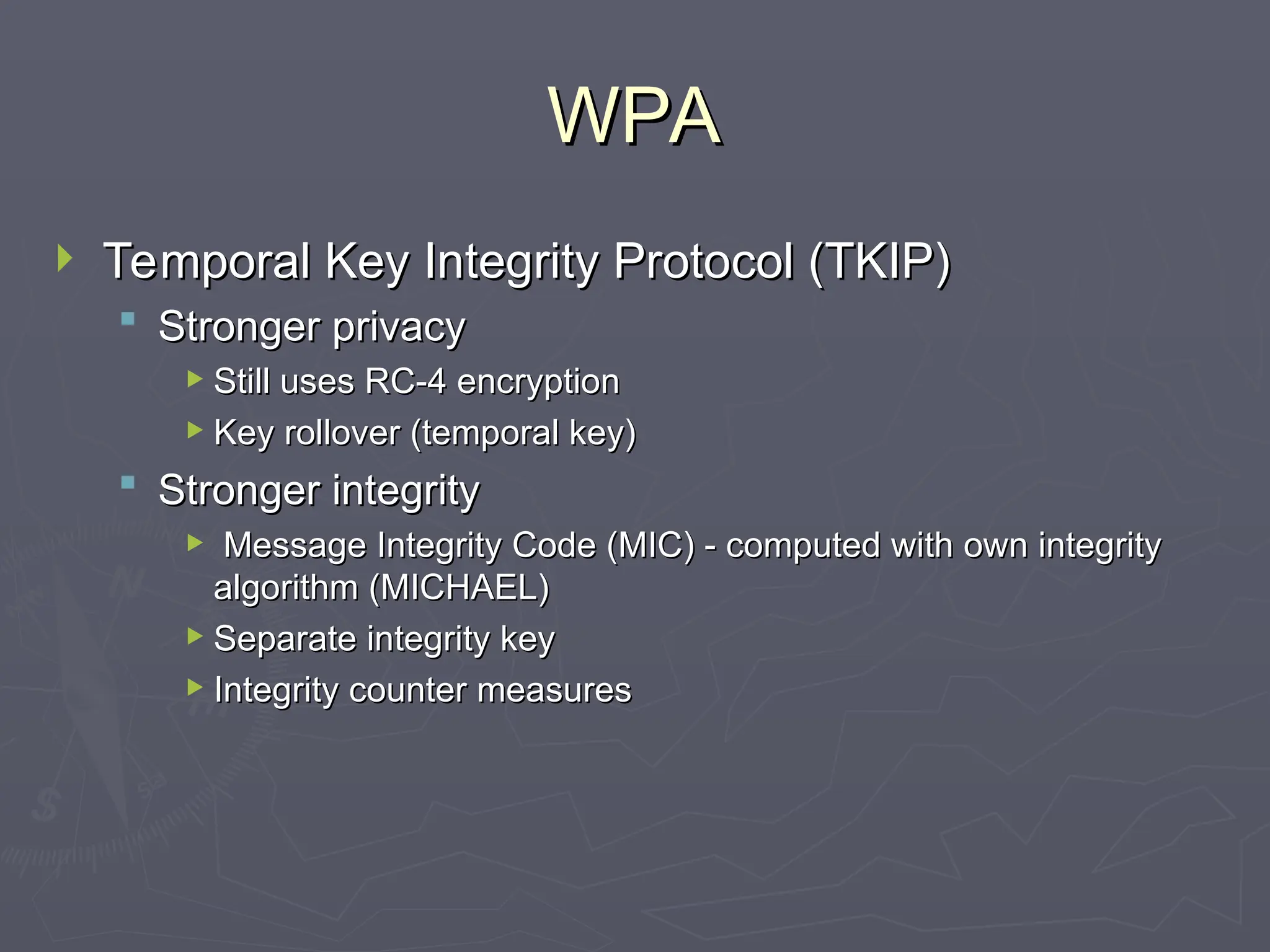
 Temporal Key Integrity Protocol (TKIP)
Temporal Key Integrity Protocol (TKIP)
 Stronger privacy
Stronger privacy
 Still uses RC-4 encryption
Still uses RC-4 encryption
 Key rollover (temporal key)
Key rollover (temporal key)
 Stronger integrity
Stronger integrity
 Message Integrity Code (MIC) - computed with own integrity
Message Integrity Code (MIC) - computed with own integrity
algorithm (MICHAEL)
algorithm (MICHAEL)
 Separate integrity key
Separate integrity key
 Integrity counter measures
Integrity counter measures
802.11i
802.11i
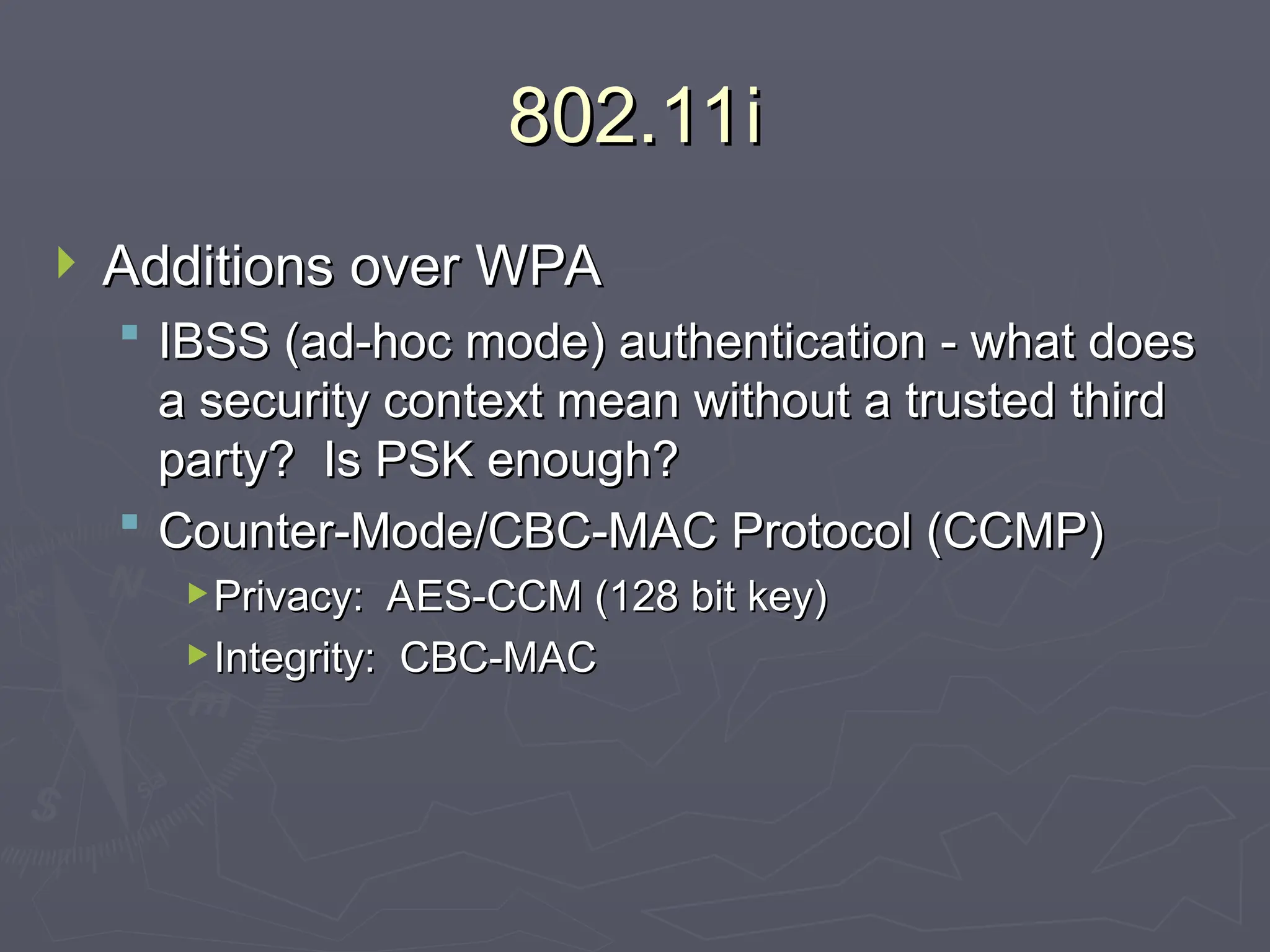
 Additions over WPA
Additions over WPA
 IBSS (ad-hoc mode) authentication - what does
IBSS (ad-hoc mode) authentication - what does
a security context mean without a trusted third
party? Is PSK enough?
 Counter-Mode/CBC-MAC Protocol (CCMP)
Counter-Mode/CBC-MAC Protocol (CCMP)
Privacy: AES-CCM (128 bit key)
Privacy: AES-CCM (128 bit key)
Integrity: CBC-MAC
Integrity: CBC-MAC
802.11i criticisms
802.11i criticisms
 Does not secure 802.11 management
Does not secure 802.11 management
control and action frames
 Disassociate, output power, etc.
Disassociate, output power, etc.
 Fundamental dilemma: does 802.11i secure
Fundamental dilemma: does 802.11i secure
 1. Traffic carried by the network?
1. Traffic carried by the network?
 2. Network elements themselves?
2. Network elements themselves?

WLAN SECURITY ..........................outline

  • 1.
    Outline Outline  Security definitions Securitydefinitions  Current 802.11 security Current 802.11 security  Weak IV problem Weak IV problem  Wi-Fi Protected WPA security Wi-Fi Protected WPA security  802.11i 802.11i
  • 2.
    Security Definitions Security Definitions Security context between two (network) Security context between two (network) entities should provide entities should provide  Authentication - to prove identity Authentication - to prove identity  Integrity - to detect altered packets Integrity - to detect altered packets  Privacy - to prevent eavesdropping Privacy - to prevent eavesdropping ..DesktopNAEavesdropping.docx
  • 3.
    Current 802.11 Security Current802.11 Security  (as per the 1999 spec) (as per the 1999 spec)  Authentication Authentication  Tied to association (session between station Tied to association (session between station and AP) and AP)  Open system - all stations may associate Open system - all stations may associate  Shared key - stations must know secret Shared key - stations must know secret  Integrity Integrity  Privacy Privacy
  • 4.
    Current 802.11 Security Current802.11 Security  (as per the 1999 spec) (as per the 1999 spec)  Authentication Authentication  Integrity - Integrity Check (IC) field Integrity - Integrity Check (IC) field  32 bit CRC in encrypted payload 32 bit CRC in encrypted payload  Not separately keyed Not separately keyed  Vulnerable to bit-flipping attacks Vulnerable to bit-flipping attacks  Privacy Privacy
  • 5.
    Current 802.11 Security Current802.11 Security  (as per the 1999 spec) (as per the 1999 spec)  Authentication Authentication  Integrity Integrity  Privacy - Wired Equivalent Privacy (WEP) Privacy - Wired Equivalent Privacy (WEP)  RC4 cipher (relies on XOR) RC4 cipher (relies on XOR)  Up to 4 keys per station (40 bit or 104 bit) Up to 4 keys per station (40 bit or 104 bit)  Initialization Vector (IV) Initialization Vector (IV)  24 bit extension to key 24 bit extension to key  Provides some randomization to key Provides some randomization to key  Unfortunately, keyspace is small! Unfortunately, keyspace is small!
  • 6.
    Big WEP Attack- Weak IV Big WEP Attack - Weak IV  Say an AP constantly sends 1500 byte frames at Say an AP constantly sends 1500 byte frames at 11 Mbps 11 Mbps  Keyspace is exhausted in 5 hours Keyspace is exhausted in 5 hours  Will be quicker if packets are smaller Will be quicker if packets are smaller  Original IV algorithms made things much worse Original IV algorithms made things much worse  Some cards used same IV for multiple packets Some Some cards used same IV for multiple packets Some cards reset IV to 0 after initialization cards reset IV to 0 after initialization  Some cards increment IV by 1 after each packet Some cards increment IV by 1 after each packet  WEP+ fixed these “Weak IV” issues WEP+ fixed these “Weak IV” issues
  • 7.
    Improving Security Improving Security Improve authentication Improve authentication  System wide common login System wide common login  Improve integrity Improve integrity  Separate integrity key Separate integrity key  Stronger integrity algorithm Stronger integrity algorithm  Improve privacy Improve privacy  Increase keyspace size (make cracker analyze more Increase keyspace size (make cracker analyze more data in order to recover key) data in order to recover key)  Per -user keys Per -user keys  Key rollover Key rollover  Stronger privacy algorithm Stronger privacy algorithm
  • 8.
    802.11i and WPA 802.11iand WPA  IEEE 802.11i - IEEE 802.11 task group IEEE 802.11i - IEEE 802.11 task group “MAC enhancement for wireless security” “MAC enhancement for wireless security”  Wi-Fi Alliance WPA - subset of 802.11i Wi-Fi Alliance WPA - subset of 802.11i  Compatible with earlier draft Compatible with earlier draft  Defined for BSS only Defined for BSS only  Defined for current hardware Defined for current hardware  WPA has two major components WPA has two major components  Authentication Authentication  TKIP encryption TKIP encryption
  • 9.
    WPA WPA  Authentication Authentication  802.1x(not 802.11x) - defined for both wired 802.1x (not 802.11x) - defined for both wired and wireless session establishment and wireless session establishment EAP (Extensible Authentication Protocol) - generic EAP (Extensible Authentication Protocol) - generic wrapper for authentication traffic wrapper for authentication traffic EAP impact EAP impact  Authentication is between laptop and server - AP is pretty Authentication is between laptop and server - AP is pretty clueless clueless  Different auth methods, updating auth methods do not Different auth methods, updating auth methods do not require upgrades on AP require upgrades on AP  Pre-Shared Key (PSK) - for SOHO networks Pre-Shared Key (PSK) - for SOHO networks
  • 10.
    WPA WPA  Temporal KeyIntegrity Protocol (TKIP) Temporal Key Integrity Protocol (TKIP)  Stronger privacy Stronger privacy  Still uses RC-4 encryption Still uses RC-4 encryption  Key rollover (temporal key) Key rollover (temporal key)  Stronger integrity Stronger integrity  Message Integrity Code (MIC) - computed with own integrity Message Integrity Code (MIC) - computed with own integrity algorithm (MICHAEL) algorithm (MICHAEL)  Separate integrity key Separate integrity key  Integrity counter measures Integrity counter measures
  • 11.
    802.11i 802.11i  Additions overWPA Additions over WPA  IBSS (ad-hoc mode) authentication - what does IBSS (ad-hoc mode) authentication - what does a security context mean without a trusted third a security context mean without a trusted third party? Is PSK enough? party? Is PSK enough?  Counter-Mode/CBC-MAC Protocol (CCMP) Counter-Mode/CBC-MAC Protocol (CCMP) Privacy: AES-CCM (128 bit key) Privacy: AES-CCM (128 bit key) Integrity: CBC-MAC Integrity: CBC-MAC
  • 12.
    802.11i criticisms 802.11i criticisms Does not secure 802.11 management Does not secure 802.11 management control and action frames control and action frames  Disassociate, output power, etc. Disassociate, output power, etc.  Fundamental dilemma: does 802.11i secure Fundamental dilemma: does 802.11i secure  1. Traffic carried by the network? 1. Traffic carried by the network?  2. Network elements themselves? 2. Network elements themselves?