Knowledge sharing over social networking systems
Content Context :  Open innovation Knowledge & learning Knowledge sharing Case study of SNS Ecademy data :  Structure Evolution Survey Knosos ADIIKS
Context : open innovation The knowledge boundaries of the organisation become fuzzy Closed Innovation :  R&D done internally E.g. : Bell labs, Xerox, … Open Innovation  (Chesborough 2003)  :  organisations are open to innovations which originated outside their boundaries organisations are prepared to let the world outside their boundaries use their innovations
Context : open innovation Examples of open innovation :  Proctor&Gamble : innocentive.com IBM : collaboration with academics & open source projects Bekaert : cognistreamer.com Crowdsourcing : cambrianhouse.com Flandersdrive.be
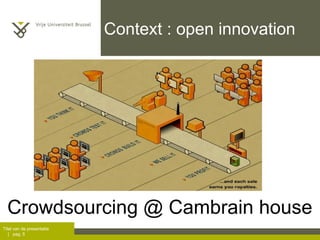
Context : open innovation Crowdsourcing @ Cambrain house
Context : open innovation Role of R&D in open innovation environment = to integrate external and internal knowledge to produce innovation :  "You need not invent the most new knowledge or the best new knowledge to win. Instead, you win by making the best use of internal and external knowledge in a timely way, creatively combining that knowledge in new and different ways to create new products or services"  (Chesborough 2003,p52)
Context : open innovation Required to obtain open innovation :  Awareness of external knowledge Communication Collaboration => Knowledge sharing over social networking systems
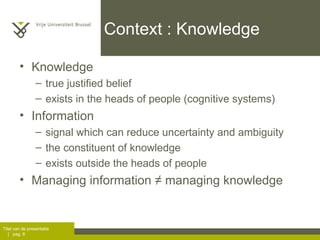
Context : Knowledge Knowledge  true justified belief exists in the heads of people (cognitive systems) Information signal which can reduce uncertainty and ambiguity the constituent of knowledge exists outside the heads of people Managing information  ≠ managing knowledge
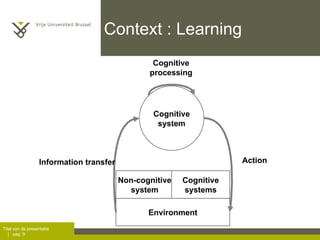
Context : Learning Cognitive system Environment Non-cognitive system Cognitive systems Action Information transfer Cognitive processing
Context : Knowledge sharing People who share knowledge with individuals from different domains are more creative  (Burt 2000, Kasperson 1978) Complex and messy problems can only be solved by interacting directly with other individuals instead of internalizing information from a DB  (Vennix 1996, Contant et al 1996)
Context : Knowledge sharing Elements that influence knowledge contribution :  Probability that you will get something in return Value of what you expect to get in return Probability that the receiver will be able to use the knowledge in the same way as the source The expected loss of value of the source’s knowledge as a result of sharing it How hard it is to externalise the knowledge How much it costs to transfer the knowledge
Social networking systems SNS : aim to expand the social network of users Examples :  Dating sites  Friendship sites (e.g. Orkut, mySpace) Business sites (e.g. OpenBC, Ecademy)
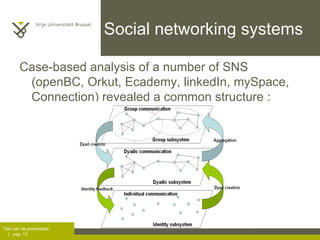
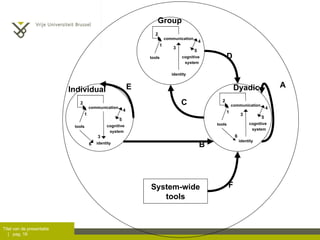
Social networking systems Case-based analysis of a number of SNS (openBC, Orkut, Ecademy, linkedIn, mySpace, Connection) revealed a common structure :
Social networking systems :  autopoiesis Autopoiesis :  “The autopoietic organisation is defined as a unity by a network of productions of components which (i) participate recursively in the same network of productions of components which produced these components, and (ii) realize the network of productions  as a unity in the space in which the component exists.”  (Varela et al 1974, p188) Autopoiesis = self-reproduction (Greek)  Autopoiesis is what distinguishes living from non living systems
Social networking systems :  autopoiesis Six Key points  (Varela et al 1974)  :  when these apply to a system, it can be said to be autopoietic e.g. :  Cell Cognition Society  Allopoiesis (not alive) :  components are produced by external entity  e.g. :  Car Computer
Individual communication identity tools cognitive   system 1 2 3 4 5 6 communication identity tools cognitive   system 1 2 3 4 5 Group communication identity tools cognitive   system 1 2 3 4 5 6 Dyadic System-wide tools A B C D E F
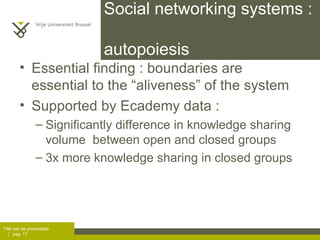
Social networking systems :  autopoiesis Essential finding : boundaries are essential to the “aliveness” of the system Supported by Ecademy data :  Significantly difference in knowledge sharing volume  between open and closed groups 3x more knowledge sharing in closed groups
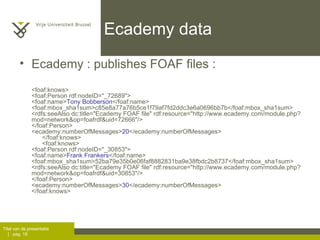
Ecademy data Ecademy : publishes FOAF files :  <foaf:knows> <foaf:Person rdf:nodeID=&quot;_72689&quot;> <foaf:name> Tony Bobberson </foaf:name> <foaf:mbox_sha1sum>c85e8a77a76b5ce1f79af7fd2ddc3e6a0696bb7b</foaf:mbox_sha1sum> <rdfs:seeAlso dc:title=&quot;Ecademy FOAF file&quot; rdf:resource=&quot;http://www.ecademy.com/module.php?mod=network&op=foafrdf&uid=72666&quot;/> </foaf:Person> <ecademy:numberOfMessages> 20 </ecademy:numberOfMessages>   </foaf:knows>   <foaf:knows> <foaf:Person rdf:nodeID=&quot;_30853&quot;> <foaf:name> Frank Frankers </foaf:name> <foaf:mbox_sha1sum>52ba79e35b0e06faf8882831ba9e38fbdc2b8737</foaf:mbox_sha1sum> <rdfs:seeAlso dc:title=&quot;Ecademy FOAF file&quot; rdf:resource=&quot;http://www.ecademy.com/module.php?mod=network&op=foafrdf&uid=30853&quot;/> </foaf:Person> <ecademy:numberOfMessages> 30 </ecademy:numberOfMessages> </foaf:knows>
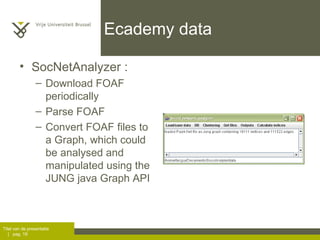
Ecademy data SocNetAnalyzer :  Download FOAF periodically Parse FOAF Convert FOAF files to a Graph, which could be analysed and manipulated using the JUNG java Graph API
Ecademy data Used Ecademy data to : Study structure Study evolution of the network Draw a sample for a survey
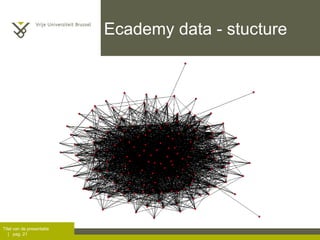
Ecademy data - stucture
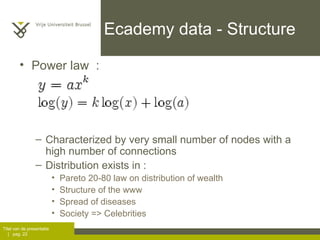
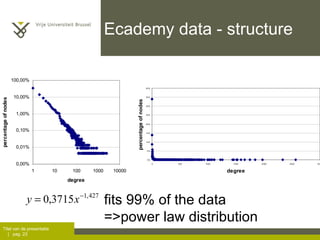
Ecademy data - Structure Power law  :  Characterized by very small number of nodes with a high number of connections  Distribution exists in :  Pareto 20-80 law on distribution of wealth Structure of the www Spread of diseases Society => Celebrities
Ecademy data - structure fits 99% of the data =>power law distribution
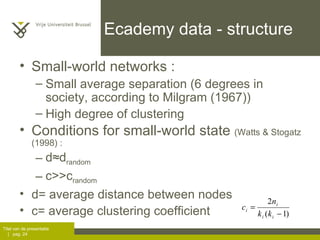
Ecademy data - structure Small-world networks : Small average separation (6 degrees in society, according to Milgram (1967))  High degree of clustering Conditions for small-world state  (Watts & Stogatz (1998) :  d ≈d random c>>c random d= average distance between nodes c= average clustering coefficient
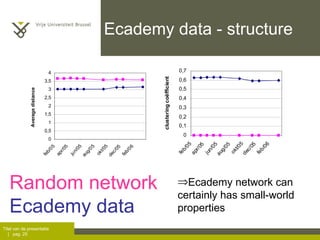
Ecademy data - structure Random network Ecademy data Ecademy network can  certainly has small-world properties
Ecademy data - evolution Why does the network evolve as it does ? Very hard to answer, because of different possible effects Stochastic actor-driven modeling  (Snijder 2005) : permits the testing of network effects, while controlling for other variables Works longitudinally, e.g. : [email_address] [email_address]
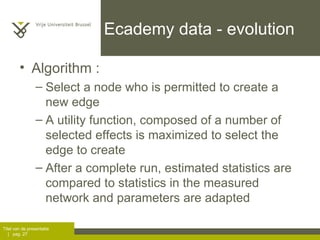
Ecademy data - evolution Algorithm :  Select a node who is permitted to create a new edge A utility function, composed of a number of selected effects is maximized to select the edge to create After a complete run, estimated statistics are compared to statistics in the measured network and parameters are adapted
Ecademy data - evolution Selected data :  Small subset of the network which had many strong connections (exchanged more than 50 messages) 3 measurements
Ecademy data - evolution Selected effects :  Network effects :  Transitivity Number of nodes at distance 2 Degree of alter Attribute effects :  Similarity Activity Popularity
Ecademy data - evolution Findings :  Structure is mainly caused by degree of alter effect : people tend to create connections to other people who already have many connections People with the same account types connect to each other Women increase their number of connections at a faster rate than men People with the same sex connect to each other
Ecademy data - evolution Common offline social mechanisms, like transitivity, do not influence the structure of the system in a social networking system. Recommendation : Make social structure more transparent than what is currently done in existing social networking systems
Ecademy data - survey Random selection of 2000 relationships with strength > 10 Sent online questionnaire which investigated the influence of certain variables on knowledge sharing and the way people share knowledge Response rate : 33,8%
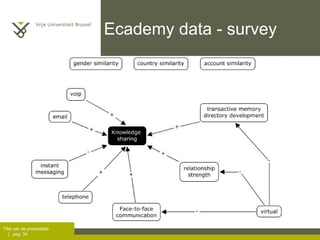
Ecademy data - survey Findings : face-to-face relationships still have a positive influence on  Relationship strength Communication intensity Transactive memory directory development  Knowledge sharing Ecademy has led to new relationships, but mainly weak ones
Ecademy data - survey
Ecademy data - survey Recommendation : when starting up new social networking systems in or between organisations, combine this with regular face-to-face events Integrating VoIP services in existing and new SNS can be beneficial Providing clues about transactive memory directories is important
Knosos Builds on PhD findings www.knosos.be Tagviz :  www.knosos.be/tagviz/
ADIIKS Advanced Distributed Interactive Knowledge Sharing Brussels region Impulse program 7-8 FTE researchers Themes :  Living ontology (VUB-StarLab) Adaptive navigation (VUB-WISE) Matching (ULB-CAD/CAM) Multilingual support (EHB-CVC) GDS (VUB-MOSI/ULB SMG) Knowledge contribution study (VUB-MOSI) Pattern development (VUB-MOSI)

Knowledge Sharing over social networking systems

  • 1.
    Knowledge sharing oversocial networking systems
  • 2.
    Content Context : Open innovation Knowledge & learning Knowledge sharing Case study of SNS Ecademy data : Structure Evolution Survey Knosos ADIIKS
  • 3.
    Context : openinnovation The knowledge boundaries of the organisation become fuzzy Closed Innovation : R&D done internally E.g. : Bell labs, Xerox, … Open Innovation (Chesborough 2003) : organisations are open to innovations which originated outside their boundaries organisations are prepared to let the world outside their boundaries use their innovations
  • 4.
    Context : openinnovation Examples of open innovation : Proctor&Gamble : innocentive.com IBM : collaboration with academics & open source projects Bekaert : cognistreamer.com Crowdsourcing : cambrianhouse.com Flandersdrive.be
  • 5.
    Context : openinnovation Crowdsourcing @ Cambrain house
  • 6.
    Context : openinnovation Role of R&D in open innovation environment = to integrate external and internal knowledge to produce innovation : &quot;You need not invent the most new knowledge or the best new knowledge to win. Instead, you win by making the best use of internal and external knowledge in a timely way, creatively combining that knowledge in new and different ways to create new products or services&quot; (Chesborough 2003,p52)
  • 7.
    Context : openinnovation Required to obtain open innovation : Awareness of external knowledge Communication Collaboration => Knowledge sharing over social networking systems
  • 8.
    Context : KnowledgeKnowledge true justified belief exists in the heads of people (cognitive systems) Information signal which can reduce uncertainty and ambiguity the constituent of knowledge exists outside the heads of people Managing information ≠ managing knowledge
  • 9.
    Context : LearningCognitive system Environment Non-cognitive system Cognitive systems Action Information transfer Cognitive processing
  • 10.
    Context : Knowledgesharing People who share knowledge with individuals from different domains are more creative (Burt 2000, Kasperson 1978) Complex and messy problems can only be solved by interacting directly with other individuals instead of internalizing information from a DB (Vennix 1996, Contant et al 1996)
  • 11.
    Context : Knowledgesharing Elements that influence knowledge contribution : Probability that you will get something in return Value of what you expect to get in return Probability that the receiver will be able to use the knowledge in the same way as the source The expected loss of value of the source’s knowledge as a result of sharing it How hard it is to externalise the knowledge How much it costs to transfer the knowledge
  • 12.
    Social networking systemsSNS : aim to expand the social network of users Examples : Dating sites Friendship sites (e.g. Orkut, mySpace) Business sites (e.g. OpenBC, Ecademy)
  • 13.
    Social networking systemsCase-based analysis of a number of SNS (openBC, Orkut, Ecademy, linkedIn, mySpace, Connection) revealed a common structure :
  • 14.
    Social networking systems: autopoiesis Autopoiesis : “The autopoietic organisation is defined as a unity by a network of productions of components which (i) participate recursively in the same network of productions of components which produced these components, and (ii) realize the network of productions as a unity in the space in which the component exists.” (Varela et al 1974, p188) Autopoiesis = self-reproduction (Greek) Autopoiesis is what distinguishes living from non living systems
  • 15.
    Social networking systems: autopoiesis Six Key points (Varela et al 1974) : when these apply to a system, it can be said to be autopoietic e.g. : Cell Cognition Society Allopoiesis (not alive) : components are produced by external entity e.g. : Car Computer
  • 16.
    Individual communication identitytools cognitive system 1 2 3 4 5 6 communication identity tools cognitive system 1 2 3 4 5 Group communication identity tools cognitive system 1 2 3 4 5 6 Dyadic System-wide tools A B C D E F
  • 17.
    Social networking systems: autopoiesis Essential finding : boundaries are essential to the “aliveness” of the system Supported by Ecademy data : Significantly difference in knowledge sharing volume between open and closed groups 3x more knowledge sharing in closed groups
  • 18.
    Ecademy data Ecademy: publishes FOAF files : <foaf:knows> <foaf:Person rdf:nodeID=&quot;_72689&quot;> <foaf:name> Tony Bobberson </foaf:name> <foaf:mbox_sha1sum>c85e8a77a76b5ce1f79af7fd2ddc3e6a0696bb7b</foaf:mbox_sha1sum> <rdfs:seeAlso dc:title=&quot;Ecademy FOAF file&quot; rdf:resource=&quot;http://www.ecademy.com/module.php?mod=network&op=foafrdf&uid=72666&quot;/> </foaf:Person> <ecademy:numberOfMessages> 20 </ecademy:numberOfMessages> </foaf:knows> <foaf:knows> <foaf:Person rdf:nodeID=&quot;_30853&quot;> <foaf:name> Frank Frankers </foaf:name> <foaf:mbox_sha1sum>52ba79e35b0e06faf8882831ba9e38fbdc2b8737</foaf:mbox_sha1sum> <rdfs:seeAlso dc:title=&quot;Ecademy FOAF file&quot; rdf:resource=&quot;http://www.ecademy.com/module.php?mod=network&op=foafrdf&uid=30853&quot;/> </foaf:Person> <ecademy:numberOfMessages> 30 </ecademy:numberOfMessages> </foaf:knows>
  • 19.
    Ecademy data SocNetAnalyzer: Download FOAF periodically Parse FOAF Convert FOAF files to a Graph, which could be analysed and manipulated using the JUNG java Graph API
  • 20.
    Ecademy data UsedEcademy data to : Study structure Study evolution of the network Draw a sample for a survey
  • 21.
  • 22.
    Ecademy data -Structure Power law : Characterized by very small number of nodes with a high number of connections Distribution exists in : Pareto 20-80 law on distribution of wealth Structure of the www Spread of diseases Society => Celebrities
  • 23.
    Ecademy data -structure fits 99% of the data =>power law distribution
  • 24.
    Ecademy data -structure Small-world networks : Small average separation (6 degrees in society, according to Milgram (1967)) High degree of clustering Conditions for small-world state (Watts & Stogatz (1998) : d ≈d random c>>c random d= average distance between nodes c= average clustering coefficient
  • 25.
    Ecademy data -structure Random network Ecademy data Ecademy network can certainly has small-world properties
  • 26.
    Ecademy data -evolution Why does the network evolve as it does ? Very hard to answer, because of different possible effects Stochastic actor-driven modeling (Snijder 2005) : permits the testing of network effects, while controlling for other variables Works longitudinally, e.g. : [email_address] [email_address]
  • 27.
    Ecademy data -evolution Algorithm : Select a node who is permitted to create a new edge A utility function, composed of a number of selected effects is maximized to select the edge to create After a complete run, estimated statistics are compared to statistics in the measured network and parameters are adapted
  • 28.
    Ecademy data -evolution Selected data : Small subset of the network which had many strong connections (exchanged more than 50 messages) 3 measurements
  • 29.
    Ecademy data -evolution Selected effects : Network effects : Transitivity Number of nodes at distance 2 Degree of alter Attribute effects : Similarity Activity Popularity
  • 30.
    Ecademy data -evolution Findings : Structure is mainly caused by degree of alter effect : people tend to create connections to other people who already have many connections People with the same account types connect to each other Women increase their number of connections at a faster rate than men People with the same sex connect to each other
  • 31.
    Ecademy data -evolution Common offline social mechanisms, like transitivity, do not influence the structure of the system in a social networking system. Recommendation : Make social structure more transparent than what is currently done in existing social networking systems
  • 32.
    Ecademy data -survey Random selection of 2000 relationships with strength > 10 Sent online questionnaire which investigated the influence of certain variables on knowledge sharing and the way people share knowledge Response rate : 33,8%
  • 33.
    Ecademy data -survey Findings : face-to-face relationships still have a positive influence on Relationship strength Communication intensity Transactive memory directory development Knowledge sharing Ecademy has led to new relationships, but mainly weak ones
  • 34.
  • 35.
    Ecademy data -survey Recommendation : when starting up new social networking systems in or between organisations, combine this with regular face-to-face events Integrating VoIP services in existing and new SNS can be beneficial Providing clues about transactive memory directories is important
  • 36.
    Knosos Builds onPhD findings www.knosos.be Tagviz : www.knosos.be/tagviz/
  • 37.
    ADIIKS Advanced DistributedInteractive Knowledge Sharing Brussels region Impulse program 7-8 FTE researchers Themes : Living ontology (VUB-StarLab) Adaptive navigation (VUB-WISE) Matching (ULB-CAD/CAM) Multilingual support (EHB-CVC) GDS (VUB-MOSI/ULB SMG) Knowledge contribution study (VUB-MOSI) Pattern development (VUB-MOSI)