
Managing Knowledge
Learning Objectives
• 1 What is the role of knowledge management systems in business?
• 2 What types of systems are used for enterprise-wide knowledge
management, and how do they provide value for businesses?
• 3 What are the major types of knowledge work systems, and how do
they provide value for firms?
• 4 What are the business benefits of using intelligent techniques for
knowledge management?
Video Cases
• Case 1: How IBM’s Watson Became a Jeopardy Champion
• Case 2: Alfresco: Open Source Document Management and
Collaboration
What Is the Role of Knowledge Management
Systems in Business?
• Knowledge management systems among fastest growing areas of software
investment
• Information economy
• 37 percent U.S. labor force: knowledge and information workers
• 55 percent U.S. GDP from knowledge and information sectors
• Substantial part of a firm’s stock market value is related to intangible assets:
knowledge, brands, reputations, and unique business processes
• Well-executed knowledge-based projects can produce extraordinary ROI
Important Dimensions of Knowledge (1 of 2)
• Data, knowledge, and wisdom
• Important dimensions of knowledge
• Knowledge is a firm asset.
• Knowledge has different forms.
• Knowledge has a location.
• Knowledge is situational.
Important Dimensions of Knowledge (2 of 2)
• Knowledge-based core competencies
• Key organizational assets
• Knowing how to do things effectively and efficiently in ways others cannot
duplicate is a prime source of profit and competitive advantage
– Example: Having a unique build-to-order production system
–Organizational learning
• Process in which organizations gain experience through collection of data,
measurement, trial and error, and feedback
The Knowledge Management Value Chain (1
of 3)
• Knowledge management
• Set of business processes developed in an organization to create, store,
transfer, and apply knowledge
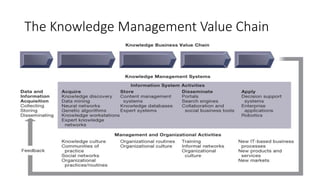
• Knowledge management value chain
• Each stage adds value to raw data and information as they are transformed
into usable knowledge
• Knowledge acquisition
• Knowledge storage
• Knowledge dissemination
• Knowledge application
The Knowledge Management Value Chain (2
of 3)
• Knowledge acquisition
• Documenting tacit and explicit knowledge
• Storing documents, reports, presentations, best practices
• Unstructured documents (e.g., e-mails)
• Developing online expert networks
• Creating knowledge
• Tracking data from TPS and external sources
• Knowledge storage
• Databases
• Document management systems
• Role of management
The Knowledge Management Value Chain (3
of 3)
• Knowledge dissemination
• Portals, wikis
• E-mail, instant messaging
• Search engines, collaboration tools
• A deluge of information?
• Training programs, informal networks, and shared management experience help
managers focus attention on important information.
• Knowledge application
• New business practices
• New products and services
• New markets
The Knowledge Management Value Chain
Types of Knowledge Management Systems
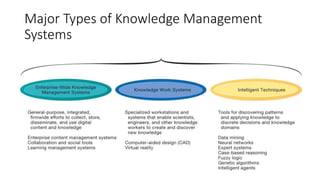
• Enterprise-wide knowledge management systems
• General-purpose firm-wide efforts to collect, store, distribute, and apply
digital content and knowledge
• Knowledge work systems (KWS)
• Specialized systems built for engineers, scientists, other knowledge workers
charged with discovering and creating new knowledge
• Intelligent techniques
• Diverse group of techniques such as data mining used for various goals:
discovering knowledge, distilling knowledge, discovering optimal solutions
Major Types of Knowledge Management
Systems
What Types of Systems Are Used for
Enterprise-Wide Knowledge Management?
• Three major types of knowledge in an enterprise
• Structured documents
• Reports, presentations
• Formal rules
• Semistructured documents
• E-mails, videos
• Unstructured, tacit knowledge
• 80% of an organization’s business content is semistructured or
unstructured
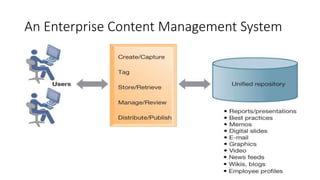
Enterprise Content Management Systems
• Help capture, store, retrieve, distribute, preserve documents and
semistructured knowledge
• Bring in external sources
• News feeds, research
• Tools for communication and collaboration
• Blogs, wikis, and so on
• Key problem: developing taxonomy
• Digital asset management systems
An Enterprise Content Management System
Locating and Sharing Expertise
• Provide online directory of corporate experts in well-defined
knowledge domains
• Search tools enable employees to find appropriate expert in a
company
• Social networking and social business tools for finding knowledge
outside the firm
• Saving
• Tagging
• Sharing web pages
Learning Management Systems (LMS)
• Provide tools for management, delivery, tracking, and assessment of employee
learning and training
• Support multiple modes of learning
• CD-ROM, web-based classes, online forums, and so on
• Automates selection and administration of courses
• Assembles and delivers learning content
• Measures learning effectiveness
• Massively open online courses (MOOCs)
• Web course open to large numbers of participants
Knowledge Workers and Knowledge Work
• Knowledge workers
• Researchers, designers, architects, scientists, engineers who create
knowledge for the organization
• Three key roles
• Keeping organization current in knowledge
• Serving as internal consultants regarding their areas of expertise
• Acting as change agents, evaluating, initiating, and promoting change projects
• Knowledge work systems
• Systems for knowledge workers to help create new knowledge and integrate
that knowledge into business
Requirements of Knowledge Work Systems
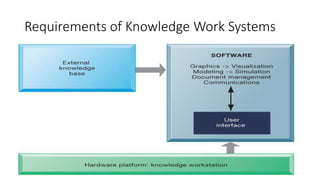
• Sufficient computing power for graphics, complex calculations
• Powerful graphics and analytical tools
• Communications and document management
• Access to external databases
• User-friendly interfaces
• Optimized for tasks to be performed (design engineering, financial
analysis)
Requirements of Knowledge Work Systems
Examples of Knowledge Work Systems
• CAD (computer-aided design)
• Creation of engineering or architectural designs
• 3D printing, MAX-MAYA
• Virtual reality systems
• Simulate real-life environments
• 3D medical modeling for surgeons
• Augmented reality (AR) systems
• Virtual Reality Modeling Language (VRML)
What Are the Business Benefits of Using
Intelligent Techniques for Knowledge
Management?
• Intelligent techniques: Used to capture individual and collective
knowledge and to extend knowledge base
• To capture tacit knowledge: Expert systems, case-based reasoning, fuzzy logic
• Knowledge discovery: Neural networks and data mining
• Generating solutions to complex problems: Genetic algorithms
• Automating tasks: Intelligent agents
• Artificial intelligence (AI) technology:
• Computer-based systems that emulate human behavior
Interactive Session: Technology: Will Robots
Replace People in Manufacturing?
• Class discussion
• Why have robots caught on in manufacturing? What knowledge to they
require?
• Can robots replace human workers in manufacturing? Explain your answer.
• If you were considering introducing robots in your manufacturing plant, what
management, organization, and technology issues would you need to
address?
Capturing Knowledge: Expert Systems (1 of 2)
• Capture tacit knowledge in very specific and limited domain of human
expertise
• Capture knowledge as set of rules
• Typically perform limited tasks
• Diagnosing malfunctioning machine
• Determining whether to grant credit for loan
• Used for discrete, highly structured decision making
• Knowledge base: Set of hundreds or thousands of rules
• Inference engine: Strategy used to search knowledge base
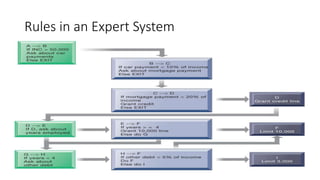
Rules in an Expert System
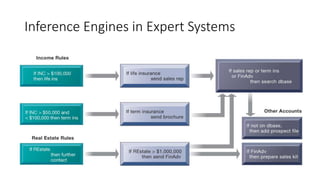
Inference Engines in Expert Systems
Capturing Knowledge: Expert Systems (2 of 2)
• Successful expert systems
• Con-Way Transportation’s system to automate and optimize planning of
overnight shipment routes
• Most expert systems deal with problems of classification
• Have relatively few alternative outcomes
• Possible outcomes are known in advance
• Many expert systems require large, lengthy, and expensive
development and maintenance efforts
• Hiring or training more experts may be less expensive
Organizational Intelligence: Case-Based
Reasoning
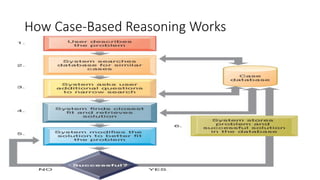
• Descriptions of past experiences of human specialists (cases), stored in
knowledge base
• System searches for cases with characteristics similar to new one and applies
solutions of old case to new case
• Successful and unsuccessful applications are grouped with case
• Stores organizational intelligence
• CBR found in:
• Medical diagnostic systems
• Customer support
How Case-Based Reasoning Works
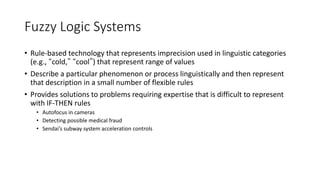
Fuzzy Logic Systems
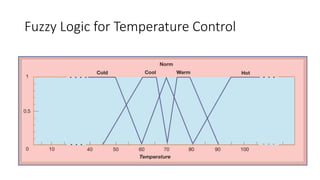
• Rule-based technology that represents imprecision used in linguistic categories
(e.g., “cold,” “cool”) that represent range of values
• Describe a particular phenomenon or process linguistically and then represent
that description in a small number of flexible rules
• Provides solutions to problems requiring expertise that is difficult to represent
with IF-THEN rules
• Autofocus in cameras
• Detecting possible medical fraud
• Sendai’s subway system acceleration controls
Fuzzy Logic for Temperature Control
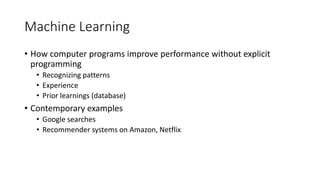
Machine Learning
• How computer programs improve performance without explicit
programming
• Recognizing patterns
• Experience
• Prior learnings (database)
• Contemporary examples
• Google searches
• Recommender systems on Amazon, Netflix
Neural Networks
• Find patterns and relationships in massive amounts of data too
complicated for humans to analyze
• “Learn” patterns by searching for relationships, building models, and
correcting over and over again
• Humans “train” network by feeding it data inputs for which outputs
are known, to help neural network learn solution by example
• Used in medicine, science, and business for problems in pattern
classification, prediction, financial analysis, and control and
optimization
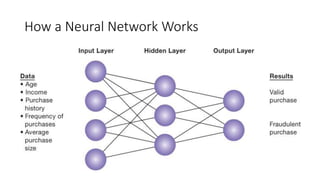
How a Neural Network Works
Intelligent Agents
• Work without direct human intervention to carry out repetitive,
predictable tasks
• Deleting junk e-mail
• Finding cheapest airfare
• Use limited built-in or learned knowledge base
• Some are capable of self-adjustment, for example: Siri
• Chatbots
• Agent-based modeling applications:
• Model behavior of consumers, stock markets, and supply chains; used to
predict spread of epidemics
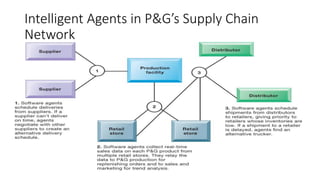
Intelligent Agents in P&G’s Supply Chain
Network
Hybrid AI Systems
• Genetic algorithms, fuzzy logic, neural networks, and expert systems
integrated into single application to take advantage of best features of
each
• For example: Matsushita “neurofuzzy” washing machine that
combines fuzzy logic with neural networks
Managing knowledge

Managing knowledge

  • 1.
  • 2.
    Learning Objectives • 1What is the role of knowledge management systems in business? • 2 What types of systems are used for enterprise-wide knowledge management, and how do they provide value for businesses? • 3 What are the major types of knowledge work systems, and how do they provide value for firms? • 4 What are the business benefits of using intelligent techniques for knowledge management?
  • 3.
    Video Cases • Case1: How IBM’s Watson Became a Jeopardy Champion • Case 2: Alfresco: Open Source Document Management and Collaboration
  • 4.
    What Is theRole of Knowledge Management Systems in Business? • Knowledge management systems among fastest growing areas of software investment • Information economy • 37 percent U.S. labor force: knowledge and information workers • 55 percent U.S. GDP from knowledge and information sectors • Substantial part of a firm’s stock market value is related to intangible assets: knowledge, brands, reputations, and unique business processes • Well-executed knowledge-based projects can produce extraordinary ROI
  • 5.
    Important Dimensions ofKnowledge (1 of 2) • Data, knowledge, and wisdom • Important dimensions of knowledge • Knowledge is a firm asset. • Knowledge has different forms. • Knowledge has a location. • Knowledge is situational.
  • 6.
    Important Dimensions ofKnowledge (2 of 2) • Knowledge-based core competencies • Key organizational assets • Knowing how to do things effectively and efficiently in ways others cannot duplicate is a prime source of profit and competitive advantage – Example: Having a unique build-to-order production system –Organizational learning • Process in which organizations gain experience through collection of data, measurement, trial and error, and feedback
  • 7.
    The Knowledge ManagementValue Chain (1 of 3) • Knowledge management • Set of business processes developed in an organization to create, store, transfer, and apply knowledge • Knowledge management value chain • Each stage adds value to raw data and information as they are transformed into usable knowledge • Knowledge acquisition • Knowledge storage • Knowledge dissemination • Knowledge application
  • 8.
    The Knowledge ManagementValue Chain (2 of 3) • Knowledge acquisition • Documenting tacit and explicit knowledge • Storing documents, reports, presentations, best practices • Unstructured documents (e.g., e-mails) • Developing online expert networks • Creating knowledge • Tracking data from TPS and external sources • Knowledge storage • Databases • Document management systems • Role of management
  • 9.
    The Knowledge ManagementValue Chain (3 of 3) • Knowledge dissemination • Portals, wikis • E-mail, instant messaging • Search engines, collaboration tools • A deluge of information? • Training programs, informal networks, and shared management experience help managers focus attention on important information. • Knowledge application • New business practices • New products and services • New markets
  • 10.
  • 11.
    Types of KnowledgeManagement Systems • Enterprise-wide knowledge management systems • General-purpose firm-wide efforts to collect, store, distribute, and apply digital content and knowledge • Knowledge work systems (KWS) • Specialized systems built for engineers, scientists, other knowledge workers charged with discovering and creating new knowledge • Intelligent techniques • Diverse group of techniques such as data mining used for various goals: discovering knowledge, distilling knowledge, discovering optimal solutions
  • 12.
    Major Types ofKnowledge Management Systems
  • 13.
    What Types ofSystems Are Used for Enterprise-Wide Knowledge Management? • Three major types of knowledge in an enterprise • Structured documents • Reports, presentations • Formal rules • Semistructured documents • E-mails, videos • Unstructured, tacit knowledge • 80% of an organization’s business content is semistructured or unstructured
  • 14.
    Enterprise Content ManagementSystems • Help capture, store, retrieve, distribute, preserve documents and semistructured knowledge • Bring in external sources • News feeds, research • Tools for communication and collaboration • Blogs, wikis, and so on • Key problem: developing taxonomy • Digital asset management systems
  • 15.
    An Enterprise ContentManagement System
  • 16.
    Locating and SharingExpertise • Provide online directory of corporate experts in well-defined knowledge domains • Search tools enable employees to find appropriate expert in a company • Social networking and social business tools for finding knowledge outside the firm • Saving • Tagging • Sharing web pages
  • 17.
    Learning Management Systems(LMS) • Provide tools for management, delivery, tracking, and assessment of employee learning and training • Support multiple modes of learning • CD-ROM, web-based classes, online forums, and so on • Automates selection and administration of courses • Assembles and delivers learning content • Measures learning effectiveness • Massively open online courses (MOOCs) • Web course open to large numbers of participants
  • 18.
    Knowledge Workers andKnowledge Work • Knowledge workers • Researchers, designers, architects, scientists, engineers who create knowledge for the organization • Three key roles • Keeping organization current in knowledge • Serving as internal consultants regarding their areas of expertise • Acting as change agents, evaluating, initiating, and promoting change projects • Knowledge work systems • Systems for knowledge workers to help create new knowledge and integrate that knowledge into business
  • 19.
    Requirements of KnowledgeWork Systems • Sufficient computing power for graphics, complex calculations • Powerful graphics and analytical tools • Communications and document management • Access to external databases • User-friendly interfaces • Optimized for tasks to be performed (design engineering, financial analysis)
  • 20.
  • 21.
    Examples of KnowledgeWork Systems • CAD (computer-aided design) • Creation of engineering or architectural designs • 3D printing, MAX-MAYA • Virtual reality systems • Simulate real-life environments • 3D medical modeling for surgeons • Augmented reality (AR) systems • Virtual Reality Modeling Language (VRML)
  • 22.
    What Are theBusiness Benefits of Using Intelligent Techniques for Knowledge Management? • Intelligent techniques: Used to capture individual and collective knowledge and to extend knowledge base • To capture tacit knowledge: Expert systems, case-based reasoning, fuzzy logic • Knowledge discovery: Neural networks and data mining • Generating solutions to complex problems: Genetic algorithms • Automating tasks: Intelligent agents • Artificial intelligence (AI) technology: • Computer-based systems that emulate human behavior
  • 23.
    Interactive Session: Technology:Will Robots Replace People in Manufacturing? • Class discussion • Why have robots caught on in manufacturing? What knowledge to they require? • Can robots replace human workers in manufacturing? Explain your answer. • If you were considering introducing robots in your manufacturing plant, what management, organization, and technology issues would you need to address?
  • 24.
    Capturing Knowledge: ExpertSystems (1 of 2) • Capture tacit knowledge in very specific and limited domain of human expertise • Capture knowledge as set of rules • Typically perform limited tasks • Diagnosing malfunctioning machine • Determining whether to grant credit for loan • Used for discrete, highly structured decision making • Knowledge base: Set of hundreds or thousands of rules • Inference engine: Strategy used to search knowledge base
  • 25.
    Rules in anExpert System
  • 26.
    Inference Engines inExpert Systems
  • 27.
    Capturing Knowledge: ExpertSystems (2 of 2) • Successful expert systems • Con-Way Transportation’s system to automate and optimize planning of overnight shipment routes • Most expert systems deal with problems of classification • Have relatively few alternative outcomes • Possible outcomes are known in advance • Many expert systems require large, lengthy, and expensive development and maintenance efforts • Hiring or training more experts may be less expensive
  • 28.
    Organizational Intelligence: Case-Based Reasoning •Descriptions of past experiences of human specialists (cases), stored in knowledge base • System searches for cases with characteristics similar to new one and applies solutions of old case to new case • Successful and unsuccessful applications are grouped with case • Stores organizational intelligence • CBR found in: • Medical diagnostic systems • Customer support
  • 29.
  • 30.
    Fuzzy Logic Systems •Rule-based technology that represents imprecision used in linguistic categories (e.g., “cold,” “cool”) that represent range of values • Describe a particular phenomenon or process linguistically and then represent that description in a small number of flexible rules • Provides solutions to problems requiring expertise that is difficult to represent with IF-THEN rules • Autofocus in cameras • Detecting possible medical fraud • Sendai’s subway system acceleration controls
  • 31.
    Fuzzy Logic forTemperature Control
  • 32.
    Machine Learning • Howcomputer programs improve performance without explicit programming • Recognizing patterns • Experience • Prior learnings (database) • Contemporary examples • Google searches • Recommender systems on Amazon, Netflix
  • 33.
    Neural Networks • Findpatterns and relationships in massive amounts of data too complicated for humans to analyze • “Learn” patterns by searching for relationships, building models, and correcting over and over again • Humans “train” network by feeding it data inputs for which outputs are known, to help neural network learn solution by example • Used in medicine, science, and business for problems in pattern classification, prediction, financial analysis, and control and optimization
  • 34.
    How a NeuralNetwork Works
  • 35.
    Intelligent Agents • Workwithout direct human intervention to carry out repetitive, predictable tasks • Deleting junk e-mail • Finding cheapest airfare • Use limited built-in or learned knowledge base • Some are capable of self-adjustment, for example: Siri • Chatbots • Agent-based modeling applications: • Model behavior of consumers, stock markets, and supply chains; used to predict spread of epidemics
  • 36.
    Intelligent Agents inP&G’s Supply Chain Network
  • 37.
    Hybrid AI Systems •Genetic algorithms, fuzzy logic, neural networks, and expert systems integrated into single application to take advantage of best features of each • For example: Matsushita “neurofuzzy” washing machine that combines fuzzy logic with neural networks