Knowledge Cafe
Information Governance
Dealing with challenges in the information space
David Williams & Vladimir Videnovic
Institute of Information Management
19 November 2013
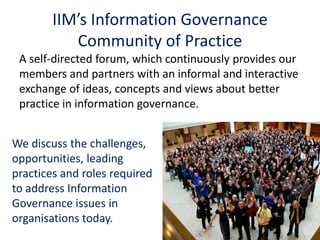
IIM’s Information Governance
Community of Practice
A self-directed forum, which continuously provides our
members and partners with an informal and interactive
exchange of ideas, concepts and views about better
practice in information governance.
We discuss the challenges,
opportunities, leading
practices and roles required
to address Information
Governance issues in
organisations today.
Objective for today
1. Experience how a knowledge café works
2. Explore some IM and data governance issues
3. Take the opportunity to meet some people
you have not met before
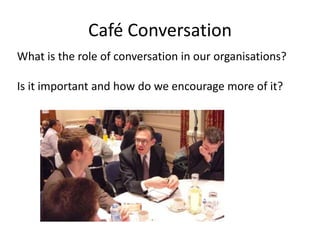
Café Conversation
What is the role of conversation in our organisations?
Is it important and how do we encourage more of it?
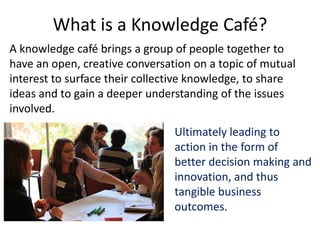
What is a Knowledge Café?
A knowledge café brings a group of people together to
have an open, creative conversation on a topic of mutual
interest to surface their collective knowledge, to share
ideas and to gain a deeper understanding of the issues
involved.
Ultimately leading to
action in the form of
better decision making and
innovation, and thus
tangible business
outcomes.
Why a cafe?
• Unstructured
• Informal
• Fun
• Relaxing
• Creative
• Social
• Collaborative
• Non threatening
• Time-bounded
Knowledge
“A body of understanding and skills that is constructed
by people and increased through interaction with other
people and with information.”
AS 5037 - 2005
7
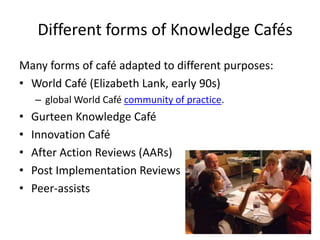
Different forms of Knowledge Cafés
Many forms of café adapted to different purposes:
• World Café (Elizabeth Lank, early 90s)
– global World Café community of practice.
• Gurteen Knowledge Café
• Innovation Café
• After Action Reviews (AARs)
• Post Implementation Reviews
• Peer-assists
What’s in it for me?
• The Café can tease out a greater level of insight of
ourselves than we are conscious of
• You hear yourself say things in Café conversations that
you did not know that you knew
• It crystallises our knowledge
– New ideas are sparked
– Fresh perspectives emerge ...
• With increased observation and reflection comes
understanding – this paves the way for change
• The opportunity to ‘emerge a slightly different person’
Theodore Zeldin
What's the process?
1. introduce the Knowledge Café and the theme
2. Purpose of the Knowledge Café is made clear
3. Pose the challenge and table topics
4. Form into small groups of 4 or 5 to discuss the
subject for 10 mins for each round.
5. Change tables 1,2 or 3 times
6. The group re-assembles for an exchange of
ideas
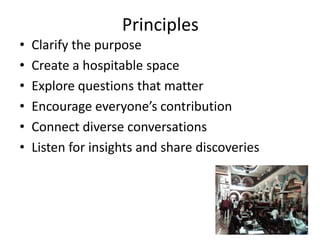
Principles
• Clarify the purpose
• Create a hospitable space
• Explore questions that matter
• Encourage everyone’s contribution
• Connect diverse conversations
• Listen for insights and share discoveries
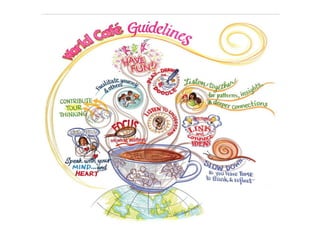
Knowledge Café Etiquette
• To listen more than speak
• Contribute your thinking
• Speak your mind and heart
• Listen for insights and deeper questions
• Link and connect ideas
• Play, doodle, draw! Have fun!
• See different views not as adversarial but as
perspectives from which we learn
• Welcome differences and withhold judgment
• To avoid being too politically correct
• All about relaxed, non-threatening, open
conversation
• No one is forced to do anything
• Everyone is equal
• No table leaders
• No reporting back
• Sharing circle: individual summary at end
• No overall summarization or attempt to reach
consensus
• No capture on flip-charts
• Outcome: what people take away in their heads
Gurteen K Café rules
How does it work
1. Have a 5 min initial round of conversation
2. Ask one person to remain at the table as the "host“
3. The others serve as travelers or "ambassadors of
meaning." The travelers carry key
ideas, themes, and questions into their new
conversations.
4. The table host welcomes the new guests to link and
connect ideas coming from their previous table
conversations
5. Listen and build on the previous contributions.
6. Rotate again
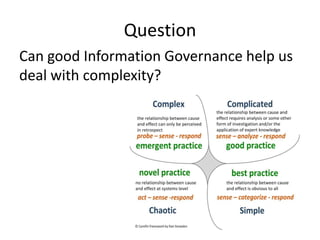
Question
Can good Information Governance help us
deal with complexity?
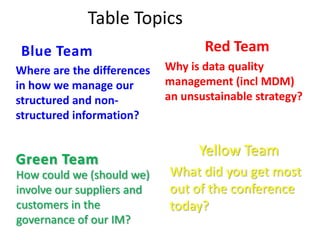
Red Team
Why is data quality
management (incl MDM)
an unsustainable strategy?
Blue Team
How could we (should we)
involve our suppliers and
customers in the
governance of our IM?
Where are the differences
in how we manage our
structured and non-
structured information?
Green Team
Table Topics
What did you get most
out of the conference
today?
Yellow Team
Observations
Conversations
Questions
Where can I learn more
about Knowledge Cafés?
• David Gurteen
www.gurteen.com
• The World Café Website:
www.theworldcafe.com
• Book - The World Café: Shaping our futures
through conversations that matter
• The Society for Philosophical Inquiry
www.philosopher.org
Summary
• Knowledge Café is a simple process
– But a lot to learn to run them well
• Powerful learning & creativity tool
• Can be adapted to varying situations
• Low cost to run
• Focus on dialogue not debate
• Business is a conversation
Attribution
• Many of these slides are attributed to David
Gurteen and Keith De la Rue
• Published under Creative Commons Licence
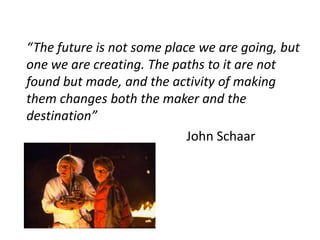
“The future is not some place we are going, but
one we are creating. The paths to it are not
found but made, and the activity of making
them changes both the maker and the
destination”
John Schaar
Questions?

How to run a Knowledge cafe

  • 1.
    Knowledge Cafe Information Governance Dealingwith challenges in the information space David Williams & Vladimir Videnovic Institute of Information Management 19 November 2013
  • 2.
    IIM’s Information Governance Communityof Practice A self-directed forum, which continuously provides our members and partners with an informal and interactive exchange of ideas, concepts and views about better practice in information governance. We discuss the challenges, opportunities, leading practices and roles required to address Information Governance issues in organisations today.
  • 3.
    Objective for today 1.Experience how a knowledge café works 2. Explore some IM and data governance issues 3. Take the opportunity to meet some people you have not met before
  • 4.
    Café Conversation What isthe role of conversation in our organisations? Is it important and how do we encourage more of it?
  • 5.
    What is aKnowledge Café? A knowledge café brings a group of people together to have an open, creative conversation on a topic of mutual interest to surface their collective knowledge, to share ideas and to gain a deeper understanding of the issues involved. Ultimately leading to action in the form of better decision making and innovation, and thus tangible business outcomes.
  • 6.
    Why a cafe? •Unstructured • Informal • Fun • Relaxing • Creative • Social • Collaborative • Non threatening • Time-bounded
  • 7.
    Knowledge “A body ofunderstanding and skills that is constructed by people and increased through interaction with other people and with information.” AS 5037 - 2005 7
  • 8.
    Different forms ofKnowledge Cafés Many forms of café adapted to different purposes: • World Café (Elizabeth Lank, early 90s) – global World Café community of practice. • Gurteen Knowledge Café • Innovation Café • After Action Reviews (AARs) • Post Implementation Reviews • Peer-assists
  • 9.
    What’s in itfor me? • The Café can tease out a greater level of insight of ourselves than we are conscious of • You hear yourself say things in Café conversations that you did not know that you knew • It crystallises our knowledge – New ideas are sparked – Fresh perspectives emerge ... • With increased observation and reflection comes understanding – this paves the way for change • The opportunity to ‘emerge a slightly different person’ Theodore Zeldin
  • 10.
    What's the process? 1.introduce the Knowledge Café and the theme 2. Purpose of the Knowledge Café is made clear 3. Pose the challenge and table topics 4. Form into small groups of 4 or 5 to discuss the subject for 10 mins for each round. 5. Change tables 1,2 or 3 times 6. The group re-assembles for an exchange of ideas
  • 11.
    Principles • Clarify thepurpose • Create a hospitable space • Explore questions that matter • Encourage everyone’s contribution • Connect diverse conversations • Listen for insights and share discoveries
  • 12.
    Knowledge Café Etiquette •To listen more than speak • Contribute your thinking • Speak your mind and heart • Listen for insights and deeper questions • Link and connect ideas • Play, doodle, draw! Have fun! • See different views not as adversarial but as perspectives from which we learn • Welcome differences and withhold judgment • To avoid being too politically correct
  • 13.
    • All aboutrelaxed, non-threatening, open conversation • No one is forced to do anything • Everyone is equal • No table leaders • No reporting back • Sharing circle: individual summary at end • No overall summarization or attempt to reach consensus • No capture on flip-charts • Outcome: what people take away in their heads Gurteen K Café rules
  • 15.
    How does itwork 1. Have a 5 min initial round of conversation 2. Ask one person to remain at the table as the "host“ 3. The others serve as travelers or "ambassadors of meaning." The travelers carry key ideas, themes, and questions into their new conversations. 4. The table host welcomes the new guests to link and connect ideas coming from their previous table conversations 5. Listen and build on the previous contributions. 6. Rotate again
  • 16.
    Question Can good InformationGovernance help us deal with complexity?
  • 17.
    Red Team Why isdata quality management (incl MDM) an unsustainable strategy? Blue Team How could we (should we) involve our suppliers and customers in the governance of our IM? Where are the differences in how we manage our structured and non- structured information? Green Team Table Topics What did you get most out of the conference today? Yellow Team
  • 18.
  • 19.
    Where can Ilearn more about Knowledge Cafés? • David Gurteen www.gurteen.com • The World Café Website: www.theworldcafe.com • Book - The World Café: Shaping our futures through conversations that matter • The Society for Philosophical Inquiry www.philosopher.org
  • 20.
    Summary • Knowledge Caféis a simple process – But a lot to learn to run them well • Powerful learning & creativity tool • Can be adapted to varying situations • Low cost to run • Focus on dialogue not debate • Business is a conversation
  • 21.
    Attribution • Many ofthese slides are attributed to David Gurteen and Keith De la Rue • Published under Creative Commons Licence
  • 22.
    “The future isnot some place we are going, but one we are creating. The paths to it are not found but made, and the activity of making them changes both the maker and the destination” John Schaar
  • 23.