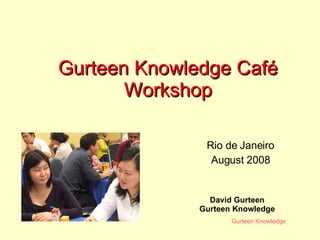


Gurteen Knowledge Café Workshop David Gurteen Gurteen Knowledge Rio de Janeiro August 2008
Begin with the end in mind Raise awareness of the role of conversation in your business lives To teach you about Knowledge Cafes and how to run them Encourage you to create more opportunities in your organization for creative conversation
Agenda Morning: Basics + Knowledge Cafe Lunch Afternoon: Advanced
Basics (morning) 09:00 – 09:15 Introductions (15 mins)  09:15 – 09:45 Business is a Conversation (30 mins) 09:45 – 10:15 Knowledge Café Process (30 mins) 10:15 – 10:45 Coffee   (30 mins) 10:45 – 12:00 Run a Knowledge Cafe (75 mins)
Advanced (afternoon) 13:00 – 13:15 Review of morning (15 mins)  13:15 – 13:45 More on the process (30 mins) 13:45 – 14:00 Other Formats & Uses (15 mins) 14:00 – 14:15 Coffee   (15 mins) 14:15 – 15:00 Café review of the day (45 mins)
Introductions
David Gurteen Independent KM consultant and facilitator Knowledge Website Knowledge Community/Letter 15,000 people 154 countries Knowledge Café Communities London, New York, Adelaide, Zurich
Speed Networking A simple technique that can be used in a variety of settings to bring a group of people together to start to get to know each other  or get to know each other a little better
How do you Speed Network? Break into pairs Find someone you don’t know Two minutes to chat then move on to another person Tell your partner something unusual about yourself When I blow my whistle once - move on When I blow my whistle twice - its all over!
Business is a Conversation
Business is a conversation Business is a conversation because the defining work of business is conversation - literally. And 'knowledge workers' are simply those people whose job consists of having interesting conversations. David Weinberger The Cluetrain Manifesto Conversation is central to all that we do Its our job!
Conversation is a meeting of minds Conversation is a meeting of minds with different memories and habits. When minds meet, they don't just exchange facts: they transform them, reshape them, draw different implications from them, engage in new trains of thought. Conversation doesn't just reshuffle the cards: it creates new cards.  Theodore Zeldin Conversation Theodore in an Oxford Historian Conversation is creative
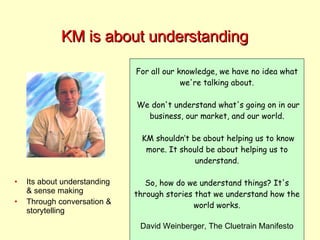
KM is about understanding For all our knowledge, we have no idea what we're talking about. We don't understand what's going on in our business, our market, and our world. KM shouldn’t be about helping us to know more. It should be about helping us to understand. So, how do we understand things? It's through stories that we understand how the world works. David Weinberger, The Cluetrain Manifesto Its about understanding & sense making Through conversation & storytelling
Conversation “A mechanistic and unproductive exchange between people seeking to defend their own views against one another”  “A frank exchange of ideas or views on a specific issue in an effort to attain mutual understanding” Debate or dialogue?
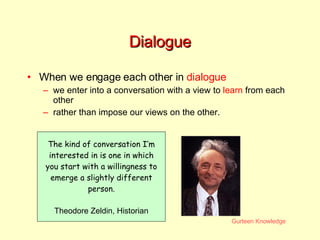
Dialogue When we engage each other in  dialogue we enter into a conversation with a view to  learn  from each other rather than impose our views on the other. The kind of conversation I’m interested in is one in which you start with a willingness to emerge a slightly different person. Theodore Zeldin, Historian
Principles of Dialogue Suspend assumptions, do not judge Observe & listen to one another Welcome differences & explore them Allow taboo subjects to be raised safely Listen to your inner voice Slow the discussion Search for the underlying meaning Dialogue is based on the work of the physicist David Bohm
Dialogue Suppose we were able to share meanings freely without a compulsive urge to impose our view or conform to those of others and without distortion and self-deception.  Would this not constitute a real revolution in culture. David Bohm, Physicist
Summary Business is a conversation Conversation is creative Understanding is more important than knowing more Dialogue is the key to quality conversations
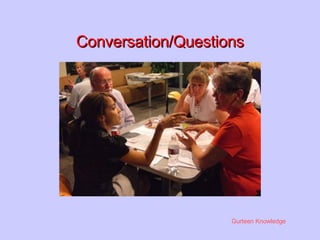
Conversation/Questions
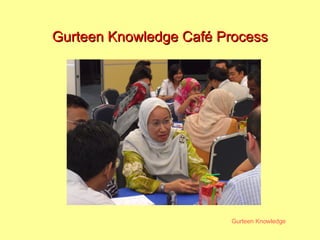
Gurteen Knowledge Café  Process
Background Coffee Machine talks Chairing conferences My dislike of ‘chalk & talk’ presentations (chicken chicken) My desire for people to engage with the subject and to learn through conversation
What is a Knowledge Café? A knowledge café brings a group of people together to have an open, creative conversation on a topic of mutual interest to surface their collective knowledge, to share ideas and to gain a deeper understanding of the issues involved.  Ultimately leading to action in the form of better decision making and innovation and thus tangible business outcomes.
What are the outcomes? Real outcomes are what you take away in your head A deeper understanding of the issue discussed A deeper insight into other people’s perspectives A better appreciation of your own point of view Better position to make more informed decisions and to take action!
What is the history? The term Knowledge Café has been around for the last 7 years or so  Only in the last 2 or 3 years has the term come into common use Roots in work of David Bohm, William Isaacs, Juanita Brown Roots in Open Space Technology which goes back to 1989
Is it a talking-shop? No its NOT a talking-shop. A talking shop is normally used pejoratively and implies no useful outcome other than the airing of ones own ideas A Knowledge Caf é  is different in that everyone leaves enriched by a deeper level of  understanding of the subject in question and is often inspired to act
Why is the Knowledge Caf é  important? The world is a more complex place than it used to be - at times even chaotic - it is not always clear what is going on - we need to take time to UNDERSTAND  We do not find the time to have open conversations, we are under pressure to make quick decisions KM for example should not be about creating and sharing ever increasing knowledge but understanding more fully the knowledge that we do have!
What does a Knowledge Café  do for the individual? The Caf é assumes we have within ourselves a greater level of insight than we are conscious of The  Caf é  helps tease this out You hear yourself say things in Café conversations that you did not know that you knew  It crystallises our knowledge New ideas are sparked Fresh perspectives emerge ... With increased observation and reflection comes understanding – this paves the way for change
What resources are needed to run a Knowledge Caf é? Not a lot! A group of people A facilitator or host A room with plenty of space Tables & chairs to seat about five people per table
What do you need in the room? Some formats have special requirements such as round tables, paper table cloths, felt tip pens, flowers on the table and coffee & biscuits Gurteen Knowledge Cafés need none of these props but of course you could use them if available Refreshments help Aim is to create a good ambience Unthreatening and hospitable environment
How do you run one? Knowledge Cafés can be run in different ways I use a simple format  Runs for 90 minutes to a couple of hours Work best with between 25 and 35 people Can run a dozen people or as many as 100 But with some modifications
What's the process? Facilitator takes 5 - 15 minutes to introduce the Knowledge Caf é  and the theme Purpose of the Knowledge Caf é  is made clear Facilitator poses an open ended question Participants form into small groups of 4 or 5 to discuss the subject for 30 - 60 minutes. Change tables 1,2 or 3 times  The group re-assembles for an exchange of ideas as a whole for 15 - 30 minutes
What subjects are covered? Any subject can be addressed Explore questions that matter to the participants Normally explore only one theme And pose only one question A Knowledge Caf é  is not a debating forum It is NOT about decision making
What is the role of the facilitator? Facilitator need not be a specialist Nor disciplined in facilitation Simply a good listener and chairperson skills Facilitator should not take a lead in the discussions Should wander around and listen into the groups Should listen out for problems and remind people gently of the rules of ‘dialogue’
What’s the role of the individual? Theodore Zeldin : to be prepared to emerge a slightly different person To see people with different views not as adversaries but as resources from which we can learn To enter into open conversation To listen more than speak To welcome differences To withhold judgment To avoid position taking To avoid being too politically correct
How do things work within  the small groups? Don’t appoint a leader or chairperson Everyone should be equal and fully engaged in the conversation Don’t appoint a note taker either Anyone can make their own notes if they want to People share their perspectives with the group only if they wish to
How does the large group sit? Bring everyone back into a relatively tight group so that every one can easily see and hear each other Only use microphones if absolutely necessary as they inhibit the natural flow of the conversation
How does the whole group work? Individuals asked to remember that their comments are for the whole group and not for the facilitator.  The objective is to hold a ‘group conversation’ The facilitator needs to work at encouraging this Plays a low key role – not the expert Turn away, even hide!
How does the facilitator work with the whole group? The group should be doing the work with minimal intervention from the facilitator Facilitator needs to encourage participation Facilitator needs to ensure that no one person or group dominates the discussion Connects diverse perspectives
How do you record the outcomes  of a Knowledge Café? The Café is fundamentally about the transfer of TACIT knowledge – not about making tacit knowledge explicit but If you record things you should avoid disrupting or influencing the conversation in anyway You could make audio or video recordings but I would advise against it Participants should not be burdened with recording as they need to be fully engaged in the conversation Best to appoint an external person to take notes
Conversation/Questions
Coffee
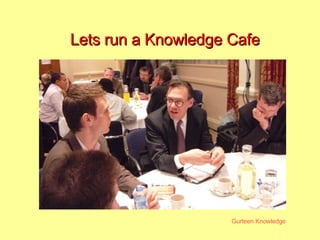
Lets run a Knowledge Cafe
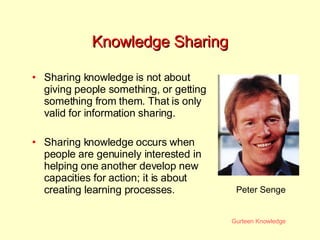
Knowledge Sharing Sharing knowledge is not about giving people something, or getting something from them. That is only valid for information sharing. Sharing knowledge occurs when people are genuinely interested in helping one another develop new capacities for action; it is about creating learning processes.  Peter Senge
Personal Reasons for Sharing To help other people & to help ourselves Other people To get things done To build relationships so they in turn help us Ourselves To get things done Learning to be gained Knowledge is perishable Someone else will make our knowledge productive first
Barriers to Knowledge Sharing A silo mentality Knowledge is power Lack of knowledge sharing processes No time allowed No knowledge sharing by executives Managers do not walk the talk Poor IT systems Lack of encouragement Bureaucracy Resistance to change by managers Karl-Eric Sveiby
The Challenge of Knowledge Sharing What prevents us from sharing our knowledge more effectively? How might we overcome these barriers?
Café Conversation How do we balance virtual conversations with face to face conversations?
Lunch
Afternoon Agenda Café process in more depth Uses of the Cafe Discussion circle
Café Process in more depth
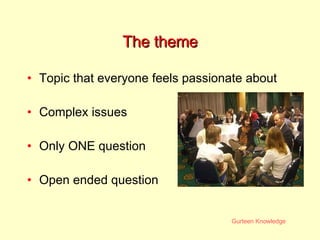
The theme Topic that everyone feels passionate about Complex issues Only ONE question Open ended question
The conversation The question is only a seed OK to go off topic Conversation as close to a conversation at the pub or over dinner
The speaker/facilitator Speaker and facilitator need not be the same Facilitator: involved/not involved Speakers can be controlling or dominant Often run over time Need to brief and handle carefully
The facilitator Important to be yourself Do not control Experiment a little Take some risks Don’t be afraid of silence If you let people talk and leave them alone you cannot go far wrong
The venue Need not be a room Boat on Thames Canal Boat (long boat in Amsterdam) Knowledge Walk/BBQ (Greenwich) Pub (Stavanger) Outside under sunshades (Scottsdale) An actual café (London & Barcelona)
The room Important Small, cosy Paper/toys on tables Small round tables Good acoustics Lecture theatre?
Holding in a lecture theatre Difficult but not impossible Problem  of moving between groups Problem of whole group conversation reporting back Need for microphones
Using microphones Avoid if possible Will need them if group is larger than 40 Maybe less if poor acoustics People hold on to them Kills the flow of conversation One for yourself and at least 2 roving mikes Avoid fixed mikes (Jakarta)
Knowledge circles Greenwich Story KM World Jakarta Workshop Not as difficult as it seems
Small group Ask people to sit with others they do not know Change groups once, twice at most 3 times People do not like changing groups Don’t force them! Kuala Lumpur story
Whole group Where you need facilitation skills People will report back out of habit Or ask you questions In some cultures best to let them Even for some groups let them Central bank librarians story Unless in expert mode do not join in too much Tolerate silence – pause and wait
Culture I have run the Cafes in many different countries UK, Spain, Norway, Moscow USA Singapore Hong Kong Kuala Lumpur Thailand Australia UAE
Cultural issues Jakarta Open Café Workshop Kuala Lumpur Won’t change tables Won’t go for coffee Bangkok Flee, video Dubai Report back Scottsdale Intense group Hong Kong Iranians
Language issues Ideally one common language Let people speak in their own language in small groups Can’t listen in! Common language (English) in whole group Even own language in whole group Use of translators Serial or concurrent
Listening in If expert mode then join  in If facilitation mode then try not to Wander around and actively listen Observe for issues Watch, think, be prepared to adapt
Wrap up No need to summarise at length Keep it short and simple Thank people
Conversation/Questions
Other Café Formats
Other Conversational Tools Gurteen Knowledge Café Traditional Knowledge Café Flip charts, capture, report back etc Conferences Speak, conversation, Q&A Reverse Café Conversation Dinner World Cafe Open Space Anecdote Circles Appreciative Inquiry
How is the Cafe different from  Open Space Technology? Process is more complex Used other than to gain mutual understanding e.g. problem solving and defining agendas Meetings tend to be larger often 100s of people compared to dozens for the Café Meetings tend to last longer often days rather than hours
Uses of the Cafe
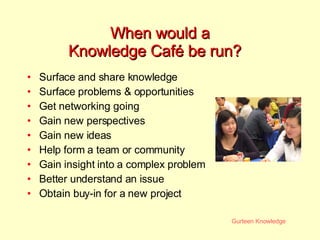
When would a  Knowledge Café be run? Surface and share knowledge  Surface problems & opportunities Get networking going Gain new perspectives Gain new ideas Help form a team or community Gain insight into a complex problem Better understand an issue Obtain buy-in for a new project
Where is it used? I use it in public forums such as conferences and within companies to explore complex issues  The Royal Society for the Arts uses a form of Knowledge Cafe in conjunction with Starbucks in the UK to discuss social issues relevant to the societies aims Many organizations quietly use it especially in SE Asia.
ISN Knowledge Café The knowledge café has led to a dramatic improvement in terms of inter-team dialog, collaboration and knowledge sharing.  Many internal work processes are now being overhauled for the better as a result of these knowledge cafes and we have seen an explosion of new ideas and initiatives on the part of staff at all levels of the organization.  Simply put, the knowledge cafe format has empowered all our staff to speak up and take the initiative in ensuring the successful development of the ISN.  Chris Pallaris, Chief Editor ISN, Zurich
Café for a UK government body Day long workshop 3 presentations on social tools A knowledge Café Future leaders in the group Future leaders determine an action plan
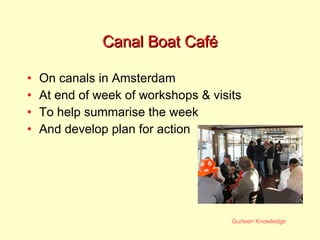
Canal Boat Café On canals in Amsterdam At end of week of workshops & visits To help summarise the week And develop plan for action
Trinidad & Tobago Oil and Gas Expert talks
StatoilHydro Series of Cafes to bring experts who were leaving together with younger members of organization to transfer knowledge In a café on an allotment (Brita) Geophysicists Discussion of preferred technologies Exchange views on experiences (Run by Monica Haga) Management Training But not called a Knowledge Cafe
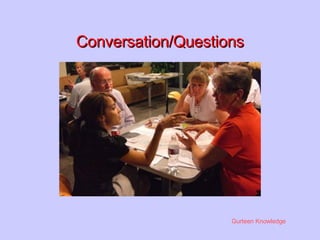
Conversation/Questions
Coffee
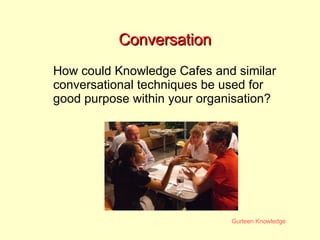
Conversation How could Knowledge Cafes and similar conversational techniques be used for good purpose within your organisation?
Where can I learn more  about Knowledge Cafés? There are a lot of resources on the web My website contains a vast amount of material www.gurteen.com The World Café Book The World Café: Shaping our futures through conversations that matter Website :  theworldcafe.com The Society for Philosophical Inquiry philosopher.org
Summary Business is a conversation Dialogue not debate Knowledge Café: simple process But a lot to learn to run them well Powerful learning & creativity tool Can be adapted to varying situations Low cost to run
Thank you!
www.gurteen.com David Gurteen Gurteen Knowledge Tel: +44 1252 812 878 Email: david.gurteen@gurteen.com
Licence You may use these slides under the following Creative Commons Licence Attribution-Share Alike 2.0 http://creativecommons.org/licenses/by-sa/2.0/uk/

Knowledge Cafe Workshop: Rio de Janeiro, August 2008

  • 1.
    Gurteen Knowledge CaféWorkshop David Gurteen Gurteen Knowledge Rio de Janeiro August 2008
  • 2.
    Begin with theend in mind Raise awareness of the role of conversation in your business lives To teach you about Knowledge Cafes and how to run them Encourage you to create more opportunities in your organization for creative conversation
  • 3.
    Agenda Morning: Basics+ Knowledge Cafe Lunch Afternoon: Advanced
  • 4.
    Basics (morning) 09:00– 09:15 Introductions (15 mins) 09:15 – 09:45 Business is a Conversation (30 mins) 09:45 – 10:15 Knowledge Café Process (30 mins) 10:15 – 10:45 Coffee (30 mins) 10:45 – 12:00 Run a Knowledge Cafe (75 mins)
  • 5.
    Advanced (afternoon) 13:00– 13:15 Review of morning (15 mins) 13:15 – 13:45 More on the process (30 mins) 13:45 – 14:00 Other Formats & Uses (15 mins) 14:00 – 14:15 Coffee (15 mins) 14:15 – 15:00 Café review of the day (45 mins)
  • 6.
  • 7.
    David Gurteen IndependentKM consultant and facilitator Knowledge Website Knowledge Community/Letter 15,000 people 154 countries Knowledge Café Communities London, New York, Adelaide, Zurich
  • 8.
    Speed Networking Asimple technique that can be used in a variety of settings to bring a group of people together to start to get to know each other or get to know each other a little better
  • 9.
    How do youSpeed Network? Break into pairs Find someone you don’t know Two minutes to chat then move on to another person Tell your partner something unusual about yourself When I blow my whistle once - move on When I blow my whistle twice - its all over!
  • 10.
    Business is aConversation
  • 11.
    Business is aconversation Business is a conversation because the defining work of business is conversation - literally. And 'knowledge workers' are simply those people whose job consists of having interesting conversations. David Weinberger The Cluetrain Manifesto Conversation is central to all that we do Its our job!
  • 12.
    Conversation is ameeting of minds Conversation is a meeting of minds with different memories and habits. When minds meet, they don't just exchange facts: they transform them, reshape them, draw different implications from them, engage in new trains of thought. Conversation doesn't just reshuffle the cards: it creates new cards. Theodore Zeldin Conversation Theodore in an Oxford Historian Conversation is creative
  • 13.
    KM is aboutunderstanding For all our knowledge, we have no idea what we're talking about. We don't understand what's going on in our business, our market, and our world. KM shouldn’t be about helping us to know more. It should be about helping us to understand. So, how do we understand things? It's through stories that we understand how the world works. David Weinberger, The Cluetrain Manifesto Its about understanding & sense making Through conversation & storytelling
  • 14.
    Conversation “A mechanisticand unproductive exchange between people seeking to defend their own views against one another” “A frank exchange of ideas or views on a specific issue in an effort to attain mutual understanding” Debate or dialogue?
  • 15.
    Dialogue When weengage each other in dialogue we enter into a conversation with a view to learn from each other rather than impose our views on the other. The kind of conversation I’m interested in is one in which you start with a willingness to emerge a slightly different person. Theodore Zeldin, Historian
  • 16.
    Principles of DialogueSuspend assumptions, do not judge Observe & listen to one another Welcome differences & explore them Allow taboo subjects to be raised safely Listen to your inner voice Slow the discussion Search for the underlying meaning Dialogue is based on the work of the physicist David Bohm
  • 17.
    Dialogue Suppose wewere able to share meanings freely without a compulsive urge to impose our view or conform to those of others and without distortion and self-deception. Would this not constitute a real revolution in culture. David Bohm, Physicist
  • 18.
    Summary Business isa conversation Conversation is creative Understanding is more important than knowing more Dialogue is the key to quality conversations
  • 19.
  • 20.
  • 21.
    Background Coffee Machinetalks Chairing conferences My dislike of ‘chalk & talk’ presentations (chicken chicken) My desire for people to engage with the subject and to learn through conversation
  • 22.
    What is aKnowledge Café? A knowledge café brings a group of people together to have an open, creative conversation on a topic of mutual interest to surface their collective knowledge, to share ideas and to gain a deeper understanding of the issues involved. Ultimately leading to action in the form of better decision making and innovation and thus tangible business outcomes.
  • 23.
    What are theoutcomes? Real outcomes are what you take away in your head A deeper understanding of the issue discussed A deeper insight into other people’s perspectives A better appreciation of your own point of view Better position to make more informed decisions and to take action!
  • 24.
    What is thehistory? The term Knowledge Café has been around for the last 7 years or so Only in the last 2 or 3 years has the term come into common use Roots in work of David Bohm, William Isaacs, Juanita Brown Roots in Open Space Technology which goes back to 1989
  • 25.
    Is it atalking-shop? No its NOT a talking-shop. A talking shop is normally used pejoratively and implies no useful outcome other than the airing of ones own ideas A Knowledge Caf é is different in that everyone leaves enriched by a deeper level of understanding of the subject in question and is often inspired to act
  • 26.
    Why is theKnowledge Caf é important? The world is a more complex place than it used to be - at times even chaotic - it is not always clear what is going on - we need to take time to UNDERSTAND We do not find the time to have open conversations, we are under pressure to make quick decisions KM for example should not be about creating and sharing ever increasing knowledge but understanding more fully the knowledge that we do have!
  • 27.
    What does aKnowledge Café do for the individual? The Caf é assumes we have within ourselves a greater level of insight than we are conscious of The Caf é helps tease this out You hear yourself say things in Café conversations that you did not know that you knew It crystallises our knowledge New ideas are sparked Fresh perspectives emerge ... With increased observation and reflection comes understanding – this paves the way for change
  • 28.
    What resources areneeded to run a Knowledge Caf é? Not a lot! A group of people A facilitator or host A room with plenty of space Tables & chairs to seat about five people per table
  • 29.
    What do youneed in the room? Some formats have special requirements such as round tables, paper table cloths, felt tip pens, flowers on the table and coffee & biscuits Gurteen Knowledge Cafés need none of these props but of course you could use them if available Refreshments help Aim is to create a good ambience Unthreatening and hospitable environment
  • 30.
    How do yourun one? Knowledge Cafés can be run in different ways I use a simple format Runs for 90 minutes to a couple of hours Work best with between 25 and 35 people Can run a dozen people or as many as 100 But with some modifications
  • 31.
    What's the process?Facilitator takes 5 - 15 minutes to introduce the Knowledge Caf é and the theme Purpose of the Knowledge Caf é is made clear Facilitator poses an open ended question Participants form into small groups of 4 or 5 to discuss the subject for 30 - 60 minutes. Change tables 1,2 or 3 times The group re-assembles for an exchange of ideas as a whole for 15 - 30 minutes
  • 32.
    What subjects arecovered? Any subject can be addressed Explore questions that matter to the participants Normally explore only one theme And pose only one question A Knowledge Caf é is not a debating forum It is NOT about decision making
  • 33.
    What is therole of the facilitator? Facilitator need not be a specialist Nor disciplined in facilitation Simply a good listener and chairperson skills Facilitator should not take a lead in the discussions Should wander around and listen into the groups Should listen out for problems and remind people gently of the rules of ‘dialogue’
  • 34.
    What’s the roleof the individual? Theodore Zeldin : to be prepared to emerge a slightly different person To see people with different views not as adversaries but as resources from which we can learn To enter into open conversation To listen more than speak To welcome differences To withhold judgment To avoid position taking To avoid being too politically correct
  • 35.
    How do thingswork within the small groups? Don’t appoint a leader or chairperson Everyone should be equal and fully engaged in the conversation Don’t appoint a note taker either Anyone can make their own notes if they want to People share their perspectives with the group only if they wish to
  • 36.
    How does thelarge group sit? Bring everyone back into a relatively tight group so that every one can easily see and hear each other Only use microphones if absolutely necessary as they inhibit the natural flow of the conversation
  • 37.
    How does thewhole group work? Individuals asked to remember that their comments are for the whole group and not for the facilitator. The objective is to hold a ‘group conversation’ The facilitator needs to work at encouraging this Plays a low key role – not the expert Turn away, even hide!
  • 38.
    How does thefacilitator work with the whole group? The group should be doing the work with minimal intervention from the facilitator Facilitator needs to encourage participation Facilitator needs to ensure that no one person or group dominates the discussion Connects diverse perspectives
  • 39.
    How do yourecord the outcomes of a Knowledge Café? The Café is fundamentally about the transfer of TACIT knowledge – not about making tacit knowledge explicit but If you record things you should avoid disrupting or influencing the conversation in anyway You could make audio or video recordings but I would advise against it Participants should not be burdened with recording as they need to be fully engaged in the conversation Best to appoint an external person to take notes
  • 40.
  • 41.
  • 42.
    Lets run aKnowledge Cafe
  • 43.
    Knowledge Sharing Sharingknowledge is not about giving people something, or getting something from them. That is only valid for information sharing. Sharing knowledge occurs when people are genuinely interested in helping one another develop new capacities for action; it is about creating learning processes. Peter Senge
  • 44.
    Personal Reasons forSharing To help other people & to help ourselves Other people To get things done To build relationships so they in turn help us Ourselves To get things done Learning to be gained Knowledge is perishable Someone else will make our knowledge productive first
  • 45.
    Barriers to KnowledgeSharing A silo mentality Knowledge is power Lack of knowledge sharing processes No time allowed No knowledge sharing by executives Managers do not walk the talk Poor IT systems Lack of encouragement Bureaucracy Resistance to change by managers Karl-Eric Sveiby
  • 46.
    The Challenge ofKnowledge Sharing What prevents us from sharing our knowledge more effectively? How might we overcome these barriers?
  • 47.
    Café Conversation Howdo we balance virtual conversations with face to face conversations?
  • 48.
  • 49.
    Afternoon Agenda Caféprocess in more depth Uses of the Cafe Discussion circle
  • 50.
    Café Process inmore depth
  • 51.
    The theme Topicthat everyone feels passionate about Complex issues Only ONE question Open ended question
  • 52.
    The conversation Thequestion is only a seed OK to go off topic Conversation as close to a conversation at the pub or over dinner
  • 53.
    The speaker/facilitator Speakerand facilitator need not be the same Facilitator: involved/not involved Speakers can be controlling or dominant Often run over time Need to brief and handle carefully
  • 54.
    The facilitator Importantto be yourself Do not control Experiment a little Take some risks Don’t be afraid of silence If you let people talk and leave them alone you cannot go far wrong
  • 55.
    The venue Neednot be a room Boat on Thames Canal Boat (long boat in Amsterdam) Knowledge Walk/BBQ (Greenwich) Pub (Stavanger) Outside under sunshades (Scottsdale) An actual café (London & Barcelona)
  • 56.
    The room ImportantSmall, cosy Paper/toys on tables Small round tables Good acoustics Lecture theatre?
  • 57.
    Holding in alecture theatre Difficult but not impossible Problem of moving between groups Problem of whole group conversation reporting back Need for microphones
  • 58.
    Using microphones Avoidif possible Will need them if group is larger than 40 Maybe less if poor acoustics People hold on to them Kills the flow of conversation One for yourself and at least 2 roving mikes Avoid fixed mikes (Jakarta)
  • 59.
    Knowledge circles GreenwichStory KM World Jakarta Workshop Not as difficult as it seems
  • 60.
    Small group Askpeople to sit with others they do not know Change groups once, twice at most 3 times People do not like changing groups Don’t force them! Kuala Lumpur story
  • 61.
    Whole group Whereyou need facilitation skills People will report back out of habit Or ask you questions In some cultures best to let them Even for some groups let them Central bank librarians story Unless in expert mode do not join in too much Tolerate silence – pause and wait
  • 62.
    Culture I haverun the Cafes in many different countries UK, Spain, Norway, Moscow USA Singapore Hong Kong Kuala Lumpur Thailand Australia UAE
  • 63.
    Cultural issues JakartaOpen Café Workshop Kuala Lumpur Won’t change tables Won’t go for coffee Bangkok Flee, video Dubai Report back Scottsdale Intense group Hong Kong Iranians
  • 64.
    Language issues Ideallyone common language Let people speak in their own language in small groups Can’t listen in! Common language (English) in whole group Even own language in whole group Use of translators Serial or concurrent
  • 65.
    Listening in Ifexpert mode then join in If facilitation mode then try not to Wander around and actively listen Observe for issues Watch, think, be prepared to adapt
  • 66.
    Wrap up Noneed to summarise at length Keep it short and simple Thank people
  • 67.
  • 68.
  • 69.
    Other Conversational ToolsGurteen Knowledge Café Traditional Knowledge Café Flip charts, capture, report back etc Conferences Speak, conversation, Q&A Reverse Café Conversation Dinner World Cafe Open Space Anecdote Circles Appreciative Inquiry
  • 70.
    How is theCafe different from Open Space Technology? Process is more complex Used other than to gain mutual understanding e.g. problem solving and defining agendas Meetings tend to be larger often 100s of people compared to dozens for the Café Meetings tend to last longer often days rather than hours
  • 71.
  • 72.
    When would a Knowledge Café be run? Surface and share knowledge Surface problems & opportunities Get networking going Gain new perspectives Gain new ideas Help form a team or community Gain insight into a complex problem Better understand an issue Obtain buy-in for a new project
  • 73.
    Where is itused? I use it in public forums such as conferences and within companies to explore complex issues The Royal Society for the Arts uses a form of Knowledge Cafe in conjunction with Starbucks in the UK to discuss social issues relevant to the societies aims Many organizations quietly use it especially in SE Asia.
  • 74.
    ISN Knowledge CaféThe knowledge café has led to a dramatic improvement in terms of inter-team dialog, collaboration and knowledge sharing. Many internal work processes are now being overhauled for the better as a result of these knowledge cafes and we have seen an explosion of new ideas and initiatives on the part of staff at all levels of the organization. Simply put, the knowledge cafe format has empowered all our staff to speak up and take the initiative in ensuring the successful development of the ISN. Chris Pallaris, Chief Editor ISN, Zurich
  • 75.
    Café for aUK government body Day long workshop 3 presentations on social tools A knowledge Café Future leaders in the group Future leaders determine an action plan
  • 76.
    Canal Boat CaféOn canals in Amsterdam At end of week of workshops & visits To help summarise the week And develop plan for action
  • 77.
    Trinidad & TobagoOil and Gas Expert talks
  • 78.
    StatoilHydro Series ofCafes to bring experts who were leaving together with younger members of organization to transfer knowledge In a café on an allotment (Brita) Geophysicists Discussion of preferred technologies Exchange views on experiences (Run by Monica Haga) Management Training But not called a Knowledge Cafe
  • 79.
  • 80.
  • 81.
    Conversation How couldKnowledge Cafes and similar conversational techniques be used for good purpose within your organisation?
  • 82.
    Where can Ilearn more about Knowledge Cafés? There are a lot of resources on the web My website contains a vast amount of material www.gurteen.com The World Café Book The World Café: Shaping our futures through conversations that matter Website : theworldcafe.com The Society for Philosophical Inquiry philosopher.org
  • 83.
    Summary Business isa conversation Dialogue not debate Knowledge Café: simple process But a lot to learn to run them well Powerful learning & creativity tool Can be adapted to varying situations Low cost to run
  • 84.
  • 85.
    www.gurteen.com David GurteenGurteen Knowledge Tel: +44 1252 812 878 Email: david.gurteen@gurteen.com
  • 86.
    Licence You mayuse these slides under the following Creative Commons Licence Attribution-Share Alike 2.0 http://creativecommons.org/licenses/by-sa/2.0/uk/