"Know your platform."
7 things every Scala developer
should know about the JVM
Origins of this talk
We were having a beer...
Origins of this talk
We were having a beer...
Origins of this talk
We were having beers...
Scala is trending
Financial & Big Data driven ;)
Origins of this talk
There is vast number of newcomers to Scala
world. Some percentage of those developers
have never programmed in Java before.
Origins of this talk
There is vast number of newcomers to Scala
world. Some percentage of those developers
have never programmed in Java before.
Do they have a notion of the platform they are
running their software on?
Origins of this talk
There is a significant number of Java
developers obsessed with all kind of APIs not
knowing a single thing about the platform that
they are using.
Origins of this talk
There is a significant number of Java
developers obsessed with all kind of APIs not
knowing a single thing about the platform that
they are using.
Those Java developers begin to move towards
other JVM languages (like Scala)
Should we even care?
“You always want to understand one level
below the level you write your code"
-- Ted Neward’s mentor
Should we even care?
Knowing one level below your level leads to:
Should we even care?
Knowing one level below your level leads to:
● Being a better engineer on general
Should we even care?
Knowing one level below your level leads to:
● Being a better engineer on general
● Ability to more accurately reason about the code
Should we even care?
Knowing one level below your level leads to:
● Being a better engineer on general
● Ability to more accurately reason about the code
● Improved performance
Should we even care?
Knowing one level below your level leads to:
● Being a better engineer on general
● Ability to more accurately reason about the code
● Improved performance
● Leaving the folklore beliefs towards scientific methods
Should we even care?
Knowing one level below your level leads to:
● Being a better engineer on general
● Ability to more accurately reason about the code
● Improved performance
● Leaving the folklore beliefs towards scientific methods
● Separation of dogmas and facts
Should we even care?
Knowing one level below your level leads to:
● Being a better engineer on general
● Ability to more accurately reason about the code
● Improved performance
● Leaving the folklore beliefs towards scientific methods
● Separation of dogmas and facts
● Efficiency in handling non-trivial errors and bugs
Should we even care?
We believe that as Scala developers
Should we even care?
We believe that as Scala developers
we should at least understand basics of
the JVM platform
Should we even care?
We believe that as Scala developers
we should at least understand basics of
the JVM platform in order to achieve
efficiency,
Should we even care?
We believe that as Scala developers
we should at least understand basics of
the JVM platform in order to achieve
efficiency, understanding,
Should we even care?
We believe that as Scala developers
we should at least understand basics of
the JVM platform in order to achieve
efficiency, understanding, robustness,
Should we even care?
We believe that as Scala developers
we should at least understand basics of
the JVM platform in order to achieve
efficiency, understanding, robustness,
determinism
Should we even care?
We believe that as Scala developers
we should at least understand basics of
the JVM platform in order to achieve
efficiency, understanding, robustness,
determinism and sanity.
JVM Bytecode
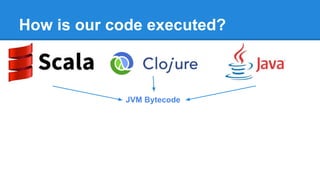
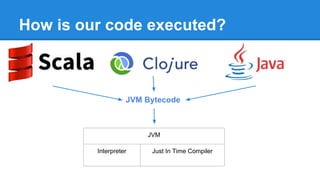
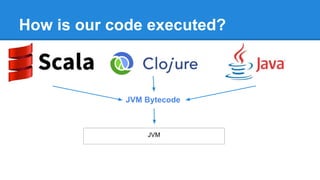
How is our code executed?
The answer: it is not directly executed by
OS/CPU.
How is our code executed?
JVM Bytecode
How is our code executed?
JVM Bytecode
JVM
How is our code executed?
JVM Bytecode
JVM
Interpreter Just In Time Compiler
Source: https://en.wikipedia.org/wiki/Strongtalk
“Work began in 1994 and they completed an
implementation in 1996.
Source: https://en.wikipedia.org/wiki/Strongtalk
“Work began in 1994 and they completed an
implementation in 1996. The company was bought by
Sun Microsystems in 1997,
Source: https://en.wikipedia.org/wiki/Strongtalk
“Work began in 1994 and they completed an
implementation in 1996. The company was bought by
Sun Microsystems in 1997, and the team got focused
on Java, releasing the HotSpot virtual machine,[3] and
work on Strongtalk stalled.”
So what exactly is bytecode?
“JVM bytecode is a low level language for non
existing CPU"
-- Jaroslaw.Palka
So what exactly is bytecode?
“JVM bytecode is a low level language for non
existing CPU"
-- Jaroslaw.Palka + beer
So what exactly is bytecode?
Bytecode is an instruction set.
So what exactly is bytecode?
Bytecode is an instruction set.
Each instruction is 1-byte size code.
So what exactly is bytecode?
Bytecode is an instruction set.
Each instruction is 1-byte size code.
So what exactly is bytecode?
Bytecode is an instruction set.
Each instruction is 1-byte size code.
So what exactly is bytecode?
Bytecode is an instruction set.
Each instruction is 1-byte size code.
Thus there are only 255 opcodes possible.
So what exactly is bytecode?
Bytecode is an instruction set.
Each instruction is 1-byte size code.
Thus there are only 255 opcodes possible.
198 are currently in use, 54 are reserved for
future use, and 3 instructions are ‘reserved
opcodes’
JVM is Stack Machine
● No registers, no accumulators, stackpointers
JVM is Stack Machine
● No registers, no accumulators, stackpointers
● Why stack based? Two theories:
JVM is Stack Machine
● No registers, no accumulators, stackpointers
● Why stack based? Two theories:
1. Different platforms, no worries about
number of and sizes of registers
JVM is Stack Machine
● No registers, no accumulators, stackpointers
● Why stack based? Two theories:
1. Different platforms, no worries about
number of and sizes of registers
2. Compactness of bytecode
JVM is Stack Machine
● No registers, no accumulators, stackpointers
● Why stack based? Two theories:
1. Different platforms, no worries about
number of and sizes of registers
2. Compactness of bytecode
● Learning is easy
Examples!
Warning: contains actual bytecode!
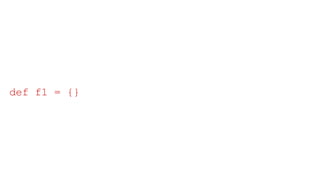
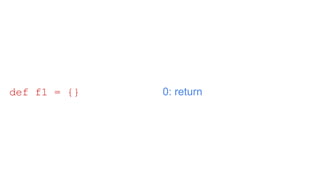
def f1 = {}
0: returndef f1 = {}
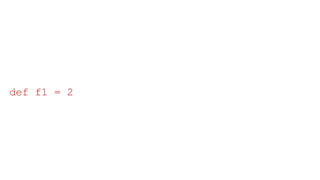
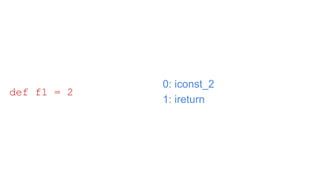
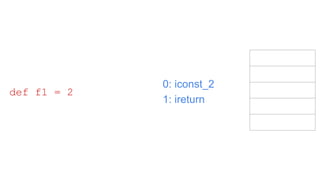
def f1 = 2
0: iconst_2
1: ireturn
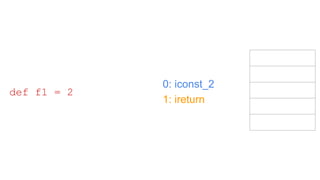
def f1 = 2
0: iconst_2
1: ireturn
def f1 = 2
0: iconst_2
1: ireturn
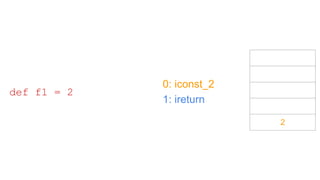
def f1 = 2
2
0: iconst_2
1: ireturn
def f1 = 2
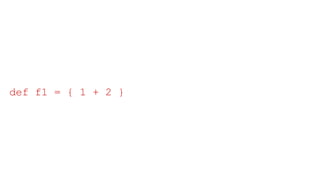
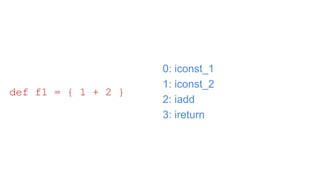
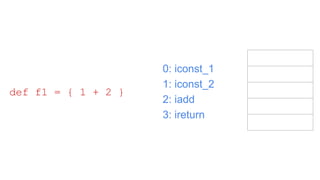
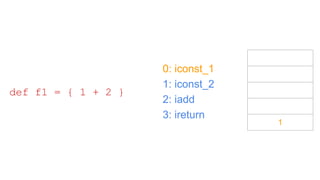
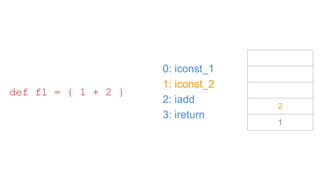
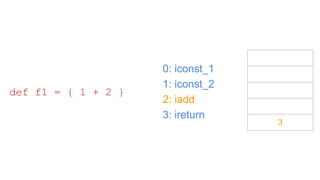
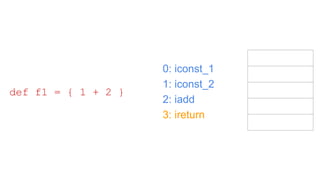
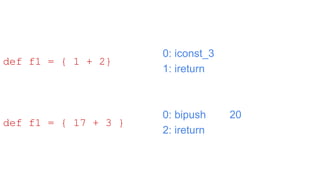
def f1 = { 1 + 2 }
0: iconst_1
1: iconst_2
2: iadd
3: ireturn
def f1 = { 1 + 2 }
0: iconst_1
1: iconst_2
2: iadd
3: ireturn
def f1 = { 1 + 2 }
0: iconst_1
1: iconst_2
2: iadd
3: ireturn
def f1 = { 1 + 2 }
1
0: iconst_1
1: iconst_2
2: iadd
3: ireturn
def f1 = { 1 + 2 }
2
1
0: iconst_1
1: iconst_2
2: iadd
3: ireturn
def f1 = { 1 + 2 }
3
0: iconst_1
1: iconst_2
2: iadd
3: ireturn
def f1 = { 1 + 2 }
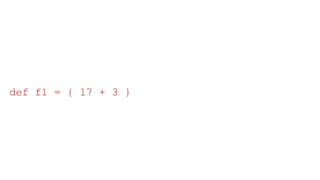
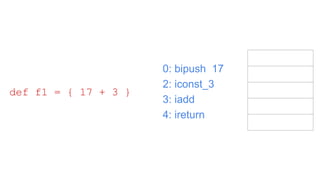
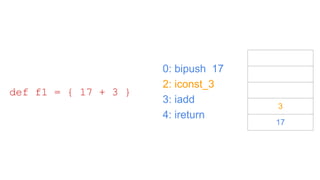
def f1 = { 17 + 3 }
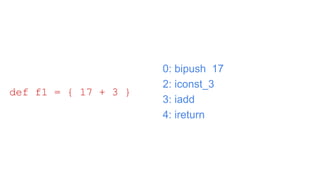
0: bipush 17
2: iconst_3
3: iadd
4: ireturn
def f1 = { 17 + 3 }
0: bipush 17
2: iconst_3
3: iadd
4: ireturn
def f1 = { 17 + 3 }
0: bipush 17
2: iconst_3
3: iadd
4: ireturn
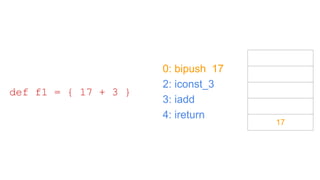
def f1 = { 17 + 3 }
17
0: bipush 17
2: iconst_3
3: iadd
4: ireturn
def f1 = { 17 + 3 }
3
17
0: bipush 17
2: iconst_3
3: iadd
4: ireturn
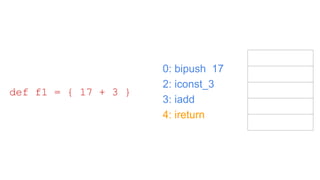
def f1 = { 17 + 3 }
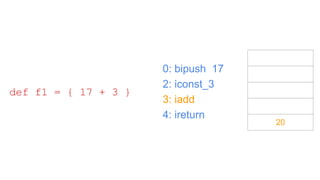
20
0: bipush 17
2: iconst_3
3: iadd
4: ireturn
def f1 = { 17 + 3 }
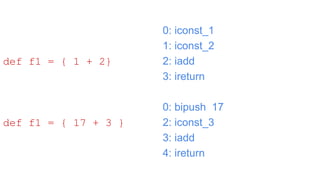
And now, the best part!
I’ve lied :)
And now, the best part!
0: iconst_1
1: iconst_2
2: iadd
3: ireturn
0: bipush 17
2: iconst_3
3: iadd
4: ireturn
def f1 = { 1 + 2}
def f1 = { 17 + 3 }
0: iconst_3
1: ireturn
0: bipush 20
2: ireturn
def f1 = { 1 + 2}
def f1 = { 17 + 3 }
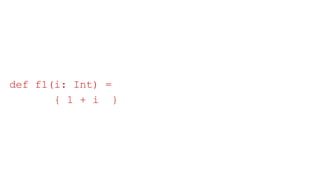
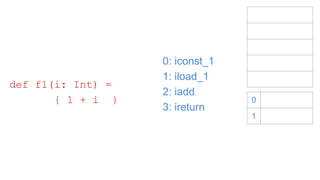
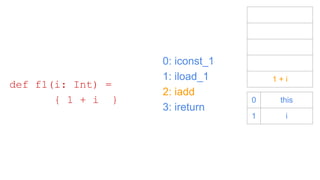
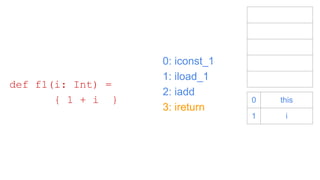
def f1(i: Int) =
{ 1 + i }
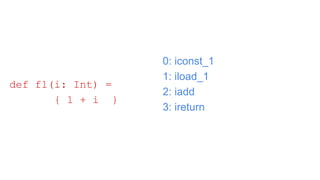
0: iconst_1
1: iload_1
2: iadd
3: ireturn
def f1(i: Int) =
{ 1 + i }
0: iconst_1
1: iload_1
2: iadd
3: ireturn
def f1(i: Int) =
{ 1 + i }
0: iconst_1
1: iload_1
2: iadd
3: ireturn
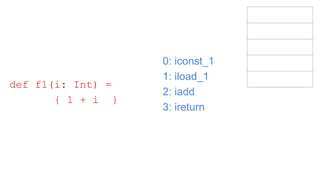
def f1(i: Int) =
{ 1 + i } 0
1
0: iconst_1
1: iload_1
2: iadd
3: ireturn
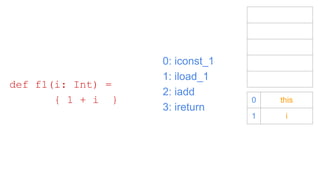
def f1(i: Int) =
{ 1 + i } 0 this
1 i
0: iconst_1
1: iload_1
2: iadd
3: ireturn
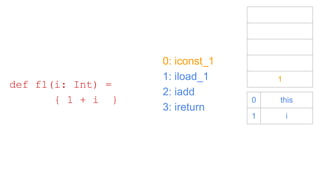
def f1(i: Int) =
{ 1 + i }
1
0 this
1 i
0: iconst_1
1: iload_1
2: iadd
3: ireturn
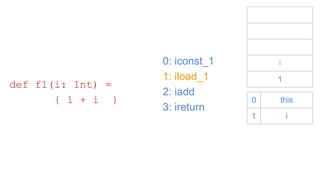
def f1(i: Int) =
{ 1 + i }
i
1
0 this
1 i
0: iconst_1
1: iload_1
2: iadd
3: ireturn
def f1(i: Int) =
{ 1 + i }
1 + i
0 this
1 i
0: iconst_1
1: iload_1
2: iadd
3: ireturn
def f1(i: Int) =
{ 1 + i } 0 this
1 i
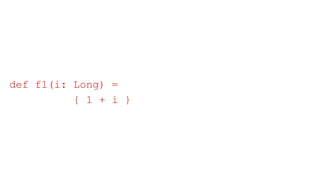
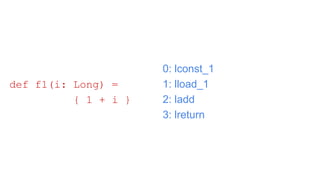
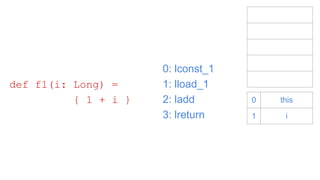
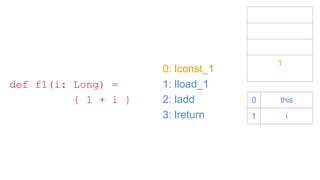
def f1(i: Long) =
{ 1 + i }
0: lconst_1
1: lload_1
2: ladd
3: lreturn
def f1(i: Long) =
{ 1 + i }
0: lconst_1
1: lload_1
2: ladd
3: lreturn
def f1(i: Long) =
{ 1 + i } 0 this
1 i
0: lconst_1
1: lload_1
2: ladd
3: lreturn
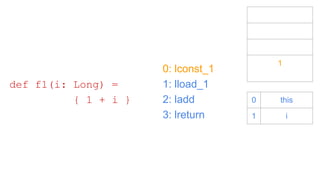
def f1(i: Long) =
{ 1 + i }
1
0 this
1 i
0: lconst_1
1: lload_1
2: ladd
3: lreturn
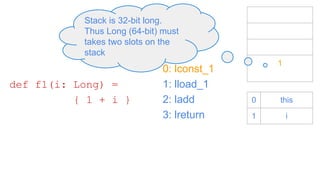
def f1(i: Long) =
{ 1 + i }
1
0 this
1 i
Stack is 32-bit long.
Thus Long (64-bit) must
takes two slots on the
stack
0: lconst_1
1: lload_1
2: ladd
3: lreturn
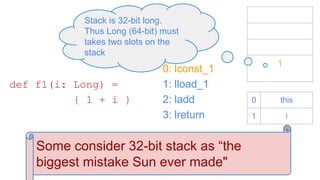
def f1(i: Long) =
{ 1 + i }
1
0 this
1 i
Stack is 32-bit long.
Thus Long (64-bit) must
takes two slots on the
stack
Some consider 32-bit stack as “the
biggest mistake Sun ever made"
0: lconst_1
1: lload_1
2: ladd
3: lreturn
def f1(i: Long) =
{ 1 + i }
1
0 this
1 i
0: lconst_1
1: lload_1
2: ladd
3: lreturn
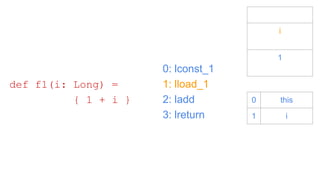
def f1(i: Long) =
{ 1 + i }
i
1
0 this
1 i
0: lconst_1
1: lload_1
2: ladd
3: lreturn
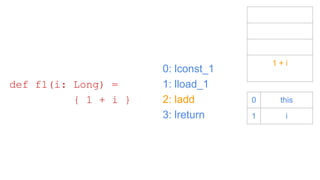
def f1(i: Long) =
{ 1 + i }
1 + i
0 this
1 i
0: lconst_1
1: lload_1
2: ladd
3: lreturn
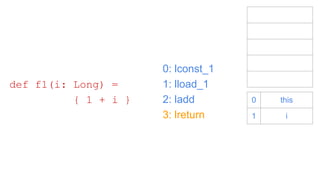
def f1(i: Long) =
{ 1 + i } 0 this
1 i
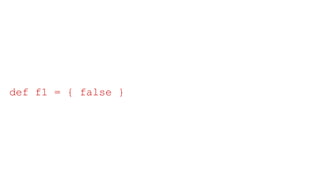
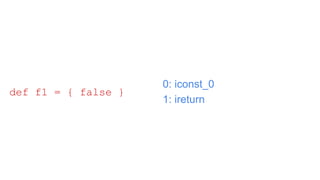
def f1 = { false }
0: iconst_0
1: ireturn
def f1 = { false }
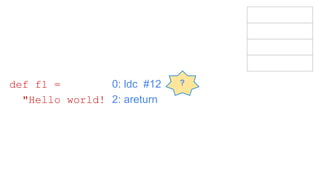
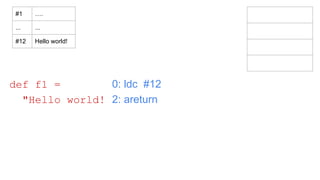
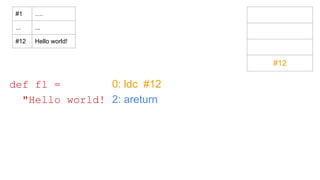
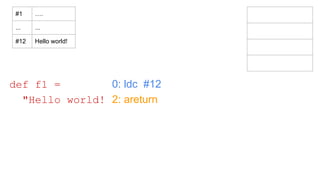
def f1 =
"Hello world!
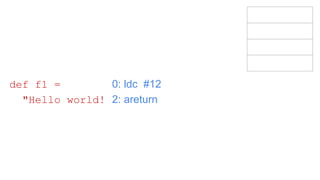
0: ldc #12
2: areturn
def f1 =
"Hello world!
0: ldc #12
2: areturn
def f1 =
"Hello world!
?
0: ldc #12
2: areturn
def f1 =
"Hello world!
?
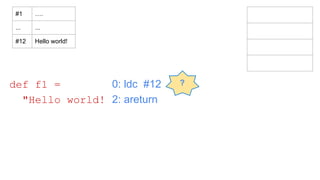
#1 ….
... ...
#12 Hello world!
0: ldc #12
2: areturn
def f1 =
"Hello world!
#1 ….
... ...
#12 Hello world!
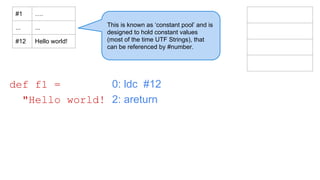
This is known as ‘constant pool’ and is
designed to hold constant values
(most of the time UTF Strings), that
can be referenced by #number.
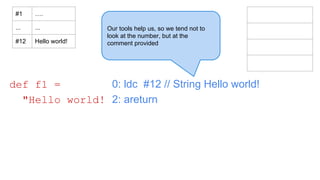
0: ldc #12 // String Hello world!
2: areturn
def f1 =
"Hello world!
#1 ….
... ...
#12 Hello world!
Our tools help us, so we tend not to
look at the number, but at the
comment provided
0: ldc #12
2: areturn
def f1 =
"Hello world!
#1 ….
... ...
#12 Hello world!
0: ldc #12
2: areturn
def f1 =
"Hello world!
#12
#1 ….
... ...
#12 Hello world!
0: ldc #12
2: areturn
def f1 =
"Hello world!
#1 ….
... ...
#12 Hello world!
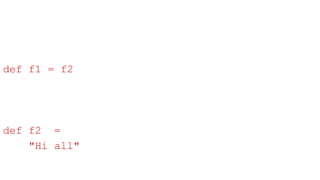
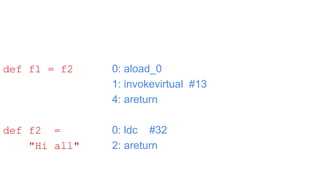
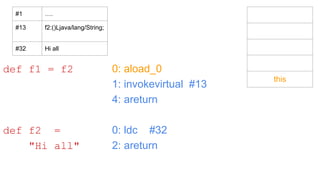
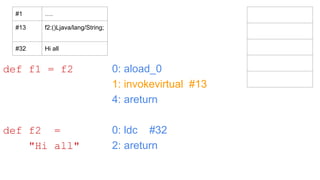
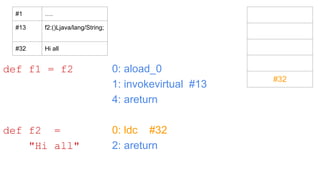
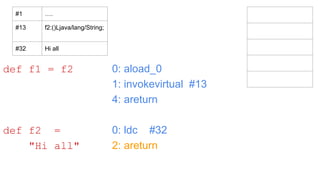
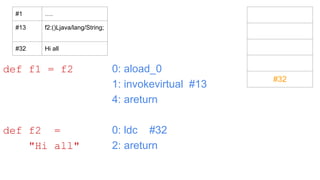
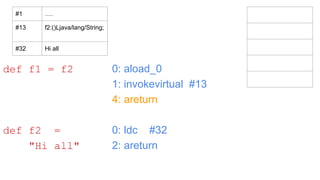
def f1 = f2
def f2 =
"Hi all"
0: aload_0
1: invokevirtual #13
4: areturn
0: ldc #32
2: areturn
def f1 = f2
def f2 =
"Hi all"
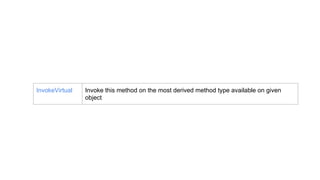
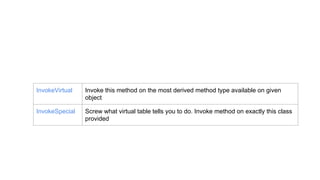
InvokeVirtual Invoke this method on the most derived method type available on given
object
0: aload_0
1: invokevirtual #13
4: areturn
0: ldc #32
2: areturn
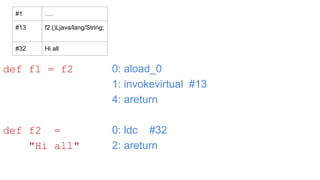
def f1 = f2
def f2 =
"Hi all"
#1 ….
#13 f2:()Ljava/lang/String;
#32 Hi all
0: aload_0
1: invokevirtual #13
4: areturn
0: ldc #32
2: areturn
def f1 = f2
def f2 =
"Hi all"
#1 ….
#13 f2:()Ljava/lang/String;
#32 Hi all
0: aload_0
1: invokevirtual #13
4: areturn
0: ldc #32
2: areturn
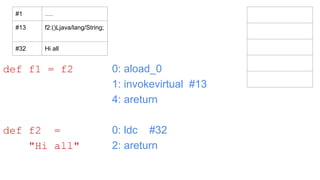
def f1 = f2
def f2 =
"Hi all"
this
#1 ….
#13 f2:()Ljava/lang/String;
#32 Hi all
0: aload_0
1: invokevirtual #13
4: areturn
0: ldc #32
2: areturn
def f1 = f2
def f2 =
"Hi all"
#1 ….
#13 f2:()Ljava/lang/String;
#32 Hi all
0: aload_0
1: invokevirtual #13
4: areturn
0: ldc #32
2: areturn
def f1 = f2
def f2 =
"Hi all"
#32
#1 ….
#13 f2:()Ljava/lang/String;
#32 Hi all
0: aload_0
1: invokevirtual #13
4: areturn
0: ldc #32
2: areturn
def f1 = f2
def f2 =
"Hi all"
#1 ….
#13 f2:()Ljava/lang/String;
#32 Hi all
0: aload_0
1: invokevirtual #13
4: areturn
0: ldc #32
2: areturn
def f1 = f2
def f2 =
"Hi all"
#32
#1 ….
#13 f2:()Ljava/lang/String;
#32 Hi all
0: aload_0
1: invokevirtual #13
4: areturn
0: ldc #32
2: areturn
def f1 = f2
def f2 =
"Hi all"
#1 ….
#13 f2:()Ljava/lang/String;
#32 Hi all
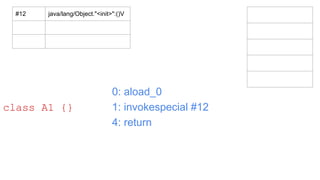
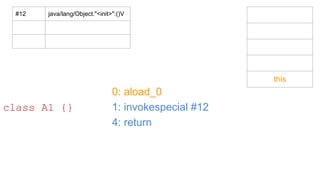
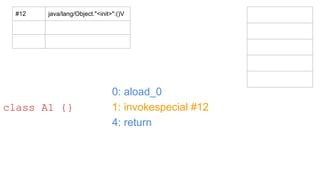
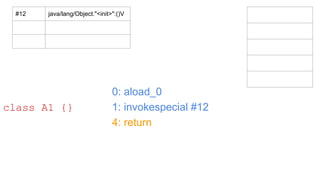
class A1 {}
0: aload_0
1: invokespecial #12
4: return
class A1 {}
#12 java/lang/Object."<init>":()V
InvokeVirtual Invoke this method on the most derived method type available on given
object
InvokeSpecial Screw what virtual table tells you to do. Invoke method on exactly this class
provided
0: aload_0
1: invokespecial #12
4: return
class A1 {}
this
#12 java/lang/Object."<init>":()V
0: aload_0
1: invokespecial #12
4: return
class A1 {}
#12 java/lang/Object."<init>":()V
0: aload_0
1: invokespecial #12
4: return
class A1 {}
#12 java/lang/Object."<init>":()V
class A3(var t1:
String)
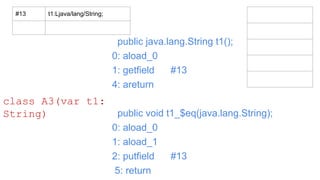
public java.lang.String t1();
0: aload_0
1: getfield #13
4: areturn
public void t1_$eq(java.lang.String);
0: aload_0
1: aload_1
2: putfield #13
5: return
class A3(var t1:
String)
#13 t1:Ljava/lang/String;
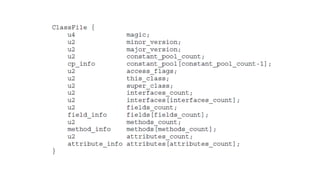
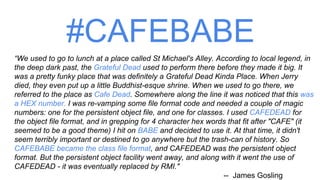
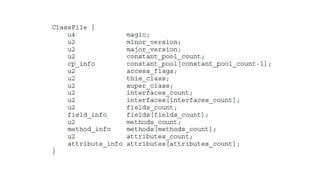
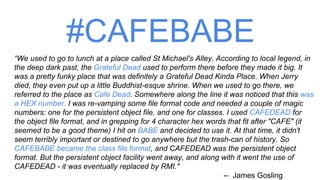
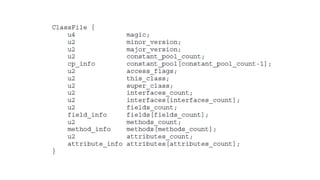
#CAFEBABE
#CAFEBABE
“We used to go to lunch at a place called St Michael's Alley. According to local legend, in
the deep dark past, the Grateful Dead used to perform there before they made it big. It
was a pretty funky place that was definitely a Grateful Dead Kinda Place. When Jerry
died, they even put up a little Buddhist-esque shrine. When we used to go there, we
referred to the place as Cafe Dead. Somewhere along the line it was noticed that this was
a HEX number. I was re-vamping some file format code and needed a couple of magic
numbers: one for the persistent object file, and one for classes. I used CAFEDEAD for
the object file format, and in grepping for 4 character hex words that fit after "CAFE" (it
seemed to be a good theme) I hit on BABE and decided to use it. At that time, it didn't
seem terribly important or destined to go anywhere but the trash-can of history. So
CAFEBABE became the class file format, and CAFEDEAD was the persistent object
format. But the persistent object facility went away, and along with it went the use of
CAFEDEAD - it was eventually replaced by RMI."
-- James Gosling
#CAFEBABE
“We used to go to lunch at a place called St Michael's Alley. According to local legend, in
the deep dark past, the Grateful Dead used to perform there before they made it big. It
was a pretty funky place that was definitely a Grateful Dead Kinda Place. When Jerry
died, they even put up a little Buddhist-esque shrine. When we used to go there, we
referred to the place as Cafe Dead. Somewhere along the line it was noticed that this was
a HEX number. I was re-vamping some file format code and needed a couple of magic
numbers: one for the persistent object file, and one for classes. I used CAFEDEAD for
the object file format, and in grepping for 4 character hex words that fit after "CAFE" (it
seemed to be a good theme) I hit on BABE and decided to use it. At that time, it didn't
seem terribly important or destined to go anywhere but the trash-can of history. So
CAFEBABE became the class file format, and CAFEDEAD was the persistent object
format. But the persistent object facility went away, and along with it went the use of
CAFEDEAD - it was eventually replaced by RMI."
-- James Gosling
#CAFEBABE
“We used to go to lunch at a place called St Michael's Alley. According to local legend, in
the deep dark past, the Grateful Dead used to perform there before they made it big. It
was a pretty funky place that was definitely a Grateful Dead Kinda Place. When Jerry
died, they even put up a little Buddhist-esque shrine. When we used to go there, we
referred to the place as Cafe Dead. Somewhere along the line it was noticed that this was
a HEX number. I was re-vamping some file format code and needed a couple of magic
numbers: one for the persistent object file, and one for classes. I used CAFEDEAD for
the object file format, and in grepping for 4 character hex words that fit after "CAFE" (it
seemed to be a good theme) I hit on BABE and decided to use it. At that time, it didn't
seem terribly important or destined to go anywhere but the trash-can of history. So
CAFEBABE became the class file format, and CAFEDEAD was the persistent object
format. But the persistent object facility went away, and along with it went the use of
CAFEDEAD - it was eventually replaced by RMI."
-- James Gosling
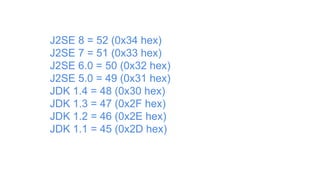
J2SE 8 = 52 (0x34 hex)
J2SE 7 = 51 (0x33 hex)
J2SE 6.0 = 50 (0x32 hex)
J2SE 5.0 = 49 (0x31 hex)
JDK 1.4 = 48 (0x30 hex)
JDK 1.3 = 47 (0x2F hex)
JDK 1.2 = 46 (0x2E hex)
JDK 1.1 = 45 (0x2D hex)
/JDK_HOME/bin/javap
Demystifying
folklore, reasoning
about facts
with Bytecode (for fun and profit)!
Belief: Use ‘Short’ for better performance
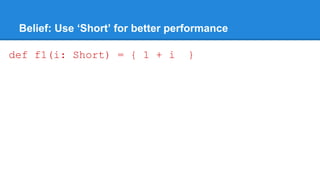
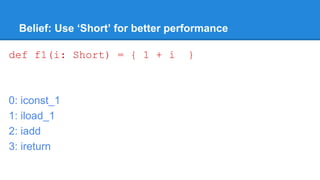
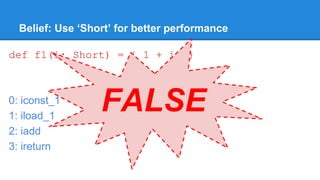
def f1(i: Short) = { 1 + i }
Belief: Use ‘Short’ for better performance
def f1(i: Short) = { 1 + i }
0: iconst_1
1: iload_1
2: iadd
3: ireturn
Belief: Use ‘Short’ for better performance
def f1(i: Short) = { 1 + i }
0: iconst_1
1: iload_1
2: iadd
3: ireturn
FALSE
Belief: Use StringBuilder instead of String
concatenation
Belief: Use StringBuilder instead of String
concatenation
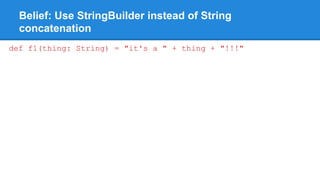
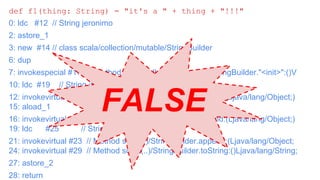
def f1(thing: String) = "it's a " + thing + "!!!"
Belief: Use StringBuilder instead of String
concatenation
def f1(thing: String) = "it's a " + thing + "!!!"
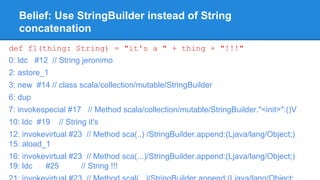
0: ldc #12 // String jeronimo
2: astore_1
3: new #14 // class scala/collection/mutable/StringBuilder
6: dup
7: invokespecial #17 // Method scala/collection/mutable/StringBuilder."<init>":()V
10: ldc #19 // String it's
12: invokevirtual #23 // Method sca(..) /StringBuilder.append:(Ljava/lang/Object;)
15: aload_1
16: invokevirtual #23 // Method sca(...)/StringBuilder.append:(Ljava/lang/Object;)
19: ldc #25 // String !!!
Belief: Use StringBuilder instead of String
concatenation
def f1(thing: String) = "it's a " + thing + "!!!"
0: ldc #12 // String jeronimo
2: astore_1
3: new #14 // class scala/collection/mutable/StringBuilder
6: dup
7: invokespecial #17 // Method scala/collection/mutable/StringBuilder."<init>":()V
10: ldc #19 // String it's
12: invokevirtual #23 // Method sca(..) /StringBuilder.append:(Ljava/lang/Object;)
15: aload_1
16: invokevirtual #23 // Method sca(...)/StringBuilder.append:(Ljava/lang/Object;)
19: ldc #25 // String !!!
21: invokevirtual #23 // Method scal(...)/StringBuilder.append:(Ljava/lang/Object;
24: invokevirtual #29 // Method scala(..)/StringBuilder.toString:()Ljava/lang/String;
27: astore_2
28: return
Belief: Use StringBuilder instead of String
concatenation
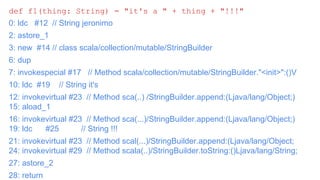
def f1(thing: String) = "it's a " + thing + "!!!"
0: ldc #12 // String jeronimo
2: astore_1
3: new #14 // class scala/collection/mutable/StringBuilder
6: dup
7: invokespecial #17 // Method scala/collection/mutable/StringBuilder."<init>":()V
10: ldc #19 // String it's
12: invokevirtual #23 // Method sca(..) /StringBuilder.append:(Ljava/lang/Object;)
15: aload_1
16: invokevirtual #23 // Method sca(...)/StringBuilder.append:(Ljava/lang/Object;)
19: ldc #25 // String !!!
21: invokevirtual #23 // Method scal(...)/StringBuilder.append:(Ljava/lang/Object;
24: invokevirtual #29 // Method scala(..)/StringBuilder.toString:()Ljava/lang/String;
27: astore_2
28: return
FALSE
Question: How Scala’s String Interpolation is
implemented?
Question: How Scala’s String Interpolation is
implemented?
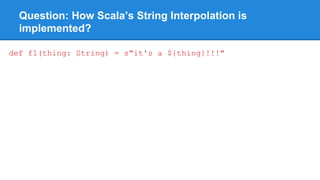
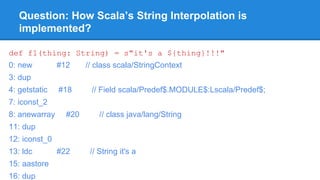
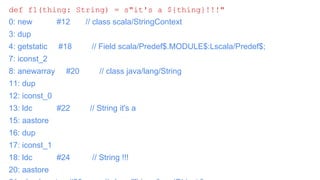
def f1(thing: String) = s"it's a ${thing}!!!"
Question: How Scala’s String Interpolation is
implemented?
def f1(thing: String) = s"it's a ${thing}!!!"
0: new #12 // class scala/StringContext
3: dup
4: getstatic #18 // Field scala/Predef$.MODULE$:Lscala/Predef$;
7: iconst_2
8: anewarray #20 // class java/lang/String
11: dup
12: iconst_0
13: ldc #22 // String it's a
15: aastore
16: dup
Question: How Scala’s String Interpolation is
implemented?
def f1(thing: String) = s"it's a ${thing}!!!"
0: new #12 // class scala/StringContext
3: dup
4: getstatic #18 // Field scala/Predef$.MODULE$:Lscala/Predef$;
7: iconst_2
8: anewarray #20 // class java/lang/String
11: dup
12: iconst_0
13: ldc #22 // String it's a
15: aastore
16: dup
17: iconst_1
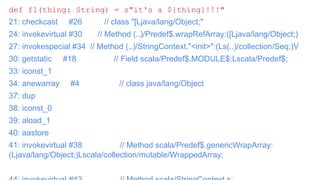
18: ldc #24 // String !!!
20: aastore
Question: How Scala’s String Interpolation is
implemented?
def f1(thing: String) = s"it's a ${thing}!!!"
21: checkcast #26 // class "[Ljava/lang/Object;"
24: invokevirtual #30 // Method (..)/Predef$.wrapRefArray:([Ljava/lang/Object;)
27: invokespecial #34 // Method (..)/StringContext."<init>":(Ls(..)/collection/Seq;)V
30: getstatic #18 // Field scala/Predef$.MODULE$:Lscala/Predef$;
33: iconst_1
34: anewarray #4 // class java/lang/Object
37: dup
38: iconst_0
39: aload_1
40: aastore
41: invokevirtual #38 // Method scala/Predef$.genericWrapArray:
(Ljava/lang/Object;)Lscala/collection/mutable/WrappedArray;
Question: How Scala’s String Interpolation is
implemented?
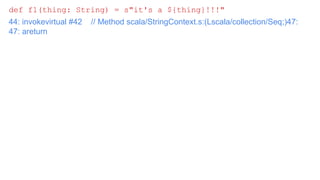
def f1(thing: String) = s"it's a ${thing}!!!"
44: invokevirtual #42 // Method scala/StringContext.s:(Lscala/collection/Seq;)47:
47: areturn
Question: How Scala’s String Interpolation is
implemented?
def f1(thing: String) = s"it's a ${thing}!!!"
0: new #12 // class scala/StringContext
3: dup
4: getstatic #18 // Field scala/Predef$.MODULE$:Lscala/Predef$;
7: iconst_2
8: anewarray #20 // class java/lang/String
11: dup
12: iconst_0
13: ldc #22 // String it's a
15: aastore
16: dup
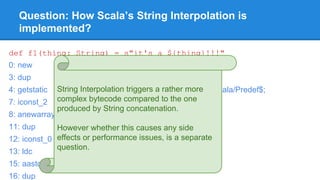
String Interpolation triggers a rather more
complex bytecode compared to the one
produced by String concatenation.
However whether this causes any side
effects or performance issues, is a separate
question.
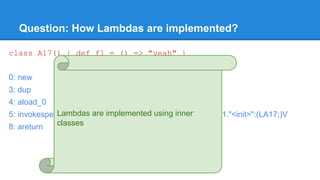
Question: How Lambdas are implemented?
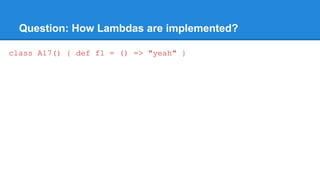
class A17() { def f1 = () => "yeah" }
Question: How Lambdas are implemented?
class A17() { def f1 = () => "yeah" }
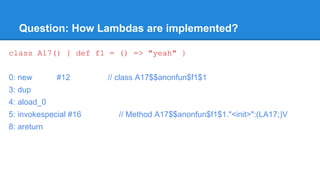
0: new #12 // class A17$$anonfun$f1$1
3: dup
4: aload_0
5: invokespecial #16 // Method A17$$anonfun$f1$1."<init>":(LA17;)V
8: areturn
Question: How Lambdas are implemented?
class A17() { def f1 = () => "yeah" }
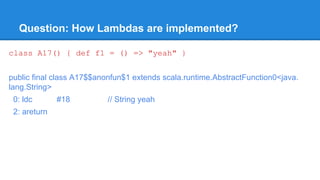
public final class A17$$anonfun$1 extends scala.runtime.AbstractFunction0<java.
lang.String>
0: ldc #18 // String yeah
2: areturn
Question: How Lambdas are implemented?
class A17() { def f1 = () => "yeah" }
0: new #12 // class A17$$anonfun$f1$1
3: dup
4: aload_0
5: invokespecial #16 // Method A17$$anonfun$f1$1."<init>":(LA17;)V
8: areturn
Lambdas are implemented using inner
classes
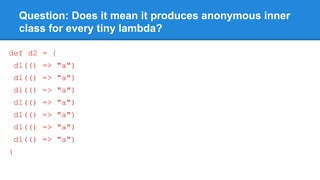
Question: Does it mean it produces anonymous inner
class for every tiny lambda?
Question: Does it mean it produces anonymous inner
class for every tiny lambda?
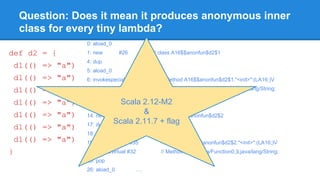
def d2 = {
d1(() => "a")
d1(() => "a")
d1(() => "a")
d1(() => "a")
d1(() => "a")
d1(() => "a")
d1(() => "a")
}
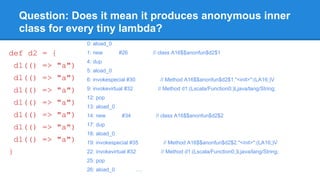
Question: Does it mean it produces anonymous inner
class for every tiny lambda?
def d2 = {
d1(() => "a")
d1(() => "a")
d1(() => "a")
d1(() => "a")
d1(() => "a")
d1(() => "a")
d1(() => "a")
}
0: aload_0
1: new #26 // class A16$$anonfun$d2$1
4: dup
5: aload_0
6: invokespecial #30 // Method A16$$anonfun$d2$1."<init>":(LA16;)V
9: invokevirtual #32 // Method d1:(Lscala/Function0;)Ljava/lang/String;
12: pop
13: aload_0
14: new #34 // class A16$$anonfun$d2$2
17: dup
18: aload_0
19: invokespecial #35 // Method A16$$anonfun$d2$2."<init>":(LA16;)V
22: invokevirtual #32 // Method d1:(Lscala/Function0;)Ljava/lang/String;
25: pop
26: aload_0 ….
Question: Does it mean it produces anonymous inner
class for every tiny lambda?
def d2 = {
d1(() => "a")
d1(() => "a")
d1(() => "a")
d1(() => "a")
d1(() => "a")
d1(() => "a")
d1(() => "a")
}
0: aload_0
1: new #26 // class A16$$anonfun$d2$1
4: dup
5: aload_0
6: invokespecial #30 // Method A16$$anonfun$d2$1."<init>":(LA16;)V
9: invokevirtual #32 // Method d1:(Lscala/Function0;)Ljava/lang/String;
12: pop
13: aload_0
14: new #34 // class A16$$anonfun$d2$2
17: dup
18: aload_0
19: invokespecial #35 // Method A16$$anonfun$d2$2."<init>":(LA16;)V
22: invokevirtual #32 // Method d1:(Lscala/Function0;)Ljava/lang/String;
25: pop
26: aload_0 ….
Scala 2.12-M2
&
Scala 2.11.7 + flag
Question: Does it mean it produces anonymous inner
class for every tiny lambda?
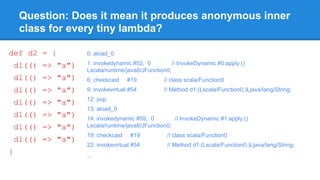
def d2 = {
d1(() => "a")
d1(() => "a")
d1(() => "a")
d1(() => "a")
d1(() => "a")
d1(() => "a")
d1(() => "a")
}
0: aload_0
1: invokedynamic #52, 0 // InvokeDynamic #0:apply:()
Lscala/runtime/java8/JFunction0;
6: checkcast #19 // class scala/Function0
9: invokevirtual #54 // Method d1:(Lscala/Function0;)Ljava/lang/String;
12: pop
13: aload_0
14: invokedynamic #59, 0 // InvokeDynamic #1:apply:()
Lscala/runtime/java8/JFunction0;
19: checkcast #19 // class scala/Function0
22: invokevirtual #54 // Method d1:(Lscala/Function0;)Ljava/lang/String;
...
Question: Does it mean it produces anonymous inner
class for every tiny lambda?
def d2 = {
d1(() => "a")
d1(() => "a")
d1(() => "a")
d1(() => "a")
d1(() => "a")
d1(() => "a")
d1(() => "a")
}
0: aload_0
1: invokedynamic #52, 0 // InvokeDynamic #0:apply:()
Lscala/runtime/java8/JFunction0;
6: checkcast #19 // class scala/Function0
9: invokevirtual #54 // Method d1:(Lscala/Function0;)Ljava/lang/String;
12: pop
13: aload_0
14: invokedynamic #59, 0 // InvokeDynamic #1:apply:()
Lscala/runtime/java8/JFunction0;
19: checkcast #19 // class scala/Function0
22: invokevirtual #54 // Method d1:(Lscala/Function0;)Ljava/lang/String;
...
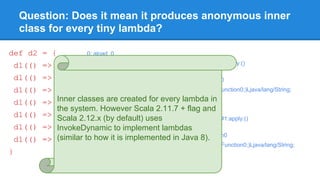
Inner classes are created for every lambda in
the system. However Scala 2.11.7 + flag and
Scala 2.12.x (by default) uses
InvokeDynamic to implement lambdas
(similar to how it is implemented in Java 8).
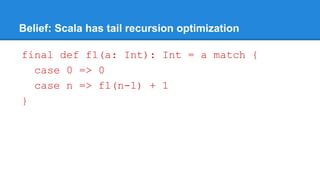
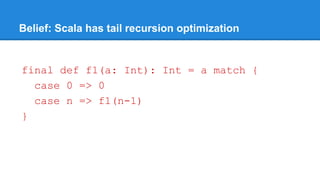
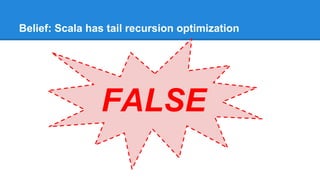
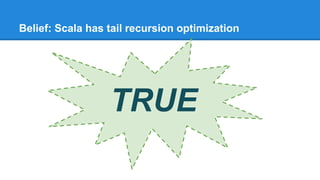
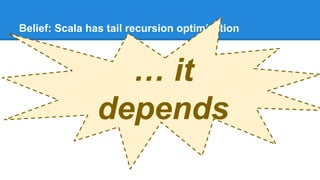
Belief: Scala has tail recursion optimization
final def f1(a: Int): Int = a match {
case 0 => 0
case n => f1(n-1) + 1
}
Belief: Scala has tail recursion optimization
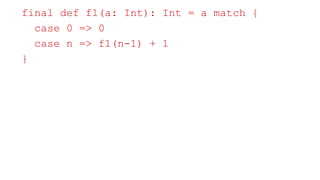
final def f1(a: Int): Int = a match {
case 0 => 0
case n => f1(n-1) + 1
}
Belief: Scala has tail recursion optimization
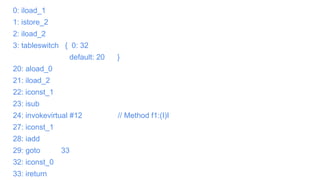
0: iload_1
1: istore_2
2: iload_2
3: tableswitch { 0: 32
default: 20 }
20: aload_0
21: iload_2
22: iconst_1
23: isub
24: invokevirtual #12 // Method f1:(I)I
27: iconst_1
28: iadd
29: goto 33
32: iconst_0
33: ireturn
Belief: Scala has tail recursion optimization
final def f1(a: Int): Int = a match {
case 0 => 0
case n => f1(n-1)
}
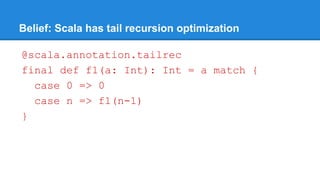
Belief: Scala has tail recursion optimization
@scala.annotation.tailrec
final def f1(a: Int): Int = a match {
case 0 => 0
case n => f1(n-1)
}
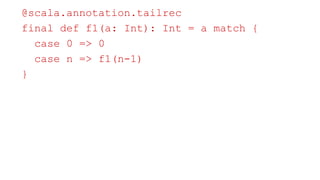
Belief: Scala has tail recursion optimization
@scala.annotation.tailrec
final def f1(a: Int): Int = a match {
case 0 => 0
case n => f1(n-1)
}
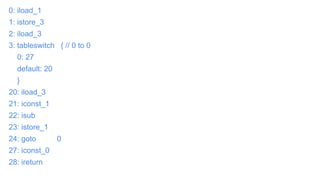
Belief: Scala has tail recursion optimization
0: iload_1
1: istore_3
2: iload_3
3: tableswitch { // 0 to 0
0: 27
default: 20
}
20: iload_3
21: iconst_1
22: isub
23: istore_1
24: goto 0
27: iconst_0
28: ireturn
Belief: Scala has tail recursion optimization
FALSE
Belief: Scala has tail recursion optimization
TRUE
Belief: Scala has tail recursion optimization
… it
depends
Homework:
Homework:
1. How Inner class can access private field of
Outer class? How is that even possible?
Homework:
1. How Inner class can access private field of
Outer class? How is that even possible?
2. Lambdas, are they being given copies of
data by value or by reference?
Homework:
1. How Inner class can access private field of
Outer class? How is that even possible?
2. Lambdas, are they being given copies of
data by value or by reference?
3. How Nothing is transformed to bytecode?
Homework:
1. How Inner class can access private field of
Outer class? How is that even possible?
2. Lambdas, are they being given copies of
data by value or by reference?
3. How Nothing is transformed to bytecode?
4. How traits are implemented? (2.11.7 vs 2.12.
x)
Memory
Organization
HotSpot memory organization
http://www.pointsoftware.ch/wp-content/uploads/2012/10/JUtH_20121024_RuntimeDataAreas_1_MemoryModel.png
http://cdn.infoq.com/statics_s2_20150819-0313/resource/articles/G1-One-Garbage-Collector-To-Rule-Them-All/en/resources/fig2largeB.jpg
HotSpot memory organization
http://www.occupycfs.com/wp-content/uploads/2014/10/are-you-serious-wtf-meme-baby-face.jpg
So what does really matter?
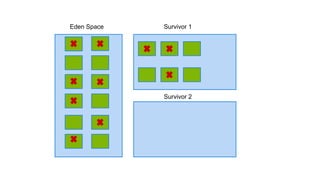
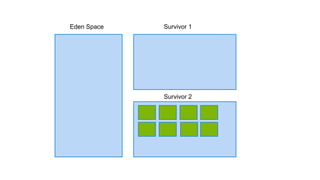
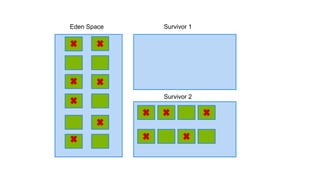
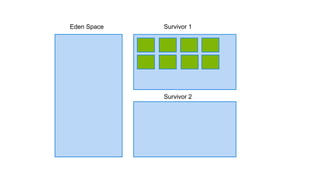
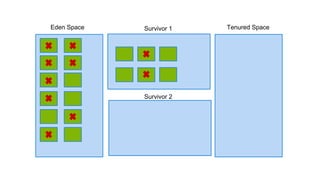
Generations
Main assumptions
Main assumptions
● Objects die young
Main assumptions
● Objects die young
● Not many references from old
objects to young objects
And… ?
And… ?
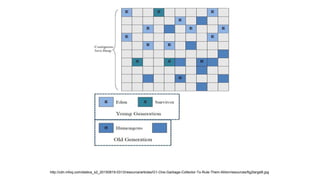
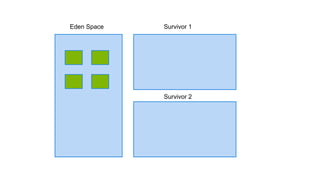
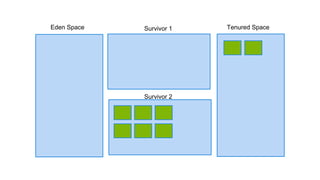
● Young Generation
And… ?
● Young Generation
○ Eden
And… ?
● Young Generation
○ Eden
○ Survivor Spaces
And… ?
● Young Generation
○ Eden
○ Survivor Spaces
● Old Generation
And… ?
● Young Generation
○ Eden
○ Survivor Spaces
● Old Generation
○ Tenured
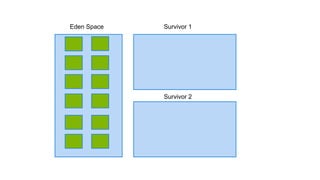
Eden Space Survivor 1
Survivor 2
Eden Space Survivor 1
Survivor 2
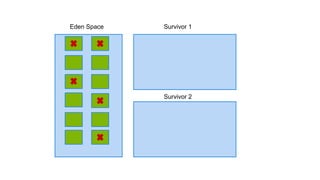
Eden Space Survivor 1
Survivor 2
Eden Space Survivor 1
Survivor 2
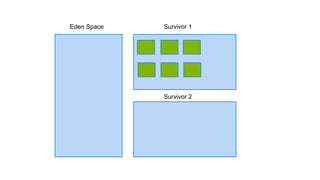
Eden Space Survivor 1
Survivor 2
Eden Space Survivor 1
Survivor 2
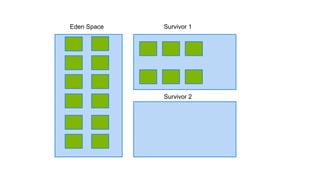
Eden Space Survivor 1
Survivor 2
Eden Space Survivor 1
Survivor 2
Eden Space Survivor 1
Survivor 2
Eden Space Survivor 1
Survivor 2
Tenured Space
Eden Space Survivor 1
Survivor 2
Tenured Space
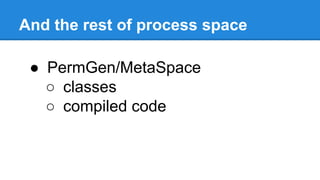
And the rest of process space
● PermGen/MetaSpace
○ classes
○ compiled code
And the rest of process space
● PermGen/MetaSpace
○ classes
○ compiled code
● Native (Non-heap)
HotSpot memory organization
http://www.pointsoftware.ch/wp-content/uploads/2012/10/JUtH_20121024_RuntimeDataAreas_1_MemoryModel.png
GC Algorithms
Young Generation GC Algorithms
● SerialGC
Young Generation GC Algorithms
● SerialGC
● ParallelGC
Young Generation GC Algorithms
● SerialGC
● ParallelGC
● ParNewGC
Young Generation GC Algorithms
● SerialGC
● ParallelGC
● ParNewGC
● G1
Old Generation GC Algorithms
● MarkSweepCompact
Old Generation GC Algorithms
● MarkSweepCompact
● ParallelOldGC
Old Generation GC Algorithms
● MarkSweepCompact
● ParallelOldGC
● ConcurrentMarkAndSwap(CMS)
Old Generation GC Algorithms
● MarkSweepCompact
● ParallelOldGC
● ConcurrentMarkAndSwap(CMS)
● G1
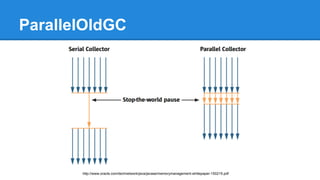
ParallelOldGC
http://www.oracle.com/technetwork/java/javase/memorymanagement-whitepaper-150215.pdf
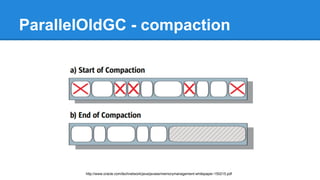
ParallelOldGC - compaction
http://www.oracle.com/technetwork/java/javase/memorymanagement-whitepaper-150215.pdf
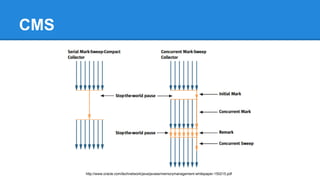
CMS
http://www.oracle.com/technetwork/java/javase/memorymanagement-whitepaper-150215.pdf
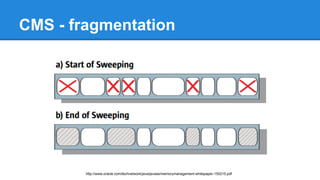
CMS - fragmentation
http://www.oracle.com/technetwork/java/javase/memorymanagement-whitepaper-150215.pdf
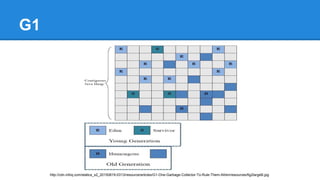
G1
http://cdn.infoq.com/statics_s2_20150819-0313/resource/articles/G1-One-Garbage-Collector-To-Rule-Them-All/en/resources/fig2largeB.jpg
G1
http://cdn.meme.am/instances/57348598.jpg
G1object MyBenchmarkLatency {
@State(Scope.Benchmark)
class Memory {
val heap = new Array[Array[Byte]](100)
}
}
@State(Scope.Thread)
class MyBenchmarkLatency {
val rand = new Random()
val base = 3000
val randBase = 100
def baseline() = ...
def testMethod(memory: Memory) = ...
def fib (max: Int): BigInt = …
}
G1@Benchmark
@BenchmarkMode(Array(Mode.AverageTime))
@OutputTimeUnit(TimeUnit.MILLISECONDS)
def testMethod(memory: Memory) {
for (i <- 0 until 100) memory.heap(i) =
new Array[Byte](1024 * 1024)
val result: BigInt =
fib(base + rand.nextInt(randBase))
for (i <- 0 until 100) memory.heap(i) = null
result + rand.nextInt()
}
G1 @Benchmark
@BenchmarkMode(Array(Mode.
AverageTime))
@OutputTimeUnit(TimeUnit.
MILLISECONDS)
def baseline() {
val result = fib(base +
rand.nextInt(randBase))
result + rand.nextInt()
}
@Benchmark
@BenchmarkMode(Array(Mode.AverageTime))
@OutputTimeUnit(TimeUnit.MILLISECONDS)
def testMethod(memory: Memory) {
for (i <- 0 until 100) memory.heap(i) =
new Array[Byte](1024 * 1024)
val result =
fib(base + rand.nextInt(randBase))
for (i <- 0 until 100) memory.heap(i) = null
result + rand.nextInt()
}
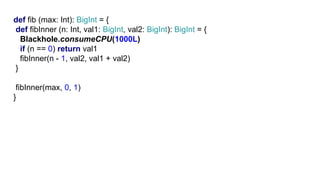
G1def fib (max: Int): BigInt = {
def fibInner (n: Int, val1: BigInt, val2: BigInt): BigInt = {
Blackhole.consumeCPU(1000L)
if (n == 0) return val1
fibInner(n - 1, val2, val1 + val2)
}
fibInner(max, 0, 1)
}
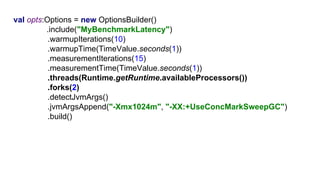
G1val opts:Options = new OptionsBuilder()
.include("MyBenchmarkLatency")
.warmupIterations(10)
.warmupTime(TimeValue.seconds(1))
.measurementIterations(15)
.measurementTime(TimeValue.seconds(1))
.threads(Runtime.getRuntime.availableProcessors())
.forks(2)
.detectJvmArgs()
.jvmArgsAppend("-Xmx1024m", "-XX:+UseConcMarkSweepGC")
.build()
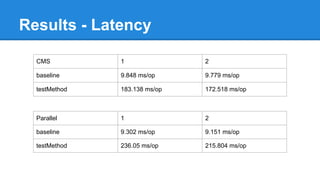
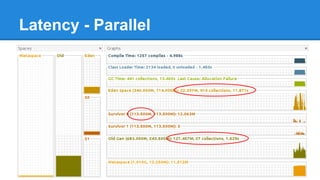
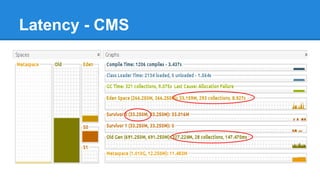
Results - Latency
CMS 1 2
baseline 9.848 ms/op 9.779 ms/op
testMethod 183.138 ms/op 172.518 ms/op
Parallel 1 2
baseline 9.302 ms/op 9.151 ms/op
testMethod 236.05 ms/op 215.804 ms/op
Latency - Parallel
Latency - CMS
G1object MyBenchmarkBatch {
@State(Scope.Benchmark)
class Memory {
val heap = new Array[Array[Byte]](100)
}
}
@State(Scope.Thread)
class MyBenchmarkBatch {
@Param(Array("10"))
var offset: Int = _
var startPtr: Int = 0
var endPtr: Int = 0
def testMethod(memory: Memory) = ...
}
}
G1@Benchmark
@BenchmarkMode(Array(Mode.Throughput))
@OutputTimeUnit(TimeUnit.SECONDS)
def testMethod(memory: Memory) {
for (i <- startPtr until startPtr + offset) memory.heap(i % 100) = new Array[Byte]
(1024)
startPtr += offset
Blackhole.consumeCPU(1000L)
for (i <- endPtr until endPtr + offset) memory.heap(i % 100) = null
}
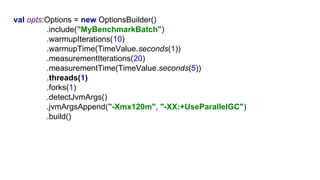
G1val opts:Options = new OptionsBuilder()
.include("MyBenchmarkBatch")
.warmupIterations(10)
.warmupTime(TimeValue.seconds(1))
.measurementIterations(20)
.measurementTime(TimeValue.seconds(5))
.threads(1)
.forks(1)
.detectJvmArgs()
.jvmArgsAppend("-Xmx120m", "-XX:+UseParallelGC")
.build()
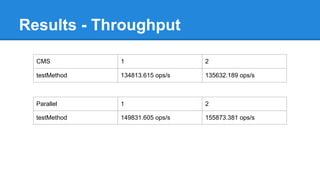
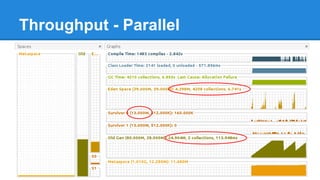
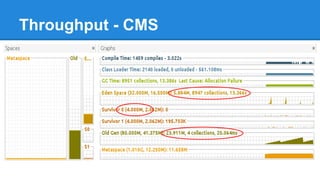
Results - Throughput
CMS 1 2
testMethod 134813.615 ops/s 135632.189 ops/s
Parallel 1 2
testMethod 149831.605 ops/s 155873.381 ops/s
Throughput - Parallel
Throughput - CMS
Monitoring tools
JDK/bin
JDK/bin
● jstack
JDK/bin
● jstack
● jmap
JDK/bin
● jstack
● jmap
● jstat
JDK/bin
● jstack
● jmap
● jstat
● jconsole
JDK/bin
● jstack
● jmap
● jstat
● jconsole
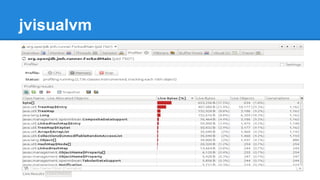
● jvisualvm
JDK/bin
● jstack
● jmap
● jstat
● jconsole
● jvisualvm
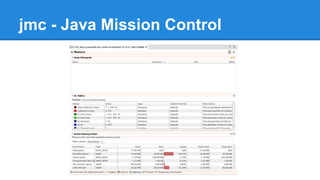
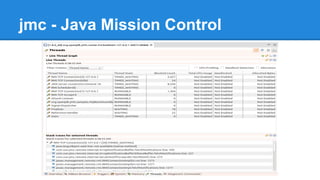
● jmc
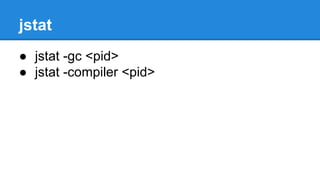
jstat
● jstat -gc <pid>
jstat
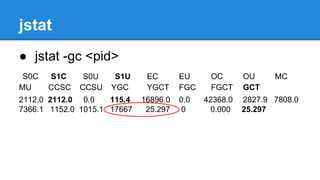
● jstat -gc <pid>
S0C S1C S0U S1U EC EU OC OU MC
MU CCSC CCSU YGC YGCT FGC FGCT GCT
2112.0 2112.0 0.0 115.4 16896.0 0.0 42368.0 2827.9 7808.0
7366.1 1152.0 1015.1 17667 25.297 0 0.000 25.297
jstat
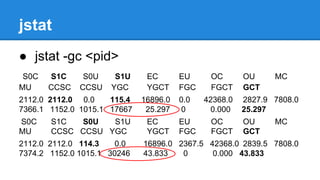
● jstat -gc <pid>
S0C S1C S0U S1U EC EU OC OU MC
MU CCSC CCSU YGC YGCT FGC FGCT GCT
2112.0 2112.0 0.0 115.4 16896.0 0.0 42368.0 2827.9 7808.0
7366.1 1152.0 1015.1 17667 25.297 0 0.000 25.297
S0C S1C S0U S1U EC EU OC OU MC
MU CCSC CCSU YGC YGCT FGC FGCT GCT
2112.0 2112.0 114.3 0.0 16896.0 2367.5 42368.0 2839.5 7808.0
7374.2 1152.0 1015.1 30246 43.833 0 0.000 43.833
jstat
● jstat -gc <pid>
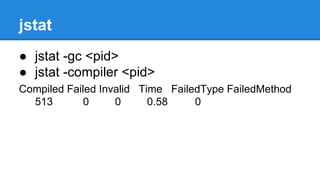
● jstat -compiler <pid>
jstat
● jstat -gc <pid>
● jstat -compiler <pid>
Compiled Failed Invalid Time FailedType FailedMethod
513 0 0 0.58 0
jstat
● jstat -gc <pid>
● jstat -compiler <pid>
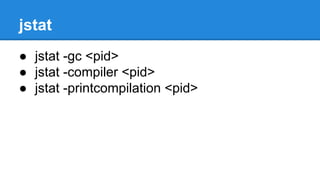
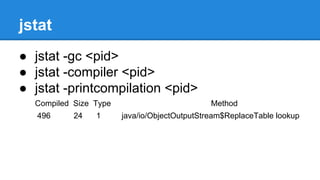
● jstat -printcompilation <pid>
jstat
● jstat -gc <pid>
● jstat -compiler <pid>
● jstat -printcompilation <pid>
Compiled Size Type Method
496 24 1 java/io/ObjectOutputStream$ReplaceTable lookup
G1
http://www.quickmeme.com/img/fc/fc3646a02beca4bbf6c05e711f81c0eb354d253149028d9ce0fca9def3aaf63a.jpg
jvisualvm
jmc - Java Mission Control
But what with GC logs?
● ParallelGC
○ Young
○ Old
● CMS
○ Young
○ Old
● G1
ParallelGC
[PSYoungGen: 117951K->17408K(128512K)] 163328K->83265K(217600K),
0,0356419 secs] [Times: user=0,03 sys=0,11, real=0,04 secs]
0,703: [Full GC (Ergonomics) [PSYoungGen: 17408K->0K(128512K)]
[ParOldGen: 65857K->77121K(135168K)] 83265K->77121K(263680K),
[Metaspace: 7223K->7223K(1056768K)], 0,0401522 secs] [Times: user=0,12
sys=0,02, real=0,04 secs]
CMS
1,881: [GC (Allocation Failure) 1,881: [ParNew
Desired survivor size 1081344 bytes, new threshold 1 (max 6)
- age 1: 2097184 bytes, 2097184 total
: 18760K->2048K(19008K), 0,0152627 secs] 705206K->704878K(725612K),
0,0153456 secs] [Times: user=0,05 sys=0,02, real=0,01 secs]
1,902: [GC (Allocation Failure) 1,902: [ParNew: 18927K->18927K(19008K),
0,0000199 secs]1,902: [CMS1,902: [CMS-concurrent-abortable-preclean:
0,072/0,678 secs] [Times: user=2,26 sys=0,20, real=0,68 secs]
(concurrent mode failure): 702830K->90458K(706604K), 0,0536025 secs]
721757K->90458K(725612K), [Metaspace: 7235K->7235K(1056768K)],
0,0545283 secs] [Times: user=0,05 sys=0,00, real=0,05 secs]
GCViewer
Thread & heap
dumps
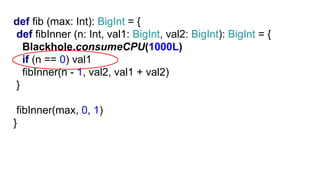
G1def fib (max: Int): BigInt = {
def fibInner (n: Int, val1: BigInt, val2: BigInt): BigInt = {
Blackhole.consumeCPU(1000L)
if (n == 0) val1
fibInner(n - 1, val2, val1 + val2)
}
fibInner(max, 0, 1)
}
How to make thread dump
● jstack [-Flm] <pid>
● kill -3 <pid>
But what with GC logs?"org.openjdk.jmh.samples.MyBenchmarkLatency.baseline-jmh-worker-3"
#13 daemon prio=5 os_prio=0 tid=0x00007fb5c0243000 nid=0x22fb runnable
[0x00007fb5a6b50000]
java.lang.Thread.State: RUNNABLE at org.openjdk.jmh.samples.
MyBenchmarkLatency.fibInner$1(MyBenchmarkLatency.scala:56) at org.
openjdk.jmh.samples.MyBenchmarkLatency.fib(MyBenchmarkLatency.scala:
59) at org.openjdk.jmh.samples.MyBenchmarkLatency.baseline
(MyBenchmarkLatency.scala:35) at org.openjdk.jmh.samples.generated.
MyBenchmarkLatency_baseline.baseline_AverageTime
(MyBenchmarkLatency_baseline.java:124)
But what with GC logs?
"org.openjdk.jmh.samples.MyBenchmarkLatency.baseline-jmh-worker-3"
#13 daemon prio=5 os_prio=0 tid=0x00007fb5c0243000 nid=0x22fb runnable
[0x00007fb5a6b50000]
java.lang.Thread.State: RUNNABLE
at java.math.BigInteger.add(BigInteger.java:1315)
at java.math.BigInteger.add(BigInteger.java:1221)
at scala.math.BigInt.$plus(BigInt.scala:203)
at org.openjdk.jmh.samples.MyBenchmarkLatency.fibInner$1
(MyBenchmarkLatency.scala:56)
at org.openjdk.jmh.samples.MyBenchmarkLatency.fib
(MyBenchmarkLatency.scala:59)
G1@Benchmark
@BenchmarkMode(Array(Mode.AverageTime))
@OutputTimeUnit(TimeUnit.MILLISECONDS)
def testMethod(memory: Memory) {
for (i <- 0 until 100) memory.heap(i) =
new Array[Byte](1024 * 1024)
val result: BigInt =
fib(base + rand.nextInt(randBase))
for (i <- 0 until 100) memory.heap(i) = null
result + rand.nextInt()
}
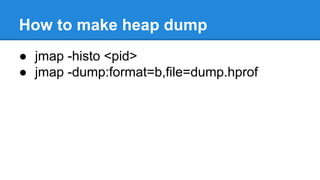
How to make heap dump
● jmap -histo <pid>
● jmap -dump:format=b,file=dump.hprof
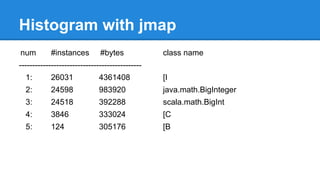
Histogram with jmap
num #instances #bytes class name
----------------------------------------------
1: 26031 4361408 [I
2: 24598 983920 java.math.BigInteger
3: 24518 392288 scala.math.BigInt
4: 3846 333024 [C
5: 124 305176 [B
JIT
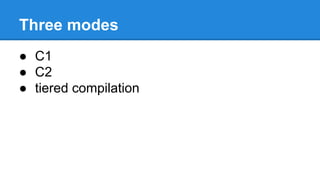
Three modes
● C1
● C2
● tiered compilation
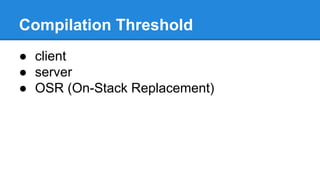
Compilation Threshold
● client
● server
● OSR (On-Stack Replacement)
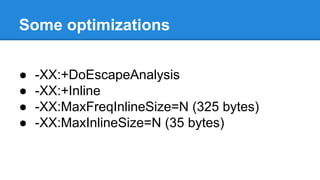
Some optimizations
● -XX:+DoEscapeAnalysis
● -XX:+Inline
● -XX:MaxFreqInlineSize=N (325 bytes)
● -XX:MaxInlineSize=N (35 bytes)
JMH
https://www.google.pl/url?sa=i&rct=j&q=&esrc=s&source=images&cd=&cad=rja&uact=8&ved=0CAcQjRxqFQoTCIn41uLEyMcCFSPVcgodewsG4A&url=http%3A%2F%2Fmemegenerator.net%
2Finstance%2F54121031&ei=AqHeVYnvM6OqywP7lpiADg&psig=AFQjCNFrs-9HN7x4SCV87eiuK4eIl4VhKQ&ust=1440739955356463
And that’s all
folks!
Paweł Szulc
@rabbit
Bartek Kaflowski
@bartkaf

Know your platform. 7 things every scala developer should know about jvm

  • 1.
    "Know your platform." 7things every Scala developer should know about the JVM
  • 2.
  • 3.
    Origins of thistalk We were having a beer...
  • 4.
    Origins of thistalk We were having a beer...
  • 5.
    Origins of thistalk We were having beers...
  • 6.
  • 7.
    Financial & BigData driven ;)
  • 8.
  • 9.
    Origins of thistalk There is vast number of newcomers to Scala world. Some percentage of those developers have never programmed in Java before.
  • 10.
    Origins of thistalk There is vast number of newcomers to Scala world. Some percentage of those developers have never programmed in Java before. Do they have a notion of the platform they are running their software on?
  • 11.
    Origins of thistalk There is a significant number of Java developers obsessed with all kind of APIs not knowing a single thing about the platform that they are using.
  • 12.
    Origins of thistalk There is a significant number of Java developers obsessed with all kind of APIs not knowing a single thing about the platform that they are using. Those Java developers begin to move towards other JVM languages (like Scala)
  • 13.
  • 14.
    Should we evencare? “You always want to understand one level below the level you write your code" -- Ted Neward’s mentor
  • 15.
  • 16.
    Should we evencare? Knowing one level below your level leads to:
  • 17.
    Should we evencare? Knowing one level below your level leads to: ● Being a better engineer on general
  • 18.
    Should we evencare? Knowing one level below your level leads to: ● Being a better engineer on general ● Ability to more accurately reason about the code
  • 19.
    Should we evencare? Knowing one level below your level leads to: ● Being a better engineer on general ● Ability to more accurately reason about the code ● Improved performance
  • 20.
    Should we evencare? Knowing one level below your level leads to: ● Being a better engineer on general ● Ability to more accurately reason about the code ● Improved performance ● Leaving the folklore beliefs towards scientific methods
  • 21.
    Should we evencare? Knowing one level below your level leads to: ● Being a better engineer on general ● Ability to more accurately reason about the code ● Improved performance ● Leaving the folklore beliefs towards scientific methods ● Separation of dogmas and facts
  • 22.
    Should we evencare? Knowing one level below your level leads to: ● Being a better engineer on general ● Ability to more accurately reason about the code ● Improved performance ● Leaving the folklore beliefs towards scientific methods ● Separation of dogmas and facts ● Efficiency in handling non-trivial errors and bugs
  • 23.
  • 24.
    Should we evencare? We believe that as Scala developers
  • 25.
    Should we evencare? We believe that as Scala developers we should at least understand basics of the JVM platform
  • 26.
    Should we evencare? We believe that as Scala developers we should at least understand basics of the JVM platform in order to achieve efficiency,
  • 27.
    Should we evencare? We believe that as Scala developers we should at least understand basics of the JVM platform in order to achieve efficiency, understanding,
  • 28.
    Should we evencare? We believe that as Scala developers we should at least understand basics of the JVM platform in order to achieve efficiency, understanding, robustness,
  • 29.
    Should we evencare? We believe that as Scala developers we should at least understand basics of the JVM platform in order to achieve efficiency, understanding, robustness, determinism
  • 30.
    Should we evencare? We believe that as Scala developers we should at least understand basics of the JVM platform in order to achieve efficiency, understanding, robustness, determinism and sanity.
  • 31.
  • 32.
    How is ourcode executed?
  • 33.
    How is ourcode executed? The answer: it is not directly executed by OS/CPU.
  • 34.
    How is ourcode executed?
  • 35.
    How is ourcode executed?
  • 36.
    How is ourcode executed?
  • 37.
    How is ourcode executed? JVM Bytecode
  • 38.
    How is ourcode executed? JVM Bytecode JVM
  • 39.
    How is ourcode executed? JVM Bytecode JVM Interpreter Just In Time Compiler
  • 42.
  • 43.
    Source: https://en.wikipedia.org/wiki/Strongtalk “Work beganin 1994 and they completed an implementation in 1996.
  • 44.
    Source: https://en.wikipedia.org/wiki/Strongtalk “Work beganin 1994 and they completed an implementation in 1996. The company was bought by Sun Microsystems in 1997,
  • 45.
    Source: https://en.wikipedia.org/wiki/Strongtalk “Work beganin 1994 and they completed an implementation in 1996. The company was bought by Sun Microsystems in 1997, and the team got focused on Java, releasing the HotSpot virtual machine,[3] and work on Strongtalk stalled.”
  • 47.
    So what exactlyis bytecode?
  • 48.
    So what exactlyis bytecode? “JVM bytecode is a low level language for non existing CPU" -- Jaroslaw.Palka
  • 49.
    So what exactlyis bytecode? “JVM bytecode is a low level language for non existing CPU" -- Jaroslaw.Palka + beer
  • 50.
    So what exactlyis bytecode?
  • 51.
    So what exactlyis bytecode? Bytecode is an instruction set.
  • 52.
    So what exactlyis bytecode? Bytecode is an instruction set. Each instruction is 1-byte size code.
  • 53.
    So what exactlyis bytecode? Bytecode is an instruction set. Each instruction is 1-byte size code.
  • 54.
    So what exactlyis bytecode? Bytecode is an instruction set. Each instruction is 1-byte size code.
  • 55.
    So what exactlyis bytecode? Bytecode is an instruction set. Each instruction is 1-byte size code. Thus there are only 255 opcodes possible.
  • 56.
    So what exactlyis bytecode? Bytecode is an instruction set. Each instruction is 1-byte size code. Thus there are only 255 opcodes possible. 198 are currently in use, 54 are reserved for future use, and 3 instructions are ‘reserved opcodes’
  • 57.
    JVM is StackMachine
  • 58.
    JVM is StackMachine ● No registers, no accumulators, stackpointers
  • 59.
    JVM is StackMachine ● No registers, no accumulators, stackpointers ● Why stack based? Two theories:
  • 60.
    JVM is StackMachine ● No registers, no accumulators, stackpointers ● Why stack based? Two theories: 1. Different platforms, no worries about number of and sizes of registers
  • 61.
    JVM is StackMachine ● No registers, no accumulators, stackpointers ● Why stack based? Two theories: 1. Different platforms, no worries about number of and sizes of registers 2. Compactness of bytecode
  • 62.
    JVM is StackMachine ● No registers, no accumulators, stackpointers ● Why stack based? Two theories: 1. Different platforms, no worries about number of and sizes of registers 2. Compactness of bytecode ● Learning is easy
  • 64.
  • 65.
  • 66.
  • 67.
  • 68.
  • 69.
  • 70.
  • 71.
  • 72.
    def f1 ={ 1 + 2 }
  • 73.
    0: iconst_1 1: iconst_2 2:iadd 3: ireturn def f1 = { 1 + 2 }
  • 74.
    0: iconst_1 1: iconst_2 2:iadd 3: ireturn def f1 = { 1 + 2 }
  • 75.
    0: iconst_1 1: iconst_2 2:iadd 3: ireturn def f1 = { 1 + 2 } 1
  • 76.
    0: iconst_1 1: iconst_2 2:iadd 3: ireturn def f1 = { 1 + 2 } 2 1
  • 77.
    0: iconst_1 1: iconst_2 2:iadd 3: ireturn def f1 = { 1 + 2 } 3
  • 78.
    0: iconst_1 1: iconst_2 2:iadd 3: ireturn def f1 = { 1 + 2 }
  • 79.
    def f1 ={ 17 + 3 }
  • 80.
    0: bipush 17 2:iconst_3 3: iadd 4: ireturn def f1 = { 17 + 3 }
  • 81.
    0: bipush 17 2:iconst_3 3: iadd 4: ireturn def f1 = { 17 + 3 }
  • 82.
    0: bipush 17 2:iconst_3 3: iadd 4: ireturn def f1 = { 17 + 3 } 17
  • 83.
    0: bipush 17 2:iconst_3 3: iadd 4: ireturn def f1 = { 17 + 3 } 3 17
  • 84.
    0: bipush 17 2:iconst_3 3: iadd 4: ireturn def f1 = { 17 + 3 } 20
  • 85.
    0: bipush 17 2:iconst_3 3: iadd 4: ireturn def f1 = { 17 + 3 }
  • 86.
    And now, thebest part!
  • 87.
    I’ve lied :) Andnow, the best part!
  • 88.
    0: iconst_1 1: iconst_2 2:iadd 3: ireturn 0: bipush 17 2: iconst_3 3: iadd 4: ireturn def f1 = { 1 + 2} def f1 = { 17 + 3 }
  • 89.
    0: iconst_3 1: ireturn 0:bipush 20 2: ireturn def f1 = { 1 + 2} def f1 = { 17 + 3 }
  • 90.
    def f1(i: Int)= { 1 + i }
  • 91.
    0: iconst_1 1: iload_1 2:iadd 3: ireturn def f1(i: Int) = { 1 + i }
  • 92.
    0: iconst_1 1: iload_1 2:iadd 3: ireturn def f1(i: Int) = { 1 + i }
  • 93.
    0: iconst_1 1: iload_1 2:iadd 3: ireturn def f1(i: Int) = { 1 + i } 0 1
  • 94.
    0: iconst_1 1: iload_1 2:iadd 3: ireturn def f1(i: Int) = { 1 + i } 0 this 1 i
  • 95.
    0: iconst_1 1: iload_1 2:iadd 3: ireturn def f1(i: Int) = { 1 + i } 1 0 this 1 i
  • 96.
    0: iconst_1 1: iload_1 2:iadd 3: ireturn def f1(i: Int) = { 1 + i } i 1 0 this 1 i
  • 97.
    0: iconst_1 1: iload_1 2:iadd 3: ireturn def f1(i: Int) = { 1 + i } 1 + i 0 this 1 i
  • 98.
    0: iconst_1 1: iload_1 2:iadd 3: ireturn def f1(i: Int) = { 1 + i } 0 this 1 i
  • 99.
    def f1(i: Long)= { 1 + i }
  • 100.
    0: lconst_1 1: lload_1 2:ladd 3: lreturn def f1(i: Long) = { 1 + i }
  • 101.
    0: lconst_1 1: lload_1 2:ladd 3: lreturn def f1(i: Long) = { 1 + i } 0 this 1 i
  • 102.
    0: lconst_1 1: lload_1 2:ladd 3: lreturn def f1(i: Long) = { 1 + i } 1 0 this 1 i
  • 103.
    0: lconst_1 1: lload_1 2:ladd 3: lreturn def f1(i: Long) = { 1 + i } 1 0 this 1 i Stack is 32-bit long. Thus Long (64-bit) must takes two slots on the stack
  • 104.
    0: lconst_1 1: lload_1 2:ladd 3: lreturn def f1(i: Long) = { 1 + i } 1 0 this 1 i Stack is 32-bit long. Thus Long (64-bit) must takes two slots on the stack Some consider 32-bit stack as “the biggest mistake Sun ever made"
  • 105.
    0: lconst_1 1: lload_1 2:ladd 3: lreturn def f1(i: Long) = { 1 + i } 1 0 this 1 i
  • 106.
    0: lconst_1 1: lload_1 2:ladd 3: lreturn def f1(i: Long) = { 1 + i } i 1 0 this 1 i
  • 107.
    0: lconst_1 1: lload_1 2:ladd 3: lreturn def f1(i: Long) = { 1 + i } 1 + i 0 this 1 i
  • 108.
    0: lconst_1 1: lload_1 2:ladd 3: lreturn def f1(i: Long) = { 1 + i } 0 this 1 i
  • 109.
    def f1 ={ false }
  • 110.
  • 111.
  • 112.
    0: ldc #12 2:areturn def f1 = "Hello world!
  • 113.
    0: ldc #12 2:areturn def f1 = "Hello world! ?
  • 114.
    0: ldc #12 2:areturn def f1 = "Hello world! ? #1 …. ... ... #12 Hello world!
  • 115.
    0: ldc #12 2:areturn def f1 = "Hello world! #1 …. ... ... #12 Hello world! This is known as ‘constant pool’ and is designed to hold constant values (most of the time UTF Strings), that can be referenced by #number.
  • 116.
    0: ldc #12// String Hello world! 2: areturn def f1 = "Hello world! #1 …. ... ... #12 Hello world! Our tools help us, so we tend not to look at the number, but at the comment provided
  • 117.
    0: ldc #12 2:areturn def f1 = "Hello world! #1 …. ... ... #12 Hello world!
  • 118.
    0: ldc #12 2:areturn def f1 = "Hello world! #12 #1 …. ... ... #12 Hello world!
  • 119.
    0: ldc #12 2:areturn def f1 = "Hello world! #1 …. ... ... #12 Hello world!
  • 120.
    def f1 =f2 def f2 = "Hi all"
  • 121.
    0: aload_0 1: invokevirtual#13 4: areturn 0: ldc #32 2: areturn def f1 = f2 def f2 = "Hi all"
  • 122.
    InvokeVirtual Invoke thismethod on the most derived method type available on given object
  • 123.
    0: aload_0 1: invokevirtual#13 4: areturn 0: ldc #32 2: areturn def f1 = f2 def f2 = "Hi all" #1 …. #13 f2:()Ljava/lang/String; #32 Hi all
  • 124.
    0: aload_0 1: invokevirtual#13 4: areturn 0: ldc #32 2: areturn def f1 = f2 def f2 = "Hi all" #1 …. #13 f2:()Ljava/lang/String; #32 Hi all
  • 125.
    0: aload_0 1: invokevirtual#13 4: areturn 0: ldc #32 2: areturn def f1 = f2 def f2 = "Hi all" this #1 …. #13 f2:()Ljava/lang/String; #32 Hi all
  • 126.
    0: aload_0 1: invokevirtual#13 4: areturn 0: ldc #32 2: areturn def f1 = f2 def f2 = "Hi all" #1 …. #13 f2:()Ljava/lang/String; #32 Hi all
  • 127.
    0: aload_0 1: invokevirtual#13 4: areturn 0: ldc #32 2: areturn def f1 = f2 def f2 = "Hi all" #32 #1 …. #13 f2:()Ljava/lang/String; #32 Hi all
  • 128.
    0: aload_0 1: invokevirtual#13 4: areturn 0: ldc #32 2: areturn def f1 = f2 def f2 = "Hi all" #1 …. #13 f2:()Ljava/lang/String; #32 Hi all
  • 129.
    0: aload_0 1: invokevirtual#13 4: areturn 0: ldc #32 2: areturn def f1 = f2 def f2 = "Hi all" #32 #1 …. #13 f2:()Ljava/lang/String; #32 Hi all
  • 130.
    0: aload_0 1: invokevirtual#13 4: areturn 0: ldc #32 2: areturn def f1 = f2 def f2 = "Hi all" #1 …. #13 f2:()Ljava/lang/String; #32 Hi all
  • 131.
  • 132.
    0: aload_0 1: invokespecial#12 4: return class A1 {} #12 java/lang/Object."<init>":()V
  • 133.
    InvokeVirtual Invoke thismethod on the most derived method type available on given object InvokeSpecial Screw what virtual table tells you to do. Invoke method on exactly this class provided
  • 134.
    0: aload_0 1: invokespecial#12 4: return class A1 {} this #12 java/lang/Object."<init>":()V
  • 135.
    0: aload_0 1: invokespecial#12 4: return class A1 {} #12 java/lang/Object."<init>":()V
  • 136.
    0: aload_0 1: invokespecial#12 4: return class A1 {} #12 java/lang/Object."<init>":()V
  • 137.
  • 138.
    public java.lang.String t1(); 0:aload_0 1: getfield #13 4: areturn public void t1_$eq(java.lang.String); 0: aload_0 1: aload_1 2: putfield #13 5: return class A3(var t1: String) #13 t1:Ljava/lang/String;
  • 140.
  • 141.
    #CAFEBABE “We used togo to lunch at a place called St Michael's Alley. According to local legend, in the deep dark past, the Grateful Dead used to perform there before they made it big. It was a pretty funky place that was definitely a Grateful Dead Kinda Place. When Jerry died, they even put up a little Buddhist-esque shrine. When we used to go there, we referred to the place as Cafe Dead. Somewhere along the line it was noticed that this was a HEX number. I was re-vamping some file format code and needed a couple of magic numbers: one for the persistent object file, and one for classes. I used CAFEDEAD for the object file format, and in grepping for 4 character hex words that fit after "CAFE" (it seemed to be a good theme) I hit on BABE and decided to use it. At that time, it didn't seem terribly important or destined to go anywhere but the trash-can of history. So CAFEBABE became the class file format, and CAFEDEAD was the persistent object format. But the persistent object facility went away, and along with it went the use of CAFEDEAD - it was eventually replaced by RMI." -- James Gosling
  • 142.
    #CAFEBABE “We used togo to lunch at a place called St Michael's Alley. According to local legend, in the deep dark past, the Grateful Dead used to perform there before they made it big. It was a pretty funky place that was definitely a Grateful Dead Kinda Place. When Jerry died, they even put up a little Buddhist-esque shrine. When we used to go there, we referred to the place as Cafe Dead. Somewhere along the line it was noticed that this was a HEX number. I was re-vamping some file format code and needed a couple of magic numbers: one for the persistent object file, and one for classes. I used CAFEDEAD for the object file format, and in grepping for 4 character hex words that fit after "CAFE" (it seemed to be a good theme) I hit on BABE and decided to use it. At that time, it didn't seem terribly important or destined to go anywhere but the trash-can of history. So CAFEBABE became the class file format, and CAFEDEAD was the persistent object format. But the persistent object facility went away, and along with it went the use of CAFEDEAD - it was eventually replaced by RMI." -- James Gosling
  • 143.
    #CAFEBABE “We used togo to lunch at a place called St Michael's Alley. According to local legend, in the deep dark past, the Grateful Dead used to perform there before they made it big. It was a pretty funky place that was definitely a Grateful Dead Kinda Place. When Jerry died, they even put up a little Buddhist-esque shrine. When we used to go there, we referred to the place as Cafe Dead. Somewhere along the line it was noticed that this was a HEX number. I was re-vamping some file format code and needed a couple of magic numbers: one for the persistent object file, and one for classes. I used CAFEDEAD for the object file format, and in grepping for 4 character hex words that fit after "CAFE" (it seemed to be a good theme) I hit on BABE and decided to use it. At that time, it didn't seem terribly important or destined to go anywhere but the trash-can of history. So CAFEBABE became the class file format, and CAFEDEAD was the persistent object format. But the persistent object facility went away, and along with it went the use of CAFEDEAD - it was eventually replaced by RMI." -- James Gosling
  • 145.
    J2SE 8 =52 (0x34 hex) J2SE 7 = 51 (0x33 hex) J2SE 6.0 = 50 (0x32 hex) J2SE 5.0 = 49 (0x31 hex) JDK 1.4 = 48 (0x30 hex) JDK 1.3 = 47 (0x2F hex) JDK 1.2 = 46 (0x2E hex) JDK 1.1 = 45 (0x2D hex)
  • 147.
  • 148.
  • 149.
    Belief: Use ‘Short’for better performance
  • 150.
    Belief: Use ‘Short’for better performance def f1(i: Short) = { 1 + i }
  • 151.
    Belief: Use ‘Short’for better performance def f1(i: Short) = { 1 + i } 0: iconst_1 1: iload_1 2: iadd 3: ireturn
  • 152.
    Belief: Use ‘Short’for better performance def f1(i: Short) = { 1 + i } 0: iconst_1 1: iload_1 2: iadd 3: ireturn FALSE
  • 153.
    Belief: Use StringBuilderinstead of String concatenation
  • 154.
    Belief: Use StringBuilderinstead of String concatenation def f1(thing: String) = "it's a " + thing + "!!!"
  • 155.
    Belief: Use StringBuilderinstead of String concatenation def f1(thing: String) = "it's a " + thing + "!!!" 0: ldc #12 // String jeronimo 2: astore_1 3: new #14 // class scala/collection/mutable/StringBuilder 6: dup 7: invokespecial #17 // Method scala/collection/mutable/StringBuilder."<init>":()V 10: ldc #19 // String it's 12: invokevirtual #23 // Method sca(..) /StringBuilder.append:(Ljava/lang/Object;) 15: aload_1 16: invokevirtual #23 // Method sca(...)/StringBuilder.append:(Ljava/lang/Object;) 19: ldc #25 // String !!!
  • 156.
    Belief: Use StringBuilderinstead of String concatenation def f1(thing: String) = "it's a " + thing + "!!!" 0: ldc #12 // String jeronimo 2: astore_1 3: new #14 // class scala/collection/mutable/StringBuilder 6: dup 7: invokespecial #17 // Method scala/collection/mutable/StringBuilder."<init>":()V 10: ldc #19 // String it's 12: invokevirtual #23 // Method sca(..) /StringBuilder.append:(Ljava/lang/Object;) 15: aload_1 16: invokevirtual #23 // Method sca(...)/StringBuilder.append:(Ljava/lang/Object;) 19: ldc #25 // String !!! 21: invokevirtual #23 // Method scal(...)/StringBuilder.append:(Ljava/lang/Object; 24: invokevirtual #29 // Method scala(..)/StringBuilder.toString:()Ljava/lang/String; 27: astore_2 28: return
  • 157.
    Belief: Use StringBuilderinstead of String concatenation def f1(thing: String) = "it's a " + thing + "!!!" 0: ldc #12 // String jeronimo 2: astore_1 3: new #14 // class scala/collection/mutable/StringBuilder 6: dup 7: invokespecial #17 // Method scala/collection/mutable/StringBuilder."<init>":()V 10: ldc #19 // String it's 12: invokevirtual #23 // Method sca(..) /StringBuilder.append:(Ljava/lang/Object;) 15: aload_1 16: invokevirtual #23 // Method sca(...)/StringBuilder.append:(Ljava/lang/Object;) 19: ldc #25 // String !!! 21: invokevirtual #23 // Method scal(...)/StringBuilder.append:(Ljava/lang/Object; 24: invokevirtual #29 // Method scala(..)/StringBuilder.toString:()Ljava/lang/String; 27: astore_2 28: return FALSE
  • 158.
    Question: How Scala’sString Interpolation is implemented?
  • 159.
    Question: How Scala’sString Interpolation is implemented? def f1(thing: String) = s"it's a ${thing}!!!"
  • 160.
    Question: How Scala’sString Interpolation is implemented? def f1(thing: String) = s"it's a ${thing}!!!" 0: new #12 // class scala/StringContext 3: dup 4: getstatic #18 // Field scala/Predef$.MODULE$:Lscala/Predef$; 7: iconst_2 8: anewarray #20 // class java/lang/String 11: dup 12: iconst_0 13: ldc #22 // String it's a 15: aastore 16: dup
  • 161.
    Question: How Scala’sString Interpolation is implemented? def f1(thing: String) = s"it's a ${thing}!!!" 0: new #12 // class scala/StringContext 3: dup 4: getstatic #18 // Field scala/Predef$.MODULE$:Lscala/Predef$; 7: iconst_2 8: anewarray #20 // class java/lang/String 11: dup 12: iconst_0 13: ldc #22 // String it's a 15: aastore 16: dup 17: iconst_1 18: ldc #24 // String !!! 20: aastore
  • 162.
    Question: How Scala’sString Interpolation is implemented? def f1(thing: String) = s"it's a ${thing}!!!" 21: checkcast #26 // class "[Ljava/lang/Object;" 24: invokevirtual #30 // Method (..)/Predef$.wrapRefArray:([Ljava/lang/Object;) 27: invokespecial #34 // Method (..)/StringContext."<init>":(Ls(..)/collection/Seq;)V 30: getstatic #18 // Field scala/Predef$.MODULE$:Lscala/Predef$; 33: iconst_1 34: anewarray #4 // class java/lang/Object 37: dup 38: iconst_0 39: aload_1 40: aastore 41: invokevirtual #38 // Method scala/Predef$.genericWrapArray: (Ljava/lang/Object;)Lscala/collection/mutable/WrappedArray;
  • 163.
    Question: How Scala’sString Interpolation is implemented? def f1(thing: String) = s"it's a ${thing}!!!" 44: invokevirtual #42 // Method scala/StringContext.s:(Lscala/collection/Seq;)47: 47: areturn
  • 164.
    Question: How Scala’sString Interpolation is implemented? def f1(thing: String) = s"it's a ${thing}!!!" 0: new #12 // class scala/StringContext 3: dup 4: getstatic #18 // Field scala/Predef$.MODULE$:Lscala/Predef$; 7: iconst_2 8: anewarray #20 // class java/lang/String 11: dup 12: iconst_0 13: ldc #22 // String it's a 15: aastore 16: dup String Interpolation triggers a rather more complex bytecode compared to the one produced by String concatenation. However whether this causes any side effects or performance issues, is a separate question.
  • 165.
    Question: How Lambdasare implemented?
  • 166.
    Question: How Lambdasare implemented? class A17() { def f1 = () => "yeah" }
  • 167.
    Question: How Lambdasare implemented? class A17() { def f1 = () => "yeah" } 0: new #12 // class A17$$anonfun$f1$1 3: dup 4: aload_0 5: invokespecial #16 // Method A17$$anonfun$f1$1."<init>":(LA17;)V 8: areturn
  • 168.
    Question: How Lambdasare implemented? class A17() { def f1 = () => "yeah" } public final class A17$$anonfun$1 extends scala.runtime.AbstractFunction0<java. lang.String> 0: ldc #18 // String yeah 2: areturn
  • 169.
    Question: How Lambdasare implemented? class A17() { def f1 = () => "yeah" } 0: new #12 // class A17$$anonfun$f1$1 3: dup 4: aload_0 5: invokespecial #16 // Method A17$$anonfun$f1$1."<init>":(LA17;)V 8: areturn Lambdas are implemented using inner classes
  • 170.
    Question: Does itmean it produces anonymous inner class for every tiny lambda?
  • 171.
    Question: Does itmean it produces anonymous inner class for every tiny lambda? def d2 = { d1(() => "a") d1(() => "a") d1(() => "a") d1(() => "a") d1(() => "a") d1(() => "a") d1(() => "a") }
  • 172.
    Question: Does itmean it produces anonymous inner class for every tiny lambda? def d2 = { d1(() => "a") d1(() => "a") d1(() => "a") d1(() => "a") d1(() => "a") d1(() => "a") d1(() => "a") } 0: aload_0 1: new #26 // class A16$$anonfun$d2$1 4: dup 5: aload_0 6: invokespecial #30 // Method A16$$anonfun$d2$1."<init>":(LA16;)V 9: invokevirtual #32 // Method d1:(Lscala/Function0;)Ljava/lang/String; 12: pop 13: aload_0 14: new #34 // class A16$$anonfun$d2$2 17: dup 18: aload_0 19: invokespecial #35 // Method A16$$anonfun$d2$2."<init>":(LA16;)V 22: invokevirtual #32 // Method d1:(Lscala/Function0;)Ljava/lang/String; 25: pop 26: aload_0 ….
  • 173.
    Question: Does itmean it produces anonymous inner class for every tiny lambda? def d2 = { d1(() => "a") d1(() => "a") d1(() => "a") d1(() => "a") d1(() => "a") d1(() => "a") d1(() => "a") } 0: aload_0 1: new #26 // class A16$$anonfun$d2$1 4: dup 5: aload_0 6: invokespecial #30 // Method A16$$anonfun$d2$1."<init>":(LA16;)V 9: invokevirtual #32 // Method d1:(Lscala/Function0;)Ljava/lang/String; 12: pop 13: aload_0 14: new #34 // class A16$$anonfun$d2$2 17: dup 18: aload_0 19: invokespecial #35 // Method A16$$anonfun$d2$2."<init>":(LA16;)V 22: invokevirtual #32 // Method d1:(Lscala/Function0;)Ljava/lang/String; 25: pop 26: aload_0 …. Scala 2.12-M2 & Scala 2.11.7 + flag
  • 174.
    Question: Does itmean it produces anonymous inner class for every tiny lambda? def d2 = { d1(() => "a") d1(() => "a") d1(() => "a") d1(() => "a") d1(() => "a") d1(() => "a") d1(() => "a") } 0: aload_0 1: invokedynamic #52, 0 // InvokeDynamic #0:apply:() Lscala/runtime/java8/JFunction0; 6: checkcast #19 // class scala/Function0 9: invokevirtual #54 // Method d1:(Lscala/Function0;)Ljava/lang/String; 12: pop 13: aload_0 14: invokedynamic #59, 0 // InvokeDynamic #1:apply:() Lscala/runtime/java8/JFunction0; 19: checkcast #19 // class scala/Function0 22: invokevirtual #54 // Method d1:(Lscala/Function0;)Ljava/lang/String; ...
  • 175.
    Question: Does itmean it produces anonymous inner class for every tiny lambda? def d2 = { d1(() => "a") d1(() => "a") d1(() => "a") d1(() => "a") d1(() => "a") d1(() => "a") d1(() => "a") } 0: aload_0 1: invokedynamic #52, 0 // InvokeDynamic #0:apply:() Lscala/runtime/java8/JFunction0; 6: checkcast #19 // class scala/Function0 9: invokevirtual #54 // Method d1:(Lscala/Function0;)Ljava/lang/String; 12: pop 13: aload_0 14: invokedynamic #59, 0 // InvokeDynamic #1:apply:() Lscala/runtime/java8/JFunction0; 19: checkcast #19 // class scala/Function0 22: invokevirtual #54 // Method d1:(Lscala/Function0;)Ljava/lang/String; ... Inner classes are created for every lambda in the system. However Scala 2.11.7 + flag and Scala 2.12.x (by default) uses InvokeDynamic to implement lambdas (similar to how it is implemented in Java 8).
  • 176.
    Belief: Scala hastail recursion optimization
  • 177.
    Belief: Scala hastail recursion optimization final def f1(a: Int): Int = a match { case 0 => 0 case n => f1(n-1) + 1 }
  • 178.
    Belief: Scala hastail recursion optimization final def f1(a: Int): Int = a match { case 0 => 0 case n => f1(n-1) + 1 }
  • 179.
    Belief: Scala hastail recursion optimization 0: iload_1 1: istore_2 2: iload_2 3: tableswitch { 0: 32 default: 20 } 20: aload_0 21: iload_2 22: iconst_1 23: isub 24: invokevirtual #12 // Method f1:(I)I 27: iconst_1 28: iadd 29: goto 33 32: iconst_0 33: ireturn
  • 180.
    Belief: Scala hastail recursion optimization
  • 181.
    Belief: Scala hastail recursion optimization final def f1(a: Int): Int = a match { case 0 => 0 case n => f1(n-1) }
  • 182.
    Belief: Scala hastail recursion optimization @scala.annotation.tailrec final def f1(a: Int): Int = a match { case 0 => 0 case n => f1(n-1) }
  • 183.
    Belief: Scala hastail recursion optimization @scala.annotation.tailrec final def f1(a: Int): Int = a match { case 0 => 0 case n => f1(n-1) }
  • 184.
    Belief: Scala hastail recursion optimization 0: iload_1 1: istore_3 2: iload_3 3: tableswitch { // 0 to 0 0: 27 default: 20 } 20: iload_3 21: iconst_1 22: isub 23: istore_1 24: goto 0 27: iconst_0 28: ireturn
  • 185.
    Belief: Scala hastail recursion optimization FALSE
  • 186.
    Belief: Scala hastail recursion optimization TRUE
  • 187.
    Belief: Scala hastail recursion optimization … it depends
  • 188.
  • 189.
    Homework: 1. How Innerclass can access private field of Outer class? How is that even possible?
  • 190.
    Homework: 1. How Innerclass can access private field of Outer class? How is that even possible? 2. Lambdas, are they being given copies of data by value or by reference?
  • 191.
    Homework: 1. How Innerclass can access private field of Outer class? How is that even possible? 2. Lambdas, are they being given copies of data by value or by reference? 3. How Nothing is transformed to bytecode?
  • 192.
    Homework: 1. How Innerclass can access private field of Outer class? How is that even possible? 2. Lambdas, are they being given copies of data by value or by reference? 3. How Nothing is transformed to bytecode? 4. How traits are implemented? (2.11.7 vs 2.12. x)
  • 193.
  • 194.
  • 195.
  • 196.
  • 197.
    So what doesreally matter? Generations
  • 198.
  • 199.
  • 200.
    Main assumptions ● Objectsdie young ● Not many references from old objects to young objects
  • 201.
  • 202.
  • 203.
    And… ? ● YoungGeneration ○ Eden
  • 204.
    And… ? ● YoungGeneration ○ Eden ○ Survivor Spaces
  • 205.
    And… ? ● YoungGeneration ○ Eden ○ Survivor Spaces ● Old Generation
  • 206.
    And… ? ● YoungGeneration ○ Eden ○ Survivor Spaces ● Old Generation ○ Tenured
  • 207.
    Eden Space Survivor1 Survivor 2
  • 208.
    Eden Space Survivor1 Survivor 2
  • 209.
    Eden Space Survivor1 Survivor 2
  • 210.
    Eden Space Survivor1 Survivor 2
  • 211.
    Eden Space Survivor1 Survivor 2
  • 212.
    Eden Space Survivor1 Survivor 2
  • 213.
    Eden Space Survivor1 Survivor 2
  • 214.
    Eden Space Survivor1 Survivor 2
  • 215.
    Eden Space Survivor1 Survivor 2
  • 216.
    Eden Space Survivor1 Survivor 2 Tenured Space
  • 217.
    Eden Space Survivor1 Survivor 2 Tenured Space
  • 218.
    And the restof process space
  • 219.
    And the restof process space ● PermGen/MetaSpace ○ classes ○ compiled code
  • 220.
    And the restof process space ● PermGen/MetaSpace ○ classes ○ compiled code ● Native (Non-heap)
  • 221.
  • 222.
  • 223.
  • 224.
    Young Generation GCAlgorithms ● SerialGC
  • 225.
    Young Generation GCAlgorithms ● SerialGC ● ParallelGC
  • 226.
    Young Generation GCAlgorithms ● SerialGC ● ParallelGC ● ParNewGC
  • 227.
    Young Generation GCAlgorithms ● SerialGC ● ParallelGC ● ParNewGC ● G1
  • 228.
  • 229.
    Old Generation GCAlgorithms ● MarkSweepCompact
  • 230.
    Old Generation GCAlgorithms ● MarkSweepCompact ● ParallelOldGC
  • 231.
    Old Generation GCAlgorithms ● MarkSweepCompact ● ParallelOldGC ● ConcurrentMarkAndSwap(CMS)
  • 232.
    Old Generation GCAlgorithms ● MarkSweepCompact ● ParallelOldGC ● ConcurrentMarkAndSwap(CMS) ● G1
  • 233.
  • 234.
  • 235.
  • 236.
  • 237.
  • 238.
  • 239.
    G1object MyBenchmarkLatency { @State(Scope.Benchmark) classMemory { val heap = new Array[Array[Byte]](100) } } @State(Scope.Thread) class MyBenchmarkLatency { val rand = new Random() val base = 3000 val randBase = 100 def baseline() = ... def testMethod(memory: Memory) = ... def fib (max: Int): BigInt = … }
  • 240.
    G1@Benchmark @BenchmarkMode(Array(Mode.AverageTime)) @OutputTimeUnit(TimeUnit.MILLISECONDS) def testMethod(memory: Memory){ for (i <- 0 until 100) memory.heap(i) = new Array[Byte](1024 * 1024) val result: BigInt = fib(base + rand.nextInt(randBase)) for (i <- 0 until 100) memory.heap(i) = null result + rand.nextInt() }
  • 241.
    G1 @Benchmark @BenchmarkMode(Array(Mode. AverageTime)) @OutputTimeUnit(TimeUnit. MILLISECONDS) def baseline(){ val result = fib(base + rand.nextInt(randBase)) result + rand.nextInt() } @Benchmark @BenchmarkMode(Array(Mode.AverageTime)) @OutputTimeUnit(TimeUnit.MILLISECONDS) def testMethod(memory: Memory) { for (i <- 0 until 100) memory.heap(i) = new Array[Byte](1024 * 1024) val result = fib(base + rand.nextInt(randBase)) for (i <- 0 until 100) memory.heap(i) = null result + rand.nextInt() }
  • 242.
    G1def fib (max:Int): BigInt = { def fibInner (n: Int, val1: BigInt, val2: BigInt): BigInt = { Blackhole.consumeCPU(1000L) if (n == 0) return val1 fibInner(n - 1, val2, val1 + val2) } fibInner(max, 0, 1) }
  • 243.
    G1val opts:Options =new OptionsBuilder() .include("MyBenchmarkLatency") .warmupIterations(10) .warmupTime(TimeValue.seconds(1)) .measurementIterations(15) .measurementTime(TimeValue.seconds(1)) .threads(Runtime.getRuntime.availableProcessors()) .forks(2) .detectJvmArgs() .jvmArgsAppend("-Xmx1024m", "-XX:+UseConcMarkSweepGC") .build()
  • 244.
    Results - Latency CMS1 2 baseline 9.848 ms/op 9.779 ms/op testMethod 183.138 ms/op 172.518 ms/op Parallel 1 2 baseline 9.302 ms/op 9.151 ms/op testMethod 236.05 ms/op 215.804 ms/op
  • 245.
  • 246.
  • 247.
    G1object MyBenchmarkBatch { @State(Scope.Benchmark) classMemory { val heap = new Array[Array[Byte]](100) } } @State(Scope.Thread) class MyBenchmarkBatch { @Param(Array("10")) var offset: Int = _ var startPtr: Int = 0 var endPtr: Int = 0 def testMethod(memory: Memory) = ... } }
  • 248.
    G1@Benchmark @BenchmarkMode(Array(Mode.Throughput)) @OutputTimeUnit(TimeUnit.SECONDS) def testMethod(memory: Memory){ for (i <- startPtr until startPtr + offset) memory.heap(i % 100) = new Array[Byte] (1024) startPtr += offset Blackhole.consumeCPU(1000L) for (i <- endPtr until endPtr + offset) memory.heap(i % 100) = null }
  • 249.
    G1val opts:Options =new OptionsBuilder() .include("MyBenchmarkBatch") .warmupIterations(10) .warmupTime(TimeValue.seconds(1)) .measurementIterations(20) .measurementTime(TimeValue.seconds(5)) .threads(1) .forks(1) .detectJvmArgs() .jvmArgsAppend("-Xmx120m", "-XX:+UseParallelGC") .build()
  • 250.
    Results - Throughput CMS1 2 testMethod 134813.615 ops/s 135632.189 ops/s Parallel 1 2 testMethod 149831.605 ops/s 155873.381 ops/s
  • 251.
  • 252.
  • 253.
  • 254.
  • 255.
  • 256.
  • 257.
  • 258.
  • 259.
    JDK/bin ● jstack ● jmap ●jstat ● jconsole ● jvisualvm
  • 260.
    JDK/bin ● jstack ● jmap ●jstat ● jconsole ● jvisualvm ● jmc
  • 261.
  • 262.
    jstat ● jstat -gc<pid> S0C S1C S0U S1U EC EU OC OU MC MU CCSC CCSU YGC YGCT FGC FGCT GCT 2112.0 2112.0 0.0 115.4 16896.0 0.0 42368.0 2827.9 7808.0 7366.1 1152.0 1015.1 17667 25.297 0 0.000 25.297
  • 263.
    jstat ● jstat -gc<pid> S0C S1C S0U S1U EC EU OC OU MC MU CCSC CCSU YGC YGCT FGC FGCT GCT 2112.0 2112.0 0.0 115.4 16896.0 0.0 42368.0 2827.9 7808.0 7366.1 1152.0 1015.1 17667 25.297 0 0.000 25.297 S0C S1C S0U S1U EC EU OC OU MC MU CCSC CCSU YGC YGCT FGC FGCT GCT 2112.0 2112.0 114.3 0.0 16896.0 2367.5 42368.0 2839.5 7808.0 7374.2 1152.0 1015.1 30246 43.833 0 0.000 43.833
  • 264.
    jstat ● jstat -gc<pid> ● jstat -compiler <pid>
  • 265.
    jstat ● jstat -gc<pid> ● jstat -compiler <pid> Compiled Failed Invalid Time FailedType FailedMethod 513 0 0 0.58 0
  • 266.
    jstat ● jstat -gc<pid> ● jstat -compiler <pid> ● jstat -printcompilation <pid>
  • 267.
    jstat ● jstat -gc<pid> ● jstat -compiler <pid> ● jstat -printcompilation <pid> Compiled Size Type Method 496 24 1 java/io/ObjectOutputStream$ReplaceTable lookup
  • 268.
  • 269.
  • 270.
    jmc - JavaMission Control
  • 271.
    jmc - JavaMission Control
  • 272.
    But what withGC logs? ● ParallelGC ○ Young ○ Old ● CMS ○ Young ○ Old ● G1
  • 273.
    ParallelGC [PSYoungGen: 117951K->17408K(128512K)] 163328K->83265K(217600K), 0,0356419secs] [Times: user=0,03 sys=0,11, real=0,04 secs] 0,703: [Full GC (Ergonomics) [PSYoungGen: 17408K->0K(128512K)] [ParOldGen: 65857K->77121K(135168K)] 83265K->77121K(263680K), [Metaspace: 7223K->7223K(1056768K)], 0,0401522 secs] [Times: user=0,12 sys=0,02, real=0,04 secs]
  • 274.
    CMS 1,881: [GC (AllocationFailure) 1,881: [ParNew Desired survivor size 1081344 bytes, new threshold 1 (max 6) - age 1: 2097184 bytes, 2097184 total : 18760K->2048K(19008K), 0,0152627 secs] 705206K->704878K(725612K), 0,0153456 secs] [Times: user=0,05 sys=0,02, real=0,01 secs] 1,902: [GC (Allocation Failure) 1,902: [ParNew: 18927K->18927K(19008K), 0,0000199 secs]1,902: [CMS1,902: [CMS-concurrent-abortable-preclean: 0,072/0,678 secs] [Times: user=2,26 sys=0,20, real=0,68 secs] (concurrent mode failure): 702830K->90458K(706604K), 0,0536025 secs] 721757K->90458K(725612K), [Metaspace: 7235K->7235K(1056768K)], 0,0545283 secs] [Times: user=0,05 sys=0,00, real=0,05 secs]
  • 275.
  • 276.
  • 277.
    G1def fib (max:Int): BigInt = { def fibInner (n: Int, val1: BigInt, val2: BigInt): BigInt = { Blackhole.consumeCPU(1000L) if (n == 0) val1 fibInner(n - 1, val2, val1 + val2) } fibInner(max, 0, 1) }
  • 278.
    How to makethread dump ● jstack [-Flm] <pid> ● kill -3 <pid>
  • 279.
    But what withGC logs?"org.openjdk.jmh.samples.MyBenchmarkLatency.baseline-jmh-worker-3" #13 daemon prio=5 os_prio=0 tid=0x00007fb5c0243000 nid=0x22fb runnable [0x00007fb5a6b50000] java.lang.Thread.State: RUNNABLE at org.openjdk.jmh.samples. MyBenchmarkLatency.fibInner$1(MyBenchmarkLatency.scala:56) at org. openjdk.jmh.samples.MyBenchmarkLatency.fib(MyBenchmarkLatency.scala: 59) at org.openjdk.jmh.samples.MyBenchmarkLatency.baseline (MyBenchmarkLatency.scala:35) at org.openjdk.jmh.samples.generated. MyBenchmarkLatency_baseline.baseline_AverageTime (MyBenchmarkLatency_baseline.java:124)
  • 280.
    But what withGC logs? "org.openjdk.jmh.samples.MyBenchmarkLatency.baseline-jmh-worker-3" #13 daemon prio=5 os_prio=0 tid=0x00007fb5c0243000 nid=0x22fb runnable [0x00007fb5a6b50000] java.lang.Thread.State: RUNNABLE at java.math.BigInteger.add(BigInteger.java:1315) at java.math.BigInteger.add(BigInteger.java:1221) at scala.math.BigInt.$plus(BigInt.scala:203) at org.openjdk.jmh.samples.MyBenchmarkLatency.fibInner$1 (MyBenchmarkLatency.scala:56) at org.openjdk.jmh.samples.MyBenchmarkLatency.fib (MyBenchmarkLatency.scala:59)
  • 281.
    G1@Benchmark @BenchmarkMode(Array(Mode.AverageTime)) @OutputTimeUnit(TimeUnit.MILLISECONDS) def testMethod(memory: Memory){ for (i <- 0 until 100) memory.heap(i) = new Array[Byte](1024 * 1024) val result: BigInt = fib(base + rand.nextInt(randBase)) for (i <- 0 until 100) memory.heap(i) = null result + rand.nextInt() }
  • 282.
    How to makeheap dump ● jmap -histo <pid> ● jmap -dump:format=b,file=dump.hprof
  • 283.
    Histogram with jmap num#instances #bytes class name ---------------------------------------------- 1: 26031 4361408 [I 2: 24598 983920 java.math.BigInteger 3: 24518 392288 scala.math.BigInt 4: 3846 333024 [C 5: 124 305176 [B
  • 284.
  • 285.
    Three modes ● C1 ●C2 ● tiered compilation
  • 286.
    Compilation Threshold ● client ●server ● OSR (On-Stack Replacement)
  • 287.
    Some optimizations ● -XX:+DoEscapeAnalysis ●-XX:+Inline ● -XX:MaxFreqInlineSize=N (325 bytes) ● -XX:MaxInlineSize=N (35 bytes)
  • 288.
  • 289.
  • 290.