A Lock-Free Hash Table Fast Bytecodes for  Funny Languages Dr. Cliff Click Chief JVM Architect & Distinguished Engineer blogs.azulsystems.com/cliff Azul Systems March 25, 2009
Fast Bytecodes For Funny Languages JVMs are used for lots of non-Javac bytecodes
Bytecode patterns are  different
Bytecode producer (this crowd) is curious: Are these bytecodes “fast”?  “fast enough”?
Am I inlining?
JIT'ing to good code?  (JIT'ing at all?) Personal goal: you ARE using that fancy JIT, right? Otherwise, why did I bother?  ;-) 'nother goal: maybe help the world escape the Java box
New language must have a fast reputation  Or a  large  programmer population won't look
Can Your Language Go “To The Metal”? Can your bytecodes go “To The Metal”? e.g. Can simple code be mapped to simple machine ops Methodology: Write dumb hot SIMPLE loop in lots of languages
Look at performance
Look at JIT'd code
Look for mismatch between language & JVM & machine code NOT-GOAL: Who is fastest
NOT TESTED: Ease of programming, time-to-market, maintenance cost
Domain fit (e.g. Ruby-on-Rails) IGNORING: Blatant language / microbenchmark mismatch (FixNum/BigNum)
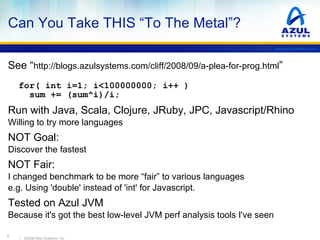
Can You Take THIS “To The Metal”? See “ http://blogs.azulsystems.com/cliff/2008/09/a-plea-for-prog.html ”   for( int i=1; i<100000000; i++ )   sum += (sum^i)/i;
Run with Java, Scala, Clojure, JRuby, JPC, Javascript/Rhino Willing to try more languages NOT Goal: Discover the fastest NOT Fair: I changed benchmark to be more “fair” to various languages
e.g. Using 'double' instead of 'int' for Javascript. Tested on Azul JVM Because it's got the best low-level JVM perf analysis tools I've seen
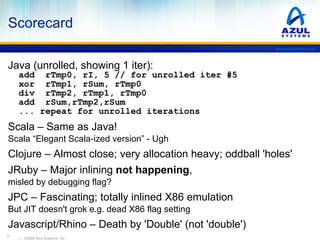
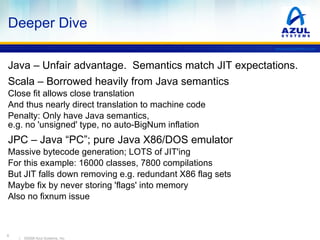
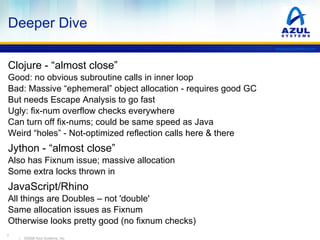
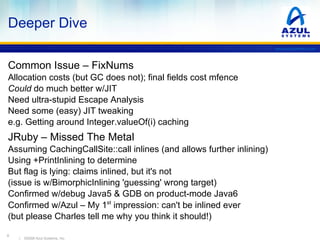
Scorecard Java (unrolled, showing 1 iter):   add  rTmp0, rI, 5 // for unrolled iter #5   xor  rTmp1, rSum, rTmp0   div  rTmp2, rTmp1, rTmp0   add  rSum,rTmp2,rSum   ... repeat for unrolled iterations

2009 Eclipse Con

  • 1.
    A Lock-Free HashTable Fast Bytecodes for Funny Languages Dr. Cliff Click Chief JVM Architect & Distinguished Engineer blogs.azulsystems.com/cliff Azul Systems March 25, 2009
  • 2.
    Fast Bytecodes ForFunny Languages JVMs are used for lots of non-Javac bytecodes
  • 3.
  • 4.
    Bytecode producer (thiscrowd) is curious: Are these bytecodes “fast”? “fast enough”?
  • 5.
  • 6.
    JIT'ing to goodcode? (JIT'ing at all?) Personal goal: you ARE using that fancy JIT, right? Otherwise, why did I bother? ;-) 'nother goal: maybe help the world escape the Java box
  • 7.
    New language musthave a fast reputation Or a large programmer population won't look
  • 8.
    Can Your LanguageGo “To The Metal”? Can your bytecodes go “To The Metal”? e.g. Can simple code be mapped to simple machine ops Methodology: Write dumb hot SIMPLE loop in lots of languages
  • 9.
  • 10.
  • 11.
    Look for mismatchbetween language & JVM & machine code NOT-GOAL: Who is fastest
  • 12.
    NOT TESTED: Easeof programming, time-to-market, maintenance cost
  • 13.
    Domain fit (e.g.Ruby-on-Rails) IGNORING: Blatant language / microbenchmark mismatch (FixNum/BigNum)
  • 14.
    Can You TakeTHIS “To The Metal”? See “ http://blogs.azulsystems.com/cliff/2008/09/a-plea-for-prog.html ” for( int i=1; i<100000000; i++ ) sum += (sum^i)/i;
  • 15.
    Run with Java,Scala, Clojure, JRuby, JPC, Javascript/Rhino Willing to try more languages NOT Goal: Discover the fastest NOT Fair: I changed benchmark to be more “fair” to various languages
  • 16.
    e.g. Using 'double'instead of 'int' for Javascript. Tested on Azul JVM Because it's got the best low-level JVM perf analysis tools I've seen
  • 17.
    Scorecard Java (unrolled,showing 1 iter): add rTmp0, rI, 5 // for unrolled iter #5 xor rTmp1, rSum, rTmp0 div rTmp2, rTmp1, rTmp0 add rSum,rTmp2,rSum ... repeat for unrolled iterations

Editor's Notes

  • #2 In summary, we have discussed the CIO Challenges, the emerging category of BTO and Mercury Interactive’s new BTO solution suite. Let’s discuss how customers get started and see results through BTO. Unlike the mega projects of the last decade, BTO solutions are not monoliths that require tens of millions of dollars, several years of implementation and still present an uncertain outcome. BTO is incremental and immediate – focusing first on improving what the customer has “today”. In 3-6 weeks customers can see improvements in their existing environments.