Introducing


by Mario Fusco
Red Hat – Senior Software Engineer
mario.fusco@gmail.com
twitter: @mariofusco
Drools Vision
Drools was born as a rule engine, but following the vision of
becoming a single platform for business modelling, it realized
it could achieve this goal only by leveraging 3 complementary
business modelling techniques:

• Business Rule Management (Drools Expert)

• Business Process Management (Drools Flow)

• Complex Event Processing (Drools Fusion)
Drools 5 – Business Logic Integration Platform


 Drools   Drools    Drools    Drools Drools
 Expert    Flow     Fusion    Guvnor Planner


          Business Logic integration System
What a rule-based program is
• A rule-based program is made up of discrete rules, each of
  which applies to some subset of the problem
• It is simpler, because you can concentrate on the rules for one
  situation at a time
• It can be more flexible in the face of fragmentary or poorly
  conditioned inputs
• Used for problems involving control, diagnosis, prediction,
  classification, pattern recognition … in short, all problems
  without clear algorithmic solutions

        Declarative                Imperative
         (What to do)
                      Vs. (How to do it)
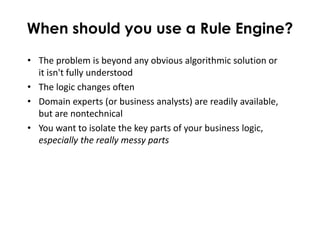
When should you use a Rule Engine?
• The problem is beyond any obvious algorithmic solution or
  it isn't fully understood
• The logic changes often
• Domain experts (or business analysts) are readily available,
  but are nontechnical
• You want to isolate the key parts of your business logic,
  especially the really messy parts
How a rule-based system works
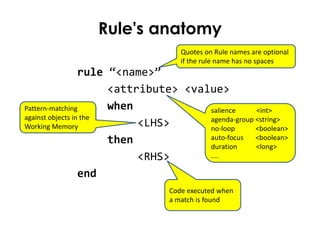
Rule's anatomy
                                    Quotes on Rule names are optional
                                    if the rule name has no spaces.
                  rule “<name>”
                       <attribute> <value>
Pattern-matching       when            salience     <int>
against objects in the                 agenda-group <string>
Working Memory              <LHS>      no-loop      <boolean>
                       then            auto-focus   <boolean>
                                       duration     <long>
                            <RHS>      ....

                  end
                                 Code executed when
                                 a match is found
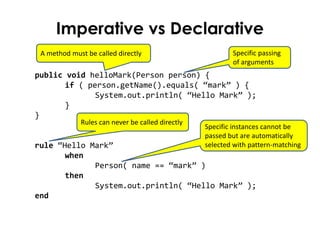
Imperative vs Declarative
 A method must be called directly                         Specific passing
                                                          of arguments
public void helloMark(Person person) {
       if ( person.getName().equals( “mark” ) {
              System.out.println( “Hello Mark” );
       }
}
             Rules can never be called directly
                                                  Specific instances cannot be
                                                  passed but are automatically
rule “Hello Mark”                                 selected with pattern-matching
       when
             Person( name == “mark” )
       then
             System.out.println( “Hello Mark” );
end
What is a pattern

Person( name == “mark” )
              Field Name         Restriction

Object Type            Field Constraint

                    Pattern
Rule's definition
// Java
public class Applicant {          // DRL
    private String name;          declare Applicant
    private int age;
                                      name : String
    private boolean valid;
                                      age : int
    // getter and setter here         valid : boolean
}                                 end


          rule "Is of valid age" when
              $a : Applicant( age >= 18 )
          then
              modify( $a ) { valid = true };
          end
Building
KnowledgeBuilder kbuilder =
        KnowledgeBuilderFactory.newKnowledgeBuilder();
kbuilder.add(
        ResourceFactory.newClassPathResource("Rules.drl"),
        ResourceType.DRL);
KnowledgeBuilderErrors errors = kbuilder.getErrors();
if (kbuilder.hasErrors()) {
    System.err.println(kbuilder.getErrors().toString());
}
KnowledgeBase kbase =
        KnowledgeBaseFactory.newKnowledgeBase();
kbase.addKnowledgePackages(kbuilder.getKnowledgePackages());
Executing
StatelessKnowledgeSession ksession =
       kbase.newStatelessKnowledgeSession();
Applicant applicant = new Applicant( "Mr John Smith", 21 );
assertFalse( applicant.isValid() );
ksession.execute( applicant );
assertTrue( applicant.isValid() );
More Pattern Examples
Person( $age : age )
Person( age == ( $age + 1 ) )


Person(age > 30 && < 40 || hair in (“black”, “brown”) )


Person(pets contain $rover )


Person(pets[’rover’].type == “dog”)
Conditional Elements
not Bus( color = “red” )
exists Bus( color = “red” )
forall ( $bus : Bus( color == “red” ) )


$owner : Person( name == “mark” )
           Pet( name == “rover” ) from $owner.pets

                                    Hibernate session
$zipCode : ZipCode()
Person( ) from $hbn.getNamedQuery(“Find People”)
                     .setParameters( [ “zipCode” : $zipCode ] )
                     .list()
 'from' can work
 on any expression
Timers & Calendars
      rule R1                     When the light is on, and has been
          timer 1m30s                on for 1m30s then turn it off
      when
          $l : Light( status == “on” )
      then
         modify( $l ) { status = “off” };

                                             rule R3
        Execute now and after                     calendars "weekday"
 1 hour duration only during weekday
                                                  timer (int:0 1h)
                                             when
rule R2                                            Alarm()
    timer ( cron: 0 0/15 * * * * ) then
when                                               sendEmail( ”Alert!” )
     Alarm()
then                                  Send alert every
    sendEmail( ”Alert!” )            quarter of an hour
Truth Maintenance System (1)
rule "Issue Adult Bus Pass" when
      $p : Person( age >= 18 )
then
                                         Coupled logic
      insert(new AdultBusPass( $p ) );
end


rule "Issue Child Bus Pass" when
                                          What happens
      $p : Person( age < 18 )             when the child
                                          becomes adult?
then
      insert(new ChildBusPass( $p ) );
end
Truth Maintenance System (2)
rule "Who Is Child" when          De-couples the logic
    $p : Person( age < 18 )
then
    logicalInsert( new IsChild( $p ) )
end
                                                 Encapsulate
                                             knowledge providing
rule "Issue Child Bus Pass" when
                                            semantic abstractions
    $p : Person( )                          for this encapsulation
    IsChild( person =$p )
then
    logicalInsert(new ChildBusPass( $p ) );
end
                                         Maintains the truth by
                                         automatically retracting
Drools Eclipse
   DEMO
Complex Event Processing
Event
  A record of state change in the application domain at a
    particular point in time

Complex Event
  An abstraction of other events called its members

Complex Event Processing
  Processing multiple events with the goal of identifying
    the meaningful events within the event cloud
Drools Fusion
• Drools modules for Complex Event Processing
• Understand and handle events as a first class
  platform citizen (actually special type of Fact)
• Select a set of interesting events in a cloud or
  stream of events
• Detect the relevant relationship (patterns)
  among these events
• Take appropriate actions based on the
  patterns detected
Events as Facts in Time
   Temporal
 relationships
between events

rule
    "Sound the alarm"
when
    $f : FireDetected( )
    not( SprinklerActivated( this after[0s,10s] $f ) )
then
    // sound the alarm
end
Workflows as Business Processes
 A workflow is a process that describes the
 order in which a series of steps need to be
        executed, using a flow chart.
Drools Flow (aka jBPM5)
• Allows to model business processes
• Eclipse-based editor to support workflows
  graphical creation
• Pluggable persistence and transaction based
  on JPA / JTA
• Based on BPMN 2.0 specification
• Can be used with Drools to model your
  business logic as combination of processes,
  events and rules
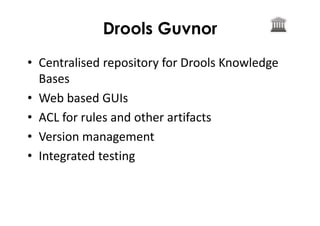
Drools Guvnor
• Centralised repository for Drools Knowledge
  Bases
• Web based GUIs
• ACL for rules and other artifacts
• Version management
• Integrated testing
Drools Planner
• Works on all kinds of planning problems
  – NP-complete
  – Hard & soft constraints
  – Huge search space
• Planning constraints can be weighted and are
  written as declarative score rules
• The planner algorithm is configurable. It searches
  through the solutions within a given amount of
  time and returns the best solution found
Q                                                 A
Mario Fusco                          mario.fusco@gmail.com
Red Hat – Senior Software Engineer     twitter: @mariofusco

Drools Introduction

  • 1.
    Introducing by Mario Fusco RedHat – Senior Software Engineer mario.fusco@gmail.com twitter: @mariofusco
  • 2.
    Drools Vision Drools wasborn as a rule engine, but following the vision of becoming a single platform for business modelling, it realized it could achieve this goal only by leveraging 3 complementary business modelling techniques: • Business Rule Management (Drools Expert) • Business Process Management (Drools Flow) • Complex Event Processing (Drools Fusion)
  • 3.
    Drools 5 –Business Logic Integration Platform Drools Drools Drools Drools Drools Expert Flow Fusion Guvnor Planner Business Logic integration System
  • 4.
    What a rule-basedprogram is • A rule-based program is made up of discrete rules, each of which applies to some subset of the problem • It is simpler, because you can concentrate on the rules for one situation at a time • It can be more flexible in the face of fragmentary or poorly conditioned inputs • Used for problems involving control, diagnosis, prediction, classification, pattern recognition … in short, all problems without clear algorithmic solutions Declarative Imperative (What to do) Vs. (How to do it)
  • 5.
    When should youuse a Rule Engine? • The problem is beyond any obvious algorithmic solution or it isn't fully understood • The logic changes often • Domain experts (or business analysts) are readily available, but are nontechnical • You want to isolate the key parts of your business logic, especially the really messy parts
  • 6.
    How a rule-basedsystem works
  • 7.
    Rule's anatomy Quotes on Rule names are optional if the rule name has no spaces. rule “<name>” <attribute> <value> Pattern-matching when salience <int> against objects in the agenda-group <string> Working Memory <LHS> no-loop <boolean> then auto-focus <boolean> duration <long> <RHS> .... end Code executed when a match is found
  • 8.
    Imperative vs Declarative A method must be called directly Specific passing of arguments public void helloMark(Person person) { if ( person.getName().equals( “mark” ) { System.out.println( “Hello Mark” ); } } Rules can never be called directly Specific instances cannot be passed but are automatically rule “Hello Mark” selected with pattern-matching when Person( name == “mark” ) then System.out.println( “Hello Mark” ); end
  • 9.
    What is apattern Person( name == “mark” ) Field Name Restriction Object Type Field Constraint Pattern
  • 10.
    Rule's definition // Java publicclass Applicant { // DRL private String name; declare Applicant private int age; name : String private boolean valid; age : int // getter and setter here valid : boolean } end rule "Is of valid age" when $a : Applicant( age >= 18 ) then modify( $a ) { valid = true }; end
  • 11.
    Building KnowledgeBuilder kbuilder = KnowledgeBuilderFactory.newKnowledgeBuilder(); kbuilder.add( ResourceFactory.newClassPathResource("Rules.drl"), ResourceType.DRL); KnowledgeBuilderErrors errors = kbuilder.getErrors(); if (kbuilder.hasErrors()) { System.err.println(kbuilder.getErrors().toString()); } KnowledgeBase kbase = KnowledgeBaseFactory.newKnowledgeBase(); kbase.addKnowledgePackages(kbuilder.getKnowledgePackages());
  • 12.
    Executing StatelessKnowledgeSession ksession = kbase.newStatelessKnowledgeSession(); Applicant applicant = new Applicant( "Mr John Smith", 21 ); assertFalse( applicant.isValid() ); ksession.execute( applicant ); assertTrue( applicant.isValid() );
  • 13.
    More Pattern Examples Person($age : age ) Person( age == ( $age + 1 ) ) Person(age > 30 && < 40 || hair in (“black”, “brown”) ) Person(pets contain $rover ) Person(pets[’rover’].type == “dog”)
  • 14.
    Conditional Elements not Bus(color = “red” ) exists Bus( color = “red” ) forall ( $bus : Bus( color == “red” ) ) $owner : Person( name == “mark” ) Pet( name == “rover” ) from $owner.pets Hibernate session $zipCode : ZipCode() Person( ) from $hbn.getNamedQuery(“Find People”) .setParameters( [ “zipCode” : $zipCode ] ) .list() 'from' can work on any expression
  • 15.
    Timers & Calendars rule R1 When the light is on, and has been timer 1m30s on for 1m30s then turn it off when $l : Light( status == “on” ) then modify( $l ) { status = “off” }; rule R3 Execute now and after calendars "weekday" 1 hour duration only during weekday timer (int:0 1h) when rule R2 Alarm() timer ( cron: 0 0/15 * * * * ) then when sendEmail( ”Alert!” ) Alarm() then Send alert every sendEmail( ”Alert!” ) quarter of an hour
  • 16.
    Truth Maintenance System(1) rule "Issue Adult Bus Pass" when $p : Person( age >= 18 ) then Coupled logic insert(new AdultBusPass( $p ) ); end rule "Issue Child Bus Pass" when What happens $p : Person( age < 18 ) when the child becomes adult? then insert(new ChildBusPass( $p ) ); end
  • 17.
    Truth Maintenance System(2) rule "Who Is Child" when De-couples the logic $p : Person( age < 18 ) then logicalInsert( new IsChild( $p ) ) end Encapsulate knowledge providing rule "Issue Child Bus Pass" when semantic abstractions $p : Person( ) for this encapsulation IsChild( person =$p ) then logicalInsert(new ChildBusPass( $p ) ); end Maintains the truth by automatically retracting
  • 18.
  • 19.
    Complex Event Processing Event A record of state change in the application domain at a particular point in time Complex Event An abstraction of other events called its members Complex Event Processing Processing multiple events with the goal of identifying the meaningful events within the event cloud
  • 20.
    Drools Fusion • Droolsmodules for Complex Event Processing • Understand and handle events as a first class platform citizen (actually special type of Fact) • Select a set of interesting events in a cloud or stream of events • Detect the relevant relationship (patterns) among these events • Take appropriate actions based on the patterns detected
  • 21.
    Events as Factsin Time Temporal relationships between events rule "Sound the alarm" when $f : FireDetected( ) not( SprinklerActivated( this after[0s,10s] $f ) ) then // sound the alarm end
  • 22.
    Workflows as BusinessProcesses A workflow is a process that describes the order in which a series of steps need to be executed, using a flow chart.
  • 23.
    Drools Flow (akajBPM5) • Allows to model business processes • Eclipse-based editor to support workflows graphical creation • Pluggable persistence and transaction based on JPA / JTA • Based on BPMN 2.0 specification • Can be used with Drools to model your business logic as combination of processes, events and rules
  • 24.
    Drools Guvnor • Centralisedrepository for Drools Knowledge Bases • Web based GUIs • ACL for rules and other artifacts • Version management • Integrated testing
  • 26.
    Drools Planner • Workson all kinds of planning problems – NP-complete – Hard & soft constraints – Huge search space • Planning constraints can be weighted and are written as declarative score rules • The planner algorithm is configurable. It searches through the solutions within a given amount of time and returns the best solution found
  • 28.
    Q A Mario Fusco mario.fusco@gmail.com Red Hat – Senior Software Engineer twitter: @mariofusco