Anatomy
 Modified Hinge, synovial joint
 Comprised of three articulations
o Two femorotibial articulations
(lateral & medial)
o Femoropatellar articulation (plane,
synovial)
 Joint stability due to –
Surrounding muscles & their
tendons – Ligaments connecting
femur & tibia
 Menisci
 Lateral meniscus
 Medial meniscus
 Bursae:
 Suprapatellar
 Subpopliteal
 Prepatellar
 Subcutaneous
 infrapatellar
 Deep infrapatellar
 Ligaments
 Medial Collateral (MCL)
 Lateral Collateral (LCL)
 Anterior Cruciate (ACL)
 Posterior Cruciate (PCL)
 Meniscofemoral (MFL)
Fast facts on knee injuries
 Highest injury rate in 15-24 years of age.
 Participation in sports and recreational activities are risk factors for
knee injury.
 Stairs, ramps, landings, and floors are most associated with knee
injuries sustained outside of sports.
 A direct blow to the knee is a serious injury and requires immediate
medical attention.
 Knees are most often injured during sports activities, exercising, or as a
result of a fall. Pain and swelling, difficulty with weight bearing, and
instability are the most common symptoms experienced with a knee
injury.
 Fracture
 Meniscus tear
 Sprains and strains
 Overuse
Fracture
 A fracture is most often caused by trauma, such as falls, motor vehicle
accidents, and sports-related contact. The most common bone broken
around the knee is the patella.
 Patellar fractures are most often caused by:
o Falling directly onto the knee
o Receiving a sharp blow to the knee, such as might occur during a head-on vehicle
collision if your kneecap is driven into the dashboard
o The patella can also be fractured indirectly. For example, a sudden contraction of the
quadriceps muscle in the knee can pull apart the patella.
 The most common symptoms of a patellar fracture are pain and
swelling in the front of the knee. Other symptoms may include:
o Bruising
o Inability to straighten the knee or keep it extended in a straight leg raise
o Inability to walk
 Treatment
o Non surgical: apply a cast or splint to keep knee straight and help prevent motion in
leg.
o Surgical
Rehabilitation
 Whether your treatment is surgical or nonsurgical, rehabilitation will
play a vital role in getting you back to your daily activities.
 Because treatment for a patellar fracture can sometimes require
keeping leg immobilized in a cast for a long period of time, so knee may
become stiff and thigh muscles may become weak.
 During rehabilitation, a physical therapist will guide specific exercises
to help:
o Improve range of motion in your knee
o Strengthen your leg muscles
o Decrease stiffness
 Distal Femoral Fracture
o Fracture immediately superior to the femoral condyles can be dangerous and difficult
to treat
o Gastrocnemius draws the bone posteriorly
o The sharp proximal edge of this distal fragment may rupture the popliteal artery
which lies directly posterior to it.
 Treatment
o Surgery
Dislocation
 A dislocation occurs when the bones of the knee are out of place, either
completely or partially. For example, the femur and tibia can be forced
out of alignment, and the patella can also slip out of place.
 Patellar dislocation
o Vastus medialis strain
o Tearing of medial patellar retinaculum
o Hemarthrosis
o Reduces with extension
 Dignosis
o Patellar hypermobility/ apprehension test
 Treatment
o Knee extension
o Aspiration to relieve discomfort and check for fat in blood
o Surgery unnecessary unless osteochondral fracture
o Crutches, RICE
o Rehabilitation focusing on vastus medialis
Meniscus tear
 A meniscal tear generally happens during sports where the knee twists,
pivots, or an individual is tackled.
 Even normal wear from aging can weaken the meniscus, causing it to
tear with a simple awkward turn during normal day to day activities.
 Symptoms of a tear are usually pain, stiffness, swelling, locking, and
decreased range of motion.
Medial meniscus tear
 Tears easier than lateral due to certain traits
 In the younger age group, meniscal tears are more likely to be caused by a
sport activity. The entire inner rim of the medial meniscus can be torn in
what is called a bucket handle tear. These tears usually occur in an area of
good blood supply in the meniscus.
 Squatting
 Internal rotation of tibia with knee flexed
 Examination
o McMurray’s test
o Apley’s compression test
 Treatment
o RICE for isolated and minimal tear
o Partial arthroscopic meniscectomy most common
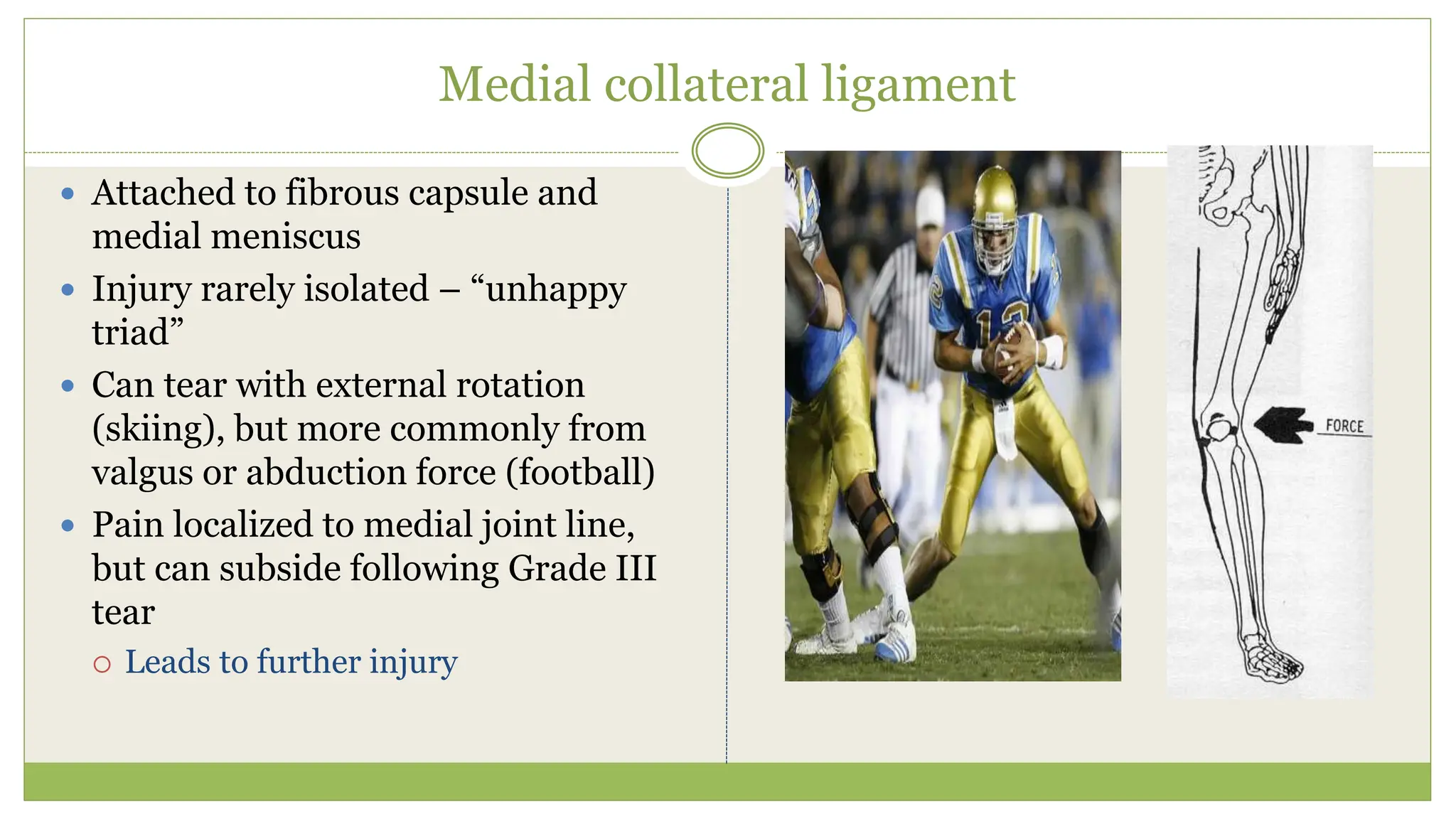
Medial collateral ligament
 Attached to fibrous capsule and
medial meniscus
 Injury rarely isolated – “unhappy
triad”
 Can tear with external rotation
(skiing), but more commonly from
valgus or abduction force (football)
 Pain localized to medial joint line,
but can subside following Grade III
tear
 Leads to further injury
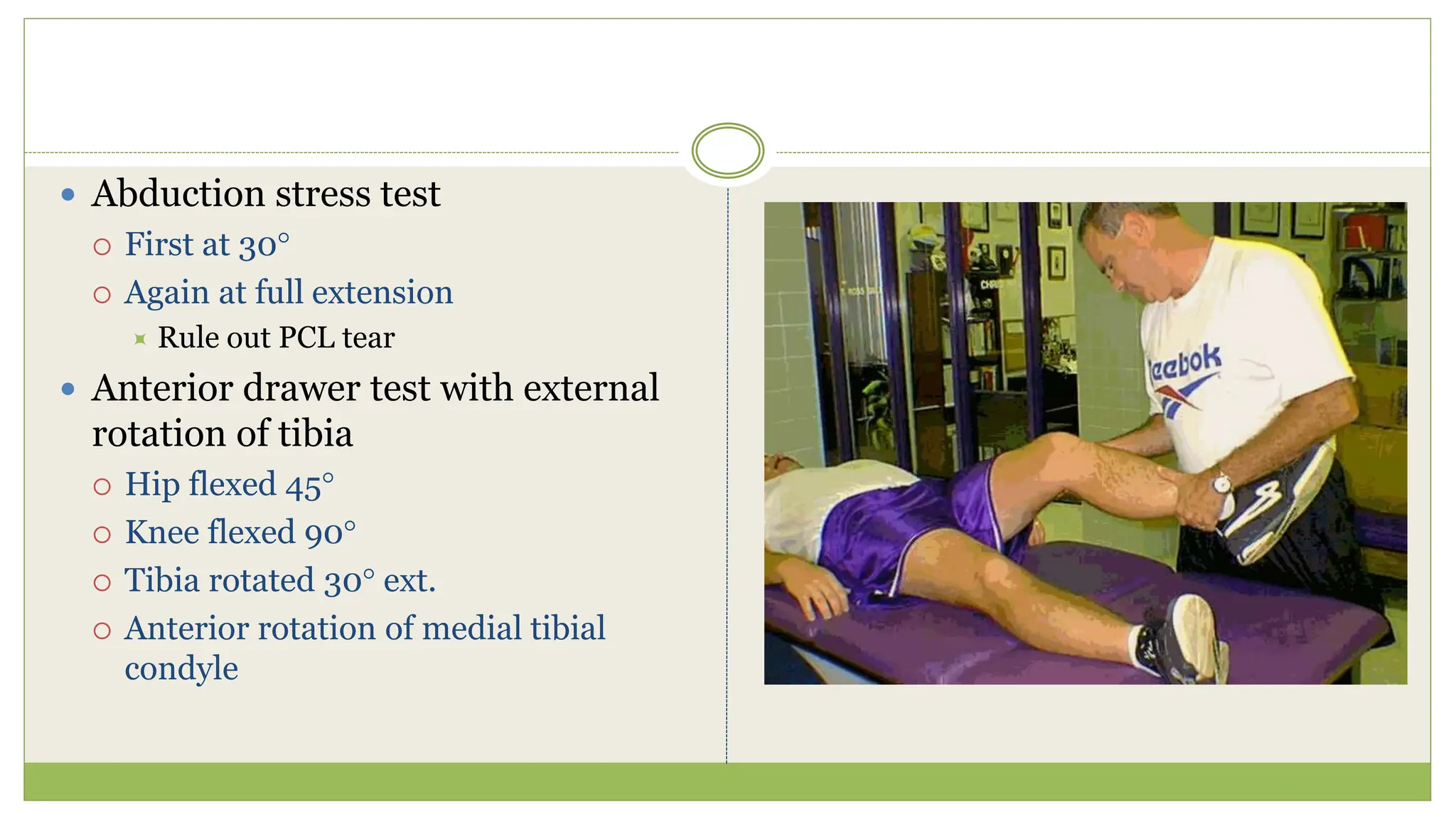
 Abduction stress test
 First at 30
 Again at full extension
 Rule out PCL tear
 Anterior drawer test with external
rotation of tibia
 Hip flexed 45
 Knee flexed 90
 Tibia rotated 30 ext.
 Anterior rotation of medial tibial
condyle
 Crutches + PRICES + rehab for
Grade I, II only if isolated
 Grade III tears may require
surgical repair, but immobilization
can be effective if isolated (rare)
Lateral collateral ligament
 Courses slightly posterior
 Sprained least frequently
 Adduction force rare
 Flexed knee = isolated tear
 Anteromedial blow 
hyperextension/ postero-lateral
corner injury
 Risk to common peroneal nerve
 Foot drop, sensation loss
 Posterolateral drawer test
o Tibia externally rotated, posterior force
applied
 Adduction stress test
o At 30, then full extension
 Treatment
o Similar to MCL
o Grade III usually requires surgery
Anterior cruciate ligament
 The anterior cruciate ligament is
often injured during sports activities.
Athletes who participate in high
demand sports like soccer, football,
and basketball are more likely to
injure their anterior cruciate
ligaments. Changing direction rapidly
or landing from a jump incorrectly
can tear the ACL.
 ACL rupture related to
hyperextension or medial rotation of
the femoral condyles on the tibial
plateau
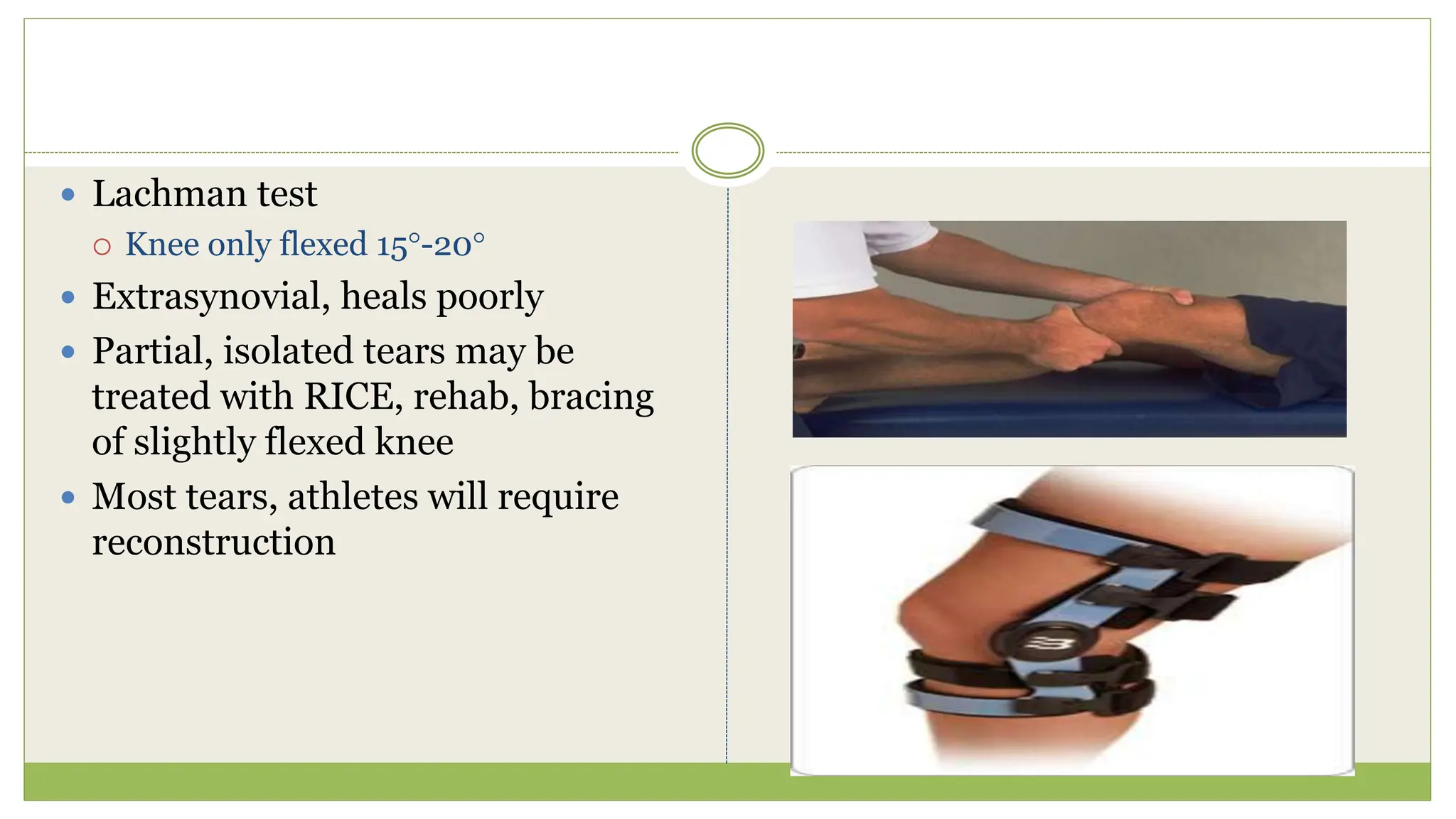
 Lachman test
 Knee only flexed 15-20
 Extrasynovial, heals poorly
 Partial, isolated tears may be
treated with RICE, rehab, bracing
of slightly flexed knee
 Most tears, athletes will require
reconstruction
Posterior cruciate ligament
 The posterior cruciate ligament is
often injured from a blow to the
front of the knee while the knee is
bent. This often occurs in motor
vehicle crashes and sports-related
contact. Posterior cruciate
ligament tears tend to be partial
tears with the potential to heal on
their own.
 Posterior drawer test
 Controversial
 RICES , rehab, bracing for most
isolated tears
 Rehab focused on quadriceps
muscles for compensatory anterior
drawer
 Surgery avoided when possible
because PCL not easy to access
without additional risk factors
 Prognosis good because better
blood supply = revascularization
Unhappy Triad
 An unhappy triad (or terrible triad, "horrible triangle", O'Donoghue's
triad or a "blown knee") is an injury to the anterior cruciate ligament,
medial collateral ligament, and the medial meniscus.
 Unfortunately the unhappy triad is a very common sports injury,
specifically in contact sports like football and even in other sports like
soccer and basketball where the knee can often be hit.
 Treatment: it requires combine treatment of ACL, MCL and medial
meniscus
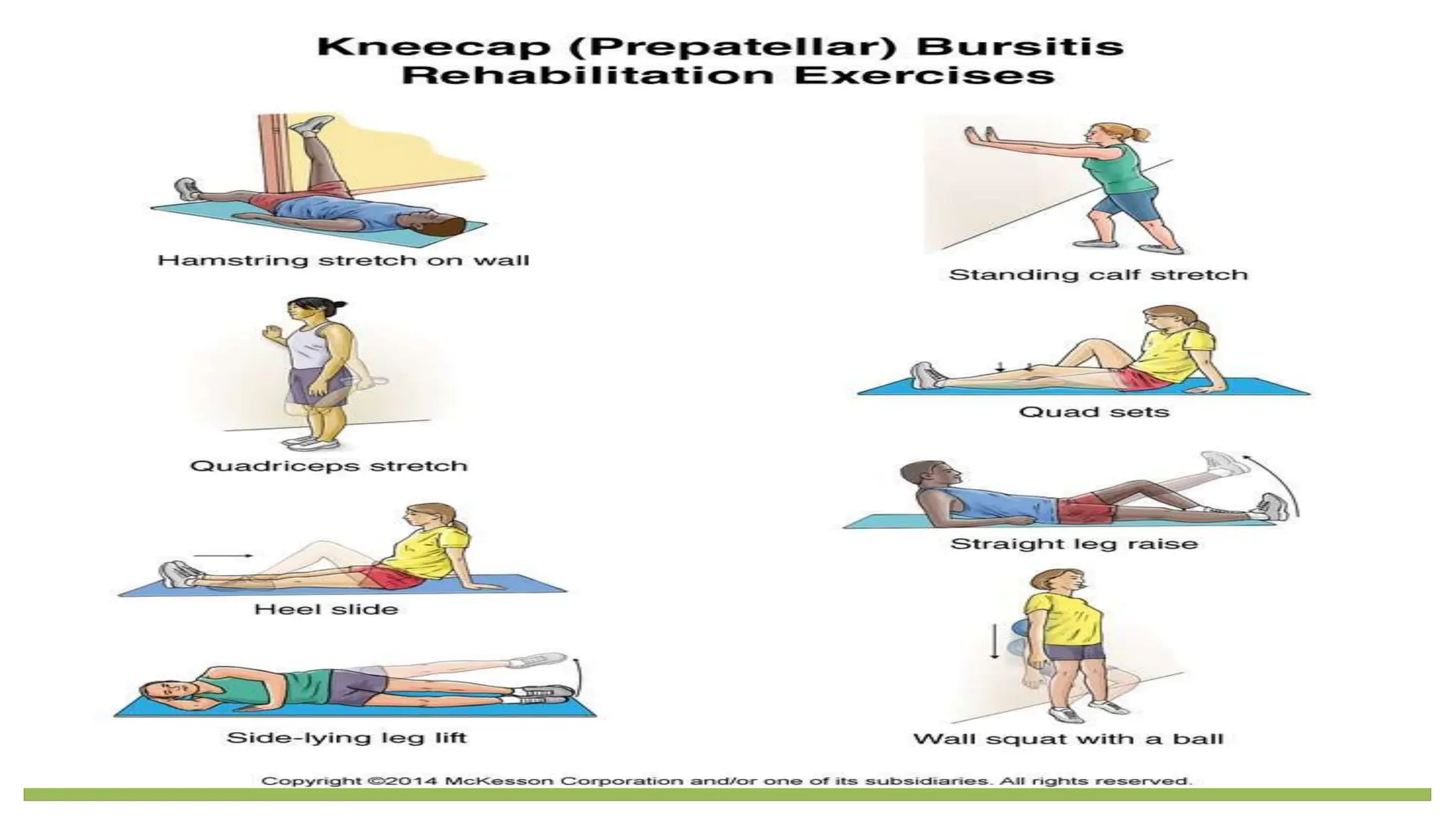
Pre-pateller bursitis
 Housemaid's knee is also known as prepatellar bursitis. It is caused
by inflammation of a small fluid-filled sac (the bursa) in front of the
kneecap. It more commonly occurs in people who spend long periods of
time kneeling.
 A direct blow to the front of knee can also cause prepatellar bursitis.
Athletes who participate in sports in which direct blows or falls on the
knee are common, such as football, wrestling, or basketball, are at
greater risk for the condition.
 Treatment is usually supportive only and the outlook is generally very
good
Infra-pateller bursitis
 Infrapatellar bursitis (clergyman's knee) is the inflammation of
the infrapatellar bursa located just below the kneecap. The
deep bursa is situated between the patellar ligament and the upper
front surface of the tibia.
 Bursitis is diagnosed by medical history and a physical examination of
knee.
 There is localized swelling and tenderness over bursa when pressure is
applied over bursa
 Physiotherapy
o Rice
o Strengthening
o Stretching
o Improve proprioception and balance
o Improve your technique and function eg walking, running, squatting, hopping and
landing
Tendon tear
 The quadriceps and patellar tendons can be stretched and torn.
Although anyone can injure these tendons, tears are more common
among middle-aged people who play running or jumping sports. Falls,
direct force to the front of the knee, and landing awkwardly from a
jump are common causes of knee tendon injuries.
 Quadriceps tendon tears are not common. They most often occur
among middle-aged people who play running or jumping sports.
 A very strong force is required to tear patellar tendon. Causes can be
direct blow to the front of knee or when knee is bent and foot planted
 Non-Surgical
o Immobilization
o Physiotherapy: specific exercises to
restore the range and strength.
 Surgical
Overuse
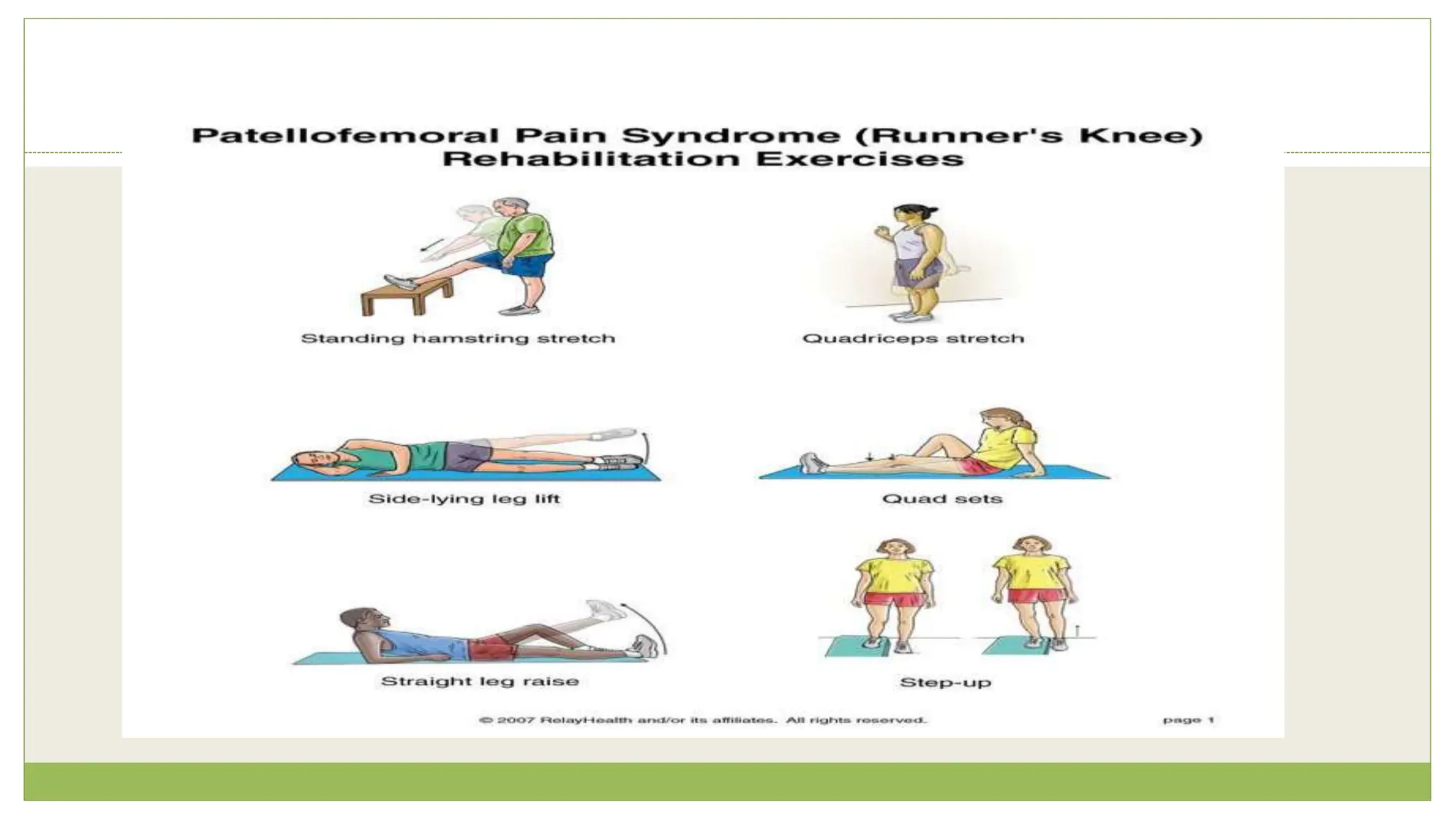
 The most common overuse injury is "runner's knee," a loose term that
refers to several disorders, including patellofemoral pain
syndrome (PFPS). These painful conditions are common among
athletes such as runners and cyclists.
 Pain is experienced behind or around the kneecap, and can travel to the
thigh or shin. The pain worsens with activity and is relieved by rest.
 Jumpers knee or patellar tendonitis is an overuse injury that results
in pain at the front of the knee, localised at a point towards the bottom
of the kneecap. Repetitive strain from too much running or jumping
causes inflammation or degeneration of the patella tendon.
 Runner's knee. : pain in the region of the knee especially when
related to running that may have a simple anatomical basis (as
tightness of a muscle) or may be a symptom of iliotibial band syndrome
or an indication of chondromalacia patellae

Knee Joint Sports Physical Therapy Anatomy of Knee, Common injuries in sports and its Rehabilitation.pptx

Knee Joint Sports Physical Therapy Anatomy of Knee, Common injuries in sports and its Rehabilitation.pptx

  • 2.
    Anatomy  Modified Hinge,synovial joint  Comprised of three articulations o Two femorotibial articulations (lateral & medial) o Femoropatellar articulation (plane, synovial)  Joint stability due to – Surrounding muscles & their tendons – Ligaments connecting femur & tibia
  • 3.
     Menisci  Lateralmeniscus  Medial meniscus  Bursae:  Suprapatellar  Subpopliteal  Prepatellar  Subcutaneous  infrapatellar  Deep infrapatellar  Ligaments  Medial Collateral (MCL)  Lateral Collateral (LCL)  Anterior Cruciate (ACL)  Posterior Cruciate (PCL)  Meniscofemoral (MFL)
  • 4.
    Fast facts onknee injuries  Highest injury rate in 15-24 years of age.  Participation in sports and recreational activities are risk factors for knee injury.  Stairs, ramps, landings, and floors are most associated with knee injuries sustained outside of sports.  A direct blow to the knee is a serious injury and requires immediate medical attention.
  • 5.
     Knees aremost often injured during sports activities, exercising, or as a result of a fall. Pain and swelling, difficulty with weight bearing, and instability are the most common symptoms experienced with a knee injury.  Fracture  Meniscus tear  Sprains and strains  Overuse
  • 6.
    Fracture  A fractureis most often caused by trauma, such as falls, motor vehicle accidents, and sports-related contact. The most common bone broken around the knee is the patella.  Patellar fractures are most often caused by: o Falling directly onto the knee o Receiving a sharp blow to the knee, such as might occur during a head-on vehicle collision if your kneecap is driven into the dashboard o The patella can also be fractured indirectly. For example, a sudden contraction of the quadriceps muscle in the knee can pull apart the patella.
  • 7.
     The mostcommon symptoms of a patellar fracture are pain and swelling in the front of the knee. Other symptoms may include: o Bruising o Inability to straighten the knee or keep it extended in a straight leg raise o Inability to walk  Treatment o Non surgical: apply a cast or splint to keep knee straight and help prevent motion in leg. o Surgical
  • 8.
    Rehabilitation  Whether yourtreatment is surgical or nonsurgical, rehabilitation will play a vital role in getting you back to your daily activities.  Because treatment for a patellar fracture can sometimes require keeping leg immobilized in a cast for a long period of time, so knee may become stiff and thigh muscles may become weak.  During rehabilitation, a physical therapist will guide specific exercises to help: o Improve range of motion in your knee o Strengthen your leg muscles o Decrease stiffness
  • 9.
     Distal FemoralFracture o Fracture immediately superior to the femoral condyles can be dangerous and difficult to treat o Gastrocnemius draws the bone posteriorly o The sharp proximal edge of this distal fragment may rupture the popliteal artery which lies directly posterior to it.  Treatment o Surgery
  • 10.
    Dislocation  A dislocationoccurs when the bones of the knee are out of place, either completely or partially. For example, the femur and tibia can be forced out of alignment, and the patella can also slip out of place.  Patellar dislocation o Vastus medialis strain o Tearing of medial patellar retinaculum o Hemarthrosis o Reduces with extension  Dignosis o Patellar hypermobility/ apprehension test
  • 11.
     Treatment o Kneeextension o Aspiration to relieve discomfort and check for fat in blood o Surgery unnecessary unless osteochondral fracture o Crutches, RICE o Rehabilitation focusing on vastus medialis
  • 12.
    Meniscus tear  Ameniscal tear generally happens during sports where the knee twists, pivots, or an individual is tackled.  Even normal wear from aging can weaken the meniscus, causing it to tear with a simple awkward turn during normal day to day activities.  Symptoms of a tear are usually pain, stiffness, swelling, locking, and decreased range of motion.
  • 13.
    Medial meniscus tear Tears easier than lateral due to certain traits  In the younger age group, meniscal tears are more likely to be caused by a sport activity. The entire inner rim of the medial meniscus can be torn in what is called a bucket handle tear. These tears usually occur in an area of good blood supply in the meniscus.  Squatting  Internal rotation of tibia with knee flexed  Examination o McMurray’s test o Apley’s compression test  Treatment o RICE for isolated and minimal tear o Partial arthroscopic meniscectomy most common
  • 15.
    Medial collateral ligament Attached to fibrous capsule and medial meniscus  Injury rarely isolated – “unhappy triad”  Can tear with external rotation (skiing), but more commonly from valgus or abduction force (football)  Pain localized to medial joint line, but can subside following Grade III tear  Leads to further injury
  • 16.
     Abduction stresstest  First at 30  Again at full extension  Rule out PCL tear  Anterior drawer test with external rotation of tibia  Hip flexed 45  Knee flexed 90  Tibia rotated 30 ext.  Anterior rotation of medial tibial condyle
  • 17.
     Crutches +PRICES + rehab for Grade I, II only if isolated  Grade III tears may require surgical repair, but immobilization can be effective if isolated (rare)
  • 18.
    Lateral collateral ligament Courses slightly posterior  Sprained least frequently  Adduction force rare  Flexed knee = isolated tear  Anteromedial blow  hyperextension/ postero-lateral corner injury  Risk to common peroneal nerve  Foot drop, sensation loss
  • 19.
     Posterolateral drawertest o Tibia externally rotated, posterior force applied  Adduction stress test o At 30, then full extension  Treatment o Similar to MCL o Grade III usually requires surgery
  • 20.
    Anterior cruciate ligament The anterior cruciate ligament is often injured during sports activities. Athletes who participate in high demand sports like soccer, football, and basketball are more likely to injure their anterior cruciate ligaments. Changing direction rapidly or landing from a jump incorrectly can tear the ACL.  ACL rupture related to hyperextension or medial rotation of the femoral condyles on the tibial plateau
  • 21.
     Lachman test Knee only flexed 15-20  Extrasynovial, heals poorly  Partial, isolated tears may be treated with RICE, rehab, bracing of slightly flexed knee  Most tears, athletes will require reconstruction
  • 22.
    Posterior cruciate ligament The posterior cruciate ligament is often injured from a blow to the front of the knee while the knee is bent. This often occurs in motor vehicle crashes and sports-related contact. Posterior cruciate ligament tears tend to be partial tears with the potential to heal on their own.
  • 23.
     Posterior drawertest  Controversial  RICES , rehab, bracing for most isolated tears  Rehab focused on quadriceps muscles for compensatory anterior drawer  Surgery avoided when possible because PCL not easy to access without additional risk factors  Prognosis good because better blood supply = revascularization
  • 24.
    Unhappy Triad  Anunhappy triad (or terrible triad, "horrible triangle", O'Donoghue's triad or a "blown knee") is an injury to the anterior cruciate ligament, medial collateral ligament, and the medial meniscus.  Unfortunately the unhappy triad is a very common sports injury, specifically in contact sports like football and even in other sports like soccer and basketball where the knee can often be hit.  Treatment: it requires combine treatment of ACL, MCL and medial meniscus
  • 25.
    Pre-pateller bursitis  Housemaid'sknee is also known as prepatellar bursitis. It is caused by inflammation of a small fluid-filled sac (the bursa) in front of the kneecap. It more commonly occurs in people who spend long periods of time kneeling.  A direct blow to the front of knee can also cause prepatellar bursitis. Athletes who participate in sports in which direct blows or falls on the knee are common, such as football, wrestling, or basketball, are at greater risk for the condition.  Treatment is usually supportive only and the outlook is generally very good
  • 26.
    Infra-pateller bursitis  Infrapatellarbursitis (clergyman's knee) is the inflammation of the infrapatellar bursa located just below the kneecap. The deep bursa is situated between the patellar ligament and the upper front surface of the tibia.
  • 27.
     Bursitis isdiagnosed by medical history and a physical examination of knee.  There is localized swelling and tenderness over bursa when pressure is applied over bursa  Physiotherapy o Rice o Strengthening o Stretching o Improve proprioception and balance o Improve your technique and function eg walking, running, squatting, hopping and landing
  • 29.
    Tendon tear  Thequadriceps and patellar tendons can be stretched and torn. Although anyone can injure these tendons, tears are more common among middle-aged people who play running or jumping sports. Falls, direct force to the front of the knee, and landing awkwardly from a jump are common causes of knee tendon injuries.  Quadriceps tendon tears are not common. They most often occur among middle-aged people who play running or jumping sports.  A very strong force is required to tear patellar tendon. Causes can be direct blow to the front of knee or when knee is bent and foot planted
  • 30.
     Non-Surgical o Immobilization oPhysiotherapy: specific exercises to restore the range and strength.  Surgical
  • 31.
    Overuse  The mostcommon overuse injury is "runner's knee," a loose term that refers to several disorders, including patellofemoral pain syndrome (PFPS). These painful conditions are common among athletes such as runners and cyclists.  Pain is experienced behind or around the kneecap, and can travel to the thigh or shin. The pain worsens with activity and is relieved by rest.
  • 32.
     Jumpers kneeor patellar tendonitis is an overuse injury that results in pain at the front of the knee, localised at a point towards the bottom of the kneecap. Repetitive strain from too much running or jumping causes inflammation or degeneration of the patella tendon.  Runner's knee. : pain in the region of the knee especially when related to running that may have a simple anatomical basis (as tightness of a muscle) or may be a symptom of iliotibial band syndrome or an indication of chondromalacia patellae 