BASIC ELECTRICAL
ENGINEERING
TOPIC- KCL & KVL
Kirchhoff’s Law
• German Physicist Kirchhoff proposed two
important laws which can be applied to solve
problems electric circuit.
• Kirchhoff's current law (KCL)
• Kirchhoff's voltage law (KVL)
• Kirchhoff's Current Law (KCL)
• Kirchhoff’s current law states that the
algebraic sum of all the current meeting at a
point is equal to zero.
Contd...
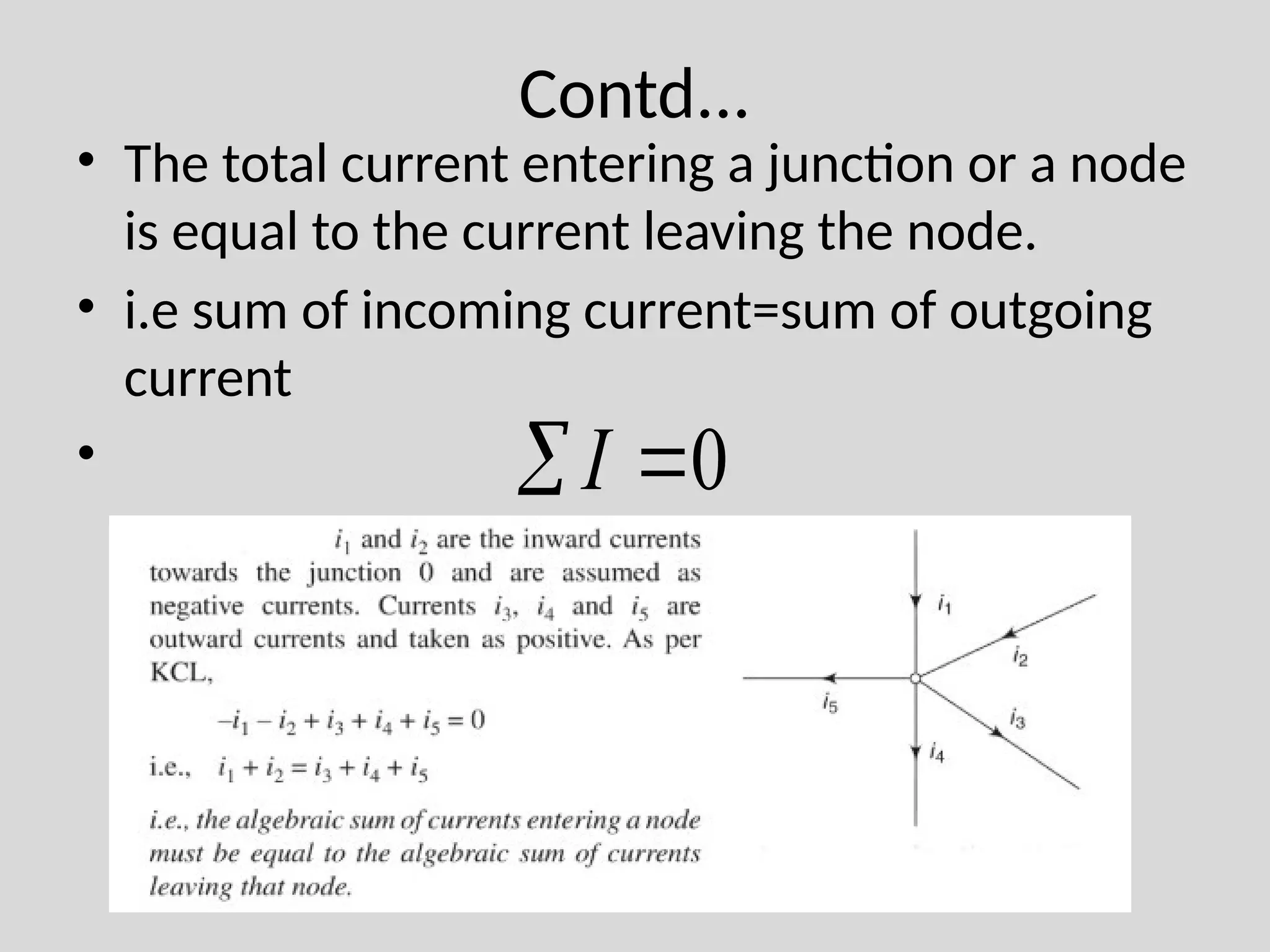
• The total current entering a junction or a node
is equal to the current leaving the node.
• i.e sum of incoming current=sum of outgoing
current
• 0

I
Kirchhoff's Voltage Law (KVL)
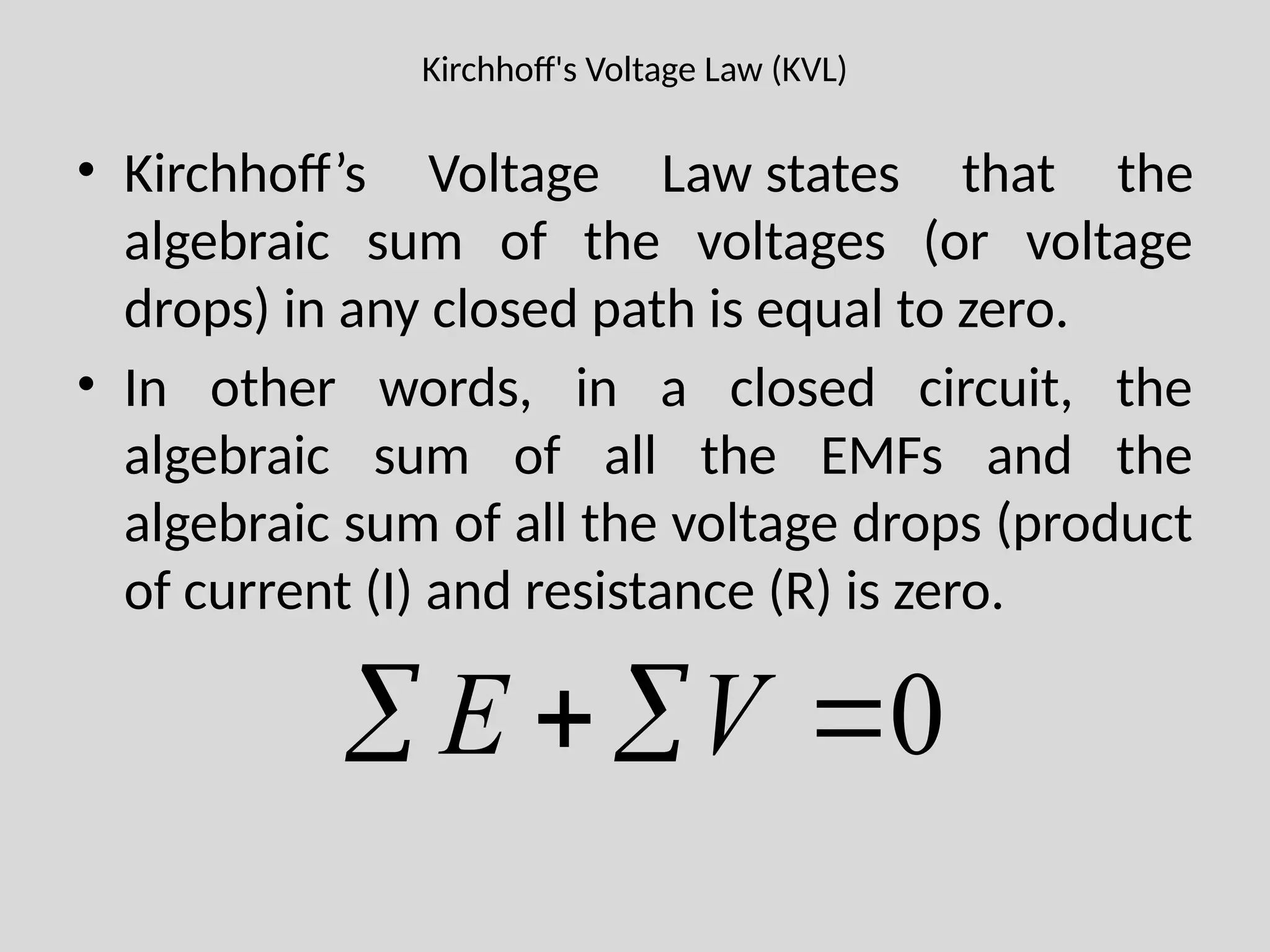
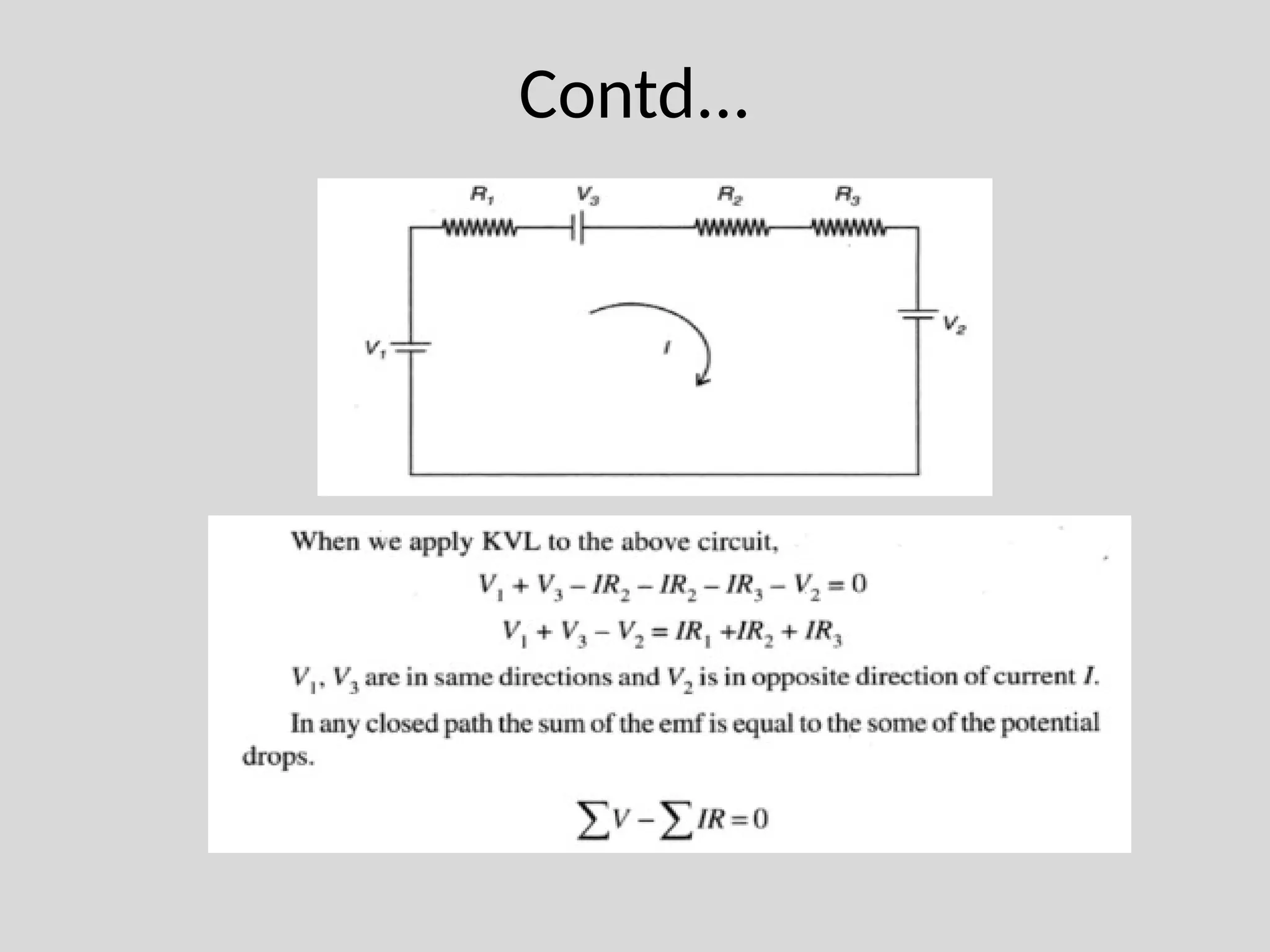
• Kirchhoff’s Voltage Law states that the
algebraic sum of the voltages (or voltage
drops) in any closed path is equal to zero.
• In other words, in a closed circuit, the
algebraic sum of all the EMFs and the
algebraic sum of all the voltage drops (product
of current (I) and resistance (R) is zero.
0



 V
E
Contd...
Contd..
ACTIVE & PASSIVE ELEMENT
• ACTIVE ELEMENTS
• An active element is an electrical component which
supplies energy to a circuit. Active elements have the
ability to electrically control electron flow (i.e. the flow
of charge).
• Common examples of active components include:
Voltage sources, current sources, transistors, generators
• PASSIVE ELEMENTS
• A passive component is an electrical component which
can only receive energy, which it can either dissipate,
absorb or store it in an electric field or a magnetic field.
• Ex- Resistor, inductor and capacitor
Unilateral & Bilateral Elements
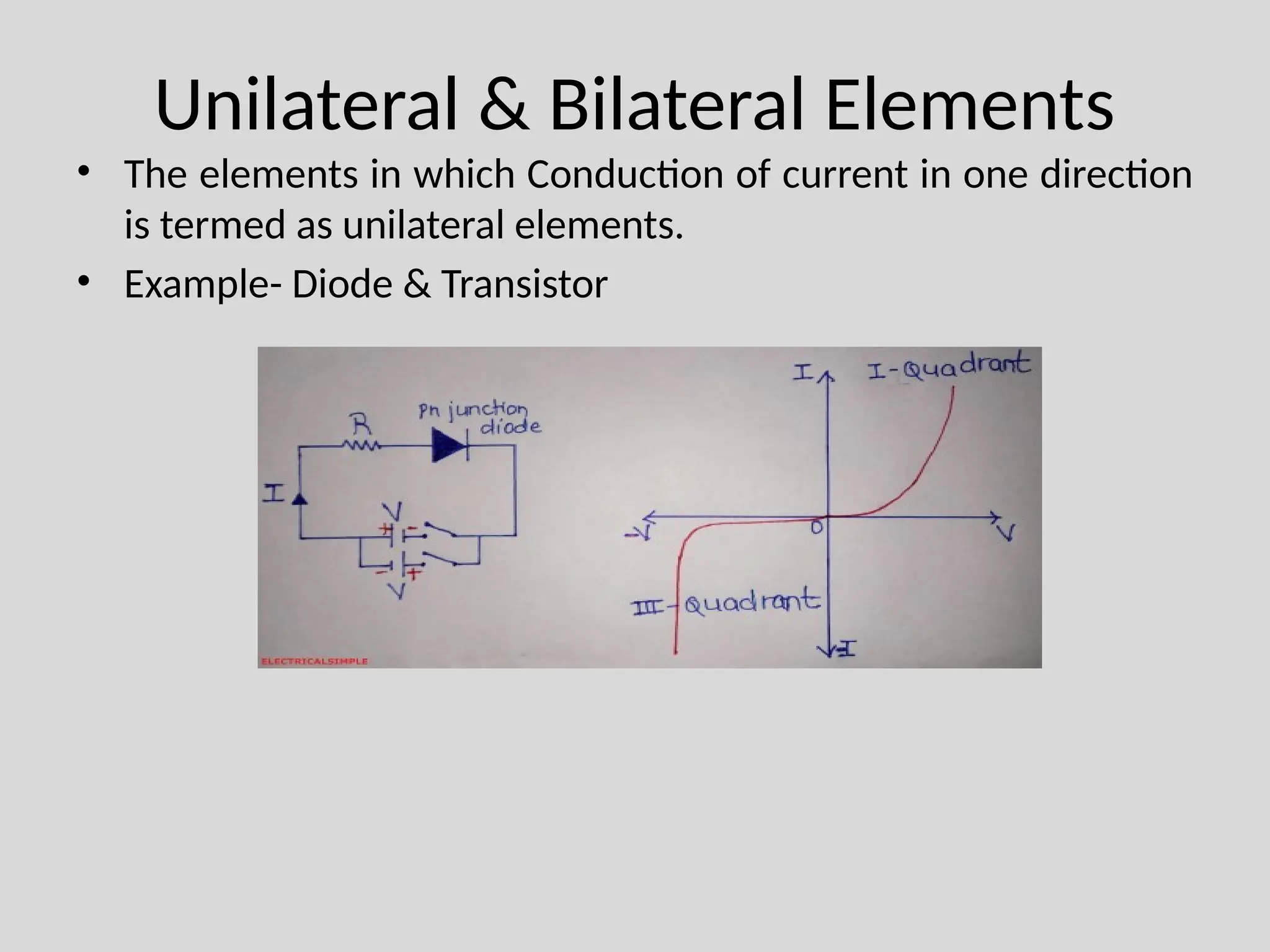
• The elements in which Conduction of current in one direction
is termed as unilateral elements.
• Example- Diode & Transistor
Contd...
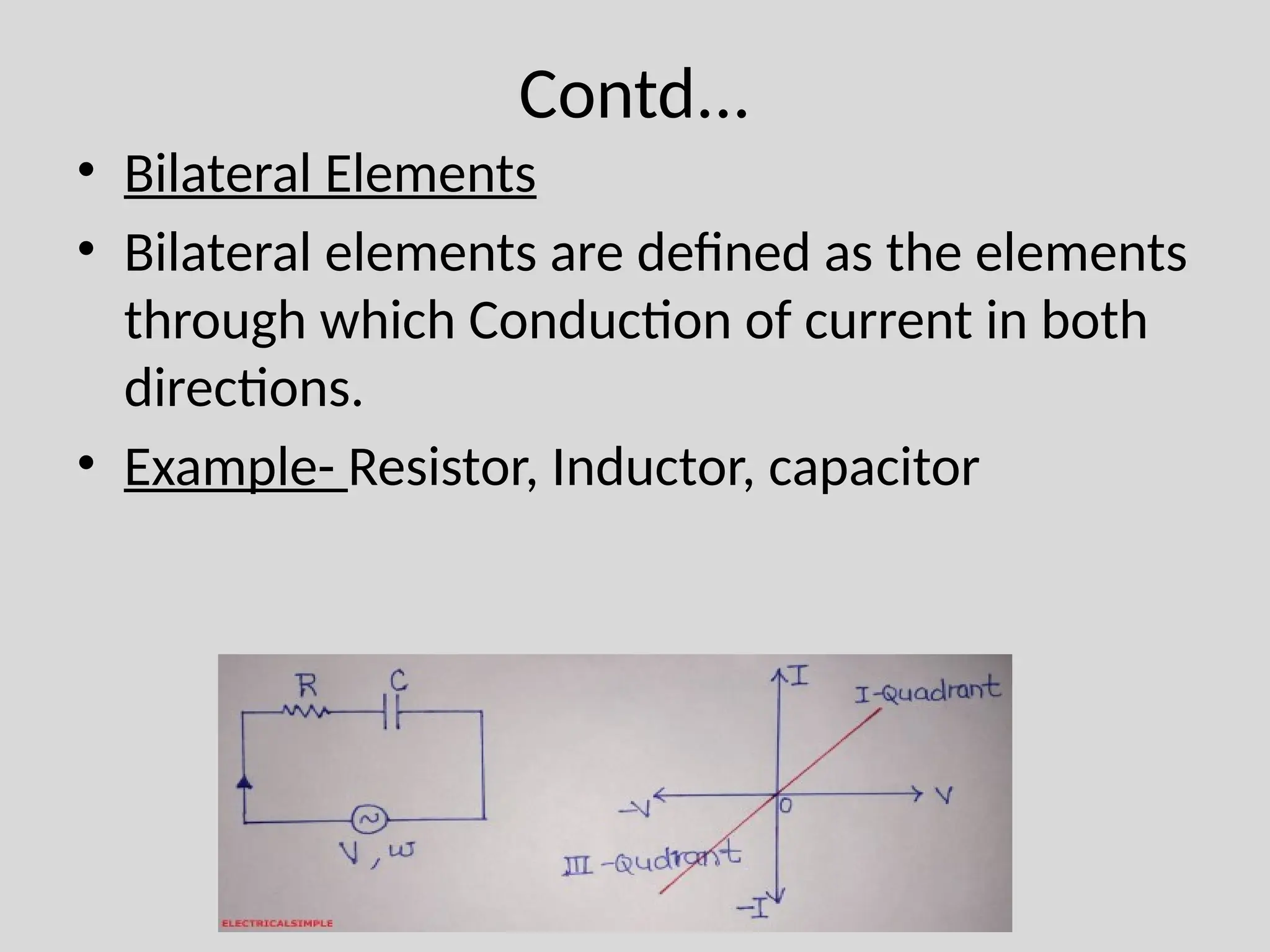
• Bilateral Elements
• Bilateral elements are defined as the elements
through which Conduction of current in both
directions.
• Example- Resistor, Inductor, capacitor
Linear & Nonlinear Elements
• The circuit elements which are always constant
irrespective of change in time, voltage, temperature
etc is known as Linear Elements.
• Ex- Resistor, Inductor & Capacitor
• A nonlinear circuit is an electric circuit whose
parameters are varied with respect to Current and
Voltage.
• In other words, an electric circuit in which circuit
parameters is not constant, is called Non Linear
Circuit.
• Example- Diode, Transistor, Transformer
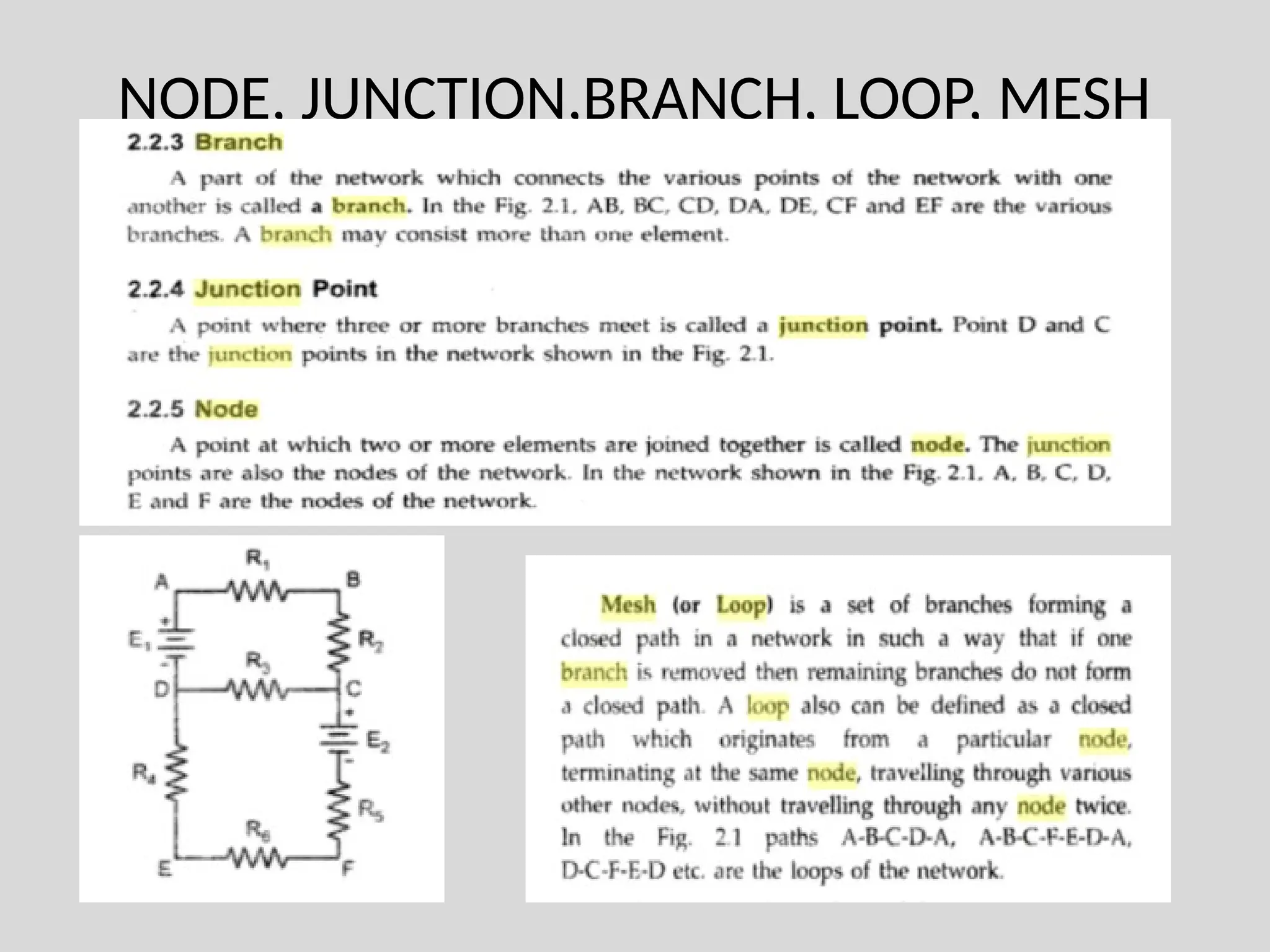
NODE, JUNCTION,BRANCH, LOOP, MESH
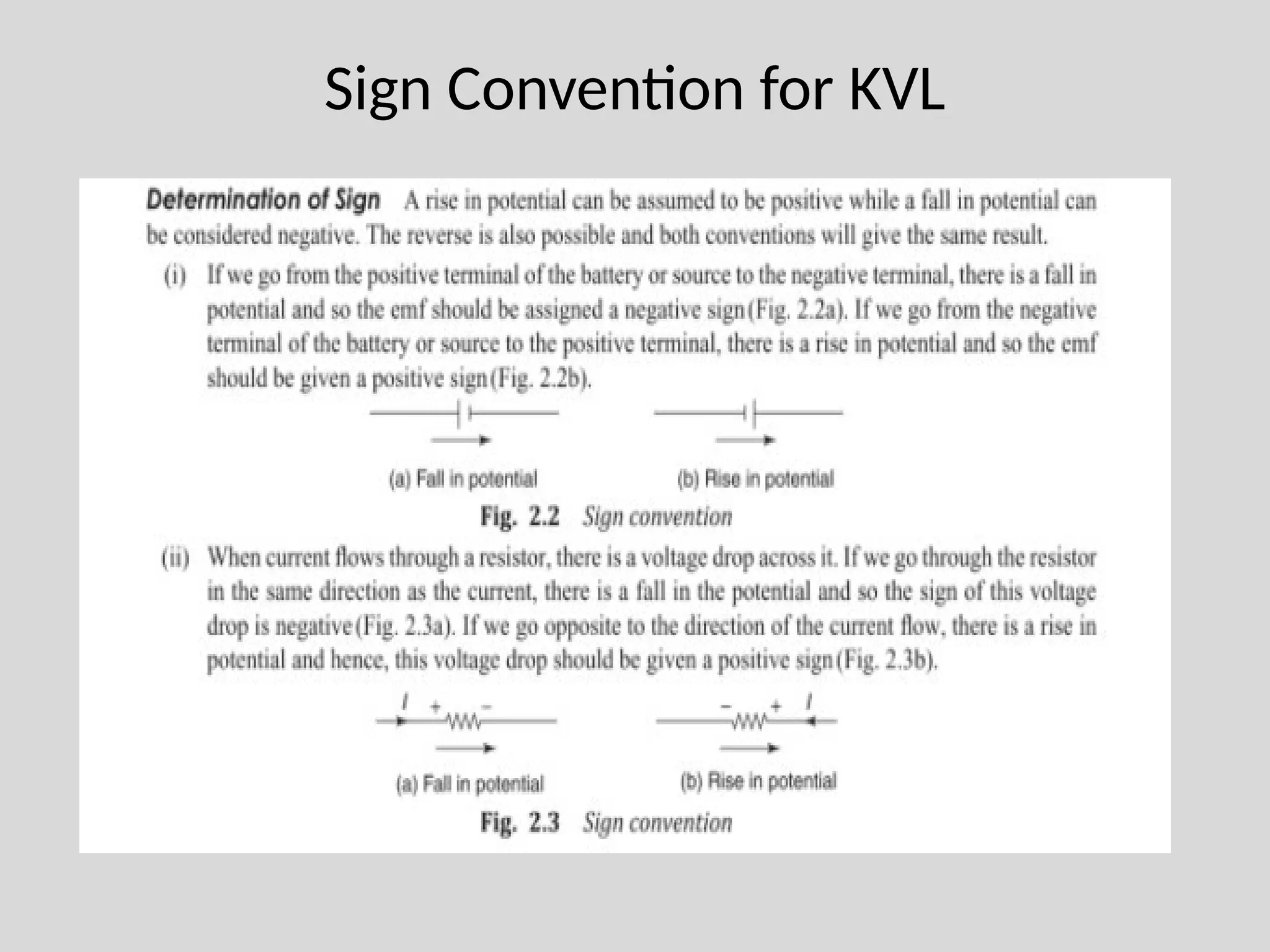
Sign Convention for KVL
Network Vs Circuit
• Network/Circuit
• An electrical network is an interconnection of
active and passive elements such as resistance,
inductance, capacitance and sources.
• An electrical circuit is a network that has a
closed loop, giving a return path for the current.
• A network is a connection of two or more
components and may not necessarily be a
circuit.
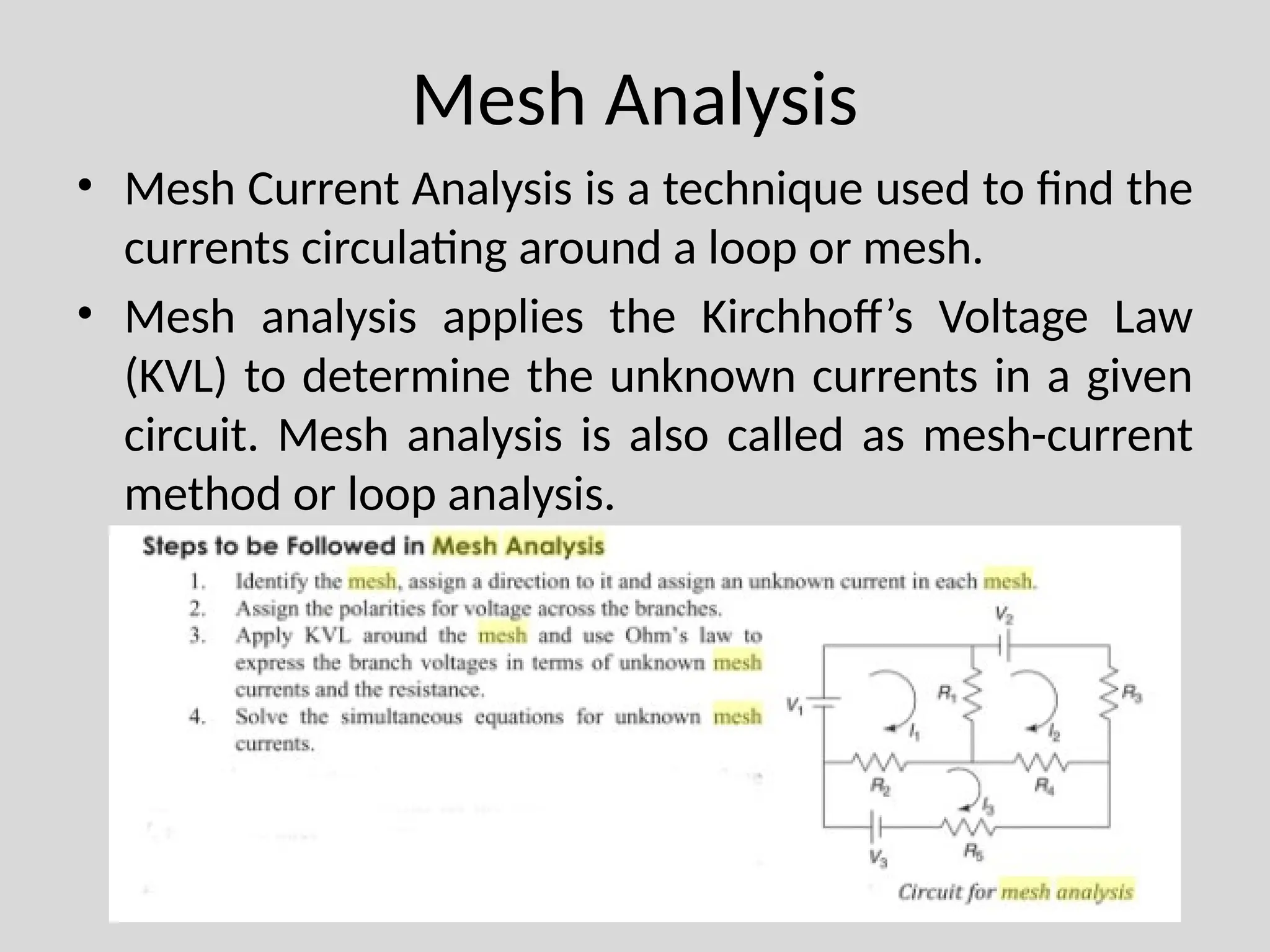
Mesh Analysis
• Mesh Current Analysis is a technique used to find the
currents circulating around a loop or mesh.
• Mesh analysis applies the Kirchhoff’s Voltage Law
(KVL) to determine the unknown currents in a given
circuit. Mesh analysis is also called as mesh-current
method or loop analysis.
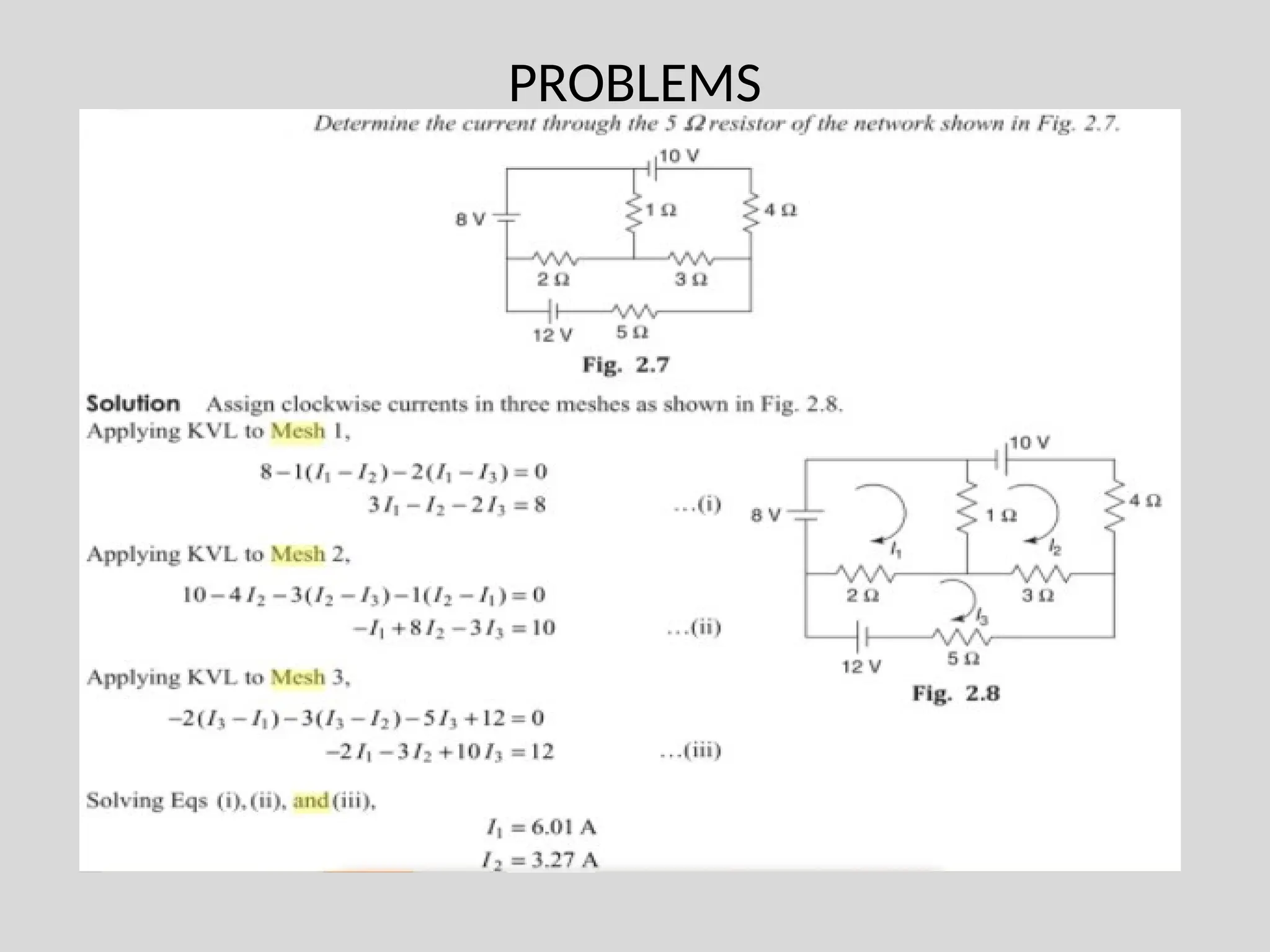
PROBLEMS
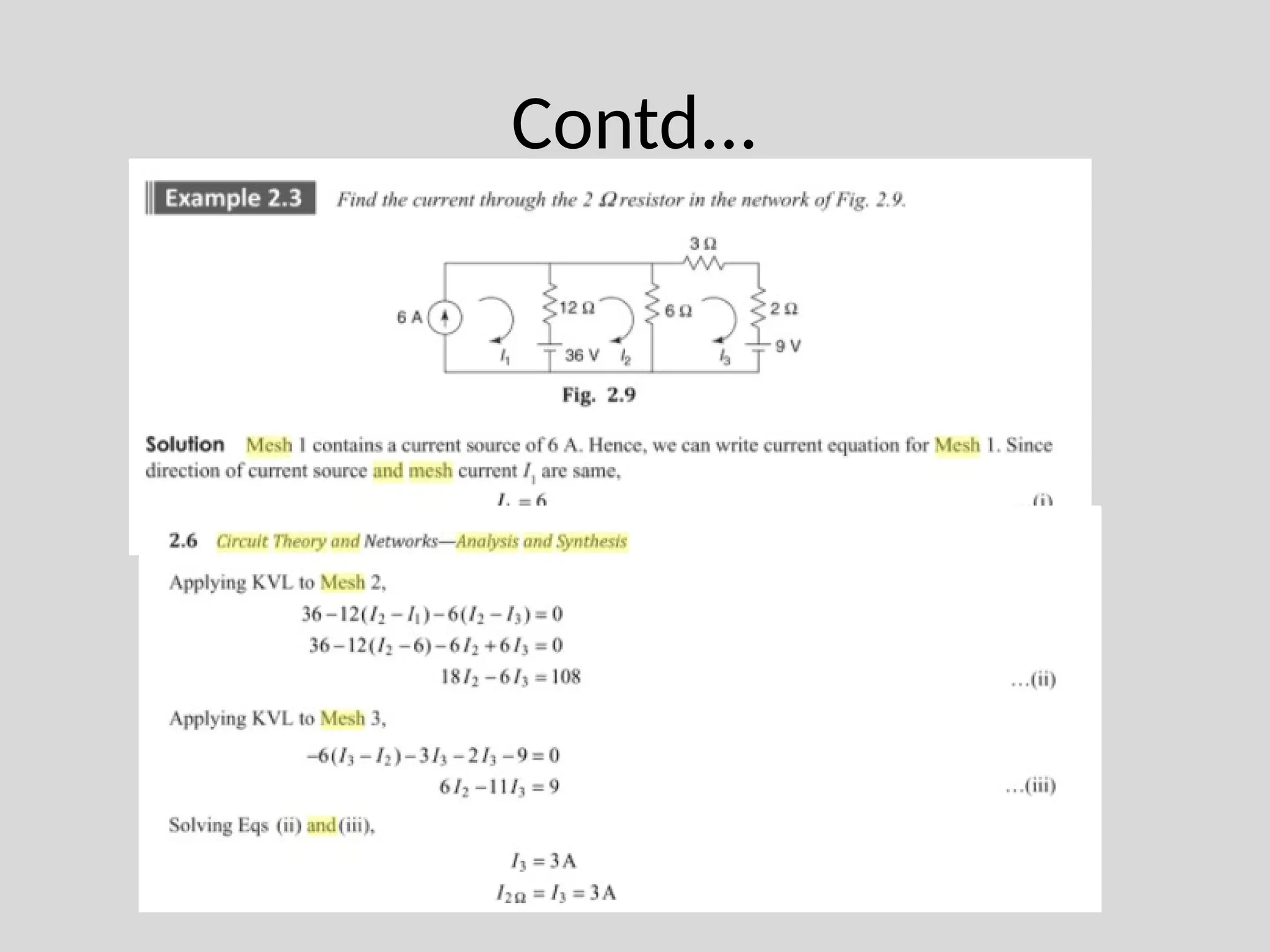
Contd...

DETAILS OF KCL AND KVL FOR BASIC ELECTRICAL

  • 1.
  • 2.
    Kirchhoff’s Law • GermanPhysicist Kirchhoff proposed two important laws which can be applied to solve problems electric circuit. • Kirchhoff's current law (KCL) • Kirchhoff's voltage law (KVL) • Kirchhoff's Current Law (KCL) • Kirchhoff’s current law states that the algebraic sum of all the current meeting at a point is equal to zero.
  • 3.
    Contd... • The totalcurrent entering a junction or a node is equal to the current leaving the node. • i.e sum of incoming current=sum of outgoing current • 0  I
  • 4.
    Kirchhoff's Voltage Law(KVL) • Kirchhoff’s Voltage Law states that the algebraic sum of the voltages (or voltage drops) in any closed path is equal to zero. • In other words, in a closed circuit, the algebraic sum of all the EMFs and the algebraic sum of all the voltage drops (product of current (I) and resistance (R) is zero. 0     V E
  • 5.
  • 6.
  • 7.
    ACTIVE & PASSIVEELEMENT • ACTIVE ELEMENTS • An active element is an electrical component which supplies energy to a circuit. Active elements have the ability to electrically control electron flow (i.e. the flow of charge). • Common examples of active components include: Voltage sources, current sources, transistors, generators • PASSIVE ELEMENTS • A passive component is an electrical component which can only receive energy, which it can either dissipate, absorb or store it in an electric field or a magnetic field. • Ex- Resistor, inductor and capacitor
  • 8.
    Unilateral & BilateralElements • The elements in which Conduction of current in one direction is termed as unilateral elements. • Example- Diode & Transistor
  • 9.
    Contd... • Bilateral Elements •Bilateral elements are defined as the elements through which Conduction of current in both directions. • Example- Resistor, Inductor, capacitor
  • 10.
    Linear & NonlinearElements • The circuit elements which are always constant irrespective of change in time, voltage, temperature etc is known as Linear Elements. • Ex- Resistor, Inductor & Capacitor • A nonlinear circuit is an electric circuit whose parameters are varied with respect to Current and Voltage. • In other words, an electric circuit in which circuit parameters is not constant, is called Non Linear Circuit. • Example- Diode, Transistor, Transformer
  • 11.
  • 12.
  • 13.
    Network Vs Circuit •Network/Circuit • An electrical network is an interconnection of active and passive elements such as resistance, inductance, capacitance and sources. • An electrical circuit is a network that has a closed loop, giving a return path for the current. • A network is a connection of two or more components and may not necessarily be a circuit.
  • 14.
    Mesh Analysis • MeshCurrent Analysis is a technique used to find the currents circulating around a loop or mesh. • Mesh analysis applies the Kirchhoff’s Voltage Law (KVL) to determine the unknown currents in a given circuit. Mesh analysis is also called as mesh-current method or loop analysis.
  • 15.
  • 16.