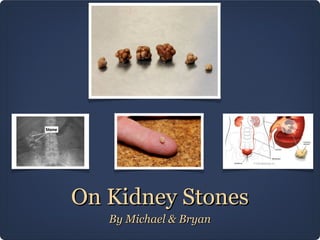
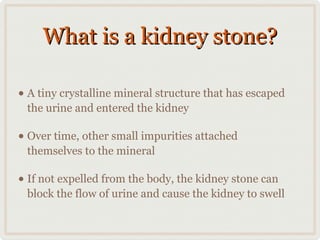
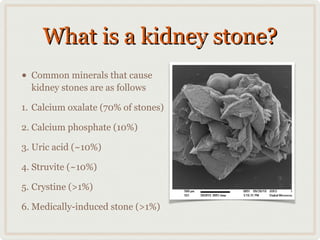
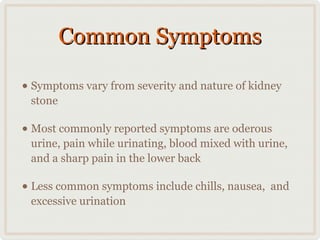
On Kidney Stones
By Michael & Bryan
What is a kidney stone?
• A tiny crystalline mineral structure that has escaped
the urine and entered the kidney

• Over time, other small impurities attached
themselves to the mineral

• If not expelled from the body, the kidney stone can

block the flow of urine and cause the kidney to swell
What is a kidney stone?
•

Common minerals that cause
kidney stones are as follows

1. Calcium oxalate (70% of stones)
2. Calcium phosphate (10%)
3. Uric acid (~10%)
4. Struvite (~10%)
5. Crystine (>1%)
6. Medically-induced stone (>1%)
Common Symptoms
• Symptoms vary from severity and nature of kidney
stone

• Most commonly reported symptoms are oderous

urine, pain while urinating, blood mixed with urine,
and a sharp pain in the lower back

• Less common symptoms include chills, nausea,
excessive urination

and
Common many reasons, the
Causes
• Kidney stones can form for
foremost being:

A. An imbalanced diet
B. Lack of proper hydration
C. Improper metabolism
D. An infection in the urinary tract
E. An over-active parathyroid gland (hyperparathyroidism)
It is also common for a kidney stone to form without any direct
cause, although diet & hydration always factor into their
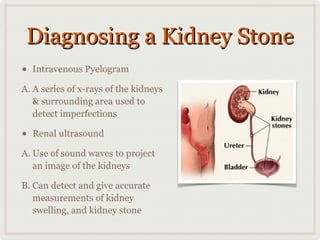
Diagnosing a Kidney Stone
•

Intravenous Pyelogram

A. A series of x-rays of the kidneys
& surrounding area used to
detect imperfections

•

Renal ultrasound

A. Use of sound waves to project
an image of the kidneys
B. Can detect and give accurate
measurements of kidney
swelling, and kidney stone
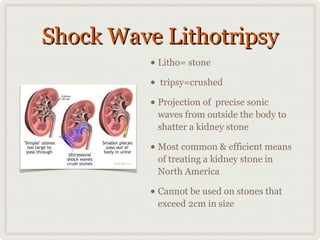
Shock Wave Lithotripsy
• Litho= stone
• tripsy=crushed
• Projection of precise sonic

waves from outside the body to
shatter a kidney stone

• Most common & efficient means
of treating a kidney stone in
North America

• Cannot be used on stones that
exceed 2cm in size
Facts & Statistics
• Roughly 10% of all Canadians will have a kidney
stone at some point in their life

• Typical age demographic ranges from 20-50 years old
• Men are three times more susceptible to forming a
kidney stone than women

• Form at a faster rate in dry climates
Facts & Statistics
• Women are becoming more likely to develop kidney
stones

• Once an individual has a kidney stone, they are more
likely to have another

• Drinks like coffee,tea, & cola help contribute to the
formation of kidney stones

• One can pass a kidney stone without knowledge of
one even forming
Bibliography
"Featured Story." The National Kidney Foundation: A to Z Health Guide. N.p., n.d.
Web.
29
Nov.
2013.
<http://www.kidney.org/atoz/content/kidneystones_ShockWave.cfm>

.

"Kidney Stones." Kidney Stones. N.p., n.d. Web. 29 Nov. 2013.
<http://medicalcenter.osu.edu/patientcare/healthcare_services/urinary_bladder_
kidney/urogenital_disorders/overview_urogenital_disorders/kidney_stones/Pages
/index.aspx>.
"Kidney Stones." - The Kidney Foundation of Canada. N.p., n.d. Web. 29 Nov. 2013.
<http://www.kidney.ca/page.aspx?pid=328>.
"Urology."
UW
Health.
29
Nov.
N.p.,
n.d.
Web.
<http://www.uwhealth.org/urology/types-of-kidney-stones/11206>.

2013.

Kidney Stones." - Causes, Symptoms, Treatment, Diagnosis. N.p., n.d. Web. 29 Nov.
2013.
<http://chealth.canoe.ca/channel_condition_info_details.asp?
disease_id=173&channel_id=2035&relation_id=20729>.

Kidneystonesmichelbeyan4

  • 1.
    On Kidney Stones ByMichael & Bryan
  • 2.
    What is akidney stone? • A tiny crystalline mineral structure that has escaped the urine and entered the kidney • Over time, other small impurities attached themselves to the mineral • If not expelled from the body, the kidney stone can block the flow of urine and cause the kidney to swell
  • 3.
    What is akidney stone? • Common minerals that cause kidney stones are as follows 1. Calcium oxalate (70% of stones) 2. Calcium phosphate (10%) 3. Uric acid (~10%) 4. Struvite (~10%) 5. Crystine (>1%) 6. Medically-induced stone (>1%)
  • 4.
    Common Symptoms • Symptomsvary from severity and nature of kidney stone • Most commonly reported symptoms are oderous urine, pain while urinating, blood mixed with urine, and a sharp pain in the lower back • Less common symptoms include chills, nausea, excessive urination and
  • 5.
    Common many reasons,the Causes • Kidney stones can form for foremost being: A. An imbalanced diet B. Lack of proper hydration C. Improper metabolism D. An infection in the urinary tract E. An over-active parathyroid gland (hyperparathyroidism) It is also common for a kidney stone to form without any direct cause, although diet & hydration always factor into their
  • 6.
    Diagnosing a KidneyStone • Intravenous Pyelogram A. A series of x-rays of the kidneys & surrounding area used to detect imperfections • Renal ultrasound A. Use of sound waves to project an image of the kidneys B. Can detect and give accurate measurements of kidney swelling, and kidney stone
  • 7.
    Shock Wave Lithotripsy •Litho= stone • tripsy=crushed • Projection of precise sonic waves from outside the body to shatter a kidney stone • Most common & efficient means of treating a kidney stone in North America • Cannot be used on stones that exceed 2cm in size
  • 8.
    Facts & Statistics •Roughly 10% of all Canadians will have a kidney stone at some point in their life • Typical age demographic ranges from 20-50 years old • Men are three times more susceptible to forming a kidney stone than women • Form at a faster rate in dry climates
  • 9.
    Facts & Statistics •Women are becoming more likely to develop kidney stones • Once an individual has a kidney stone, they are more likely to have another • Drinks like coffee,tea, & cola help contribute to the formation of kidney stones • One can pass a kidney stone without knowledge of one even forming
  • 10.
    Bibliography "Featured Story." TheNational Kidney Foundation: A to Z Health Guide. N.p., n.d. Web. 29 Nov. 2013. <http://www.kidney.org/atoz/content/kidneystones_ShockWave.cfm> . "Kidney Stones." Kidney Stones. N.p., n.d. Web. 29 Nov. 2013. <http://medicalcenter.osu.edu/patientcare/healthcare_services/urinary_bladder_ kidney/urogenital_disorders/overview_urogenital_disorders/kidney_stones/Pages /index.aspx>. "Kidney Stones." - The Kidney Foundation of Canada. N.p., n.d. Web. 29 Nov. 2013. <http://www.kidney.ca/page.aspx?pid=328>. "Urology." UW Health. 29 Nov. N.p., n.d. Web. <http://www.uwhealth.org/urology/types-of-kidney-stones/11206>. 2013. Kidney Stones." - Causes, Symptoms, Treatment, Diagnosis. N.p., n.d. Web. 29 Nov. 2013. <http://chealth.canoe.ca/channel_condition_info_details.asp? disease_id=173&channel_id=2035&relation_id=20729>.