The Size and Nature of
                 Informal Entrepreneurship
                             and
                      How to Tackle it?

M Shehryar Shahid, PhD
Director, Centre for Entrepreneurship and SMEs (CESME)
University of Central Punjab
Presentation Track

•   Definition & Research Questions
•   What we did?
•   How we did it?
•   What will we do?
•   When will we do it?
•   What we found out?
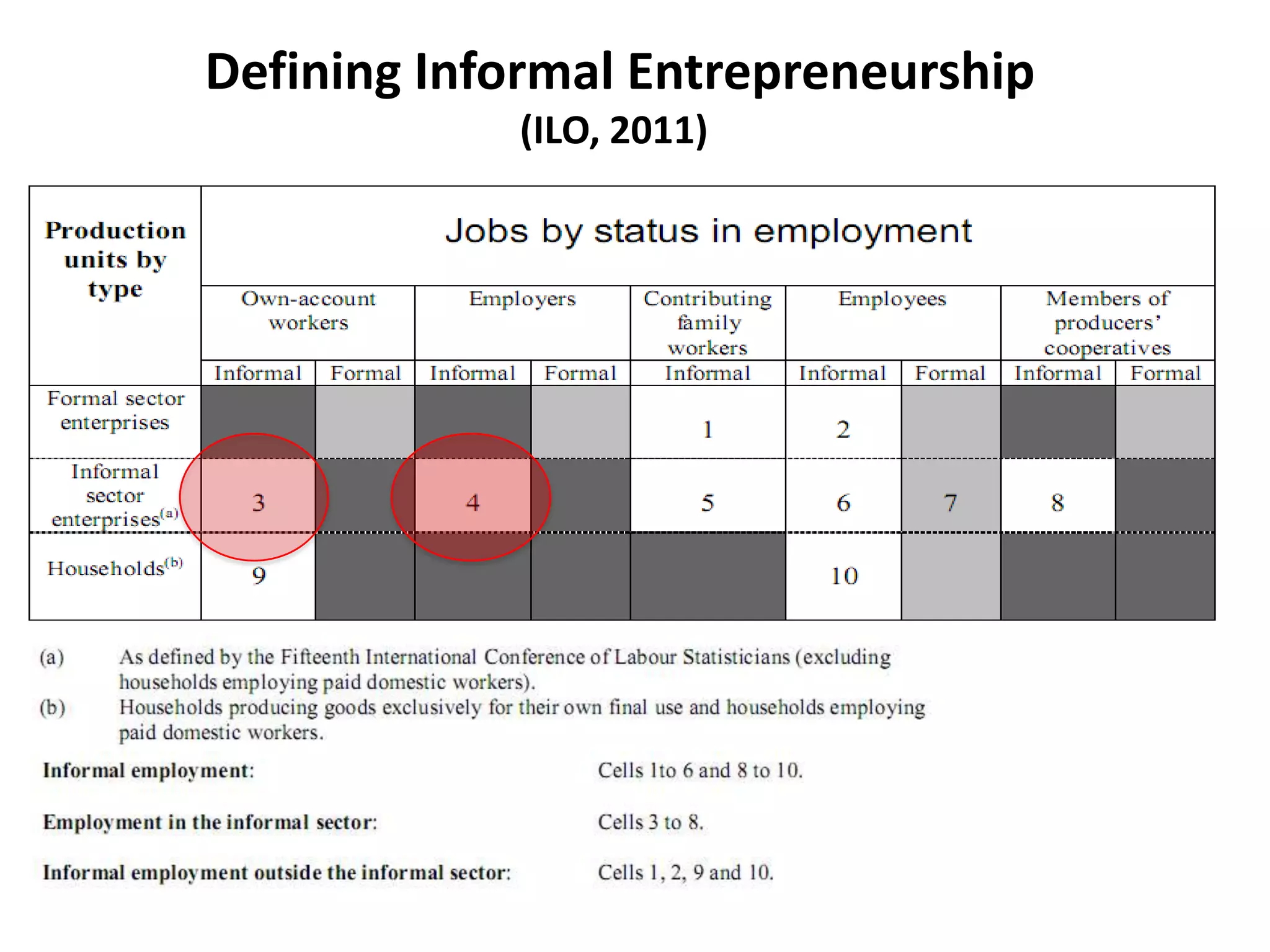
Defining Informal Entrepreneurship
            (ILO, 2011)
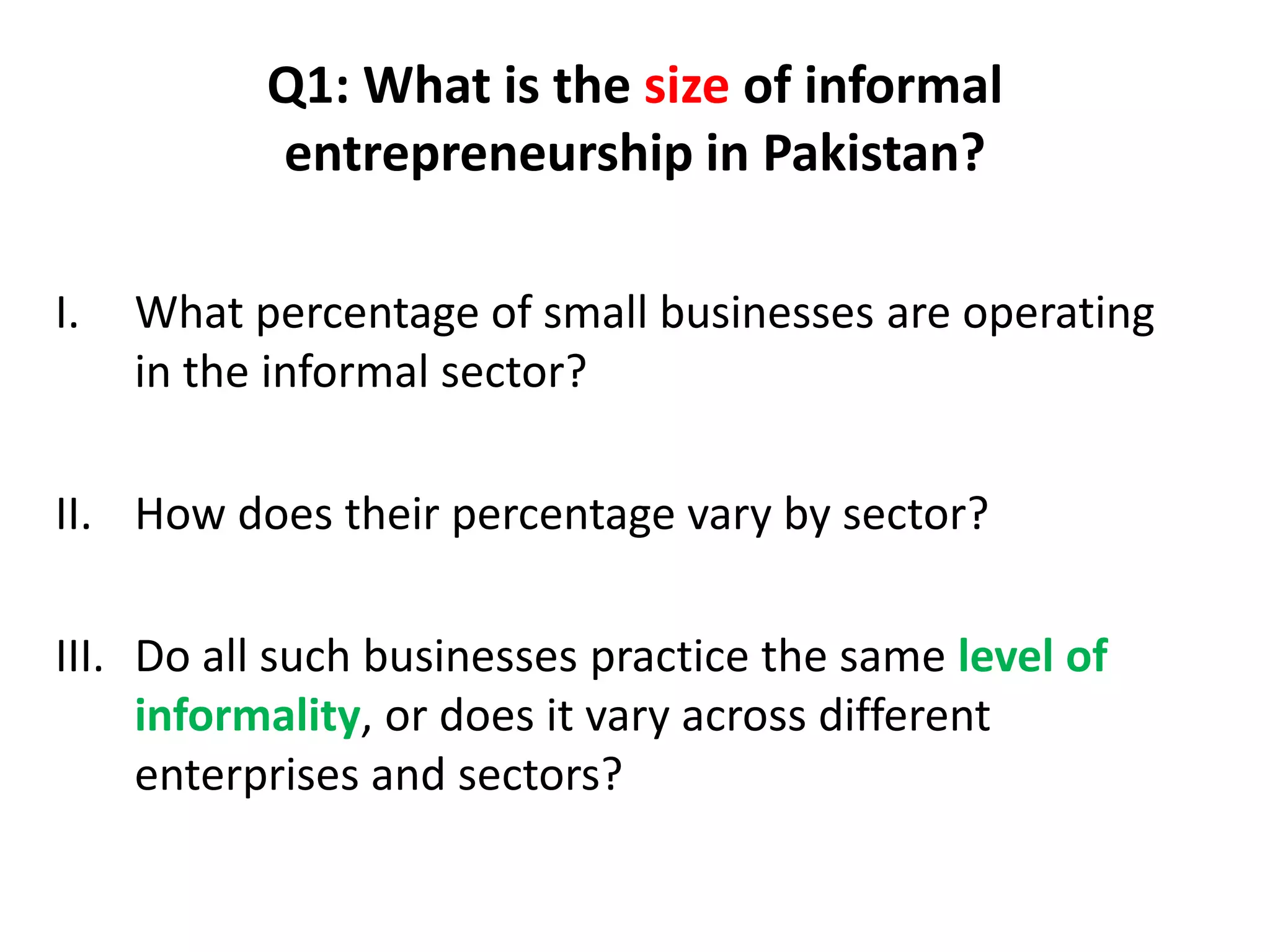
Q1: What is the size of informal
           entrepreneurship in Pakistan?

I.   What percentage of small businesses are operating
     in the informal sector?

II. How does their percentage vary by sector?

III. Do all such businesses practice the same level of
     informality, or does it vary across different
     enterprises and sectors?
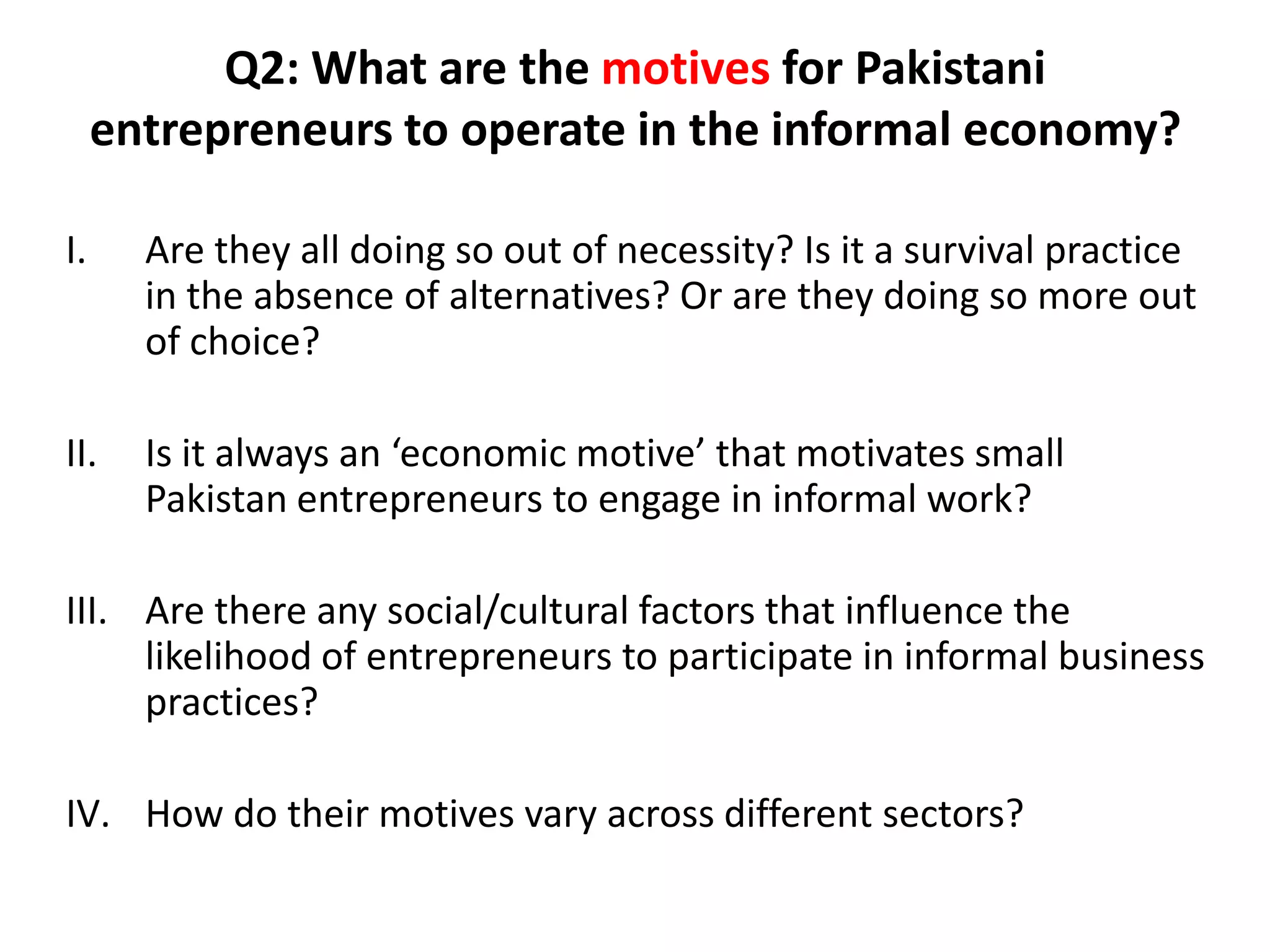
Q2: What are the motives for Pakistani
     entrepreneurs to operate in the informal economy?

I.     Are they all doing so out of necessity? Is it a survival practice
       in the absence of alternatives? Or are they doing so more out
       of choice?

II.    Is it always an ‘economic motive’ that motivates small
       Pakistan entrepreneurs to engage in informal work?

III. Are there any social/cultural factors that influence the
     likelihood of entrepreneurs to participate in informal business
     practices?

IV. How do their motives vary across different sectors?
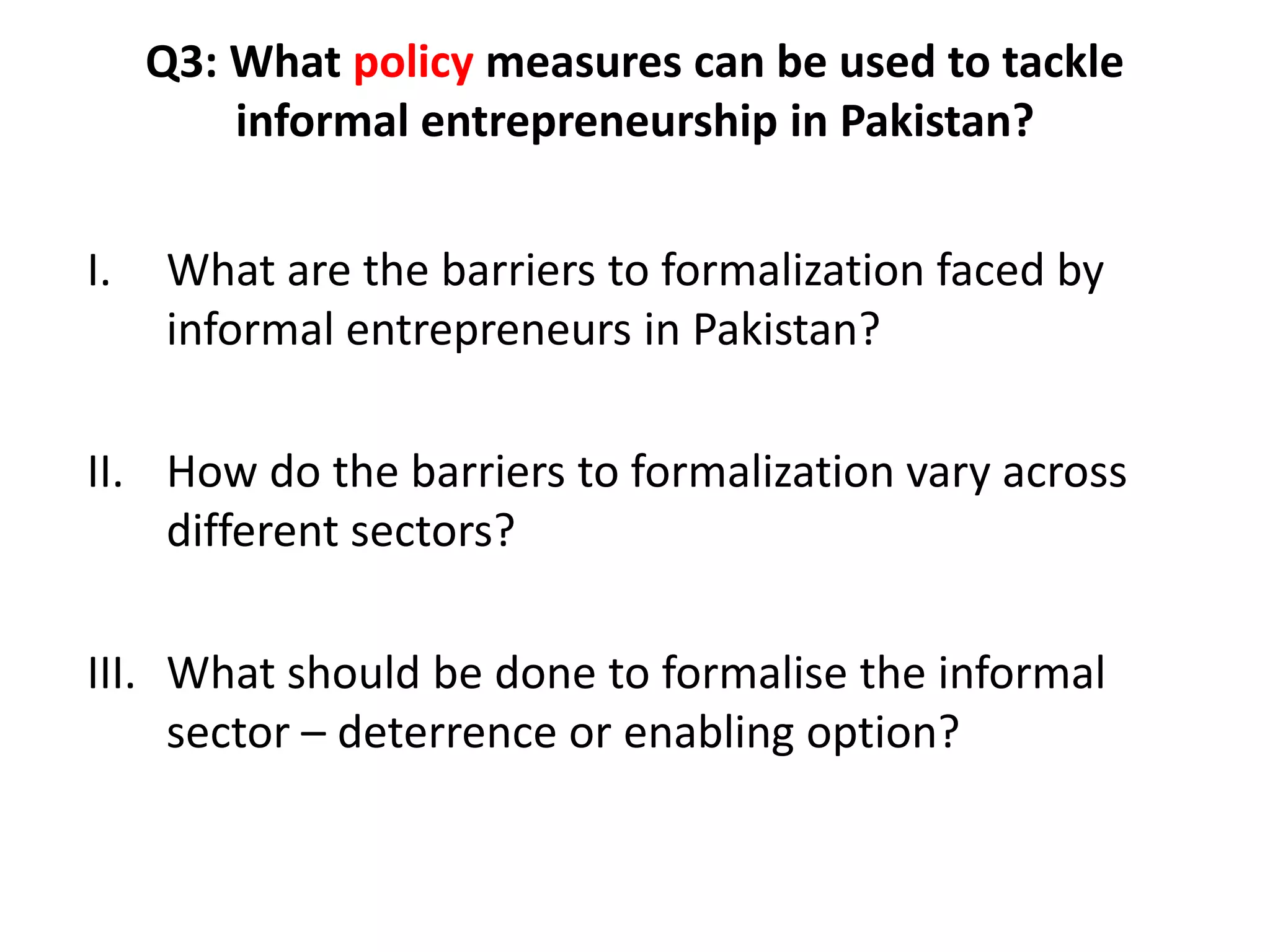
Q3: What policy measures can be used to tackle
         informal entrepreneurship in Pakistan?


I.   What are the barriers to formalization faced by
     informal entrepreneurs in Pakistan?

II. How do the barriers to formalization vary across
    different sectors?

III. What should be done to formalise the informal
     sector – deterrence or enabling option?
What we did?
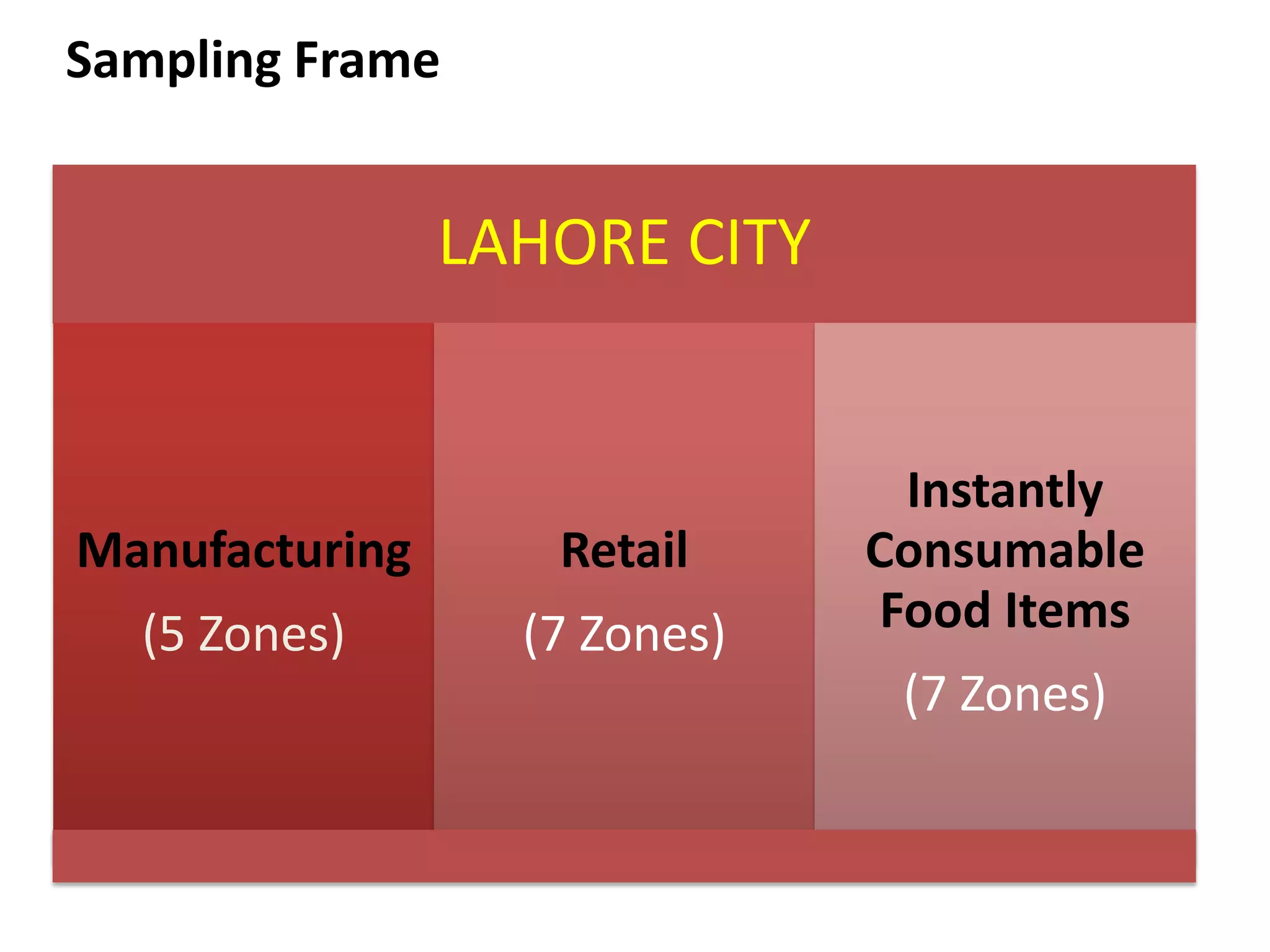
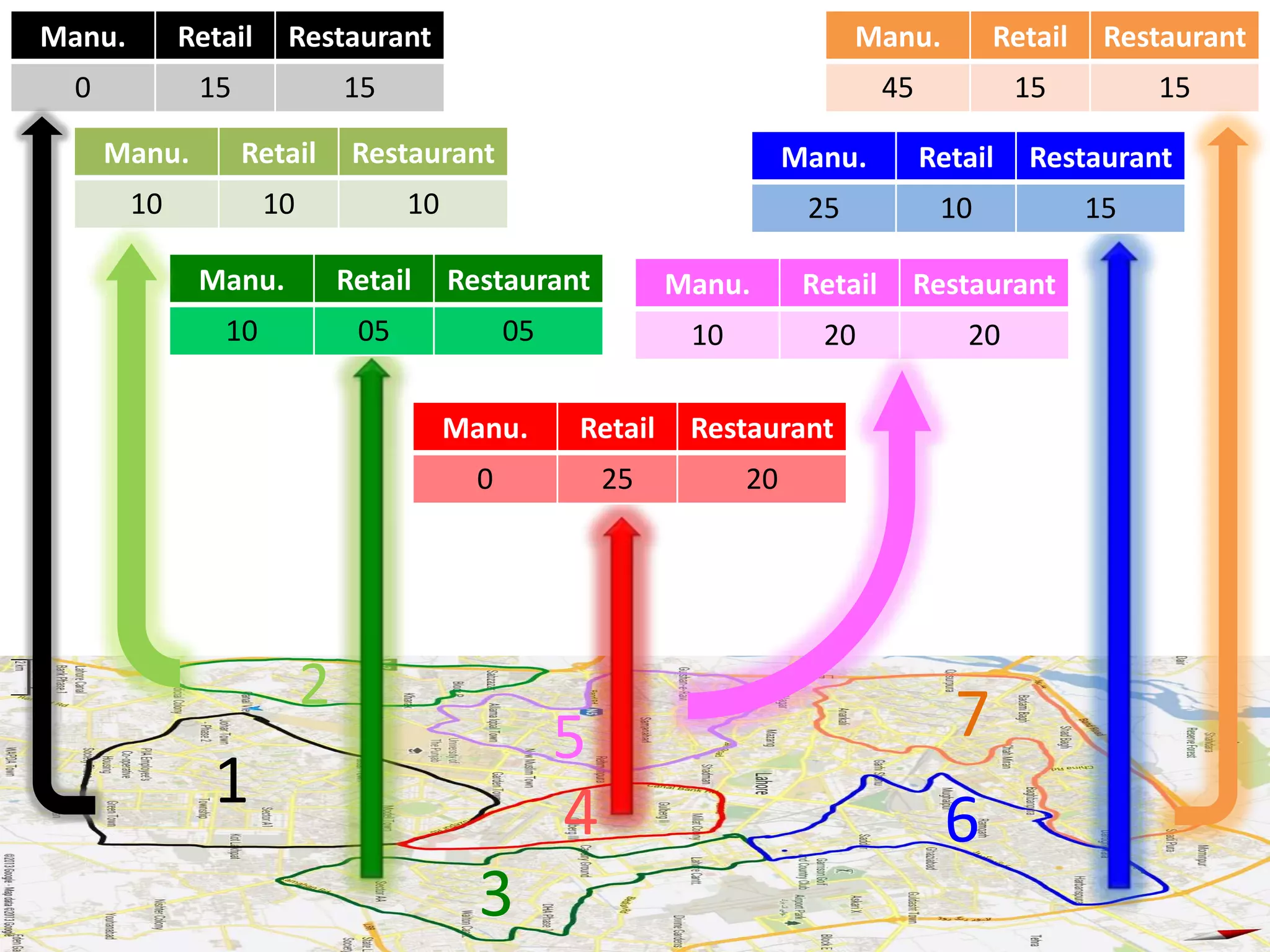
Sampling Frame


                LAHORE CITY


                               Instantly
Manufacturing      Retail     Consumable
  (5 Zones)       (7 Zones)   Food Items
                               (7 Zones)
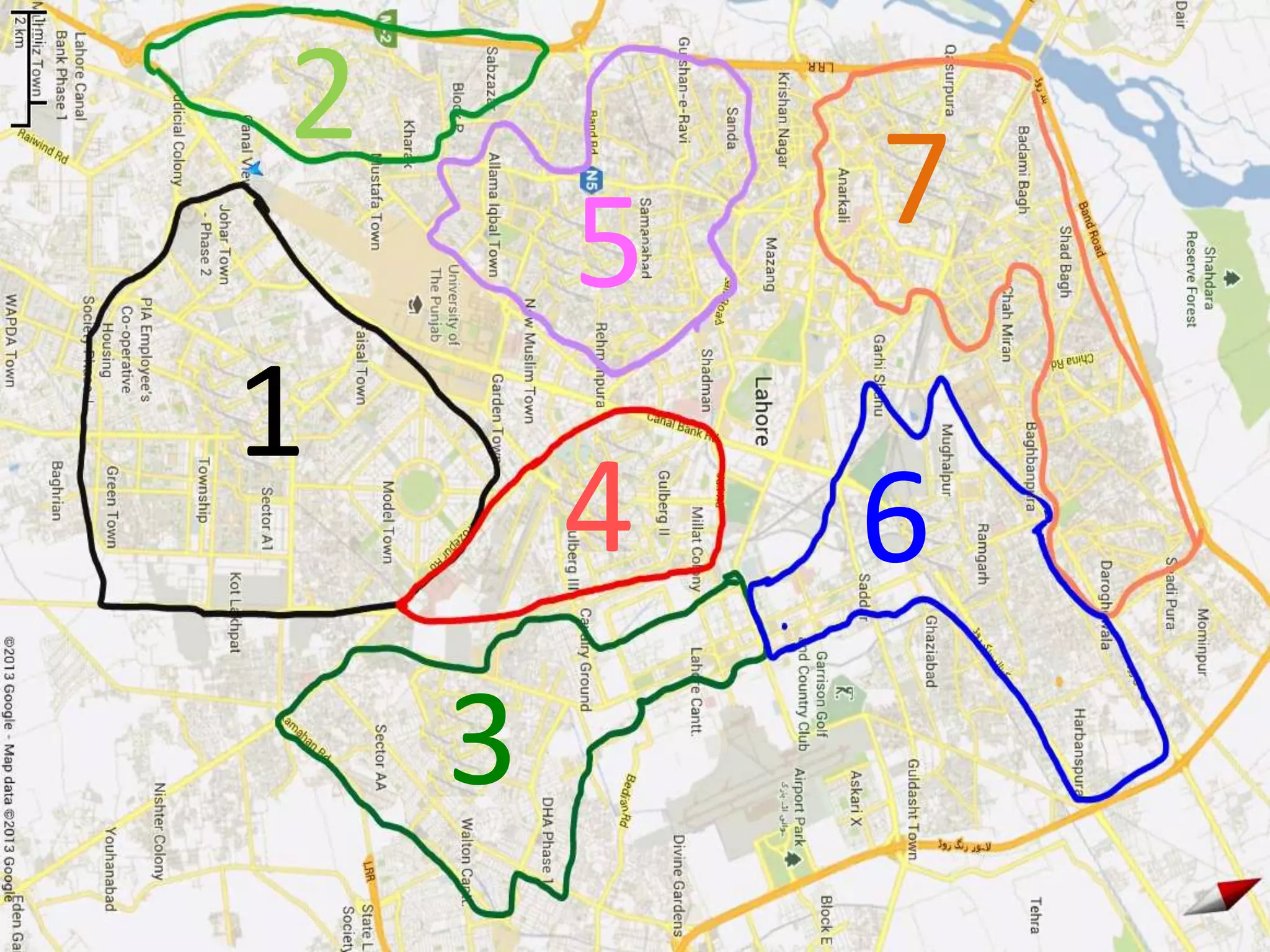
2
        5   7
1
        4   6
    3
Manu.        Retail    Restaurant                                              Manu.          Retail    Restaurant
  0           15               15                                                  45            15         15

      Manu.        Retail       Restaurant                               Manu.          Retail   Restaurant
        10            10             10                                   25             10            15

              Manu.            Retail     Restaurant          Manu.       Retail    Restaurant
                10              05              05             10          20              20

                                          Manu.      Retail    Restaurant
                                            0            25         20


                           2
                                                     5                                    7
               1                                     4                                    6
                                            3
How we did it?
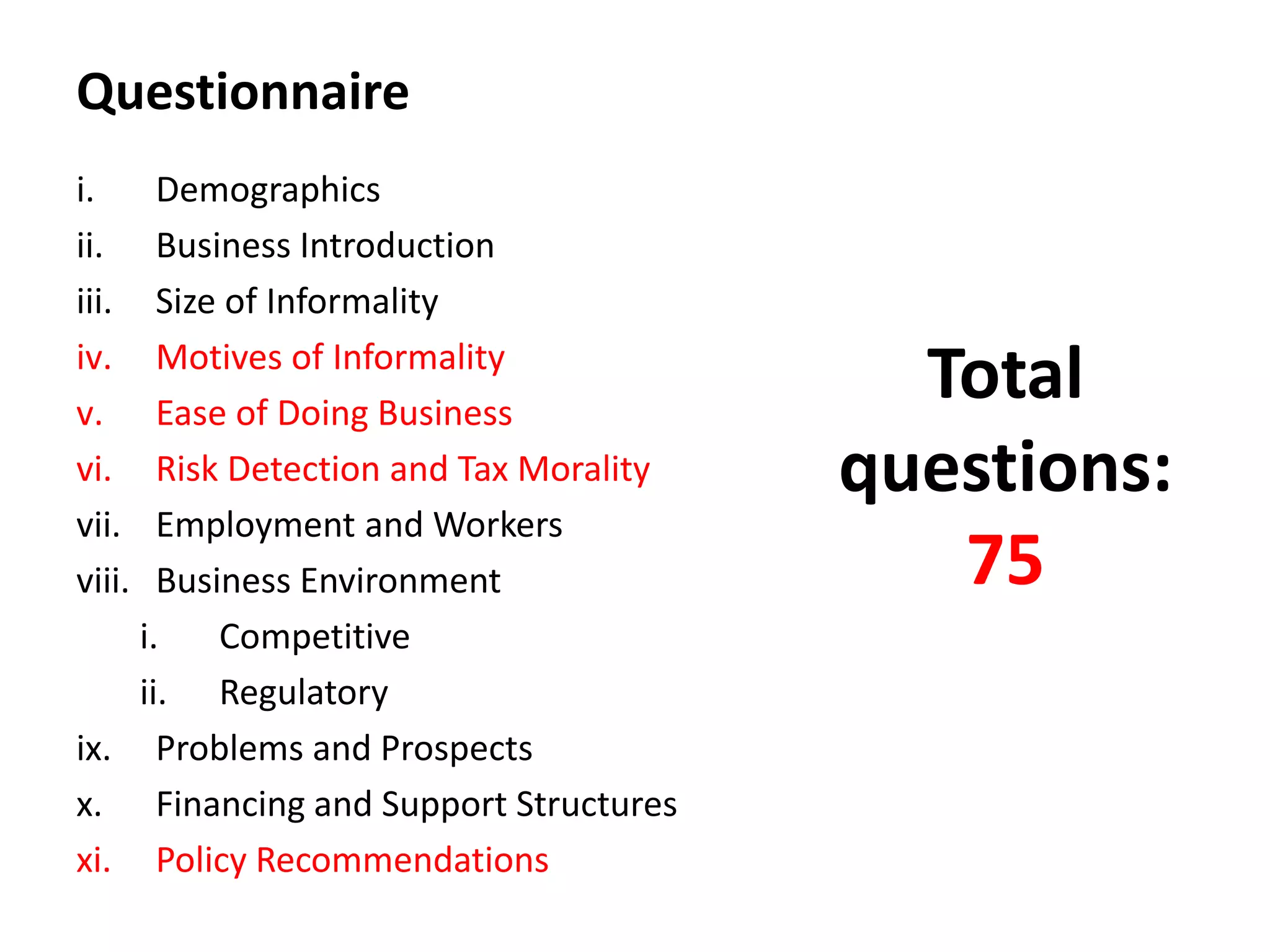
Questionnaire
i.    Demographics
ii.   Business Introduction
iii.  Size of Informality
iv.
v.
      Motives of Informality
      Ease of Doing Business
                                          Total
vi.   Risk Detection and Tax Morality   questions:
vii.  Employment and Workers
viii. Business Environment                 75
    i.    Competitive
    ii. Regulatory
ix. Problems and Prospects
x. Financing and Support Structures
xi. Policy Recommendations
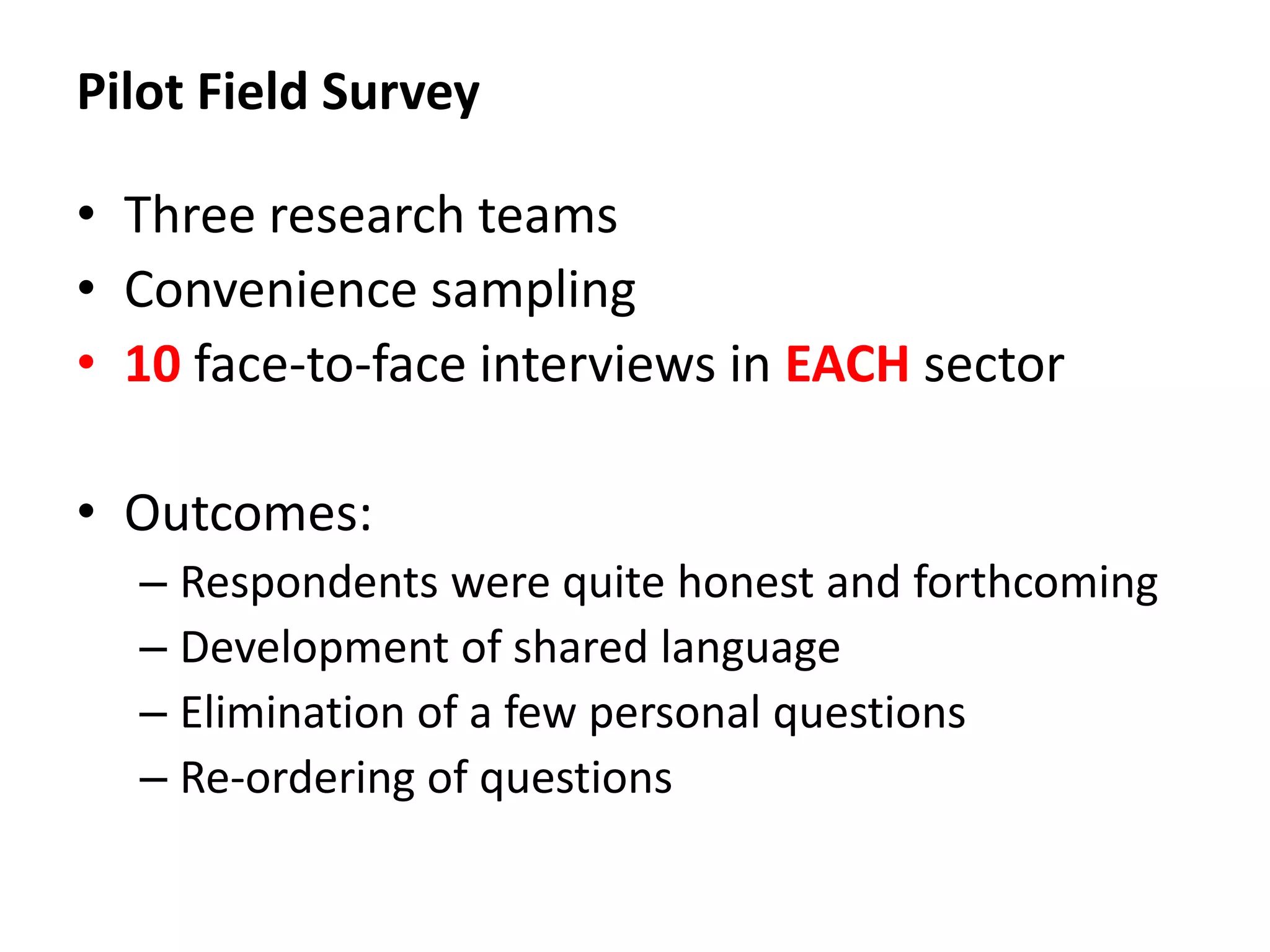
Pilot Field Survey

• Three research teams
• Convenience sampling
• 10 face-to-face interviews in EACH sector

• Outcomes:
  – Respondents were quite honest and forthcoming
  – Development of shared language
  – Elimination of a few personal questions
  – Re-ordering of questions
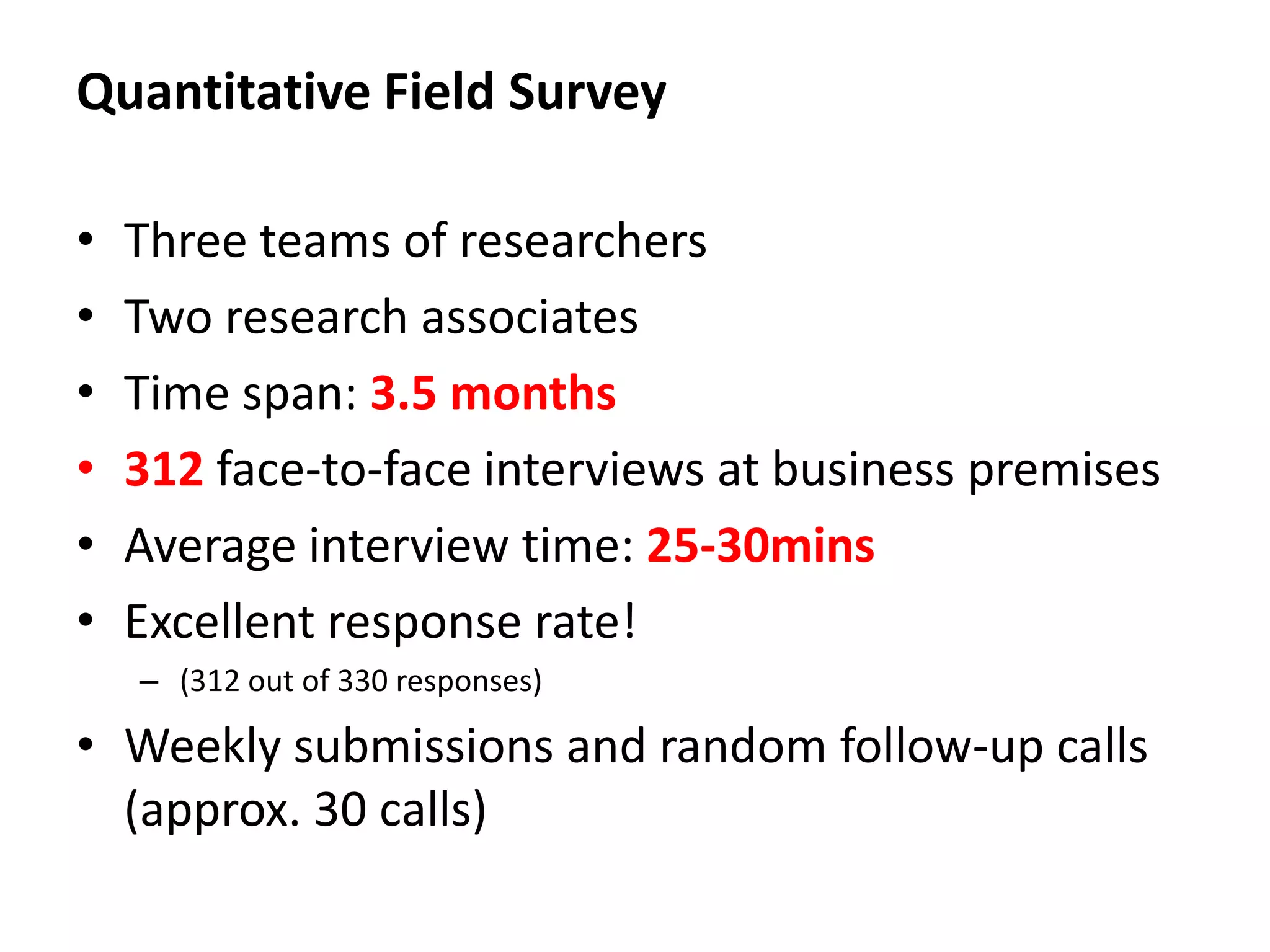
Quantitative Field Survey

•   Three teams of researchers
•   Two research associates
•   Time span: 3.5 months
•   312 face-to-face interviews at business premises
•   Average interview time: 25-30mins
•   Excellent response rate!
    – (312 out of 330 responses)

• Weekly submissions and random follow-up calls
  (approx. 30 calls)
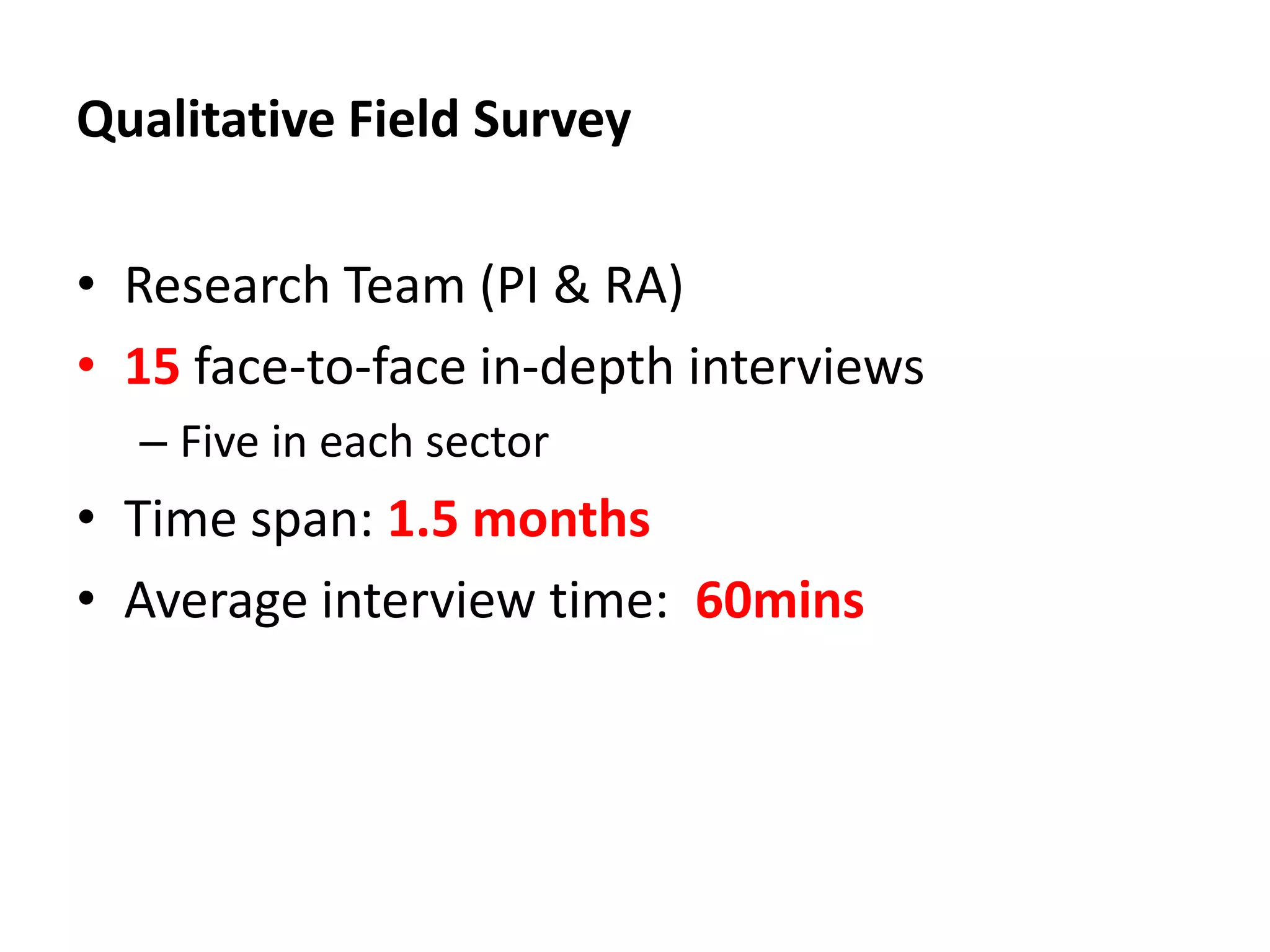
Qualitative Field Survey

• Research Team (PI & RA)
• 15 face-to-face in-depth interviews
  – Five in each sector
• Time span: 1.5 months
• Average interview time: 60mins
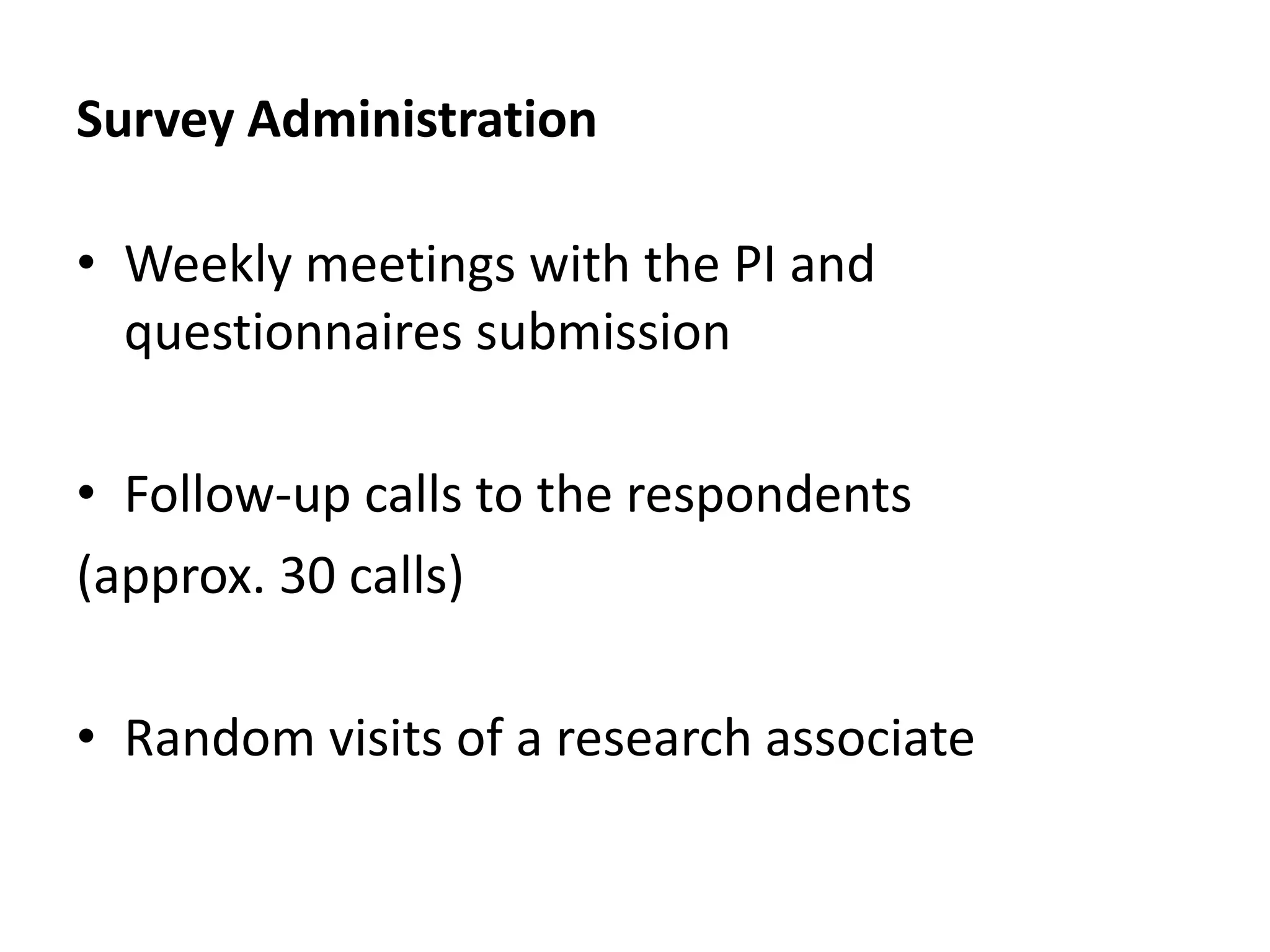
Survey Administration

• Weekly meetings with the PI and
  questionnaires submission

• Follow-up calls to the respondents
(approx. 30 calls)

• Random visits of a research associate
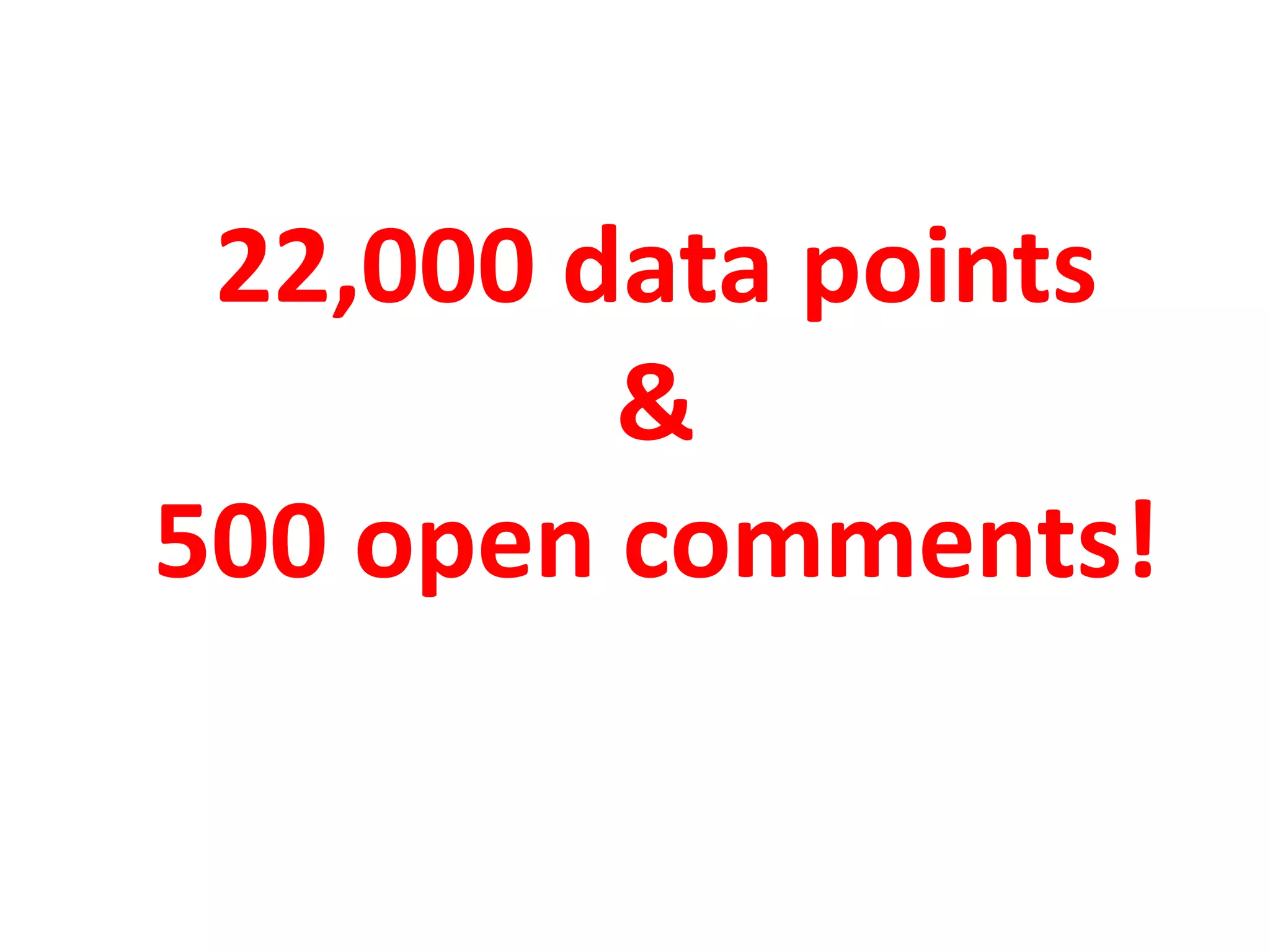
What we got?
22,000 data points
         &
500 open comments!
What will we do?
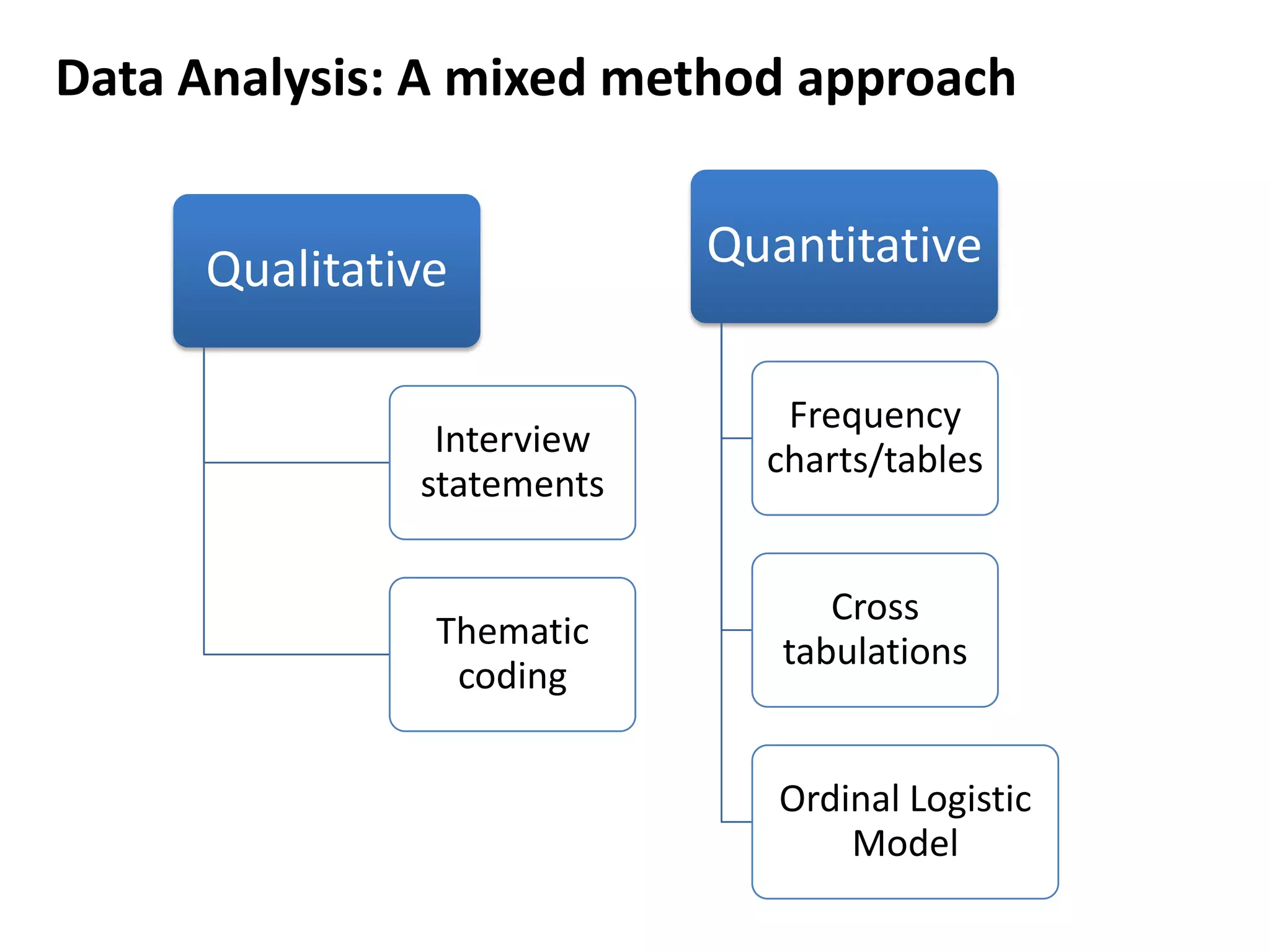
Data Analysis: A mixed method approach


     Qualitative           Quantitative


                              Frequency
               Interview     charts/tables
              statements


                                 Cross
               Thematic       tabulations
                coding


                              Ordinal Logistic
                                  Model
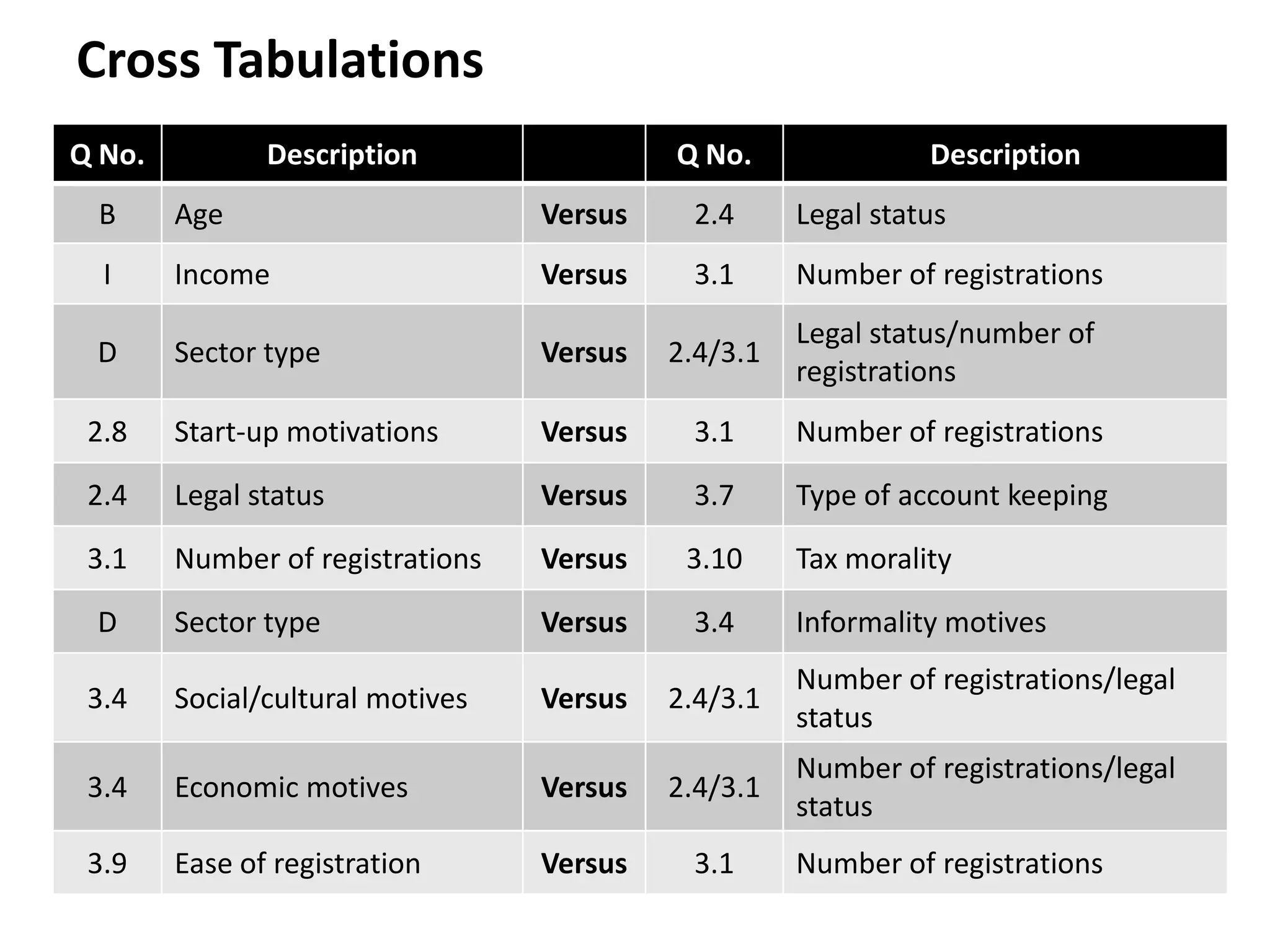
Cross Tabulations
Q No.          Description                 Q No.               Description
 B      Age                       Versus    2.4      Legal status
  I     Income                    Versus    3.1      Number of registrations
                                                     Legal status/number of
 D      Sector type               Versus   2.4/3.1
                                                     registrations
 2.8    Start-up motivations      Versus    3.1      Number of registrations

 2.4    Legal status              Versus    3.7      Type of account keeping

 3.1    Number of registrations   Versus    3.10     Tax morality

 D      Sector type               Versus    3.4      Informality motives
                                                     Number of registrations/legal
 3.4    Social/cultural motives   Versus   2.4/3.1
                                                     status
                                                     Number of registrations/legal
 3.4    Economic motives          Versus   2.4/3.1
                                                     status
 3.9    Ease of registration      Versus    3.1      Number of registrations
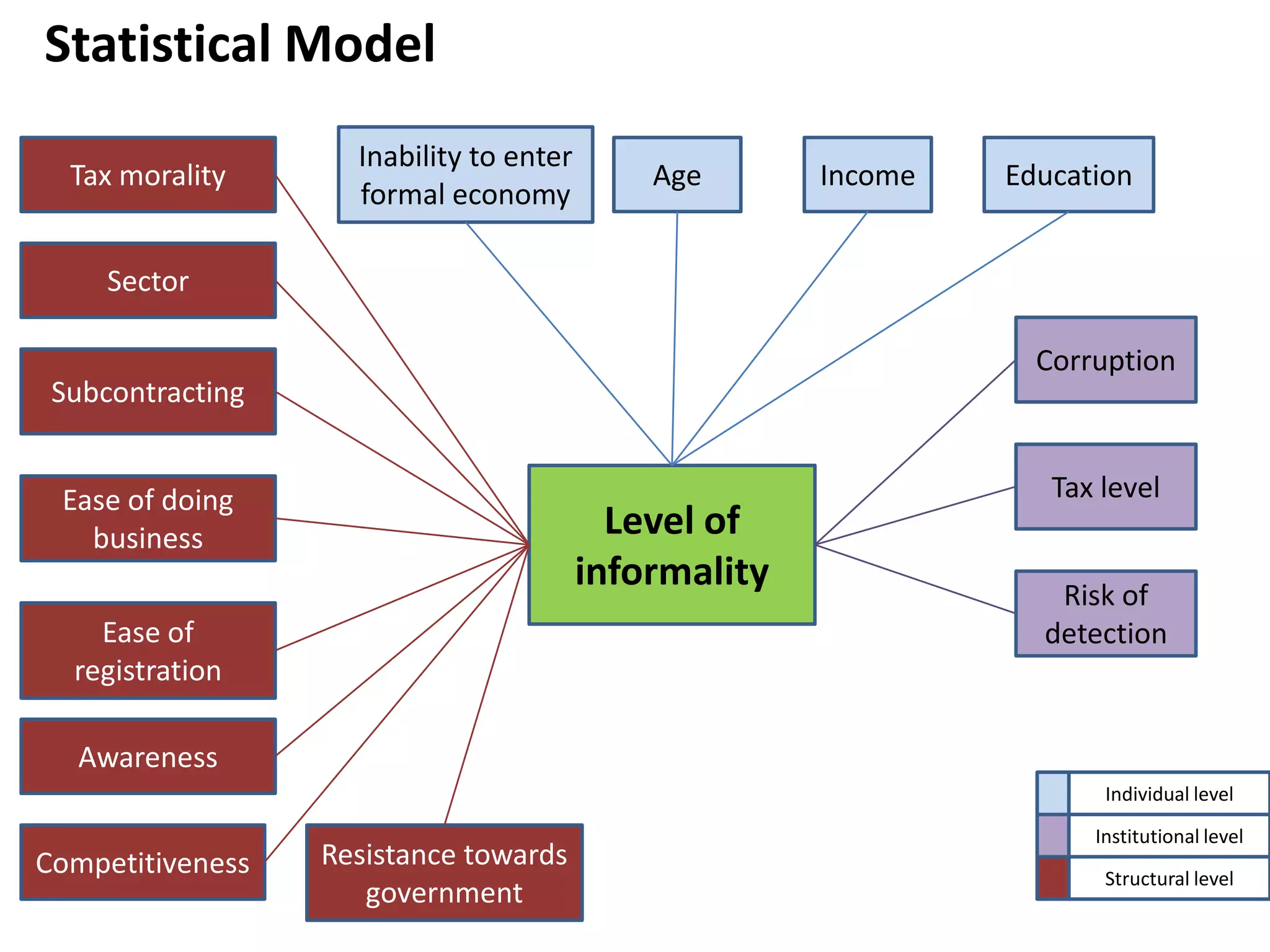
Statistical Model
                    Inability to enter
  Tax morality                               Age       Income   Education
                    formal economy

     Sector

                                                                  Corruption
 Subcontracting


 Ease of doing                                                     Tax level
   business                                Level of
                                         informality               Risk of
    Ease of                                                       detection
  registration

  Awareness
                                                                       Individual level

                                                                      Institutional level
Competitiveness   Resistance towards
                                                                       Structural level
                     government
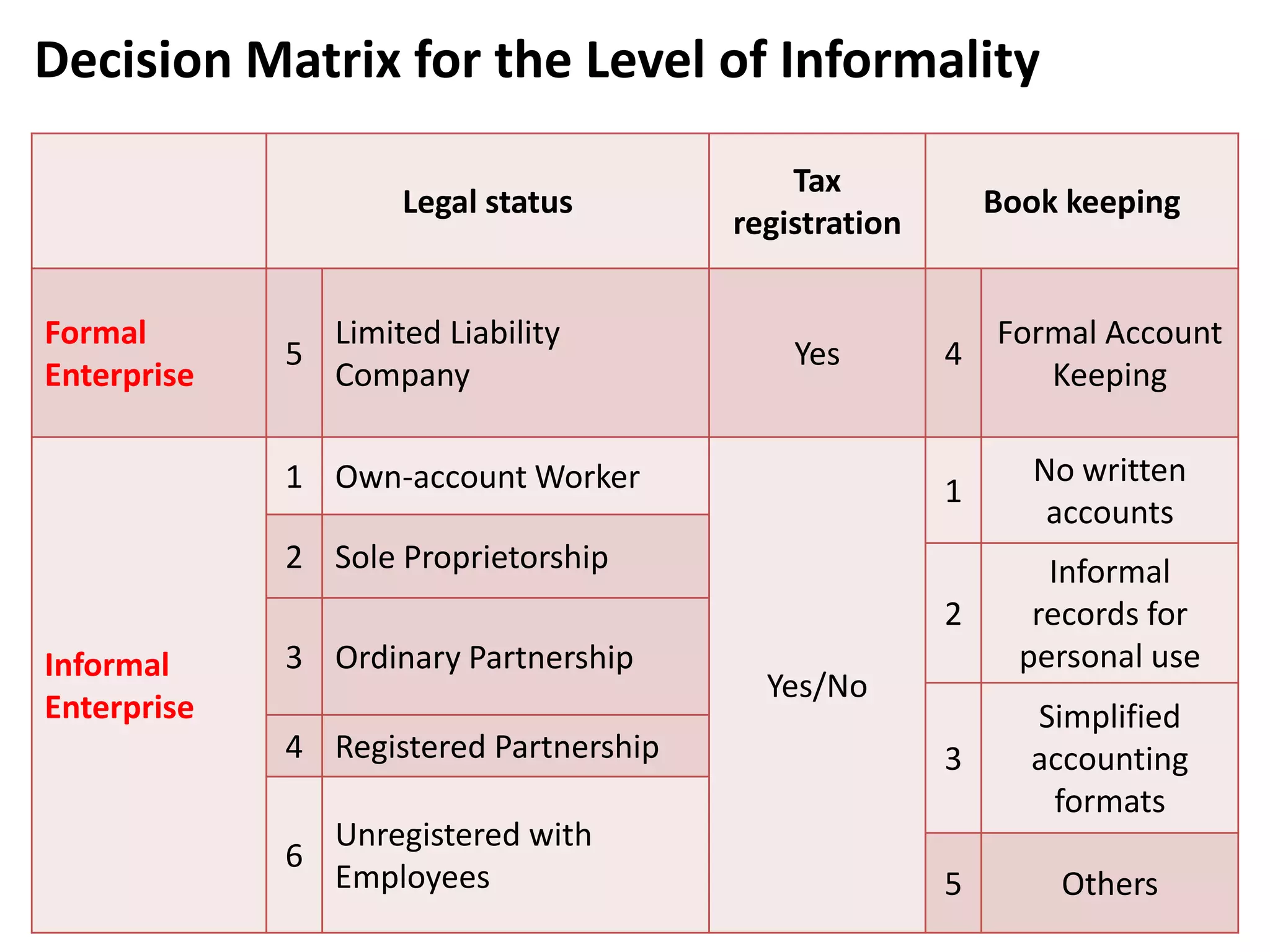
Decision Matrix for the Level of Informality

                                            Tax
                      Legal status                         Book keeping
                                        registration


Formal           Limited Liability                         Formal Account
             5                              Yes        4
Enterprise       Company                                      Keeping

             1 Own-account Worker                             No written
                                                       1
                                                               accounts
             2 Sole Proprietorship                             Informal
                                                       2      records for
Informal     3 Ordinary Partnership                          personal use
                                          Yes/No
Enterprise                                                   Simplified
             4 Registered Partnership                  3     accounting
                                                              formats
                 Unregistered with
             6
                 Employees                             5       Others
When will we do it?
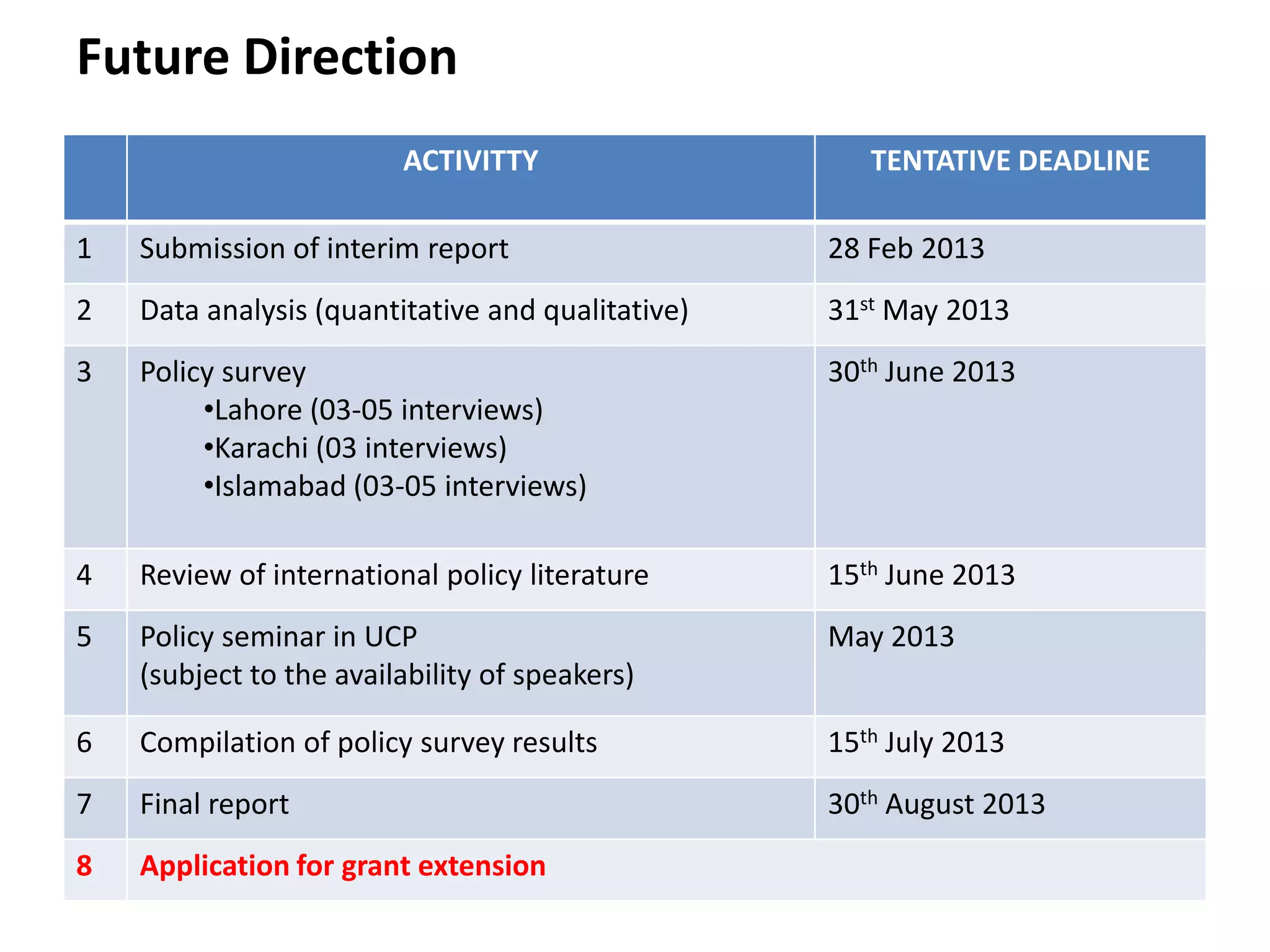
Future Direction
                         ACTIVITTY                    TENTATIVE DEADLINE

1   Submission of interim report                   28 Feb 2013
2   Data analysis (quantitative and qualitative)   31st May 2013
3   Policy survey                                  30th June 2013
         •Lahore (03-05 interviews)
         •Karachi (03 interviews)
         •Islamabad (03-05 interviews)

4   Review of international policy literature      15th June 2013
5   Policy seminar in UCP                          May 2013
    (subject to the availability of speakers)

6   Compilation of policy survey results           15th July 2013
7   Final report                                   30th August 2013
8   Application for grant extension
What we found out?
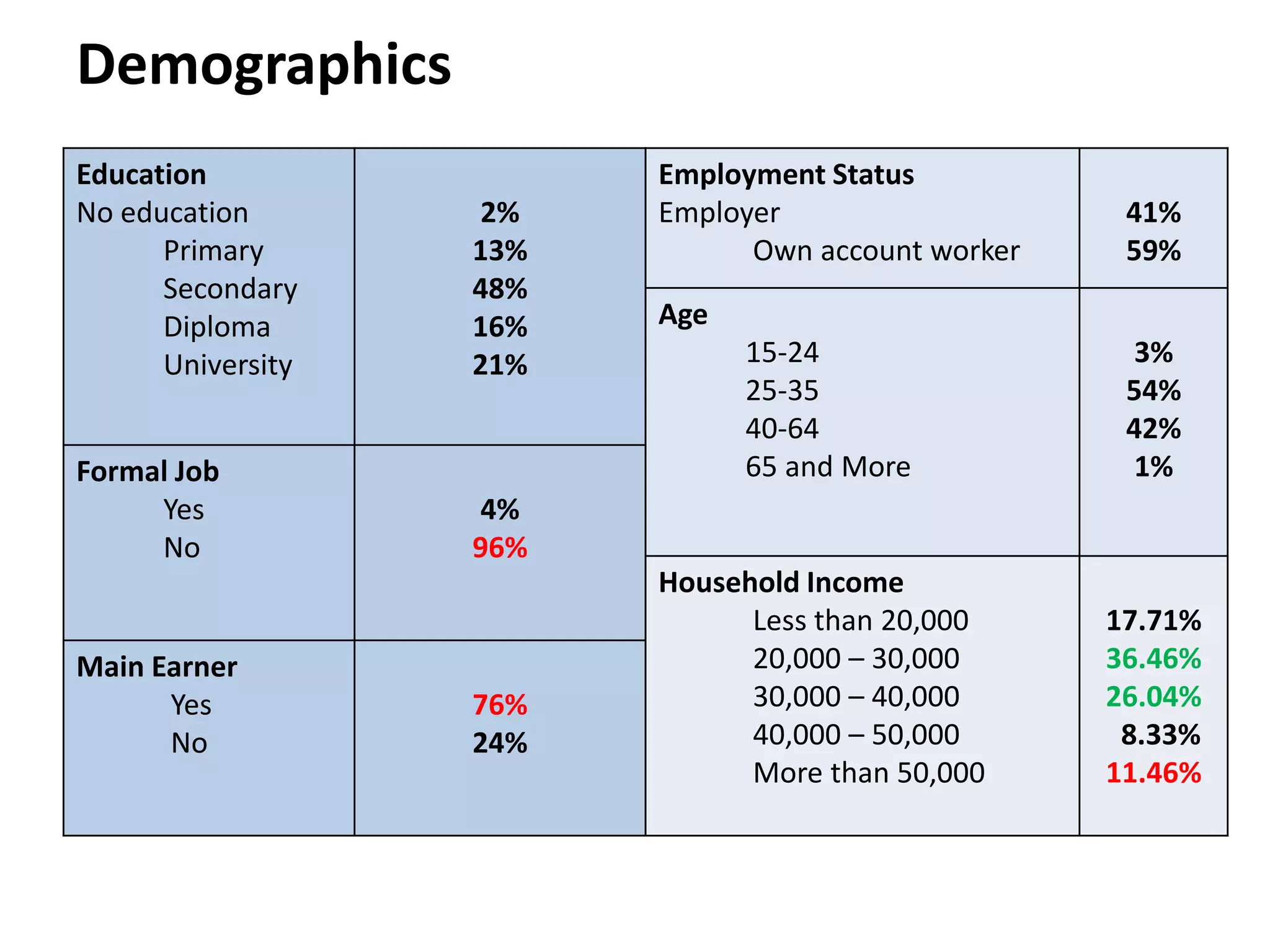
Demographics
Education                Employment Status
No education        2%   Employer                    41%
      Primary      13%         Own account worker    59%
      Secondary    48%
      Diploma      16%   Age
      University   21%         15-24                  3%
                               25-35                 54%
                               40-64                 42%
Formal Job                     65 and More            1%
     Yes            4%
     No            96%
                         Household Income
                               Less than 20,000     17.71%
Main Earner                    20,000 – 30,000      36.46%
      Yes          76%         30,000 – 40,000      26.04%
      No           24%         40,000 – 50,000       8.33%
                               More than 50,000     11.46%
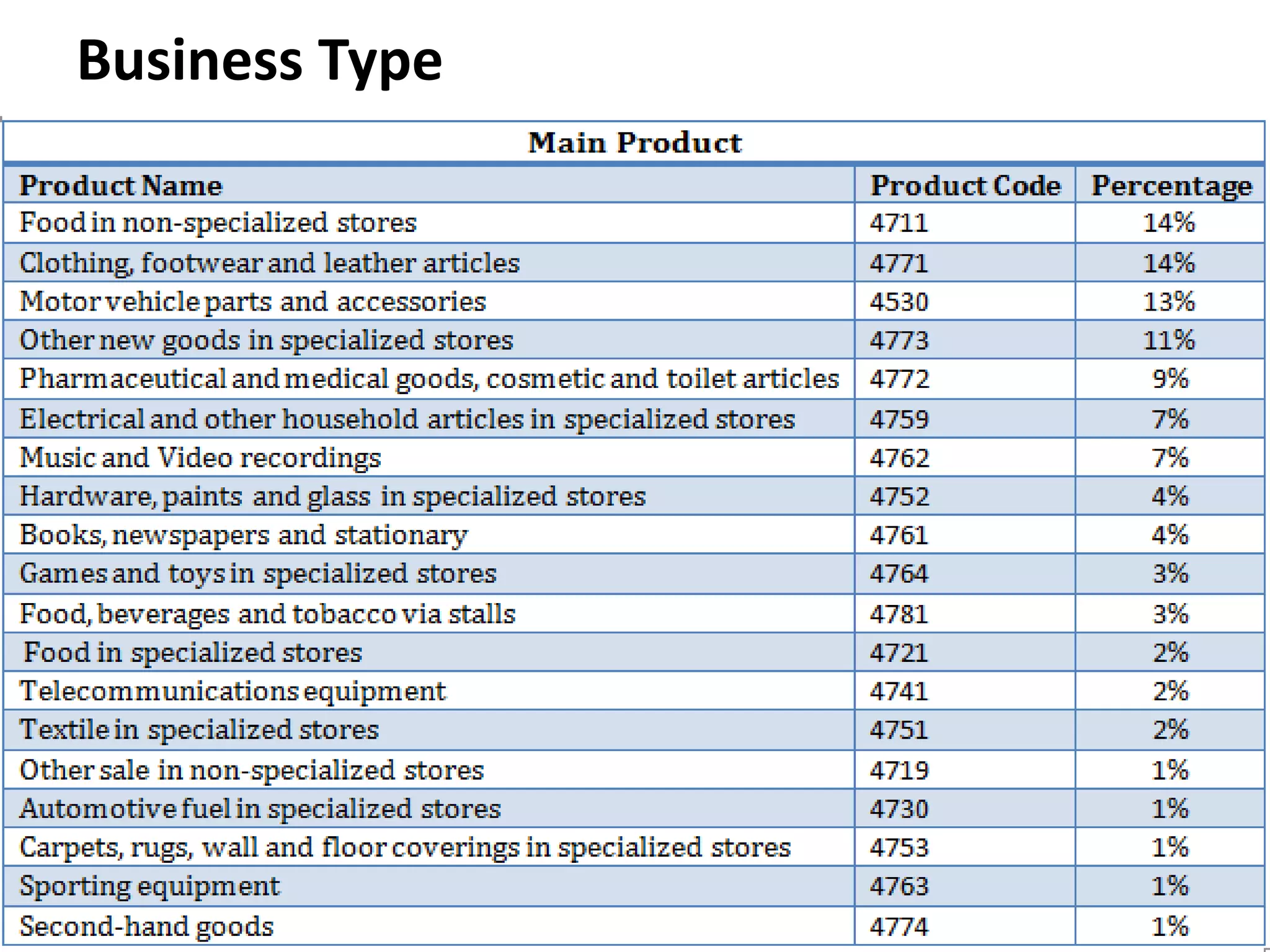
Business Type
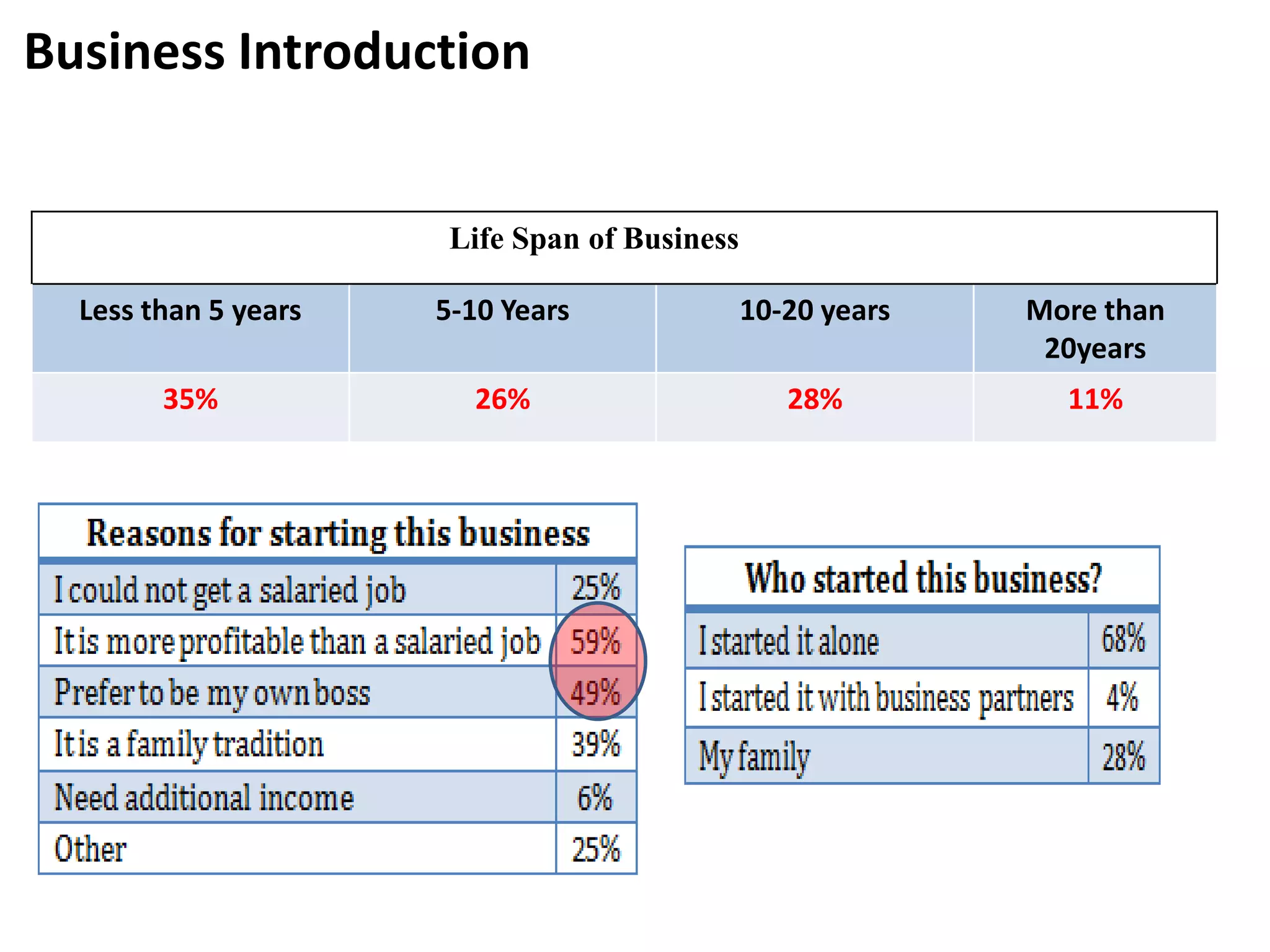
Business Introduction


                       Life Span of Business

  Less than 5 years   5-10 Years               10-20 years   More than
                                                              20years
        35%             26%                       28%          11%
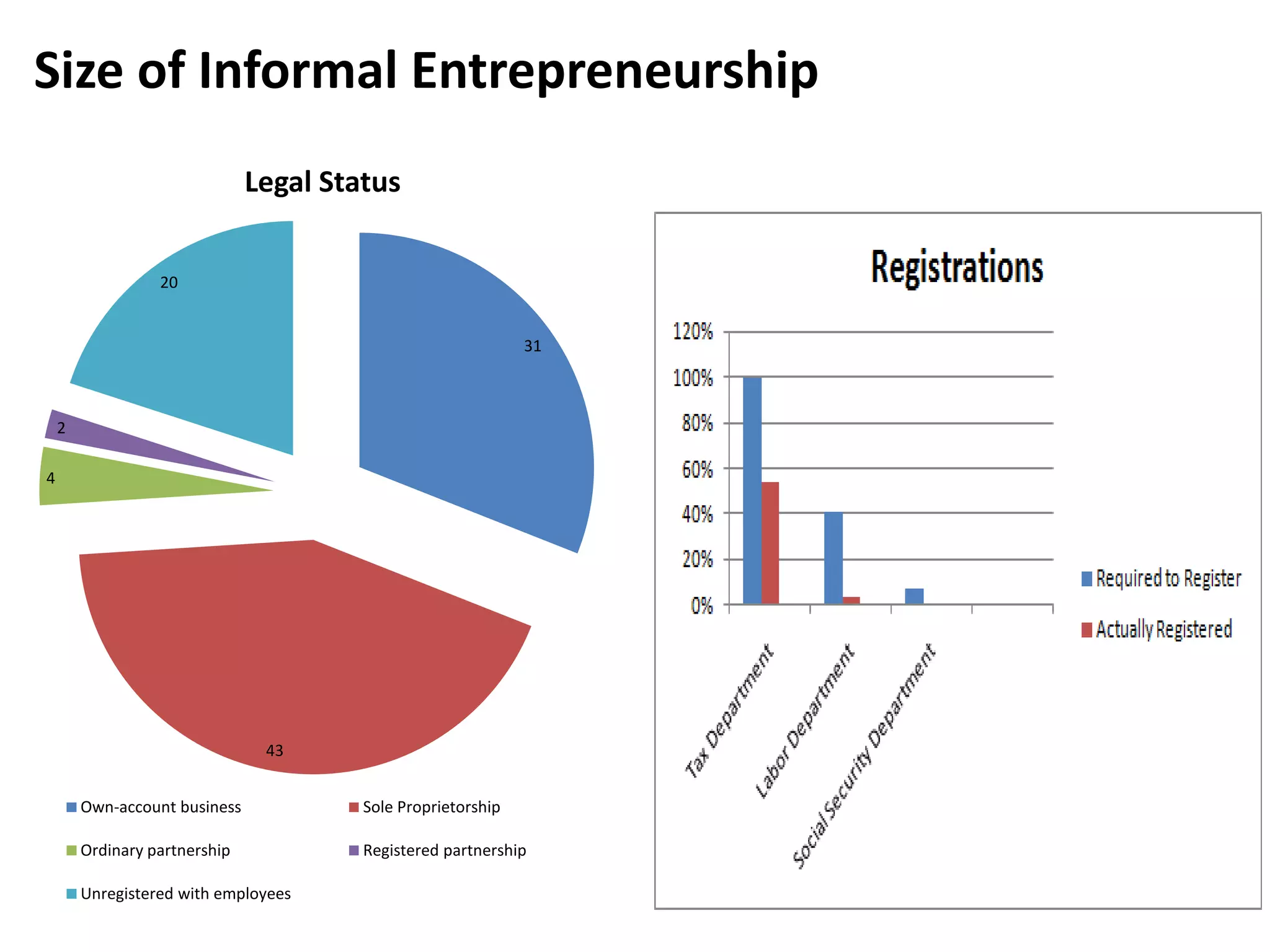
Size of Informal Entrepreneurship
                               Legal Status


                  20


                                                              31


    2

4


                                43


        Own-account business            Sole Proprietorship

        Ordinary partnership            Registered partnership

        Unregistered with employees
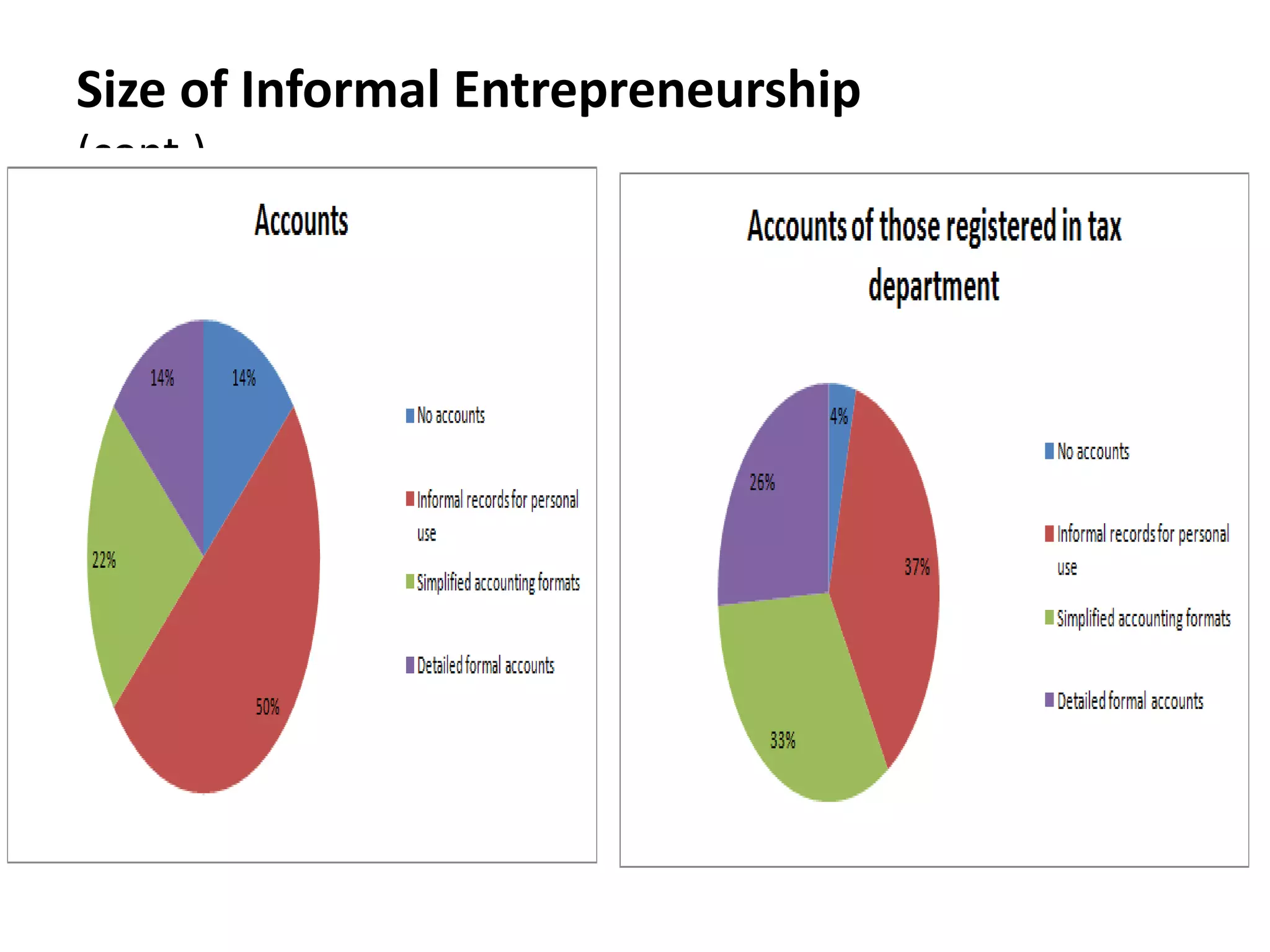
Size of Informal Entrepreneurship
(cont.)
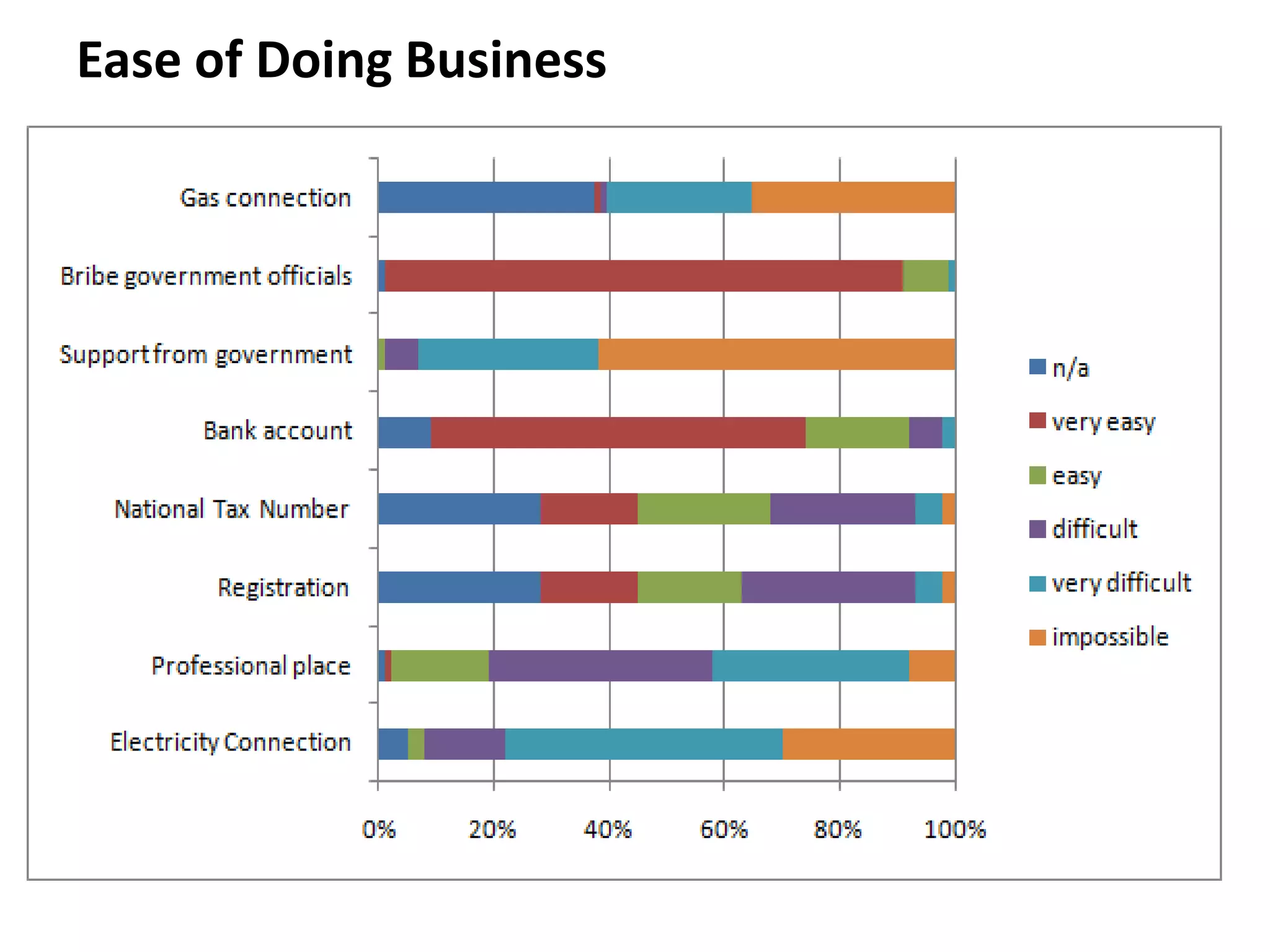
Ease of Doing Business
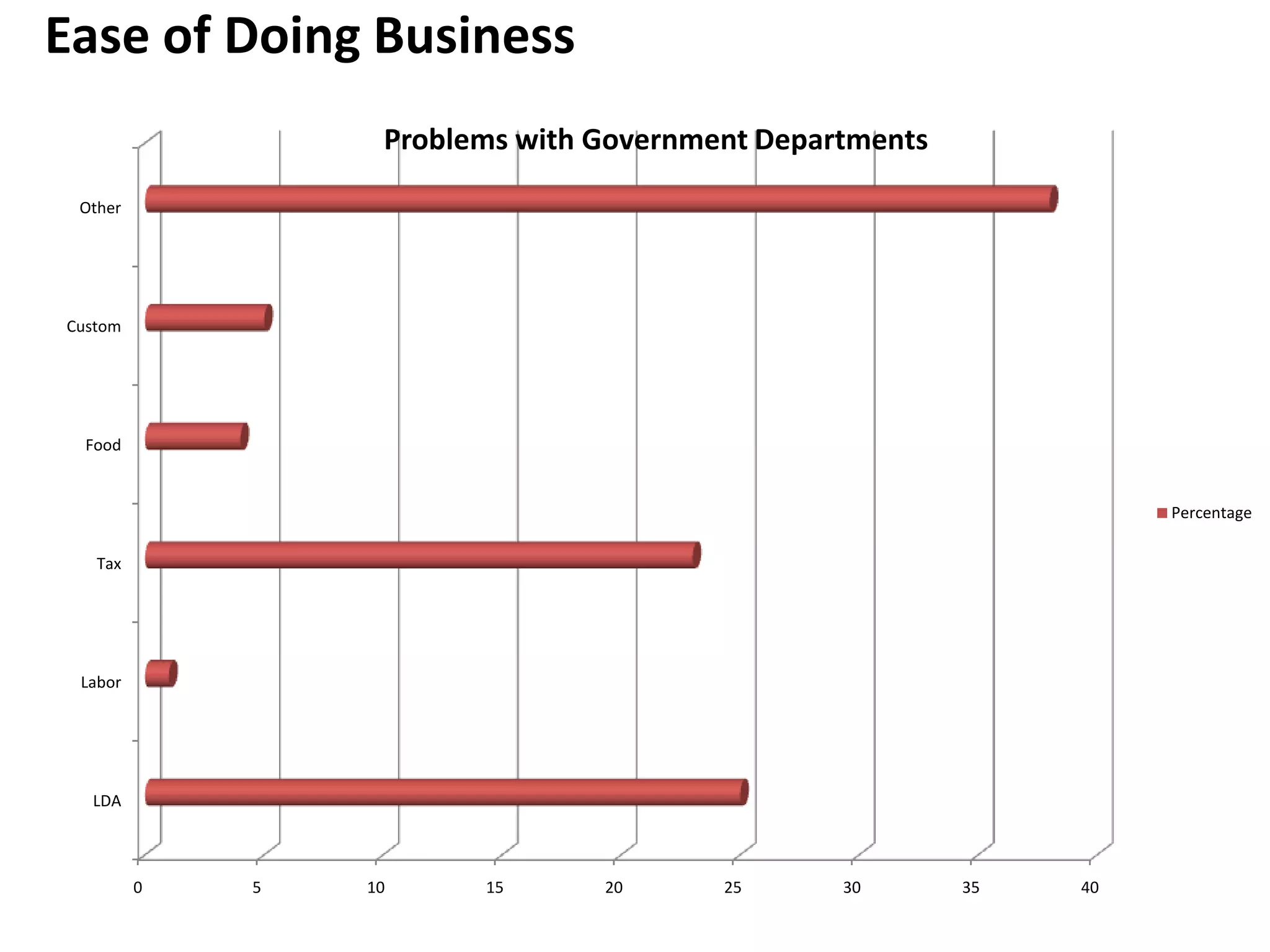
                  Problems with Government Departments

 Other


Custom


  Food


                                                                   Percentage

   Tax


 Labor


  LDA


         0   5   10     15      20      25      30       35   40
Ease of Doing Business
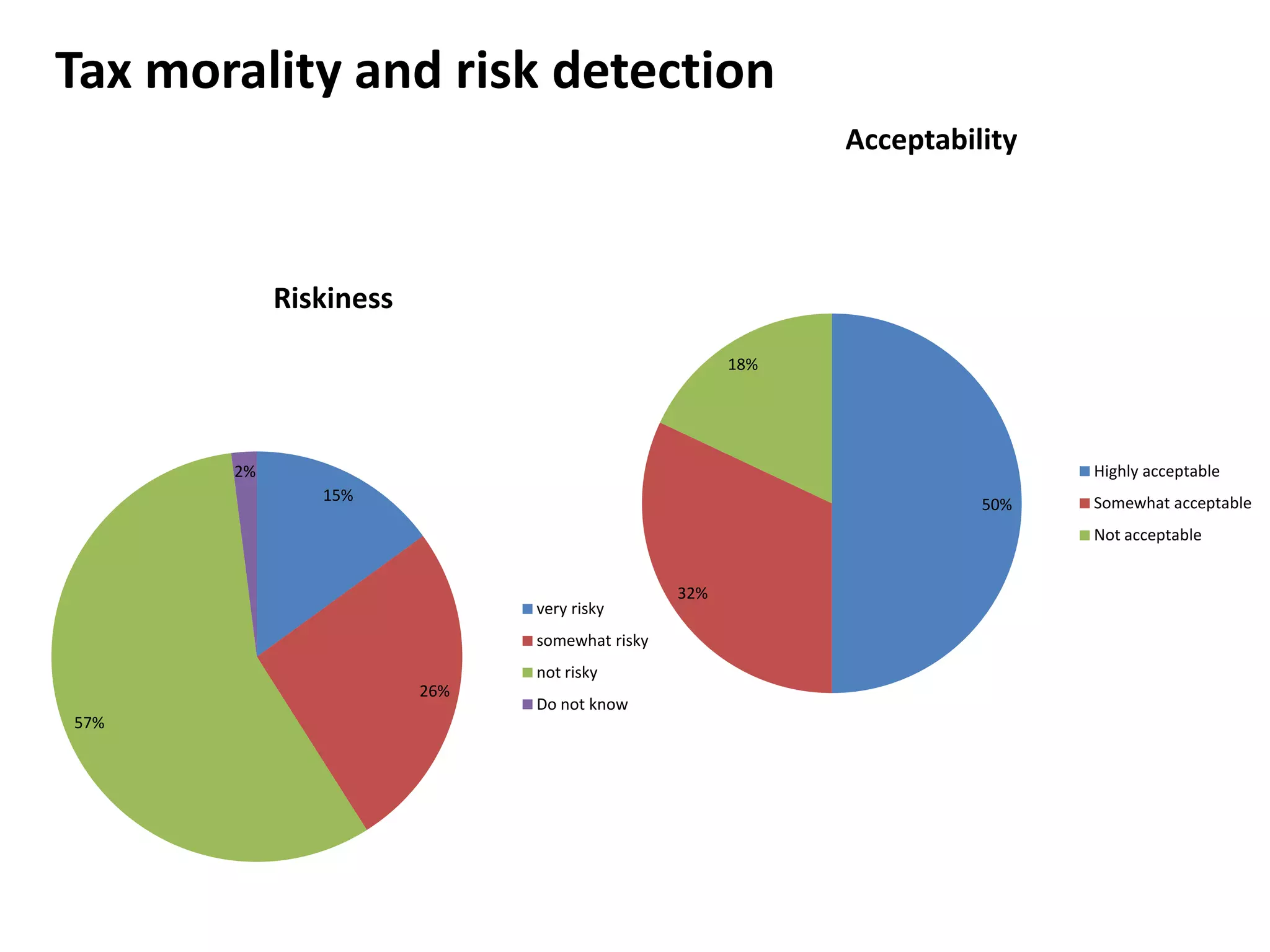
Tax morality and risk detection
                                                           Acceptability


            Riskiness
                                                     18%


       2%                                                                  Highly acceptable
               15%                                                         Somewhat acceptable
                                                                     50%
                                                                           Not acceptable


                                               32%
                              very risky
                              somewhat risky
                              not risky
                        26%
                              Do not know
57%
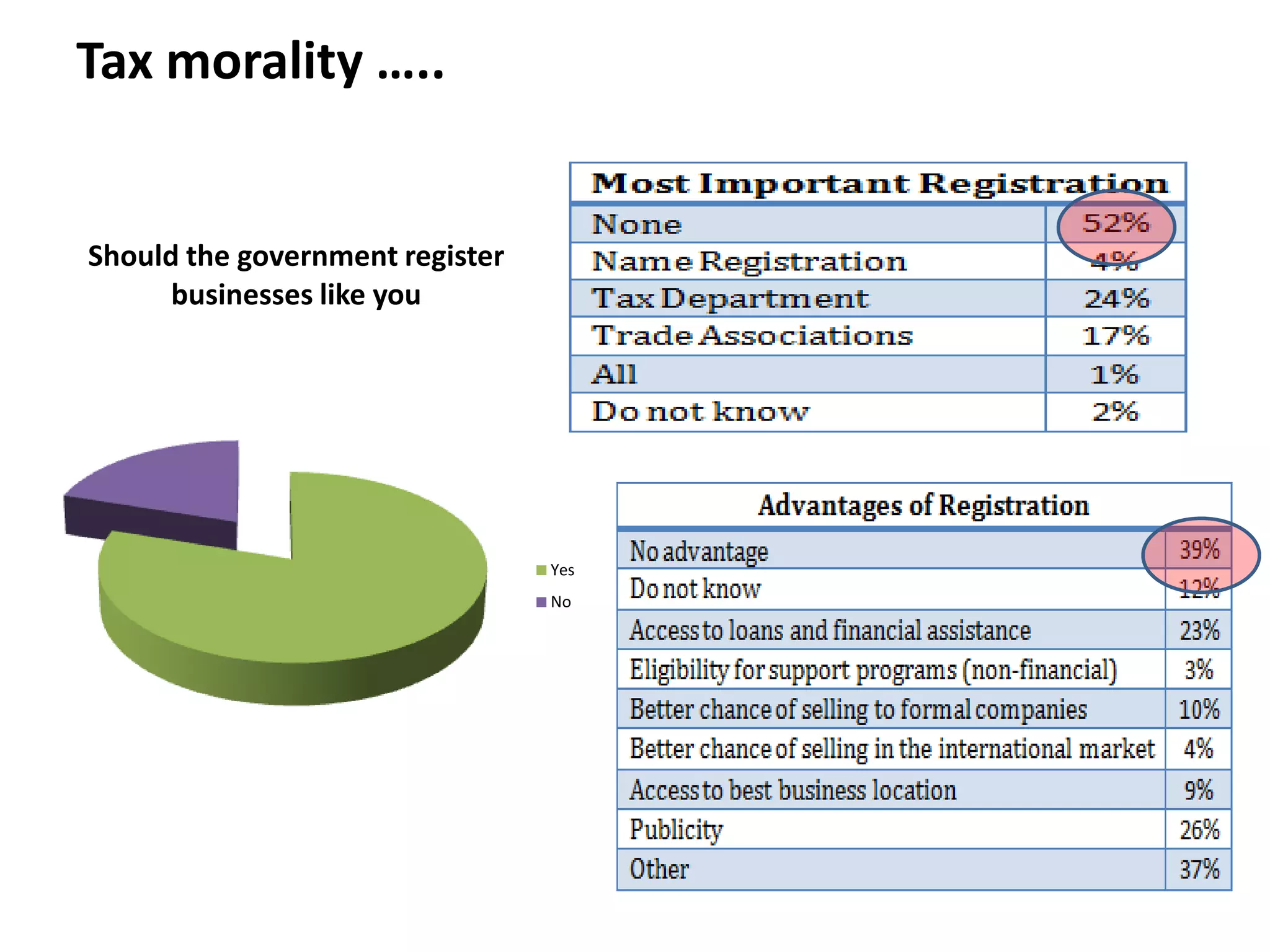
Tax morality …..


Should the government register
      businesses like you


                                 Yes
                                 No
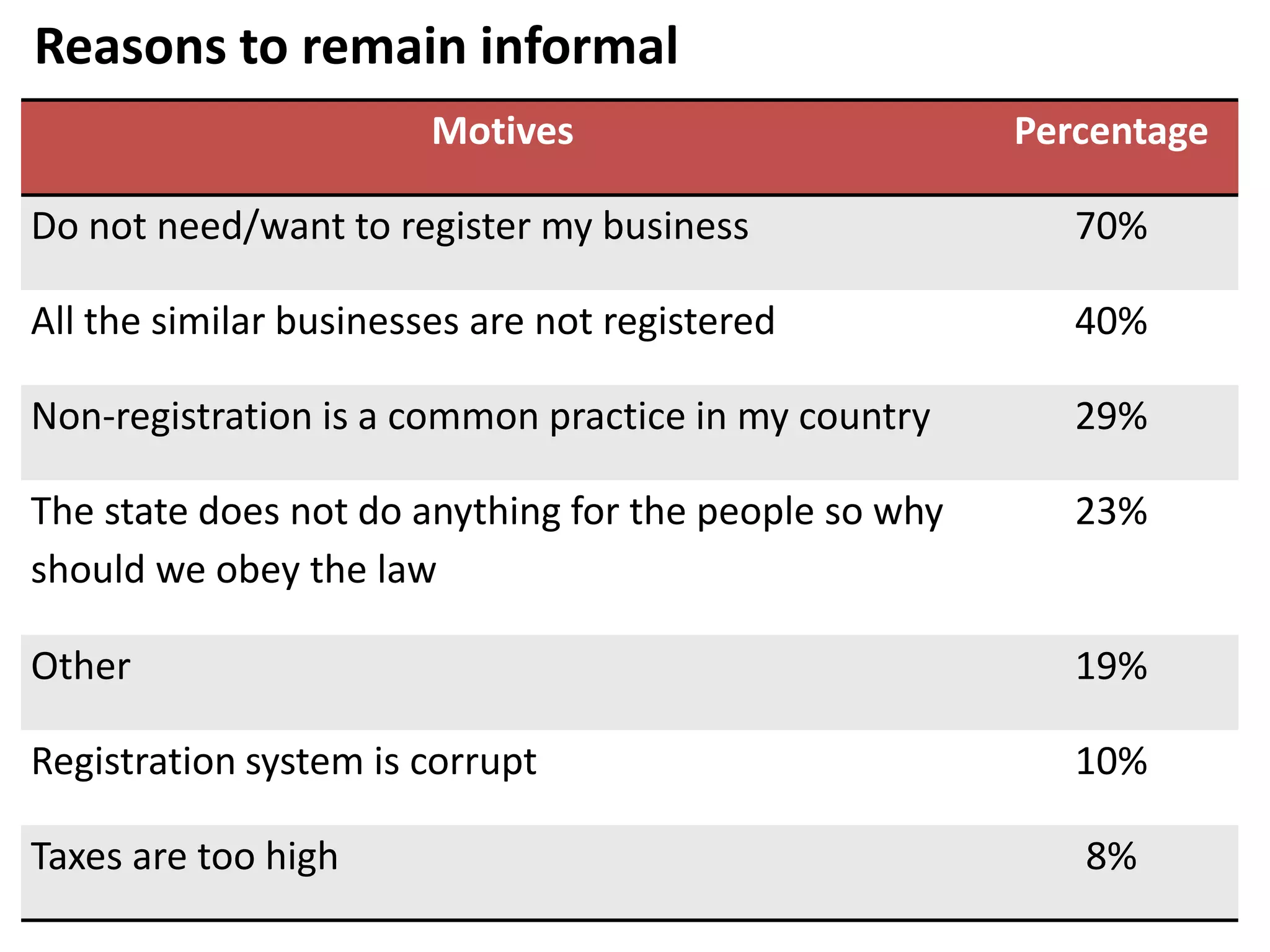
Reasons to remain informal
                        Motives                        Percentage

Do not need/want to register my business                  70%

All the similar businesses are not registered             40%

Non-registration is a common practice in my country       29%

The state does not do anything for the people so why      23%
should we obey the law

Other                                                     19%

Registration system is corrupt                            10%

Taxes are too high                                        8%
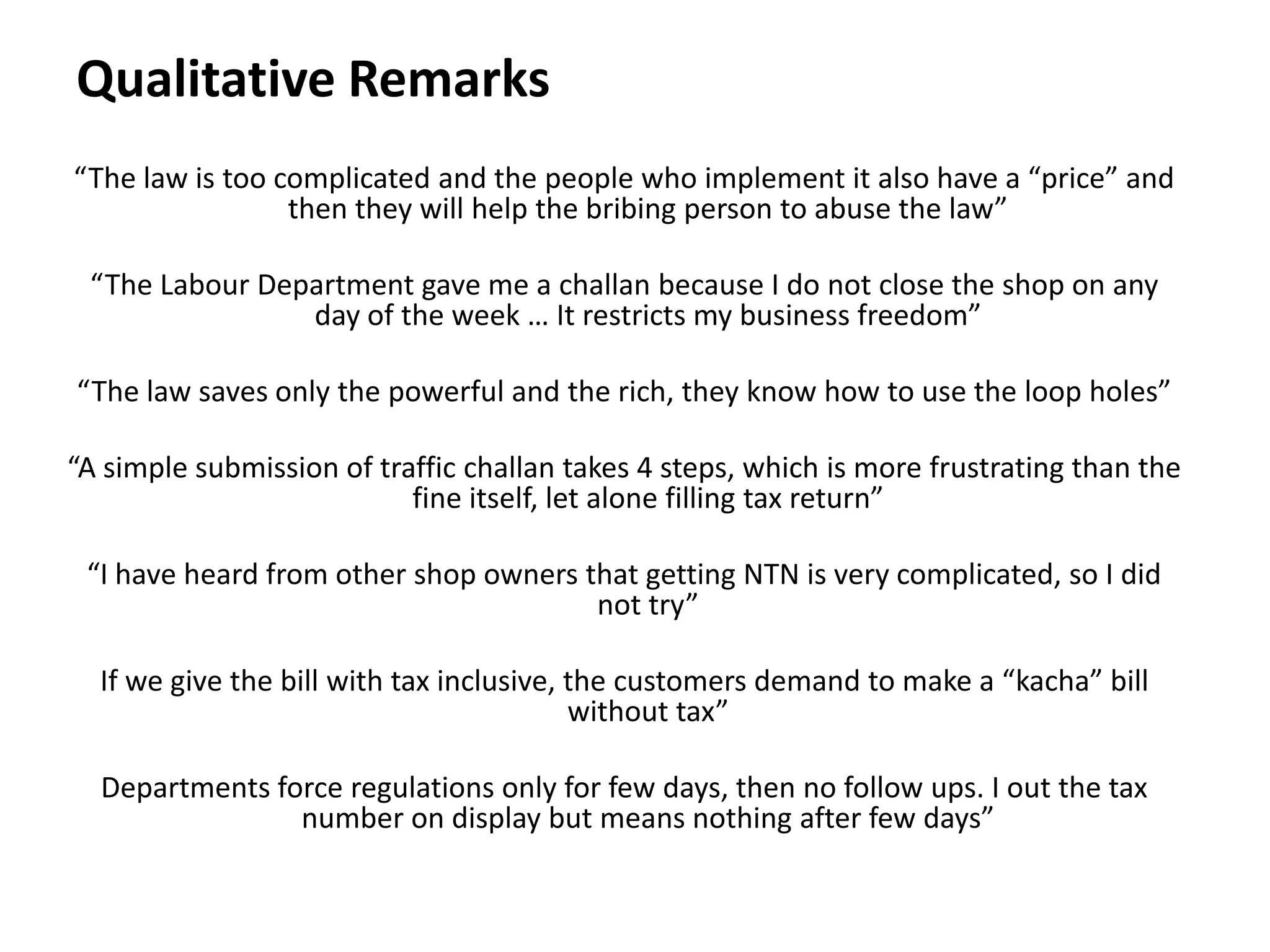
Qualitative Remarks
“The law is too complicated and the people who implement it also have a “price” and
                 then they will help the bribing person to abuse the law”

 “The Labour Department gave me a challan because I do not close the shop on any
                day of the week … It restricts my business freedom”

“The law saves only the powerful and the rich, they know how to use the loop holes”

“A simple submission of traffic challan takes 4 steps, which is more frustrating than the
                           fine itself, let alone filling tax return”

 “I have heard from other shop owners that getting NTN is very complicated, so I did
                                       not try”

  If we give the bill with tax inclusive, the customers demand to make a “kacha” bill
                                          without tax”

  Departments force regulations only for few days, then no follow ups. I out the tax
                number on display but means nothing after few days”
The Size and Nature of Informal Entrepreneurship in Pakistan and How to Tackle It by Dr. Muhammad Shehryar Shahid , University of Central Punjab, Lahore
The Size and Nature of Informal Entrepreneurship in Pakistan and How to Tackle It by Dr. Muhammad Shehryar Shahid , University of Central Punjab, Lahore

  • 1.
    The Size andNature of Informal Entrepreneurship and How to Tackle it? M Shehryar Shahid, PhD Director, Centre for Entrepreneurship and SMEs (CESME) University of Central Punjab
  • 2.
    Presentation Track • Definition & Research Questions • What we did? • How we did it? • What will we do? • When will we do it? • What we found out?
  • 3.
  • 4.
    Q1: What isthe size of informal entrepreneurship in Pakistan? I. What percentage of small businesses are operating in the informal sector? II. How does their percentage vary by sector? III. Do all such businesses practice the same level of informality, or does it vary across different enterprises and sectors?
  • 5.
    Q2: What arethe motives for Pakistani entrepreneurs to operate in the informal economy? I. Are they all doing so out of necessity? Is it a survival practice in the absence of alternatives? Or are they doing so more out of choice? II. Is it always an ‘economic motive’ that motivates small Pakistan entrepreneurs to engage in informal work? III. Are there any social/cultural factors that influence the likelihood of entrepreneurs to participate in informal business practices? IV. How do their motives vary across different sectors?
  • 6.
    Q3: What policymeasures can be used to tackle informal entrepreneurship in Pakistan? I. What are the barriers to formalization faced by informal entrepreneurs in Pakistan? II. How do the barriers to formalization vary across different sectors? III. What should be done to formalise the informal sector – deterrence or enabling option?
  • 7.
  • 8.
    Sampling Frame LAHORE CITY Instantly Manufacturing Retail Consumable (5 Zones) (7 Zones) Food Items (7 Zones)
  • 9.
    2 5 7 1 4 6 3
  • 10.
    Manu. Retail Restaurant Manu. Retail Restaurant 0 15 15 45 15 15 Manu. Retail Restaurant Manu. Retail Restaurant 10 10 10 25 10 15 Manu. Retail Restaurant Manu. Retail Restaurant 10 05 05 10 20 20 Manu. Retail Restaurant 0 25 20 2 5 7 1 4 6 3
  • 11.
  • 12.
    Questionnaire i. Demographics ii. Business Introduction iii. Size of Informality iv. v. Motives of Informality Ease of Doing Business Total vi. Risk Detection and Tax Morality questions: vii. Employment and Workers viii. Business Environment 75 i. Competitive ii. Regulatory ix. Problems and Prospects x. Financing and Support Structures xi. Policy Recommendations
  • 13.
    Pilot Field Survey •Three research teams • Convenience sampling • 10 face-to-face interviews in EACH sector • Outcomes: – Respondents were quite honest and forthcoming – Development of shared language – Elimination of a few personal questions – Re-ordering of questions
  • 14.
    Quantitative Field Survey • Three teams of researchers • Two research associates • Time span: 3.5 months • 312 face-to-face interviews at business premises • Average interview time: 25-30mins • Excellent response rate! – (312 out of 330 responses) • Weekly submissions and random follow-up calls (approx. 30 calls)
  • 15.
    Qualitative Field Survey •Research Team (PI & RA) • 15 face-to-face in-depth interviews – Five in each sector • Time span: 1.5 months • Average interview time: 60mins
  • 16.
    Survey Administration • Weeklymeetings with the PI and questionnaires submission • Follow-up calls to the respondents (approx. 30 calls) • Random visits of a research associate
  • 17.
  • 18.
    22,000 data points & 500 open comments!
  • 19.
  • 20.
    Data Analysis: Amixed method approach Qualitative Quantitative Frequency Interview charts/tables statements Cross Thematic tabulations coding Ordinal Logistic Model
  • 21.
    Cross Tabulations Q No. Description Q No. Description B Age Versus 2.4 Legal status I Income Versus 3.1 Number of registrations Legal status/number of D Sector type Versus 2.4/3.1 registrations 2.8 Start-up motivations Versus 3.1 Number of registrations 2.4 Legal status Versus 3.7 Type of account keeping 3.1 Number of registrations Versus 3.10 Tax morality D Sector type Versus 3.4 Informality motives Number of registrations/legal 3.4 Social/cultural motives Versus 2.4/3.1 status Number of registrations/legal 3.4 Economic motives Versus 2.4/3.1 status 3.9 Ease of registration Versus 3.1 Number of registrations
  • 22.
    Statistical Model Inability to enter Tax morality Age Income Education formal economy Sector Corruption Subcontracting Ease of doing Tax level business Level of informality Risk of Ease of detection registration Awareness Individual level Institutional level Competitiveness Resistance towards Structural level government
  • 23.
    Decision Matrix forthe Level of Informality Tax Legal status Book keeping registration Formal Limited Liability Formal Account 5 Yes 4 Enterprise Company Keeping 1 Own-account Worker No written 1 accounts 2 Sole Proprietorship Informal 2 records for Informal 3 Ordinary Partnership personal use Yes/No Enterprise Simplified 4 Registered Partnership 3 accounting formats Unregistered with 6 Employees 5 Others
  • 24.
  • 25.
    Future Direction ACTIVITTY TENTATIVE DEADLINE 1 Submission of interim report 28 Feb 2013 2 Data analysis (quantitative and qualitative) 31st May 2013 3 Policy survey 30th June 2013 •Lahore (03-05 interviews) •Karachi (03 interviews) •Islamabad (03-05 interviews) 4 Review of international policy literature 15th June 2013 5 Policy seminar in UCP May 2013 (subject to the availability of speakers) 6 Compilation of policy survey results 15th July 2013 7 Final report 30th August 2013 8 Application for grant extension
  • 26.
  • 27.
    Demographics Education Employment Status No education 2% Employer 41% Primary 13% Own account worker 59% Secondary 48% Diploma 16% Age University 21% 15-24 3% 25-35 54% 40-64 42% Formal Job 65 and More 1% Yes 4% No 96% Household Income Less than 20,000 17.71% Main Earner 20,000 – 30,000 36.46% Yes 76% 30,000 – 40,000 26.04% No 24% 40,000 – 50,000 8.33% More than 50,000 11.46%
  • 28.
  • 29.
    Business Introduction Life Span of Business Less than 5 years 5-10 Years 10-20 years More than 20years 35% 26% 28% 11%
  • 30.
    Size of InformalEntrepreneurship Legal Status 20 31 2 4 43 Own-account business Sole Proprietorship Ordinary partnership Registered partnership Unregistered with employees
  • 31.
    Size of InformalEntrepreneurship (cont.)
  • 32.
    Ease of DoingBusiness
  • 33.
    Ease of DoingBusiness Problems with Government Departments Other Custom Food Percentage Tax Labor LDA 0 5 10 15 20 25 30 35 40
  • 34.
    Ease of DoingBusiness
  • 35.
    Tax morality andrisk detection Acceptability Riskiness 18% 2% Highly acceptable 15% Somewhat acceptable 50% Not acceptable 32% very risky somewhat risky not risky 26% Do not know 57%
  • 36.
    Tax morality ….. Shouldthe government register businesses like you Yes No
  • 37.
    Reasons to remaininformal Motives Percentage Do not need/want to register my business 70% All the similar businesses are not registered 40% Non-registration is a common practice in my country 29% The state does not do anything for the people so why 23% should we obey the law Other 19% Registration system is corrupt 10% Taxes are too high 8%
  • 38.
    Qualitative Remarks “The lawis too complicated and the people who implement it also have a “price” and then they will help the bribing person to abuse the law” “The Labour Department gave me a challan because I do not close the shop on any day of the week … It restricts my business freedom” “The law saves only the powerful and the rich, they know how to use the loop holes” “A simple submission of traffic challan takes 4 steps, which is more frustrating than the fine itself, let alone filling tax return” “I have heard from other shop owners that getting NTN is very complicated, so I did not try” If we give the bill with tax inclusive, the customers demand to make a “kacha” bill without tax” Departments force regulations only for few days, then no follow ups. I out the tax number on display but means nothing after few days”