Essential shortcuts
These are the essential keyboard shortcuts that every Windows 10 user
should know.
Keyboard shortcut Action
Ctrl + A Select all content.
Ctrl + C (or Ctrl + Insert) Copy selected items to clipboard.
Ctrl + X Cut selected items to clipboard.
Ctrl + V (or Shift + Insert) Paste content from clipboard.
Ctrl + Z
Undo an action, including undelete files
(limited).
Ctrl + Y Redo an action.
Ctrl + Shift + N Create new folder on desktop or File Explorer.
Alt + F4
Close active window. (If no active window
present, then shutdown box appears.)
Ctrl + D Delete selected item to the Recycle Bin.
Keyboard shortcut Action
F2 Rename selected item.
ESC Close current task.
Shift + Delete
Delete selected item permanently skipping
Recycle Bin.
Alt + Tab Switch between open apps.
Windows key + I Open Settings app.
Windows key + E Open File Explorer.
Windows key + A Open Action center.
Windows key + D Display and hide the desktop.
Windows key + L Lock device.
Windows key + V Open Clipboard bin.
Windows key + period (.)
or semicolon (;)
Open emoji panel.
Windows key + PrtScn
Capture full screenshot in the "Screenshots"
folder.
Keyboard shortcut Action
Windows key + Shift + S Capture part of the screen in a screenshot.
Windows key + Left arrow
key
Snap app or window left.
Windows key + Right
arrow key
Snap app or window right.
Desktop shortcuts
You can use these keyboard shortcuts to open, close, navigate, and complete
specific tasks more quickly throughout the desktop experience, including on
Start menu, taskbar, Settings, and more.
Keyboard shortcut Action
Ctrl + Esc (or Windows
key)
Open Start menu.
Ctrl + Arrow keys Change Start menu size.
Ctrl + Shift + Esc Open Task Manager.
Ctrl + Shift Switch keyboard layout.
Keyboard shortcut Action
Alt + F4
Close active window. (If no active window
present, then shutdown box appears.)
Ctrl + F5 (or R) Refresh current window.
Ctrl + Alt + Tab View open apps.
Ctrl + Arrow keys (to
select) + Spacebar
Select multiple items on desktop or File
Explorer.
Alt + Tab
Switch between open apps while pressing Tab
multiple times.
Alt + Left arrow key Go back.
Alt + Right arrow key Go forward.
Alt + Page Up Move up one screen.
Alt + Page down Move down one screen.
Alt + Esc Cycle through open windows.
Alt + Spacebar Open context menu for the active window.
Keyboard shortcut Action
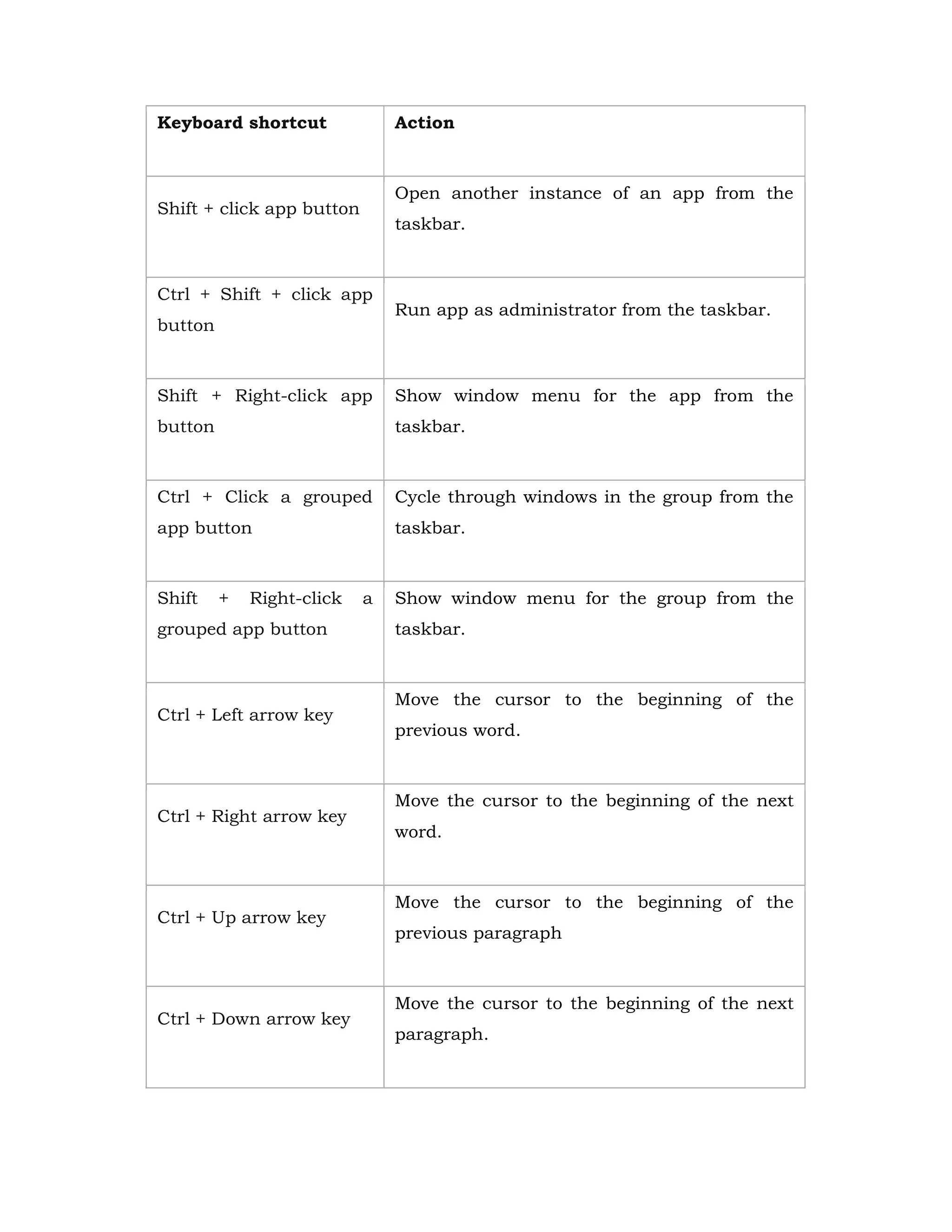
Shift + click app button
Open another instance of an app from the
taskbar.
Ctrl + Shift + click app
button
Run app as administrator from the taskbar.
Shift + Right-click app
button
Show window menu for the app from the
taskbar.
Ctrl + Click a grouped
app button
Cycle through windows in the group from the
taskbar.
Shift + Right-click a
grouped app button
Show window menu for the group from the
taskbar.
Ctrl + Left arrow key
Move the cursor to the beginning of the
previous word.
Ctrl + Right arrow key
Move the cursor to the beginning of the next
word.
Ctrl + Up arrow key
Move the cursor to the beginning of the
previous paragraph
Ctrl + Down arrow key
Move the cursor to the beginning of the next
paragraph.
Keyboard shortcut Action
Ctrl + Shift + arrow key Select block of text.
Ctrl + Spacebar Enable or disable Chinese IME.
Shift + F10 Open context menu for selected item.
Shift + Arrow keys Select multiple items.
Windows key + X Open Quick Link menu.
Windows key + Number
(0-9)
Open app in number position from the taskbar.
Windows key + T Cycle through apps in the taskbar.
Windows key + Alt +
Number (0-9)
Open Jump List of the app in number position
from the taskbar.
Windows key + D Display and hide the desktop.
Windows key + M Minimize all windows.
Windows key + Shift + M Restore minimized windows on the desktop.
Windows key + Home
Minimize or miximize all but the active desktop
window.
Keyboard shortcut Action
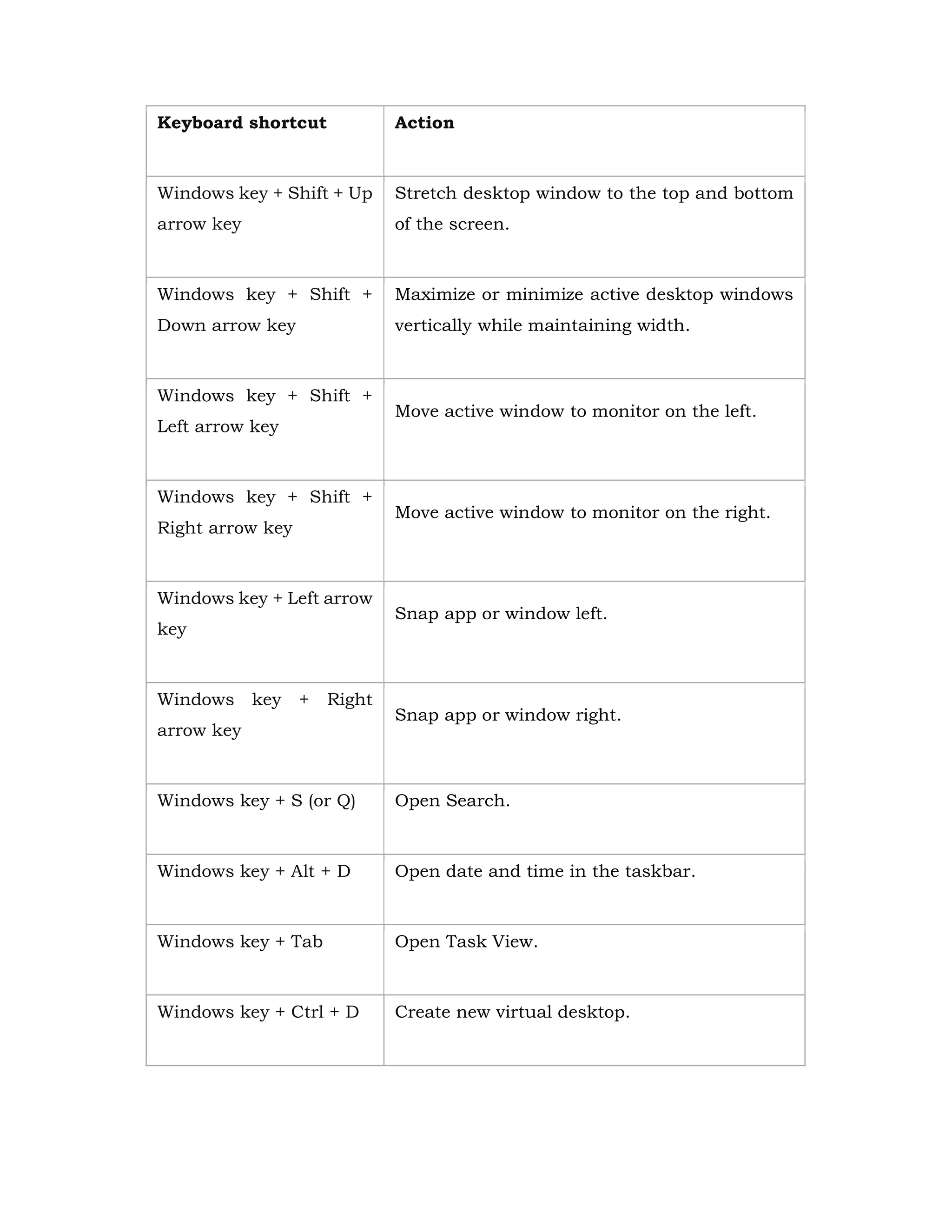
Windows key + Shift + Up
arrow key
Stretch desktop window to the top and bottom
of the screen.
Windows key + Shift +
Down arrow key
Maximize or minimize active desktop windows
vertically while maintaining width.
Windows key + Shift +
Left arrow key
Move active window to monitor on the left.
Windows key + Shift +
Right arrow key
Move active window to monitor on the right.
Windows key + Left arrow
key
Snap app or window left.
Windows key + Right
arrow key
Snap app or window right.
Windows key + S (or Q) Open Search.
Windows key + Alt + D Open date and time in the taskbar.
Windows key + Tab Open Task View.
Windows key + Ctrl + D Create new virtual desktop.
Keyboard shortcut Action
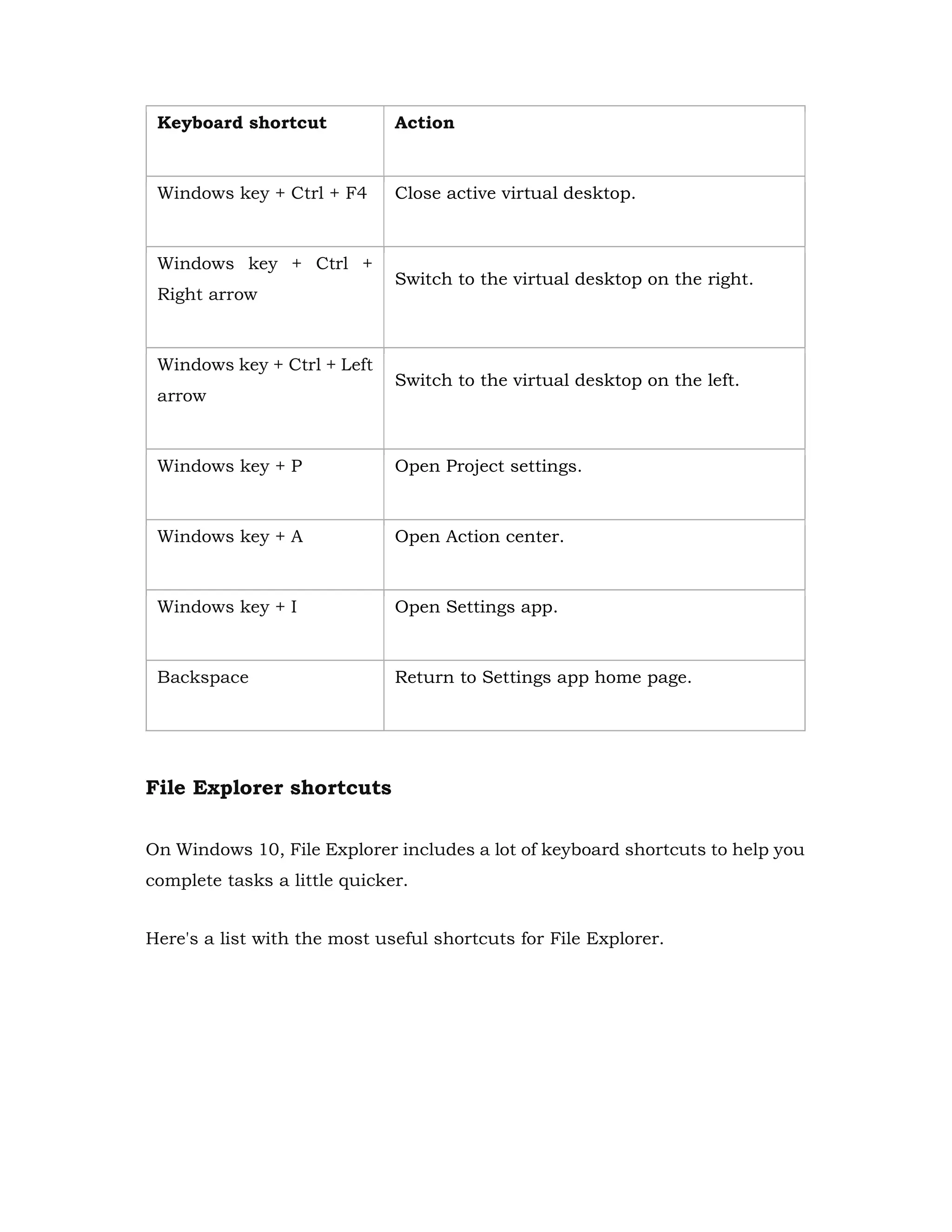
Windows key + Ctrl + F4 Close active virtual desktop.
Windows key + Ctrl +
Right arrow
Switch to the virtual desktop on the right.
Windows key + Ctrl + Left
arrow
Switch to the virtual desktop on the left.
Windows key + P Open Project settings.
Windows key + A Open Action center.
Windows key + I Open Settings app.
Backspace Return to Settings app home page.
File Explorer shortcuts
On Windows 10, File Explorer includes a lot of keyboard shortcuts to help you
complete tasks a little quicker.
Here's a list with the most useful shortcuts for File Explorer.
Keyboard shortcut Action
Windows key + E Open File Explorer.
Alt + D Select address bar.
Ctrl + E (or F) Select search box.
Ctrl + N Open new window.
Ctrl + W Close active window.
Ctrl + F (or F3) Start search.
Ctrl + mouse scroll wheel Change view file and folder.
Ctrl + Shift + E
Expands all folders from the tree in the
navigation pane.
Ctrl + Shift + N
Create new folder on desktop or File
Explorer.
Ctrl + L Focus on the address bar.
Ctrl + Shift + Number (1-8) Changes folder view.
Alt + P Display preview panel.
Keyboard shortcut Action
Alt + Enter
Open Properties settings for the selected
item.
Alt + Right arrow key View next folder.
Alt + Left arrow key (or
Backspace)
View previous folder.
Alt + Up arrow Move up a level in the folder path.
F11 Switch active window full screen mode.
F5 Refresh the instance of File Explorer.
F2 Rename selected item.
F4 Switch focus to address bar.
F5 Refresh File Explorer's current view.
F6 Cycle through elements on the screen.
Home Scroll to top of the window.
End Scroll to bottom of the window.
Command Prompt shortcuts
If you use Command Prompt, you can use these keyboard shortcuts to work
a little more efficiently.
Keyboard shortcut Action
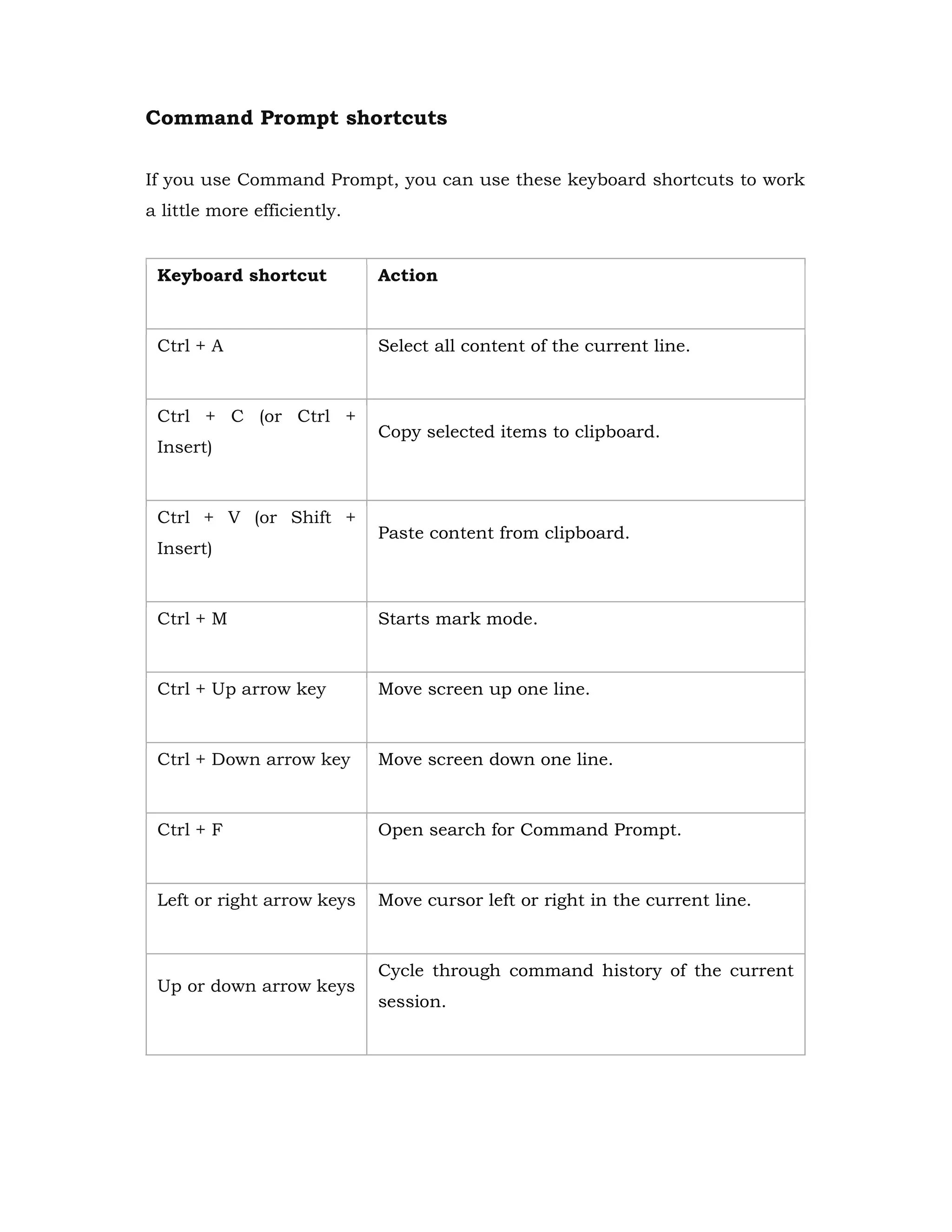
Ctrl + A Select all content of the current line.
Ctrl + C (or Ctrl +
Insert)
Copy selected items to clipboard.
Ctrl + V (or Shift +
Insert)
Paste content from clipboard.
Ctrl + M Starts mark mode.
Ctrl + Up arrow key Move screen up one line.
Ctrl + Down arrow key Move screen down one line.
Ctrl + F Open search for Command Prompt.
Left or right arrow keys Move cursor left or right in the current line.
Up or down arrow keys
Cycle through command history of the current
session.
Keyboard shortcut Action
Page up Move cursor one page up.
Page down Move cursor one page down.
Ctrl + Home Scroll to top of the console.
Ctrl + End Scroll to the bottom of the console.
Windows key shortcuts
Using the Windows key in combination with other keys, you can perform a
number of useful tasks, such as launch Settings, File Explorer, run
command, apps pinned in the taskbar, or you can open specific features like
Narrator or Magnifier. In addition, you can accomplish tasks like controlling
windows, virtual desktops, take screenshots, lock your device, and a lot more.
Here's a list with all the most common keyboard shortcuts using the Windows
key.
Keyboard shortcut Action
Windows key Open Start menu.
Windows key + A Open Action center.
Windows key + S (or Q) Open Search.
Keyboard shortcut Action
Windows key + D Display and hide the desktop.
Windows key + L Lock device.
Windows key + M Minimize all windows.
Windows key + B Set focus notification area in the taskbar.
Windows key + O Lock device orientation.
Windows key + T Cycle through apps in the taskbar.
Windows key + Z
Switch input between the desktop experience
and Windows Mixed Reality.
Windows key + G Open Game bar.
Windows key + H Open dictation feature.
Windows key + E Open File Explorer.
Windows key + I Open Settings.
Windows key + R Open Run command.
Windows key + K Open Connect settings.
Keyboard shortcut Action
Windows key + X Open Quick Link menu.
Windows key + V Open Clipboard bin.
Windows key + W Open the Windows Ink Workspace.
Windows key + U Open Ease of Access settings.
Windows key + Ctrl +
Enter
Open Narrator.
Windows key + Plus (+) Zoom in using the magnifier.
Windows key + Minus (-) Zoom out using the magnifier.
Windows key + Esc Exit magnifier.
Windows key + forward-
slash (/)
Start IME reconversion.
Windows key + Comma
(,)
Temporarily peek at the desktop.
Windows key + Up arrow
key
Maximize app windows.
Keyboard shortcut Action
Windows key + Down
arrow key
Minimize app windows.
Windows key + Home
Minimize or maximize all but the active desktop
window.
Windows key + Shift + M Restore minimized windows on the desktop.
Windows key + Shift +
Up arrow key
Stretch desktop window to the top and bottom
of the screen.
Windows key + Shift +
Down arrow key
Maximize or minimize active windows vertically
while maintaining width.
Windows key + Shift +
Left arrow key
Move active window to monitor on the left.
Windows key + Shift +
Right arrow key
Move active window to monitor on the right.
Windows key + Left
arrow key
Snap app or window left.
Windows key + Right
arrow key
Snap app or window right.
Keyboard shortcut Action
Windows key + Number
(0-9)
Open app in number position in the taskbar.
Windows key + Shift +
Number (0-9)
Open another instance of the app in number
position in the taskbar.
Windows key + Ctrl +
Number (0-9)
Switch to last active window of the app in
number position in the taskbar.
Windows key + Alt +
Number (0-9)
Open Jump List of the app in number position
in the taskbar.
Windows key + Ctrl +
Shift + Number (0-9)
Open another instance as an administrator of
the app in number position in the taskbar.
Windows key + + Ctrl +
Spacebar
Change previous selected input option.
Windows key + Tab Open Task View.
Windows key + Ctrl + D Create a virtual desktop.
Windows key + Ctrl + F4 Close active virtual desktop.
Windows key + Ctrl +
Right arrow
Switch to the virtual desktop on the right.
Keyboard shortcut Action
Windows key + Ctrl +
Left arrow
Switch to the virtual desktop on the left.
Windows key + Ctrl +
Shift + B
Wake up the device when black or a blank
screen.
Windows key + PrtScn
Capture full screenshot in the "Screenshots"
folder.
Windows key + Shift + S Create part of the screen screenshot.
Windows key + Shift + V Cycle through notifications.
Windows key + Ctrl + F Open search for device on a domain network.
Windows key + Ctrl + Q Open Quick Assist.
Windows key + Alt + D Open date and time in the taskbar.
Windows key + period (.)
or semicolon (;)
Open emoji panel.
Windows key + Pause Show System Properties dialog box.
https://www.windowscentral.com/best-windows-10-keyboard-
shortcuts

Keyboard shortcuts

  • 1.
    Essential shortcuts These arethe essential keyboard shortcuts that every Windows 10 user should know. Keyboard shortcut Action Ctrl + A Select all content. Ctrl + C (or Ctrl + Insert) Copy selected items to clipboard. Ctrl + X Cut selected items to clipboard. Ctrl + V (or Shift + Insert) Paste content from clipboard. Ctrl + Z Undo an action, including undelete files (limited). Ctrl + Y Redo an action. Ctrl + Shift + N Create new folder on desktop or File Explorer. Alt + F4 Close active window. (If no active window present, then shutdown box appears.) Ctrl + D Delete selected item to the Recycle Bin.
  • 2.
    Keyboard shortcut Action F2Rename selected item. ESC Close current task. Shift + Delete Delete selected item permanently skipping Recycle Bin. Alt + Tab Switch between open apps. Windows key + I Open Settings app. Windows key + E Open File Explorer. Windows key + A Open Action center. Windows key + D Display and hide the desktop. Windows key + L Lock device. Windows key + V Open Clipboard bin. Windows key + period (.) or semicolon (;) Open emoji panel. Windows key + PrtScn Capture full screenshot in the "Screenshots" folder.
  • 3.
    Keyboard shortcut Action Windowskey + Shift + S Capture part of the screen in a screenshot. Windows key + Left arrow key Snap app or window left. Windows key + Right arrow key Snap app or window right. Desktop shortcuts You can use these keyboard shortcuts to open, close, navigate, and complete specific tasks more quickly throughout the desktop experience, including on Start menu, taskbar, Settings, and more. Keyboard shortcut Action Ctrl + Esc (or Windows key) Open Start menu. Ctrl + Arrow keys Change Start menu size. Ctrl + Shift + Esc Open Task Manager. Ctrl + Shift Switch keyboard layout.
  • 4.
    Keyboard shortcut Action Alt+ F4 Close active window. (If no active window present, then shutdown box appears.) Ctrl + F5 (or R) Refresh current window. Ctrl + Alt + Tab View open apps. Ctrl + Arrow keys (to select) + Spacebar Select multiple items on desktop or File Explorer. Alt + Tab Switch between open apps while pressing Tab multiple times. Alt + Left arrow key Go back. Alt + Right arrow key Go forward. Alt + Page Up Move up one screen. Alt + Page down Move down one screen. Alt + Esc Cycle through open windows. Alt + Spacebar Open context menu for the active window.
  • 5.
    Keyboard shortcut Action Shift+ click app button Open another instance of an app from the taskbar. Ctrl + Shift + click app button Run app as administrator from the taskbar. Shift + Right-click app button Show window menu for the app from the taskbar. Ctrl + Click a grouped app button Cycle through windows in the group from the taskbar. Shift + Right-click a grouped app button Show window menu for the group from the taskbar. Ctrl + Left arrow key Move the cursor to the beginning of the previous word. Ctrl + Right arrow key Move the cursor to the beginning of the next word. Ctrl + Up arrow key Move the cursor to the beginning of the previous paragraph Ctrl + Down arrow key Move the cursor to the beginning of the next paragraph.
  • 6.
    Keyboard shortcut Action Ctrl+ Shift + arrow key Select block of text. Ctrl + Spacebar Enable or disable Chinese IME. Shift + F10 Open context menu for selected item. Shift + Arrow keys Select multiple items. Windows key + X Open Quick Link menu. Windows key + Number (0-9) Open app in number position from the taskbar. Windows key + T Cycle through apps in the taskbar. Windows key + Alt + Number (0-9) Open Jump List of the app in number position from the taskbar. Windows key + D Display and hide the desktop. Windows key + M Minimize all windows. Windows key + Shift + M Restore minimized windows on the desktop. Windows key + Home Minimize or miximize all but the active desktop window.
  • 7.
    Keyboard shortcut Action Windowskey + Shift + Up arrow key Stretch desktop window to the top and bottom of the screen. Windows key + Shift + Down arrow key Maximize or minimize active desktop windows vertically while maintaining width. Windows key + Shift + Left arrow key Move active window to monitor on the left. Windows key + Shift + Right arrow key Move active window to monitor on the right. Windows key + Left arrow key Snap app or window left. Windows key + Right arrow key Snap app or window right. Windows key + S (or Q) Open Search. Windows key + Alt + D Open date and time in the taskbar. Windows key + Tab Open Task View. Windows key + Ctrl + D Create new virtual desktop.
  • 8.
    Keyboard shortcut Action Windowskey + Ctrl + F4 Close active virtual desktop. Windows key + Ctrl + Right arrow Switch to the virtual desktop on the right. Windows key + Ctrl + Left arrow Switch to the virtual desktop on the left. Windows key + P Open Project settings. Windows key + A Open Action center. Windows key + I Open Settings app. Backspace Return to Settings app home page. File Explorer shortcuts On Windows 10, File Explorer includes a lot of keyboard shortcuts to help you complete tasks a little quicker. Here's a list with the most useful shortcuts for File Explorer.
  • 9.
    Keyboard shortcut Action Windowskey + E Open File Explorer. Alt + D Select address bar. Ctrl + E (or F) Select search box. Ctrl + N Open new window. Ctrl + W Close active window. Ctrl + F (or F3) Start search. Ctrl + mouse scroll wheel Change view file and folder. Ctrl + Shift + E Expands all folders from the tree in the navigation pane. Ctrl + Shift + N Create new folder on desktop or File Explorer. Ctrl + L Focus on the address bar. Ctrl + Shift + Number (1-8) Changes folder view. Alt + P Display preview panel.
  • 10.
    Keyboard shortcut Action Alt+ Enter Open Properties settings for the selected item. Alt + Right arrow key View next folder. Alt + Left arrow key (or Backspace) View previous folder. Alt + Up arrow Move up a level in the folder path. F11 Switch active window full screen mode. F5 Refresh the instance of File Explorer. F2 Rename selected item. F4 Switch focus to address bar. F5 Refresh File Explorer's current view. F6 Cycle through elements on the screen. Home Scroll to top of the window. End Scroll to bottom of the window.
  • 11.
    Command Prompt shortcuts Ifyou use Command Prompt, you can use these keyboard shortcuts to work a little more efficiently. Keyboard shortcut Action Ctrl + A Select all content of the current line. Ctrl + C (or Ctrl + Insert) Copy selected items to clipboard. Ctrl + V (or Shift + Insert) Paste content from clipboard. Ctrl + M Starts mark mode. Ctrl + Up arrow key Move screen up one line. Ctrl + Down arrow key Move screen down one line. Ctrl + F Open search for Command Prompt. Left or right arrow keys Move cursor left or right in the current line. Up or down arrow keys Cycle through command history of the current session.
  • 12.
    Keyboard shortcut Action Pageup Move cursor one page up. Page down Move cursor one page down. Ctrl + Home Scroll to top of the console. Ctrl + End Scroll to the bottom of the console. Windows key shortcuts Using the Windows key in combination with other keys, you can perform a number of useful tasks, such as launch Settings, File Explorer, run command, apps pinned in the taskbar, or you can open specific features like Narrator or Magnifier. In addition, you can accomplish tasks like controlling windows, virtual desktops, take screenshots, lock your device, and a lot more. Here's a list with all the most common keyboard shortcuts using the Windows key. Keyboard shortcut Action Windows key Open Start menu. Windows key + A Open Action center. Windows key + S (or Q) Open Search.
  • 13.
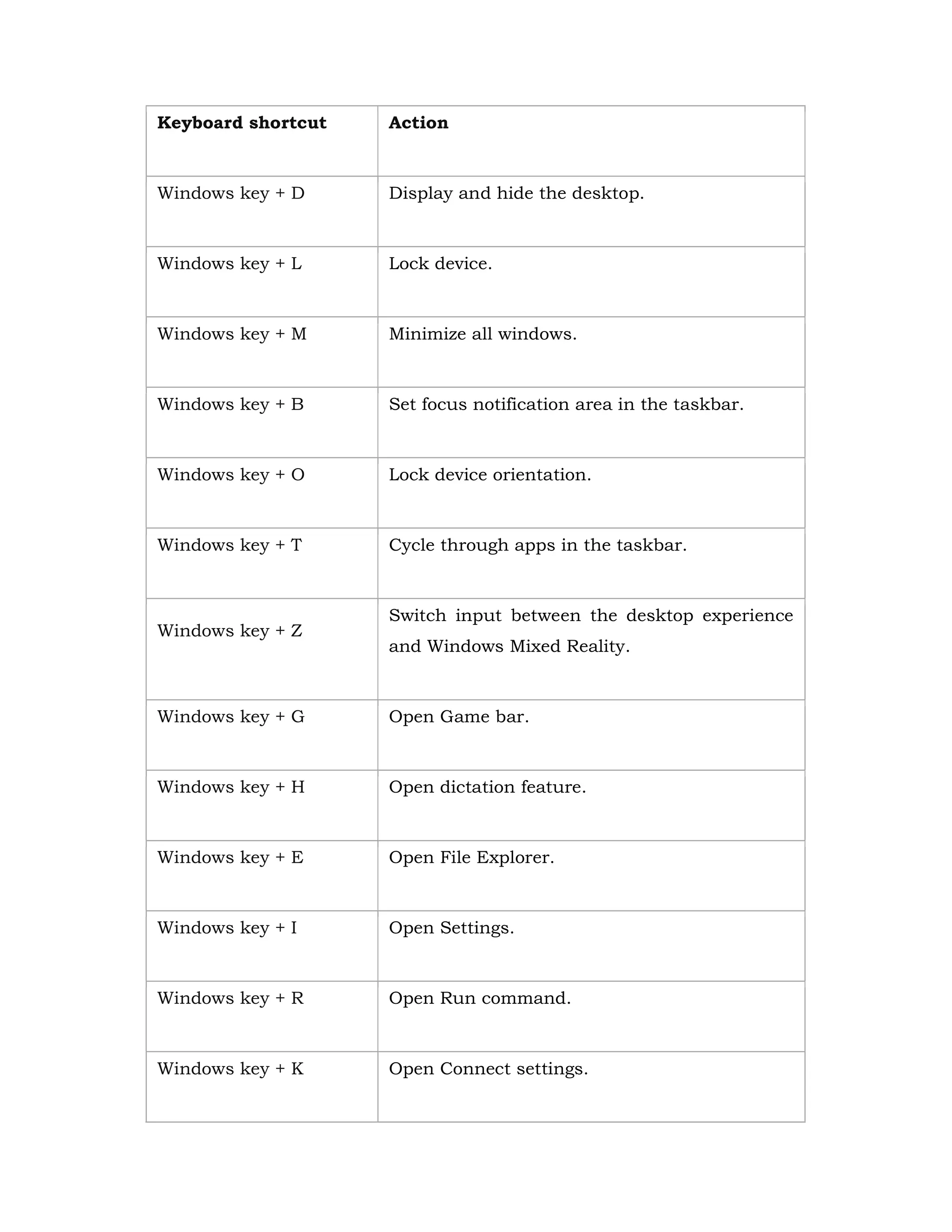
    Keyboard shortcut Action Windowskey + D Display and hide the desktop. Windows key + L Lock device. Windows key + M Minimize all windows. Windows key + B Set focus notification area in the taskbar. Windows key + O Lock device orientation. Windows key + T Cycle through apps in the taskbar. Windows key + Z Switch input between the desktop experience and Windows Mixed Reality. Windows key + G Open Game bar. Windows key + H Open dictation feature. Windows key + E Open File Explorer. Windows key + I Open Settings. Windows key + R Open Run command. Windows key + K Open Connect settings.
  • 14.
    Keyboard shortcut Action Windowskey + X Open Quick Link menu. Windows key + V Open Clipboard bin. Windows key + W Open the Windows Ink Workspace. Windows key + U Open Ease of Access settings. Windows key + Ctrl + Enter Open Narrator. Windows key + Plus (+) Zoom in using the magnifier. Windows key + Minus (-) Zoom out using the magnifier. Windows key + Esc Exit magnifier. Windows key + forward- slash (/) Start IME reconversion. Windows key + Comma (,) Temporarily peek at the desktop. Windows key + Up arrow key Maximize app windows.
  • 15.
    Keyboard shortcut Action Windowskey + Down arrow key Minimize app windows. Windows key + Home Minimize or maximize all but the active desktop window. Windows key + Shift + M Restore minimized windows on the desktop. Windows key + Shift + Up arrow key Stretch desktop window to the top and bottom of the screen. Windows key + Shift + Down arrow key Maximize or minimize active windows vertically while maintaining width. Windows key + Shift + Left arrow key Move active window to monitor on the left. Windows key + Shift + Right arrow key Move active window to monitor on the right. Windows key + Left arrow key Snap app or window left. Windows key + Right arrow key Snap app or window right.
  • 16.
    Keyboard shortcut Action Windowskey + Number (0-9) Open app in number position in the taskbar. Windows key + Shift + Number (0-9) Open another instance of the app in number position in the taskbar. Windows key + Ctrl + Number (0-9) Switch to last active window of the app in number position in the taskbar. Windows key + Alt + Number (0-9) Open Jump List of the app in number position in the taskbar. Windows key + Ctrl + Shift + Number (0-9) Open another instance as an administrator of the app in number position in the taskbar. Windows key + + Ctrl + Spacebar Change previous selected input option. Windows key + Tab Open Task View. Windows key + Ctrl + D Create a virtual desktop. Windows key + Ctrl + F4 Close active virtual desktop. Windows key + Ctrl + Right arrow Switch to the virtual desktop on the right.
  • 17.
    Keyboard shortcut Action Windowskey + Ctrl + Left arrow Switch to the virtual desktop on the left. Windows key + Ctrl + Shift + B Wake up the device when black or a blank screen. Windows key + PrtScn Capture full screenshot in the "Screenshots" folder. Windows key + Shift + S Create part of the screen screenshot. Windows key + Shift + V Cycle through notifications. Windows key + Ctrl + F Open search for device on a domain network. Windows key + Ctrl + Q Open Quick Assist. Windows key + Alt + D Open date and time in the taskbar. Windows key + period (.) or semicolon (;) Open emoji panel. Windows key + Pause Show System Properties dialog box. https://www.windowscentral.com/best-windows-10-keyboard- shortcuts